
Acid stain concrete cost usually falls between $2 and $25 per square foot, depending on how simple or custom the project is. For a typical project, a realistic total budget is around $11,000, with many jobs landing between $3,000 and $18,500.
If you're staring at a plain backyard patio, a dusty garage floor, or a worn slab around a commercial entry and wondering whether staining is worth it in Arizona, that question usually starts with price. It should. A stain job that looks affordable on paper can get expensive fast if the concrete is dirty, cracked, sun-beaten, or poorly sealed for our climate.
Arizona changes the math. Intense sun, blowing dust, tracked-in grit, hard water, and hot surface temperatures all affect how long a stained surface holds its color and how often it needs maintenance. National pricing guides give you a baseline. They usually don't tell you what happens when a floor sits in full Phoenix sun or gets blasted with dust every week.
That's why budgeting for acid stain concrete takes more than grabbing a low per-square-foot number online. You need to know what level of prep the slab needs, whether the design is basic or custom, how the finish will be protected, and what maintenance looks like after the crew leaves.
Transforming Your Concrete on a Budget
A lot of Arizona property owners don't need a new slab. They need the slab they already have to look finished, cleaner, and more intentional.
That's where acid stain makes sense. It can turn a flat gray patio, walkway, or interior floor into something with depth and color without the cost of tearing out concrete and replacing it. For many projects, that makes it one of the more budget-friendly upgrades available.
According to Homewyse concrete stain pricing data, acid stain concrete is often less expensive than carpeting, tile, or high-end wood flooring, while advanced decorative work can reach pricing similar to ceramic or quarry tile, which averages $10 to $12 per square foot. That range matters because it shows why one homeowner gets a simple stained patio at the low end, while another ends up paying tile-like pricing for a custom decorative finish.
Where Arizona owners usually start
Many I speak with are in one of these situations:
- The patio looks tired: The concrete is structurally fine, but it feels unfinished and drags down the yard.
- The garage needs a cleaner look: Bare concrete shows dust, tire marks, and staining fast.
- The entry or walkway feels dated: The slab works, but it doesn't add anything visually.
Before stain ever goes down, the surface has to be cleaned right. If you're comparing options for prep, this guide on the best way to clean a concrete driveway gives a practical look at what a properly cleaned slab should look like before any decorative work begins.
Practical rule: If the slab is dirty, sealed with the wrong product, or full of surface contamination, acid stain won't magically fix it. It will highlight problems.
The appeal is simple. You keep the concrete you already paid for, improve the appearance, and avoid the cost and disruption of full replacement. That's the budget advantage. The catch is that stain rewards good prep and punishes shortcuts.
Breaking Down the Average Acid Stain Concrete Cost
A Phoenix homeowner gets quoted one price for a shaded back patio and a very different price for a west-facing pool deck that has baked in the sun for years. Same material category. Different slab history, different prep, different budget.
The broad national benchmark still helps as a starting point. The Angi stained concrete cost guide lists a national average of $11,000, with most projects falling between $3,000 and $18,500. It also places basic stained concrete at $2 to $6 per square foot and custom multi-color work at $12 to $25 per square foot.
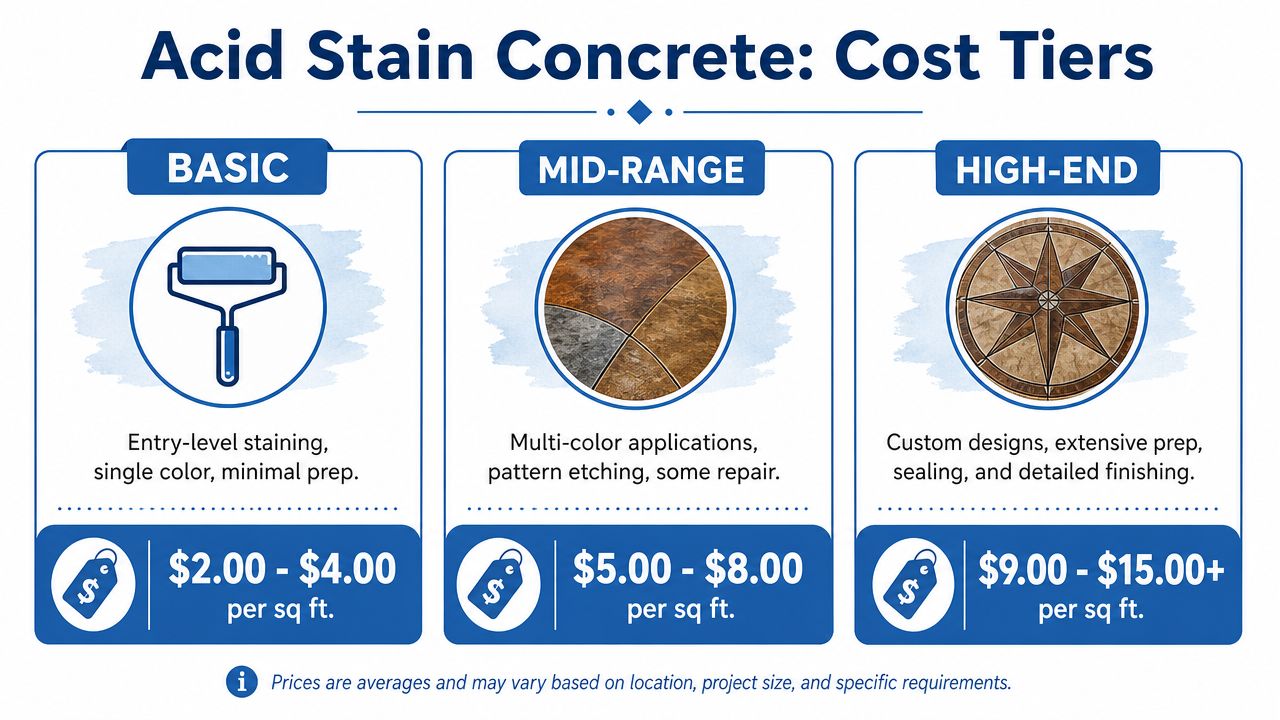
Basic, mid-range, and high-end
On Arizona jobs, these numbers make more sense when you sort them by what the crew is dealing with on site.
| Project Tier | Cost Per Sq. Ft. | Estimated Total (500 sq. ft.) |
|---|---|---|
| Basic | $2 to $6 | $1,000 to $3,000 |
| Mid-Range | $6 to $12 | $3,000 to $6,000 |
| High-End | $12 to $25 | $6,000 to $12,500 |
A basic job is usually a single-color stain on a slab that is already open, clean, and in decent shape. These are the projects every online calculator assumes you have.
A mid-range job is more common here. The slab may need extra cleaning, light grinding, repair blending, or a second color pass to keep the finish from looking blotchy. On outdoor concrete in Arizona, sun exposure and dust often push a project into this range because the surface has weathered unevenly.
A high-end job includes custom borders, layered color, saw-cut patterns, stencil work, or heavy correction before stain can be applied with any consistency. If the concrete has old sealer, hard-water deposits, patchwork repairs, or visible wear paths, labor climbs fast.
What those averages look like on real jobs
The national averages are useful for ballpark budgeting, but square footage alone does not price an acid stain project well.
A 500-square-foot patio can stay near the low end if the slab is uniform and ready for stain. The same 500 square feet can jump several thousand dollars if it needs coating removal, grinding, patch blending, and a better sealer to hold up under Arizona UV.
That is the part many national guides skip. In Arizona, the stain itself is only one part of the bill. Desert dust works into porous concrete. Full-sun exposure dries and ages sealers faster. Pool areas and irrigated walkways often carry mineral deposits that have to be cleaned off before the color will react evenly.
If you are comparing decorative concrete options, this breakdown of concrete polishing cost helps because polishing and staining can overlap on price, but they age differently outdoors in our climate.
Uneven slabs can also add cost before color is even discussed. If a surface needs flattening or patch preparation before decorative work, the Tiles Mate Pty Ltd levelling guide gives a useful look at why substrate correction changes the budget.
A low per-square-foot quote usually means the slab is easy to work on, not that the contractor found a shortcut on a difficult surface.
What the average misses
Average pricing does not tell you whether your concrete will take acid stain evenly.
That depends on age, porosity, past sealers, repair history, contamination, and how much sun and weather the slab has taken. In Arizona, those factors show up constantly on patios, walkways, garages, and pool decks.
Two properties can have the same square footage and end up in different price brackets because one slab is ready after cleaning and the other needs real corrective prep. That is why acid stain pricing is usually more accurate after a site visit than after an online estimate form.
Key Factors That Influence Your Final Price
The final quote comes down to what the crew has to do before, during, and after the stain application. Most homeowners focus on color. Contractors focus on the slab.
Surface prep usually decides the job
The HomeAdvisor stained concrete pricing guide identifies surface preparation as a major cost driver. It lists contractor grinding or sanding at $1 to $4 per square foot and notes that a high-performance sealer at around $0.16 per square foot is mandatory to protect the finish.
If I had to pick the one line item people underestimate most, it's prep.
Arizona slabs collect everything. Dust, grease, tire residue, irrigation minerals, old curing compounds, overspray, rust marks, and failed sealers all interfere with stain penetration. Acid stain reacts with the concrete itself, so the slab has to be open and consistent enough to accept it.
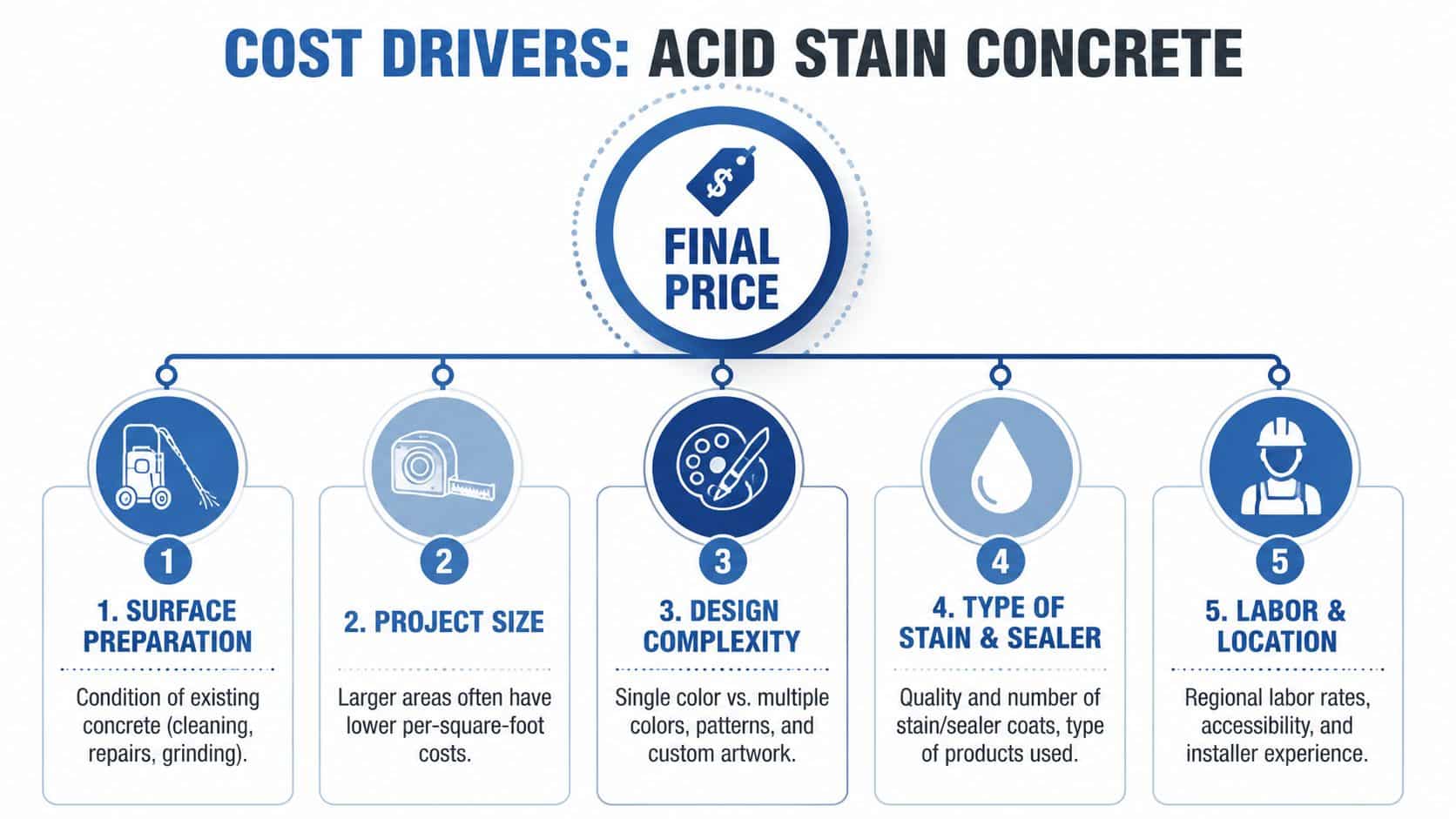
Five drivers that change the quote
Condition of the concrete
Old paint, grease, crack repairs, and patchy previous coatings usually mean more grinding, cleaning, and testing.Size of the project
Larger jobs can spread mobilization and setup costs better, but they still need uniform prep.Design complexity
A single-color finish is one thing. Multi-step decorative work takes more labor and more control.Sealer choice
In Arizona, I'd pay attention to UV resistance and maintenance expectations more than glossy brochure language.Labor and access
Tight access, occupied spaces, furniture moving, or staged work all increase labor time.
For owners trying to understand why floor condition matters so much before any finish goes down, this Tiles Mate Pty Ltd levelling guide is a helpful read on what it takes to get a surface into shape before decorative work starts.
Here's a useful visual on how concrete staining is approached in the field.
Arizona-specific cost pressures
Arizona adds a few practical wrinkles that generic guides miss.
- Sun exposure: Outdoor surfaces in full sun need more attention to sealer performance and future maintenance.
- Dust load: Windblown grit acts like sandpaper on traffic paths, especially entries and patios.
- Hot-surface use: Pool decks, patios, and walkways get more thermal stress than many other markets.
- Hard-water exposure: Irrigation overspray and mineral deposits can leave the slab uneven in appearance before work even starts.
The prettier the finish you're chasing, the less forgiving the slab becomes.
The good news is that these issues can be managed. The bad news is that they aren't free to manage. That's why clean, straightforward quotes should spell out prep, stain application, sealer, and any repair work separately.
DIY vs Professional Installation A Cost and Risk Analysis
A homeowner in Phoenix sees a small patio kit online, figures the slab already looks decent, and assumes acid stain is a low-cost weekend project. Then the stain hits one repaired area differently, the color turns uneven in the afternoon heat, and the sealer shows dust scratches within months. That is how a cheap project gets expensive in Arizona.
DIY acid staining can make sense on a low-visibility slab where appearance is secondary and the owner accepts a wider margin for error. It is far less forgiving on front entries, pool decks, courtyards, and retail walkways where color consistency and finish durability matter.
Why DIY looks cheaper on paper
The first number owners see is usually the stain kit, a few sprayers, and some cleaning supplies. That keeps the entry cost low.
The missing line items are the ones that usually decide the outcome. Surface profiling, sealer removal, patch blending, test areas, neutralizing residue correctly, and buying enough material to correct a weak first pass all add cost fast. In Arizona, exterior slabs also pick up fine dust, irrigation minerals, sunscreen oils around pools, and tire residue on driveway-adjacent concrete. If that contamination is still in the slab, the stain does not react evenly.
A good way to sort out whether appearance or pure function is driving the project is this guide on how to choose residential decorative concrete. That decision affects whether DIY risk is acceptable.
Where DIY usually breaks down
The Direct Colors article on acid-stained concrete floors describes acid stain as difficult to predict and notes that bad results can require grinding and re-application. That matches field reality.
Acid stain is a chemical reaction, not paint. Old adhesive, curing compounds, hard-water deposits, patch material, and inconsistent porosity all change the final color. Arizona adds another problem. Slabs exposed to intense sun and wind often look dry on the surface while still reacting unevenly across hotter and cooler sections.
Correction is where the budget gets hit. Once a floor comes out blotchy or weak, fixing it may involve mechanical grinding, more stain, more sealer, and extra downtime. On a visible surface, hiring a pro after a failed DIY attempt usually costs more than hiring one at the start.
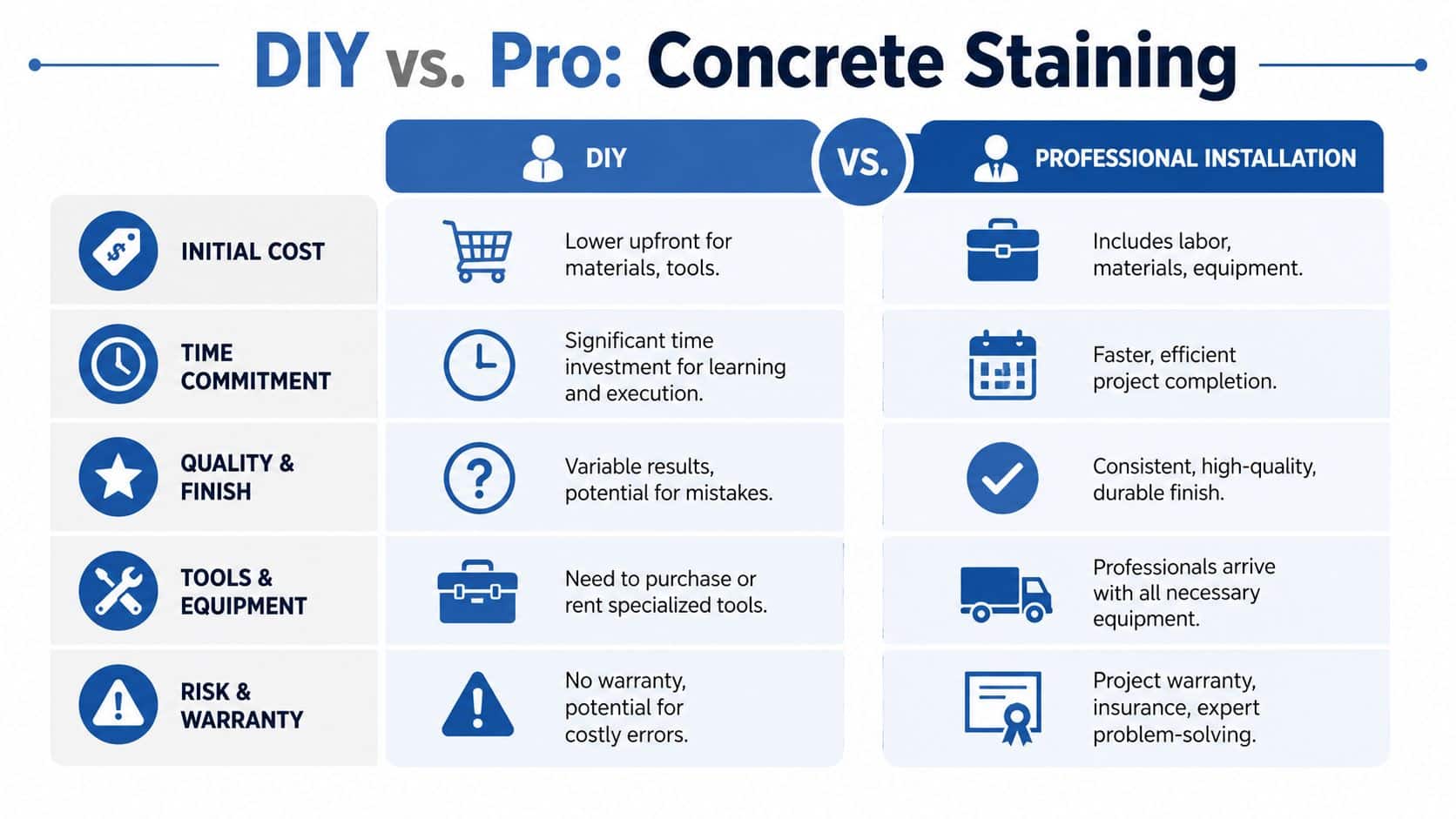
| Decision Point | DIY | Professional |
|---|---|---|
| Upfront spending | Lower material cost | Higher labor and equipment cost |
| Prep quality | Limited by homeowner tools and experience | Better cleaning, testing, and surface correction |
| Color control | More variable from slab to slab | More consistent process, though concrete still varies |
| Risk of rework | Falls on the owner | Usually absorbed into the contractor's process and scope |
For exterior slabs, prep starts with getting the concrete clean, not just rinsed off. This guide on pressure washing a driveway before concrete staining shows the level of cleaning needed before anyone should expect proper stain reaction or sealer bond.
On a prominent slab, the cheapest bid or the cheapest DIY plan often becomes the most expensive version of the job.
When professional installation is the better financial choice
Professional installation usually pencils out better when the slab has an unknown history, when the surface is large enough that mistakes are costly, or when the finished look needs to be controlled. I would add most Arizona exteriors to that list. Sun, dust, and heat expose weak prep and thin sealer work quickly.
Professional crews also test more before committing. They check how the slab reacts, identify areas that may need repair or heavier prep, and build the finish system around actual site conditions. That does not remove all variability. It does reduce the odds of paying twice.
DIY can still work for a utility space where appearance is not critical. For patios, entries, pool areas, and commercial approaches, professional work is usually the more reliable budget decision.
Beyond the Install Lifecycle Costs and Maintenance
Initial installation cost is only part of the budget. Acid-stained concrete is not a one-time purchase you forget about, especially outdoors in Arizona.
The Concrete Camouflage guide on staining concrete floor costs points out that mandatory re-sealing and waxing every 1 to 3 years can push lifetime expense 20% to 30% higher than many owners expect. It also notes sealer costs of $0.16 to $1.00 per square foot and waxes at $0.02+ per square foot.
What ongoing care actually looks like
An acid-stained surface needs protection. Indoors, that may include waxing depending on the finish system. Outdoors, the main issue is sealer performance and renewal.
Arizona makes this more important because UV exposure, dust abrasion, and heat wear the protective layer faster than many people expect. If the sealer degrades, the surface can lose depth, become harder to clean, and wear unevenly.
Budget for ownership, not just install
A realistic ownership plan includes:
- Routine cleaning: Dust and grit should be removed before they grind into the finish.
- Periodic inspection: Look at traffic paths, sun-exposed sections, and irrigation-hit zones.
- Re-sealing on schedule: Don't wait until color loss is obvious.
- Occasional finish refresh: Especially on surfaces that take regular abrasion.
If your broader maintenance plan includes exterior flatwork, this article on how often you should seal your driveway is a good companion read because the same climate pressures apply to many Arizona concrete surfaces.
Skipping maintenance doesn't save money. It usually shifts money from routine care into repair.
Where owners get surprised
They budget for color and installation. They don't budget for keeping the finish protected.
That's the gap. If you go in expecting the stain to be permanent and maintenance-free, the long-term numbers will feel frustrating. If you go in knowing the finish needs periodic care, the project is much easier to evaluate realistically.
Saving Money on Your Arizona Concrete Staining Project
There are smart ways to lower acid stain concrete cost without setting yourself up for a bad result. In Arizona, the best savings usually come from reducing avoidable labor and protecting the surface properly from day one.
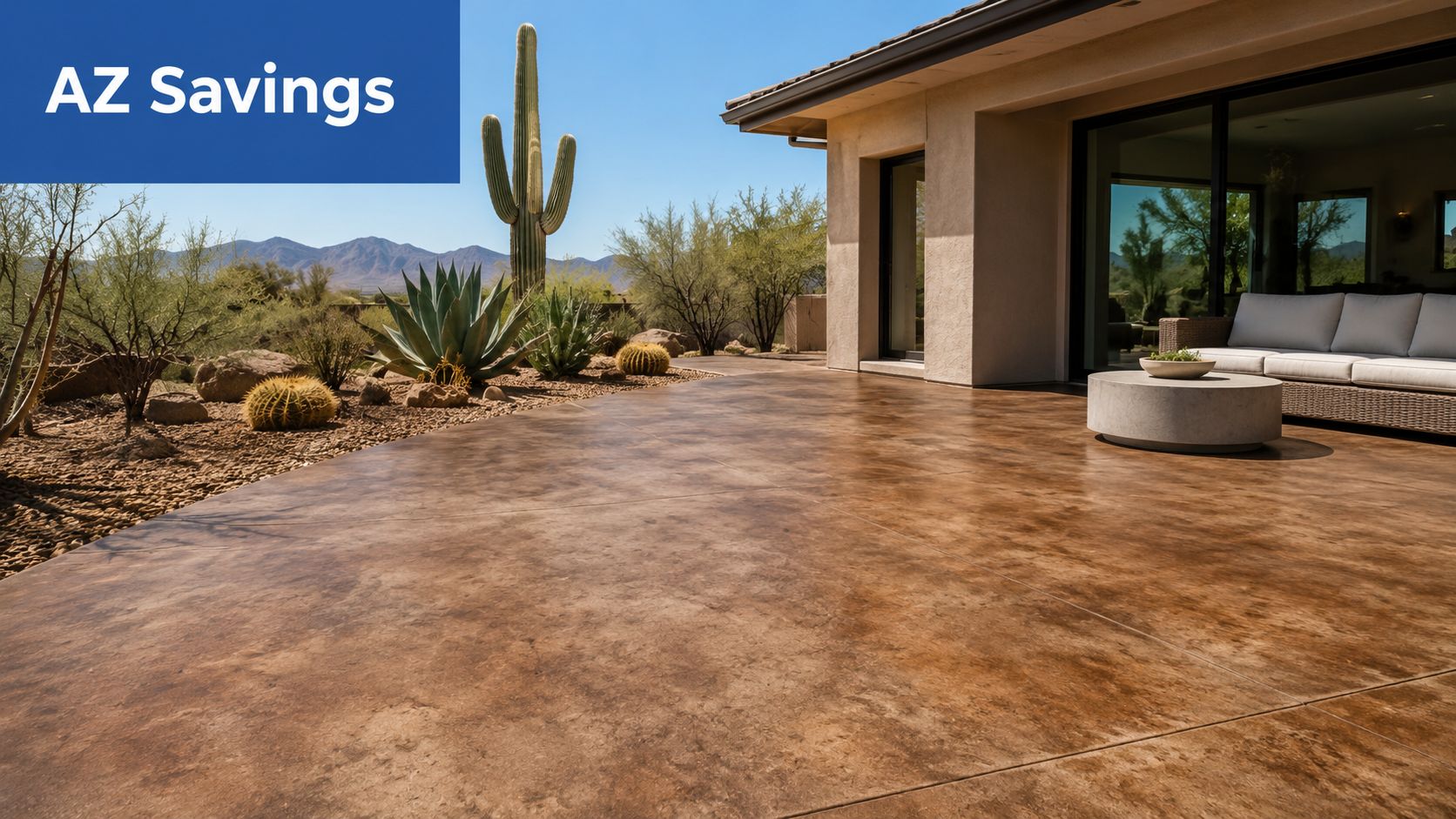
Where to cut cost safely
Start with the items that don't affect the chemistry of the stain job.
- Handle basic site clearing first: Move furniture, planters, and stored items before the crew arrives.
- Choose a simpler design: A clean single-color finish often looks better than an overcomplicated pattern on average concrete.
- Fix drainage and irrigation issues early: If sprinklers hit the slab constantly, maintenance gets harder and appearance suffers faster.
- Keep expectations tied to the slab: Old concrete has character. Trying to force it into a perfect tile-like look usually costs more.
Where not to cut
The wrong place to save money is on prep and sealer. That's especially true in Phoenix, Scottsdale, Paradise Valley, Chandler, Tempe, and Gilbert, where UV exposure and dust are constant.
A bargain sealer can look fine right after install and disappoint much sooner than a better product. The same goes for rushing prep on a patio or garage floor that has years of contamination built into it. If the stain can't react evenly, no topcoat fixes that completely.
For Arizona owners, the best long-term value usually comes from a restrained design, a properly prepared slab, and a finish system chosen for sun and wear instead of showroom shine.
One practical budgeting mindset
Think in terms of durable appearance, not just lowest bid.
That shift helps you avoid spending more later on correction, early resealing, or cosmetic disappointment. A straightforward project done well usually beats a flashy design done cheaply.
Questions to Ask Your Concrete Staining Contractor
A good estimate is more than a square-foot number. It should tell you how the contractor thinks.
If you want a broader checklist for screening companies in general, this guide on vetting home contractors is a useful starting point. For acid stain work, I'd narrow the conversation to the slab, the prep, and the protection system.
Ask these before you sign
What prep is included in the quote?
Ask whether the price includes grinding, cleaning, crack treatment, and removal of old sealers or contaminants.How do you test the slab before staining?
You want to hear that they evaluate absorption, previous coatings, repairs, and problem areas before promising a look.What sealer system are you using, and why is it right for Arizona?
This question quickly tells you whether they understand UV, dust abrasion, and exterior wear.What kind of appearance variation should I expect?
A solid contractor won't promise factory-perfect uniformity from a reactive stain.How should this surface be maintained after installation?
If they don't give you a clear maintenance plan, they're leaving out part of the total cost.
A strong answer sounds grounded
The best contractors usually sound practical, not theatrical. They talk about the condition of your slab, the prep it needs, where the risks are, and what kind of finish is realistic.
Good contractors don't just sell color. They explain limits, maintenance, and what the slab will and won't do.
That kind of honesty matters. It's how you avoid paying for expectations the concrete can't support.
If you're improving exterior concrete, windows, storefront glass, or building surfaces in Arizona, South Mountain Window Cleaning, LLC is a reliable local partner for residential, commercial, and high rise service across Phoenix, Scottsdale, Paradise Valley, Chandler, Tempe, and Gilbert. Their team handles window washing, pressure washing, and exterior cleaning work that helps properties look sharp, stay safer, and hold curb appeal in Arizona's dusty, sun-heavy conditions.