
Concrete polishing cost usually runs $2 to $16 per square foot, and that spread is real, not marketing fluff. A 1,000-square-foot floor can cost $2,000 to $16,000, depending on slab condition, finish level, design choices, and how much prep the job needs.
If you manage property in Phoenix or Scottsdale, you’re probably not looking at a pristine slab in a climate-controlled showroom. You’re looking at dust, tracked-in grit, sun-baked entries, worn traffic lanes, old coatings, rust marks, and a floor that has to keep working while the building stays occupied. That’s why pricing varies so much. The floor itself decides a big part of the budget.
For Arizona properties, polished concrete keeps showing up for a reason. It fits the climate, it handles hard use well, and it gives owners a way to improve appearance without switching to a flooring system that needs constant replacement cycles. This guide breaks down what influences concrete polishing cost up or down, what a quote usually includes, and where the long-term value shows up for Phoenix-area commercial properties.
Why Polished Concrete is a Top Choice for Phoenix Properties
Phoenix floors take a beating. Fine dust gets carried in daily, desert grit acts like sandpaper under shoes and carts, and high-traffic entries start looking tired fast. In that setting, polished concrete makes practical sense because it starts with the slab you already have and turns it into a finished surface that’s easier to maintain and better suited to visible wear.
The appeal isn’t local only. The global polished concrete market was valued at USD 2.87 billion in 2025 and is projected to reach USD 4.95 billion by 2035, with a 5.6% CAGR from 2026 to 2035, reflecting growing demand for durable, sustainable flooring in commercial and residential settings, according to Research Nester's polished concrete market report. That matters because it shows polished concrete isn’t a niche finish anymore. Owners, architects, and facility teams are choosing it at scale.
Why the Phoenix climate favors polished concrete
A lot of floor coverings struggle in Arizona for simple reasons. Dust settles everywhere. Sun exposure is relentless near entrances and window lines. Maintenance teams need finishes that clean up without turning floor care into a recurring project.
Polished concrete works well when the goal is durability with fewer moving parts. There’s no soft surface to trap dirt, and there isn’t a separate top layer that feels disposable. For property managers, that usually translates into a cleaner-looking floor over time, provided the slab is prepared correctly and the finish level matches the use of the space.
Practical rule: The best polished floor isn’t always the glossiest one. It’s the one that matches the traffic, maintenance routine, and appearance standards of the property.
That same logic applies outdoors around the building envelope. If you’re already dealing with dirty hardscape, stained approaches, or neglected entries, a good surface plan starts before polishing ever begins. Routine exterior cleaning and slab care often go hand in hand with flooring upgrades, especially on properties where curb appeal matters. For related exterior maintenance, this guide on the best way to clean concrete driveway is a useful reference.
What property managers are really buying
They’re not just buying shine. They’re buying a floor system with fewer maintenance headaches, better wear characteristics, and a more intentional appearance than bare, dusty concrete.
In Phoenix, that matters most in spaces like:
- Retail entries: where traffic lanes show quickly
- Office common areas: where appearance affects tenant perception
- Industrial and warehouse floors: where function matters more than decorative effects
- Mixed-use properties: where owners want one durable surface across multiple use zones
The cost question matters, but so does fit. A polished concrete floor can be a smart buy here. It just has to be specified accurately.
The Real Cost of Polished Concrete Per Square Foot
The headline number is broad because the product range is broad. Professional polished concrete costs range from $2 to $16 per square foot, with an average project cost of $4,500, and significant repairs or resurfacing can add $3 to $5 per square foot, according to Angi's 2026 polished concrete cost guide.
That’s a huge spread, but it makes sense in the field. A clean, open slab with a basic finish prices very differently than a damaged floor that needs repair, stain work, edge detail, and a high-gloss polish. This can be compared to vehicle trims. The base model gets you where you need to go, while the upgraded trim adds more features, better finish, and more labor behind the scenes.
Cost ranges by project size
Here’s a practical look at how the range scales.
| Project Size (Square Feet) | Low-End Cost (Matte/Basic Finish) | High-End Cost (High-Gloss/Complex Design) |
|---|---|---|
| 200 | $400 | $3,200 |
| 500 | $1,000 | $8,000 |
| 1,000 | $2,000 | $16,000 |
| 2,000 | $4,000 | $32,000 |
Those ranges are useful for early budgeting, but they don’t replace a site visit. On real jobs, two floors with the same square footage can land far apart because one needs only straightforward polishing and the other needs patching, coating removal, or resurfacing before the polishing crew can even start.
What a standard quote usually includes
Most professional polishing quotes cover the core process needed to convert an existing slab into a polished floor. That usually includes labor, machine grinding, progressive polishing steps appropriate to the finish, densifier, and a sealer or final treatment depending on the contractor’s system.
What many owners miss is that quotes often assume the slab is reasonably ready for work. If it isn’t, the number climbs.
A practical estimator won’t treat every floor like a clean blank slate. Tools like Exayard concrete estimating software are useful because they help teams structure takeoffs and cost assumptions more consistently before the field conditions force a rewrite.
What commonly costs extra
The expensive surprises usually come from prep and access, not from the polishing machine itself.
- Major slab repair: Deep damage, failing surface areas, or sections that need resurfacing can add $3 to $5 per square foot when a fresh top layer is required, as noted in the Angi pricing data.
- Coating or adhesive removal: Old mastics, paint, epoxy, and failed sealers slow the whole process.
- Furniture and fixture moving: Contractors may exclude this entirely.
- Tight or occupied spaces: Partition walls, built-ins, and active business operations make production less efficient.
- Higher-level slab conditions: On or above grade floors can cost more than simple ground-level slab work.
A cheap quote on a bad slab often becomes an expensive project later.
That’s why property managers should ask what prep assumptions are built into the number. If the answer is vague, the quote probably is too.
A square-foot price is only the start
For budgeting purposes, square-foot pricing is necessary. For decision-making, it isn’t enough. You need to know what level of finish is being priced, what slab condition is assumed, and what exclusions could become change orders.
That’s also true when comparing polishing to other surface work on the property. Owners often look at floor restoration in the same capital planning cycle as site washing, walkway cleaning, or storefront cleanup. If you’re comparing broader surface-maintenance budgets, this breakdown of the cost of pressure washing helps put exterior prep and cleaning costs in context.
Decoding Your Quote Key Factors That Influence Price
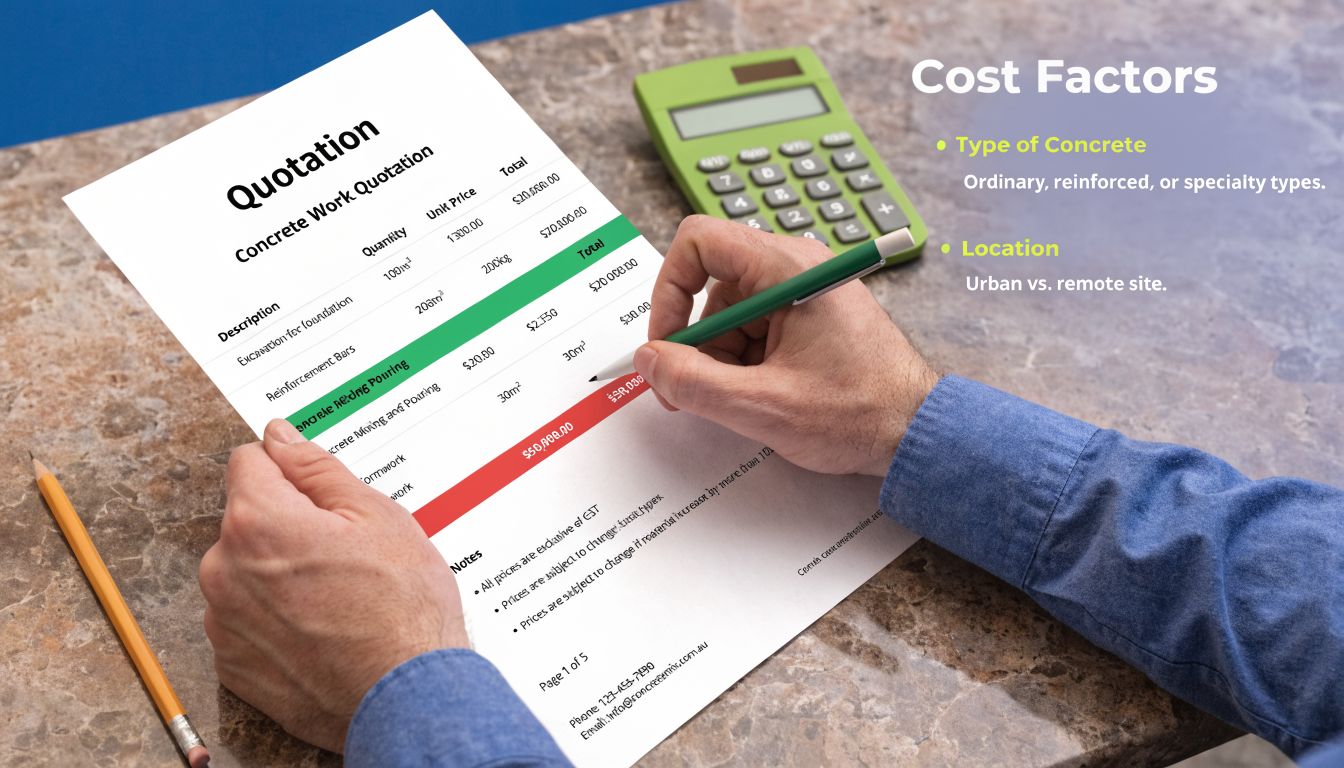
Two quotes can describe the same square footage and still be miles apart in price. That usually comes down to five factors that directly affect labor time, tooling wear, surface prep, and scheduling complexity. If you know how to read those factors, you can spot whether a quote is realistic or just incomplete.
Concrete condition
The slab comes first. If the concrete has cracks, spalling, old adhesive, paint, failed coatings, oil contamination, or uneven patches, the polishing crew has to solve those problems before the floor can look uniform.
Cause and effect is simple here. Better slab condition means fewer prep steps. Poorer slab condition means more grinding, more patching, and more visible risk if repairs don’t blend perfectly with the original concrete.
This is also where hidden staining matters. Rust, irrigation overspray residue, and other embedded discoloration can change the final look even after grinding. If you’re evaluating an older slab with visible staining, this overview of what causes rust stains on concrete helps explain what may need to be addressed before polishing starts.
Project size and layout
Large open spaces are usually more efficient to polish than chopped-up interiors. A clean warehouse bay lets a crew run larger grinders in steady passes. A suite with tight rooms, corners, built-ins, and constant edge work slows everything down.
What raises price isn’t only size. It’s interruption. Every doorway, obstruction, and transition forces smaller tools, more handwork, and slower production.
Grinding and gloss level
A low-sheen floor takes fewer polishing stages than a high-reflective one. That means less machine time and fewer passes with finer diamond tooling.
The more sheen you want, the more precision the crew needs. Any inconsistency that might be acceptable on a utilitarian finish becomes obvious on a reflective surface.
Before looking at finish options in detail, it helps to see the process in action:
Design complexity
Decorative work changes the budget fast. Dyes, stains, aggregate exposure preferences, custom scoring, or a specific visual effect all add labor and increase the chance that the contractor needs more mockups or approval steps before full production.
This isn’t automatically a bad investment. It just moves the project away from straightforward polishing and into specialty finish territory.
Location and accessibility
Access issues add cost even when the floor itself isn’t especially difficult. Ground-floor, empty, easy-to-enter spaces are simpler to schedule and execute. Occupied buildings, restricted working hours, long hose runs, elevator coordination, or limited staging areas all reduce efficiency.
If a contractor can’t easily get machines, dust control equipment, and crews to the slab, the job won’t price like an easy-access project.
For property managers, the best move is to walk the site the way a contractor will. Look for obstructions, stored inventory, tenant activity, slab damage, and any surface contamination. That site walk often explains the quote better than the proposal does.
From Matte to Mirror How Finish Level Drives Your Budget
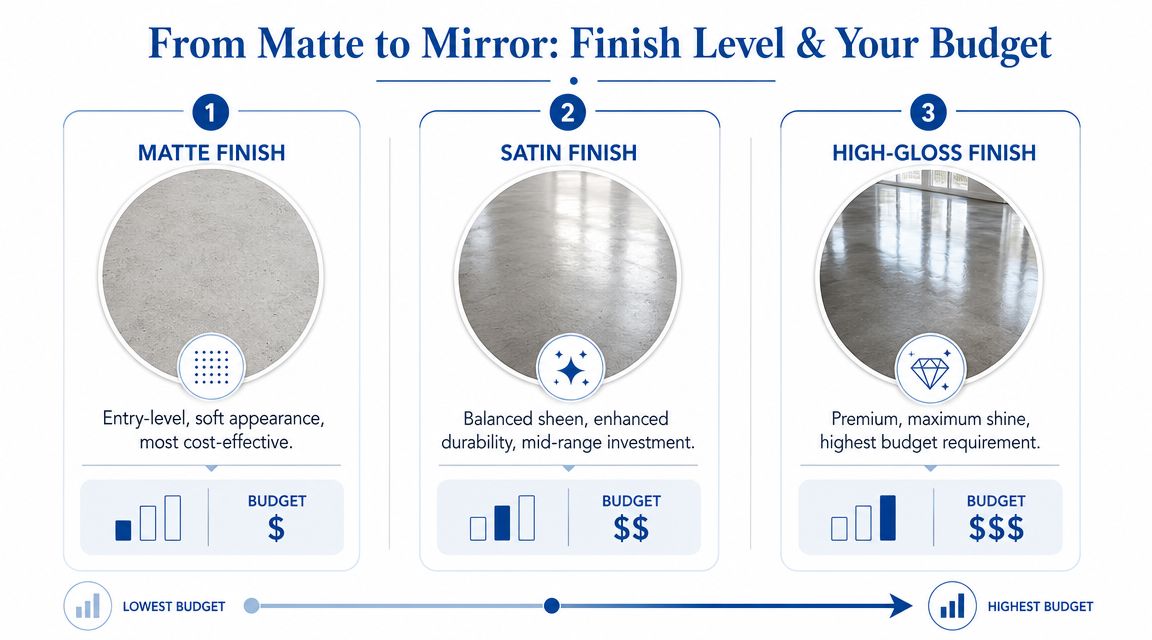
Finish level is one of the clearest pricing drivers because it changes the process itself. The cost escalates directly with gloss level. A matte finish at 50 to 100 grit costs about $2.00 to $2.50 per square foot, a satin finish at 100 to 400 grit costs $2.50 to $2.75 per square foot, and a high-gloss finish at 800 to 3000 grit costs $2.75 to $3.15 per square foot, according to CPC Floor Coatings' cost breakdown for polishing concrete floors.
Matte finish
A matte finish is the functional choice. It gives the slab a cleaner, refined appearance without pushing the polishing process into the most labor-intensive stages.
This is often the right fit for warehouses, utility areas, back-of-house spaces, and properties that want durability first. It won’t create a mirror effect, but it usually gives owners the most straightforward value.
Satin finish
Satin sits in the middle. It has more sheen, better visual lift, and a more finished look without asking for the full effort of a showroom-style polish.
For many commercial spaces, satin is the practical sweet spot. It looks intentional, reflects light better than a matte surface, and avoids some of the cost sensitivity that comes with chasing maximum gloss.
A satin finish is often where appearance and budget stop fighting each other.
High-gloss finish
High-gloss is where the floor becomes part of the design. It’s the premium option, and it takes more time because the crew keeps stepping through finer grits to create stronger clarity and reflectivity.
That’s why these jobs cost more even when the square footage stays the same. The process has more stages, the tooling demand is higher, and the slab has to be consistent enough to support a cleaner visual result.
Why the process changes the price
The simplest way to understand polishing is to think about fine woodworking. If you stop sanding at a rougher grit, the surface is functional and serviceable. If you keep sanding through finer and finer grits, the surface gets smoother, clearer, and more visually refined. Concrete polishing works the same way.
More refinement means more passes. More passes mean more labor, more wear on diamond abrasives, and more attention to detail at edges and transitions.
Here’s a quick comparison:
- Matte: Lower cost, softer appearance, best for utility-driven spaces
- Satin: Mid-range cost, balanced sheen, strong fit for many commercial interiors
- High-gloss: Premium look, highest labor demand, best for retail and lobby-style environments
If the floor sits near other outdoor living or amenity areas, finish choice should also be coordinated with the broader look of the property. A sleek interior floor can clash with neglected exterior hardscape, especially around leisure zones. This article on swimming pool deck cleaning gives a useful exterior counterpart for managers trying to keep finish quality consistent across the site.
DIY vs Professional Polishing A Cost and Risk Analysis
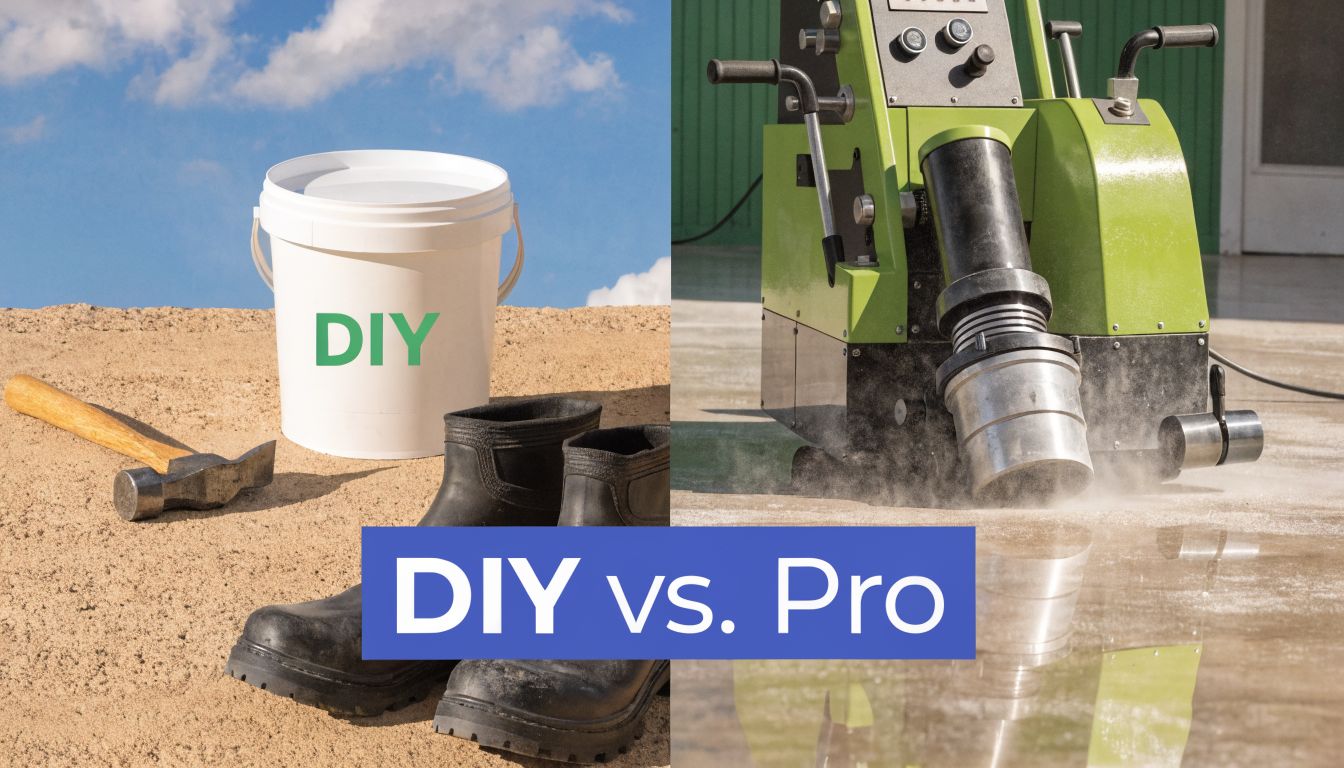
DIY polishing sounds cheaper until the floor starts teaching expensive lessons. On paper, it looks simple. Rent a grinder, buy some diamonds, clean the slab, and work through the grit sequence. In practice, the margin for error is tight, especially on commercial floors where appearance matters and downtime has a cost.
Where DIY usually goes wrong
Most first-time operators struggle with consistency. They leave uneven cut patterns, miss low spots, burn edges, or stop the process too early and wonder why the floor still looks cloudy. Even if the slab survives, the finish often doesn’t.
Dust control is another major issue. Professional crews pair grinders with proper vacuums and containment methods because concrete dust isn’t something you want loose in an occupied building. Equipment handling also matters. Heavy grinders can do real damage if the operator doesn’t understand pressure, pacing, and grit progression.
- Tool mismatch: Renting a machine doesn’t mean you have the right diamonds or edge tools for the slab
- Prep mistakes: Coatings, glue, and patch material can react differently than expected
- Visual inconsistency: A patchy sheen is hard to fix after the fact
- Operational disruption: A DIY project often takes longer and creates more disruption than expected
What professional pricing really buys
A pro isn’t just selling machine time. The value is in evaluation, sequencing, repair judgment, dust control, production speed, and a finish that matches the spec.
For a small personal garage, some owners still choose to experiment. For tenant-facing space, retail, office, or industrial property with real operational value, that gamble rarely makes sense. A bad polishing job isn’t like a poor paint color choice. You can’t easily hide grinding mistakes in concrete.
The biggest DIY cost isn’t the rental. It’s turning a salvageable slab into one that now needs corrective work.
Professional crews also carry the workflow discipline to keep surrounding surfaces protected, coordinate with occupancy constraints, and finish on a schedule that works for the property. That matters more than people expect until the space has to reopen.
The Long-Term Value Concrete Polishing ROI in Arizona
The purchase decision shouldn’t stop at the installation quote. For Arizona property managers, the stronger question is total cost of ownership. A floor that costs less upfront can still be the more expensive choice once maintenance cycles, labor, and disruption are factored in.
For a 10,000-square-foot commercial space in Arizona, annual stripping and waxing of VCT can run around $5,000, and over 5 years that maintenance can exceed $25,000, not including business downtime, while polished concrete requires minimal ongoing maintenance, according to ProMatcher's Arizona concrete cost data.
Where the Arizona math changes
In Phoenix, dust isn’t a minor housekeeping issue. It’s a constant abrasive presence. Floors at entries, common corridors, and retail zones get worn by fine grit every day. That pushes maintenance planning into the foreground.
Polished concrete tends to fit that reality well because it reduces the number of recurring floor-care events that disrupt operations. It also avoids the cycle of stripping, waxing, and restoring a separate finished surface layer. For managers overseeing multiple suites or large open commercial spaces, fewer recurring interventions can simplify staffing and vendor coordination.
Comparing ownership, not just installation
A lower upfront material can look attractive in a budget meeting because it shrinks the initial line item. But if that material brings recurring annual maintenance and periodic operational interference, the true cost shows up later in janitorial budgets, after-hours scheduling, and tenant inconvenience.
That’s where polished concrete often wins. It asks for more thought at the beginning, then much less drama afterward.
A useful way to frame it:
- Upfront comparison: Installation price varies by slab condition and finish
- Maintenance comparison: Polished concrete generally needs far less routine intervention
- Operational comparison: Fewer intensive maintenance cycles usually means less disruption
- Climate fit comparison: Arizona dust and sun exposure reward harder-wearing, simpler surfaces
Why property managers keep choosing it
The return isn’t only financial. A well-executed polished slab also helps the building look cleaner and more current with less visible fatigue between maintenance visits. That matters in leasing, tenant retention, and customer-facing environments.
It’s also one of the few flooring decisions that can support both function and appearance without creating a heavy replacement cycle. In practical terms, owners aren’t just paying for a polished floor. They’re paying to remove future floor headaches from the calendar.
Good flooring decisions lower future workload. That’s part of the return, even when it doesn’t show up neatly on the original quote.
Your Next Steps From Prep Work to a Perfect Finish
Concrete polishing cost is flexible because the floor’s condition, the finish target, and the use of the space all change the scope. The cleanest way to approach it is to treat the project in three phases, not one. Evaluate the slab, prep the surface correctly, then price the finish you need.
Step one starts with surface preparation
A polished result depends on the condition of the concrete before the grinders arrive. Dirt, embedded grime, old sealers, grease, and staining can all interfere with proper evaluation and prep. If the slab is dirty, you can’t assess it clearly, and the polishing contractor may be pricing blind.
That’s why flat-surface cleaning and power washing matter early. Surface prep is often where project outcomes improve or go sideways.
Step two is defining the right finish
Don’t ask for high gloss because it sounds premium. Ask what finish fits the traffic, cleaning routine, and visual standard of the property. A warehouse, retail shell, office suite, and lobby don’t need the same polish target.
If your maintenance team handles in-house cleanup, think about dust control during the work too. For shops, garages, and building teams trying to achieve a safer workshop environment, proper dust collection practices are worth understanding before any grinding begins.
Step three is getting a quote that matches reality
A useful quote should answer these questions:
- What slab condition is assumed
- What finish level is included
- What prep or repairs are excluded
- How access, occupancy, and scheduling affect the job
If any of that stays vague, ask for clarification before approving the work. The best pricing conversations happen on-site, with the actual slab in view.
If you need help getting concrete, walkways, entries, or exterior hard surfaces properly cleaned before a polishing contractor evaluates them, contact South Mountain Window Cleaning, LLC for prep work pricing. If you’re still in the planning stage, they can also help point you toward trusted local polishing partners so you can move from dirty slab to finished surface with fewer surprises.
Frequently Asked Questions About Concrete Polishing
Can old concrete still be polished
Often, yes. Old concrete can polish well if the slab is structurally sound enough and the surface issues are manageable. Age alone isn’t the problem. The bigger questions are condition, contamination, old coatings, patch history, and whether repairs will blend acceptably into the final look.
Is concrete polishing messy
It can be, but professional crews usually manage that with proper grinding equipment, vacuums, and jobsite controls. The mess level depends a lot on the contractor’s dust-control setup and how occupied the building is during the work. For managers concerned about slab condition before installation, moisture is another issue worth checking early. Resources like Flacks Flooring on preventing moisture damage can help you understand why testing matters before committing to a finish.
How do I know if my quote is too low
Low quotes often leave out prep, repairs, furniture moving, access challenges, or finish details. If the contractor hasn’t closely evaluated cracks, coatings, staining, or layout complexity, the number may only represent the best-case scenario.
A reliable proposal usually makes assumptions clear. If it doesn’t, ask what happens if the slab needs more repair than expected.
What maintenance does a polished floor need
Most polished floors are straightforward to maintain compared with many traditional commercial flooring systems. Day-to-day care usually centers on keeping abrasive dirt off the surface and using appropriate cleaning methods, not aggressive restoration cycles.
That matters in Phoenix because windblown dust and tracked-in grit are constant. The floor will perform better and look better if the property has a consistent cleaning routine that matches the level of traffic.
If you manage a property in Phoenix, Scottsdale, Paradise Valley, Chandler, Tempe, or Gilbert and need concrete, walkways, entries, or other hard surfaces cleaned before restoration work begins, South Mountain Window Cleaning, LLC can help with professional exterior and flat-surface cleaning. Reach out for a quote on prep work that gives polishing contractors a cleaner, more accurate starting point.