
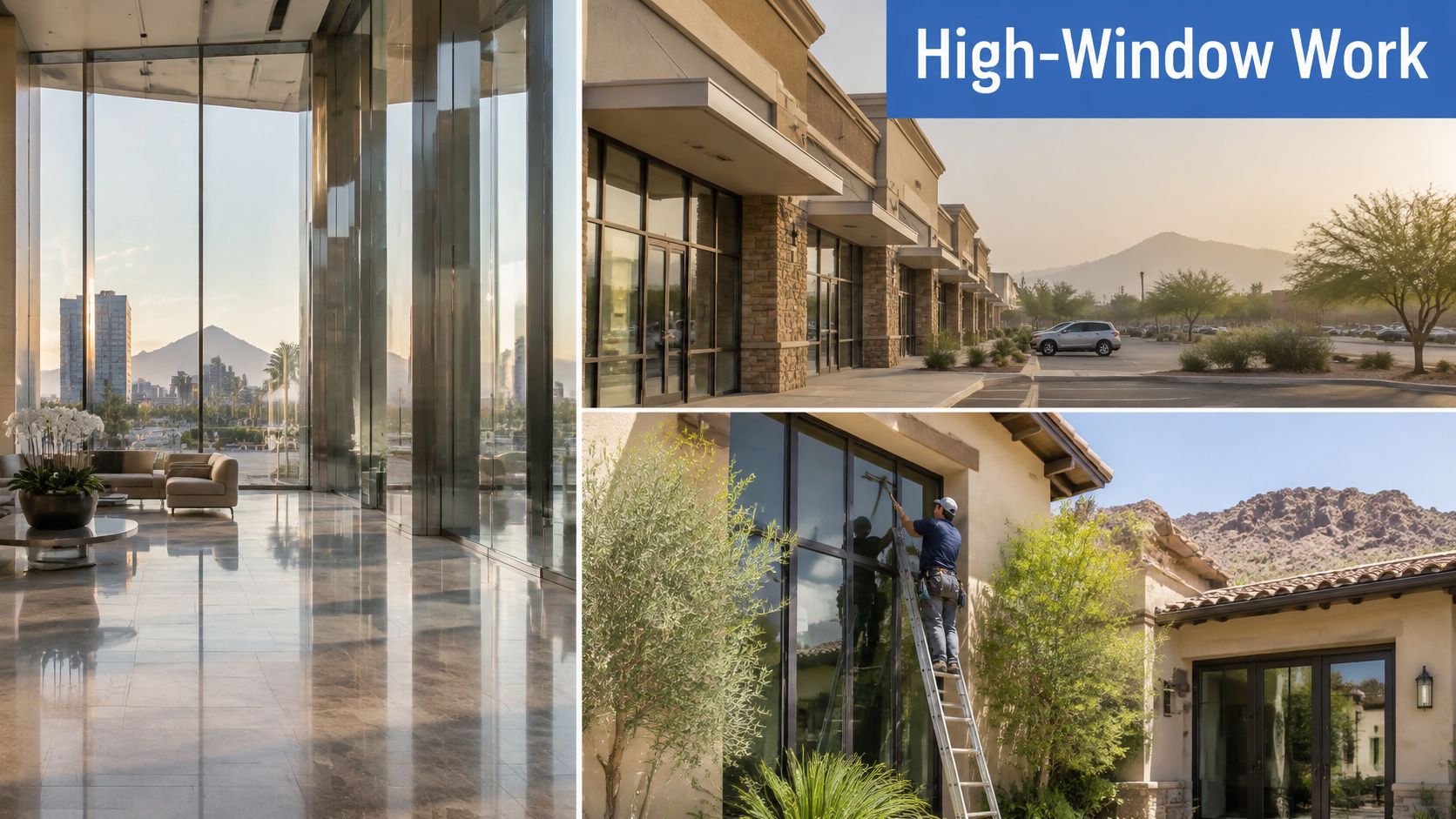
A tower lobby can look clean at opening and still show a veil of dust across the glass by midmorning. A storefront catches the gray film left after a storm, while a home's tall great-room windows stay just beyond safe reach from the floor. In Phoenix, window cleaning for high windows starts with choosing a safe way to reach the glass, not with choosing a soap.
For owners and property managers, that decision affects the work area, pedestrian access, schedule, and emergency plan. South Mountain Window Cleaning serves residential, commercial, and high-rise properties in Phoenix, Scottsdale, Paradise Valley, Chandler, Tempe, and Gilbert. Its stated credentials include licensing, bonding, insurance, a $2 million insurance policy, and a base of more than 400 five-star reviews. Those details matter, but they don't replace a site-specific review of how the crew plans to do the job.
What High-Window Work Actually Looks Like on a Phoenix Job
A Valley morning might start with overnight dust on a tower lobby's exterior glass. At a strip-mall storefront, the challenge may be a long run of windows beside active customer traffic. In a Paradise Valley home, a two-story great-room window may be reachable from inside, from a balcony, or only from outside. The glass needs cleaning in each case, but the access problem is different.
That's why a crew shouldn't start by reaching for a ladder. The first questions are about the façade: Where are the setbacks and deep reveals? Can the glass be reached from indoors or from the ground? Are there overhead wires, landscaping, or pedestrians in the work zone? The answers determine whether a technician uses an interior setup, a water-fed pole, a lift, a suspended platform, or rope access.
The hazards have shaped the trade since its early days. High-window cleaning developed alongside modern skyscrapers in late 19th-century New York. A reported estimate from 1932 said that, on average, one out of every 200 window cleaners was killed each year; on May 29, 1962, four cleaners died when a scaffold fell at New York's Equitable Life Building (history of window cleaning). Those events are a stark reminder that height work demands engineered access and fall protection, not improvised ledge or ladder work.
A rushed setup can create problems before anyone touches the glass: an unstable ladder, an unprotected sidewalk, or equipment that can't reach the façade cleanly. The practical rule is simple: choose the access method to fit the building geometry, then plan the cleaning around that method.
The Inside-First Decision Tree and Water-Fed Pole Workflow
Before a technician leaves the ground, check whether the glass can be reached without working at height. Start with interior access, then consider a balcony or a ground-level water-fed pole. Escalate to a ladder, mobile platform, suspended access, or rope system only when the first options can't reach the glass or deliver an acceptable finish.
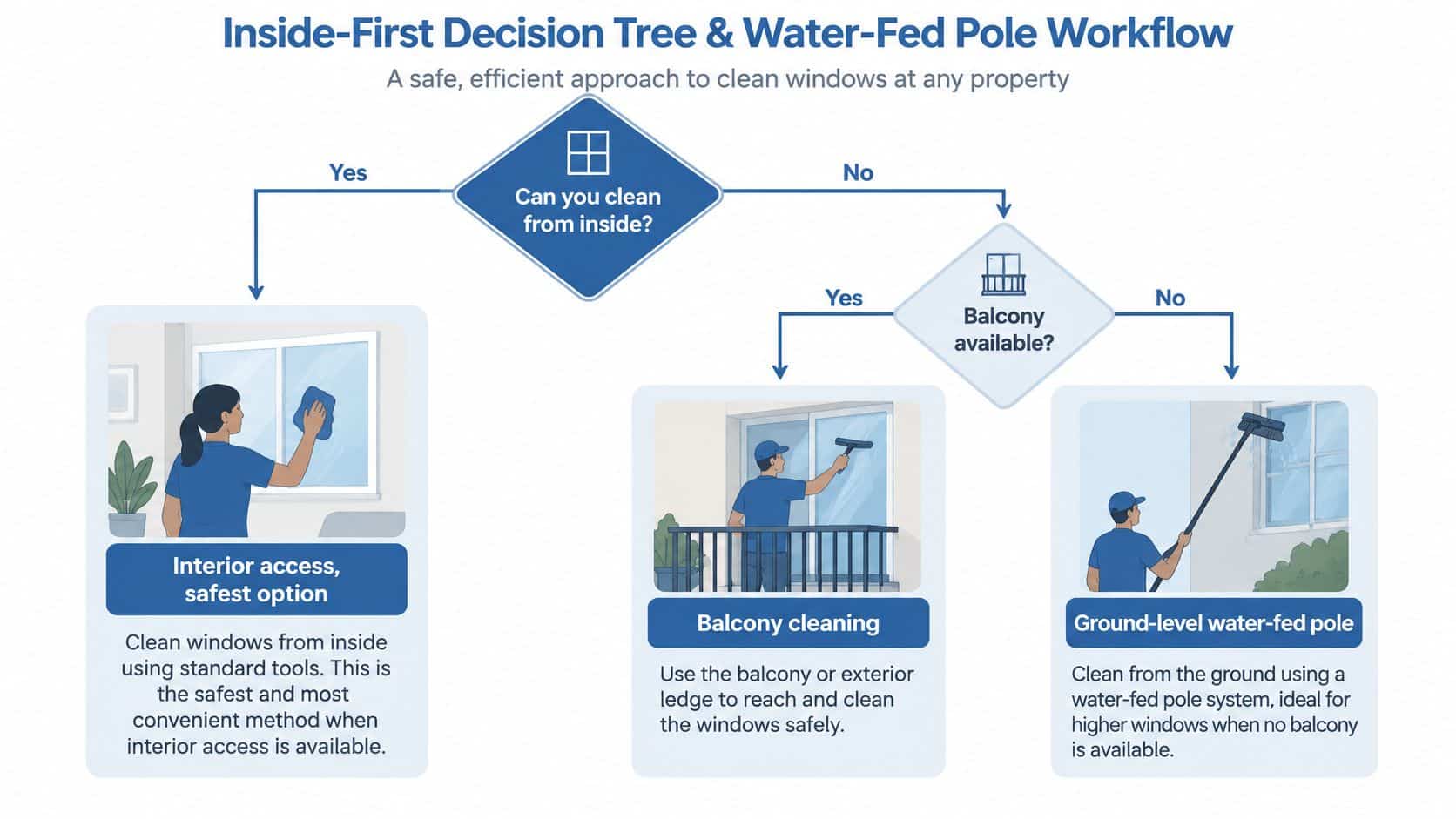
A water-fed pole carries purified water to a brush at the top of an extendable pole. HSE guidance says these systems can clean to approximately 80 ft (24 m) from the ground and should be preferred when they remove the need to work at height (HSE water-fed pole guidance). That reach is useful, not unlimited. Deep reveals, projecting mullions, façade setbacks, wind loading, and operator fatigue can make pole work impractical or leave edges and frames poorly cleaned.
A ground-level pole workflow
- Survey the façade. Identify overhead hazards, the glass layout, runoff paths, and pedestrian routes.
- Control the area. Set an exclusion zone and warning signs where people could pass beneath or beside the work.
- Inspect the system. Check the pole, brush, fittings, hose, and water system before extending the equipment.
- Clean methodically. Work across upper frames and glass while keeping stable footing and controlling the hose.
- Check the result. Inspect each pane from multiple angles after it dries. Rework visible spotting, missed edges, or frame runoff.
A pole isn't suitable when it's defective or when conditions make it unsafe. Stop pole work during high winds or thunderstorms, near overhead power lines, and whenever an extended pole would need to be lifted away from the building. Wet paving and trailing hoses also create slip and trip hazards, so barriers and signs matter in public areas.
For a closer look at this option, see water-fed pole window cleaning. The safest reach is the one that lets the technician keep both feet on stable ground.
Lifts, Suspended Platforms, and Boatswain's Chairs Compared
When ground-based methods can't do the job, choose engineered access according to the building, setup area, work duration, and rescue plan. A boom lift can suit a parking-garage stair tower if the operator has firm ground and a clear route. A scissor lift works where the work is vertical and the equipment can be positioned beneath it. Both may be poor choices when landscaping, overhead obstructions, or a narrow setback blocks access.
Suspended platforms suit façades where equipment can be installed or rigged from the roof and lowered along the building. They can cover a broad curtain-wall elevation, but rigging, anchorage, pedestrian control, and rescue arrangements need careful planning. A single-point adjustable suspended scaffold, commonly called a boatswain's chair, can suit restricted spaces where a wider platform won't fit. It demands disciplined rigging and fall protection.
OSHA identifies the boatswain's chair as equipment used to clean skyscraper exteriors. Its standard sets a 250-pound maximum intended load for the single-point scaffold and requires the supporting rope to remain vertical unless a qualified person designs another arrangement (OSHA single-point suspended scaffolds). That load limit is an equipment constraint, not a suggestion to estimate by eye.
The Equitable Life Building scaffold collapse, noted earlier, is a lasting reminder of what can go wrong when suspended access fails. A method statement should account for setup, inspection, communications, and rescue before a worker leaves the roof or ground.
| Height band | Recommended method | Best fit | Key constraint |
|---|---|---|---|
| Reachable from indoors | Interior access | Atriums and tall residential glass | Interior access and safe footing |
| Ground-accessible upper glass | Water-fed pole | Open façades with workable brush access | Wind, setbacks, and obstructions |
| Low-to-mid-rise areas with clear ground | Scissor or boom lift | Storefronts, garages, and accessible façades | Ground condition and overhead clearance |
| High-rise or restricted façades | Suspended platform or rope access | Curtain walls and narrow setbacks | Engineered rigging and rescue planning |
Rope access can reach awkward geometry without placing a lift beneath the façade, but it requires a qualified team and a specific rigging and rescue plan. Review the rope-access window cleaning approach against the site before approving the method. The right match can prevent delays; an unsuitable one can turn a straightforward clean into a complicated setup.
Fall Protection and the Three-Point Contact Rule
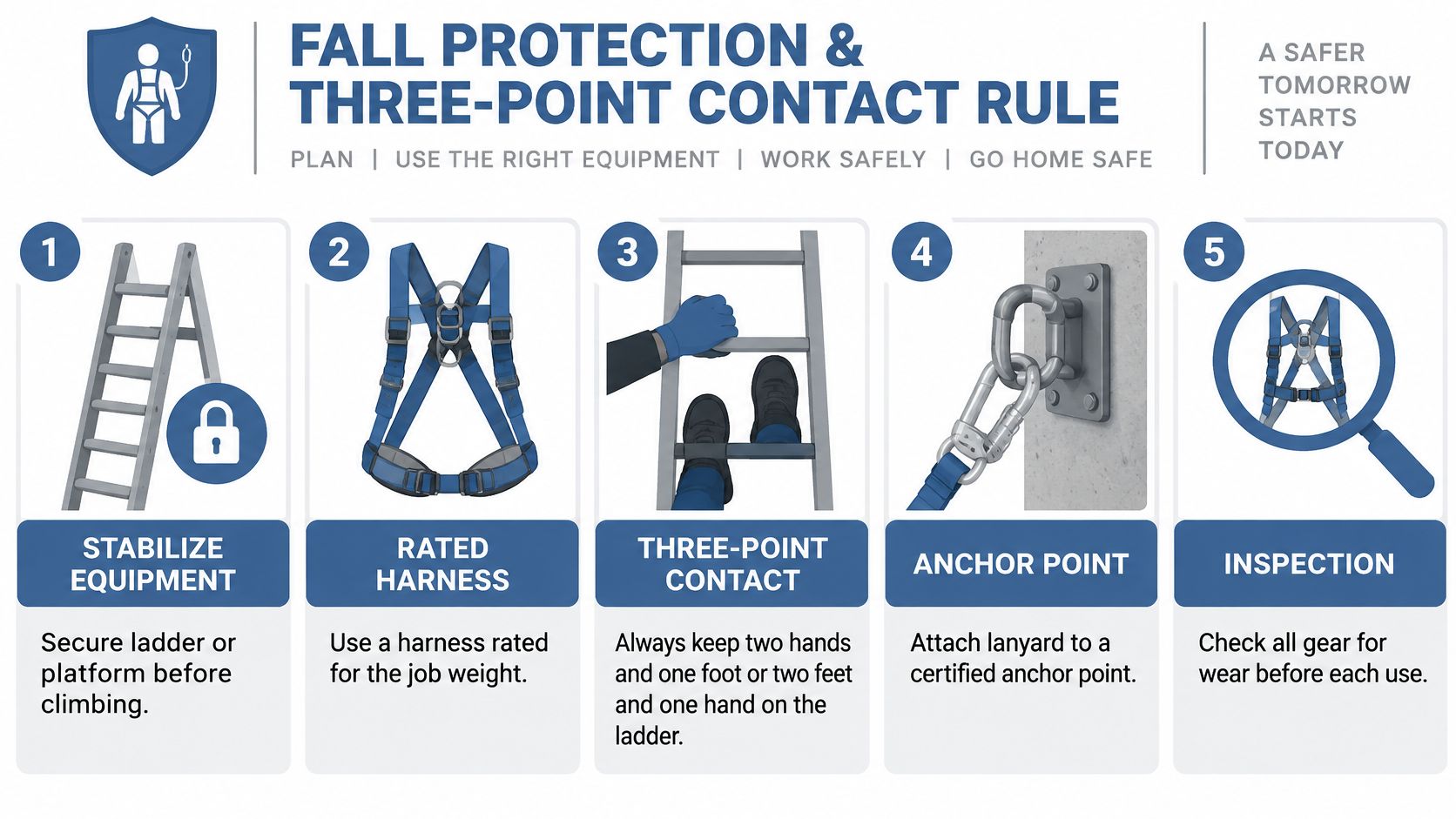
On high window work, stabilize the equipment before relying on a worker's balance. Secure a ladder against movement whenever practicable, set platforms on suitable ground, and inspect the gear before use. Where fall risk remains, use appropriate fall protection with a verified anchor and a rescue plan suited to the actual work.
OSHA's portable-ladder guidance calls for three-point contact while climbing: either two hands and one foot, or two feet and one hand. Workers should face the ladder, keep their bodies near the middle of the step, inspect the ladder, and check for overhead power lines. When an extension ladder provides access to another level, OSHA says it must extend at least 3 ft (0.9 m) above the landing, with the ladder secured at the top or bottom (OSHA portable ladder guidance).
That matters on an everyday job, too. If a technician needs both hands for a tool or bucket, the safe response is to plan a different way to carry it, not to climb while holding it. HSE guidance notes that almost all ladder falls happen when a ladder moves unexpectedly, so stabilization is a primary control, not an optional extra (HSE window-cleaning safety guidance).
Common failures to prevent
- Overreaching: Reposition the ladder or access equipment instead of leaning past the safe working area.
- Carrying tools while climbing: Keep hands available for secure contact and use a planned way to raise equipment.
- Unsecured ladders or platforms: Stabilize the equipment before work begins.
- Dropped tools and exposed pedestrians: Protect the area below the work and keep tools controlled.
- Unplanned rescue: Confirm how the crew will respond if a worker can't descend independently.
For a lone worker, a communication plan matters alongside the physical controls. Property teams comparing options can review live monitoring for lone workers as one resource for maintaining contact during isolated work.
The embedded demonstration offers a visual reminder to keep ladder movement and body position in view while planning a safe setup.
What Building Owners Should Verify Before Authorizing the Job
An insurance certificate is necessary, but it doesn't tell you whether a contractor has inspected the rigging, accounted for pedestrians, or planned a rescue. Before approving high-window work, ask for the method statement and the documents that support it. South Mountain Window Cleaning states that it is licensed, bonded, and insured, with a $2 million insurance policy; confirm that any contractor's coverage meets your property's requirements. More information is available on its window-cleaning insurance page.
A pre-service verification list
- Insurance and licensing: Confirm current documentation and that the named business matches the contractor on site.
- Equipment inspection records: Ask how ladders, lifts, poles, harnesses, ropes, and other equipment are inspected before use.
- Anchor verification: For suspended work, request applicable anchor and rigging documentation, and confirm who is qualified to assess it.
- Technician training: Verify that workers have training appropriate to the access method and fall-protection equipment.
- Site-specific risk assessment: Look for façade hazards, overhead lines, weather limits, exclusion zones, and runoff controls.
- Pedestrian protection: Confirm how signs, barriers, spotters, or temporary closures will protect tenants and the public.
- Written rescue plan: Ask who will respond, how communication works, and how a worker will be brought to safety.
- Heat-readiness plan: Request hydration controls, acclimatization procedures, shaded recovery, and clear stop-work triggers.
Heat planning deserves a direct question in Phoenix. A certificate of insurance won't show whether the crew has planned for hot conditions or knows when work should pause. The owner should see those controls in writing before the crew begins the work.
Falls were the leading cause of workplace deaths in 2023, accounting for 36% of fatalities; OSHA-related guidance calls for training, inspections, fall-protection systems, and rescue planning for elevated work (OSHA-related window-cleaning safety guidance). That broader workplace figure isn't specific to window cleaners, but it reinforces why a rescue plan belongs in the pre-job review, not in a worker's pocket as an afterthought.
Ask for the method statement. “Are you insured?” is a starting point. “Show me how you'll access this façade, protect people below, manage heat, and rescue a worker” is the more useful authorization question.
Rope Access, Lifts, and Pure-Water Pole Crews Side by Side
Contractors bring different strengths to a façade. Pure-water pole crews work well where the glass can be reached from the ground and the brush can reach the frames and edges. They avoid exposing a technician to a fall from height, but deep reveals, wind, and access beyond the pole's practical reach can limit the result.
Lift operators can move workers and tools to a specific work area without roof rigging. A boom lift can be useful around a parking structure or an atrium; a scissor lift suits work where the platform can rise directly beneath the glass. Lifts lose their advantage when the ground is soft, the building sits behind a setback, or overhead obstructions block the approach.
Rope-access teams can work on tall or awkward façades with less equipment occupying the ground. That can reduce disruption, but it doesn't eliminate the need for engineered anchors, equipment checks, weather limits, communications, and rescue planning. The crew has to match its rigging to the building rather than assuming rope access fits every façade.
Phoenix weather affects scheduling as well. Monsoon storms can make afternoon work at height a poor choice, so managers should ask contractors how they set weather limits and whether an early start is appropriate. Pole work still needs safe conditions; it isn't automatically suitable in wind or around overhead electrical hazards.
South Mountain Window Cleaning's stated service approach includes pure-water systems and professional squeegees for residential, commercial, and high-rise work. For a home or a ground-accessible commercial façade, that may be a practical starting point. For a true high-rise or a building with difficult setbacks, compare qualified lift and rope-access options by access, disruption, and rescue readiness, not just by the quoted price.
Scheduling, Maintenance Cadence, and When to Call the Crew Back
Phoenix's exterior glass doesn't stay clean just because the last service went well. The National Weather Service reports an average of approximately 2.8 dust storms a year from June through September, with frequency peaking in late July and early August (Phoenix dust-storm technical memorandum). Dust can redeposit on glass and frames after a clean, so property managers should plan recurring service around exposure, use, and appearance rather than waiting for a complaint.
A useful starting point is to assess the property type and what clean glass does for the people using the space. Retail and restaurant storefronts may need regular attention to stay presentable. Office and high-rise condominium façades can be placed on a recurring inspection and cleaning schedule, with timing adjusted to exposure and tenant expectations. For homes, including properties in Paradise Valley, align exterior service with seasonal buildup and the condition of the glass.
See this guide to how often commercial windows should be cleaned when setting a maintenance rhythm. Then use the glass itself and the site's activity to decide when to bring the crew back.
Schedule a return visit when
- Spotting is obvious from the ground: Visible marks are affecting the view or the property's presentation.
- Tenants or customers report film: Complaints can flag a problem the regular inspection has missed.
- A storm leaves residue: Check the glass and frames after dust or rain has settled.
- The property is being listed or presented: Clean exterior glass supports the overall impression of the building.
- The last method isn't solving the problem: Mineral deposits, construction runoff, or persistent hard-water staining may need a different assessment rather than another routine wash.
In Arizona's dust-and-sun climate, window cleaning is recurring exterior maintenance, not a one-time event.
A planned schedule can help avoid a rushed clean after the glass has become a visible problem. South Mountain Window Cleaning offers residential, commercial, and high-rise window washing, along with a stated 100% satisfaction guarantee and computerized scheduling. Property teams can request a free quote or schedule online.
South Mountain Window Cleaning, LLC provides residential, commercial, and high-rise window washing across Phoenix, Scottsdale, Paradise Valley, Chandler, Tempe, and Gilbert, using access methods suited to the property and its safety needs. Request a free quote or schedule online with South Mountain Window Cleaning, LLC to plan high-window service before dust, access issues, or tenant complaints make the job urgent.