

By midweek in Phoenix, the glass usually tells the story. Fine dust has settled again. Sprinklers may have left mineral spotting near lower panes. On taller buildings, the windows that need the most attention are often the hardest and riskiest to reach. Property managers know the pattern. Traditional ladder work takes longer, disrupts foot traffic, and still doesn't always produce a consistent finish across every elevation.
That's why water fed pole cleaning has become the modern standard on so many residential and commercial properties. It changes the job from a ladder-heavy process into a ground-based system that combines purified water, a telescopic pole, and a soft brush to clean exterior glass safely and efficiently. In Arizona, that matters even more. Dust is constant, hard water is a real issue, and direct sun exposes every streak.
The Modern Way to a Flawless Shine
A Phoenix property can look clean on Monday and show dust, sprinkler marks, and sun-baked spotting by Thursday. That is the reality here. Exterior glass takes a beating, and the cleaning method matters just as much as the schedule.
Traditional window cleaning still has a place for touch-up work and certain interior details. For many exterior windows on multi-story homes, office buildings, medical suites, and retail centers, water fed pole cleaning is the better working method because it handles height, repeatability, and Arizona residue more effectively.
On site, the difference is obvious. Crews spend less time hauling and resetting ladders and more time washing glass. That matters on properties with foot traffic, tight landscaping, parked vehicles, or long runs of storefront windows where constant ladder movement slows the job and creates more disruption than most managers want.
What changed in the trade was simple. Cleaners stopped treating every high pane like a ladder job.
With a water fed pole system, the technician works from the ground, agitates the glass and frames with a soft brush, and rinses with purified water that dries without the mineral spotting left by ordinary tap water. In Arizona, that is a major advantage. Hard water is common, airborne dust is constant, and direct sun makes any leftover residue show up fast.
Property managers usually notice three things first:
- Less congestion around the building: fewer ladders, fewer tools staged near entrances, and less interference with tenants, staff, and customers
- More consistent exterior results: upper panes, frames, and awkward glass can be cleaned with the same process across the property
- A better fit for Arizona conditions: purified water helps prevent the spotting and haze that standard water can leave behind on hot glass
There are trade-offs, and experienced cleaners should be honest about them. Water fed pole cleaning is designed for exterior glass. It is not the answer for every interior pane, and badly neglected windows may still need restoration work before routine maintenance delivers the finish you want. But for ongoing exterior service, especially in Phoenix, it gives crews a faster, safer, more consistent way to keep glass presentable.
If you want a closer look at the equipment behind that process, South Mountain's page on pure water window cleaning systems explains how professional setups are built for spot-free exterior cleaning.
How Water Fed Pole Cleaning Actually Works
On a Phoenix property, exterior glass does not stay clean for long. Dust settles fast, hard water leaves minerals behind, and heat makes any residue show up the same day. Water fed pole cleaning works because it addresses those conditions at the source.
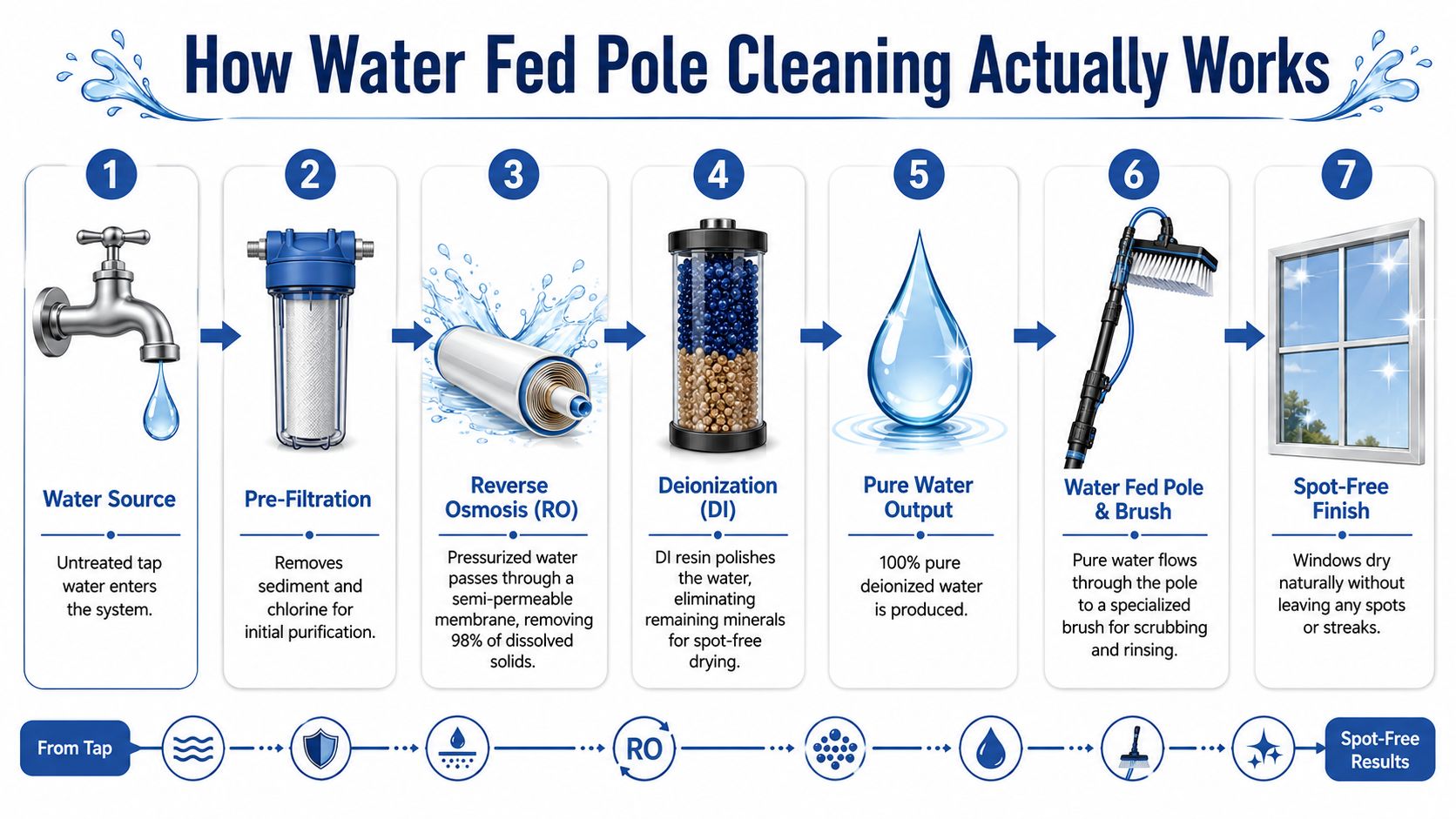
It starts with water purification
Tap water carries dissolved minerals. If that water dries on glass, those minerals stay behind as spots, haze, and light streaking. A professional system removes those contaminants before the water ever reaches the window, which is why the finish dries clear instead of chalky.
The quality of the water matters. Operators track total dissolved solids because lower readings mean less residue left on the glass. This guide to cleaning windows with a pole gives a useful overview of why purified water performs better than ordinary tap water for exterior window cleaning.
In Arizona, that difference is easy to see. Hard water is common, and intense sun exposes every bit of leftover mineral content.
Then the pole carries purified water to the glass
The pole sends that purified water through lightweight tubing to a brush head, so the cleaner can scrub and rinse windows from the ground. On homes, retail storefronts, office buildings, and multi-story elevations, that gives crews access to a large share of exterior glass without setting a ladder at every window.
Pole choice affects results more than people expect. A pole that is too flexible is harder to control. A pole that is too heavy slows the technician down and makes detail work at the top of the pane less precise. South Mountain's page on reach window cleaning for taller and hard-to-access glass shows where that extra reach becomes especially useful.
Pure water handles the rinse. Good technique handles the clean.
A short demonstration helps make the process easier to visualize.
The brush does the real cleaning
The brush is not there just to move water across the pane. It breaks up the film that collects on exterior glass, especially along top edges, frame lips, and corners where dust packs in. On Arizona buildings, that usually means desert dust, pollen, traffic residue, and mineral staining on the frames.
A standard cleaning sequence looks like this:
- Pre-rinse the window and frame: purified water loosens loose dust and surface debris.
- Scrub the glass and edges: the brush agitates grime from the pane, corners, seals, and frame lines.
- Rinse thoroughly with pure water: the technician flushes the loosened contamination off the surface.
- Allow the glass to dry naturally: with properly purified water and a complete rinse, the window dries without squeegee marks or mineral spotting.
That last step is where technique matters. If the frame is dirty, it needs enough agitation. If the rinse is rushed, residue can pull back onto the glass as it dries. Done properly, the system leaves a uniform finish that holds up well on routine exterior maintenance, especially on Phoenix properties that deal with constant dust and hard-water exposure.
Benefits Over Traditional Squeegee Methods
A Phoenix property can look clean at 7 a.m. and wear a fresh layer of dust by afternoon. On exterior glass, the cleaning method has to do more than remove fingerprints. It has to handle blowing grit, dirty frames, and hard-water residue without turning the job into a ladder-heavy production.
That is why water fed pole cleaning outperforms traditional squeegee work on many Arizona exteriors. The advantage is not novelty. It is control, safety, and more consistent results on the kinds of buildings we clean every week.
Safer work, less disruption on site
Ground-based cleaning changes the risk profile right away. Crews spend less time carrying, setting, and shifting ladders around entries, walkways, parked cars, and desert landscaping. For a property manager, that means fewer trip hazards, fewer access conflicts, and a cleaner jobsite during service.
It also keeps the work moving. Instead of stopping every few windows to reposition equipment, technicians can cover long exterior elevations in a steady pattern. That matters on occupied office buildings, storefronts, HOAs, and homes with difficult access. It is one reason this method works so well for cleaning high exterior windows safely from the ground.
Better fit for Arizona exterior maintenance
Traditional squeegee cleaning still has its place. Interior glass, first-floor detail work, paint specks, and tight specialty cleanup often call for hand tools and close inspection.
Exterior maintenance is different, especially in Phoenix. Dust collects along frame tops and seals. Sprinklers and hard water leave mineral residue. Strong sun can dry soap and rinse water too quickly if the process is not controlled. A water fed system helps because it washes the frame and glass together, then rinses with purified water that dries without adding new mineral spotting.
That frame-first benefit gets overlooked. On Arizona properties, dirty frames are often what pull grime back onto freshly cleaned glass.
Speed matters, but consistency matters more
A pure-water setup usually lets a crew clean exterior routes faster because there is less ladder work and less repeated setup. The practical value is larger than labor savings alone. Faster routes mean less time on site, less interruption for tenants or customers, and an easier path to keeping glass on a regular schedule.
Consistency is the bigger win on recurring service. Traditional squeegee work can leave clean glass beside dusty frame edges if the scope is rushed or split up. Water fed pole cleaning handles the whole exterior assembly more uniformly, which is exactly what helps buildings in Arizona stay presentable between visits.
One industry article also notes gains in production speed, reduced service frequency on some properties, faster equipment payback, and the wide working range of modern poles in its guide to benefits of water fed pole cleaning.
A side-by-side comparison
| Feature | Water-Fed Pole Cleaning | Traditional Squeegee Cleaning |
|---|---|---|
| Primary working position | Ground-based on many exterior jobs | Often requires ladder work for upper glass |
| Exterior maintenance pace | Faster on many routes because crews spend less time resetting access | Slower when ladder setup and repositioning are frequent |
| Finish method | Purified water dries naturally | Soap, squeegee, and cloth detailing |
| Frame cleaning | Glass and frames are usually cleaned in the same pass | Often involves separate hand detailing |
| Site disruption | Less equipment movement around the property | More staging around doors, walks, and parking areas |
| Best use case | Routine exterior cleaning on hard-to-reach glass | Interior glass, detail work, and specialty removal |
For Arizona exteriors, the trade-off is straightforward. Traditional squeegee methods are still useful for detail work. Water fed pole cleaning is usually the stronger system for routine outside glass because it reduces ladder exposure, moves faster across the property, and leaves a cleaner result on frames and glass together.
Ideal Applications for Phoenix Homes and Businesses
In the Valley, this method isn't limited to one property type. It fits a wide range of buildings because the same core benefits apply across residential neighborhoods, retail corridors, and office sites.

Homes with tall exterior glass
A two-story home in Chandler or Paradise Valley is a strong candidate for water fed pole cleaning. High foyer windows, stairwell glass, and rear elevations above pools or landscaping are awkward with ladders and time-consuming with traditional hand work. A pure-water setup lets a cleaner scrub and rinse those panes from the ground while covering frames at the same time.
Pole selection matters here. One industry guide recommends choosing a pole about 1.2 times the height of the highest window to account for working angle and flex, as explained in this guide to waterfed pole window cleaning. That's one reason experienced crews handle these jobs better than someone using a pole that's too short or too flexible.
Storefronts and office buildings
In Scottsdale, Tempe, and Phoenix, many retail and office properties need clean exterior glass without slowing down business. Water fed pole cleaning works well on storefront runs, entry glass, and upper panes where managers want service completed with minimal interruption.
Good applications include:
- Retail centers: exterior glass can be cleaned without filling walkways with ladders.
- Restaurants and cafés: crews can service windows early with less interference around patios and entrances.
- Office properties: upper exterior panes are easier to maintain on a recurring schedule.
- HOA common areas: clubhouses and community buildings often have high decorative glass that suits the method well.
If the property has especially challenging upper windows, South Mountain's page on high windows cleaning gives a solid overview of what professional access planning looks like.
A good fit for water fed pole cleaning is any property where exterior glass is high, repetitive, or difficult to reach efficiently with ladders.
Solar panels and delicate exterior surfaces
The method also suits solar panel cleaning because it uses purified water and soft brush contact rather than harsh chemicals. In dusty parts of Gilbert, Chandler, and Phoenix, that matters. The goal is to lift off fine debris without grinding grit across the surface.
The same applies to many window frames, trims, and exterior glass assemblies. Water quality remains critical. If filtration slips and TDS rises above the clean range, spotting can follow. That's why proper equipment maintenance is part of the service, not an extra.
Why WFP Is the Smart Choice for the Arizona Climate
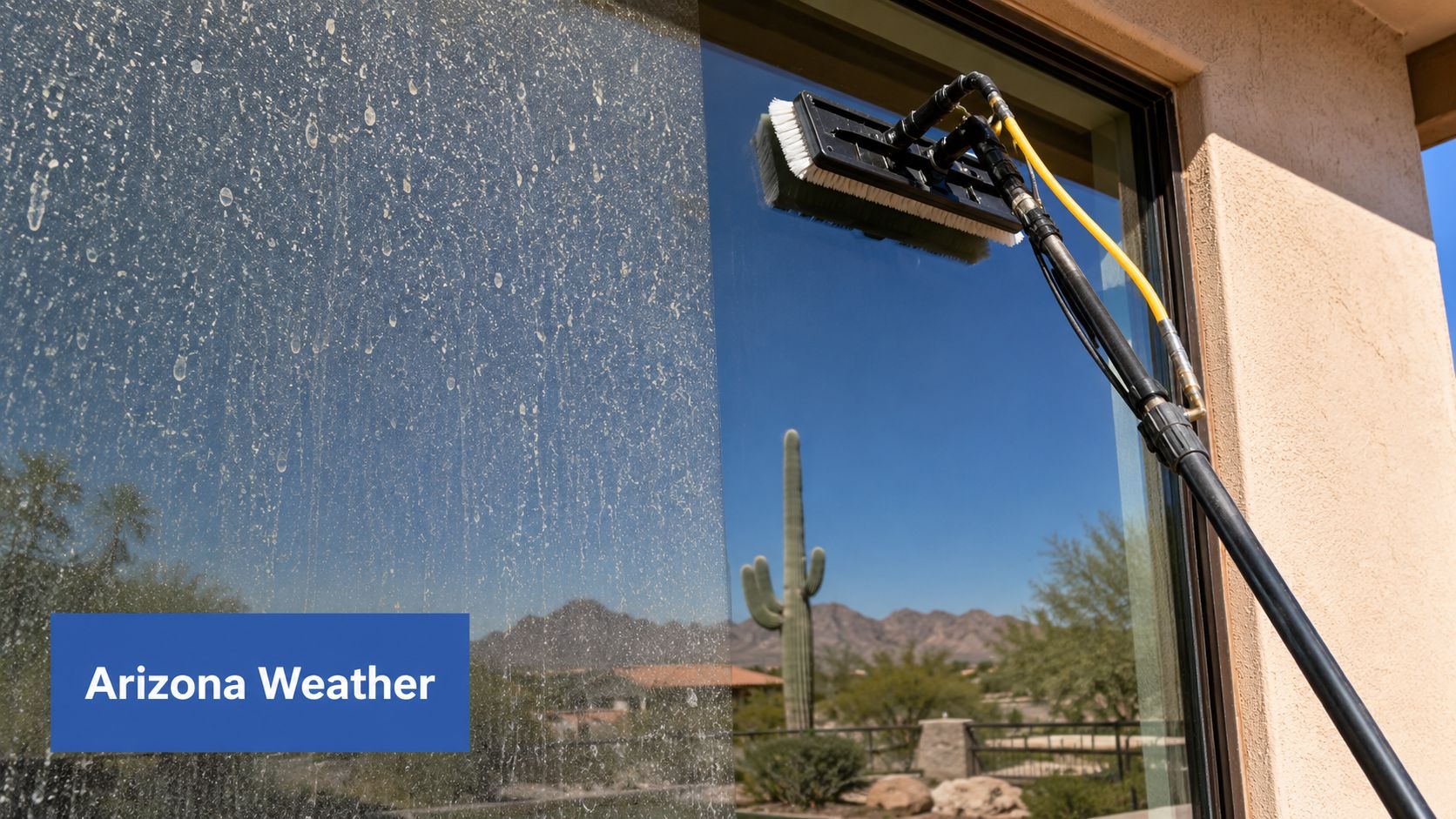
Arizona makes window cleaning harder than many property owners realize. The issue isn't just dust. It's dust plus minerals plus heat. That combination exposes every weakness in a cleaning method.
Hard water is the first problem
In Arizona, ordinary tap water can leave visible mineral residue on glass. When that water dries in the sun, the spotting is hard to ignore. Water fed pole cleaning solves that at the source by purifying the water before it ever reaches the brush.
That matters for any property manager trying to protect curb appeal. If you're comparing exterior service budgets more broadly, this guide to commercial cleaning costs for businesses gives useful context on how cleaning services are typically evaluated.
Dust is the second problem
Desert dust doesn't just sit on the glass. It settles into edges, frames, and seals. A traditional quick wipe can move that grime around without fully flushing it away. The brush-and-rinse action of a water fed pole system is better suited to that kind of environment because it lifts and carries debris off the surface.
That makes a visible difference on:
- Street-facing storefronts: traffic dust builds up fast.
- Stucco homes near open lots: fine grit settles on frames and upper panes.
- Properties after wind events: windows often need more than a cosmetic wipe-down.
Sun is the third problem
The Arizona sun speeds up everything, including bad results. Soap residue, tap-water minerals, and rushed detailing become obvious quickly when the glass heats up. Pure water helps because it dries without leaving those mineral traces behind when the system is maintained correctly.
Monsoon season adds another layer. Dust, rain, and runoff can all affect how long windows stay clean and when it makes sense to service them. South Mountain's article on whether you should clean your windows during monsoon season in Phoenix, Arizona is worth reading if you're planning seasonal maintenance.
In Arizona, the best cleaning method isn't the one that looks good for an hour. It's the one that holds up after dust settles and the afternoon sun hits the glass.
That's why water fed pole cleaning isn't just a newer tool in this market. It's the method that best matches the local conditions.
Your Water Fed Pole Cleaning Questions Answered
Will it work on windows that haven't been cleaned in a long time
Usually, yes. But this is where experience matters. Water fed pole cleaning is highly effective, yet heavily soiled or baked-on contamination may not come off perfectly on the first pass. On neglected glass, a technician may need a second rinse or even a traditional squeegee follow-up, as noted in this practical video discussion of water-fed pole limitations.
That isn't a weakness. It's just the reality of first-time restoration work. A good technician knows when pure water alone is enough and when the glass needs a different finishing step.
Is it safe for stucco, siding, and landscaping
In most cases, yes. The system uses purified water and a soft-bristle brush, so it's generally well suited to homes and commercial buildings with painted trim, stucco, and surrounding landscaping. Safe work still depends on technique. The operator needs to control runoff, avoid forcing water where it doesn't belong, and choose the right brush pressure for the surface.
How often should Phoenix properties schedule service
That depends on exposure. A storefront on a busy corridor may need more frequent service than a sheltered residential elevation. A home near open desert or active construction will usually show dust faster than one in a more protected area. The practical approach is to set a schedule based on what your property collects, not on a one-size-fits-all rule.
For many managers and homeowners, the best first step is simple:
- Walk the sunny side of the property: that's where spotting and dust usually show first.
- Check upper windows, not just eye-level glass: those panes often get ignored until buildup is obvious.
- Look at frames as well as the glass: if the edges are dirty, the whole elevation looks tired.
- Ask how the cleaner handles first-time cleans: that answer tells you a lot about their experience.
A professional should be able to explain when water fed pole cleaning is the right tool, when traditional detailing is still useful, and how to combine both for the best result.
If you need reliable exterior window cleaning in Phoenix, Scottsdale, Paradise Valley, Chandler, Tempe, or Gilbert, South Mountain Window Cleaning, LLC offers residential, commercial, and high-rise service with pure-water systems, trained technicians, and practical solutions for Arizona's dust, hard water, and sun. Request a free quote and get a cleaning plan that fits your property instead of a generic one-size-fits-all visit.