
If you manage a high-rise in Phoenix, you already know the pattern. A stretch of clear glass can look sharp on Monday, then pick up dust, hard-water spotting, and windblown grime before the week is out. Add intense sun, tenant expectations, and the need to keep entries, sidewalks, and loading zones open, and exterior window cleaning stops being a cosmetic task. It becomes an operations decision.
That's where rope access window cleaning stands apart. For many towers and mid-to-high-rise buildings in Phoenix, Scottsdale, Tempe, Paradise Valley, Chandler, and Gilbert, it solves the three problems property managers care about most: access, safety, and disruption. Instead of surrounding a building with bulky equipment, trained technicians work directly on the facade with controlled rope systems and tightly managed site procedures.
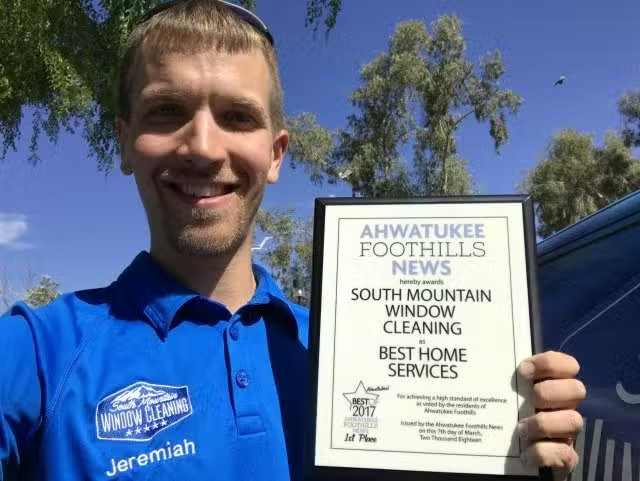
South Mountain Window Cleaning provides residential, commercial, and high rise window washing services in Phoenix, Scottsdale, Paradise Valley, Chandler, Tempe, Gilbert, Arizona. For property managers in the Valley, the important question isn't whether windows can be cleaned. It's which method fits the building, the climate, and the risk profile without slowing down daily operations.
The Modern Solution for Phoenix High-Rise Window Cleaning
A common Phoenix scenario starts with an inspection walk. The morning light hits the west elevation, and every streak, dust line, and mineral deposit shows up at once. Tenants notice it. Ownership notices it. Prospective tenants definitely notice it.
Traditional access methods can work on some buildings, but they often create new problems. Scaffolding takes space. Boom lifts need clearance and access routes. On active commercial sites, both can interfere with pedestrians, deliveries, valet areas, or parking flow. On buildings with setbacks, recessed glass, decorative features, or tight urban footprints, they can also leave awkward coverage gaps.
That's why rope access has become the practical modern answer for many high-rise properties. Often called industrial mountaineering, this method lets trained technicians move across the facade with a small equipment footprint and a high level of control. For property managers trying to maintain curb appeal without turning the property into a work zone, that matters.
Why it fits the Valley
Phoenix buildings deal with conditions that punish glass and equipment alike.
- Sun exposure: UV and heat accelerate wear on exterior materials and demand disciplined equipment inspection.
- Dust and airborne grit: Wind carries fine dust that settles fast, especially after dry periods and storm activity.
- Mixed architecture: Office towers, luxury condos, hotels, and mixed-use properties often combine flat glass with ledges, overhangs, fins, and recessed sections.
A property manager comparing service options may also review broader marketplaces such as SaberTask's platform for window services to understand how providers present scope and scheduling. The bigger issue, though, is whether the contractor understands what high-rise cleaning looks like in Phoenix, not just in theory but on buildings exposed to sun, dust, and constant tenant traffic.
Clean glass is part appearance, part asset care. On a high-rise, the access method determines whether the job stays efficient and controlled or becomes a site management problem.
How Rope Access Window Cleaning Actually Works
Rope access looks dramatic from the ground, but the process itself is methodical. The trade often gets described as industrial mountaineering because the equipment and movement systems come from climbing and rescue disciplines, adapted for controlled building access.
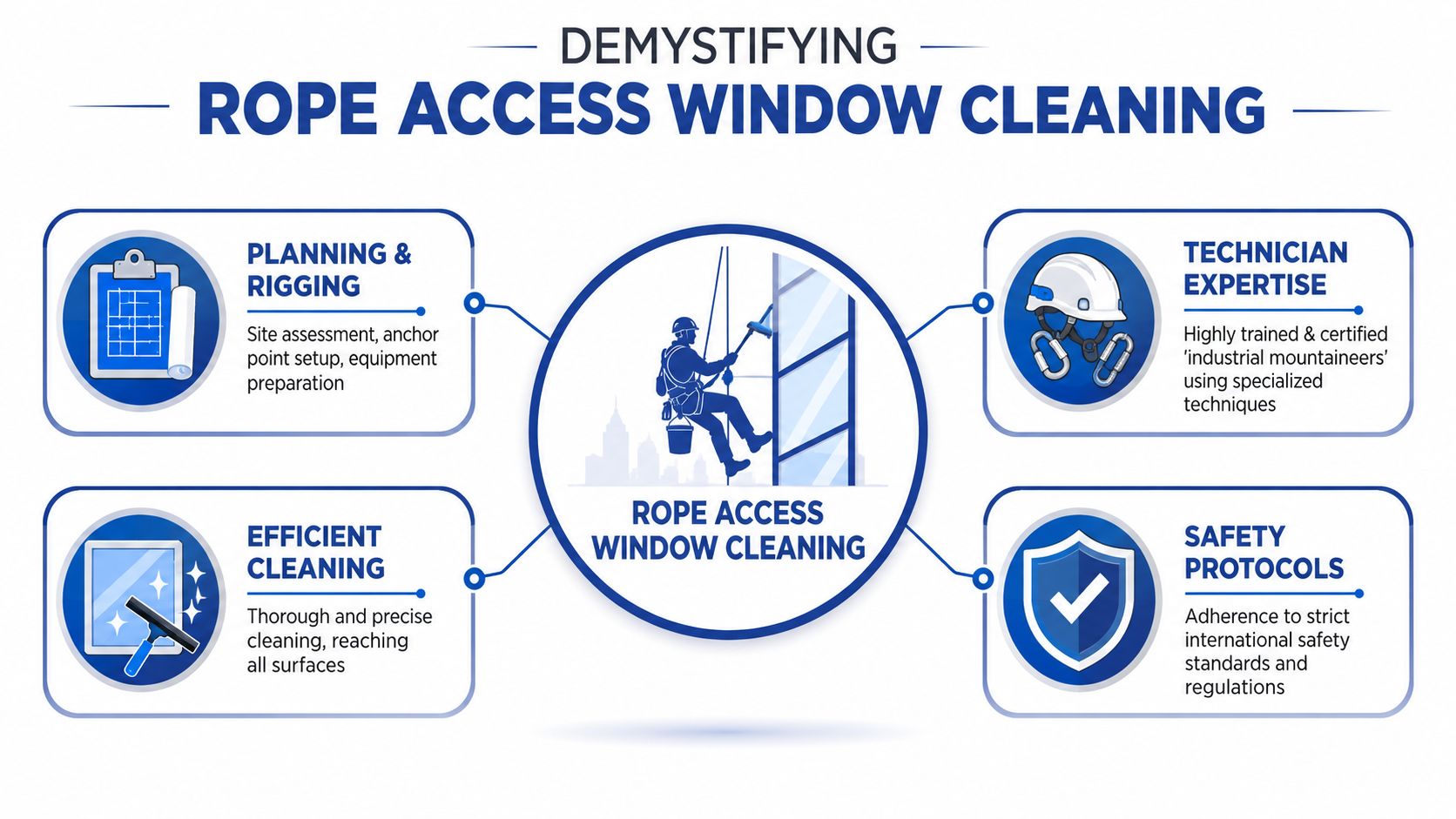
Before getting into the details, this visual gives a clear overview of the workflow and safeguards involved.
The core system
At the center of the method is redundancy. Rope access operations mandate a dual-rope configuration: one primary load-bearing rope for access and support, and one independent safety backup rope. All window washing tools must be secured by lanyard to prevent impact injuries below, directly addressing third-party safety hazards in the rope platform safety guidance.
Technicians are connected to both lines through a sit harness that's designed for suspended work. The working line supports the technician's movement and positioning. The backup line is independent and there in case the primary line or device fails. Descender devices are selected so they don't allow an uncontrolled rush downward if control is lost.
If you want a closer look at the gear involved, South Mountain's overview of high-rise window cleaning equipment is useful for understanding what belongs on a properly equipped job.
What happens on a real job
A typical rope access window cleaning project follows a predictable sequence.
Roof assessment and rigging
The crew confirms access, identifies usable anchor locations, checks edge protection needs, and prepares lines so they run cleanly over the building edge without damage.Exclusion zone setup
Ground-level areas below the work zone are controlled so pedestrians, tenants, and vendors stay clear of the active drop line.Equipment check
Harnesses, ropes, descenders, helmets, and tool lanyards are checked before use. The system only works when every component is inspected and used as intended.Controlled descent and cleaning
The technician descends in measured sections, cleaning glass, frames, and reachable facade areas according to the building's scope and surface type.Completion and retrieval
After the drop is finished, lines are retrieved, equipment is checked again, and the site is cleared.
A video can help make that movement easier to picture on an actual facade.
Why property managers usually misread it at first
From the ground, rope access can look improvised if you've never managed this kind of work. In practice, it's the opposite. The system is structured, repetitive, and controlled. Every descent depends on pre-planning, anchor setup, equipment checks, and communication.
Practical rule: If a contractor can't explain their rigging plan, exclusion zone plan, and rescue readiness in plain language, they're not ready to work on your building.
Rope Access vs Scaffolding and Boom Lifts
Property managers don't buy access methods. They buy outcomes. The right question is simple: which option gets the building cleaned with the least disruption, the right safety controls, and a sensible total project cost?
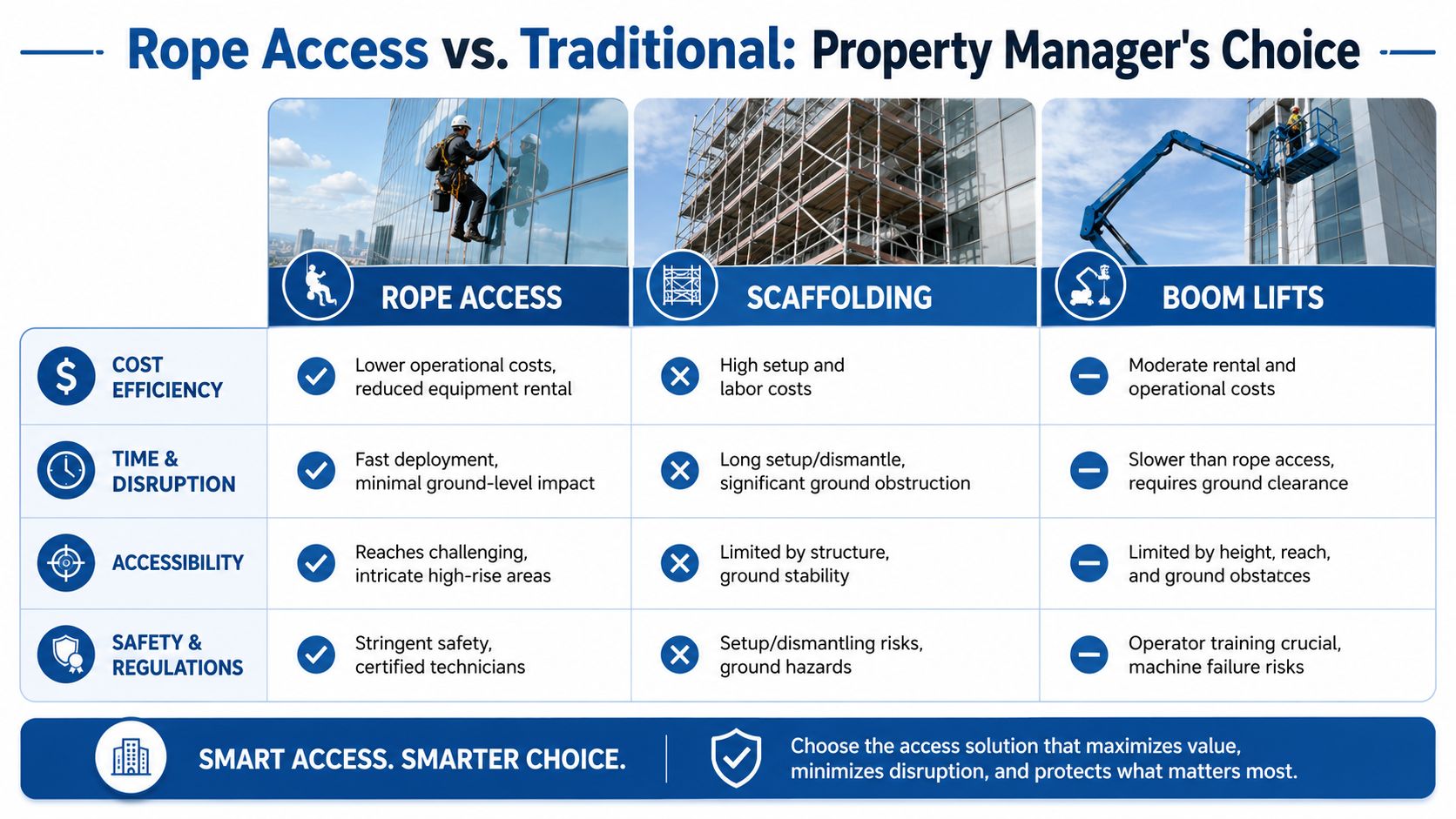
For many high-rise properties, rope access wins because it removes the biggest inefficiencies built into traditional access systems. According to Valcourt's high-rise cleaning overview, rope access window cleaning significantly improves operational efficiency by reducing labor hours by 50–70% compared to traditional methods like scaffolding, eliminating the substantial costs and logistical time associated with the setup and removal of bulky structures.
Side by side in practical terms
Here's how the trade-offs usually look on active commercial properties.
| Method | Where it helps | Where it struggles |
|---|---|---|
| Rope access | Small ground footprint, strong facade reach, fast deployment | Needs suitable anchor strategy and a specialized crew |
| Scaffolding | Useful for some extended facade tasks | Heavy setup, visual obstruction, major site impact |
| Boom lifts | Works well where ground access is wide open | Limited by reach, clearance, and ground conditions |
Speed and operational flow
Scaffolding often turns a cleaning project into a staging project. Materials arrive, access gets blocked off, setup takes time, and teardown takes more. On a busy property, that can affect tenant movement and service traffic before the first pane gets cleaned.
Boom lifts reduce some of that, but they still need space to move and operate. In downtown or tight-site conditions, that can become the limiting factor.
Rope access starts lighter. The crew rigs from the roof, controls the ground zone directly below, and works the facade without building a temporary structure around it. That's often the difference between a manageable service day and a week of coordination.
Building access and facade complexity
Modern Arizona buildings rarely present one flat, uninterrupted wall of glass. You get step-backs, balcony lines, fins, recessed windows, canopies, parapets, and ornamental transitions.
Rope access handles those variables better than bulky mechanical systems because technicians move with the facade instead of trying to force a machine into a fixed geometry. For property managers evaluating service scope, South Mountain's high-rise window cleaning service page outlines where this method fits best on taller and more complex buildings.
Tenant experience matters
The cleanest quote on paper can still be the wrong choice if it frustrates tenants all week.
- Scaffolding changes the building's appearance while the project is active.
- Boom lifts create noticeable ground activity and usually need more site choreography.
- Rope access keeps the visual footprint smaller, which matters for office towers, luxury residential, and hospitality properties.
The right access method should fit the building, not force the building to adapt to the equipment.
That doesn't mean rope access is universal. Some restoration tasks need heavier tools and a different setup. For cleaning, though, especially on glass-heavy high-rises in Phoenix, it's often the cleaner operational fit.
Understanding Critical Safety and Certification Standards
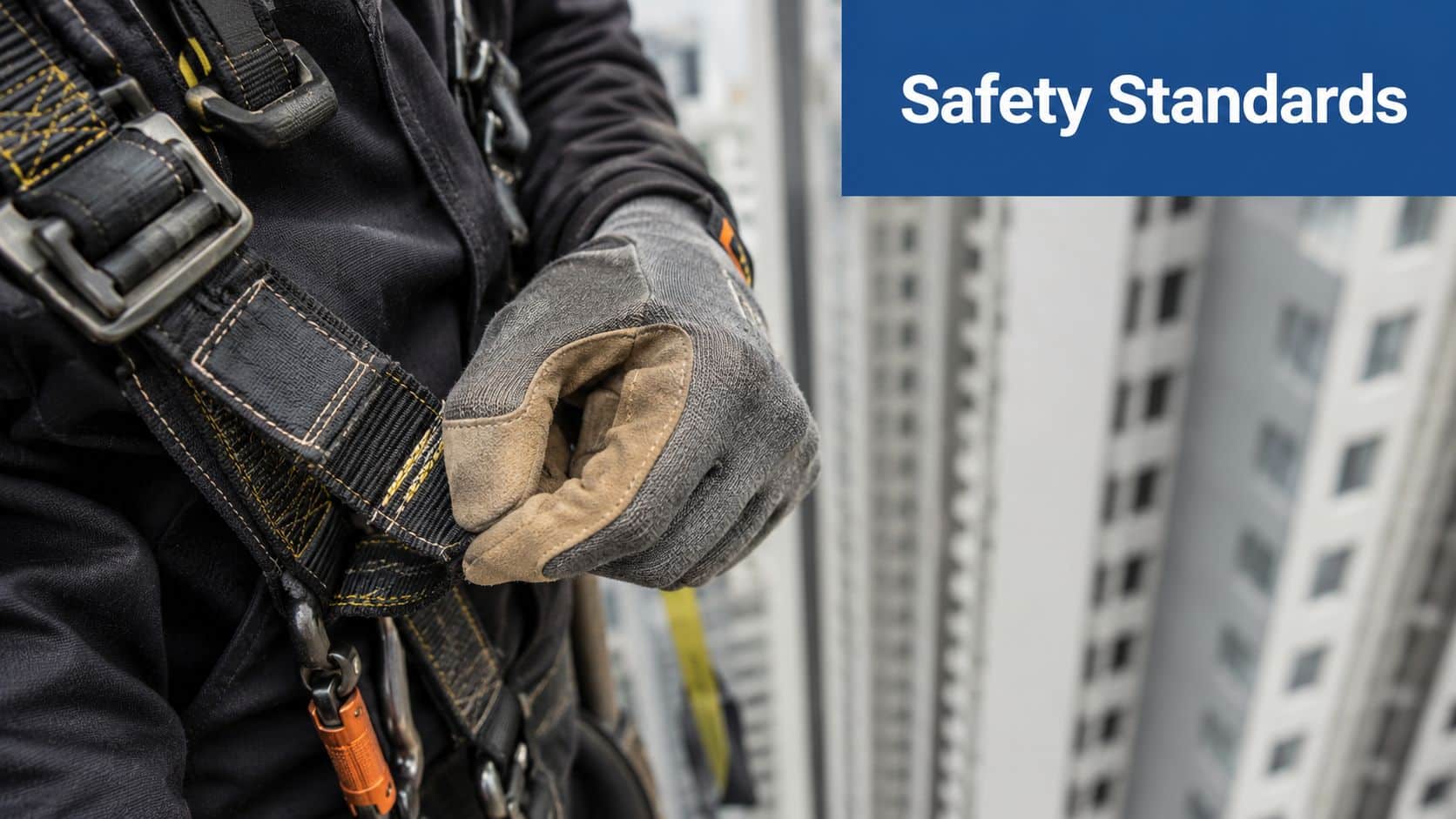
For a property manager, safety isn't a talking point. It's a vendor-screening issue, a liability issue, and a building operations issue. Rope access only works when the contractor treats safety as the system, not the sales pitch.
The anchor requirement property managers should know
One of the clearest benchmarks comes from OSHA. Rope access window cleaning requires anchor points to support at least 5,000 pounds per worker under OSHA 1910.27 regulations. These anchors must be identified, inspected, and certified by a qualified person every ten years to ensure structural integrity according to this OSHA anchor summary.
That single requirement tells you a lot. It means a contractor shouldn't be improvising anchor decisions on site. The roof system, anchor history, and certification status matter before anyone goes over the edge.
What certification means in practice
IRATA certification is one of the key competence markers in rope access work. In practical terms, it means technicians have trained in rope systems, movement, rescue awareness, and site discipline under a recognized standard. It's one of the reasons experienced property managers ask for proof of certification rather than accepting vague claims about years in business.
For building owners and managers, insurance matters too. A contractor's policy doesn't replace safe work, but it does show whether the company operates as a serious commercial vendor. If you're reviewing vendor risk documents, this overview of window cleaning insurance is a helpful starting point for what to request and verify.
The checks that should happen every time
A qualified rope access team doesn't jump straight to descent. They work through a repeatable pre-job process.
- Anchor verification: The crew confirms that the planned anchor points are correct for the specific drop and in current compliant condition.
- Equipment inspection: Ropes, descenders, harnesses, connectors, and edge protection are checked before use.
- Exclusion zone control: The area below active work is managed so people and vehicles stay clear.
- Rescue readiness: A specific rescue plan should exist for the work being performed, not as a generic document buried in a binder.
Safety in Phoenix has a local layer
Arizona climate adds pressure to every exterior system. Heat, UV exposure, and dust don't just affect glass. They affect the condition and lifespan of ropes, webbing, and protective components. That's why local experience matters. A crew that works in Phoenix has to understand how fast conditions can change on a roof and why inspection discipline can't be casual.
Ask a contractor to explain their rescue plan and anchor verification process in plain English. If the answer gets vague, keep looking.
What Determines the Cost of Rope Access Cleaning
The fastest way to get a bad quote is to ask for a price without defining the building. Rope access window cleaning is usually priced by the square foot, but the rate changes when rigging becomes more complex or the building introduces access constraints.
A published market range gives property managers a useful starting point. Rope access window cleaning costs average $0.75–$1.25 per square foot for high-rise properties, with pricing thresholds rising to $1.50+ for buildings over 150 feet due to increased rigging complexity and insurance requirements, as noted in this pricing reference for rope access window cleaning.
The variables that move a quote
A clean, accurate proposal usually depends on five factors.
- Height and rigging demands: Taller buildings can require more involved rope management, roof planning, and safety controls.
- Glass square footage: More glass usually means a clearer production estimate.
- Facade shape: Recessed sections, overhangs, balconies, and irregular elevations slow production and change access planning.
- Condition of the glass: First-time cleans, post-storm buildup, and hard-water spotting usually take more labor than routine maintenance.
- Service frequency: Buildings on a maintenance schedule are often easier to price than buildings cleaned only after visible buildup becomes severe.
Why paperwork affects price too
The labor on the glass is only part of the job. High-rise work also carries planning requirements, safety documentation, and insurance obligations. Property managers who want cleaner bid comparisons should ask how much of the quote reflects active cleaning time versus setup, access planning, and site control.
If your internal team reviews job planning documents, it helps to understand the difference between risk documents. This short guide on understanding JSA and SWMS gives useful context for how contractors may structure work planning and safety communication.
A low quote can mean one of two things. The contractor found a smarter way to do the work, or they left something out. On high-rise jobs, you need to know which one.
How to Hire a Reputable Rope Access Contractor in Phoenix
In high-rise cleaning, the cheapest quote can become the most expensive decision. Problems rarely show up in the proposal. They show up when the crew arrives without a clear plan, when the roof access conversation gets fuzzy, or when the contractor blurs the line between light cleaning and facade repair.
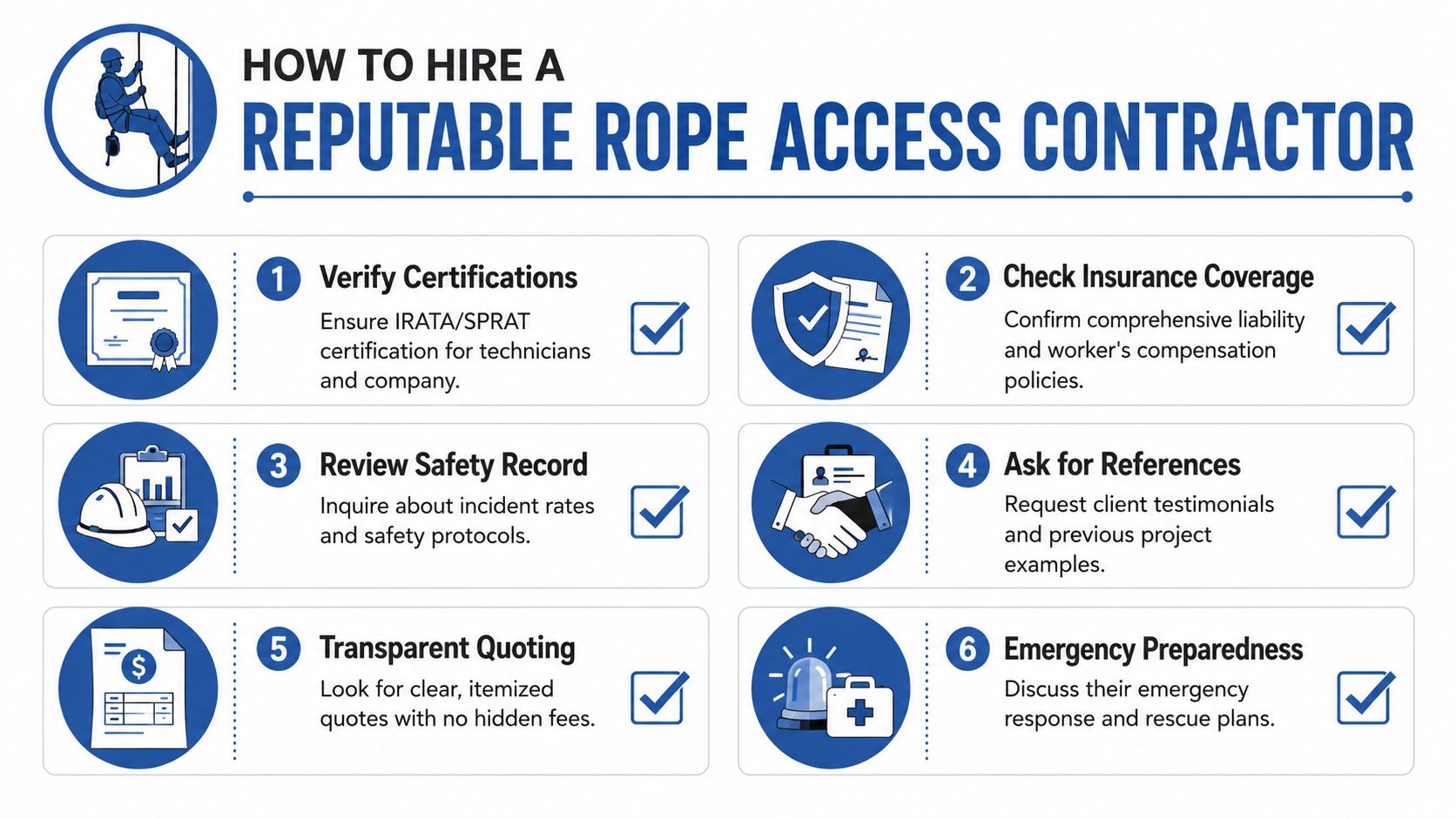
One screening point deserves special attention. Clients must enforce RAMS (Risk Assessments and Method Statements) and verify IRATA membership, not just "experience," to prevent catastrophic falls, as 75% of incidents occur when subcontractors are used instead of directly employed staff, based on the industry discussion cited here.
Questions worth asking before you sign
Start with documents, then move to specifics.
Who is performing the work?
Ask whether the crew members are direct employees or subcontractors. That matters because crew consistency affects training standards, accountability, and site control.Can you provide project-specific RAMS?
Generic paperwork isn't enough. The method statement should match your roof layout, pedestrian conditions, access points, and building use.Is the scope strictly cleaning, or are you proposing maintenance tasks too?
Rope access cleaning and rope access restoration aren't the same service. Cleaning crews work with lightweight tools. Heavy repair, masonry work, or major sealant replacement may require a different contractor and setup.How do you protect tenants and pedestrians?
Listen for details about exclusion zones, communication, scheduling, and tool security.
The Phoenix-specific filters
A contractor can be competent in general and still be the wrong fit for Phoenix.
- Local climate awareness: They should talk comfortably about UV exposure, dust accumulation, and how weather affects equipment inspection and scheduling.
- Commercial coordination: They should understand loading windows, tenant access, parking constraints, and front-entry visibility.
- Roof access discipline: They should be prepared to review anchor conditions, roof edge protection, and building rules before the start date.
For managers comparing service partners, South Mountain Window Cleaning offers commercial window cleaning service for commercial properties that need recurring scheduling, documentation, and site coordination.
What strong answers sound like
Strong contractors are specific. They'll explain their crew structure, insurance, access plan, and emergency planning without dodging. Weak contractors stay broad and lean on phrases like “we've done this a long time.”
Hire the company that answers hard questions clearly, not the one that gets uncomfortable when you ask them.
Frequently Asked Questions for Property Managers
Does Phoenix heat shorten the life of ropes and safety gear
Yes, climate exposure matters. ANSI/IWA 14.1 requires that all anchors and ropes be inspected before each use and replaced every 1–2 years depending on exposure to UV and chemical pollutants, a protocol critical for high-rise facilities in sun-intense climates like Arizona, according to this reference on anchor and rope inspection requirements. In Phoenix, that means inspection discipline isn't optional. UV, heat, and airborne contaminants can change how equipment ages.
How do crews protect people below during cleaning
A competent crew controls the drop zone under active work and secures tools so nothing can fall freely. On busy sites, that also means coordinating with building staff about entrances, valet lanes, and delivery periods. Good planning keeps the job contained instead of letting it interfere with daily operations.
Can rope access handle unusual building shapes
Usually, yes. It's often the most adaptable method for setbacks, recessed glass, architectural fins, and other hard-to-reach sections that don't work well with lifts. The exact answer still depends on the roof, anchor strategy, and facade layout, but this method is especially useful where a building's shape defeats bulkier equipment.
What kind of insurance should a property manager verify
You should review general liability and workers' compensation details and make sure the contractor's coverage aligns with high-rise work. If your internal team wants a simple outside reference, this overview of window cleaner general liability is a useful primer before you request certificates and endorsements from a vendor.
Is rope access a fit for only downtown towers
No. It can also fit mid-rise office buildings, condominiums, hotels, and mixed-use properties across Scottsdale, Tempe, Chandler, Gilbert, and Paradise Valley, especially where access is tight and exterior presentation matters.
If you manage a commercial or high-rise property in the Valley and need a practical plan for safe exterior glass cleaning, South Mountain Window Cleaning, LLC can review your building's access conditions, cleaning scope, and scheduling needs, then provide a quote based on the actual facade, roof setup, and site constraints.