

You're looking at competing window-cleaning bids for the same building. One contractor charges by the pane, another quotes a flat visit price, and neither makes it clear whether interior glass, lift rental, or hard-water removal is included. The cheaper number isn't useful until you know what the crew will do.
The practical answer to how to price commercial window cleaning is to estimate labor hours first, calculate the full operating cost, and show access and risk separately. Then present a per-pane or per-visit price the property manager can budget against. That gives contractors a defensible quote and owners a way to compare bids on the same scope sheet.
Which Pricing Model Fits Your Building
A storefront with uniform, reachable panes is easy to count. A multi-floor building with mixed access and irregular glass is not. Match the pricing model to how predictable the work is, then show labor hours and access or risk charges as separate lines so competing bids can be compared on the same scope.
Pricing models compared for commercial window cleaning
| Model | Basis | Best fit | Main risk |
|---|---|---|---|
| Per pane, both sides | Panes multiplied by rate per pane | Accessible storefronts with clearly defined glass | Height, screens, and interior access can add time |
| Per elevation sq ft | Glass area per facade multiplied by rate | Repetitive facades with similar-sized panes | Small, numerous panes take more detailing than the area suggests |
| Per hour | Crew hours multiplied by hourly rate | First-time restoration when soil or condition is uncertain | The client cannot budget an open-ended figure |
| Per visit, flat | Estimated labor hours converted to one price | Routine maintenance on a known building | The price depends on the assumed service frequency |
| Recurring contract | Per-visit price with a frequency discount | Scheduled storefronts and multi-site portfolios | Catch-up restoration may be excluded or overlooked |
For a clear, accessible storefront, per-pane pricing is straightforward to audit. On repetitive elevations, square-foot pricing can work, provided the estimate allows for detailing each small pane. A large glass area does not always mean less labor.
Use a flat visit price for routine work once the building, scope, and service schedule are established. For a first-time restoration with uncertain soil or glass condition, hourly billing can protect the contractor from unplanned labor. Set an authorization limit and a stop-and-review point, so the customer is not exposed to an unrestricted clock.
Match the model to service predictability
A recurring schedule can reduce estimating, sales, travel, and setup costs per visit. Offer a lower visit price only when the schedule actually creates those savings. A contract for isolated appointments does not make each visit more efficient.
Set the maintenance price only after agreeing on how often commercial windows should be cleaned. If frequency or scope changes, revisit the visit price rather than absorbing extra work into the original estimate.
Pricing rule: Build the quote from labor hours. Show access and risk separately, then present the customer-facing price per pane or per visit. State the frequency and included surfaces on the same scope sheet.
How to Turn Panes Into Labor Hours
A storefront with clear glass can still take longer than expected when interior access is restricted or the crew must wait for shared equipment. Build the estimate from the work on each elevation, then show access and risk as a separate line so customers can compare bids on the same scope.
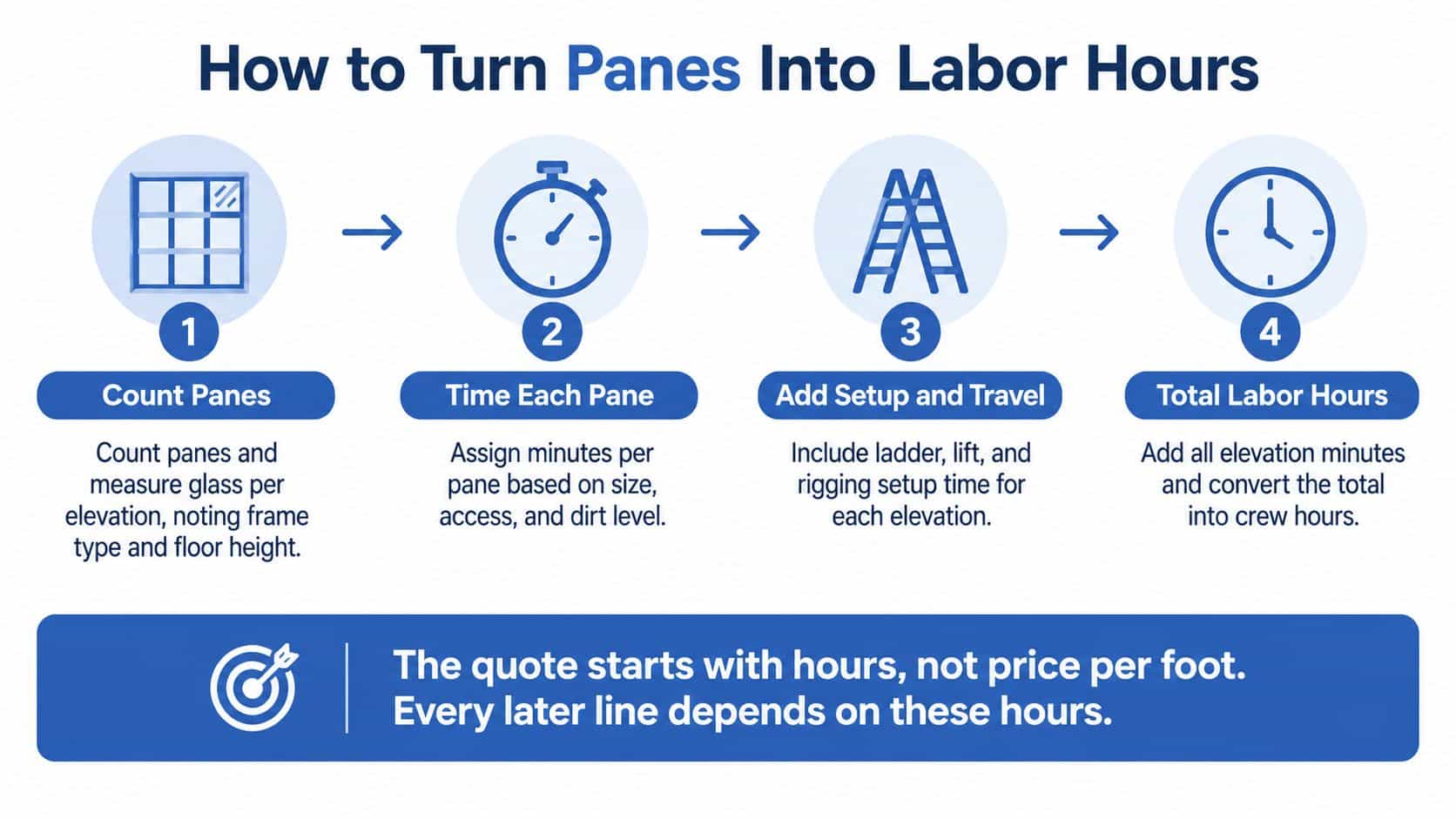
Build the production estimate
Count panes and measure each elevation. Record the interior and exterior faces separately, plus frame type and floor location. Make an inventory rather than relying on “all windows,” particularly when tenants control interior access.
Sort by access method. Group ground-level glass, water-fed-pole work, and areas requiring a lift or rope access. The easiest elevation should not set the pace for the hardest one.
Set a planning time for each pane. For a first estimate, use 10 minutes per accessible pane for cleaning both sides, as a planning assumption, not a sourced production standard or guarantee. It applies only to panes of a similar size and ordinary soil, with straightforward access and no screen or track work. Larger panes, heavier buildup, or slower access require a separate allowance. A facility-management calculator citing ISSA production ranges may offer context, but it does not establish this per-pane assumption. Keep the assumption visible on the worksheet and revise it using your own completed jobs.
Time screens, tracks, and sun screens separately. Removal, washing, drying, and reinstallation take labor beyond glass cleaning. Residential-style frames may roughly double the time when these tasks are included. Treat that as a cautious estimate to verify on site, not a universal multiplier.
Assess soil before assigning maintenance time. Hard-water film, construction dust, and neglected frames need a separate allowance or restoration estimate. Clear-looking glass can still have buildup that ordinary dust removal will not resolve.
Add setup, teardown, and movement. Allow for unloading, interior protection, moving between floors, and packing equipment. Keep this allowance provisional and compare it with your first three completed jobs instead of burying it in pane time.
Convert the work into labor-hours. Add person-minutes and divide by minutes per hour. If estimating elapsed crew time, multiply by crew size instead. Check that the work fits the route, including travel and building access windows.
Check the bottleneck, not just the headcount
A per-pane assumption can miss the delay caused by uninspected screens or restricted work positions. More technicians do not automatically shorten the job in proportion to crew size.
When workers share a ladder, pole, or limited work area, they may have to wait rather than clean separate panes. Assign tasks by elevation and equipment before assuming every person can work continuously.
Labor-hours measure paid effort. Elapsed hours measure how long the building occupies the crew's schedule. Track both.
Keep the labor estimate and the access-and-risk allowance distinct. Confirm equipment availability and high-access requirements before treating the quote as final.
Costs to Add on Top of Labor
The hourly wage is a floor, not a selling price. Employee pay doesn't cover employer taxes, insurance, travel, equipment, supervision, estimating, or the hours nobody can invoice.
Start with payroll records. Apply your actual employment burden to direct wages, then allocate operating expenses using realistic billable labor-hours rather than every hour employees are paid.
Cost lines to add on top of labor hours
| Cost line | What it covers | How to allocate it |
|---|---|---|
| Payroll taxes and workers' compensation | Employer taxes, comp premiums, and benefits | Apply your actual burden percentage to direct wages |
| General liability and commercial auto | Property damage on site and crew driving between sites | Divide annual premium by billable labor-hours |
| Janitorial or fidelity bond | Employee theft, often requested by contract | Spread across contracts or quote separately when required |
| Travel | Drive time, parking, and fuel between sites | Charge drive time at a loaded rate or use a visit zone fee |
| Equipment and water purification | Pure-water rig, poles, ladders, and lift rental | Allocate owned equipment across annual visits; rent lifts per job |
| Supervision and administration | Estimating, scheduling, invoicing, and site checks | Apply a documented overhead percentage to labor cost |
| Contingency and profit | Weather delays, reschedules, and margin target | Set margin by contract type; hold contingency separately |
Payroll burden belongs against wages. Liability and auto premiums need their own allocation unless they're already included elsewhere. Equipment ownership also costs money when the rig is paid off, because maintenance and replacement still need funding.
For a hypothetical allocation, assume annual liability and commercial auto premiums total $6,000, with 1,200 billable labor-hours. Dividing those assumed inputs produces an insurance allocation of $5 per labor-hour. These aren't market premiums or a recommended utilization target.
Verify contract requirements before committing
An Arizona cleaning-business insurance overview identifies general liability, workers' compensation for employers, commercial auto, and janitorial bonds as relevant coverages. Verify workers' compensation obligations when regularly hiring employees, including part-time workers, rather than assuming casual scheduling removes the requirement.
Ask the customer about certificates of insurance, additional-insured status, and bonding requirements before finalizing the price. Obtain any incremental cost from the insurance provider instead of taking it out of the expected profit.
If the customer also needs commercial high dusting, estimate its labor and equipment separately before considering shared mobilization savings.
Keep contingency visible and name the uncertainty it covers. A discount shouldn't quietly remove the money reserved for that uncertainty.
Arizona and High-Rise Conditions That Change the Price
Heat can change the usable workday before it changes the pane count. For Arizona properties, check whether exposed elevations require early-morning work or a cooler-season schedule, then confirm that tenant access and delivery traffic permit it.
Inspect desert dust and mineral film separately. Treat monsoon rescheduling as a defined weather contingency rather than inflating every pane's cleaning time.
Work at height requires a different access plan, as the platform image illustrates.
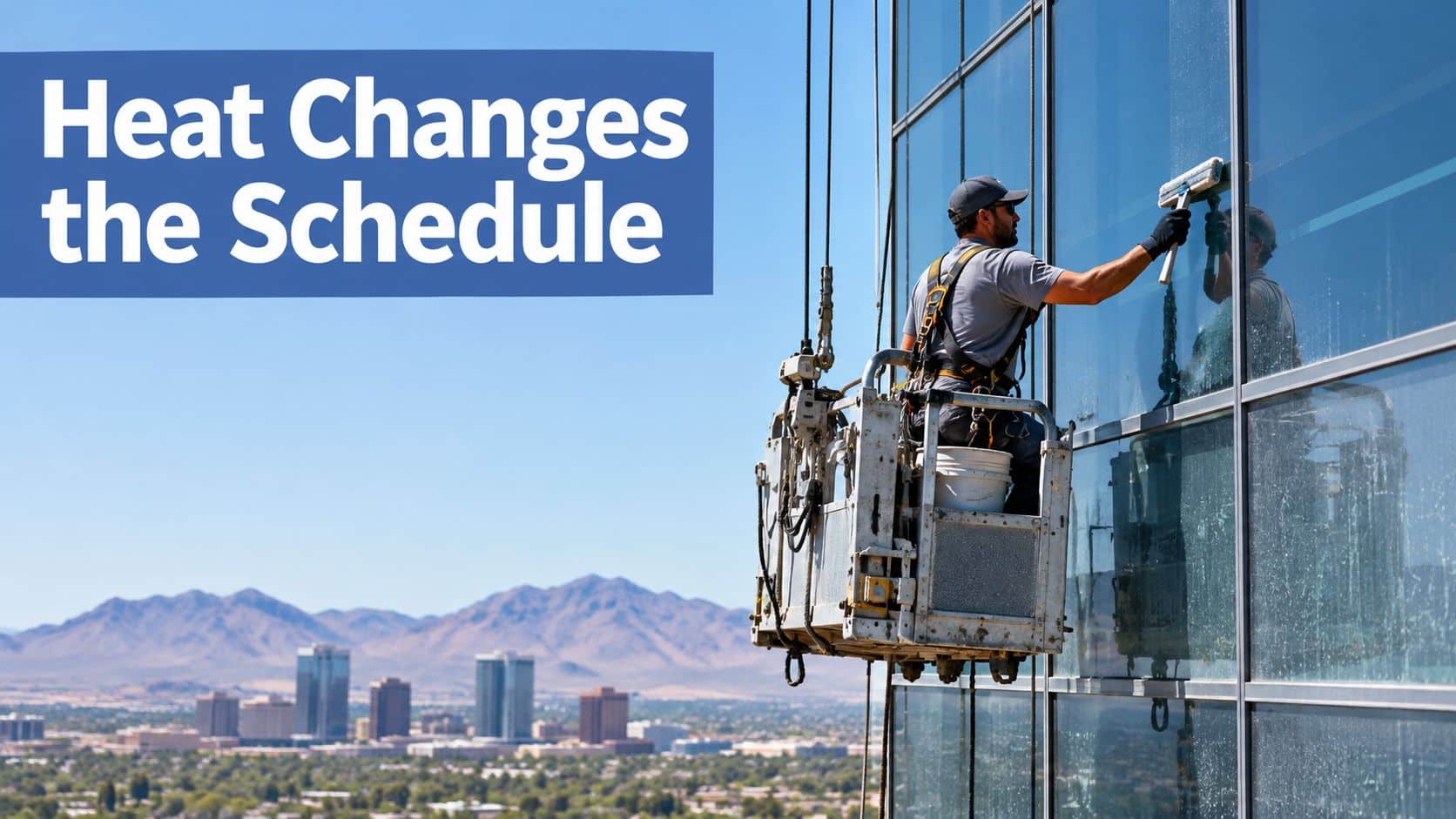
Price the required access system
Under OSHA's powered-platform requirements, employees on platforms must use compliant personal fall-arrest systems. Where intermittent stabilization is used, building-anchor intervals cannot exceed three floors or 50 feet, whichever is less.
- Emergency planning: Employers need a written plan addressing power failures, equipment failures, and other emergencies.
- Operator preparation: Competent personnel must train operators to recognize hazards, use fall-arrest systems, and inspect and operate equipment safely.
- Cost allocation: Equipment, inspections, stabilization, trained labor, emergency planning, and safety administration belong in the raised-work estimate.
Those obligations don't fit inside an ordinary storefront rate. Put them on the access-and-risk line, and evaluate high-rise window-cleaning cost against the building's actual access system before promising a price.
Worked Quotes for Three Commercial Buildings
Three bids can use the same pane count and still produce very different totals once labor and access are separated. These are illustrative calculations, not Arizona price benchmarks. Each quote starts with labor hours, then shows access and risk separately so buyers can compare the same scope line by line.
Assume loaded labor is 1.4 times direct wages, and calculate the selling price as total cost divided by 0.6, targeting a 40% gross margin. The wage input is $17.71 per hour, the national median listed in the BLS occupational profile for janitors and building cleaners. It represents employee wages, not an invoice rate for window cleaning or the hiring cost of a specialized high-rise technician.
Sample quote build-up for three commercial buildings
The examples use 10 minutes per pane, the accessible-pane planning midpoint established above. For a high-rise, this is only an arithmetic assumption. A real bid needs production time based on the work method and site conditions.
| Building | Labor hours | Loaded labor | Access and risk | Travel and equipment | Quote at 40% margin |
|---|---|---|---|---|---|
| Strip-mall storefront, 12 panes | 2 | $49.59 | No separate elevated-access allowance assumed | $30 | $133 |
| Four-story office, 60 panes | 10 | $247.94 | $250 rented lift | $45 | $905 |
| 22-floor high-rise, 180 panes | 30 | $743.82 | $2,500 illustrative allowance | $150 | $5,656 |
Storefront. At the assumed pane time, the job takes 2 person-hours for one technician. Direct wages are $35.42, and loaded labor is $49.59. With $30 for travel and equipment, total cost is $79.59. The rounded quote is $133, or about $11 per pane.
Office. The calculation gives 10 person-hours, or 5 elapsed hours for a two-person crew if tasks can run concurrently. Direct wages are $177.10. Loaded labor, the lift rental, and travel and equipment bring total cost to $542.94. The rounded quote is $905, about $15 per pane.
High-rise. The estimate comes to 30 person-hours, equivalent to 10 elapsed hours for a three-person crew if the work plan allows it. Direct wages are $531.30. After loaded labor, the separate access-and-risk allowance, and travel and equipment, total cost is $3,393.82. The rounded quote is $5,656, about $31 per pane.
Read the assumptions before using the totals
The high-rise access allowance is hypothetical. It covers rope or platform work, qualified operators, inspections, emergency planning, and an insurance surcharge. Replace it with actual access-provider and insurance costs. Check that supervision, administration, and contingency are funded before submitting the bid.
The comparison graphic uses a separate illustrative dataset, not the building estimates in the table.
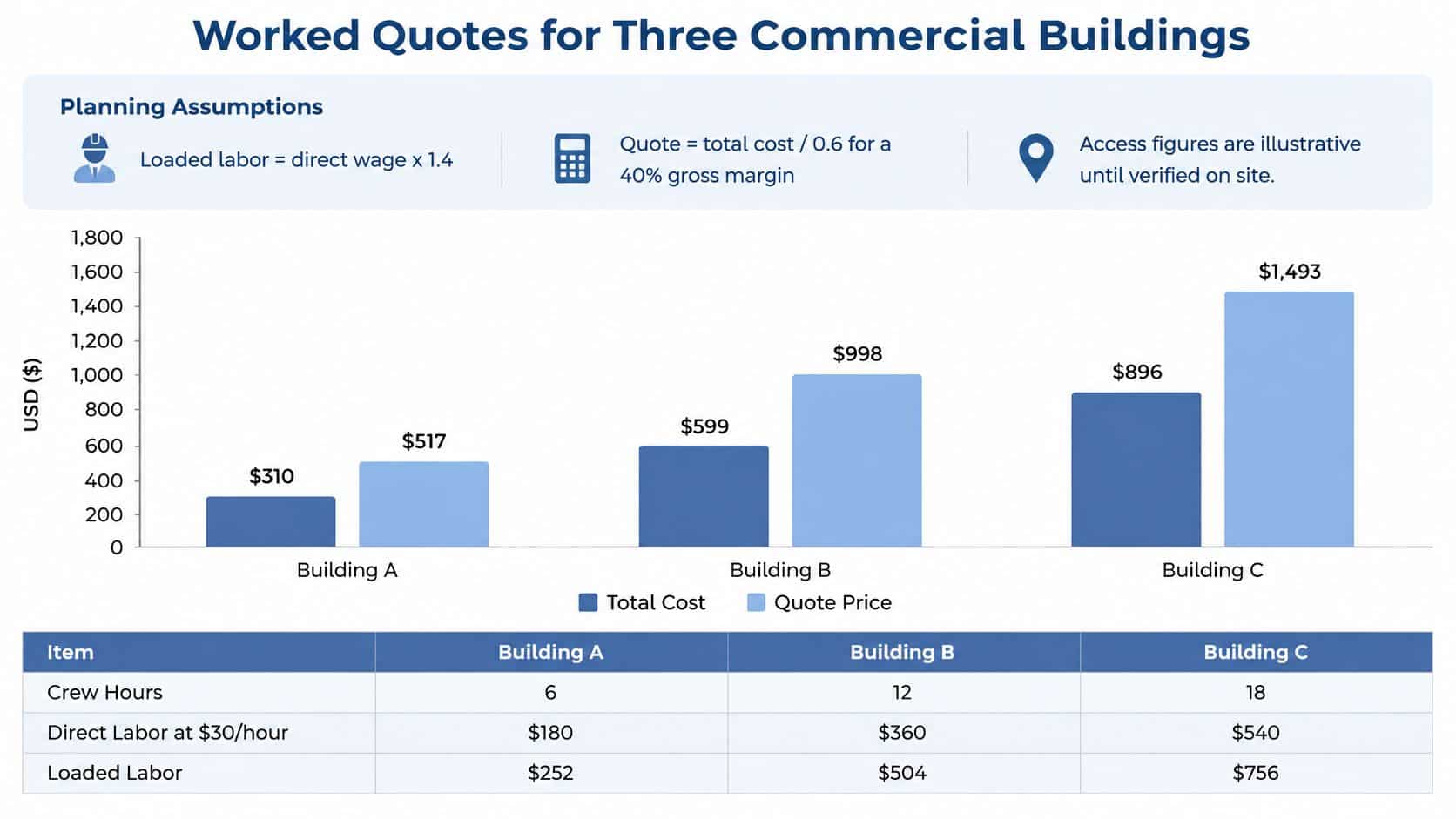
The per-pane price roughly triples between the storefront and the tower. Applying the storefront rate to the high-rise would leave the assumed costs unrecovered, even before replacing simplified inputs with verified site costs.
How to Lay Out a Proposal That Gets Approved
The first page should answer the manager's purchasing questions: What does each visit cost, what does the annual schedule cost, and what's included? Don't make the buyer reconstruct the budget from equipment charges and unit rates.
A hypothetical summary could read: Monthly interior and exterior storefront glass, 48 panes, $620 per visit, $7,440 per year. Put the corresponding per-pane figure beside it, while stating that additions remain subject to equivalent access and glass condition.
Use the guide below as a layout reference; its sample prices are separate hypothetical figures.
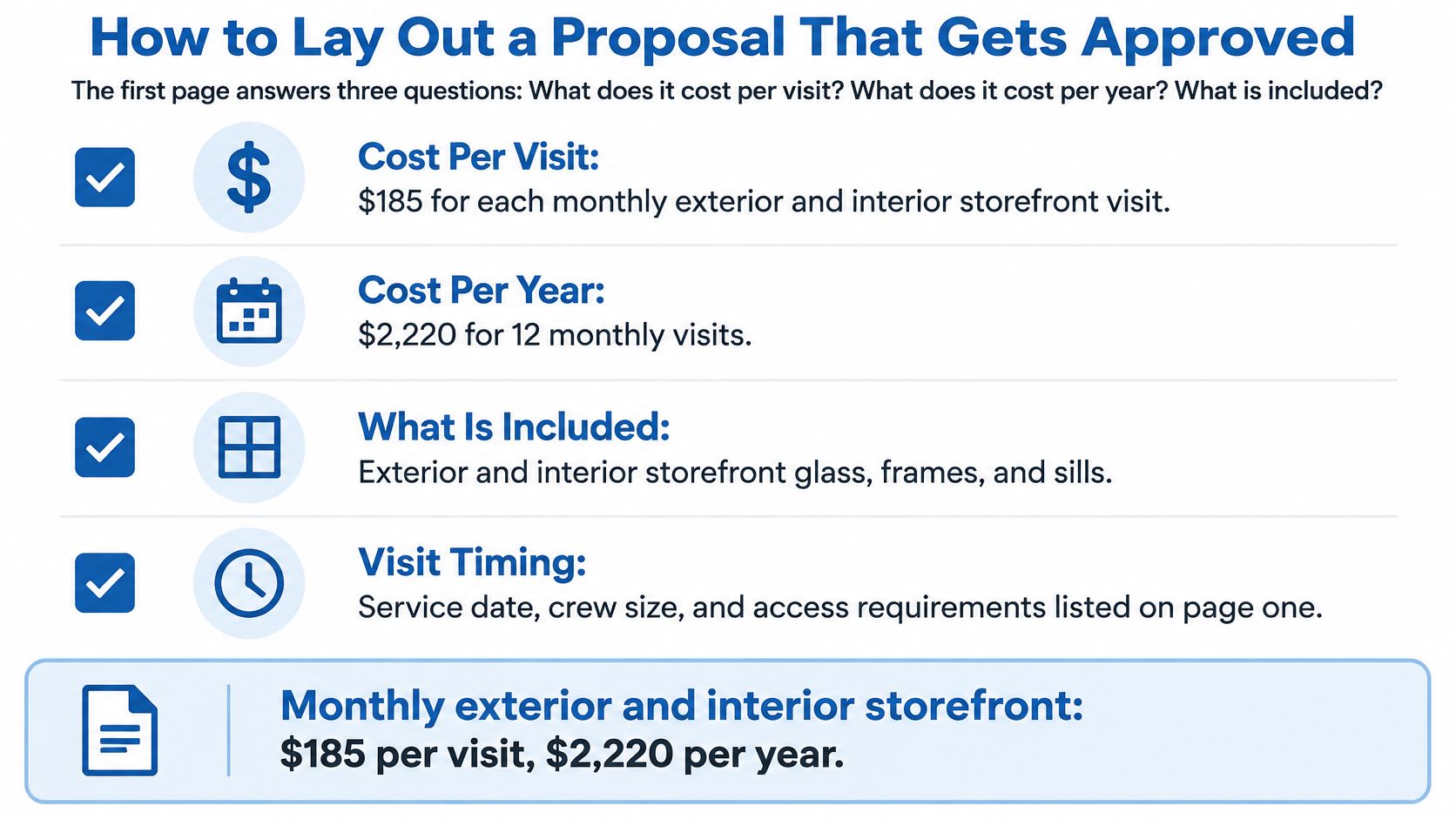
Put the purchasing information in reading order
- Scope and schedule: Name the service frequency and every included surface, including whether frames and sills receive attention.
- Pane or elevation schedule: Identify locations so the manager can reconcile the count with the building.
- Access assumptions: State ground-level, pole, lift, or rope access and any customer-provided arrangements.
- Exclusions: Address screens, tracks, furniture moves, mineral removal, and restoration unless specifically included.
- Minimum charge: Explain the minimum visit charge and when it applies.
- Change-order triggers: Identify added panes, blocked access, unexpected deposits, and changed operating hours.
- Validity and payment: Set an explicit acceptance deadline and payment terms. A proposed 30-day validity period is a contract choice, not a universal requirement.
Keep the access-and-risk fee visible. If the customer questions it, explain the required work rather than rolling it into another line to make it disappear.
Separate first-time restoration from recurring maintenance. Otherwise, the customer may mistake a catch-up cleaning cost for the ongoing service price, or expect restoration at a maintenance rate.
For an additional visual reference, the following video can be viewed alongside the written scope.
Before acceptance, ask the manager to confirm the pane schedule and access assumptions. A signed total is less useful than a signed scope both parties understand.
Contract Clauses That Protect Price and Safety
A low bid can leave the property manager exposed to injury claims, property damage, or a disrupted workday. Compare bids against the same scope sheet, with labor hours and the access-and-risk line shown separately. A lower total is meaningful only if the contractor has priced the same work and protections.
Unger's discussion of OSHA's frequently cited violations highlights fall protection as a recurring safety concern. For work at height, put the required access controls and responsibilities in writing instead of treating them as optional extras.
Make the accepted assumptions enforceable
The proposal sets the price and scope. The contract should explain how the parties will handle changes in site conditions, access, and customer requirements.
- Insurance documentation: State the required coverage limits, certificates, and any additional-insured terms. Review window-cleaning insurance considerations before comparing bids with different coverage.
- After-hours access: Assign responsibility for badges, keys, security escorts, tenant notices, and delays if authorized access is unavailable.
- Scope boundaries: Distinguish routine cleaning from construction, repair, alteration, or improvement work. If the work may cross into regulated contracting, verify applicable requirements with the Arizona Registrar of Contractors.
- Local authorization: Arizona does not issue a general statewide janitorial license, but local requirements may apply. Check with each relevant city or county; an authorization in one area may not cover every service location.
- Weather rescheduling: Specify who approves a postponement, how the replacement date is set, and whether remobilization changes the price.
- Annual escalation: Set out how renewal pricing will be reviewed and communicated, so future adjustments are not left open-ended.
Negotiate scope rather than removing protections
If the customer needs a lower price, adjust the frequency, pane count, or service area. Keep required access controls and any allowance for a stated uncertainty in the quote. Removing those items while keeping the same scope shifts the cost and risk to the crew.
A price concession should come with a written scope change, not an expectation that the crew will work faster.
Compare proposals line by line: labor hours, base cleaning price, access-and-risk charge, exclusions, and stated insurance limits. This makes it easier to see whether a cheaper bid reflects a genuine efficiency or an omitted part of the work. If work classification is uncertain, confirm it before signing rather than relying on an assumption about licensing.
Pre-Send Checklist
Run these checks before releasing the proposal. The send decision comes after the site information is confirmed, not before.
- Count off site, then verify. Request drawings, prepare a pane schedule, and reconcile it during the property walk.
- Document existing conditions. Photograph frames, sills, and the roofline; identify mineral film, heavy soil, and existing damage.
- Confirm access for work at height. Ask whether building anchors exist and obtain the relevant access documentation. Don't assume visible hardware is suitable or ready for use.
- Test the operating plan. Run the estimate against a comparable storefront or office assignment and check that the labor-hours fit a realistic daily route.
- Check jurisdiction and scope. Verify applicable requirements in Phoenix, Scottsdale, Paradise Valley, Chandler, Tempe, and Gilbert, Arizona, including any contractor-licensing boundary.
- Complete the site walk before sending. Resolve unanswered access and condition questions, replace provisional equipment allowances, and confirm that the scope sheet matches the final price.
South Mountain Window Cleaning, LLC offers residential, commercial, and high-rise window washing in Phoenix, Scottsdale, Paradise Valley, Chandler, Tempe, and Gilbert, Arizona. Visit South Mountain Window Cleaning, LLC to request a site-specific estimate and discuss the pane count, service frequency, included surfaces, and access requirements that determine your building's price.