
A routine cleaning crew can leave an office looking spotless while dust remains on the ductwork above the ceiling grid. In a warehouse, cobwebs may stretch across a 30-foot roof deck, lint can collect on beams, and a layer of residue may sit on light fixtures without anyone seeing it from the floor. The problem usually becomes obvious only after dust falls onto inventory, employees report stale air, or a facility inspection reveals neglected overhead surfaces.
Commercial high dusting addresses those hidden areas. It's a planned maintenance service for upper surfaces that normal janitorial tools can't safely reach, and the right method can support cleaner air, better housekeeping, and combustible-dust control. This guide explains what the work includes, why it differs from routine cleaning, how crews reach high surfaces, how to plan service intervals, and what to verify before hiring a provider.
What Commercial High Dusting Is and Why Building Owners Care
Commercial high dusting means removing dust, debris, cobwebs, lint, and other accumulated material from surfaces above normal reach. The scope may include ductwork, beams, pipe runs, sprinkler heads, light fixtures, conduit, ceiling tiles, exposed joists, signage, and ceiling-mounted equipment. Major facility guidance treats this as a distinct task because overhead surfaces often require extension poles, ladders, lifts, or other access equipment, as explained in this commercial building maintenance checklist.
The service is best understood as preventive maintenance, not an occasional cosmetic touch-up. Routine cleaners can wipe desks, counters, floors, and other hand-reachable surfaces, but they usually aren't equipped or scheduled to inspect the structure above them. Dust keeps settling on overhead surfaces until air movement, vibration, maintenance work, or a cleaning operation sends it back into the occupied space.
What the crew actually cleans
A professional scope should identify surfaces rather than merely promise “high dusting.” For example, a warehouse proposal might include roof beams, light housings, sprinkler lines, ductwork, cable trays, and the tops of storage structures. An office or retail proposal may focus on ceiling diffusers, exposed ductwork, atrium ledges, skylight frames, and decorative features.
The dust load also varies by facility. Offices may need high dusting quarterly, while manufacturing sites can require monthly service in dust-heavy areas such as machining, woodworking, or metal fabrication, according to commercial high-dusting facility guidance.
Why owners should put it on the calendar
Overhead dust can move toward HVAC returns and diffusers, settle on merchandise or equipment, and become airborne when fans, doors, or maintenance activity disturb it. That makes the work relevant to indoor-air quality, fire-risk reduction, equipment protection, and building appearance.
A property manager who schedules high dusting can also coordinate it with filter changes, sprinkler inspections, construction cleanup, and floor care. The practical sequence is simple: inspect high surfaces, choose a capture method, clean from high to low, then complete floor and touchpoint cleaning after overhead work is finished.
Why Overhead Dusting Is a Different Job Than Routine Cleaning
Overhead dust behaves like sediment in a river. Each day adds another small amount, and the buildup may remain unnoticed until airflow or vibration moves it downstream. Nightly cleaning that stops at desks and floors is like wiping a kitchen counter while ignoring grease collecting inside the range hood. The visible surfaces look cared for, but the hidden source remains.
Routine dusting generally stops at hand-reachable areas. Commercial high dusting begins where ordinary tools and body position no longer provide safe, controlled access. Facility guidance commonly separates overhead surfaces above six feet from routine dusting, and work around 10 feet or higher often becomes a specialized task requiring access planning. See the guidance on cleaning after construction for a related example of why high-level residue needs a defined scope rather than an improvised wipe-down.
The air-quality question
The important question isn't only whether overhead surfaces look dirty. It's whether the cleaning method captures particles or redistributes them. Health Canada recommends damp wiping, lint-free cloths, or wet methods for routine building cleaning because dry methods can generate more airborne dust. The Health Canada guidance on improving indoor air quality in office buildings supports choosing methods that prevent dust buildup while minimizing resuspension.
That distinction matters in offices, retail buildings, healthcare environments, and production spaces. A dry brush or compressed-air blow-down may make a beam look clean while sending the removed material into the air and onto lower surfaces. A HEPA vacuum, damp microfiber tool, or carefully controlled capture system gives the crew a better chance of removing the material instead of merely relocating it.
A useful comparison is exterior building care. Managers evaluating the broader relationship between façade condition, access, and maintenance can also consult this exterior cleaning guide from Ventura County Roof Cleaners. The same principle applies indoors: the visible finish is only one part of a responsible maintenance program.
The Safety and Compliance Stakes of Skipping Overhead Dusting
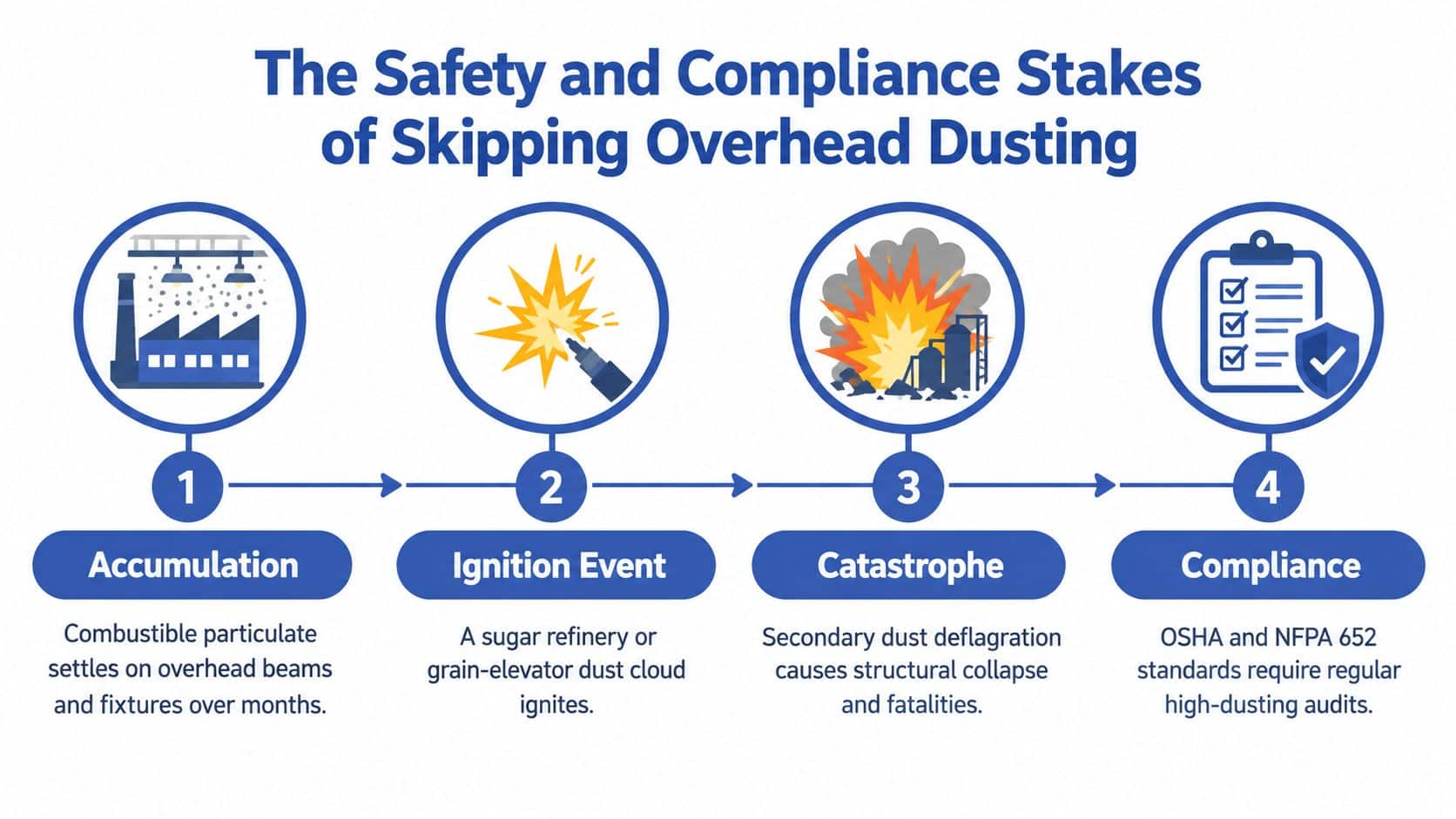
A sugar refinery, grain facility, woodworking plant, or metalworking operation can have combustible material in the air and on overhead surfaces. If accumulated dust becomes suspended and encounters an ignition source, the event can become far more serious than an ordinary housekeeping incident. OSHA reported that wood and food products accounted for an average of 70% of materials involved in combustible-dust fires and explosions in 2018, in a 2023 release about combustible-dust hazards (OSHA's combustible-dust safety release).
The historical record explains why facility managers treat overhead dust as a safety issue. A U.S. Chemical Safety and Hazard Investigation Board study identified nearly 280 dust fires and explosions in industrial facilities over 25 years, resulting in 119 fatalities and more than 700 injuries, as summarized in the same OSHA release. Those figures don't mean every dusty building faces the same hazard, but they do show why overhead housekeeping deserves more attention in facilities that handle combustible materials.
Housekeeping becomes risk control
Industry guidance often uses a 1/32-inch dust layer as a housekeeping benchmark for limiting combustible-dust risk, as noted in the OSHA material above. A facility should not treat that benchmark as permission to wait until dust reaches a visible thickness. The appropriate threshold depends on the material, process, ventilation, surface, and safety program.
OSHA emphasizes housekeeping controls for combustible dust. In practice, that means facility teams should document the areas inspected, the dust condition found, the method used, and the date of service. A written record helps the manager demonstrate that overhead areas are part of the facility's maintenance program rather than an overlooked gap.
The same caution applies to worker protection. OSHA and International Window Cleaning Association aligned guidance states that exterior window cleaning should stop when workers face excessive winds, and that fall protection, perimeter guarding, or personal fall arrest or restraint systems must be provided where a fall hazard exists (commercial window-cleaning safety guidance). High dusting crews should bring the same disciplined approach to interior work at height.
Equipment and Methods Used to Reach High Surfaces
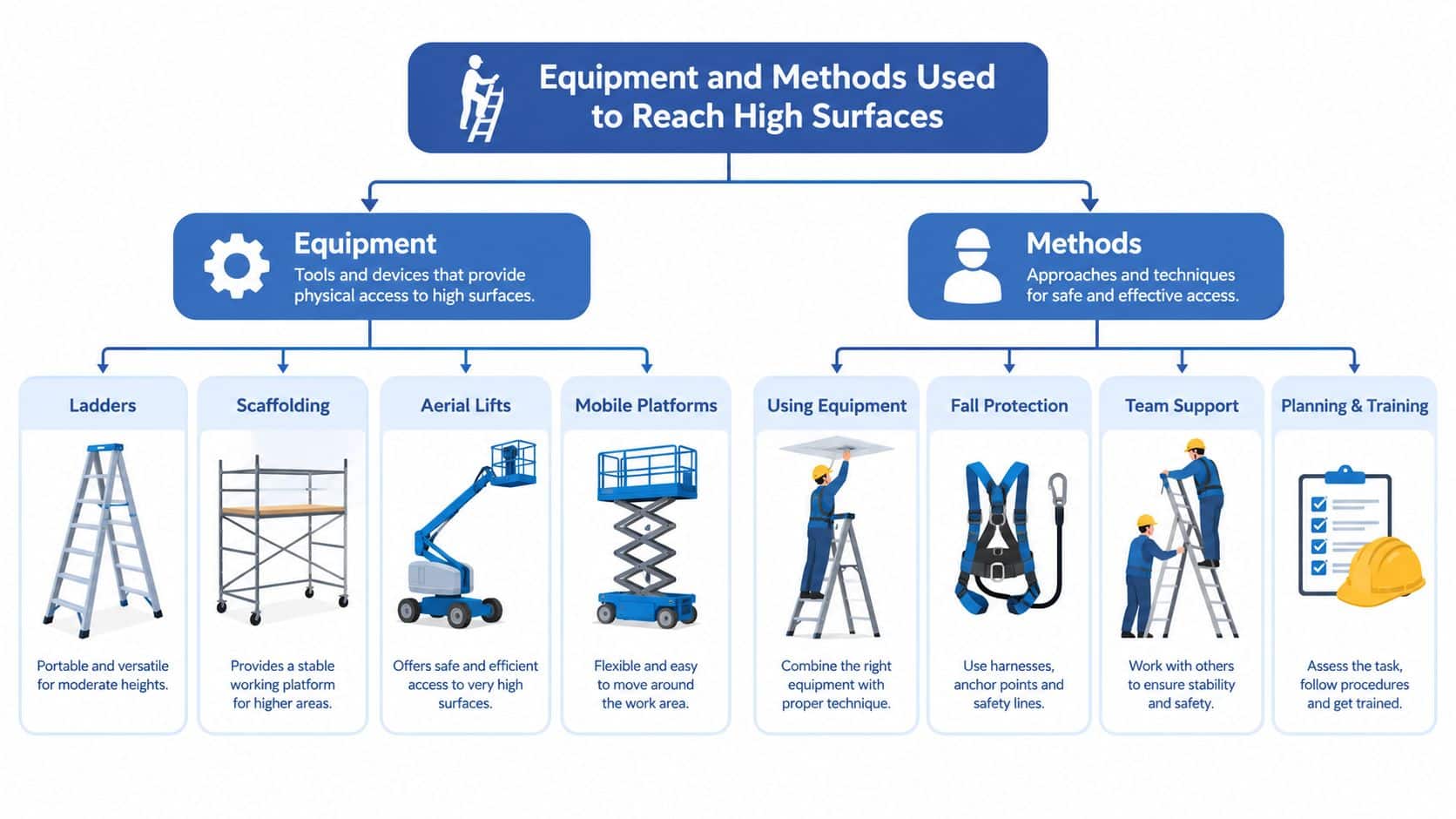
A qualified crew chooses equipment based on height, floor conditions, obstructions, surface type, and the amount of dust present. The safest approach isn't always the most elaborate one. A telescoping pole may be ideal in one part of a building, while a lift or rope-access system may be necessary only a few aisles away.
Start with floor-based tools
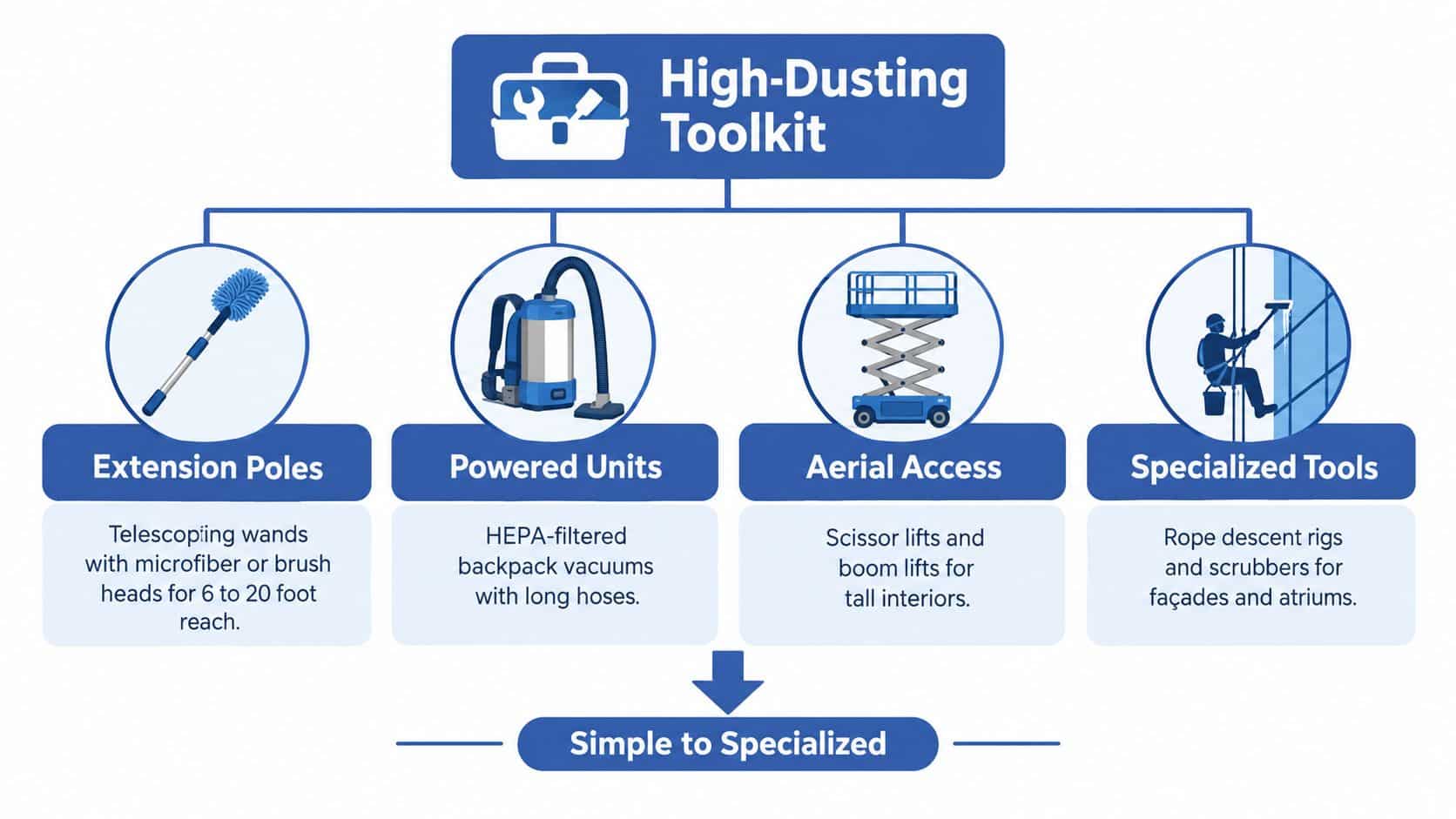
Telescoping extension poles fitted with microfiber, lambswool, or specialty brush heads can handle many accessible ceilings and ledges. These tools work well where the floor is clear, the ceiling is relatively flat, and the operator can maintain control without leaning or overreaching.
The head matters. Microfiber can hold dust against the material, while a damp method can reduce resuspension. Natural or synthetic dusters need regular cleaning. An overloaded duster can begin spreading material instead of collecting it.
Move to lifts when the building requires them
A scissor lift suits a warehouse or big-box retail floor with a firm, level surface and enough clearance for the platform. An articulating boom lift becomes more useful when the crew must work around racking, machinery, mezzanines, or other obstructions.
Ladders aren't a substitute for a proper access plan. OSHA's window-cleaning guidance restricts grade-supported ladders when the window top is more than 45 feet above grade, and any high-level task involving a fall hazard requires appropriate protection. The crew should assess the work position rather than only asking whether a ladder can physically reach the surface.
Reserve rope access for difficult geometry
Rope access can serve atriums, tall lobbies, skylight structures, and architectural features where a lift can't be positioned beneath the target. It requires a written plan, suitable anchors, rescue procedures, trained technicians, and protection for people below.
High-rise access planning also overlaps with commercial window cleaning. The high-rise window cleaning equipment overview shows why building geometry determines whether crews use rope access, aerial lifts, suspended scaffolding, or water-fed poles.
Recommended Schedules and What Commercial High Dusting Costs
A warehouse can look clean at floor level while dust collects on beams, pipes, lights, and roof structures overhead. That buildup can return to the air when doors open, equipment vibrates, or maintenance work disturbs it. Scheduling high dusting therefore starts with the dust source and the indoor-air-quality or combustible-dust risk, not with a standard calendar. Manufacturing sites in dust-heavy areas may need monthly high dusting, while offices may need quarterly service, according to commercial facility high-dusting guidance.
The right interval also depends on the building's use. Food processing, healthcare, electronics assembly, warehouses, retail floors, and offices need different assessments. A proposal should identify high-load zones, sensitive areas, production limits, and the intended cleaning method. One facility may require frequent work in a dusty loading bay but less frequent service in a lightly used administrative wing.
What moves the price
A high-dusting quote reflects the work above the floor, not floor area alone. Ceiling height, overhead congestion, dust load, operating hours, access equipment, capture method, mobilization, and disposal all affect the total.
Published rates are difficult to apply without a site visit. A pole-access office and a lift-access warehouse with the same floor area can have very different labor and equipment needs. Pole work may be relatively direct when ceilings are open and reachable. A warehouse may require equipment delivery, setup, repositioning around racking, and tighter production coordination.
The main cost drivers are:
- Height: greater reach can require specialized access equipment and additional safety controls.
- Congestion: racking, machinery, ductwork, and stored goods slow movement and limit working positions.
- Capture method: vacuum collection, damp wiping, and other methods require different tools, labor, and disposal arrangements.
A clear quote should show how these factors shape the price rather than repeat a generic square-foot rate. It should separate labor, equipment mobilization, consumables, captured-material disposal, and after-hours work.
Managers can compare proposals more effectively by asking what areas are included, how collected dust will be handled, and whether production coordination is priced separately. These vendor tips for commercial buildings can also help place overhead cleaning alongside other recurring building tasks.
Choosing the Right Access Method for Your Building
The access decision becomes easier when managers match the building's geometry to the method rather than choosing equipment by habit. Three common options cover most commercial environments: extension poles, aerial lifts, and rope descent.
| Access method | Maximum reach | Setup time | Cost per visit | Regulatory requirements | Ideal facility type | Main drawback |
|---|---|---|---|---|---|---|
| Extension poles | Suitable for lower, open surfaces and many areas around 20 feet | Usually quick | Generally the least equipment-intensive option | Safe work positioning and surface assessment | Offices, retail, and clear lower ceilings | Limited around obstructions and very high structures |
| Aerial lifts | Suited to mid-height and taller interiors within the lift's rated capacity | Requires delivery, inspection, and positioning | Higher because equipment and trained operation are involved | Fall protection, equipment training, and site controls | Warehouses, distribution areas, and big-box retail | Needs suitable floor access and room to maneuver |
| Rope descent | Suited to tall, open, or architecturally complex spaces | Requires planning, anchors, rescue preparation, and controlled setup | Specialized project pricing | Fall protection, anchor assessment, rescue planning, and trained personnel | Atriums, hotel lobbies, and unusual architectural features | More complex planning and limited suitability for ordinary floor layouts |
A practical decision rule
If the ceiling is flat, clear, and below the point where a pole can be controlled safely, start with extension tools. If the work is higher or interrupted by ductwork, racking, machinery, or mezzanines, plan for a lift after checking floor loading, clearance, and travel paths.
If the space is tall, open in the middle, and unreachable by a lift, rope descent may be appropriate. A professional provider should explain why that method fits the structure, not merely add specialized equipment to increase the quote.
Washington State's window-cleaning rule illustrates the level of inspection expected for suspended work. It requires an inspection before work begins to ensure building surfaces and fixtures won't damage fall-protection or cleaning equipment, and it specifies a 5,000-pound minimum breaking strength for rope used with suspended equipment (Washington's commercial window-cleaning safety rule).
Hiring a Professional High Dusting Crew With Confidence
Treat vendor selection as a verification exercise, not a contest between headline prices. A responsible provider should inspect the building, understand the highest surfaces, identify hazards, and explain how the crew will capture dust without spreading it through occupied areas.
Start with the written scope. It should name the surfaces, height zones, access method, dust-capture process, work hours, preparation requirements, cleanup responsibilities, and exclusions. “High dusting throughout the facility” is too vague to compare.
Ask for documentation before signing
Use these questions during the vendor review:
- Insurance: Can the provider show current general liability and workers' compensation certificates? Many states require workers' compensation once a business hires its first worker, and commercial property managers often request a certificate of insurance before work begins. Business-owned vehicles used to haul equipment typically need commercial auto coverage in almost every state, according to this commercial window-cleaning insurance overview.
- Training: Has each worker received training for fall protection, aerial work, and the equipment listed in the proposal?
- Access credentials: Does the crew have the appropriate lift training or rope-access qualifications for the selected method?
- Method statement: Will the provider supply a written plan for the actual ceiling height, floor conditions, anchors, obstructions, and people working below?
- Comparable experience: Can the company provide references from a warehouse, distribution center, healthcare building, retail site, or similar facility?
- Capture method: Does the scope specify HEPA vacuuming, damp wiping, microfiber collection, or another controlled approach?
- Quote detail: Are labor, mobilization, equipment, consumables, after-hours work, and disposal listed separately?
A site visit should happen before a meaningful proposal. The provider needs to see whether a lift can enter, whether production must stop, whether sprinkler lines or electrical equipment require special care, and whether dust could fall onto stock or sensitive machinery.
Recognize weak bids
Be cautious when a company refuses to provide certificates, offers a price without seeing the building, gives no safety plan, or can't explain how workers will be rescued after an access incident. A low bid may omit equipment, training, capture, disposal, or insurance rather than represent a genuine efficiency.
For broader vendor-screening ideas, this cleaner reliability check from HomeProBadge offers useful context on reviewing service providers. Commercial high dusting requires an even more formal check because work at height affects employees, visitors, inventory, and the building owner's risk profile.
Bringing It All Together for Cleaner, Safer Facilities
Commercial high dusting sits at the intersection of air quality, housekeeping, safety, and budget control. Dust on beams, ducts, fixtures, and pipe runs can become airborne, move toward HVAC components, settle on products, or add fuel in facilities that handle combustible materials. Removing it with a controlled method makes the service a preventive maintenance activity rather than a cosmetic extra.
The access choice follows the building. Lower, unobstructed ceilings may suit extension tools. Mid-height warehouse areas and spaces blocked by racking or ductwork usually need an aerial lift. Tall atriums, truss spaces, and architectural features that a lift can't reach may call for rope-access or suspended-work specialists.
The schedule should follow dust load and facility use. Offices may fit a quarterly program, while dust-heavy manufacturing areas may need monthly attention, based on the facility guidance cited earlier. Other buildings need a documented inspection before the manager selects an interval.
Cost planning should also remain practical. Use a site-specific proposal rather than relying on a generic square-foot figure, and ask the provider to separate labor, equipment, mobilization, capture materials, after-hours work, and disposal. That format gives you a defensible budget and makes competing bids easier to compare.
Walk the facility before requesting proposals. Measure or estimate the highest surfaces, mark obstructions, note dust on stock or equipment, identify HVAC returns, and record areas where workers or customers remain below the work zone. Then request a documented scope from a properly insured high-dusting provider that can explain the access method and cleaning process.
South Mountain Window Cleaning, LLC offers commercial and high-rise window cleaning services for properties in Phoenix, Scottsdale, Paradise Valley, Chandler, Tempe, Gilbert, and nearby Arizona communities, with trained crews and documented commercial insurance. To discuss building-care needs at height and request a quote, visit South Mountain Window Cleaning, LLC.