
Concrete may feel dry on the surface within 24 to 48 hours, but true curing typically takes about 7 days, and full design strength develops around 28 days. Drying for sealing or flooring can take months, depending on slab thickness and site conditions.
That distinction matters when an Arizona homeowner wants to schedule a driveway wash, a property manager needs to reopen a walkway, or a business plans to seal a dumpster pad before the next operating day. Phoenix heat can make the top look ready quickly, but a dry-looking surface doesn't prove that the concrete has finished curing or that moisture has left the slab.
Why Concrete Dry Time Confuses So Many Property Owners
A homeowner in Scottsdale may have a new patio poured on Monday and see a firm, pale surface by Tuesday afternoon. A property manager in Tempe may pressure wash a storefront walkway in the morning, see no standing water by lunch, and assume a sealer can go down that evening. Both situations create the same question: how long does concrete take to dry?
The problem is that “dry” can mean several different things. It might mean safe for cautious foot traffic, ready for a vehicle, sufficiently cured for a load, or dry enough that a coating won't trap moisture. Those are different decisions with different consequences.
Surface appearance is the least reliable guide. The top can harden while moisture remains inside, and a new slab can continue developing strength after it feels solid. For cleaned concrete, Arizona's low humidity and strong sun may remove visible water quickly, yet shaded edges, joints, porous areas, and thicker sections can remain damp longer.
Practical rule: Decide what the surface needs to be ready for before deciding how many days to wait.
For routine exterior work, the right question isn't whether the concrete looks dry. Ask whether it has cured enough for the intended traffic, whether internal moisture is low enough for a sealer, and whether the surface is clean and stable enough to accept that product. South Mountain Window Cleaning's flat-surface cleaning service fits into that sequence by addressing the cleaning stage before a property owner commits to sealing or reopening the area.
The rest of the decision depends on slab thickness, the concrete mix, water-cement ratio, temperature, humidity, shade, wind, and the finish being applied. A driveway, a freshly poured structural slab, and a pressure-washed commercial pad shouldn't share one calendar rule.
The Difference Between Drying and Curing
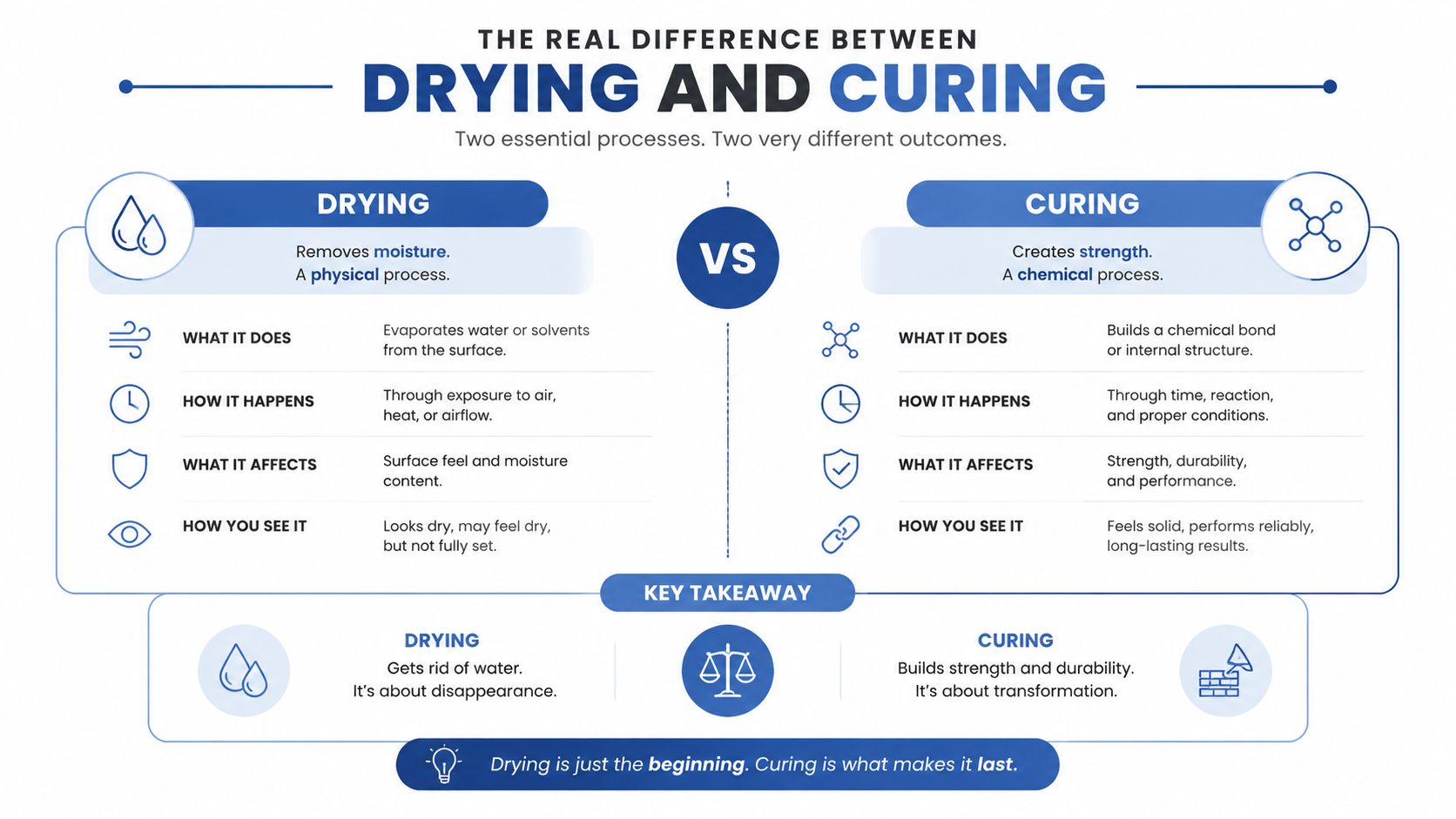
For an Arizona property owner planning a sealer, these terms answer different questions. Curing and drying are separate processes. Curing is the chemical reaction that lets cement and water form the hardened structure responsible for concrete strength. Drying is the physical movement and evaporation of moisture from the slab.
A surface can feel firm while moisture remains below it. A hard surface isn't proof that the interior has reached the condition you need. That distinction matters after power washing, too. Desert sun can remove visible water quickly, while shaded edges, joints, porous sections, and thicker areas stay damp.
The Federal Highway Administration says Portland cement concrete pavements should generally remain moist above 10 °C for at least 7 days. High-early-strength concrete may use a 3-day curing period under applicable criteria. Curing can also end early when field-cured cylinders reach 70% of required strength or satisfy other strength-based requirements. Time provides a starting point, but measured strength may better support a project decision.
Why the 28-day milestone isn't a drying deadline
The familiar 28-day benchmark relates to design strength, not automatically to sealer or coating readiness. Concrete may meet its standard strength reference while retaining enough internal moisture to interfere with a coating or adhesive.
The Cement Concrete and Aggregates Australia guidance gives a rule of thumb of about one month of drying for every 25 mm of slab thickness after curing or re-wetting ends (CCAA moisture guidance). Under that rule, a 100 mm slab drying from one side may need roughly four months, a 150 mm slab about six months, and a 200 mm slab about 12 months. The document also describes a modeled 100 mm slab reaching 85% relative humidity after 116 days under stated conditions.
For painted or coated floors, the discussion of curing time for painted floors adds useful application context. Exterior sealers still depend on product instructions and site conditions. For decorative work, the cost of acid-stained concrete makes moisture timing part of protecting the finish. Strength development and moisture readiness are different checkpoints.
Typical Timelines for New Concrete and Cleaned Surfaces
The right schedule depends on what the surface must handle. Light foot traffic, a delivery vehicle, pressure washing, and a moisture-sensitive coating each place different demands on concrete. In Arizona, a slab can look dry before it is ready for the next job.
A newly placed residential slab may tolerate cautious walking after 24 to 48 hours, provided people avoid dragging objects and concentrating loads in one area. That early access does not make the surface suitable for vehicles, pressure washing, or sealing. As noted in the curing section above, early-age care and later moisture readiness are separate decisions.
| Use Case | Typical Wait Time | Key Consideration |
|---|---|---|
| Cautious foot traffic on new concrete | 24 to 48 hours | Keep use light and avoid dragging or concentrated loads. |
| Sealing a cleaned existing surface | Until fully dry, often about 24 hours in favorable Arizona conditions | Check shaded areas, joints, low spots, and the sealer manufacturer's requirements. |
| Flooring or moisture-sensitive coating | Potentially months | Use internal moisture or emission testing instead of appearance alone. |
| Vehicle or heavy service use | Project-specific | Follow the concrete specification or verified strength requirements. |
Pressure washing creates a different scheduling problem. A mature driveway can usually be cleaned without waiting for early-age strength development, but rinsing leaves water in pores, joints, cracks, and shaded sections. Aggressive pressure can also scar a young finish even when the concrete feels firm. Before arranging the next step, review this guide to the best way to clean a concrete driveway.
For a recently cleaned existing surface, visible water may disappear in about a day under favorable Arizona conditions. That estimate changes with shade, humidity, porous texture, rinse volume, and the slab's drainage. A bright, dry-looking center does not confirm that edges, control joints, or low spots are ready for sealer.
What changes after pressure washing
Cleaning an established slab is mainly a moisture-management issue. The concrete is generally past its early hydration period, so the question is how much water remains after rinsing and where it has collected. Inspect the full surface, not only the area that receives direct sun.
Do not seal while joints, cracks, shaded sections, or depressions are holding water. If the project involves flooring or another moisture-sensitive coating, appearance alone is too limited. Industry practice uses benchmarks such as 4% moisture content, 75% or 85% relative humidity, and a moisture-vapor-emission limit of 3 pounds per 1,000 square feet per 24 hours under ASTM F1869. Internal relative humidity is commonly measured under ASTM F2170, as explained in the ESCSI concrete drying guidance.
For routine exterior sealing, follow the product instructions, confirm the surface is uniformly dry, and allow extra time wherever Arizona shade or surface texture slows evaporation.
How Arizona Conditions Change the Drying Timeline
A driveway can look dry by midafternoon after a morning wash, yet still hold moisture in shaded joints and low spots. Arizona heat, low humidity, direct sun, and wind speed up surface evaporation. They do not guarantee that the slab is dry throughout, or that new concrete has cured safely.
The main desert trade-off is simple: fast evaporation isn't automatically good drying. On a young slab, rapid moisture loss can weaken the surface or contribute to shrinkage cracking before the cement has used the available water. Technical curing guidance from MBT notes that curing depends on weather and exposure, recommends a minimum of 7 days in common situations, and explains that hydration can effectively stop when internal humidity falls below about 80% (technical curing guidance).
Arizona variables that change the schedule
- Temperature: Warm weather usually speeds moisture movement and strength development. Extreme heat can pull water from the exposed surface faster than the interior can replace it.
- Humidity: Arizona's dry air encourages evaporation, while higher humidity during monsoon conditions slows it. A shaded corner can remain damp after the sunny center appears ready.
- Sun and wind: These conditions dry the top quickly, especially after pressure washing. They do not prove that moisture has left the slab's interior.
- Shade and orientation: North-facing areas, covered patios, edges beside walls, and spaces beneath vehicles receive less drying energy. Treat them as separate test areas rather than relying on the brightest section.
- Thickness and exposure: A thin walkway often releases moisture sooner than a deep slab. Concrete exposed on only one side also dries more slowly than a surface with airflow on both sides. The CCAA moisture guidance explains why slab thickness and drying conditions affect the timeline.
- Surface condition: Porous concrete, heavy rinse water, textured finishes, control joints, and depressions retain water after cleaning. Drainage can matter as much as air temperature.
A slab may therefore look ready long before its deeper moisture has moved out. The Tramex drying reference shows how thickness, mix design, and drying exposure can produce long timelines under controlled reference conditions. Arizona sun can shorten visible surface drying, but it cannot remove those underlying constraints.
For scheduling, a summer cleaning may leave an established driveway looking dry quickly, while winter shade or monsoon humidity can extend the wait. Protect new pours during curing. For mature concrete, inspect every slow-drying area and measure before sealing when the coating, warranty, or schedule matters.
Simple Field Tests to Verify Concrete Is Ready
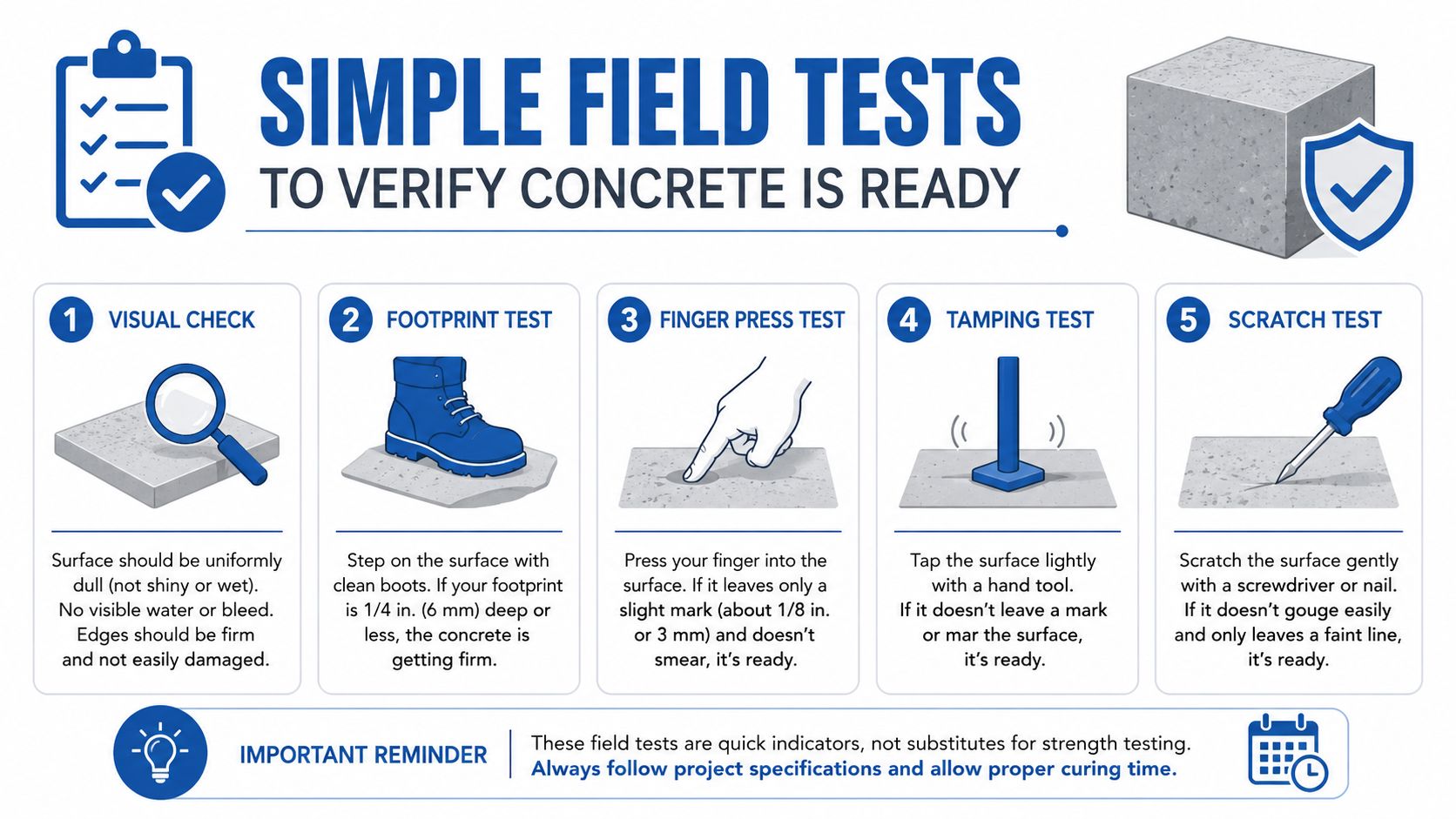
A visual check is a starting point, not a final approval. Look for uniform color, no glossy damp areas, and no water remaining in joints or depressions. Then inspect locations that dry slowly, including shaded edges, areas beneath vehicles, and places where rinse water collects.
Use basic checks carefully
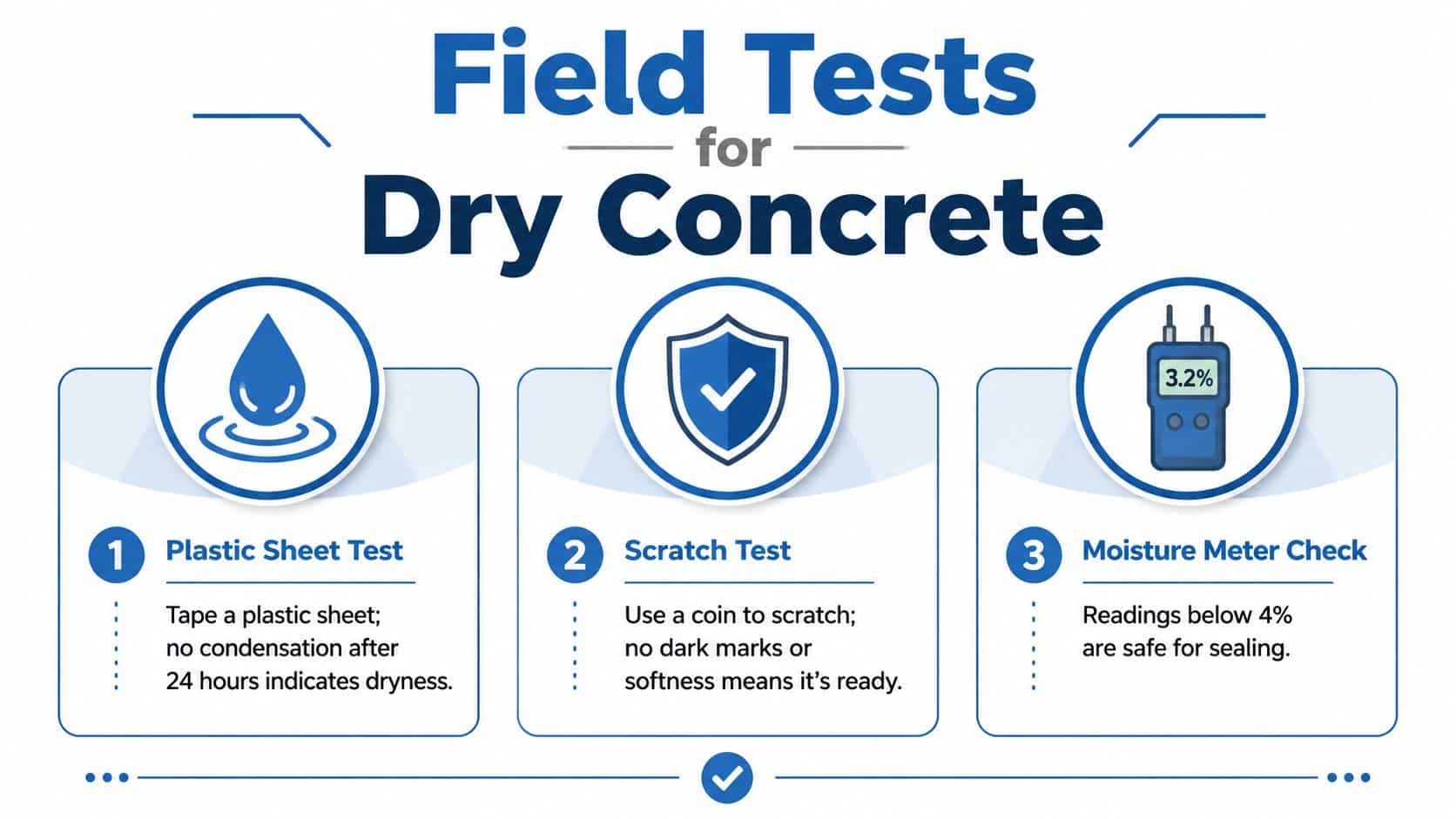
The plastic-sheet test can reveal active surface moisture. Tape clear plastic tightly to the slab and inspect it after 24 hours. Condensation or a darker patch beneath the plastic indicates that moisture is still moving toward the surface. A clean result doesn't replace formal testing for a coating warranty, but it can prevent an obvious mistake.
A scratch check with a coin can reveal softness or a weak top layer. If the coin leaves dark powder, a soft mark, or easily removes the surface, stop and investigate. This test says more about surface condition than deep moisture, so it can't establish readiness by itself.
Measure when the finish matters
For sealing, flooring, or coatings, use a suitable moisture meter or a recognized test method. Technical guidance identifies 4% moisture content, 75% RH, and 85% RH as common reference thresholds, but the correct limit belongs to the product and substrate system. A reading that works for one sealer may not satisfy a flooring adhesive or coating specification.
The moisture meter results explained resource can help homeowners understand why a reading needs context. Take readings in multiple areas rather than relying on the sunniest section, and record the conditions when the test is performed.
Measured readiness beats a confident guess. A slab can look perfect at noon and still fail a moisture-sensitive finish later.
Don't use a household humidity reading as a substitute for slab testing. Ambient air affects drying, but internal concrete moisture is the condition that the sealer or flooring system must tolerate.
Scheduling Professional Cleaning and Sealing Services
Cleaning and sealing should be scheduled as two connected operations, not as one rushed appointment. A pressure-washed surface needs time to release rinse water, and a new slab needs appropriate curing protection before anyone treats it like a finished floor.
For a commercial property, map the surface by exposure. Drive-thrus may receive repeated vehicle moisture and traffic, walkways may stay shaded by building façades, and dumpster pads can hold rinse water in texture and joints. Building exteriors and flat surfaces also create sequencing issues when runoff reaches concrete that you planned to seal.
South Mountain Window Cleaning provides residential, commercial, and high-rise window washing across Phoenix, Scottsdale, Paradise Valley, Chandler, Tempe, and Gilbert, while also handling power washing for drive-thrus, walkways, building exteriors, dumpster pads, and other flat surfaces. A contractor coordinating those services should inspect the surface, identify slow-drying areas, and confirm that the concrete is ready before applying a product.
Sequence the work around conditions
A practical schedule includes:
- Clean first: Remove dirt, oil, biological growth, and loose residue before evaluating the substrate.
- Allow drainage: Keep vehicles, furniture, and stored materials off areas where they block evaporation.
- Check the slow spots: Inspect shade, joints, edges, and low points instead of judging the center alone.
- Confirm product limits: Match moisture readings and surface conditions to the sealer or coating instructions.
- Protect the finished work: Keep traffic away for the period required by the product, not merely until the surface feels dry.
A pool deck needs the same discipline because trapped moisture can interfere with adhesion and appearance. Guidance on how to protect your pool deck with sealing reinforces the value of treating sealing as a preparation process, not a quick cosmetic step. For driveway maintenance, use the recommended driveway sealing schedule as a planning reference, then adjust it to the actual concrete condition and product requirements.
A Practical Decision Framework for Your Concrete Surface
Start with three questions: Is this new concrete or a mature slab? What will happen next? Which areas are slowest to dry?
For a new pour, protect moist curing and avoid treating 24 to 48 hours of surface hardness as full readiness. Use the about 7-day curing benchmark and the 28-day design-strength reference as starting points, then follow project-specific strength requirements. For a mature slab after cleaning, wait until visible water is gone, inspect shaded and recessed areas, and use moisture testing before sealing or installing flooring.
Thickness and mix design control the long wait. A thin exterior walkway may dry sooner than a deep slab, while flooring work can require months even after the familiar curing milestone. Arizona heat can speed surface evaporation, but it can't guarantee internal dryness.
When the consequences of failure are expensive, document the conditions and measure rather than guessing. That approach protects the finish, reduces schedule surprises, and gives property owners a defensible reason to open the surface or postpone it.
South Mountain Window Cleaning, LLC can coordinate residential and commercial window washing, power washing, flat-surface cleaning, dumpster pad sanitation, and related exterior services around realistic concrete drying conditions. Visit South Mountain Window Cleaning, LLC to request a free quote and schedule service in the Phoenix Valley.