
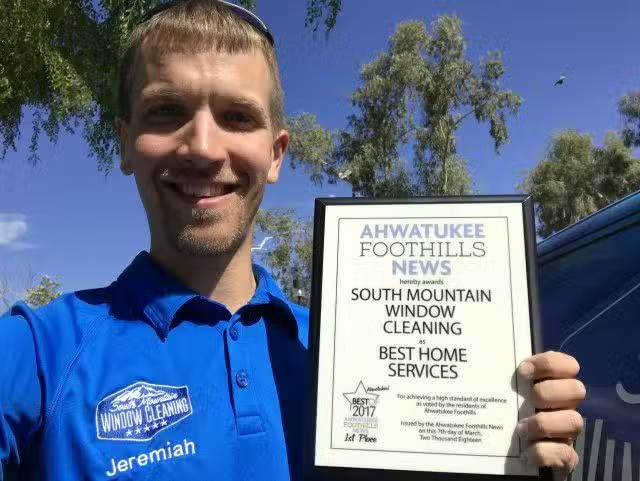
You're probably looking at the glass right now and seeing the same Arizona story again. A fine coat of dust on the patio door, a few hard-water freckles near the sprinklers, maybe a hazy strip across the storefront that didn't bother you last month but looks worse after the latest wind. In this climate, window cleaning isn't just about making glass look nice, it's about stopping dust, sun, and mineral buildup from turning a routine maintenance job into a bigger repair later.
What Arizona Window Cleaning Really Means for Your Property
A property in Arizona can look clean from the street and still be fighting a slow build of grime on the glass. I've seen owners call for service because the windows looked dull, but the problem was layered dust, hard-water spotting, and residue sitting on the frames and tracks long before the glass felt “dirty.” That's why Arizona window cleaning has to be treated as part of exterior maintenance, not as a cosmetic quick fix.
A proper service usually covers more than panes. It can include exterior glass, interior glass, screens, tracks, sills, mirrors, ceiling fans, and solar panels, depending on the property and the scope. For a homeowner, that might mean a one-time detail clean before a sale or event. For a business, it usually means a recurring maintenance plan that keeps storefronts and office glass from slipping into the “needs a restoration” category.
The job changes with the property
A single-family home in Phoenix doesn't need the same setup as a retail strip in Chandler or a condo tower in Scottsdale. A house might be handled with ladders, poles, and hand-detailing. A commercial property may need proof of insurance, a weather policy, and a crew that can work around tenants, parking, and opening hours.
That difference matters because the market here is broad and active. IBISWorld estimates Arizona's janitorial-services industry at $2.0 billion in 2026, with 24,756 businesses and 45,229 employees, and notes that the category includes window exteriors and building exteriors IBISWorld. At the narrower end, Arizona had 986 window-cleaning services as of January 23, 2025, up 3.72% from 2023 Rentech Digital.
Practical rule: if a property has sun, dust, and irrigation overspray, it needs a maintenance rhythm, not just an occasional polish.
That's why local marketing for this trade has to answer the actual buyer questions, not just the how-to questions. A useful place to see how service businesses think about lead capture is browse window cleaning lead generation tips, because the best pages speak to property type, scheduling, and service fit, not only streak-free results.
Service Types Available Across the Valley
The first thing to sort out is what kind of cleaning you need. Too many quotes get compared as if every glass job is the same, and that's how property owners end up paying for the wrong scope or the wrong access method. In Arizona, service type drives equipment, crew size, paperwork, and risk.
Residential, storefront, and high-access work are different jobs
Residential single-family cleaning is usually the most straightforward. Crews often use poles, ladders, and hand tools to handle exterior and interior glass, plus screens and tracks if requested. It fits homes in places like Gilbert, Tempe, and Paradise Valley where the goal is curb appeal, daylight, and keeping dust from building up in the corners.
Commercial storefront and office cleaning is a different rhythm. A storefront on a busy street wants regular service, clean edges, and minimal interruption. The work may be done early in the morning, with ground-based poles for reachable glass and ladders or lifts when geometry forces the issue.
High-rise and mid-rise cleaning needs its own planning. Rope descent, anchor checks, and lift access introduce more documentation, more coordination, and more insurance scrutiny. If a building has setbacks, roof obstacles, or limited landing space, the access method matters as much as the soap.
Solar panel cleaning is its own category because the surface is functional equipment, not just glass. Rooftop panels are often best handled with purified water and safe access planning, especially where dust accumulation is frequent.
A job that looks simple from the parking lot can become elevated work as soon as the crew leaves the ground.
Add-ons often get bundled in because they're efficient to handle during the same visit. Those include screen cleaning, track and sill detailing, mirror cleaning, ceiling fan cleaning, gutter clearing, rust removal, and power washing for walkways or dumpster pads. South Mountain Window Cleaning, LLC is one Arizona option that combines window cleaning, screen and track care, solar panel cleaning, house washing, rust removal, and flat-surface cleaning under one service umbrella for homes and businesses across the Valley.
Pricing Ranges and What Drives Your Quote
Most Arizona buyers want the same thing before they call: a number they can trust. The problem is that window cleaning quotes change for reasons that are easy to miss if you're only comparing totals. Height, access, buildup, and add-ons all move the price, and those variables matter more here because the climate pushes glass harder than in wetter markets.
Standard work versus harder access
For commercial window cleaning in Arizona, recent pricing guidance puts standard work at about $4 to $8 per pane or $50 to $75 per hour Arizona Window Washers. That range is useful because it shows where the labor goes, especially on larger properties where the time is tied to access and not just pane count. Residential jobs are often quoted as a flat package or per-window, which makes sense when the crew is balancing inside work, exterior work, and screens.
| Job Type | Typical Rate | What Moves the Price |
|---|---|---|
| Commercial panes | $4 to $8 per pane | Height, access, buildup, add-ons |
| Commercial labor | $50 to $75 per hour | Crew size, scheduling, difficulty |
| Residential service | Flat package or per window | Number of windows, screens, tracks, hard-water removal |
The quote changes when the glass changes. A first-floor patio door is a different job from a second-story façade with landscaping in the way. Screens, tracks, and sills add time. Solar panels add care. Hard-water removal and post-construction detail work can turn a routine stop into a longer, more technical visit.
Average cost of window cleaning in Phoenix and what affects it is worth reading if you're comparing bids, because it helps separate simple glass maintenance from heavier cleanup.
The trade-off is maintenance versus restoration. Cheap routine visits help prevent the kind of dust and mineral buildup that later requires deeper remediation. Waiting too long can turn an ordinary exterior-cleaning visit into a harder, slower, more expensive job.
Why Arizona's Climate Changes the Cleaning Equation
Arizona doesn't just make windows dusty. It changes what sticks to them, how fast it bonds, and how often the service has to happen. That's why a homeowner in Phoenix or a property manager in Scottsdale shouldn't think in terms of “when does the glass look bad,” but “what is the glass sitting in between visits.”
Dust, sun, and mineral buildup work together
Dust events leave more than a surface film. Fine grit settles into edges, screen frames, tracks, and solar-panel surfaces, then the heat bakes it in. Monsoon humidity can make residue cling harder to hot glass, and irrigation overspray adds hard-water minerals that don't behave like ordinary dirt. Once that happens, cleaning takes longer and the result depends more on process than elbow grease.
UV exposure makes the issue worse over time. On a hot, sun-intense façade, contaminants can be baked into the surface between cleanings, which is why a good crew cares about wash water, dwell time, and rinsing discipline. The same logic applies to solar panels, where dust layers can sit long enough to affect output and make a rooftop system work harder than it should.
For properties with solar, the maintenance question is especially important. One Arizona-focused guide frames the issue clearly by treating solar-panel cleaning as a performance and upkeep problem, not just an appearance issue. You can see that angle in Arizona monsoon-season window and solar maintenance guidance.
Maintenance rule of thumb: in this market, fewer but deeper cleanings often cost more in the long run than regular light service.
That's why pure-water systems matter here. They help crews leave a cleaner finish on glass and panels without leaving mineral residue behind. They're not a magic fix for bad technique, but they do support consistent results in a climate where tap water and dust can work against you fast.
Safety, Insurance, and What to Require on Paper
Any time a crew leaves the ground, the job changes. A storefront that seems easy from the parking lot can still trigger fall-protection planning, and property managers shouldn't rely on a handshake or a casual “we do this all the time.” The right paperwork protects the building, the tenants, and the vendor.
Height changes the rules
OSHA-aligned fall-protection planning starts at relatively low heights, 4 feet or more in general-industry work and 6 feet or more in construction-equivalent work National Window Cleaning Authority. That means the access method has to match the building, not the assumption that “it's only a low rise.” In Arizona, many storefronts and low-rise properties still cross those thresholds once a worker steps onto a ladder or uses a lift.
Arizona law also restricts minors under 16 from window washing work that involves a ladder, scaffold, window sill, or similar structure more than five feet high Arizona labor code. That tells you how seriously the state treats this kind of high-rise work.
For rope-descent high-rise work, anchor points need to be rated to support 5,000 pounds per worker, and the equipment should be identified, inspected, and certified, with separate fall-arrest systems for each worker OSHA-related anchor guidance.
What to ask for before the crew starts
A serious vendor should be able to produce these items without hesitation:
- Certificate of insurance, matched to the property type.
- Method statement, showing how the job will be accessed and cleaned.
- Fall-protection plan, for any high-up work.
- Weather policy, especially important for monsoon season and windy days.
- Scope confirmation, so screens, tracks, solar panels, or add-ons don't get disputed later.
Arizona workmanship standards also emphasize site protection and verified post-clean quality, which is exactly what a commercial manager should want before service starts Arizona ROC workmanship standards. If a vendor can't show how they'll protect landscaping, manage drop zones, and inspect the finish, the price doesn't matter much.
Window cleaning insurance basics for Arizona properties is a useful reference if you manage commercial space and need to understand what coverage should look like before anyone sets foot on the roof.
DIY Versus Hiring a Professional Crew
There's nothing wrong with cleaning a ground-floor patio door yourself. A bucket, a towel, a decent squeegee, and a little patience can handle light dust between scheduled visits. For simple touch-ups, DIY can make sense.
Where DIY still works
A homeowner can reasonably handle:
- Ground-level glass, especially easy-access sliders and French doors.
- Quick dust-offs, between professional service visits.
- Small interior touch-ups, where ladders and roof access aren't involved.
The job stops being simple once hard-water spots show up or the glass is above a single story. Technique starts to matter, and so does safety. If you've ever dragged a squeegee down a sunny pane and left lines behind, you already know how easy it is to make a window look worse before it looks better.
Where professional service earns its keep
Anything involving hard-water stain removal, post-construction detail work, solar panels, or elevated access usually belongs with a trained crew. That's especially true on commercial façades and two-story homes where a poor finish is obvious from the street and access risk climbs quickly. A professional team also brings tools that most owners don't keep at home, including pure-water poles, extension systems, and the right approach for screens and tracks.
If the task needs a ladder, roof access, or restoration work, the savings from DIY shrink fast.
Arizona-specific DIY guidance can be helpful for simple jobs, and how to do your own window cleaning in Phoenix is useful reading if you want to handle the easy stuff yourself. Still, the honest question for a busy owner or property manager is simple, is my time plus my risk worth the savings?
What to Expect on the Day of Service
A professional visit should feel organized before anyone picks up a tool. Good crews don't wander in, guess at the scope, and start spraying glass. They arrive with a plan, confirm what's included, and protect the property before the first pane is touched.
The first thing you should see is a clean, professional crew with boot covers or comparable site protection, followed by a walk-around to confirm the scope. From there, landscaping and hard surfaces should get drop cloths or similar protection, especially around flower beds, pavers, and indoor flooring. Screens usually come off first and get cleaned separately so dust doesn't end up back on the glass.
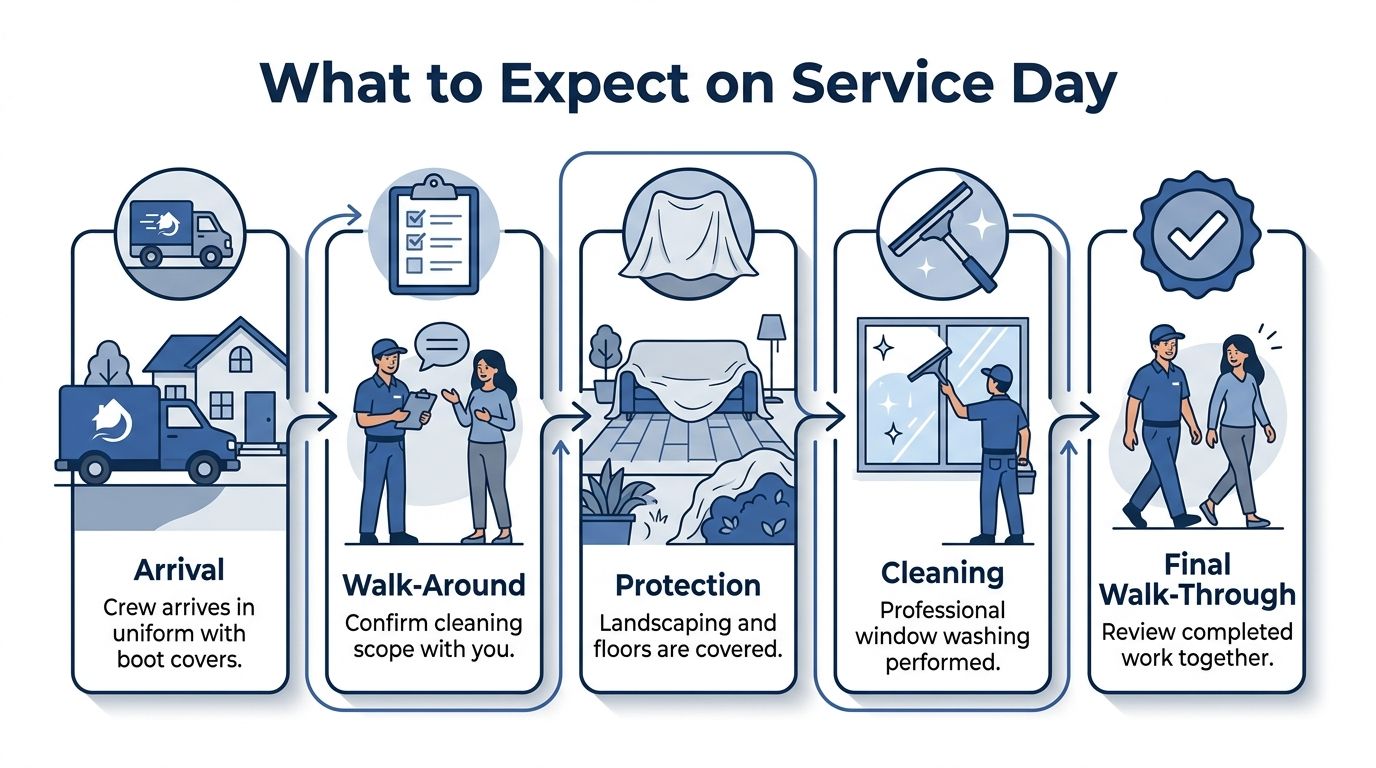
Exterior glass may be scraped, hand-squeegeed, or cleaned with a pure-water pole, depending on access and buildup. Interior work comes after the outside is handled so the crew doesn't track residue back through the building. Tracks, sills, and any agreed-upon add-ons should be wiped and checked before the final walkthrough.
If something looks off, the crew should say so. A cracked pane, a torn screen tab, or a stubborn spot isn't something a good team hides until the customer finds it later. Communication on service day is part of the job, not an extra.
Choosing the Right Arizona Window Cleaning Company
A good vendor in this market should be easy to judge. You don't need a sales pitch, you need signs that the crew can work safely, show up when promised, and leave the glass in better shape without creating a new problem for the building.
What to look for before you sign
Start with licensed, bonded, and insured coverage that fits your property type. For high-up work, ask for a documented safety method and a fall-protection plan. For routine service, look for a real cleaning process, not just a bottle and a rag.
Reliability matters just as much. Computerized scheduling, clear communication, and a visible satisfaction policy tell you more than a flashy claim ever will. Reputation helps too, especially when you can verify it through review volume and named commercial accounts.
South Mountain Window Cleaning, LLC fits that profile for Phoenix, Scottsdale, Paradise Valley, Chandler, Tempe, and Gilbert, with a $2 million insurance policy, 400+ five-star reviews, a 100% satisfaction guarantee, and approved-vendor status for Amazon and Google Home Services. Those are the kinds of details that matter when a building owner needs more than a one-off cleanup.
Buying signal: pick the company that can explain how it cleans, how it protects the property, and what happens if weather or access changes the plan.
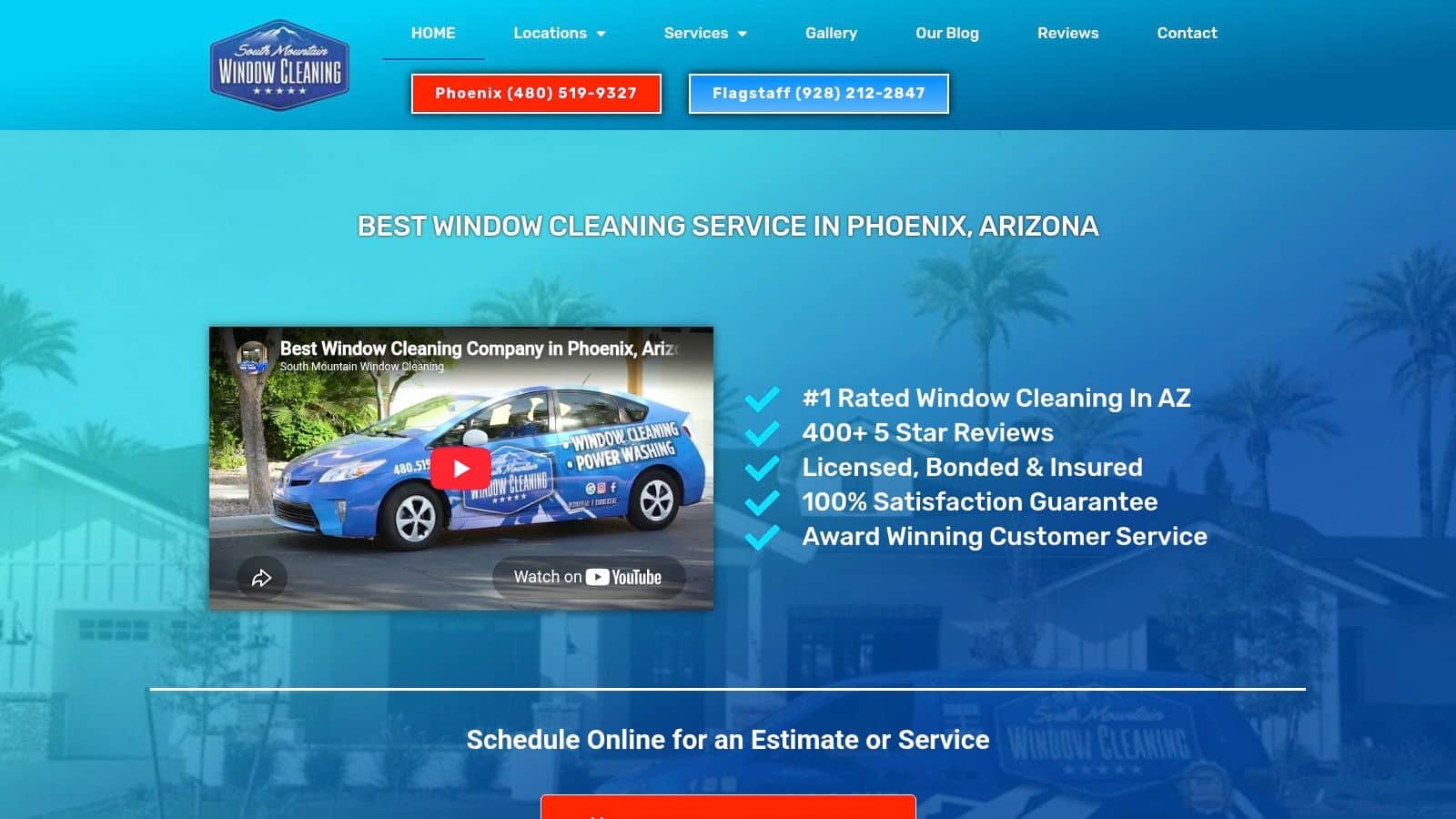
If you manage a home, storefront, HOA, or commercial building in the Valley, the next step is simple. Ask for a free quote, compare the scope line by line, and make sure the crew's access plan fits your property before service day.
If you want a crew that understands Arizona dust, hard water, solar panels, and the paperwork that comes with high-rise work, contact South Mountain Window Cleaning, LLC. They handle residential, commercial, and high-rise window cleaning across the Valley, along with the add-ons that keep glass and solar systems performing between visits.