
Clean your gutters at least twice a year. In Arizona, time those two visits around the monsoon, with one before the season starts and one after it ends, rather than following a leaf based calendar.
That timing surprises homeowners who have almost no trees and assume they can skip the work. Dust, gravel, roof grit, and storm-blown debris still collect in channels, downspouts, and scuppers, and the first strong monsoon rain will expose a blockage fast. How often to clean gutters isn't really a question about leaves in the Valley. It's a question about whether your drainage path is clear before water arrives in volume.
Recommended Cleaning Frequency by Property Type
Match the cleaning count to the debris over the roof, not to a neighbor's calendar. Two full cleanings a year is the floor for most properties. The Federal Emergency Management Agency home safety guidance advises homeowners to thoroughly clean gutters and downspouts at least two times per year, before rainy seasons and again in fall when vegetation can obstruct drainage.
Roof shingles shed granules that settle as sediment, so a channel can lose capacity with no leaves in it. Speed the schedule up when an inspection shows rapid buildup, slow drainage, or overflow at the eaves.
Match Your Property to a Row
| Property type | Main debris source | Minimum cleanings per year | Add a visit when |
|---|---|---|---|
| Single-family home under deciduous trees | Leaves, seed pods, twigs | 2 (spring and after leaf fall) | Gutters overflow after heavy rain |
| Home beside pines or other evergreens | Needles, cones, fine debris | 2 to 3 | Needles and cones build up at downspouts |
| Low-tree desert home in Phoenix or Scottsdale | Dust, gravel, storm-blown debris | 2 (before and after monsoon) plus storm inspections | A monsoon storm leaves debris on the roof or in the gutter |
| Condo or townhouse with shared roof | Mixed debris from common areas | 2, set by the association | Water spills over at a shared downspout |
| Commercial storefront or office | Landscape debris, roof grit | 2 minimum, quarterly when debris is heavy | Overflow near entrances or walkways |
| High-rise or multi-story building | Roof debris, wind-blown material | Set by documented inspections | Any visible overflow or leak |
I would count what sits over the roofline before copying the house next door. A home under mesquite or pine fills a downspout elbow faster than a tile roof with desert landscaping on the same street, so that property often earns a third full clean. A low-tree desert home in Phoenix or Scottsdale should keep the two timed cleanings and add an inspection after each monsoon storm that blows dust, gravel, or debris onto the roof. Those storm checks matter more than raising the fixed annual count. Condo owners should confirm who owns the schedule, because one shared downspout can fail for every unit below it.
Practical rule: The minimum stays at two visits. Debris loading, not the calendar alone, tells you whether you need a third full clean. On a low-tree desert roof, a post-storm inspection usually answers that before you book another visit.
Seasonal Schedule for Arizona and Leaf-Heavy Climates
A desert gutter schedule fails when you copy a leaf calendar. In Phoenix and the rest of the Valley, the load is dust, gravel, and monsoon storms. In a deciduous region, the load is leaf fall and spring rain. Those two clocks barely overlap.
Location-level gutter maintenance data based on precipitation, forest-canopy, and freeze-thaw data found recommendations ranging from one to four or more cleanings annually, and ZIP-code recommendations within a single state could differ by as much as half a cleaning per year. A single fixed count fits poorly once precipitation, canopy, and freeze-thaw change by location. That same discussion cites City of Phoenix guidance to clear roof drains and scuppers before monsoon rainfall, because debris can stop a roof from draining.
Two Calendars Side by Side
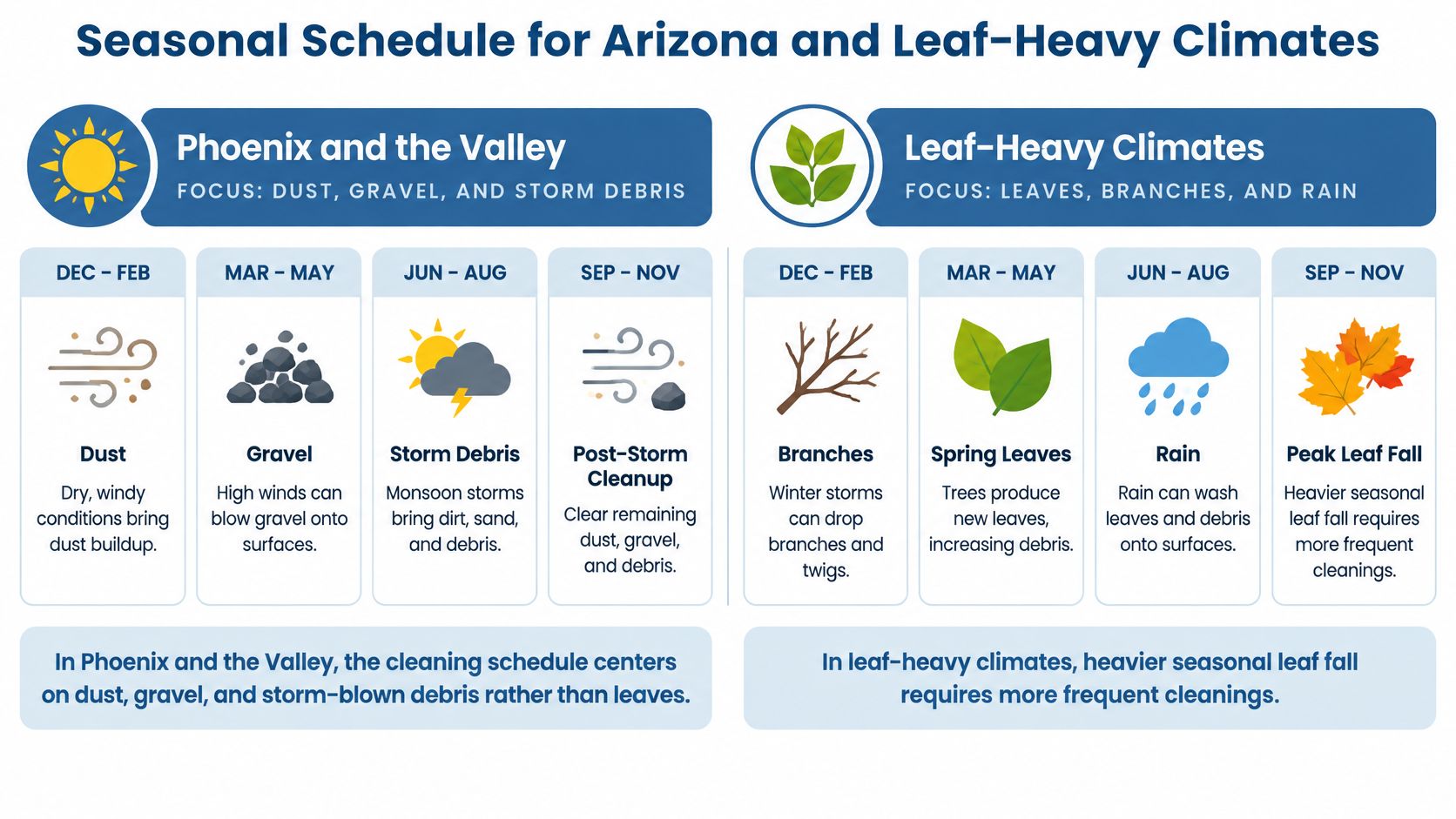
| Season | Phoenix and Arizona | Leaf-heavy climate |
|---|---|---|
| Early spring (March to April) | Light inspection after winter winds | Full clean after snowmelt and before spring rain |
| Late spring (May) | Full clean and roof-drain check before monsoon | Quick check for debris from winter storms |
| Monsoon (June to September) | Inspect after each major storm | Clean after strong summer storms that drop branches |
| Early fall (October) | Full clean after the monsoon ends, then check after dusty, windy weeks | Full clean once most leaves have dropped |
| Late fall (November to December) | Light check before winter | Second full clean or check after last leaf fall |
| Winter | Check after storms only | Check for ice and blocked outlets |
For a low-tree desert home, I keep two timed cleanings. May is the full clean and roof-drain check before monsoon. October is the full clean after monsoon ends, with a look after dusty, windy weeks. Between June and September, storm-triggered inspections matter more than a third date on the calendar. Wind can drop gravel into a scupper in one afternoon. That scupper can pond water on a flat roof while the open gutters still look clear from the street.
An extra midsummer cleaning on a quiet week mostly shifts dust. An inspection after a real storm tells you whether the October clean has to move up.
During rain, watch each downspout for a steady stream and the gutter lip for water sheeting over the edge. Spillover means the channel or outlet is already full. Pull the next visit forward. Do not hold it for October.
Warning Signs That Gutters Need Cleaning Now
Overflow during rain is the clearest sign and the most urgent. Water pouring over the front edge means the channel is full or the outlet is blocked. During monsoon season, schedule cleaning within days and before the next storm, not at the next routine visit.
Other signs rank lower but still tell you something specific:
- Water down the fascia or drips at seams: A clog or sagging section is holding water where it shouldn't sit.
- Soil washed out at the downspout base: Runoff is landing too close to the foundation, usually from a blocked, disconnected, or short outlet.
- Sagging sections or pulled hangers: Wet debris adds weight. Repair the hangers and pitch before you rely on cleaning alone.
- Plants sprouting in the channel: Seeds have found decomposing material, which means buildup has been there for months.
- Standing water after rain: The University of Minnesota Extension pest guidance identifies clogged gutters among the places where water collects and where mosquitoes breed.
Prioritize by location. Overflow above an entrance, walkway, or electrical fixture is a same day problem. Granules in the channel bottom and a sour, musty smell can wait for the next visit, but they shouldn't wait for the next season.
Our breakdown of the importance of gutter maintenance covers what prolonged overflow does to walls and soil in more detail. Use it when you're deciding whether a stain is cosmetic or a drainage failure.
Two or more signs at once means your current interval is too long for that property. Shorten it.
When Ladder Risk Should Change Your Schedule
Every extra gutter cleaning is another ladder setup, another reach, and another descent with a full bucket. On a low-tree Arizona home, monsoon storms and blown dust load the channel more than leaves do. Keep two timed cleanings. Add a storm-triggered inspection from the ground. That check matters more than a third climb.
Ladder falls injure many people each year, according to safety data. Ladder movement is a frequent part of those incidents. Stacking visits after every dust storm multiplies setups and removes little that a ground look would not have flagged.
Stop Conditions
Stay off the ladder when any of these apply:
- Sloped, soft, or uneven ground: Decomposed granite shifts, so you cannot level the feet reliably.
- Power lines near the roof edge: Keep metal ladders and tools well clear, with no exceptions.
- Second story or higher: Repeated repositioning at that height belongs with a crew trained in fall protection.
- Wet surfaces, damaged gutters, or limited mobility: If you cannot hold three-point contact comfortably, stop.
- No second person available: Someone should steady the base and pass tools up.
A ground check is not a cleaning. After a storm, binoculars or a phone zoom show whether the run needs a climb now or can wait for the next scheduled visit. Our guide on how to clean gutters safely walks through ladder setup and positioning when the climb is justified.
If the property needs more than two climbs a year, or several stop conditions apply, I would hand the work to a crew with safety training. A fall costs far more than the visit you skip.
Gutter Cleaning Checklist for Every Visit
A good visit follows the water path, from roof edge to discharge point. Removing leaves without testing the downspout leaves the most common blockage untouched.
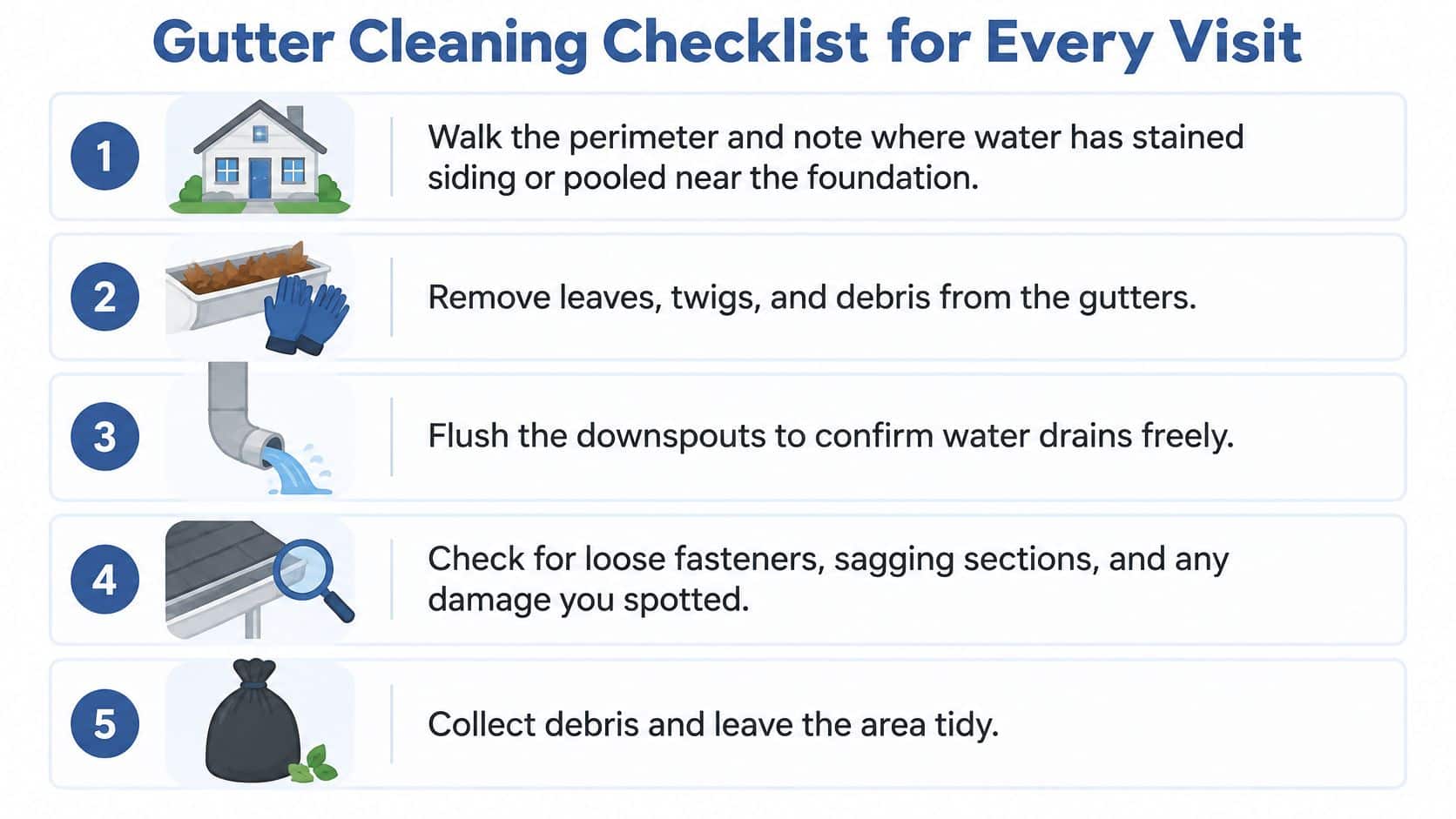
- Walk the perimeter first. Note siding stains, eroded soil, and pooled water near the foundation. These marks tell you which run failed last storm.
- Remove debris into a bucket. Start at the downspout end and work toward the far end with a plastic scoop. The common mistake is pushing material into the outlet.
- Flush toward the downspout. Run a hose from the far end so water carries fine grit out. In Arizona, this step removes the dust and gravel sediment a scoop leaves behind.
- Test every downspout. Run water through each one and confirm it's open and connected at every elbow. Slow, gurgling discharge means a partial blockage remains.
- Check discharge distance. The University of Minnesota Extension basement moisture guidance recommends extensions discharge water at least 4 feet beyond the wall, with at least one downspout for every 50 linear feet of roof eave.
- Inspect hangers, seams, and slope. Tighten loose hangers and reseal leaking seams while the channel is clean and dry enough to hold sealant.
- Clear screens and guards. Fine particles collect on top and restrict flow even when the channel underneath is empty.
- Bag debris and remove it. Don't wash it across pavement or into a storm drain.
Our notes on how to remove leaves from gutter runs cover technique for packed material at outlets. Finish with a hose test at full flow. The outlet should discharge steadily with no spillover at the edge and no drips at the seams.
Scheduling Gutter Service for Commercial and High-Rise Buildings
A fixed count rarely fits a building with several roof sections, varied tree cover, and tenants who notice overflow at the front door. Managers need a baseline plus evidence from the site itself.
The FEMA roof systems fact sheet supports inspecting and cleaning gutters and downspouts at least twice per year, typically before and after the wet season, and notes that gutters sized for normal rainfall can become overwhelmed during extreme rainfall when maintenance is poor. For Phoenix properties, that means one inspection before the summer monsoon, one after, and post-storm checks when wind deposits debris.
A Three Layer Calendar
- Recurring service: Two full cleanings tied to the wet season.
- Quarterly inspection: Add it when yard debris is heavy or prior visits found sediment and standing water early.
- Event trigger: Inspect after any storm that causes overflow, visible roof debris, or a tenant leak report.
Document each inspection properly. Record outlet condition, visible leaks, loose connections, and where water discharges relative to entrances and walkways. Overflow is a functional warning, not a cosmetic complaint, and your log is what justifies shortening the interval.
Plan access before you plan dates. Multi-story and high-rise work needs fall protection, contractor insurance, and crew certification, plus scheduling around tenant hours. Our commercial building maintenance checklist helps managers fold gutter visits into a wider exterior calendar.
Gutter guards reduce bulk debris. They don't remove the need for documented inspection.
Review the schedule each year against your logged incidents. If overflow events cluster after monsoon storms, add storm triggers. If quarterly inspections keep finding clean channels, step back to the baseline.
Set Your Gutter Cleaning Calendar and Book the Visit
Build your calendar this week in three moves. First, match your property to a row in the frequency table and write down two baseline dates. In Phoenix, Scottsdale, Paradise Valley, Chandler, Tempe, and Gilbert, put one in May and one in October.
Second, add your event triggers. Note inspections after each strong monsoon storm, after leaf fall if you have deciduous trees, and whenever overflow, sagging, or standing water appears. A calendar without triggers fails exactly when storms don't follow the schedule.
Third, decide who climbs. A single-story home with level ground and no stop conditions can handle the ground check and two cleanings. Any property with a second story, power lines, or repeat quarterly needs shouldn't rely on a homeowner ladder.
We provide residential, commercial, and high-rise window washing across the Valley, and our services also include gutter cleaning, house washing, rust removal, garbage bin cleaning, and flat surface cleaning. We provide a fast and free quote for any cleaning needs. Customers in Phoenix and Scottsdale can call us at (480) 519-9327.
Book the first visit before the next monsoon cell or leaf drop arrives. A calendar you start late is just a record of what already overflowed.
Keep your gutters, glass, and exterior surfaces on one reliable schedule with South Mountain Window Cleaning, LLC, serving homes, commercial buildings, and high-rise properties across Phoenix, Scottsdale, Paradise Valley, Chandler, Tempe, and Gilbert. Visit us to request your fast, free quote and get your pre-monsoon gutter cleaning booked before the next storm tests your drainage.