
You usually notice gutter trouble in Phoenix at the worst time. The sky turns dark, the wind kicks up, a monsoon cell rolls through, and instead of water moving cleanly through the system, it pours over the gutter edge onto stucco, planting beds, and walkways.
In Arizona, the mess often starts long before the rain. Dry leaves, roof grit, seed pods, and fine desert dust bake in place for months. Then the first hard storm turns that material into a heavy sludge that doesn't move the way homeowners expect. If you want to remove leaves from gutter lines safely and restore flow, you need more than a quick blast from the hose.
South Mountain Window Cleaning provides residential, commercial, and high rise window washing services in Phoenix, Scottsdale, Paradise Valley, Chandler, Tempe, Gilbert, Arizona.
Why Your Gutters Cannot Wait for Monsoon Season
A common Phoenix pattern goes like this. A homeowner ignores the gutters through the dry months because they don't look that bad from the ground. Then monsoon rain hits fast, the gutter fills, and water jumps the front edge instead of exiting through the downspout.
That overflow doesn't just make a mess. It can stain siding, beat up landscaping, and push water where you don't want it, especially around the base of the house. If you already keep up with broader residential roof maintenance, gutter cleaning belongs in that same routine because the drainage system only works when the exit path is open.
What makes Arizona different is the debris mix. It's not only leaves. It's brittle organic debris, granules, dust, and mud that hardens in place. Some homeowners try hosing from the top and assume pressure will fix it. That often fails when the clog is deeper in the system.
Moderately clogged gutters can trap 1–3 gallons of debris per 10-foot section, with most blockages forming in downspout elbows where compacted sludge acts like glue and water pressure alone can't dislodge it, according to HomeFixx's gutter clog guide.
What Arizona homeowners usually miss
- Dry season buildup: Debris sits for months, then turns heavy when the first storm arrives.
- Hidden elbow clogs: The gutter channel may look partly open while the downspout bend is packed tight.
- Delayed damage: You might not see the problem until rainwater starts spilling near entry points, walls, or foundations.
A practical habit is checking timing before storm season, not during it. Homeowners who want help planning that window can review this guide on the best time for gutter cleaning.
In Phoenix, a gutter can look dry and harmless one week, then fail completely in the first serious downpour.
Gearing Up for a Safe Gutter Cleanup
Before you touch the gutter, get the setup right. Most injuries happen before the actual cleaning starts. The wrong ladder angle, unstable soil, loose gravel, or reaching too far sideways creates the greatest risk.

The basic kit that actually helps
You don't need a truck full of gear. You do need the right gear.
- Gloves that can handle sharp edges: Gutters collect metal fragments, roof grit, and dried twigs. Thin disposable gloves won't cut it.
- Protective glasses: Dry Arizona debris breaks apart easily. Dust and grit fall straight back toward your face.
- A sturdy ladder matched to the house: Single-story homes may allow a safer setup than taller elevations, but the ladder still needs solid footing.
- Gutter scoop or garden trowel: A rigid tool works better than your hands on compacted buildup.
- Bucket or debris bag: Don't throw muck onto decorative rock, turf, or shrubs if you can avoid it.
- Garden hose with spray nozzle: Use it after manual removal, not as a substitute for manual removal.
Ladder safety is not optional
Set the ladder on stable ground. In the Valley, that might mean avoiding loose decomposed granite, wet irrigation areas, or sloped pavers near planting borders. Keep three points of contact whenever you climb, and move the ladder often instead of leaning outside the rails.
Also look up before you start. Overhead utility lines and service drops change the entire risk level.
For homeowners weighing safer alternatives first, this resource on preventing ladder injuries is worth reading. If you want a local overview of ground-based options and their limits, this article on how to clean gutters without a ladder helps frame the decision.
Protect the area below
Before scooping, clear the work zone.
- Move patio furniture: Falling debris stains cushions and rugs.
- Cover delicate plants: Wet gutter sludge can smother smaller ornamentals.
- Keep walkways clear: You don't want hoses, cords, and buckets turning into trip hazards.
- Work with a spotter when possible: A second person can steady the ladder and keep people away from the drop zone.
Practical rule: If the roofline is high, the ground is uneven, or you're already thinking about how not to fall, that's usually the point where DIY stops making sense.
The Professional Method for Clearing Gutters
The method matters as much as the effort. A lot of homeowners start at the far end and push debris toward the outlet. That feels efficient, but it often packs the downspout tighter.
Start with the process pros use every day.

Start at the downspout
The best sequence begins at the exit point. The expert method is to start at the downspout and work toward the opposite end, using a rigid gutter scoop or garden trowel to remove wet debris manually rather than pushing it into the drain, as explained in this professional leaf removal guide.
That matters in Phoenix because compacted material near the outlet can behave like adobe. If you shove fresh debris into that area, you've made the blockage worse.
Work in short sections
Don't try to clear the whole run in one sweep. Clean a manageable section, place debris into the bucket, then move the ladder. This keeps your body centered and lets you inspect the gutter bottom as you go.
A practical sequence looks like this:
- Check the downspout opening first: Remove visible material around the outlet.
- Scoop out bulk debris: Use the trowel or scoop to lift, not rake.
- Clear corners carefully: Elbows and end caps tend to trap the densest sludge.
- Bag the debris: Don't leave wet piles on walkways or in rock beds.
Here's a visual walkthrough of the process in action.
Flush only after the solids are out
Once the trough is mostly clear, flush with a hose from the end opposite the downspout. You're checking whether water travels freely, not trying to pressure-wash the entire problem away.
If the water backs up fast, stop. That usually means there's still a choke point lower in the system. Keep forcing water and you'll just add weight and overflow.
A hose is a test tool after scooping. It isn't the first tool for packed debris.
Finish with a close inspection
After flow is restored, look for signs of wear:
- Separated joints
- Loose brackets or hangers
- Rust spots or pinholes
- Gutter bottoms holding residue after flushing
This is also the point where many homeowners realize the issue wasn't only leaves. To properly remove leaves from gutter lines in Arizona, you usually need to remove leaves, dust, grit, seed pods, and hardened sediment together.
Troubleshooting Common Gutter Blockages
Sometimes the gutter looks clean and still doesn't drain right. When that happens, two causes show up over and over. A hidden downspout clog, or a gutter run that no longer has enough pitch to move water.
When the downspout is still blocked
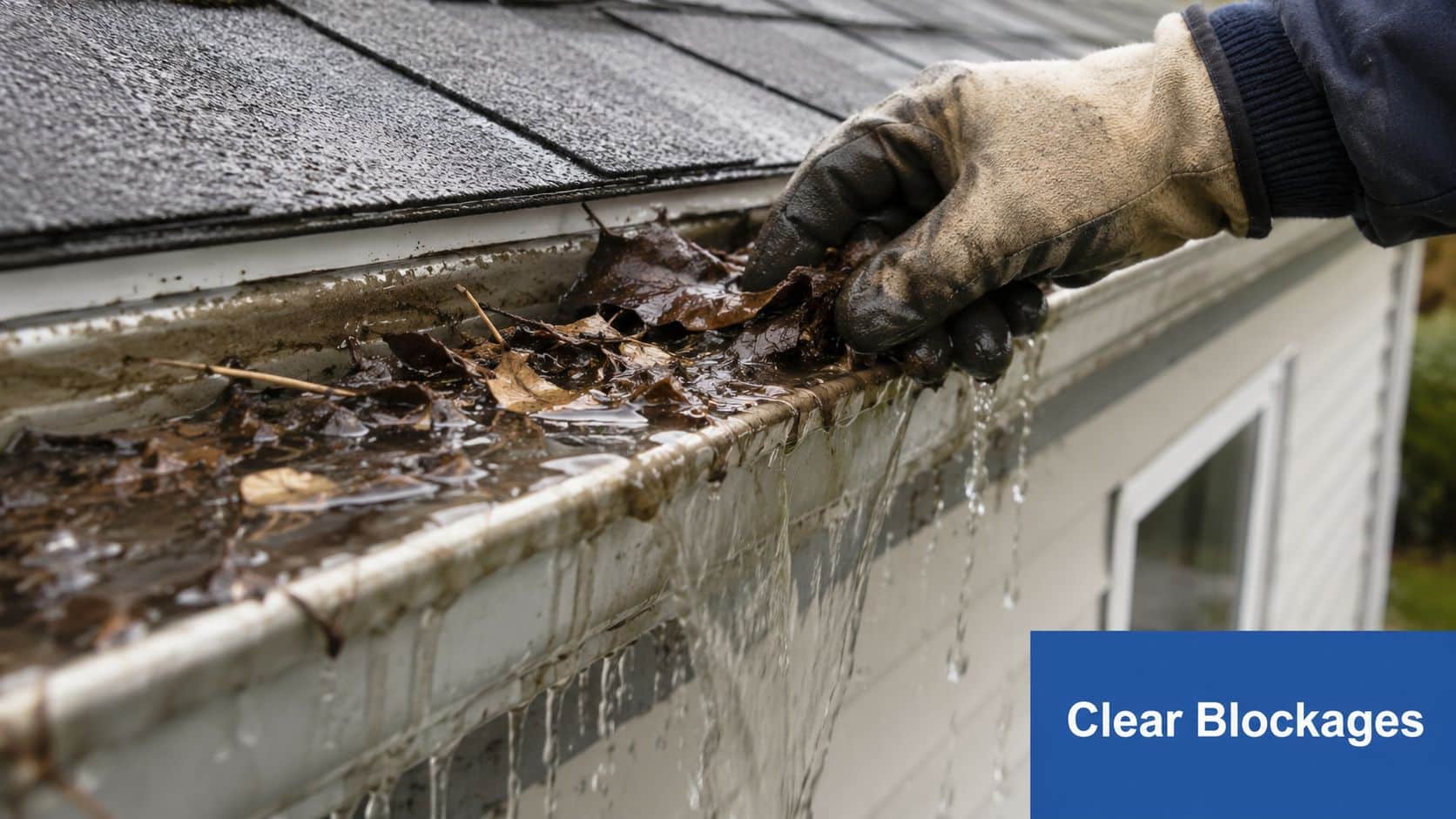
If you flushed the trough and water stalled near the outlet, the clog is often inside the elbow. That area catches dense sludge and small debris that compacts over time. In homes with underground drain tie-ins, access gets trickier because the visible problem may not be the full problem.
Try the system in this order:
- Remove what you can by hand: Reach the opening first.
- Test with controlled water flow: Don't blast blindly if backup starts immediately.
- Use an auger when needed: Some clogs need mechanical breakup rather than more pressure.
- Inspect the lower discharge area: Make sure the blockage isn't farther down the line.
When the slope is the real issue
Not every clog comes from debris volume. A gutter can be clean and still hold water if it sags. The technical benchmark is a minimum drop of 1/4 inch per 10 feet toward the downspout, and 60% of gutter clogs result from improper installation or sagging hangers rather than debris volume alone, according to this gutter slope and flush test reference.
That's why the flush test matters. Run water from the far end and watch whether it drains quickly and cleanly. If water pools in the middle, hangs in one section, or leaves standing water after the flow stops, the pitch needs attention.
If water remains in a clean gutter, stop blaming the trees. Check the hangers and the slope.
If overflow has already shown up near fascia, soffits, or wall lines, pair the gutter check with these DIY roof leak inspection tips so you don't miss moisture entry points higher up.
Keeping Gutters Clearer for Longer
The easiest gutter cleaning job is the one that never gets severe. In Arizona, that means paying attention to what drops onto the roof and when it drops. Palo Verde, Mesquite, ornamental trees, and neighboring shade trees all contribute differently. Dust matters too. Even homes without dense leaf fall can collect enough grit to slow drainage over time.
A good maintenance plan starts with tree exposure, not guesswork. For homes with deciduous trees within canopy range of the roofline, the recommended minimum is twice per year, while properties with 10 or more mature trees within 50 feet of the roofline need quarterly cleaning, based on this gutter cleaning frequency guide.
A practical schedule for Arizona homes
Use the property itself to drive the schedule.
- Light tree coverage: Inspect before monsoon season and after major debris periods.
- Heavy canopy near the roof: Expect more frequent service because valleys, elbows, and downspouts load faster.
- Dust-prone areas: Check for sediment buildup even when there aren't many visible leaves.
For a local service mindset instead of a once-a-year scramble, this overview of gutter cleaning and maintenance is a useful reference.
Where gutter guards help and where they don't
Gutter guards can reduce maintenance, but they don't make gutters maintenance-free. In Arizona, guards can still collect mud, fine seed debris, and roof grit on top or around openings. They help most when the property gets repeated leaf drop and the homeowner wants fewer ladder trips.
A few trade-offs matter:
| Option | What it does well | What it struggles with |
|---|---|---|
| Open gutters | Easy to inspect and scoop clean | Fill faster in leaf-heavy areas |
| Guarded gutters | Reduce large debris entry | Can still collect fine dust and compacted sediment |
| Professional maintenance plan | Catches buildup before storms | Costs more than waiting and hoping |
The point isn't to eliminate all future cleaning. It's to avoid the packed, storm-failing condition that turns a maintenance task into a drainage problem.
DIY Gutter Cleaning vs Calling the Pros
For some homes, DIY is perfectly reasonable. For others, it's false economy. The right answer depends on height, access, debris type, and how confident you are with ladder work.

When DIY makes sense
A single-story house with open access and light debris is the best case for a homeowner. If the gutters are visible, the ladder can sit on firm level ground, and you're dealing with loose dry material instead of packed sludge, you can often handle it well with basic tools and patience.
DIY also makes sense if you're willing to do the full job. That means setup, manual debris removal, downspout testing, flush testing, cleanup, and inspection.
When calling a professional is smarter
Professional service becomes the better choice when the roofline is high, the gutters are packed, or the property has awkward access. The same goes for homes with repeated drainage problems, signs of sagging, or downspouts tied into underground drains.
Cost is part of the equation. The average cost for professional gutter cleaning is $360 per appointment, with two- and three-story homes rising to $210–$450, and a typical service visit takes 2 to 4 hours, according to this professional gutter cleaning cost breakdown. If you want a local budgeting reference, review this guide to gutter cleaning cost.
Side by side decision points
| Factor | DIY | Professional service |
|---|---|---|
| Direct cost | Lower cash outlay if you already own the tools | Higher upfront service cost |
| Time | Your weekend, your cleanup, your ladder setup | Handled in one scheduled visit |
| Safety | Higher personal risk on ladders and upper rooflines | Better fit for difficult access and taller homes |
| Thoroughness | Good if conditions are simple and you know what to check | Better for hidden clogs, slope issues, and full inspection |
If the job includes height, stubborn clogs, or uncertainty about what's causing the overflow, hiring it out usually costs less than one avoidable repair.
If your gutters are packed with leaves, dust, and monsoon-season buildup, South Mountain Window Cleaning, LLC is a practical call. The team handles exterior cleaning for homes and businesses across Phoenix, Scottsdale, Paradise Valley, Chandler, Tempe, and Gilbert, and that includes the kind of gutter work that's safer and more effective with trained crews and proper equipment. If you'd rather skip the ladder, get a quote and have the system cleaned before the next storm tests it for you.