
A lot of Phoenix-area homeowners don't think about their gutters until the first hard monsoon rain hits. Water comes off the roof fast, the sky opens up, and suddenly you hear it. Splashing over the edge, pouring near the patio, hammering one corner of the house harder than it should. In that moment, the question isn't whether your gutters look clean from the ground. It's whether they're moving water where it needs to go.
This underscores the importance of gutter maintenance. Gutters aren't trim. They're part of the drainage system that protects the roofline, exterior walls, and foundation from water that would otherwise dump right against the structure. When they clog, even partially, they stop acting like channels and start acting like spillways.
In Arizona, that risk gets overlooked because we don't deal with steady rain for long stretches the way some climates do. But that can make homeowners less prepared for the kind of intense burst that exposes every weak point at once. A gutter full of dust, seed pods, leaves, roof grit, and nesting debris may sit undisturbed for weeks. Then one storm turns all of it into a blockage.
That's why routine upkeep belongs on the same list as roof checks, exterior washing, and seasonal inspections. If you're reviewing your broader annual home maintenance checklist, gutter service should sit near the top, not near the bottom.
Your Home's First Line of Defense Against Water Damage
A Phoenix monsoon can dump roof runoff in minutes, not hours. In that short burst, the gutter system has one job. Catch the water at the roof edge, move it into the downspouts, and discharge it far enough from the house that it does not soak fascia, stucco, window trim, or the soil along the foundation.
When that path stays clear, water leaves in a controlled way. When it does not, the roofline starts shedding water wherever gravity wins. Overflow at one corner can leave dirty streaks on exterior walls, soften painted wood, and keep areas damp that were built to dry quickly. If you have ever seen water slipping behind the gutter instead of through it, the system is already failing at its basic purpose.
Practical rule: If roof runoff is not being collected and redirected, the house is taking that water somewhere you do not want it.
The Federal Emergency Management Agency identifies gutters and downspouts as part of the drainage measures used to direct water away from a structure and reduce water intrusion risk, as explained in FEMA guidance on protecting building utility systems from flood damage. That matters in Arizona because short, intense storms expose weak drainage fast. A gutter can look acceptable from the driveway and still be carrying packed dust, roof grit, seed pods, and bird nesting material that cuts flow when the rain arrives.
I see that pattern often on Phoenix, Scottsdale, Paradise Valley, Chandler, Tempe, and Gilbert homes. Dust storms load fine debris into troughs and downspouts. Pigeons, insects, and rodents treat neglected gutters like protected edges. Then one hard rain turns a slow-developing maintenance problem into staining, moisture intrusion, and expensive repair work. Owners who follow a realistic annual home maintenance checklist for Arizona homes usually catch these issues before runoff starts finding its own path.
That connection between repeated moisture exposure and building damage is also part of understanding property damp and timber issues. Gutters sit at the front of that problem. If they stop controlling water at the roofline, the rest of the exterior has to absorb the consequences.
The Cascade of Damage from Neglected Gutters
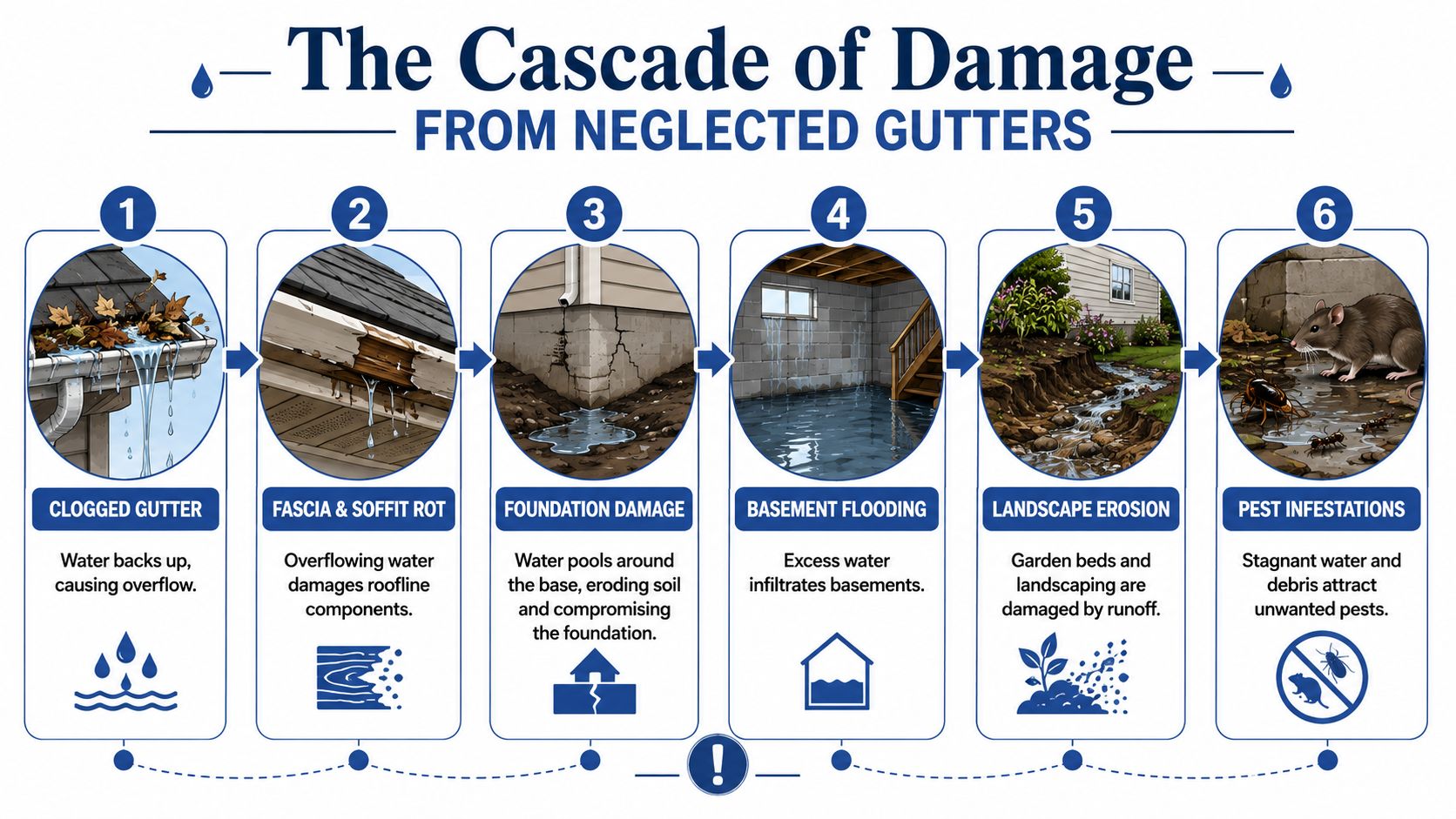
A Phoenix monsoon can dump heavy rain on a house in minutes. If the gutters are packed with dust, seed pods, and nesting debris, that water has nowhere controlled to go. It spills over the front edge, runs behind the gutter, and starts wetting trim, stucco, roof decking, and the soil around the house all at once.
What starts at the roofline
The first damage usually shows up at the fascia and soffits. Those parts are exposed as soon as water starts backing up under the roof edge or spilling over in the same spot storm after storm. On stucco homes, I often see dark streaking and paint failure first. On homes with wood trim, the warning signs are swelling, peeling, and soft areas that do not stay cosmetic for long.
Water also travels in ways owners do not expect. It can run behind the gutter, wick into joints, and stay trapped where airflow is poor. Guidance from TK Gutters on gutter installation and maintenance explains that clogged gutters turn roof runoff into uncontrolled discharge against the fascia, siding, and foundation. This discharge is the central concern, as the gutter stops directing water and starts dumping it onto the building.
On two-story homes and larger rooflines, this gets missed for too long because the overflow is hard to see from the ground.
How the damage moves down the house
Once water leaves the gutter in the wrong place, the next problems show up around the perimeter.
- Foundation exposure increases when runoff collects next to the house instead of being carried away.
- Soil erosion starts around planting beds, pavers, and walkways where repeated discharge cuts channels into the grade.
- Finish damage shows up on siding, stucco, trim, and paint where splashback keeps materials wet longer than they were built to handle.
- Moisture intrusion risk rises at corners, penetrations, and wall transitions that see repeated saturation.
The downspout matters as much as the trough. The EPA's water management guidance for homes recommends extending downspouts at least 5 feet from the house so runoff does not collect against the foundation. In Arizona, that point gets overlooked because long dry stretches make drainage problems easy to ignore until the next hard storm exposes them.
If you are already seeing staining, soft trim, or recurring moisture at exterior walls, it helps to understand how prolonged wetting affects the structure over time. This overview of understanding property damp and timber issues is useful because it connects surface symptoms to the hidden material damage behind them.
The secondary problems owners miss
Neglected gutters also attract pests. In Phoenix-area neighborhoods, debris-filled troughs give pigeons, insects, and rodents a sheltered edge near the roofline. Add monsoon moisture, and that buildup stays damp longer than many owners realize. A gutter full of packed dust can act like soil. I have seen weeds growing out of them, which tells you water and organic debris have been sitting there for a while.
A few signs usually show up before repair bills do. Water spilling over the front edge points to a blockage or slow downspout. Sagging sections usually mean trapped debris and standing water are adding weight. Washed-out mulch below one corner often means runoff is concentrating at a failed joint or clogged outlet.
| Warning sign | What it often means |
|---|---|
| Water spilling over the front edge | Debris blockage or slow downspout flow |
| Dark streaks on walls | Repeated overflow in the same location |
| Sagging gutter sections | Weight from trapped debris or retained water |
| Washed-out mulch below one corner | Concentrated discharge from a failed section |
| Plant growth in the gutter | Long-term buildup and retained moisture |
Owners usually call after the overflow becomes obvious. The better move is to deal with the buildup before runoff starts finding weak points in the exterior. A realistic gutter cleaning cost breakdown for Arizona homes makes that decision easier, especially compared with fascia repairs, repainting, drainage correction, or stucco patching.
The Financial Case for Gutter Maintenance
Most owners don't need to be convinced that water damage is bad. What matters is whether regular gutter service makes financial sense. It does, because the cost of upkeep is usually small compared with the cost of letting runoff hit the structure over and over.
A useful benchmark comes from an industry summary cited by CAI Keystone's guidance on gutter cleaning and property protection. It estimates gutter installation at about $1,000 to $2,500 and replacement at roughly $1,000 to $3,000. The same guidance makes the practical point that a low-cost maintenance routine can help avoid repairs that are often more expensive than the gutters themselves.
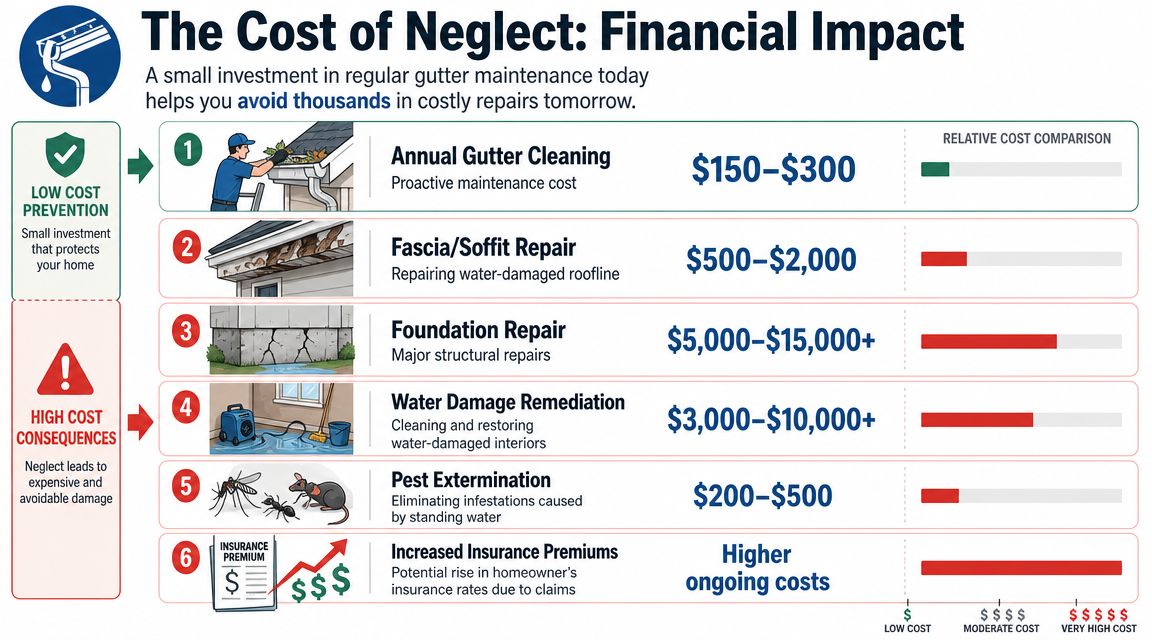
That matters because neglected gutters rarely create one tidy invoice. They create a stack of smaller and larger costs that hit different parts of the property at different times. You may start with trim repair. Then you need repainting. Then a drainage correction. Then interior cleanup after water finds its way inside.
Why deferred maintenance gets expensive
Owners often think in terms of direct gutter problems. The more accurate way to think about it is risk transfer. If the gutter fails, the house becomes the drainage path.
That means you may end up paying for things such as:
- Roof-edge repairs when fascia or soffits stay wet
- Exterior cleanup and restoration after staining and runoff marks build up
- Drainage corrections when water repeatedly lands near the structure
- Moisture-related remediation if hidden dampness develops behind finishes
If you're budgeting service, it helps to compare options ahead of time. A local guide to gutter cleaning cost can help frame what routine maintenance typically includes so you can evaluate it against the far less predictable cost of repairs.
Here's a practical visual on that trade-off:
What owners get wrong about saving money
The biggest budgeting mistake is assuming that if gutters still look attached, they're doing their job. Function matters more than appearance. A system can stay in place and still discharge water in the wrong spot every time it rains.
Bottom line: Maintenance is cheaper when you buy it on your schedule, not after water chooses the timing for you.
That's the financial logic behind the importance of gutter maintenance. You're not paying for debris removal alone. You're paying to keep water from becoming a repair category.
Unique Gutter Challenges in the Phoenix Climate
Arizona changes the equation. Generic gutter advice usually focuses on leaves, snow, and long wet seasons. In the Phoenix area, gutter failures often come from sudden storm intensity, airborne dust, heat exposure, and pest activity.

Monsoon rain exposes partial clogs fast
A gutter doesn't need to be packed solid to fail in Arizona. During a hard monsoon burst, even a partially blocked section can overflow because the water arrives too quickly for a narrowed channel or slow downspout to keep up.
That's why baseline scheduling matters. Guidance commonly recommends cleaning gutters at least twice a year, and for properties surrounded by trees the recommendation rises to every three months, as explained in Great Day Improvements' maintenance guidance. In Arizona, that same logic applies to dust and desert plant debris, not just leaves.
If you're trying to time service around local weather patterns, this guide on the best time for gutter cleaning is a practical place to start.
Dust storms create sludge, not just debris
Haboobs do more than blow material onto the roof. They fill valleys, corners, and gutters with fine dust that mixes with seed pods, shingle grit, feathers, and organic debris. Once a little moisture hits that mix, it can form a dense sludge that doesn't rinse out on its own.
That creates two common problems:
- Flow restriction in trough sections that look only partly dirty from above
- Downspout blockages where heavy sediment settles and compacts
This is why quick visual checks from the ground can be misleading. The gutter may not look full, but the outlet can still be narrowed enough to fail under pressure.
Heat and pests make neglect worse
Arizona sun is hard on exterior materials. Over time, heat and UV exposure can contribute to brittleness, joint movement, and seal degradation. Add trapped debris and retained moisture to that mix, and small defects become more likely to show up during a storm.
Pests are the other local factor owners underestimate. Clogged gutters give insects and small animals shade, shelter, and moisture. Birds pull from the buildup for nesting. In some homes, the roof edge becomes a recurring activity zone because the gutter was left dirty long enough to become habitat.
Phoenix-area gutter care isn't about copying a national checklist. It's about preparing for a climate where long dry spells hide problems, then one storm reveals all of them at once.
DIY Cleaning vs Hiring a Professional Service
Some homeowners can clean their own gutters. On a single-story home with stable footing, the right ladder, gloves, a scoop, a bucket, and a hose, DIY may be workable. But the main question isn't whether it's possible. It's whether it's the safest and most complete way to get the system functioning again.

Where DIY makes sense
DIY usually works best when the property is simple and the owner is realistic about the job.
A basic homeowner approach can be reasonable if:
- The home is low and accessible with straightforward rooflines
- The debris is light and hasn't compacted into wet sediment
- You can inspect downspouts fully, not just remove what's visible at the top
- You already use ladder safety correctly and don't rush the work
The upside is control. You can handle the schedule yourself and address small buildup before it becomes a bigger blockage. If you're considering that route, this practical guide on how to clean gutters safely covers the basics worth reviewing before you get on a ladder.
Where DIY usually falls short
Most incomplete gutter jobs fail in one of two places. The homeowner clears the trough but doesn't fully flush the downspout, or they remove the obvious debris and miss sagging sections, separated joints, or areas where water has already been running behind the gutter.
That's especially common on taller homes, tile-roof properties, and buildings with multiple roof transitions. The work also takes longer than people expect, especially when debris has packed into corners or outlets.
A balanced view looks like this:
| Decision factor | DIY cleaning | Professional service |
|---|---|---|
| Up-front expense | Lower if you already have tools | Higher because you're paying for labor and service |
| Time required | Often a half-day or more | Minimal owner time |
| Safety exposure | You take the ladder risk | Crew handles access and roof-edge work |
| Inspection quality | Depends on experience | Better chance of spotting drainage and attachment issues |
| Result consistency | Varies by property and effort | More predictable if the scope includes clearing and flushing |
What a pro should actually do
Professional service is worth it when the provider does more than scoop out leaves. A proper visit should include debris removal, downspout flow verification, and a look at the condition of the system after cleaning. South Mountain Window Cleaning, LLC is one local option that provides gutter cleaning as part of exterior maintenance service in the Phoenix area.
Gutter guards don't eliminate this need. Guidance from SERVPRO's gutter maintenance resource emphasizes that guards are not a full substitute for maintenance and that gutters should still be checked at least twice a year, because clogs, sagging, and downspout backups can still happen.
Guards can reduce what gets in. They don't correct pitch, flush downspouts, or tell you when water is escaping in the wrong place.
For many owners, the deciding factor is simple. If the property is tall, the roofline is complex, the gutter has gone too long without service, or you want someone to catch problems before the next storm, hiring a professional is the more practical choice.
Your Action Plan for Healthy Gutters
A workable gutter plan doesn't need to be complicated. It needs to be consistent. Most properties should be checked and cleaned at least twice a year. Homes with heavier debris exposure, nearby trees, or recurring dust accumulation may need more frequent attention, especially before and after monsoon season.
The key is to stop treating gutters as an isolated chore. As noted in guidance on gutter maintenance and envelope protection, gutter cleaning isn't just a roof task. It's part of envelope maintenance and risk reduction. Repeated overflow can saturate exterior walls, damage soffits, and create hidden moisture issues behind cladding.
A simple owner checklist helps between service visits:
- Watch water behavior during rain. Overflow, drips behind the gutter, or one downspout dumping weakly are all warning signs.
- Look at the exterior below the roofline for stains, washed-out soil, or damaged mulch beds.
- Check for sagging sections or joints that appear separated after storms.
- Pay attention to pest activity near eaves, especially where debris tends to sit.
- Schedule proactively instead of waiting for visible overflow.
Clean gutters protect more than the gutter itself. They protect the surfaces and structure below it.
If you want the simplest path, put inspections on the calendar before the heavy rain period, after major storms, and anytime you see runoff behaving differently than it should. That approach catches problems when they're still maintenance items, not restoration jobs.
If your home or building in Phoenix, Scottsdale, Paradise Valley, Chandler, Tempe, or Gilbert needs gutter attention, South Mountain Window Cleaning, LLC can provide a straightforward assessment and help you schedule routine service before the next storm tests your drainage system.