
That weekend chore of clearing out your gutters feels straightforward enough, but it hides a serious risk far too many homeowners overlook. Knowing how to clean gutters safely is the critical first step, not just a friendly suggestion. This job takes more than a ladder and a bucket; it demands real preparation, awareness, and a healthy respect for the heights involved.
At South Mountain Window Cleaning, we've seen it all, from sun-baked debris in Scottsdale to monsoon-clogged gutters in Phoenix. Our team of professionals serves homeowners across Paradise Valley, Chandler, Tempe, and Gilbert, and we want to share our expertise to help you stay safe.
The Hidden Dangers of DIY Gutter Cleaning
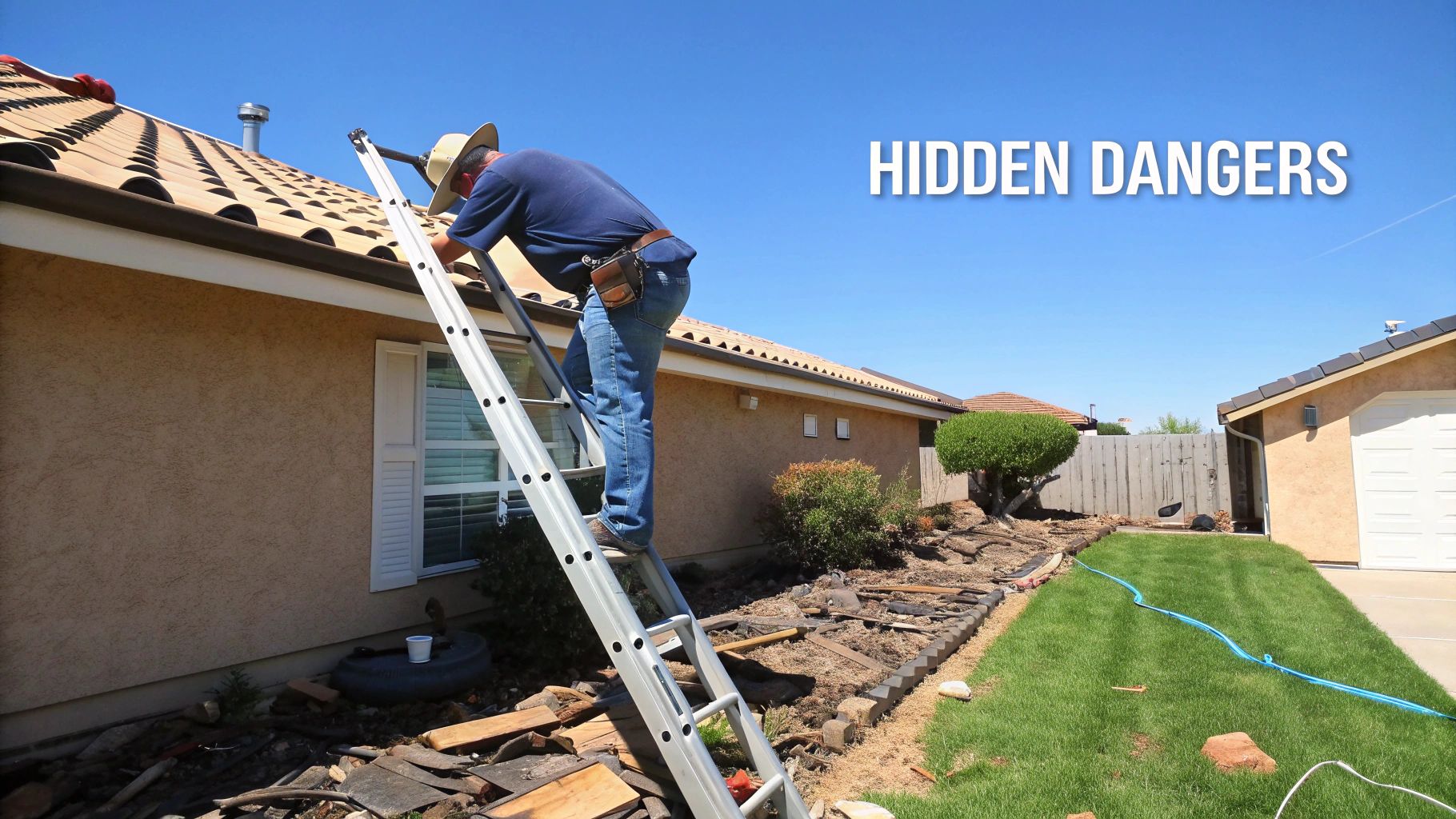
Most people completely underestimate the risk that comes with gutter maintenance until it's too late. The task seems simple, but it consistently ranks as one of the most dangerous home maintenance jobs you can do.
This isn't about scaring you; it's about fostering respect for the task at hand. The moment your feet leave the ground, the potential for a life-altering accident goes up dramatically.
An Eye-Opening Reality
The numbers paint a pretty stark picture. Every single year in the United States, ladder falls during gutter cleaning send around 20,000 people to the emergency room. These incidents are a huge slice of the more than 500,000 annual ladder-related injuries reported nationwide. You can see more on these ladder safety statistics at afaluminum.com.
A momentary lapse in judgment, like overreaching for just one more handful of leaves, is all it takes to become part of that statistic. This is exactly why a safety-first mindset is the only way to approach this job.
For homeowners in Phoenix, Scottsdale, and right across the Valley, our local conditions add another layer of risk. The intense Arizona sun can bake debris into a solid, almost concrete-like mass that requires some serious force to dislodge.
Arizona’s Unique Challenges
The environment here in the desert throws some unique curveballs that can turn a simple job into a high-stakes activity.
- Hardened Debris: Months of sun exposure can turn leaves, dust, and roof grit into a stubborn, compacted layer. Trying to pry this stuff loose is a great way to unbalance yourself on a ladder.
- Unstable Ground: Our dry, dusty, or gravel-covered ground offers poor footing for a ladder. A setup that seems stable can shift without warning, especially as you move and apply force from above.
- Monsoon Aftermath: Cleaning up after a big storm often means dealing with heavy, water-logged debris. That adds a ton of weight to your gutters and makes the job physically demanding and treacherous.
Understanding these Arizona-specific factors is absolutely essential. They demand more than just caution; they require a deliberate, well-planned strategy for how to clean your gutters safely from start to finish.
Gathering Your Essential Tools and Safety Gear
Any job, whether you're a pro or a DIYer, starts with having the right gear. Gutter cleaning is no different. Honestly, getting your setup right before you even think about stepping on a ladder is half the battle. This isn’t just about making the job easier; it’s about making sure you finish the day in one piece.
Think of your equipment in two simple buckets: the stuff that protects you, and the stuff that gets the gunk out. Let's break down what you actually need, especially with our unique Arizona environment in mind.
Personal Protective Equipment (PPE)
This is the gear you wear. Don't even think about skipping this stuff—it’s a small hassle that can prevent a big injury.
- Heavy-Duty Gloves: You're not just scooping out a few damp leaves here in Arizona. You’ll find sun-baked, razor-sharp twigs, gravel from your roof, and maybe even a few mesquite thorns. A good pair of thick, puncture-resistant gloves is an absolute must to keep your hands safe from cuts, scrapes, and nasty bacteria.
- Safety Glasses: Gutter gunk has a way of flying everywhere when you least expect it. A simple pair of safety glasses is all it takes to protect your eyes from falling debris, dust, and all the other grime you’ll be pulling out.
- Non-Slip Footwear: This is non-negotiable. You need sturdy, closed-toe shoes or boots that have a serious grip. The soles need to hold firm on ladder rungs and stay stable on our often rocky or uneven desert ground.
Essential Gutter Cleaning Tools
The right tools make this job go from a frustrating chore to a straightforward task. You might be surprised that what the pros use is often pretty simple. If you're curious about the gear we use for other jobs, you can get a peek at what professionals use to clean windows.
For your gutters, this is the core kit you’ll want:
- A Sturdy Ladder with a Stabilizer: An extension ladder is usually what you'll need. But the key accessory here is a ladder stabilizer (sometimes called stand-off arms). It’s a U-shaped attachment that braces against the roof itself, not your gutters. This is a game-changer—it stops you from crushing or scratching the gutters and makes the ladder incredibly more stable.
- Gutter Scoop or Trowel: You can buy a plastic gutter scoop, which is great because it’s flexible and won’t gouge the metal. A simple garden trowel works just as well for scraping out that packed-down dirt and debris.
- Buckets with Hooks: Get a couple of 5-gallon buckets and attach some sturdy hooks to them. You can hang them right off the ladder, which frees up your hands so you can always maintain three points of contact.
- Garden Hose with a Spray Nozzle: Once the big chunks are gone, you’ll need to flush everything out. A hose with a high-pressure nozzle will clear out the remaining grit and is the perfect way to check if your downspouts are running clear.
Before you start, lay everything out and give it a quick once-over. Are your gloves torn? Is the ladder wobbly? Take a minute to fix or replace anything that looks off. This simple pre-check habit is fundamental to doing the job safely.
Your Gutter Cleaning Safety Checklist
Here’s a simple table to help you double-check that you have everything ready to go before you climb that ladder.
| Item Category | Essential Gear | Safety Purpose |
|---|---|---|
| Head & Eye Protection | Safety Glasses | Shields eyes from falling debris, dust, and grime. |
| Hand Protection | Heavy-Duty, Puncture-Resistant Gloves | Protects hands from sharp objects, bacteria, and roof grit. |
| Foot Protection | Sturdy, Non-Slip Shoes/Boots | Ensures solid footing on ladder rungs and the ground. |
| Ladder & Stability | Extension Ladder with a Stabilizer | Provides safe roof access and prevents damage to gutters. |
| Debris Removal | Gutter Scoop or Garden Trowel | Efficiently removes packed-down leaves, twigs, and muck. |
| Debris Collection | Buckets with Ladder Hooks | Keeps your hands free for a secure grip while working. |
| Final Flushing | Garden Hose with a High-Pressure Nozzle | Clears remaining fine debris and tests downspout flow. |
Having these items ready and in good condition is your best insurance policy for a successful and accident-free cleaning day.
Mastering Ladder Safety and Preventing Falls
Once you have your gear ready, the most important part of the job begins before your foot ever touches that first rung. Honestly, knowing how to clean your gutters safely is really all about mastering your ladder. Every year, thousands of people get seriously hurt not from bad equipment, but from simple, preventable mistakes in how they set up and use their ladders.
Here in Phoenix and across the Valley, the ground itself can be a real challenge. Our dry, often uneven desert landscape is not exactly the perfect foundation. Finding a stable patch of ground is your first—and most critical—task. You'll want to avoid any soft, sandy spots or areas with loose gravel. Look for firm, level dirt and clear away any rocks or debris that could make the ladder’s feet shift.
This infographic breaks down the core process into three essential safety actions.
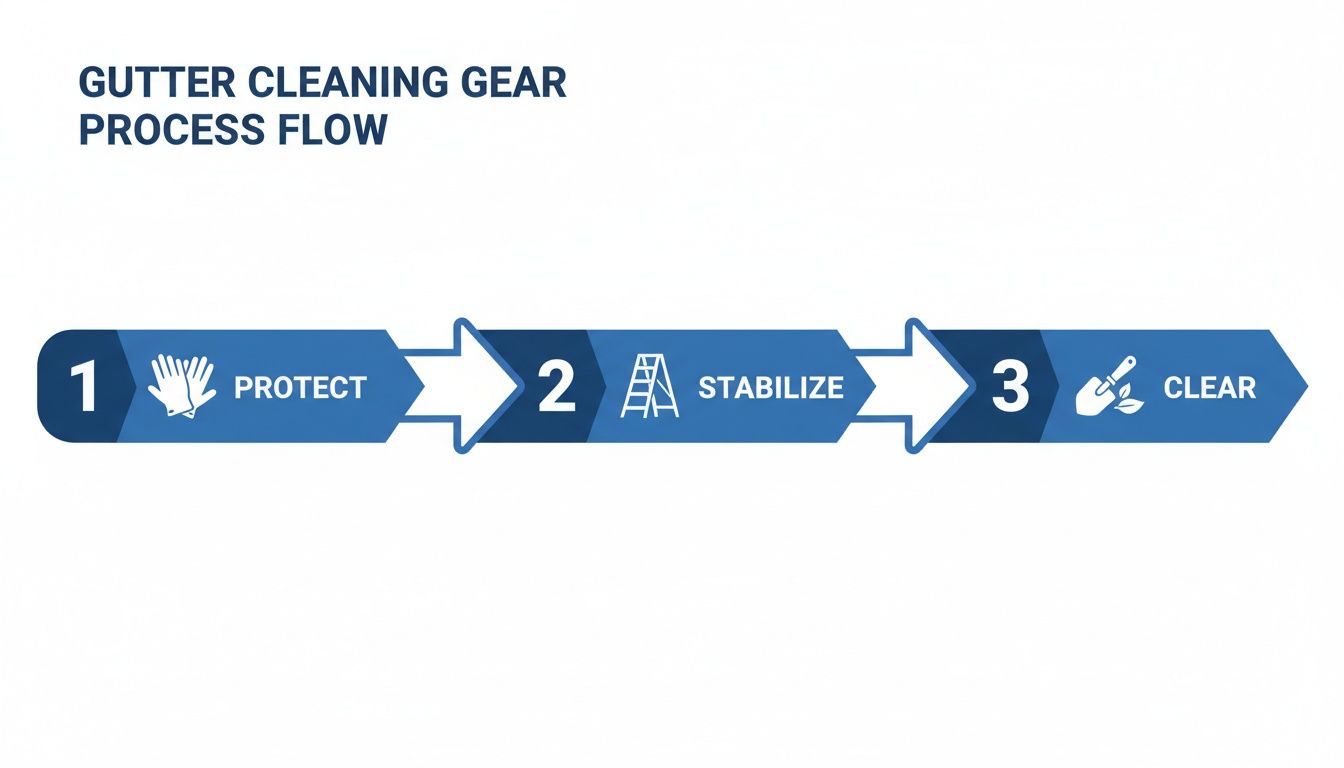
It really highlights that safety is a sequence: protection for yourself, stability for your ladder, and a methodical approach to clearing debris are the cornerstones of getting the job done right.
Setting the Correct Ladder Angle
After you’ve found a solid spot, the next step is getting the ladder set at the proper angle. This is where a lot of people go wrong, and it creates a dangerously unstable situation. The go-to rule of thumb is the 4-to-1 rule: for every four feet of height the ladder reaches up the wall, the base should be one foot away from it.
There's an easy way to check this. Just stand with your toes touching the feet of the ladder and stretch your arms straight out. Your fingertips should just graze the rungs. If you find yourself leaning forward, the base is too far away; if your arms are bent, it's too close. Nailing this angle gives you that perfect balance of stability and support.
A ladder set too steeply can tip backward on you as you climb. One that's too shallow can have its feet slide right out from under you. The 4-to-1 angle is the non-negotiable standard for a reason—it just works.
Before you even think about climbing, give the ladder a firm shake. It shouldn't wobble or shift at all. On an extension ladder, double-check that every single locking mechanism is fully engaged. This simple test takes five seconds and can prevent a disaster.
The Three Points of Contact Rule
As you start working, the most important safety mantra to have on repeat is "three points of contact." This means you should always have either two hands and one foot, or two feet and one hand, on the ladder. This is exactly why using a bucket with a hook is so crucial—it frees up your hands so you can keep a secure grip.
This rule is absolute. It means you have to fight that powerful temptation to overreach. When you stretch your body way out to one side, you're shifting your center of gravity outside the ladder's rails, which is the number one cause of those sideways tipping falls. It is always, always safer to climb down and move the ladder a few feet than to risk a dangerous stretch. For a deeper dive on this and other vital techniques, check out these essential ladder safety tips that we follow on every single job.
What Not to Do When on the Ladder
Knowing what to avoid is just as important as knowing what to do. Here are a few common but dangerous mistakes we see homeowners make all the time:
- Never Stand on the Top Two Rungs: Seriously, don't do it. Those are for holding on to maintain stability, not for standing. Using them as steps throws your balance off and makes the ladder incredibly unstable.
- Avoid Working in Bad Weather: This is a big one during Arizona's monsoon season. Sudden, gusty winds can easily knock a ladder right over. Never try to clean your gutters on a windy or rainy day.
- Don't Carry Tools in Your Hands: Use a tool belt or hooked buckets to get your gear up. Climbing up or down with your hands full is a direct violation of the three-points-of-contact rule and is just asking for trouble.
- Face the Ladder When Climbing: Always face the ladder and use both hands when you're going up or down. Never try to "walk" down or turn your back to the rungs.
By sticking to these fundamental safety principles, you can turn gutter cleaning from a high-risk gamble into a totally manageable and safe home maintenance task.
Getting to Work: How to Properly Clear Your Gutters
Alright, you’ve got your ladder set up safely and your gear is on. Now for the main event. It’s tempting to just start scooping from one end and work your way to the other, but a little strategy here goes a long way. I always tell people to start at the downspout and work away from it.
Why? It’s simple. This way, you’re pulling all the gunk away from the drain instead of accidentally jamming it down there. Trust me, creating a nasty clog in the downspout is the last thing you want to do after you’ve spent all this time on a ladder. It makes the final flush-out much, much easier.
Scoop Out the Heavy Stuff First
Your first pass is all about brute force—getting the big debris out. Grab your gutter scoop or a garden trowel you don’t mind getting dirty and start lifting out the bulk of it. Here in Arizona, we’re not just dealing with a few fluffy leaves. More often than not, it’s a solid, sun-baked brick of dirt, roof granules, and whatever else has found its way up there.
Take your time and work in small sections you can easily reach without stretching. Scoop the debris directly into your bucket. Once it's about two-thirds full, climb down, dump it, and move the ladder. Trying to rush or overreach is where people get into trouble.
It’s easy to put off this chore, but the numbers don't lie. A recent report found that 27% of homeowners wait until there’s a problem before they even think about their gutters. That's a huge gamble when 40% have already dealt with home damage from overflows. You can read more about these gutter protection findings to see why getting ahead of the problem is so critical.
The Final Flush: Test and Clean
Once you’ve wrestled all the solid junk out of the gutters, it’s time to break out the garden hose. Make sure you have a high-pressure nozzle attached. Start at the end farthest from the downspout and give the gutter a good, strong spray.
This accomplishes two key things:
- It clears out the fine grit. The spray will wash away all the leftover roof sediment, dust, and tiny particles your scoop missed.
- It’s a performance test. You get to see your work in action. What you’re looking for is a powerful, steady stream of water gushing out the bottom of the downspout.
If the water starts pooling or just dribbles out, you’ve got a clog hiding in the downspout. Sometimes a few firm taps on the side of the downspout can shake it loose. For a really stubborn blockage, you might need to feed a plumber’s snake down from the top to break it up.
Dealing with Arizona-Specific Gutter Problems
Cleaning gutters around Phoenix has its own unique quirks. You have to be ready for what our climate throws at you.
A single monsoon storm can dump an unbelievable amount of debris—heavy palm fronds, mesquite branches, and thick mud—into your gutters in a matter of minutes. These aren't your average clogs; they can be dense and incredibly stubborn.
And then there are the critters. Our dry, warm weather makes gutters a prime piece of real estate for pests. It's common to find bird nests, signs of rodents, or even wasp nests tucked under the eaves. If you see a wasp nest or any other sign of infestation, back away slowly and call a pro. The last place you want to be when you anger a swarm of wasps is at the top of a ladder. It’s just not worth the risk.
Identifying and Avoiding Electrical Hazards
Of all the things that can go wrong while you're cleaning your gutters, there's one hazard that's both the most overlooked and the most lethal: overhead power lines. Before you even think about setting up your ladder, the very first thing you need to do is stop, look up, and scan the entire area for any electrical wires.
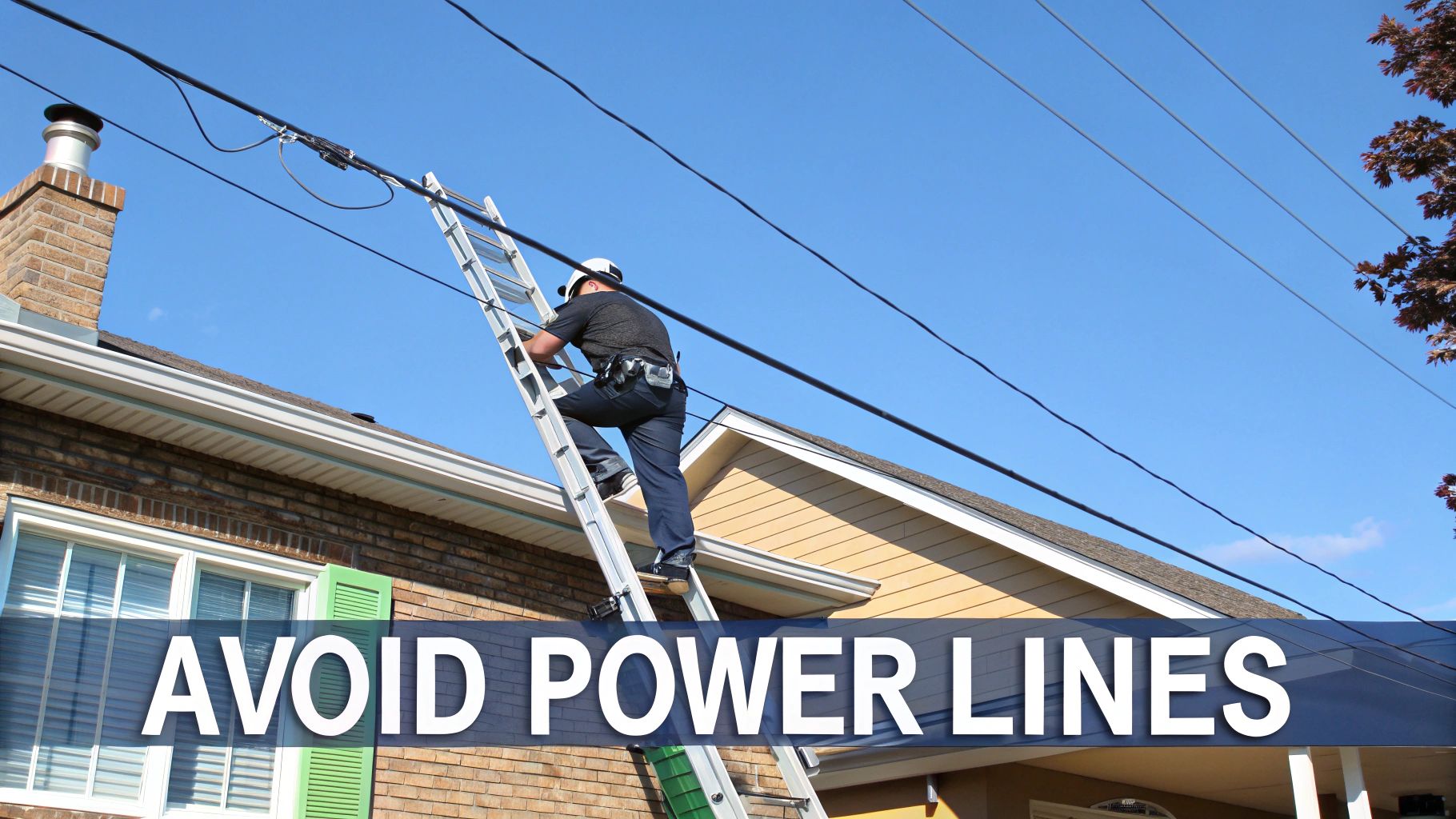
This initial survey is absolutely non-negotiable. If you spot any power lines running from a utility pole to your house—or even to a neighbor's place—you have to proceed with extreme caution. The danger gets even bigger if you're using a metal ladder, which is an excellent conductor of electricity.
The Unseen Danger Above
The statistics on this are frankly terrifying. Between 2011 and 2020, contact with overhead power lines was responsible for a staggering 39% of all electrically related workplace fatalities. A lot of these tragedies involved everyday people doing tasks just like gutter cleaning.
The rule here is simple and absolute: if power lines are anywhere near your roofline, this is no longer a DIY job. The risk of a fatal accident is just too high to ignore.
Never, ever use a metal ladder anywhere in the vicinity of overhead power lines. Electricity can arc from the wire to the ladder even without direct contact, and that jump is more than enough to be lethal. The only truly safe distance is a professional’s distance.
When to Immediately Call a Professional
If you see this hazard, it’s a clear sign to put down your tools and call in an expert. The team here at South Mountain Window Cleaning is trained to assess and work in these high-risk environments. Our technicians know how to operate safely around electrical hazards, a skill set that goes way beyond typical home maintenance. It's the same level of expertise we apply to other tricky rooftop jobs, like the ones detailed in our guide on how to clean solar panels safely.
And it's not just the obvious overhead lines. Your home's internal electrical systems can also pose a risk. It’s always a good idea to understand the safety devices in your home, which is why we recommend learning what a safety switch is and why your home needs one.
Trusting a professional isn't about giving up on a DIY project; it's about making the smartest, safest choice for you and your family.
Knowing When to Call a Professional
Being a savvy homeowner isn't just about knowing how to do a job yourself—it's about knowing when not to. While DIY gutter cleaning is certainly manageable for some, a few specific situations can dramatically increase the risks. This is where a weekend chore can quickly turn into a job best left for trained experts.
Recognizing the red flags is the key to staying safe.
If your home has a second story or a roof with a steep pitch, the danger of a serious fall skyrockets. The same goes for gutters that are packed solid with heavy, compacted debris or are showing visible signs of damage, like sagging or pulling away from the fascia. Trying to tackle those issues from a ladder without the proper training and professional-grade equipment is a huge gamble.
Bottom line: Your safety is always the number one priority. If you feel hesitant for any reason, don't have the right safety gear, or simply can't find the time to do the job properly, calling a pro is the smartest call you can make.
Signs It Is Time for an Expert
Sometimes you'll run into issues that should be an immediate stop sign for any DIY effort. Finding a pest infestation, for instance, requires a lot more than just a garden hose. Trying to handle wasps or bees while balancing on a ladder is a specialized skill, and it's a dangerous situation for the unprepared. You can learn more about how to safely remove wasp nests from the experts.
Hiring a licensed and insured team like South Mountain Window Cleaning gives you more than just safety—it buys you efficiency and genuine peace of mind. We have the right equipment and safety protocols to handle even the most complex jobs across Phoenix, Scottsdale, and the neighboring communities.
Choosing a professional isn't just an expense; it's a smart investment in protecting your home and, more importantly, yourself. If you're curious about the cost, you can check out our overview of local gutter cleaning prices to get a better idea of the investment.
Still Have Questions About Gutter Safety?
Even with the best game plan, it's normal to have a few questions pop up before you get started. We get calls about this stuff all the time, so here are some quick answers to the most common concerns we hear from homeowners around Phoenix.
How Often Do Gutters Need Cleaning in Arizona?
You'll want to give them a look every quarter, but a deep clean should happen at least twice a year. With our intense monsoon season and the constant dust blowing around, waiting a full year is just asking for trouble. A good rule of thumb is to clear them out right after a big storm—it stops all that wet debris from turning into a solid, concrete-like clog.
Is It Okay to Clean Gutters From the Roof?
We're going to give that a hard no. It's incredibly risky to walk on your roof to clean gutters, and we strongly advise against it. This is especially true for the tile roofs you see all over Scottsdale and Paradise Valley; those tiles can be surprisingly slick and are easily broken. A good, sturdy ladder that's set up correctly is the only safe way to tackle this job from above.
The biggest mistake we see homeowners make is getting complacent. They'll set up a ladder on an uneven spot, overreach instead of just moving the ladder, or completely miss the power lines running right next to the house. Any one of these slip-ups can lead to a serious fall. Taking an extra minute to double-check your setup is non-negotiable.
When the job starts feeling like too much of a hassle or the heights are making you nervous, that's what we're here for. The pros at South Mountain Window Cleaning have the training, insurance, and proper gear to get it done right. We serve Phoenix, Scottsdale, Paradise Valley, Chandler, Tempe, Gilbert, and the entire Valley, making sure your gutters are clear and you stay safely on the ground.
Ready to hand it over to us? Schedule your service at https://www.southmountainwindowcleaning.com.