
You turn off the ceiling fan and finally see what the moving blades were hiding: a thick gray ridge along each edge. There's a bed, dining table, or reception desk underneath, and reaching the top of the blades means more than stretching with a duster.
A ceiling fan cleaning service should remove that dust without spreading it through the room, protect the fixture's finish, and flag mechanical problems that cleaning won't fix. The useful distinction isn't clean versus dirty. It's whether the fan can be reached, isolated from power, and maintained safely.
Ceiling Fan Cleaning Costs and Time at a Glance
A basic cleaning estimate can help frame the budget, but access and scope determine the actual quote.
| Service | Typical price | What it covers |
|---|---|---|
| Basic cleaning, one fan | $117-$144 per fan | Blade, grille and light-kit cleaning on readily serviceable fans, subject to the quoted scope |
| Repair, for comparison only | $88-$198, average $142 | Mechanical or electrical fixes, not cleaning |
| Time per fan | Depends on fan count, ceiling height and access | Ask for an estimate for the whole visit, including setup and cleanup |
The basic-cleaning estimate assumes favorable, readily serviceable conditions. Repair is a separate category: a cleaning quote doesn't include diagnosing wiring, replacing a motor, or correcting a defective mounting assembly.
What moves the quote
A reachable bedroom fixture takes a different setup from a fan beneath a vaulted ceiling or above furniture that needs protection or moving. Fan count, ceiling height and access all affect how long the visit takes, so ask for a whole-visit estimate rather than relying on a per-fan time guess.
Other price drivers include integrated lights, heavy buildup and parts that need to be removed and reinstalled. Delicate fittings require careful handling, while sticky deposits take more than a quick dusting pass.
South Mountain Window Cleaning, LLC provides a fast, free quote for cleaning needs. Compare the scope with our cleaning service cost guide, then confirm whether the quote is per fan or per visit and whether it includes the downrod and light kit.
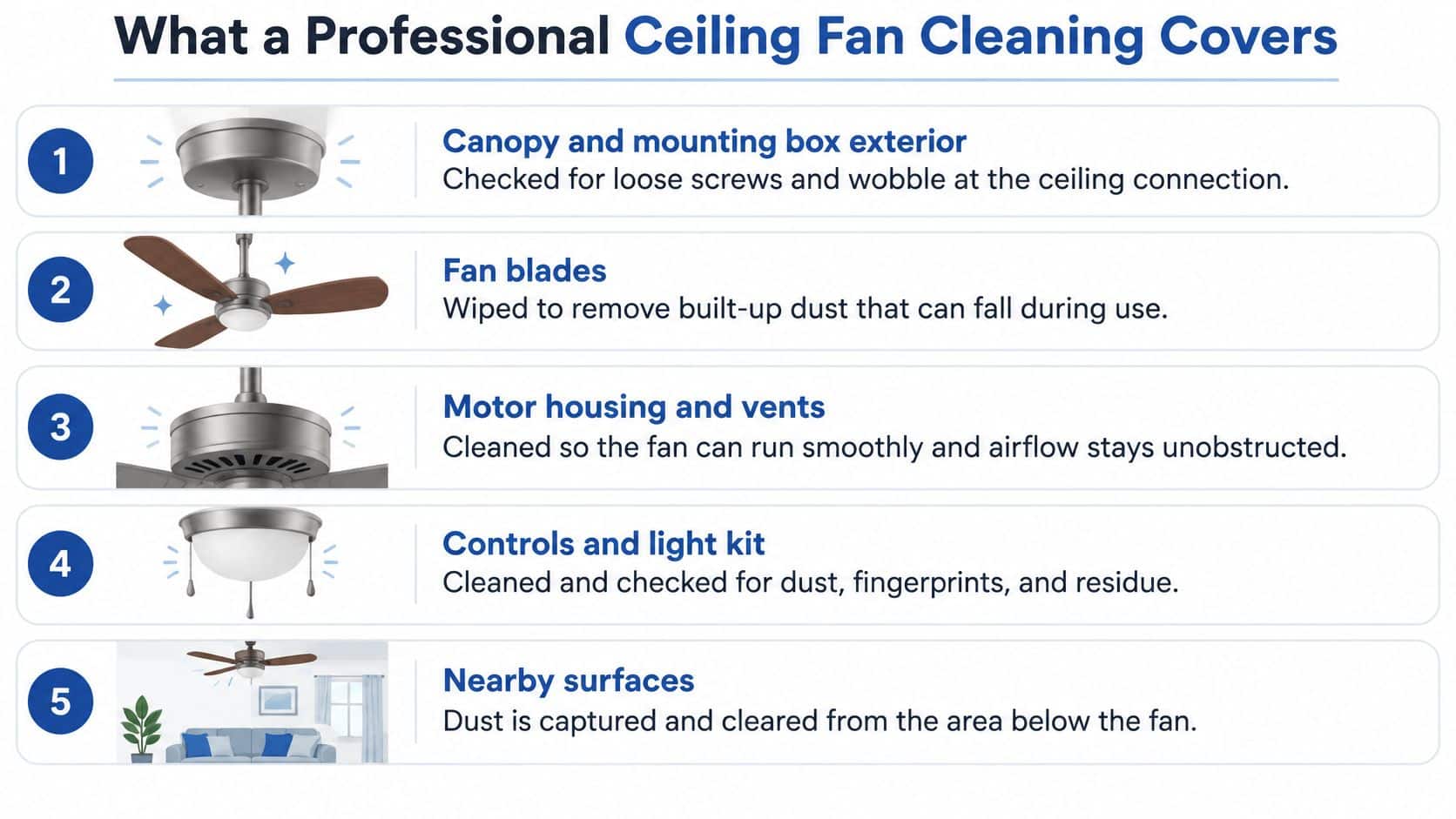
What a Professional Ceiling Fan Cleaning Covers
A complete scope follows the fixture from the ceiling connection to the surfaces beneath it. Cleaning only the visible underside leaves the main dust-catching surfaces untouched.
- Canopy and mounting box exterior are cleaned and checked for loose screws or movement at the ceiling connection.
- The downrod and its connection are inspected because looseness here can transmit vibration through the assembly.
- The motor housing exterior is wiped dry only to keep moisture away from the motor and electrical openings.
- Every blade's top, bottom and leading edge is cleaned because dust often forms a ridge where a casual underside wipe won't reach.
- Blade brackets and screws are checked, with accessible loose screws tightened only where that work is authorized and appropriate.
- The light kit and glass shades are cleaned, with shades removed only when their intended retainers release without force.
- Grilles and pull chains are wiped so dust and handling residue aren't left on the smaller components.
- A balance and noise check follows power restoration, with wobble or grinding reported rather than dismissed as ordinary operation.
The checklist below illustrates the main cleaning areas.
Where cleaning stops
Rewiring, motor repair and blade replacement are separate jobs. A cracked blade or loose bracket should be documented in writing, not repaired without permission. Removing electrical covers or dismantling the motor isn't a routine cleaning task.
Nearby furnishings also belong in the scope discussion. A technician needs room for stable access, a protective covering beneath the fixture, and a way to collect debris without dragging it across upholstery.
Scope check: Get the cleaning checklist in writing before the appointment, then use it to inspect the finished work.
Our residential window-cleaning services include inside and outside glass, screen cleaning and repair, track cleaning, window tinting, ceiling fan cleaning, coach light cleaning, and mirror cleaning. That gives homeowners a practical opportunity to discuss fan cleaning alongside other hard-to-reach or detailed surfaces.
We offer weekly, monthly, quarterly and one-time commercial window cleaning. When arranging service, specify whether you want fan cleaning as a standalone appointment, an add-on, or proposed within a commercial maintenance plan; don't assume every window-cleaning visit automatically includes it.
How Cleaning Protects Indoor Air and Fan Performance
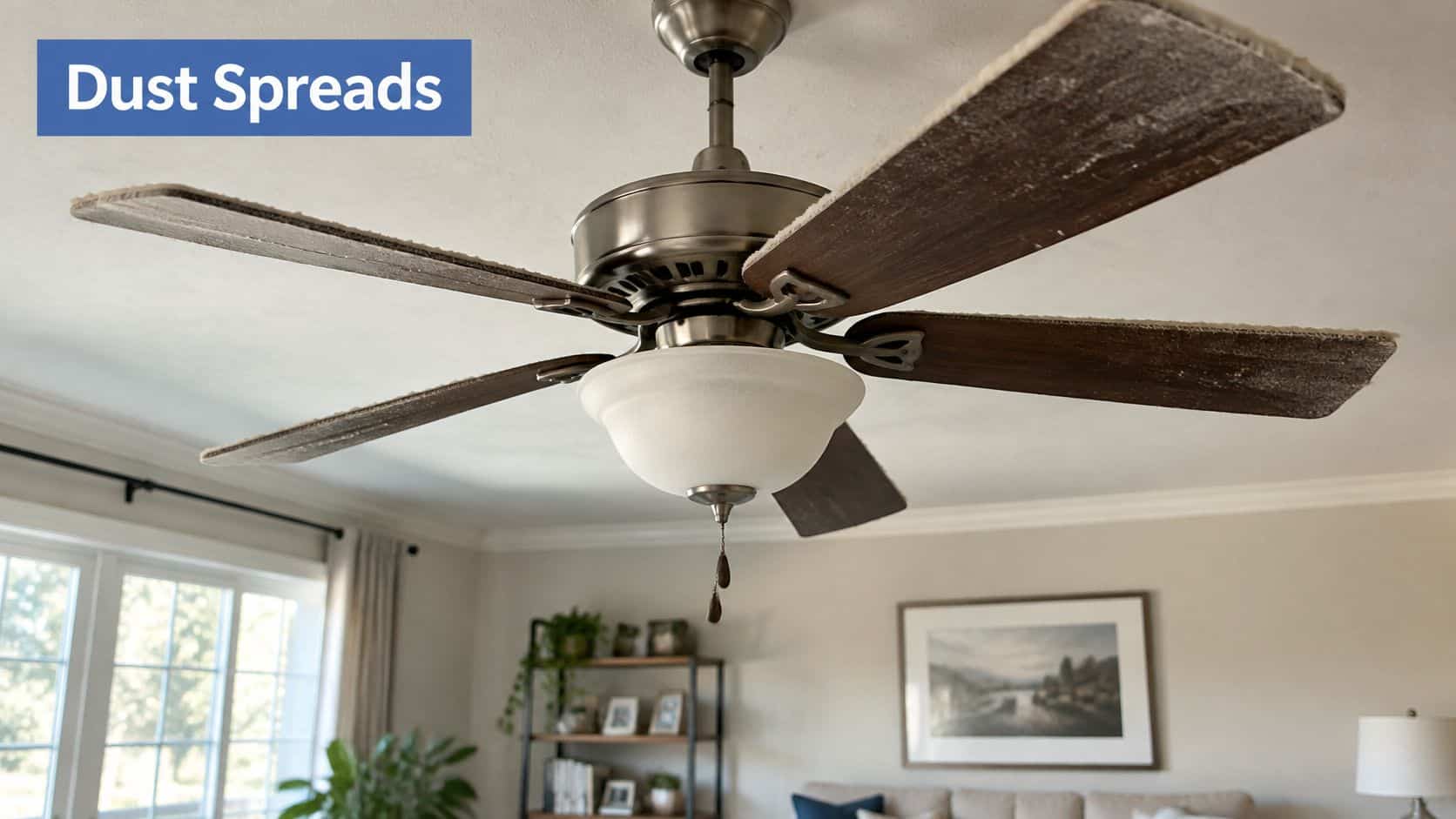
A ceiling fan moves air through a room, but it does not filter that air. Dust collected on the blades can be stirred up and redistributed when the fan runs, so cleaning removes a source of particles without replacing ventilation or filtration.
Dust often builds up more heavily on the top of the blades than it appears from below.
The University of California, Berkeley ceiling-fan guide describes a trade-off: under some conditions, fan-driven air movement can reduce pollutant concentration in an exposed person's breathing zone by more than 20%, while also increasing particle deposition on indoor surfaces. That finding does not mean a fan removes pollutants from a building.
Capture dust instead of broadcasting it
The goal is to collect dust rather than displace it. Blowing it off the blades can send particles onto nearby desks, bedding, food-service surfaces, or floors. Use a method that contains the debris and leaves the surrounding area clean.
For broader household dust-control context, see Covenant Aire Solutions' a homeowner's guide to desert dust. In commercial settings, commercial high dusting refers to cleaning surfaces above the fan itself.
This video offers another visual reference for the cleaning task.
Dust can also affect how a fan runs. Uneven deposits add weight to individual blades and may contribute to imbalance and vibration. Buildup can also alter the blade profile and add resistance.
Treat energy claims cautiously. A Florida fan-use field study documented sharply different operating patterns between households, but it did not establish a specific energy saving from cleaning alone.
Cleaning is preventive maintenance, not a guaranteed reduction in your electricity bill. A clean surface, a balance check, and a written note of unusual noise are practical outcomes.
When DIY Ceiling Fan Cleaning Becomes Unsafe
Take a one-minute self-test before getting out the ladder: match the fan to the conditions below and follow the most serious row that applies. Being able to touch a blade with an extension pole doesn't mean you can safely clean or inspect the fixture.
| Condition | Action |
|---|---|
| Vaulted or high ceiling, fan above a stairwell or in a high-bay space | Call a professional; fall risk needs stable access equipment |
| Hardwired fan or integrated light kit | Isolate power at the breaker or fuse box, not the wall switch alone |
| Painted, wood or plastic blades | Check the fan maker's instructions before choosing any cleaner |
| Ladder you cannot stabilize | Call a professional |
| Cracked or bent blade, wobble, grinding or burning smell | Stop and call a professional; don't clean around the fault |
| Low ceiling, plug-in fan, dust ridges only | Unplug it, then lightly dust with a dry microfiber cloth from a stable ladder |
BISSELL's ceiling-fan cleaning guidance emphasizes turning the fan off, checking material-specific care instructions and avoiding cleaner sprayed directly onto the fixture. A product suitable for one finish can leave residue or damage another.
A safe access assessment comes before the cloth or cleaner.
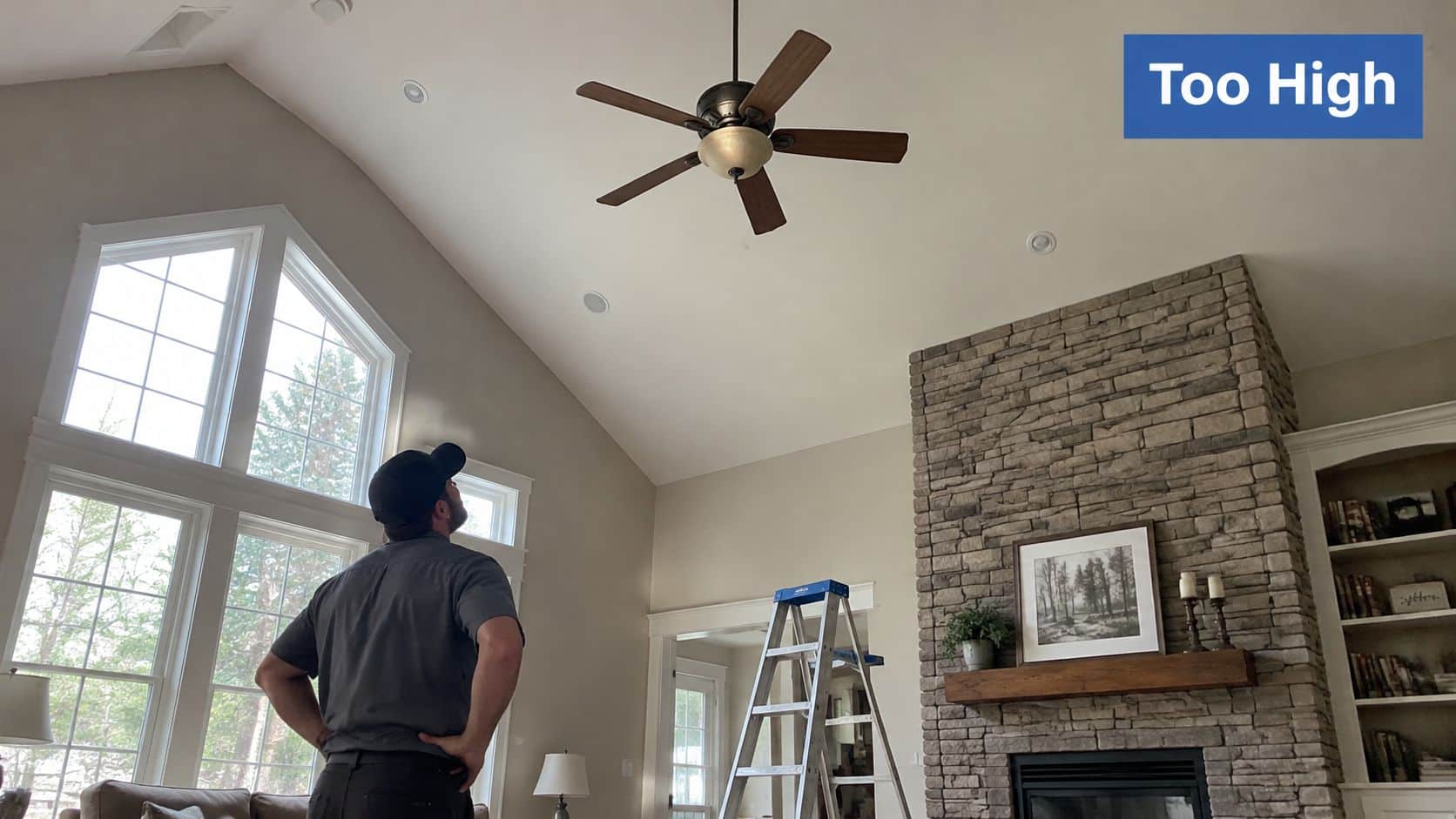
The limits of reaching from the floor
An extension duster can help with light, loose dust when the fixture is safely accessible from below. It's a poor choice for sticky buildup, checking fasteners, or cleaning around fragile glass because you can't see or control the contact well.
Don't push harder to compensate for poor access. A pole can knock a light shade, mark the ceiling, or leave the blade's upper surface dirty while making the underside look finished.
Our team members undergo extensive window-cleaning safety training. For higher work, we still need the actual fan height, access route and surrounding conditions rather than a description such as ordinary ceiling.
The same stable-access principles discussed in our guide to cleaning gutters safely matter indoors: don't improvise a ladder position to reach an awkward location. Before accepting a quote, confirm the fan type, electrical exposure, nearby furnishings, equipment requirements and any need to schedule around occupants.
For property managers, that planning prevents a small cleaning assignment from becoming a fall hazard, damaged finish or avoidable tenant disruption.
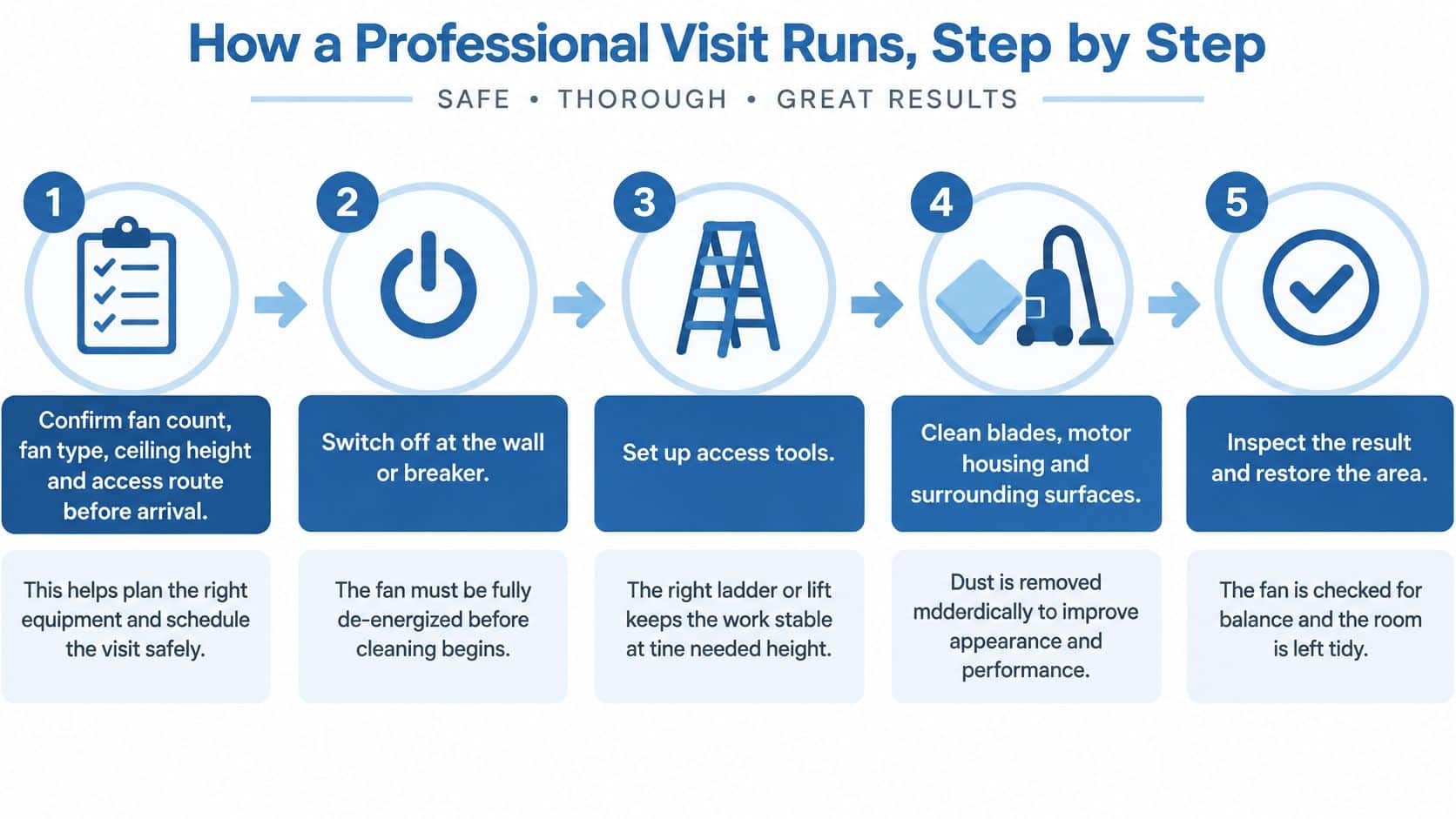
How a Professional Visit Runs, Step by Step
A well-planned visit starts before the technician enters the room. The ASHRAE preventive-maintenance checklist includes cleanliness, balance, vibration and bearing noise among inspection considerations for fan equipment, reinforcing the value of checking condition rather than removing visible dirt.
Confirm the job before arrival. Record fan count, fixture type, ceiling height and the access route, including stairs, narrow doors and furniture beneath the work. This lets the crew plan suitable equipment and avoids discovering an inaccessible fixture after setup.
Isolate power and prepare the room. Switch off the wall control and disconnect permanently installed or hardwired fans at the breaker or fuse box, preventing someone from inadvertently restoring power. Verify the fan can't start, let lights cool, protect furnishings, and position the access equipment on a stable surface.
Inspect before disturbing deposits. Look for cracked blades, loose fasteners, damaged brackets and evidence of movement at the mounting connection. Recording the starting condition helps distinguish an existing fault from a cleaning issue and identifies equipment that shouldn't be operated.
Remove dust methodically. Work from the canopy toward the blade tips, using microfiber cloths to capture debris while supporting each blade gently rather than bending it. Use a lightly dampened cloth only where the manufacturer permits, keep the motor housing dry, and never spray cleaner directly onto blades or electrical parts.
Detail the light kit and grille. Release glass shades only through their intended fittings and only when they come free without force. Clean suitable removable glass separately, dry it fully and reinstall it securely without overtightening.
Restore power and test operation. Once everything is dry, reassembled and clear of tools, run the fan on low and observe its balance. Listen for rubbing, grinding or other unusual noise, stopping the test if a fault appears.
Record findings and restore the area. Report cracked blades, loose brackets or abnormal sound for authorized follow-up instead of attempting unapproved repairs. Allow loosened particles to settle, remove collected debris and clean affected nearby surfaces before returning the room to use.
The process illustration summarizes the main stages.
Planning the occupied building
Ask for a time estimate per visit, including protection, equipment setup and the final check. Fan count, access height and fixture construction determine the workload; a decorative light assembly can demand more handling than the blades themselves.
For commercial spaces, coordinate the appointment with HVAC and high-surface maintenance. Restaurants, open-door retail, industrial areas and construction-adjacent properties need schedules responsive to their dust conditions rather than an unchanged household routine.
We use computerized scheduling for commercial window cleaning so crews arrive at the scheduled time. When combining services, identify room-access windows, tenant restrictions and any food or equipment that must be covered before work begins.
A completed job has evenly clean blades, no cleaning residue on the light kit and a tidy area beneath the fan. The fan should run smoothly; if it doesn't, the completion record should identify the unresolved problem rather than imply that cleaning repaired it.
How Often Ceiling Fans Need Professional Cleaning
A U.S. Department of Energy-sponsored report, based on a survey of 2,550 people, found average ceiling-fan operation of 6.4 hours per day and estimated annual consumption of 99 kilowatt-hours per fan; it also cited the 2009 Residential Energy Consumption Survey, which found installed fans in 73% of U.S. households, approximately 239 million fans nationwide. These are frequently used fixtures, not decorations that can be forgotten between room cleanings.
Phoenix adds another consideration: a NOAA-supported study identified 189 dust-storm events affecting the metropolitan area from 2010 through 2023. That doesn't establish an indoor cleaning interval, but it supports checking dust-prone properties after outdoor dust events.
Set the interval by condition
The following are practical planning recommendations, not manufacturer requirements or research-established cleaning frequencies.
| Setting | Recommended interval | Reason |
|---|---|---|
| Home with dust-free air and moderate use | Once a year, with light dusting between visits | Baseline interval |
| Fan running more than six hours a day | Sooner than the baseline; check leading edges on each visit | Heavily used fans warrant closer attention |
| Kitchens, short-term rentals, high-traffic rooms | More often than the baseline | Higher particle load and turnover |
| Dust-prone Phoenix-area homes | More often than the baseline, especially after dust events | Blowing dust and dust storms |
| Restaurants, food-service areas, open-door retail | Shorter than home intervals, set by a commercial plan | Higher traffic and airborne particle load |
| Any fan showing dust ridges | Book a visit now, regardless of calendar date | Buildup has reached the blade edges |
A relatively clean bedroom and an open-plan kitchen shouldn't automatically share the same schedule. Cooking residue can require a different cleaning method, while rental turnover gives managers a useful opportunity to inspect fixtures before the next occupancy.
Add fan inspections to your annual home-maintenance checklist rather than maintaining a separate reminder that's easy to miss. For decisions about the duct system itself, the Purified Air Duct Cleaning frequency guide addresses a separate maintenance task; a dirty fan alone isn't proof that ducts need cleaning.
Use the calendar as a reminder, not permission to ignore visible buildup.
Look along the leading edges with the fan stopped. If distinct dust ridges appear before the planned appointment, bring the cleaning forward and adjust the next interval to match the room.
Schedule Your Ceiling Fan Cleaning Visit
A useful booking request describes the work, not just the symptom. Saying the fans are dusty gives the scheduler less to work with than identifying their locations, access constraints and fixture details.
Gather the following before calling:
- Fan count and rooms: List each fixture and identify kitchens, rental rooms and busy common areas.
- Ceiling height and access: Note vaulted ceilings, stairwells, furniture beneath the fan and restricted routes.
- Fixture construction: Identify hardwired connections, integrated lights, glass shades and delicate finishes.
- Visible concerns: Report damaged blades, movement, unusual sounds or odors separately from the cleaning request.
- Property use: State whether the appointment is residential or commercial and when rooms can be vacated.
Confirm the appointment details
South Mountain Window Cleaning, LLC provides residential, commercial and high-rise window washing in Phoenix, Scottsdale, Paradise Valley, Chandler, Tempe and Gilbert, Arizona, and serves the wider Valley. Our residential services include ceiling fan cleaning, so you can discuss it while planning other cleaning work.
Confirm whether your quote is per fan or per visit, whether the downrod and light kit are included, and what happens if access or fixture condition prevents completion. Those details are more useful than comparing headline prices without matching the scope.
Commercial operators evaluating their own customer-inquiry processes may also find the home services lead strategies from Voicedial.ai useful for organizing incoming service requests. For this appointment, the priority is straightforward: provide enough information for an accurate scope and access plan.
Customers in Phoenix and Scottsdale can call (480) 519-9327, or schedule an estimate or service online. At the appointment, agree on the next cleaning date based on the fixture's condition, room use and operating pattern.
Book the visit before dust ridges form on the blades.
South Mountain Window Cleaning, LLC offers ceiling fan cleaning within its residential cleaning services, alongside window, screen, track and mirror care. Visit South Mountain Window Cleaning, LLC to request a fast, free quote, share your fan locations and access details, and schedule an estimate or service.