

You look through a front window in Phoenix and see the same thing a lot of Arizona owners see. Dust on the glass. Hard-water spotting near the sprinklers. Tracks holding grit. Maybe the storefront still looks passable from the parking lot, but up close it reads neglected.
The first question usually isn't whether the property needs cleaning. It's what the cleaning services cost will be, and why one quote looks nothing like another.
That confusion makes sense. Exterior cleaning isn't priced like buying a product off a shelf. A single-story home in Gilbert, a retail storefront in Tempe, and a high-rise property in Scottsdale don't require the same labor, tools, access plan, or risk management. In Arizona, climate adds another layer. Fine dust, sun exposure, monsoon residue, and hard water all change how often surfaces need attention and much work each visit takes.
Your Guide to Exterior Cleaning Costs in Arizona
A common situation goes like this. A homeowner cleans the inside of the glass, steps back, and realizes the haze is still there because the buildup is outside. Or a property manager notices the entry glass is covered in fingerprints and dust by midweek, even though it looked fine right after the last service.
That moment is when price starts to matter. Not just the number on a quote, but what sits behind it.

Common Questions
They want to know whether they're looking at an hourly service, a flat fee, or something priced by pane or square footage. They also want to know whether professional service is worth the premium over a cheaper solo operator.
National pricing gives a useful baseline. In 2025, average hourly rates for standard cleaning services ranged from $25 to $75 per cleaner, with professional companies commonly charging $40 to $75 and freelancers often charging $25 to $50. Flat fees also remain common, with standard cleaning for a 2 to 3 bedroom home at $120 to $280 per visit, while move-out services can run $330 to $440. In Arizona markets, recurring contracts are often 20% to 30% cheaper than one-time jobs (goinstacare.com).
Those numbers don't tell you what your windows, exterior walls, solar panels, or storefront glass will cost. They do show the basic trade-off. Lower pricing usually strips out some mix of insurance, training, reliability, scheduling systems, or service consistency. Higher pricing often reflects those protections.
Why Arizona changes the equation
Exterior cleaning in Arizona isn't cosmetic fluff. It affects what people see when they pull up, what tenants think about building care, how safely upper glass gets serviced, and whether dust is sitting on solar panels longer than it should.
Practical rule: In dusty climates, maintenance pricing often beats restoration pricing. The first clean removes neglect. The next clean protects the surface and usually takes less effort.
That's why price should be viewed in context. A quote isn't just for soap and labor. It's for access, safety, equipment, planning, and whether the job gets done right the first time.
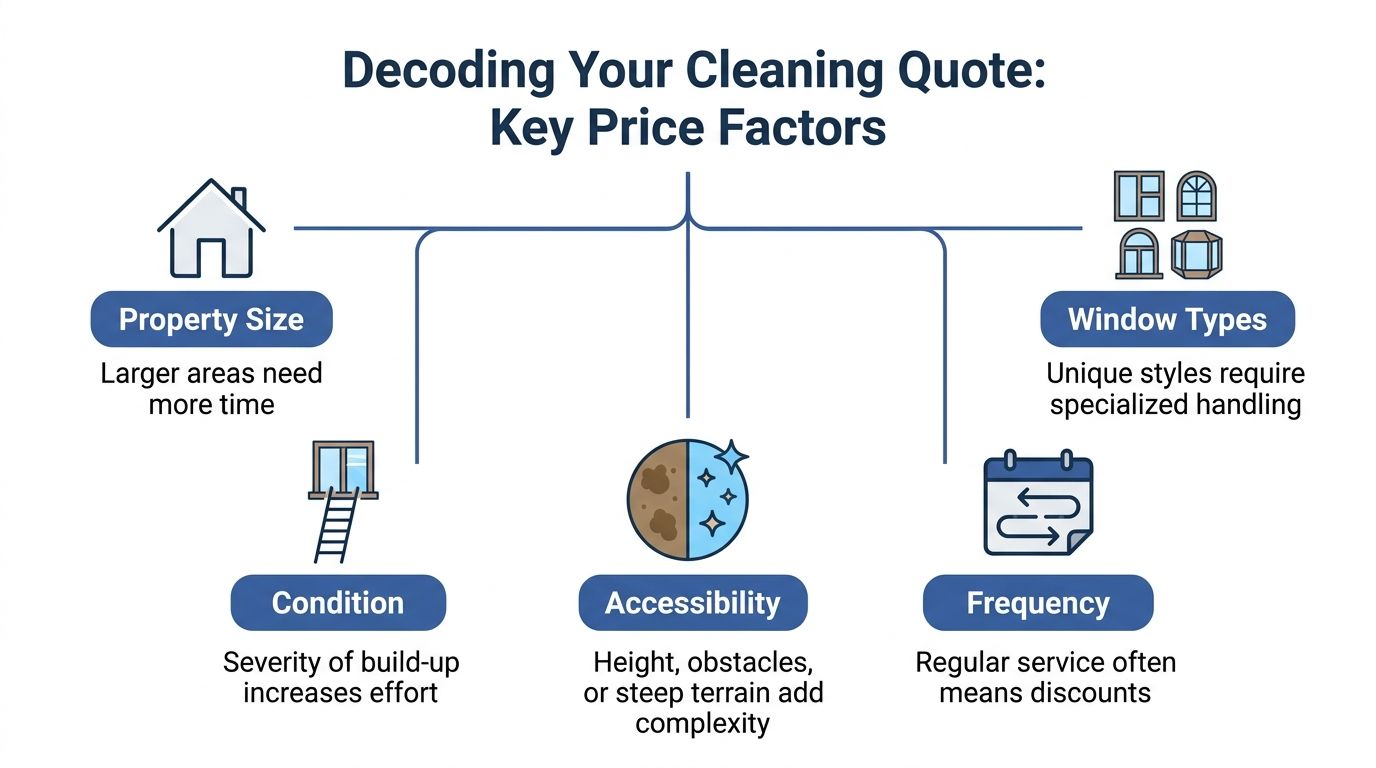
Decoding Your Cleaning Quote Key Price Factors
A good quote should feel explainable. If it doesn't, ask questions. Most exterior cleaning prices come down to five variables, and once you know them, quote comparisons become much easier.
Size changes labor more than people expect
The first factor is simple. Larger properties take more time.
For residential work, that can mean more panes, more screens, more tracks, and longer walking paths around the home. For commercial work, square footage matters because it usually tracks with labor hours, setup time, and how much equipment has to move across the site. If you want a deeper industry view of how commercial cleaning is priced, that overview is useful because it shows how labor and facility type affect cost models.
What doesn't work is comparing your home to your neighbor's quote without checking scope. Two houses may have similar square footage but very different window counts and access conditions.
Access is the hidden line item
Access is where many price gaps come from.
A single-story ranch with open walkways is faster and safer than a home with tight side yards, decorative landscaping, steep grades, or glass over tile roofs. Commercial access gets even more technical. Storefront glass on a clear sidewalk is one thing. Upper windows over signage, patios, drive-thrus, or pedestrian traffic are another.
Access affects:
- Setup time because crews may need ladders, hose runs, cones, or lift planning
- Tool selection because pure-water poles work well in some areas, while hand detailing or high-reach access may be needed in others
- Risk control because harder access increases the need for trained technicians and stricter work practices
For owners comparing pressure and surface-cleaning quotes, this guide to https://www.southmountainwindowcleaning.com/power-washing-service-cost/ helps show how different access conditions shift the final number.
Height and safety raise the standard
Height doesn't just add minutes. It changes the entire job.
High-rise and multi-story cleaning requires more than longer ladders. It can require specialized safety procedures, insurance verification, trained crews, and more deliberate scheduling. That's why upper-level work often carries a premium even when the visible square footage doesn't seem dramatic.
This is one of the easiest places to make a bad buying decision. If a quote seems unusually cheap for high-level work, ask what's included in safety planning and insurance coverage.
Low pricing on high-level work often means someone removed a protection you assumed was standard.
Condition determines whether you're buying maintenance or recovery
Light dust is one kind of job. Baked-on debris, hard-water spotting, post-monsoon residue, and neglected tracks are another.
Arizona properties often collect a fine layer of dust that looks minor from inside but takes more handwork than expected. Add sprinkler overspray or mineral staining, and labor rises fast. The same property can price very differently based on whether it's been maintained regularly or left alone for a long stretch.
This is why photos help. A clear set of images gives a much more honest starting point than saying the glass is "not too bad."
Frequency changes efficiency
Recurring service usually lowers the cost per visit because the crew isn't starting from scratch each time. Once heavy buildup is removed, later visits move faster and require less restoration work.
A recurring schedule works especially well for:
- Storefronts that show fingerprints and dust quickly
- Homes with large glass exposure where curb appeal matters year-round
- Solar-equipped properties where dust control has a direct practical benefit
- High-visibility commercial sites that can't afford to look neglected
What doesn't work is waiting until glass, concrete, and panels all need recovery at once. That's when small issues turn into larger invoices.
A Detailed Breakdown of Exterior Cleaning Costs
A Phoenix homeowner often calls after seeing three problems at once. Dust on the windows, dingy concrete at the entry, and solar panels that have not been cleaned since the last monsoon season. Those are three different jobs with three different pricing models, because each one uses different tools, labor, and risk controls.
A good quote should show that clearly.
Window cleaning pricing
Window cleaning is usually priced per pane, per window, or by a defined scope. That approach tracks labor better than square footage alone. A smaller home with divided panes, sunscreens, and mineral spotting can take longer than a larger home with simple glass.
The final number usually changes based on what is included:
- Basic glass cleaning covers the visible glass
- Screen cleaning adds removal, wash time, and reinstall
- Track detailing adds hand labor
- Hard-water treatment requires specialty products and more time
- Second-story or difficult access raises labor and safety requirements
In Arizona, windows also affect more than appearance. Clean glass improves curb appeal right away, which matters if you are selling, leasing, or trying to keep a high-end property looking cared for. On homes with large western exposures, clear glass also helps interior light without the dusty film that makes the whole property feel neglected.
Power washing and house washing
Pressure washing and soft washing are usually priced by square footage or by fixed scope. Large, consistent surfaces are easier to price by area. Irregular trouble spots are not.
Square-foot pricing works well for surfaces like:
- sidewalks
- patios
- pool decks
- drive-thrus
- broad exterior walls
- parking-adjacent concrete
Flat pricing often works better for jobs that have more setup, edge work, or stain treatment than raw surface area suggests. That includes dumpster pads, entry canopies, loading zones, and small courtyards with heavy buildup.
The trade-off is simple. A square-foot quote is easy to budget. A scope-based quote is often more accurate on surfaces with oil, rust, mineral staining, or organic growth. If algae or organic buildup is part of the issue, this practical guide on how to remove algae from siding explains why treatment method matters. The wrong chemical mix or pressure setting can scar paint, etch siding, or leave uneven results.
For budgeting, it also helps to review a local pressure washing cost breakdown for Arizona properties before asking for a custom quote.
Arizona owners usually see the return in three places. Clean walkways and entries improve curb appeal. Cleaner exterior surfaces reduce baked-on grime that becomes harder and more expensive to remove later. On retail and office properties, a washed storefront or entry concrete changes how the whole property reads from the street.
Commercial and high-rise pricing
Commercial exterior cleaning uses a different pricing logic than a single-family home. Access, scheduling, insurance requirements, water access, tenant coordination, and safety planning all affect labor.
High-rise work is the clearest example. The glass itself is only part of the cost. You are also paying for trained crews, anchor and rope systems where required, lift access on some buildings, and a company that carries the right insurance for high-level work. Cheap pricing in that category usually means something was removed from the scope that should not have been.
Here is the basic pricing logic most owners will see:
| Service type | Common pricing logic | Why it works |
|---|---|---|
| Residential windows | Per pane or per window | Matches detail work and cleaning time |
| Storefront maintenance | Route or recurring flat price | Predictable scope and visit frequency |
| Power washing | Square foot or flat scope | Fits broad exterior surfaces or defined problem areas |
| High-rise work | Custom quote | Access, safety setup, and staging vary by building |
| Solar panel cleaning | Custom by layout and access | Roof pitch, panel layout, and hose reach affect labor |
A short visual walkthrough can also help show why tools and technique affect final pricing.
Solar panels and the Arizona ROI question
Solar panel cleaning deserves its own line item because the value is practical, not cosmetic. In Arizona, dust buildup can cut production. Owners feel that in output and in utility savings.
Panel cleaning is usually quoted by panel count, roof layout, pitch, and access difficulty. A single-story home with an open roofline is faster than a steep tile roof with limited hose reach and tight panel spacing. The price difference reflects risk and setup time, not just the number of panels.
This is one of the strongest ROI services in the state. Clean panels can produce more efficiently, especially after long dry stretches and dust events. For commercial sites, that can support energy performance goals. For homeowners, it can help protect the value of the system they already paid for.
Sample Cleaning Estimates for Phoenix Properties
A homeowner in Gilbert may need a straightforward window cleaning visit. A property manager in Downtown Phoenix may need recurring storefront service to keep dust, runoff, and hard water from becoming a constant complaint. Both are buying cleaning, but the price logic is different.
Sample estimates help set expectations. They do not replace a real quote, especially in Arizona, where sun exposure, dust, roof runoff, and access can change labor time fast.
How to use these examples
Start with the closest property type, then adjust for access, soil level, and service frequency. A clean single-story home with open access prices differently than a similar home with baked-on mineral spotting, sun screens, and tight side yards.
The same applies to commercial work. A small storefront on a regular route usually costs less per visit than a neglected storefront that needs extra scraping, detailing, and stain removal to get back to maintenance condition.
2026 Estimated Exterior Cleaning Costs in Phoenix, AZ
| Property Type / Service | Typical Scope | Estimated Cost Range |
|---|---|---|
| Single-story home in Gilbert | Exterior and interior window cleaning for a typical 1,200 to 2,400 sq. ft. home | $120 to $480 |
| Two-story home in Paradise Valley | Window cleaning with added complexity for upper access, screens, and tracks | Base window pricing plus 15% to 25% |
| Small storefront in Downtown Phoenix | Recurring window maintenance on a frequent schedule | Custom quote, with recurring service often lowering effective rates over time |
| 2,000 sq. ft. office exterior service | Routine commercial exterior cleaning benchmark | $140 to $300 |
| Medium-sized office nightly cleaning benchmark | Commercial cleaning with crew-based labor | $210 to $450 |
These ranges are best used as budgeting examples, not fixed rate cards. Final pricing usually shifts based on buildup, safety setup, and how much detail work the owner wants included.
Three practical examples
A 2,000 square foot single-story home in Gilbert often falls near the easier end of the range if the windows are maintained and access is open. Add full screen washing, track detailing, or hard water removal, and the labor increases quickly. In Arizona, that extra detail work often pays off because cleaner glass improves curb appeal immediately, which matters if the home is being listed, photographed, or shown.
A larger two-story home in Paradise Valley usually costs more because the work slows down upstairs. Ladder placement, roofline obstacles, delicate landscaping, and premium finishes all require more care. On homes with solar, owners also tend to combine services to protect output and avoid another trip charge later.
A small commercial storefront in Phoenix gets the best return from recurring service. Clean front glass presents better, but the business value goes beyond appearance. Regular service helps prevent dust, runoff stains, and oxidation from turning into restoration work, and it keeps the property looking cared for in a market where first impressions affect foot traffic and tenant perception.
High-access properties are a separate category. For multi-story buildings, the price is shaped by safety planning, staging, and access method as much as the glass count. On those jobs, a key value is risk reduction. You are paying for trained crews, proper setup, and work completed without creating a liability issue for staff, tenants, or the public.
If your project also includes roof runoff staining, exterior walls, or surrounding concrete, it helps to review related service costs at the same time. This guide to roof pressure cleaning cost in Phoenix is useful for building a more realistic maintenance budget.
The best estimate is the one that clearly shows what is included, what is excluded, and why the crew priced it that way.
The True Cost of DIY vs Hiring a Professional
DIY cleaning always looks cheaper at first. On paper, you're buying a squeegee, soap, maybe a brush, and giving up a Saturday. In practice, exterior cleaning turns into a test of access, technique, and patience very quickly.
What DIY gets right
For low interior glass or one small exterior section, doing it yourself can make sense. You control the timing. You can touch up one problem area without scheduling a service call.
DIY also helps owners understand the work. After one serious attempt at exterior glass in Arizona, many realize why streak-free results take more than household spray and paper towels.
A practical starting point for homeowners who want to see the basics is this guide to https://www.southmountainwindowcleaning.com/how-to-do-your-own-window-cleaning-in-phoenix-arizona/
Where DIY starts costing more
The trouble starts when the job includes height, mineral spotting, messy screens, or large surface areas.
A homeowner usually underestimates four costs:
- Time cost because exterior work takes longer than expected, especially when you redo streaked panes
- Equipment cost because ladders, extension poles, pressure washers, hoses, and better tools enter the picture
- Risk cost because working at height and wet surfaces don't leave much room for error
- Result cost because poor technique can leave lines, residue, damaged screens, or inconsistent cleaning
The DIY route also tends to fragment the job. Maybe the glass gets done, but not the tracks. Maybe the driveway gets cleaned, but the wand leaves stripes. Maybe the solar panels are skipped because roof access feels unsafe.
What professional service provides
Hiring a professional isn't just outsourcing labor. It's paying for a repeatable result.
Professionals bring the right combinations of pure-water systems, pro squeegees, extension tools, detergents suited to exterior buildup, and methods matched to each surface. On high-level or commercial work, you're also paying for trained crews, scheduling reliability, and insurance backing.
Here's the side-by-side version:
| Decision factor | DIY approach | Professional approach |
|---|---|---|
| Glass finish | Can be uneven without technique | More consistent, streak-free result |
| Safety on height | Owner assumes the risk | Trained crew handles high-level work |
| Speed | Often slower than expected | Usually completed far faster |
| Scope control | Easy to skip difficult areas | Full job is more likely to get done properly |
| Stress level | High on large jobs | Lower, especially for recurring service |
If a job requires you to question the ladder angle, roof footing, or how to remove spotting without damaging glass, it's probably no longer a DIY project.
For most owners, the key comparison isn't free versus paid. It's whether a weekend of effort, equipment handling, and mixed results is worth more than a clean finish done safely and efficiently.
Smart Strategies to Manage Your Cleaning Budget
A Phoenix property owner usually notices the budget problem after the dirt has already become expensive. The storefront glass looks dull, the entry walk has baked-in grime, the panels on the roof are carrying desert dust, and the next quote comes back higher because the job now needs restoration work instead of routine maintenance.
The best budget strategy is simple. Keep exterior cleaning on a maintenance schedule that matches Arizona conditions.
In this climate, heat, dust, hard water, and monsoon residue change the economics of cleaning fast. A property that stays on schedule usually costs less to maintain over time because crews can clean surfaces before buildup hardens, stains set, or access gets more complicated. That matters most on surfaces tied to actual return, not just appearance.
Set a schedule based on value, not guesswork
Every property does not need the same frequency. The right cadence depends on what the surface does for you.
If entry glass shapes first impressions, clean it often enough to protect curb appeal. If solar panels support your power savings, keep them clear enough to perform as intended. If you manage a mid-rise or high-rise property, regular service also reduces the chance that minor soil buildup turns into a bigger safety or access issue later.
A practical schedule often looks like this:
- Storefront glass: more frequent service because customers notice fingerprints, dust, and splash marks immediately
- Residential exterior windows: scheduled around dust exposure, irrigation spotting, and seasonal pollen or storms
- Solar panels: cleaned on a cadence based on dust accumulation, nearby construction, and visible production drop
- Walkways, entries, and flatwork: timed to control appearance and slip risk, especially in shaded or high-traffic areas
Bundle tasks that share labor and access
One of the easiest ways to control cost is to combine work that uses the same crew setup. If technicians are already on site with water access, ladders, poles, roof-access planning, or lift coordination, adding related services can improve the efficiency of the visit.
The strongest bundles are the ones that reduce duplicate setup:
- Windows and screens
- Storefront glass and entry concrete
- House washing and exterior window cleaning
- Solar panel cleaning and other roof-access exterior work
That does not mean every bundled service gets a discount. It means you are paying for mobilization, setup, and coordination once instead of repeating those costs across separate visits.
Prioritize surfaces with a direct return
If the budget is tight, start with the surfaces that protect income, efficiency, safety, or property value.
Solar panels are a good example in Arizona. Dust on panels is not just cosmetic. It can cut output, which means the cleaning cost has to be weighed against lost production. Entry glass and front-facing surfaces matter for a different reason. They shape how tenants, customers, and buyers judge the property before they ever walk inside. On taller buildings, routine cleaning also helps address access needs before conditions get riskier and more expensive to handle.
That is a key budget question. Which cleaning line item preserves the most value?
Reduce avoidable labor before the crew arrives
Small site-prep steps can trim wasted time. Move patio furniture or signage away from work areas. Open gates. Provide clear access to hose bibs and electrical outlets if needed. Flag delicate landscaping, pets, alarm issues, or sprinkler schedules before the appointment.
None of that changes the size of the job. It does help the crew work faster and with fewer interruptions, which is how jobs stay predictable.
Owners who manage cleaning costs well usually treat exterior service as planned maintenance. In Arizona, that approach protects curb appeal, supports solar performance, and keeps difficult access work from becoming a bigger expense later.
Frequently Asked Questions About Cleaning Costs
Why do two cleaning quotes for similar properties look so different
Because similar properties often aren't similar jobs. One may have easy ground-level access and regularly maintained glass. The other may have second-story windows, detailed screens, mineral spotting, narrow side yards, or scheduling constraints. Scope clarity matters more than the headline number.
Is hourly pricing or flat pricing better
Neither is automatically better. Hourly pricing works when the exact labor need is hard to predict. Flat pricing works when the scope is clear and you want budgeting certainty. For recurring exterior maintenance, many owners prefer flat pricing because it removes surprises.
Are recurring services really worth it
Usually, yes. Recurring service tends to reduce buildup, shorten future visits, and keep the property looking consistently cared for. It's also easier on surfaces because you're maintaining them instead of forcing aggressive cleanup after long neglect.
What adds cost fastest on exterior cleaning jobs
Height, access difficulty, and condition. A dirty but easy one-story job can be straightforward. A mildly dirty job with awkward upper access can still take more time because setup and safety slow everything down.
Should I clean solar panels on the same schedule as windows
Not always. The right cadence depends on dust exposure, roof pitch, nearby construction, and how closely you monitor output. Some owners pair solar cleaning with other roof-access work because it simplifies scheduling and site coordination.
Does cheap pricing always mean poor quality
Not always, but low pricing should trigger better questions. Ask what's included. Ask whether screens, tracks, water spot treatment, safety planning, and insurance are part of the quote. Cheap pricing becomes expensive when the scope was never complete.
What's the best way to get an accurate quote
Give the company useful detail. Share the address, the property type, the number of stories, your main concerns, and photos if possible. Mention hard-water stains, upper glass, solar panels, gutters, or surrounding flatwork upfront. Good information produces a tighter quote and fewer surprises.
Your Next Step to a Spotless Property
A clean property isn't just about appearance. In Arizona, it also affects upkeep, visibility, safety, and in some cases operational performance. The key is understanding what you're paying for. Size, access, condition, frequency, and crew quality all shape the final cleaning services cost.
The right quote should leave you informed, not guessing. It should tell you what is being cleaned, how the job is being approached, and where the value comes from. That's how owners avoid both overpaying and underbuying.
If you're comparing options, get a detailed quote, ask direct questions, and choose the company that explains the work clearly. Clear pricing usually reflects clear process.
For fast, free, no-obligation pricing, contact South Mountain Window Cleaning, LLC. The team serves Phoenix, Scottsdale, Paradise Valley, Chandler, Tempe, Gilbert, and surrounding Valley communities with residential, commercial, and high-level exterior cleaning. With numerous five-star reviews and a satisfaction guarantee, it's an easy next step if you want honest pricing and dependable service. You can call or use the online scheduling tool to request a quote.