
If you're managing a glass-heavy office tower or condo in Phoenix right now, you're probably dealing with the same headache I hear every week. Tenants notice streaks before they notice almost anything else, ownership wants the building to look sharp, and someone asks whether this is just a bigger version of regular window cleaning. It isn't.
High-rise glass work starts long before a squeegee touches the pane. The question isn't just how to clean high rise windows. It's whether the building can legally and safely support the access method, whether the anchors are certified, whether the crew has a written rescue plan, and whether you're hiring a contractor who won't turn a routine wash into a liability event.
For property managers and owners in Phoenix, Scottsdale, Paradise Valley, Chandler, Tempe, and Gilbert, that's the part that matters. South Mountain Window Cleaning provides residential, commercial, and high rise window washing services in those Arizona markets, but the same rule applies to any contractor you consider. If the building-side compliance isn't in order, the job shouldn't start.
Why High Rise Window Cleaning Is Not a DIY Job
A lot of owners still think window cleaning becomes "high-rise" only when the building gets very tall. That's the wrong threshold. Once workers are off the ground and relying on suspended access or rope descent, you're no longer dealing with janitorial work. You're dealing with regulated high-level work.
Modern U.S. high-rise window cleaning falls under a formal safety framework that became much more specific with OSHA 1910.27, effective in November 2017 for rope-descent systems and suspended-access work. That rule requires certified rooftop anchor systems, documented operator training, and equipment inspection. Industry guidance from ANSI/IWCA I-14.1 adds more direction on training and redundancy, which is why towers aren't supposed to be serviced like storefronts or patio glass (OSHA high-rise framework overview).
What disqualifies DIY work
Three issues usually end the DIY conversation fast:
- Anchor verification: A building owner can't guess whether a roof anchor is acceptable. The job needs documented certification and a real record of what the system is rated for.
- Fall protection setup: Rope-descent work requires a working line and a separate safety line with independent anchorage. That's not a hardware-store setup.
- Legal exposure: If someone gets hurt while leaning out, rigging improvised lines, or working from an uncertified point, the owner gets dragged into the problem immediately.
Practical rule: If the glass can't be cleaned safely from the ground or from a simple extension pole on a low structure, stop treating it like DIY maintenance.
There is a legitimate DIY lane. Single-story patio glass, reachable transoms, and low residential panes that can be cleaned from stable ground are one thing. A tower face, upper-level condo stack, or office facade is something else entirely.
Why owners carry the real risk
Historical safety data explain why this work is tightly controlled. One OSHA analysis cited across industry sources recorded 88 window-washing accidents over 15 years, with 62 fatalities, which works out to about 70.5% of reported accidents in that dataset being fatal (historical accident data and later exposure context). That's exactly why trained, insured, standards-based contractors are the baseline for high-rise jobs now.
If you're the building owner or manager, your decision isn't "Can somebody clean this glass?" It's "Can this job start legally, with documented controls, and with a contractor whose paperwork survives scrutiny after an incident?" If the answer is shaky, don't let a rope go over the parapet.
Equipment, PPE, and Pre-Shift Checks
Good high-rise crews don't start with soap. They start with layout, inspection, and documentation. If the gear isn't right before sunrise, the drop shouldn't happen.
What the crew lays out before any descent
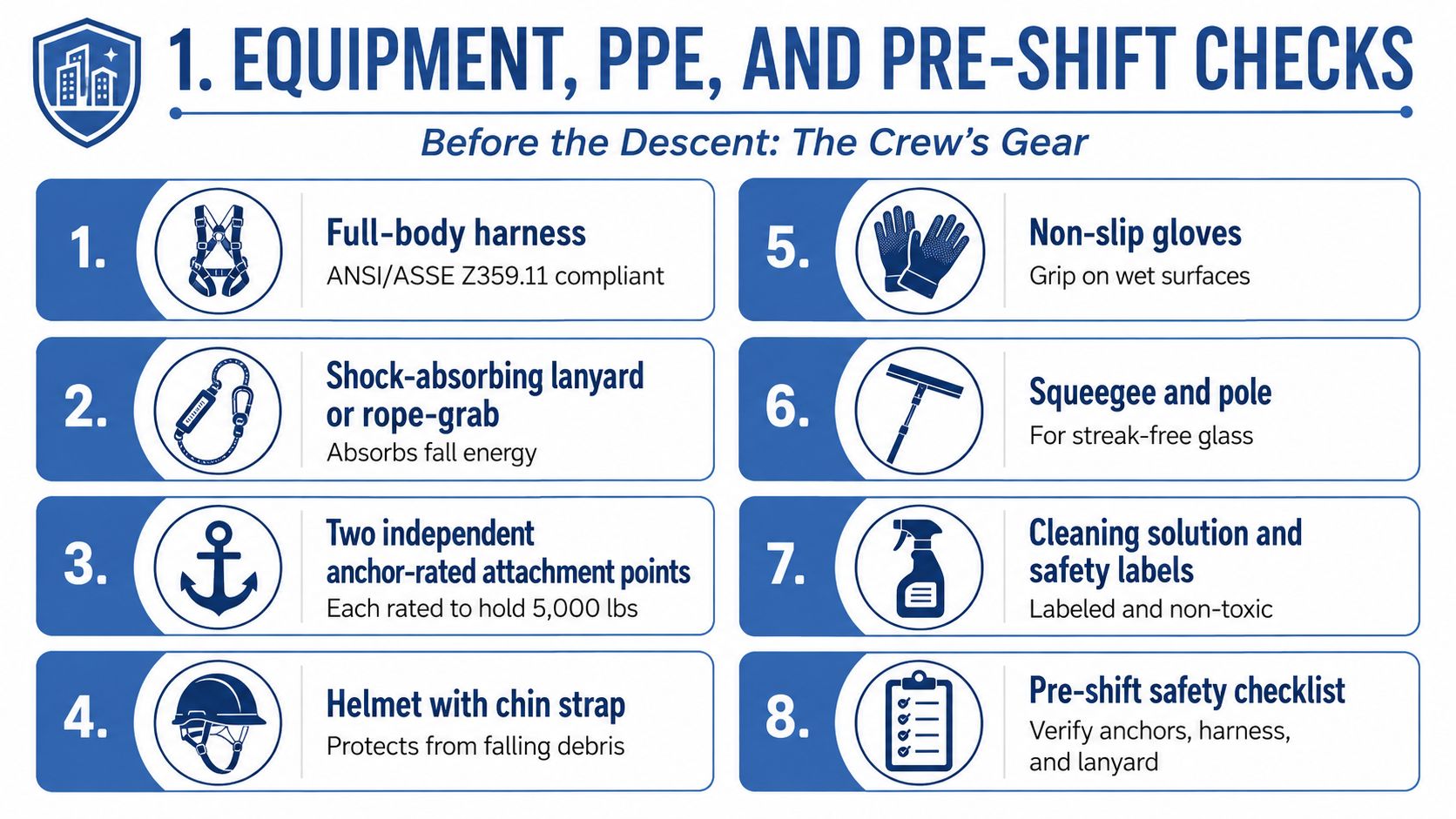
A competent crew stages access gear separately from cleaning tools. That sounds basic, but it prevents one of the most common failures on real jobs: mixing life-safety equipment with production equipment like they're all just "job supplies."
Core gear should include:
- Full-body harness: Not an improvised belt, not a roofing harness pulled from another trade.
- Shock-absorbing lanyard or rope-grab: The fall-protection connection has to match the access method and be in serviceable condition.
- Two independent attachment points: OSHA-based rope-descent systems require redundant rigging with a working line and a separate safety line tied to independent anchor points rated to support at least 5,000 pounds per attached worker (rope-descent requirements and anchor capacity).
- Helmet with chin strap, gloves, and non-slip footwear: Hard hats that fall off during a descent are useless. Wet parapets and dusty roofs punish bad footwear fast.
- Cleaning tools: T-bar applicator, squeegee with fresh rubber, lint-free scrubber, neutral cleaner, and a secured bucket or pouch that won't become a falling-object hazard.
If you want a plain-language look at the gear used on these jobs, this overview of equipment for high-rise window cleaners is a useful reference.
The inspection sequence that matters
The best crews follow the same order every time because repetition catches problems.
- Check the anchor records first. If the log is missing, outdated, or vague, the crew shouldn't "just make it work."
- Inspect ropes by hand and by eye. You're looking for abrasion, glazing, contamination, cuts, or stiffness.
- Inspect harnesses and connectors. Buckles, stitching, descenders, grabs, and carabiners all need a pre-use check.
- Confirm the rigging plan. Separate anchors. Separate lines. Protected rope path over edges.
- Review the day's conditions. Roof obstructions, public exposure below, changed access, and weather all matter.
- Run a documented toolbox talk. Every technician should know the drop plan, ground control plan, and rescue assignments before anyone clips in.
A fast setup isn't a sign of competence. A consistent setup is.
Cleaning gear still matters
Safety gets the headlines, but production quality still depends on simple details. Burned squeegee rubber leaves chatter. Dirty applicators drag grit. Harsh chemicals can leave residue on glass and frames, especially on sun-baked Arizona facades.
I prefer straightforward kits and disciplined prep over overloaded rigs. South Mountain Window Cleaning, LLC is one example of a company that pairs pure-water systems and pro squeegees with high-rise service in the Valley, but the point is broader than one brand. The contractor you hire should be able to explain why each tool is on the roof and how each safety check is documented.
Approved Access Methods Compared
The right method depends on building geometry, height, setbacks, tenant activity below, and what kind of finish you expect. Owners get into trouble when they ask a crew to use the cheapest access method instead of the right one.
Rope access and bosun chairs
Rope access is the most adaptable option for towers with architectural fins, recessed sections, or awkward setbacks. It also comes with the most paperwork because the rigging, anchors, and rescue planning have to be tight. OSHA also generally prohibits rope-descent systems above 300 feet above grade unless the employer can show other methods aren't feasible or would create a greater hazard (OSHA 300-foot rope-descent threshold).
ANSI/IWCA guidance reinforces that rope-descending systems are regulated by OSHA CFR 1910.27 and require a separate fall-arrest system, so no serious contractor should be relying on a single rope arrangement (IWCA safe practices for rope-descent systems).
Bosun chairs still have a place on simpler facades. They're workable on flat, straightforward elevations where the drop path is predictable. They become a headache on buildings that step in, kick out, or have facade features that force repeated repositioning.
Water-fed poles and drones
Water-fed poles are a smart option for lower commercial glass, atriums, and exterior sections that can be cleaned from the ground. They remove a lot of fall exposure because the technician stays off the facade. They're excellent when the reach and building shape cooperate.
Drone cleaning is getting more attention because it may reduce exposure for certain facade tasks, and market commentary points to growing adoption of AI-guided and sensor-assisted workflows in facade cleaning (facade-cleaning drone market discussion). It still isn't a replacement for every job. A drone may help with inspection and light exterior rinsing, but it doesn't automatically replace the finish quality of a hand detail and true squeegee pass.
If you're evaluating drone vendors, owners should also understand the operator side. Training matters. A resource on professional drone pilot education is useful context because the cleaning hardware gets attention, but pilot competency often gets skipped.
For Phoenix towers with setbacks or difficult upper glass, rope access window cleaning is often the practical choice when the building and height limits support it.
Access Method Comparison for High Rise Windows
| Method | Max Reach | Best Building Type | OSHA Compliance | Cost per Drop |
|---|---|---|---|---|
| Rope access | Up to 300 feet above grade unless a safer alternative isn't feasible | Towers with setbacks, fins, and complex facade lines | Strong fit when anchor certification, redundant lines, and fall-arrest requirements are fully documented | Varies by building and drop complexity |
| Bosun chair | Qualitatively suited to suspended facade work on simpler drops | Flat facades with predictable vertical runs | Requires proper suspended-access and fall-protection compliance | Often used where setup is simpler |
| Water-fed pole | Ground-based reach for lower exterior glass | Low-rise commercial, atriums, accessible elevations | Reduces fall exposure because work stays on the ground | Often efficient for lower glass |
| Drone access | Best for inspection and limited rinse-style tasks | Buildings where visual assessment or light exterior treatment makes sense | Must be paired with appropriate operating controls and site planning | Varies widely by scope |
Regulatory and Permit Requirements
The biggest mistake I see is owners focusing on cleaning technique before they verify whether the job is even allowed to proceed. Compliance decides that first.
What OSHA 1910.27 means in plain English
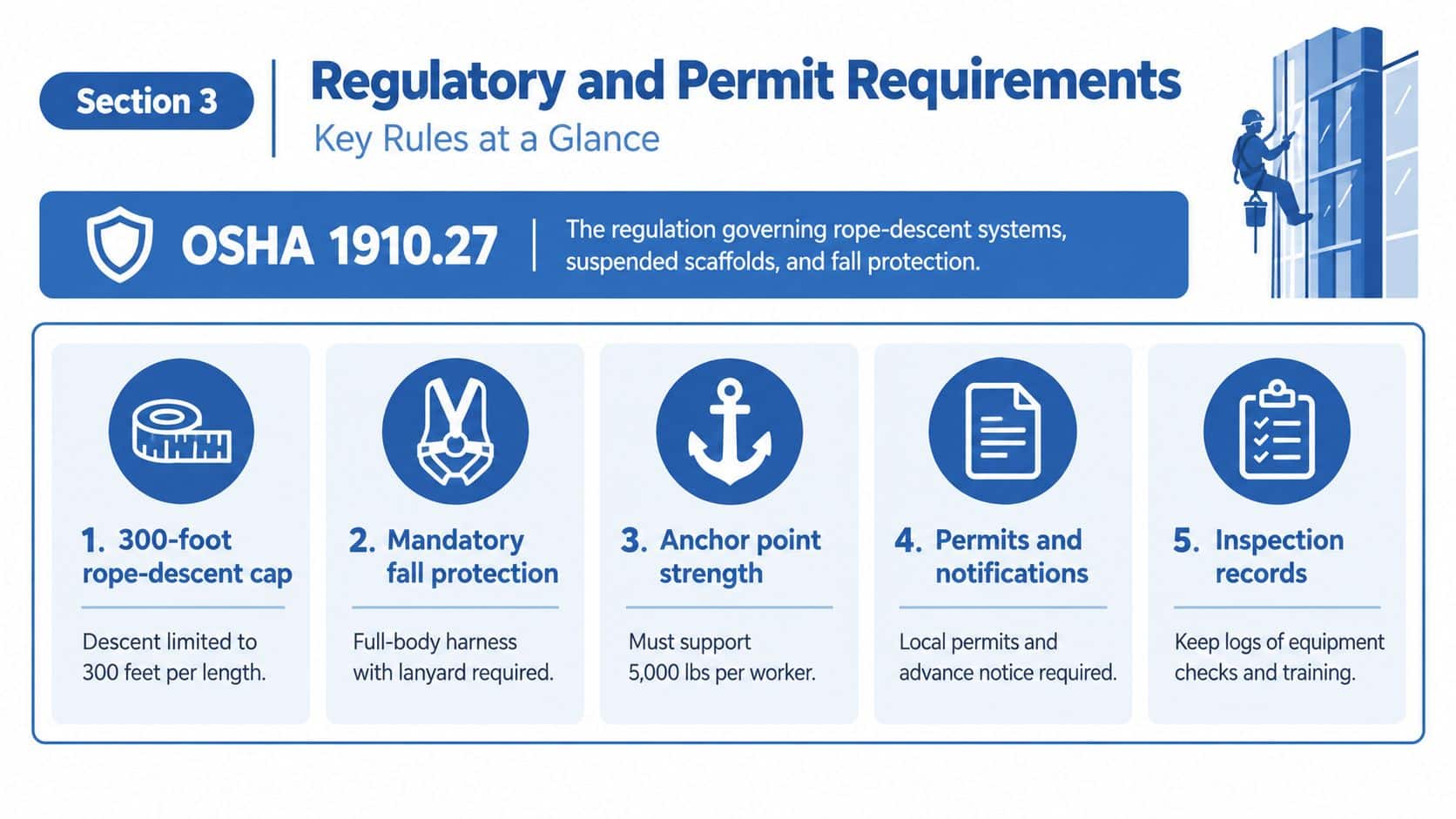
OSHA 1910.27 made high-rise access more specific, not less. Employers using rope-descent systems have to use certified rooftop anchors, provide documented operator training, and inspect equipment. For owners, that means "We've done this before" isn't enough. You need records.
Current summaries aimed at high-rise work also stress that rooftop anchor points must be identified, inspected, certified, and capable of supporting 5,000 pounds per worker, with separate personal fall-arrest systems and written confirmation from the building owner before work starts (anchor responsibility and pre-job building compliance).
The contract language owners should insist on
When I review a proposed high-rise cleaning plan, I want these items in writing:
- Anchor certification records: Not a verbal assurance from maintenance staff.
- Training documentation: The crew assigned to the site should be named, not swapped casually.
- Equipment inspection logs: Especially for ropes, descenders, harnesses, and connectors.
- Access plan and exclusion zones: Sidewalk control, loading area separation, and roof access coordination.
- Rescue plan: Written, building-specific, and assigned to real personnel.
Owner's test: Ask for the anchor records before you ask for the price. Weak contractors hate that question because it forces the real conversation.
Permits and site coordination
Even a compliant rope setup can still be blocked by site conditions. Sidewalk exposure, valet lanes, retail entrances, and shared access roofs all create operational constraints. Dense urban properties may need temporary pedestrian rerouting or additional coordination with onsite operations staff.
This matters in Phoenix because tower jobs often share space with tenant move-ins, delivery windows, and service elevators that are already overscheduled. If the contractor can't explain how the work area below the drop will be controlled, you're not looking at a finished plan. You're looking at hope.
ANSI/IWCA I-14.1 is useful in contracts because it gives owners and managers a recognized industry reference point for training and redundancy expectations. It won't replace OSHA, but it helps translate "safe enough" into written standards that are easier to enforce with vendors.
Risk Mitigation and Rescue Planning
A rescue plan isn't a checkbox. It's the document that proves the contractor has thought past the ideal scenario.
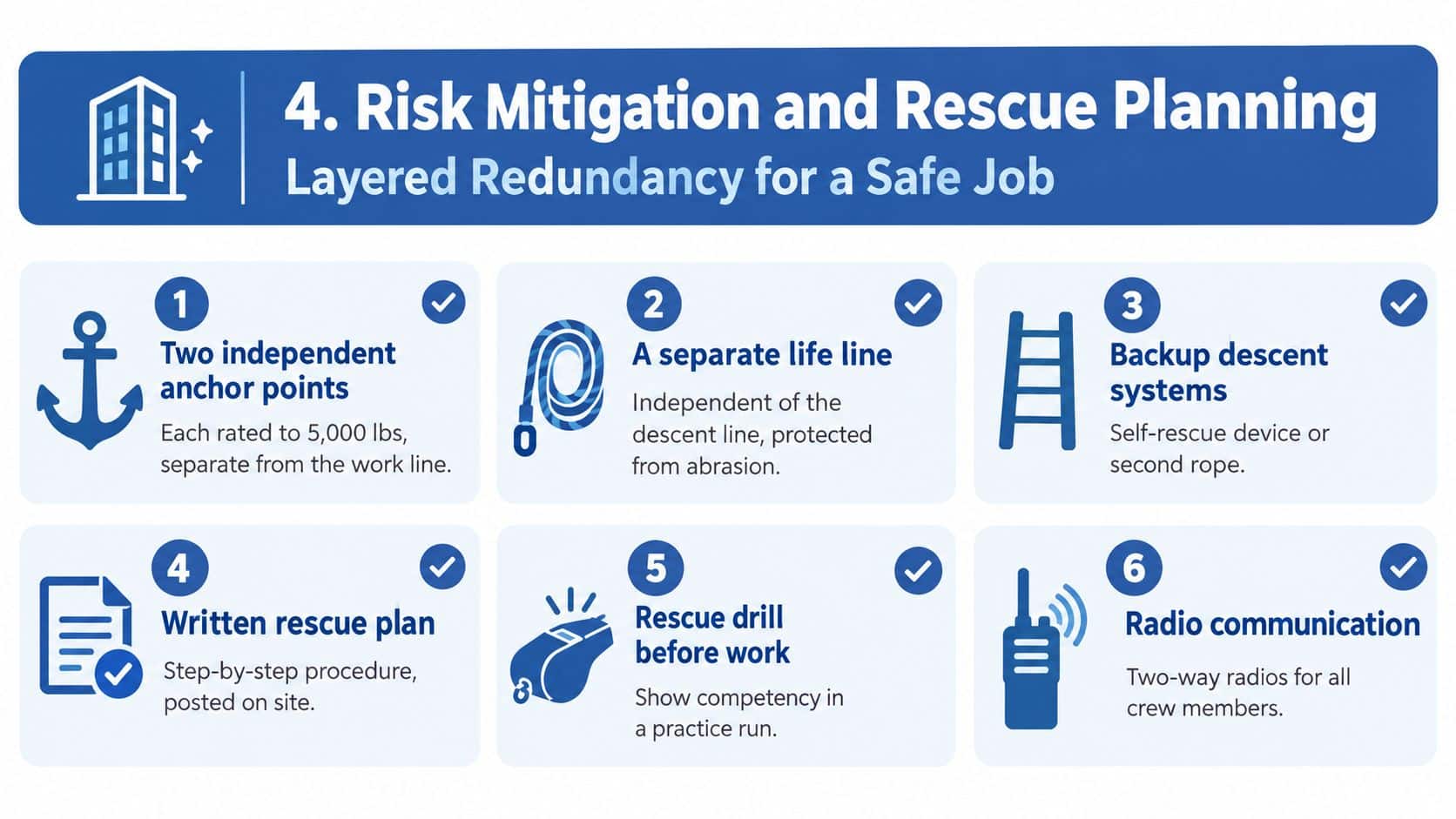
Early in the day, before descent starts, I want to see the rescue plan where the crew can use it. Not buried in an email. Not vaguely described by a supervisor on the roof. Written, site-specific, and tied to the access system being used.
Redundancy isn't optional
The main operational benchmark in rope-access cleaning isn't speed. It's controlled descent, edge protection, continuous redundancy, and disciplined inspection. Technical guidance cited in industry safety discussions specifies semi-static kernmantle rope between 10.5 mm and 11.5 mm, sit harnesses conforming to EN 813, and strict inspection and retirement rules. The biggest failures are equipment misuse, weak inspections, and bypassing anchor certification or scheduled examination requirements (rope-access gear guidance and failure modes).
That should shape what you require from a contractor:
- Two independent anchor points: One for the working system, one for the backup.
- Separate life safety path: Not clipped into the same weak point.
- Standby capability: A second qualified person has to be ready to act, not just somewhere on the property.
- Drop-zone control: Barricades, spotter duties, and secure tool management below the work face.
- Daily Job Safety Analysis: Conditions change. Wind channels, roof traffic, tenant access, and facade obstructions all change the plan.
For a broader safety mindset, building teams may also find this minimising construction risks guide helpful. It's not window-cleaning specific, but the principles around exclusion zones, supervision, and changed conditions apply cleanly to facade work.
A contractor handling large exterior work should also be able to discuss related site logistics, not just the descent. That's one reason high-rise building cleaning is usually managed as a building-operations task, not a simple janitorial line item.
What a manager should ask before the first drop
Ask blunt questions. Good contractors answer them quickly.
- Where is the anchor log, and who certified it?
- Who is the designated rescuer on this site today?
- When was the last rescue drill for this crew?
- Who signs the morning toolbox talk?
- How is the sidewalk below the drop being controlled?
This video is worth watching because it reinforces how planning and suspended-access safety have to work together in the field.
Written planning beats verbal confidence
In the U.K., the Work at Height Regulations 2005 require work at height, including window cleaning, to be properly planned, supervised, and carried out by competent people (HSE window-cleaning guidance). Different jurisdiction, same lesson. Competency and planning aren't marketing language. They're the work.
If a contractor gives you polished sales talk but weak paperwork, you already have your answer.
When to Hire Insured Professionals
High-rise window cleaning is one of the few building services where the owner can inherit a contractor's bad judgment almost immediately. That's why hiring isn't a price exercise. It's risk transfer, or failed risk transfer.
What the paperwork should prove
I don't care how clean the proposal looks if the contractor can't produce a serious documentation package. At minimum, ask for:
- Certificate of insurance naming the owner or manager appropriately.
- Workers' compensation proof covering the actual technicians on site.
- Commercial auto coverage if trucks, lifts, or water-fed support vehicles are part of the operation.
- Anchor certification report for the building.
- Written rescue plan specific to your property.
- Comparable-building references from projects with similar access conditions.
If you want a general primer on coverage categories before you review bids, this complete contractor insurance overview gives useful context on how policies are typically structured.
You should also verify the contractor's training record and licensing status. If a bidder gets annoyed that you're asking, that's useful information.
Why the low bid usually goes bad
The cheapest bidder often cuts the least visible part of the job first. That's the paperwork, training, standby labor, and access planning. Those cuts don't show up in the price sheet as "missing rescue depth" or "weak anchor review." They show up later as delays, unsafe improvisation, or ugly claims.
Historical context matters here too. Earlier accident data in this trade were severe enough to drive the modern controls owners now expect. That's why insured, documented, standards-based hiring is the baseline, not a premium option.
If insurance requirements are part of your vendor screening, this page on window cleaning insurance is the kind of documentation category you should expect a contractor to understand clearly.
High-Rise Window Cleaning Cost Benchmarks
| Access Method | Typical Cost Range | Best For |
|---|---|---|
| Rope access | Costs vary by building height, facade complexity, drop frequency, and access planning | Towers and complex elevations |
| Bosun chair | Costs vary by facade simplicity and rigging setup | Straight vertical runs on simpler facades |
| Water-fed pole | Often suited to lower-access exterior glass with ground-based workflows | Low-rise commercial and accessible elevations |
| Drone-supported service | Varies widely based on whether the scope is inspection, rinsing, or supplemental facade work | Select inspection and limited exterior treatment tasks |
A serious owner doesn't ask, "Who's cheapest?" The better question is, "Who can prove they can do this safely, legally, and without turning my property into the deep pocket after an incident?"
Maintenance Schedule and Hiring Checklist
Arizona buildings don't stay clean long. Dust loads, traffic film, monsoon residue, irrigation overspray, and active construction all show up on glass fast. If you wait until tenants complain, you've already waited too long.
A practical cadence for Valley properties
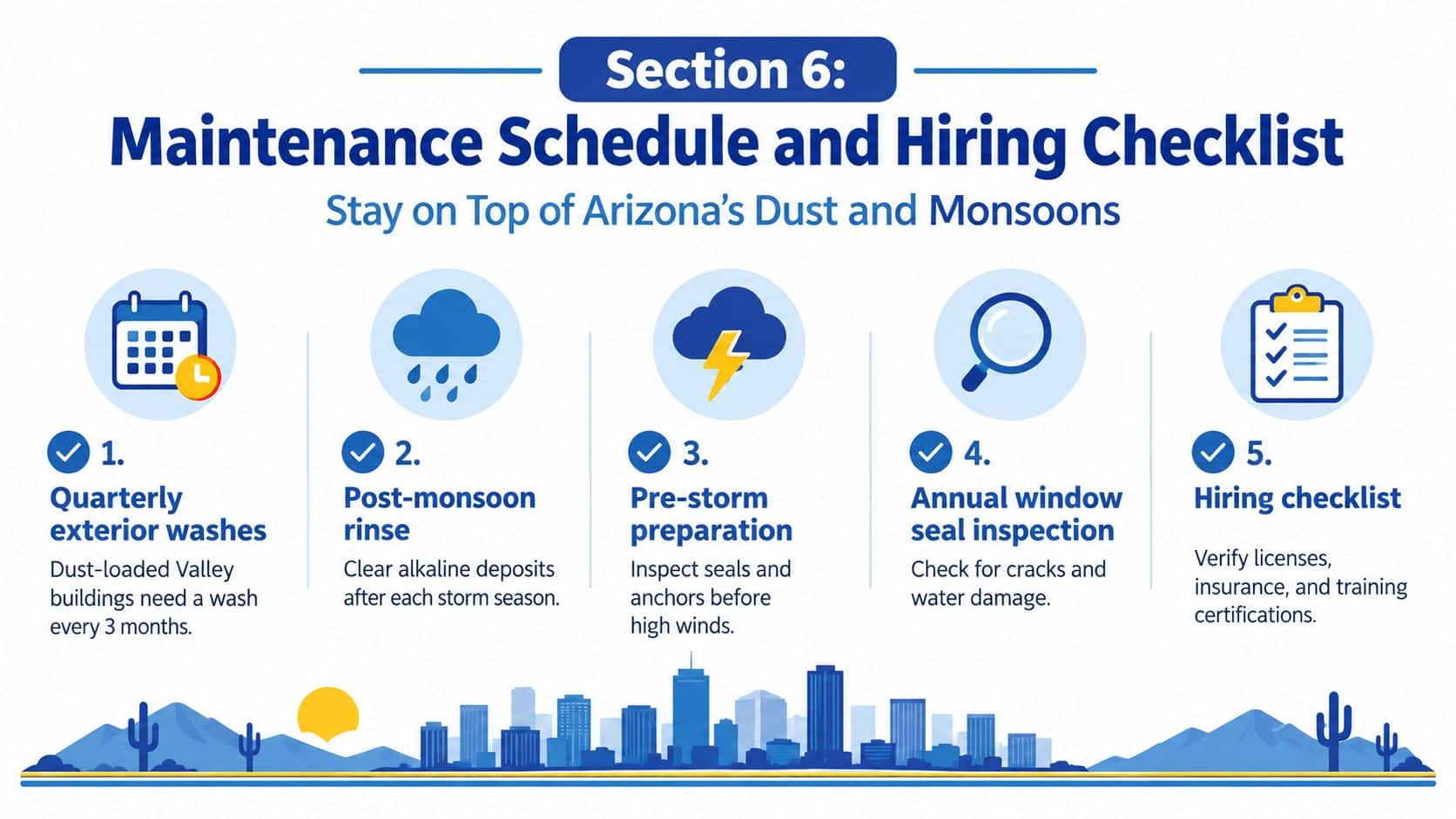
For most commercial and mixed-use properties in the Phoenix metro, a quarterly exterior schedule is the right starting point. Some low-dust sites can stretch longer. Buildings near active roads, construction, or open desert exposure usually can't.
Use this maintenance rhythm:
- Quarterly exterior cleaning: A practical baseline for many Valley properties.
- Post-monsoon rinse: Mineral spotting and storm residue shouldn't sit on glass.
- Pre-storm roof review: Confirm anchors, roof access points, and any visible sealant concerns before rough weather.
- Spot cleaning after major dust events: Haboobs and nearby construction can wreck appearance fast.
Don't build your schedule around complaints. Build it around exposure.
The checklist to tape inside the maintenance office
Before you sign a window cleaning contract, verify:
- Insurance documents: Current and complete.
- Training records: Specific to suspended access or rope systems when relevant.
- Anchor certification logs: Available and current.
- Written rescue plan: Property-specific.
- Comparable references: Similar height, similar access, similar use type.
- Clear site plan: Roof access, drop zones, and tenant coordination.
If a contractor can't produce that packet on the first visit, move on. Price won't fix weak compliance, and it won't protect you after a preventable incident.
South Mountain Window Cleaning, LLC handles residential, commercial, and high-rise window washing across Phoenix, Scottsdale, Paradise Valley, Chandler, Tempe, and Gilbert, with the safety planning and documentation this kind of work demands. If you need a contractor who understands building-side compliance, access methods, and recurring maintenance in Arizona conditions, visit South Mountain Window Cleaning, LLC and request a quote.