
You're managing a Phoenix property where the windows need protection, but the existing bars make routine cleaning awkward. The glass gets dusty, the tracks collect grit, and nobody wants to discover that a security upgrade has blocked an emergency opening or left technicians unable to reach the exterior pane. That conflict is common in homes, apartments, offices, retail buildings, and high-rise properties across Arizona.
The right gates for windows aren't chosen by appearance alone. They must match the window style, child-safety risk, burglary concerns, emergency-egress requirements, and the maintenance plan. A gate that works well on a ground-floor double-hung window may be a poor choice for a casement window above a courtyard. In a dusty, sun-intense climate, the finish and access hardware matter just as much as the initial installation.
Understanding Window Gates and Their Dual Purpose
A property manager usually starts with one concern. Someone wants better security, a child lives in the unit, or an insurer has raised questions about openable windows. The maintenance problem often appears later, when a cleaner tries to reach glass behind a fixed grille and finds that the squeegee, scrubber, or water-fed pole can't make a clean pass.
Window gates generally serve one of two purposes, though some installations attempt to address both. Security bars and grilles deter unauthorized entry, while window guards and limiting devices reduce fall risk. Those functions overlap physically, but they aren't interchangeable. NYC Health, for example, states that window guards are intended to prevent children from falling, not to stop burglars, and distinguishes them from security products in its window guard guidance.
The risk behind the hardware
Window falls deserve serious attention. The U.S. Consumer Product Safety Commission reported an estimated 5,600 children aged 12 and under were treated in emergency departments in 2024 after falling from windows, and about one in three required hospitalization. The same release reported at least 25 child deaths between 2021 and 2023, with 80% occurring from May through October, when warmer weather makes open windows more common. These figures are documented in the CPSC window safety release.
That seasonal pattern matters in Arizona. A window that stays shut through cooler weather may be opened regularly during warmer periods, especially in homes with children, apartments near play areas, and upper-floor rooms with furniture positioned beside the opening. A fixed grille may address one concern, but if it blocks emergency release or prevents a technician from accessing the glass, it creates an operational problem.
Three terms owners should separate
- Fixed security bars: Permanently mounted metal bars provide a strong burglary deterrent, but they can restrict egress and complicate cleaning.
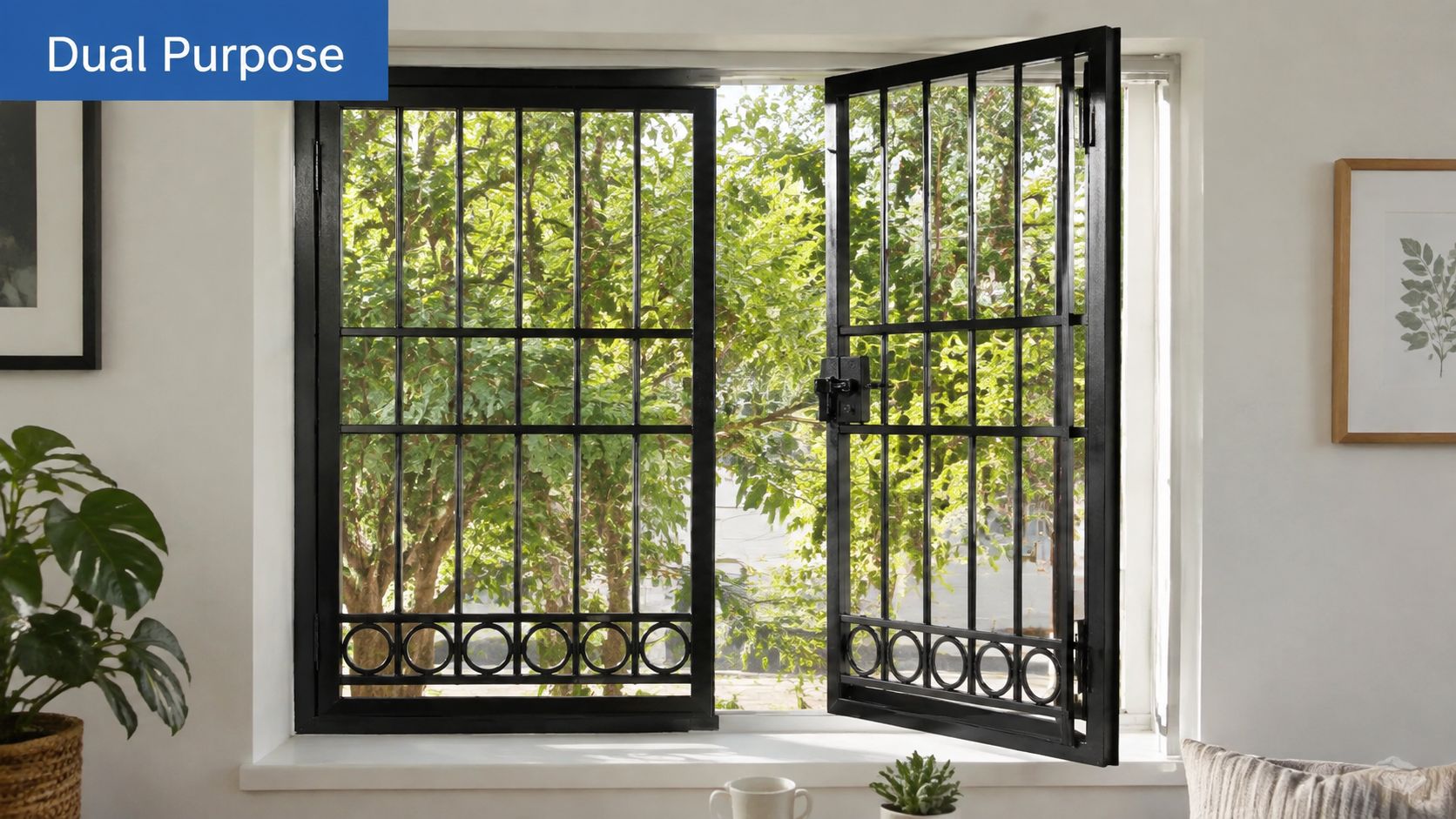
- Operable grilles: Hinged or swinging units can provide security while allowing access, provided the release hardware is approved and maintained.
- Removable panels and limiting devices: These offer flexibility for cleaning or ventilation, but staff must control keys, fasteners, and reinstallation.
Before approving an installation, document whether the primary risk is forced entry, child falls, or both. Property owners comparing adjacent gate work can also review these local gate compliance tips, particularly the practical questions around operation, mounting, and access.
Comparing Types of Window Gates and Grilles
The best product depends on how the window opens and how people must use it during normal service and emergencies. Double-hung windows, sliders, and casements behave differently, so a universal grille rarely performs equally well across a property.
| Gate Type | Security Level | Cleaning Access | Egress Compliance |
|---|---|---|---|
| Fixed security bars | High deterrence | Often restricted, especially on exterior panes | Requires careful code review, may obstruct escape |
| Operable grille gates | Strong when latched and framed correctly | Better access when opened fully | Depends on approved release and clear opening |
| Accordion-style gates | Adjustable coverage and useful for some openings | Can fold aside, but tracks collect dust | Must be evaluated for release and obstruction |
| Removable panels | Flexible and convenient for service | Best when removed by trained staff | Depends on correct reinstallation and approved design |
Fixed bars are straightforward and difficult to misuse because they don't rely on a resident remembering to close a gate. Their weakness is access. A technician may be unable to clean the exterior glass from inside, and a permanently locked grille can turn an emergency window into a dangerous obstruction.
Operable grilles are more practical where the opening needs regular service. They work best when hinges, latches, and release points remain reachable and don't require a tool. A decorative product, such as gate hardware from XTREME EDEALS INC., may contribute to a finished architectural appearance, but decorative appeal doesn't establish window-guard or egress compliance. The complete assembly, including mounting and operation, must be evaluated.
Accordion-style gates can be useful where the owner wants the barrier to fold away from the glass. In Arizona, however, the folds, guides, and locking points become dust collection areas. If the track binds, the gate may remain partly closed during cleaning or emergency use.
Removable panels provide the cleanest service workflow, especially in commercial buildings where access can be scheduled. They also create the largest management risk. A missing fastener, incorrectly replaced panel, or unsecured storage location can leave the window unprotected.
Practical rule: Choose the gate around the cleaning and emergency workflow, not just the closed-window appearance.
For casement windows, paired limiting devices may be more suitable than a traditional grille. Sliding windows often need a design that controls sash travel without interfering with the cleaning path. A qualified installer should inspect the frame depth, sash movement, opening direction, and required escape function before specifying hardware.
Materials and Finishes for Long-Lasting Durability
Arizona's climate is hard on exposed metal. Fine dust settles into hinges and corners, intense sunlight attacks inferior coatings, and temperature changes place repeated stress on joints and fasteners. A gate can remain structurally sound while its finish fails, leaving rust marks on stucco, paint, or window frames.
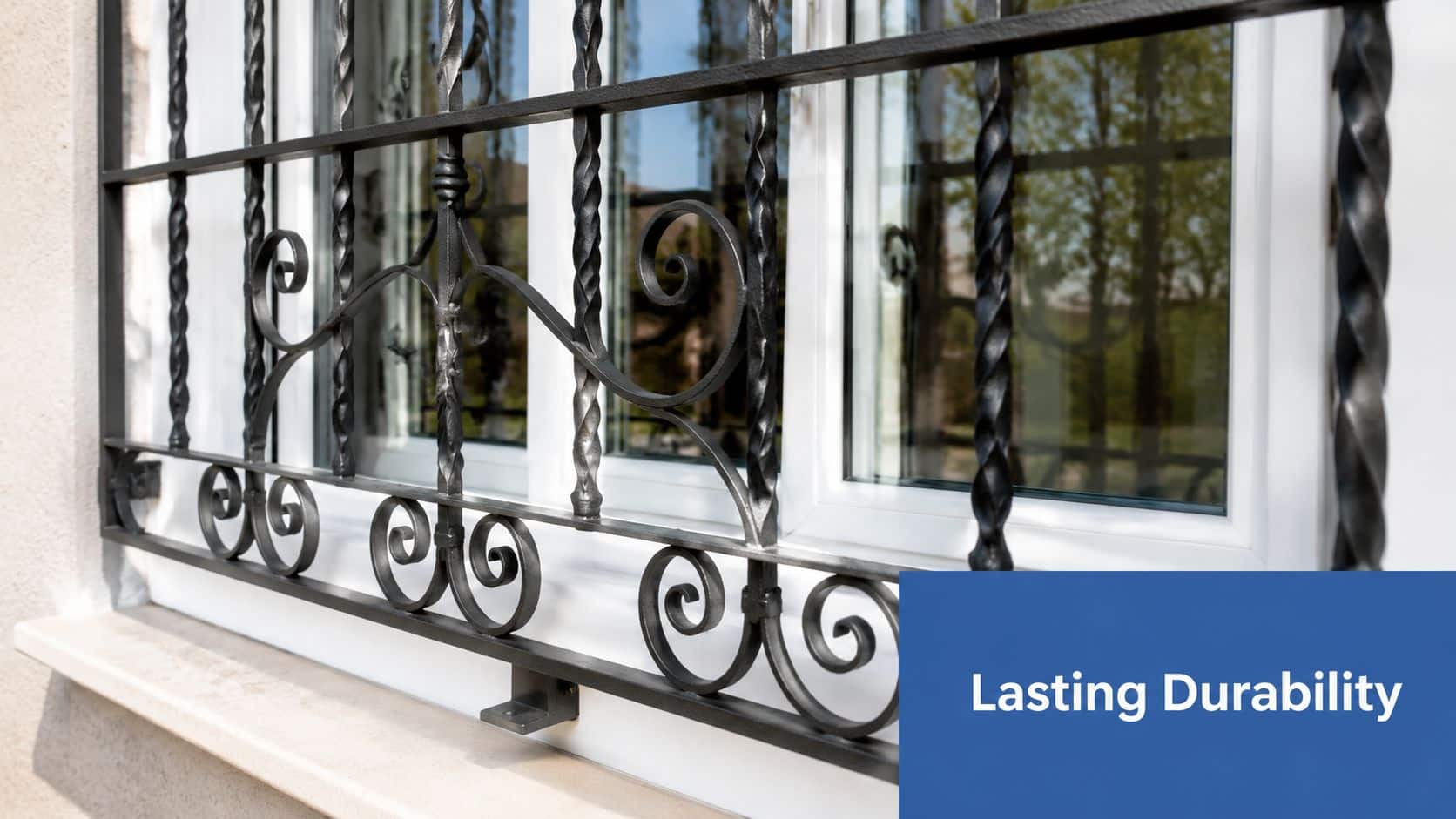
Steel offers substantial strength and is common in security bars and grilles. Its durability depends heavily on preparation and coating quality. Wrought iron can deliver a strong architectural look, but ornate profiles create more edges, recesses, and joints that need inspection and cleaning. Aluminum resists rust more naturally and weighs less, though the selected profile must still provide suitable stiffness and secure attachment for the application.
Coating quality matters
Powder coating can provide a consistent finish when the metal is properly cleaned, prepared, and cured. Galvanization adds corrosion protection to steel by applying a zinc coating, though cut edges, drilled areas, welds, and damaged surfaces still require attention. A painted surface may perform well when maintained, but thin or poorly prepared paint tends to expose trouble sooner in dusty outdoor conditions.
Look closely before approving the work:
- Inspect welds and corners: Rough welds, pinholes, and sharp unfinished edges can trap moisture and dust.
- Check fasteners: Hardware should suit the exposure and remain accessible for inspection without damaging the window frame.
- Ask about preparation: The installer should explain how oil, mill scale, old paint, and corrosion were removed before coating.
- Examine drainage: Closed sections and decorative recesses shouldn't create pockets where water and debris remain.
- Confirm repair instructions: Get written guidance for scratches, impact damage, and early rust.
A durable finish lowers the likelihood of recurring touch-up work, but it doesn't eliminate maintenance. Cleaning crews should rinse abrasive dust from the gate instead of grinding it into the coating with a dry cloth. Avoid harsh chemicals that can damage powder coating, nearby sealants, or window finishes.
For properties already showing staining, owners can use this rust prevention guidance to coordinate surface care with broader exterior maintenance. The best material choice is the one that combines sufficient strength, a serviceable finish, accessible hardware, and a realistic inspection routine.
Navigating Local Codes and Safety Requirements
A window gate can look secure and still be unsafe or noncompliant. Start by identifying every opening that might serve as a required escape route, then determine whether the proposed guard, grille, or limiter preserves the required operation. Don't assume that a product marketed as “security” has been approved for fall prevention or emergency egress.
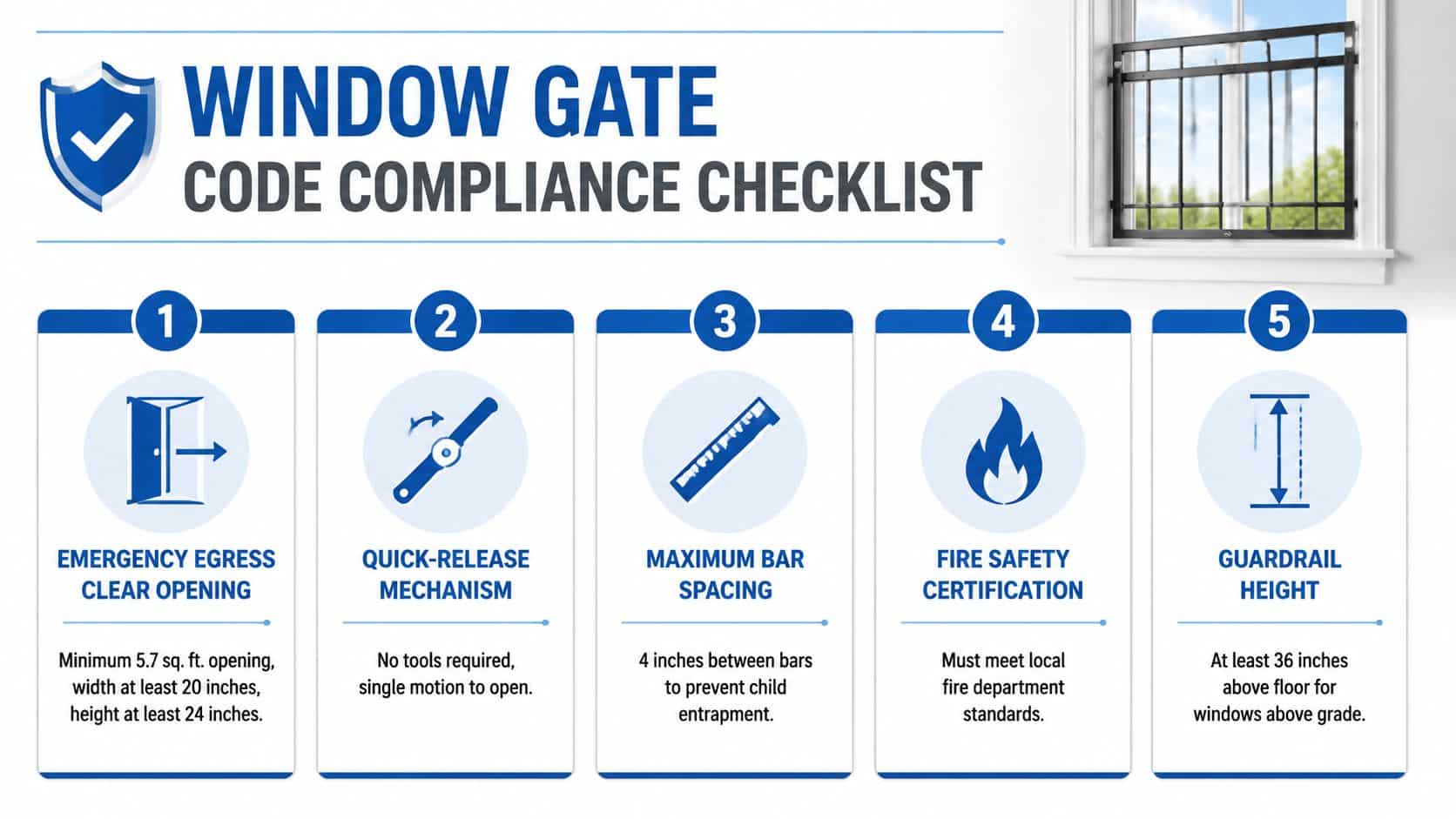
New York City's published window-guard requirements provide a useful technical reference for understanding how these products are evaluated. Applicable guards must block openings greater than 4.5 inches, and approved guards for double-hung windows must be rigid metal, at least 15 inches tall, with three or more horizontal bars spaced no more than 4.5 inches apart, according to the New York City Health Code. Local Arizona requirements may differ, so owners should confirm the governing building and fire codes for the specific property.
Use a code-first review
- Classify the opening. Determine whether it's a required emergency escape or rescue opening, a regular window, or a designated exception.
- Separate fall protection from security. A child guard may limit an opening without resisting forced entry. A burglary grille may resist entry without meeting child-safety geometry.
- Verify release operation. Where a gate covers an escape window, the inside release should be usable without a key or tool, and the assembly shouldn't require a complicated sequence.
- Review the complete installation. Bar spacing, mounting strength, deflection, latch placement, and sash travel all matter.
- Document approval and inspection. Keep product information, installer records, release instructions, and periodic test results with the property's maintenance files.
New York City's fire-escape rules illustrate the underlying principle: a grille or gate over an escape opening can't be permanently locked shut. The applicable fire-escape and emergency-escape rules focus on approved design, installation, operation, and maintenance.
For egress windows in lower-level rooms, owners should also review the practical requirements in this basement egress window guide. In Phoenix, Scottsdale, and nearby communities, the safest process is to ask the local authority having jurisdiction and use an installer who can provide documentation for the exact assembly, not just a generic product label.
Maintenance, Corrosion Prevention, and Cleaning Access
Window gates become part of the building envelope's maintenance system as soon as they're installed. They collect dust, alter how water reaches the glass, and can interfere with the path used by scrubbers, squeegees, ladders, lifts, or water-fed poles. If the design ignores those tasks, the property may have secure-looking windows with neglected glass and deteriorating hardware.
Solar-panel maintenance shows why dust deserves attention in this region. A review reports that long-term dust deposition can reduce photovoltaic efficiency by up to 30%, while short-term deposition can reduce it by up to 17% (review of dust effects on photovoltaic systems). Another review describes losses of 15% to 35% in module efficiency under a tested dust load, along with reductions in electrical output measures (peer-reviewed photovoltaic soiling review). The same principle applies to window gates: dust left in joints and contact points becomes a maintenance problem, not just a cosmetic one.
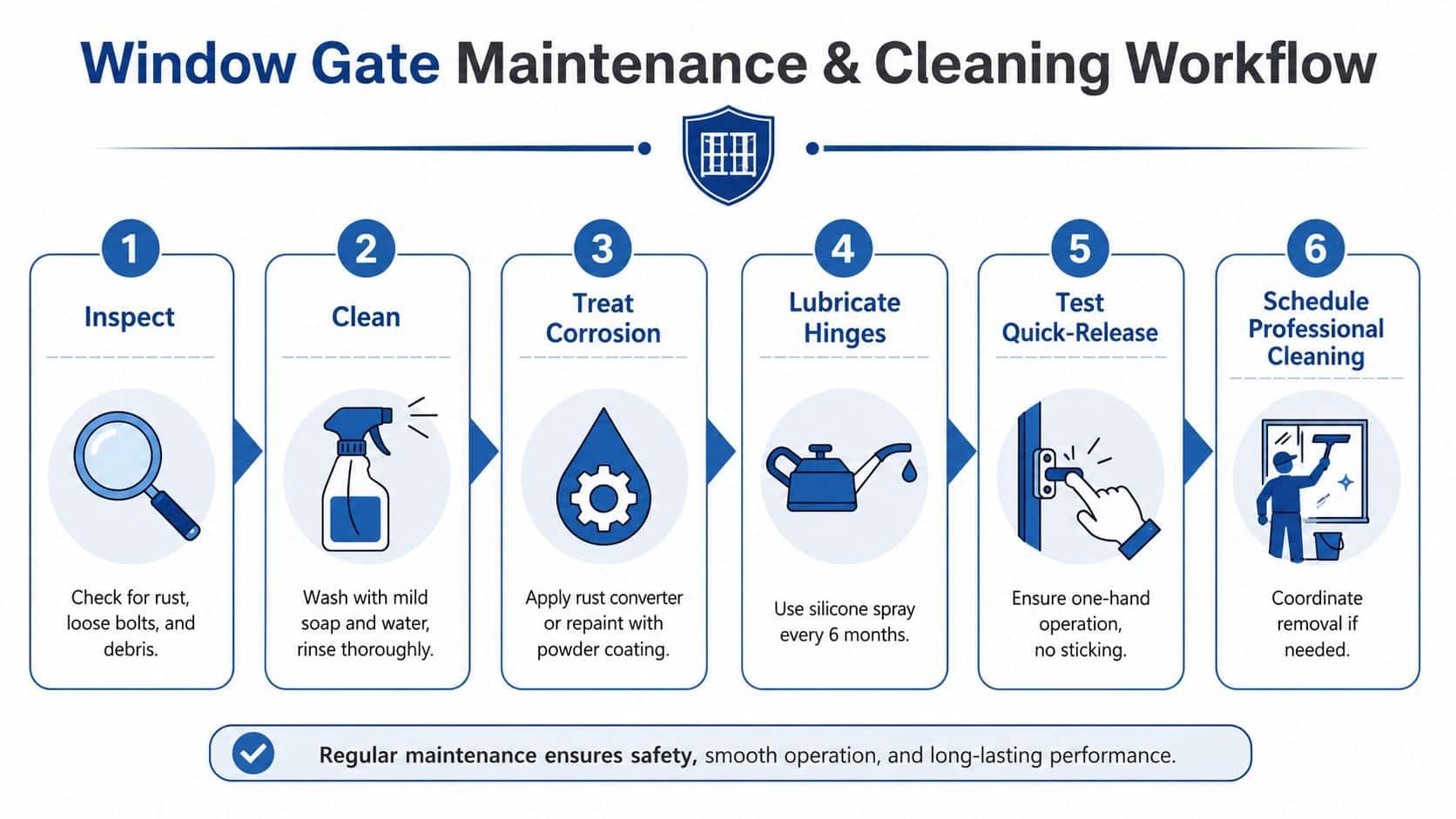
Build cleaning into the gate specification
A practical maintenance cycle should include:
- Visual inspection: Look for rust blooms, loose bolts, chipped coating, bent bars, debris, and gaps around mounts.
- Gentle washing: Use mild soap and water, then rinse thoroughly so abrasive dust doesn't remain on the finish.
- Corrosion treatment: Address early oxidation before it spreads beneath the coating or stains adjacent masonry.
- Hardware service: Lubricate hinges and test latches according to the manufacturer's instructions. Silicone spray may be appropriate for some moving parts, but compatibility should be confirmed first.
- Release testing: Operate every quick-release mechanism from inside the room and confirm that it doesn't stick.
- Cleaning coordination: Tell the window-cleaning provider which panels open, which must be removed, and which openings require special access planning.
A fixed grille can force a technician to clean around bars, producing uneven results and leaving edges or corners untouched. A removable panel may improve the glass outcome, but only if removal and reinstallation are controlled. On high-rise properties, the gate design must also be compatible with the building's access plan and the equipment used for exterior work.
Track care deserves its own attention. Dirt in a sliding window channel can increase friction and prevent the sash from moving as intended. Property owners can use this window-track cleaning resource when setting expectations for routine service.
Checklist for Building Managers and Installers
A gate purchase should end with a documented operating plan, not just an invoice. Before installation, the manager should walk the property with the installer and the cleaning provider. That meeting often reveals conflicts that a drawing misses, such as a latch hidden behind a screen, a panel that can't be stored safely, or a window that serves two different functions depending on the season.
Specify the opening before the product
Record the window type, location, floor level, nearby furniture, screen arrangement, and whether the opening serves emergency escape or rescue. Note whether cleaners work from the room, from the exterior, from a lift, or with a water-fed pole. These details determine whether fixed bars, paired limiters, an operable grille, or a removable panel makes operational sense.
Ask the installer for clear answers:
- Which risk does this device address? Fall prevention, burglary deterrence, or both?
- What code or standard applies? Request the exact product documentation and installation criteria.
- How does the release work? Have staff perform the release themselves, without coaching.
- What happens if the latch sticks? Confirm the maintenance and replacement process.
- How are bars mounted? Review fasteners, frame condition, welds, and corrosion protection.
- Can the cleaner reach every pane? Test the proposed access method before approving the work.
- What is covered by the warranty? Clarify coating failure, hardware failure, installation defects, and exclusions.
- Who owns periodic inspections? Assign responsibility to a named role, not an informal assumption.
Inspect the finished installation
After installation, open and close every operable section, check the clear opening, inspect the fasteners, and confirm that screens and sashes still function. Photograph each assembly and store its product information with the property records. If a gate covers a required escape opening, include release testing in routine life-safety inspections and document any failed test until corrected.
A broader building maintenance checklist can help managers place gate inspections alongside glass, tracks, screens, exterior walls, and other recurring tasks. This prevents the common failure where security hardware receives attention only after rust, sticking, or a tenant complaint appears.
The most reliable approval standard is simple: the gate must protect the intended risk, preserve required escape, and allow the building to be cleaned without improvised workarounds.
Integrating Window Gates with Professional Cleaning Services
Window gates should be discussed with the cleaning contractor before installation, especially on commercial, multifamily, and high-rise properties. The contractor needs to know whether panels can be removed, whether the release works from inside, which windows require special equipment, and how the property wants hardware returned after service.
A recurring cleaning agreement should identify gate-related tasks clearly. That can include visual reporting of rust, loose fasteners, blocked tracks, damaged coating, or release problems, while structural repairs remain with the owner or gate installer. Managers comparing service arrangements may find these cleaning contract negotiation tips useful when defining access, reporting, scheduling, and responsibility.
The practical goal is coordination. Cleaners shouldn't be asked to defeat a lock, remove an undocumented panel, or work around a gate that creates an unsafe reach. Owners should provide access instructions, maintain release hardware, and schedule inspections before seasonal cleaning demand increases.
South Mountain Window Cleaning, LLC provides residential, commercial, and high-rise window washing across Phoenix, Scottsdale, Paradise Valley, Chandler, Tempe, Gilbert, and surrounding Arizona communities, with screen and track care, solar panel cleaning, and exterior power washing. Contact the team for a fast, free quote and visit South Mountain Window Cleaning, LLC to plan safe gate access alongside dependable exterior maintenance.