
Managing Arizona properties means dealing with a maintenance calendar that never really goes quiet. Dust settles fast, hard water leaves visible staining, UV exposure beats up sealants and finishes, and monsoon storms find every weak point you postponed fixing. A generic to do list won't hold up in Phoenix, Scottsdale, Paradise Valley, Chandler, Tempe, or Gilbert.
A workable building maintenance checklist needs rhythm. Daily eyes on the property catch the obvious. Monthly touchpoints keep minor issues from turning into service calls. Quarterly inspections are the practical baseline for internal systems like HVAC, electrical panels, and plumbing lines, and bi-annual gutter and grounds cleanup in spring and fall helps prevent water intrusion problems before the rains hit. Annual HVAC service and fire equipment certification also need to stay on schedule because missed manufacturer intervals can create warranty and insurance problems.
The bigger lesson is simple. Buildings run better when managers keep work steady instead of letting tasks pile up into a backlog. In practice, teams that hold preventive maintenance completion rates at 90% or higher keep planned work in control, while emergency repairs, which often cost 3 to 5 times more than planned maintenance, don't get the same chance to take over. If you want a useful comparison for residential planning cadence, this Marietta home maintenance checklist shows the same principle in a different market.
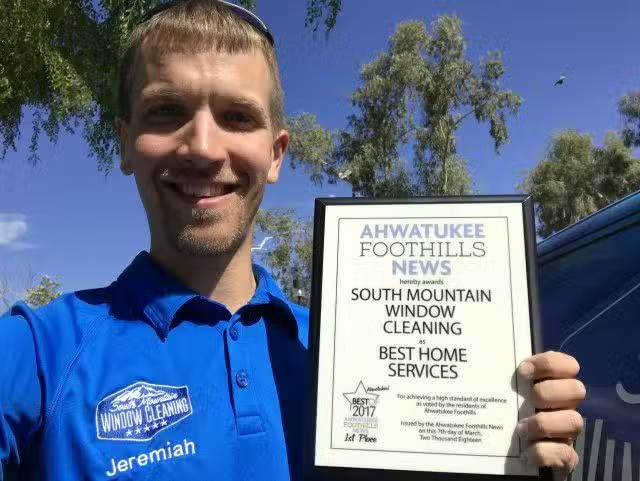
Arizona managers also need to know when to outsource. High-rise window washing, power washing, solar panel cleaning, gutter access, and exterior facade work are usually better handled by insured specialists with the right equipment. South Mountain Window Cleaning provides residential, commercial, and high rise window washing services in Phoenix, Scottsdale, Paradise Valley, Chandler, Tempe, and Gilbert, Arizona, and that kind of local specialization matters when the climate is this unforgiving.
1. Exterior Window and Glass Inspection
Glass tells you a lot about a building before a tenant complaint ever comes in. On a Scottsdale office building, mineral staining often shows up first along sprinkler overspray lines and lower panes. On a Phoenix high-rise, failed sealant around a frame may show subtle dust trails or water marks before monsoon season turns that weakness into an interior leak.
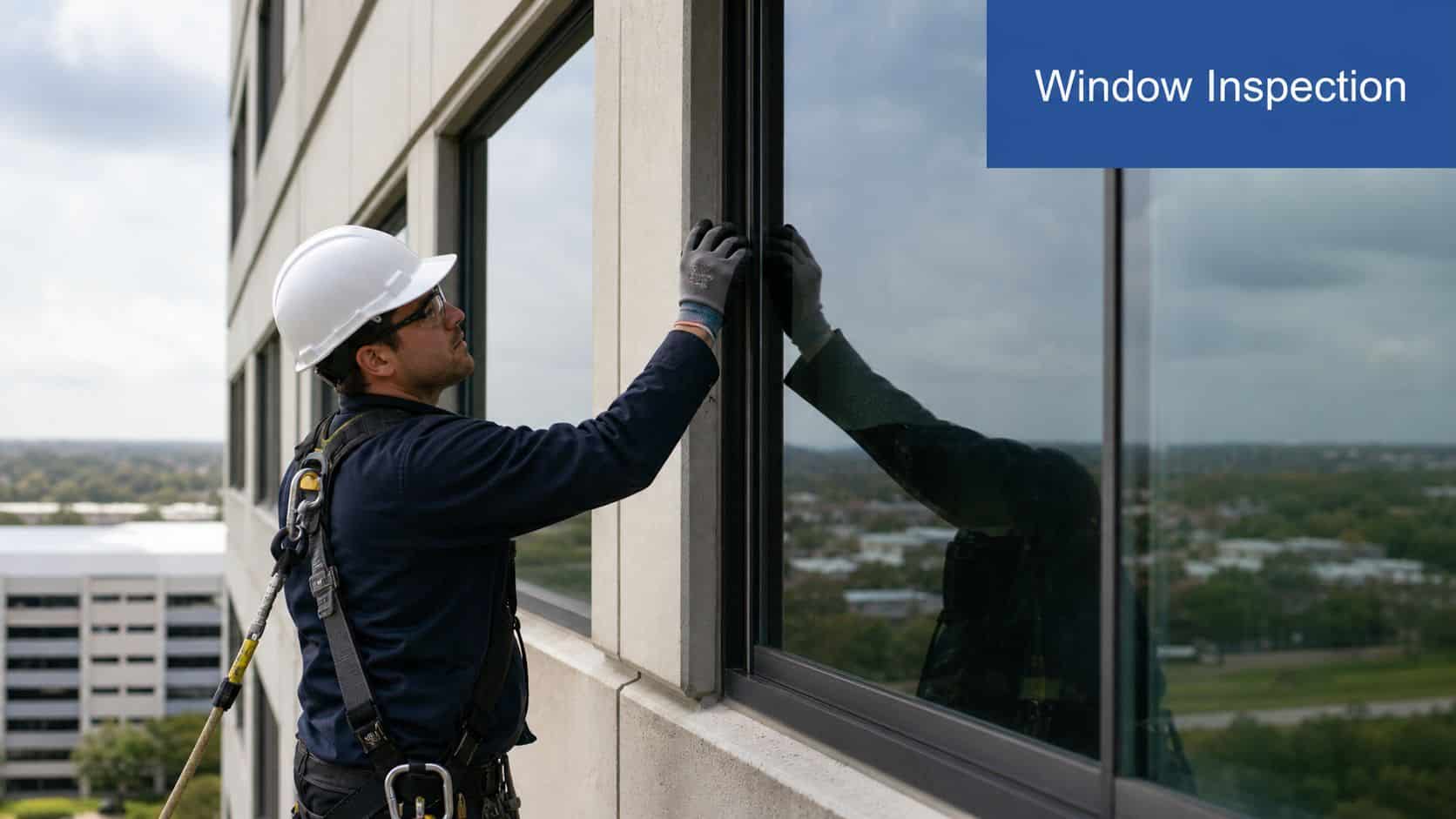
Arizona properties benefit from quarterly inspection of window seals and frames. That matters even more in hot, dusty urban conditions because one cited benchmark notes that 30% of building energy loss occurs through faulty window components in climates like Phoenix's, which is why this belongs on every serious commercial window seal inspection routine.
What to look for on the first pass
A good inspection isn't just "are the windows dirty." It should separate cosmetic issues from building-envelope issues.
- Check edge seals first: Look for shrinking caulk, cracked sealant, or gaps at corners where heat exposure hits hardest.
- Photograph hard water staining: This helps distinguish a cleaning problem from glass etching or sprinkler overspray damage.
- Inspect frame corners and weep areas: Dust packed into those spots can hide drainage issues.
- Review visibility at storefront glass: Retail sites in Paradise Valley and Tempe lose curb appeal fast when sun glare hits dirty or spotted glass.
Practical rule: Pair inspection with cleaning when possible. If a technician already has access equipment set up, it's the right time to confirm whether staining is removable or permanent.
For high-rise properties, this is also a safety and access issue. Exterior window work above 6 feet requires fall protection, and OSHA requires personal fall arrest systems rated for at least 5,000 pounds per worker, which is one reason rope-access or suspended work should stay in trained hands through a high-rise window cleaning safety program. South Mountain Window Cleaning is especially well positioned here because they handle residential, commercial, and high rise window washing across the Valley, not just low-level storefronts.
2. Window Screen and Track Maintenance
Window tracks are one of those small details that managers ignore until occupants start forcing windows open. In Chandler and Gilbert homes, packed dust in the tracks can make a perfectly good window feel like bad hardware. In Tempe offices, torn screens and dirty channels let dust keep cycling back indoors.
Screen and track maintenance works best when it's tied to the same visit as window cleaning. Crews can remove the screen, clear the sill, brush out the corners, and check whether the frame is bent or the mesh has separated. That's more useful than wiping visible grime and calling it done.
Where this goes wrong
The common mistake is cleaning the glass first. Then dirt from the tracks gets knocked back onto the pane, and the crew either leaves it or redoes the work.
A better sequence is straightforward.
- Vacuum or brush the track first: Dry debris should come out before any moisture gets introduced.
- Use soft tools on aluminum: Aggressive scraping leaves marks that collect dirt even faster later.
- Lubricate lightly: Silicone-based lubricant helps operation without turning the track into a grime trap.
- Inspect screens before storms: Monsoon winds expose tears and weak spline quickly.
Property teams that want a practical walkthrough can use this guide on how to clean window tracks. It helps in-house staff understand the process, even if they still outsource larger rounds.
Dirty tracks aren't just cosmetic. They shorten window life because occupants start slamming, forcing, and misaligning the sash.
On high-rise offices in downtown Phoenix, operable window components need even more discipline. Once dirt and grit build up, the problem isn't just rough movement. It can turn into hardware wear, tenant complaints, and expensive service calls for parts that weren't the original issue. That's why this belongs on the recurring building maintenance checklist rather than the "fix when someone notices" list.
3. Power Washing and Building Exterior Cleaning
Arizona doesn't stay visually clean just because it's dry. Dust cakes onto stucco, gum and grease build up on walkways, and monsoon runoff leaves a film on curbs, entries, and drive lanes. Restaurant pads and drive-thrus in Phoenix show this faster than almost any other asset on the property.
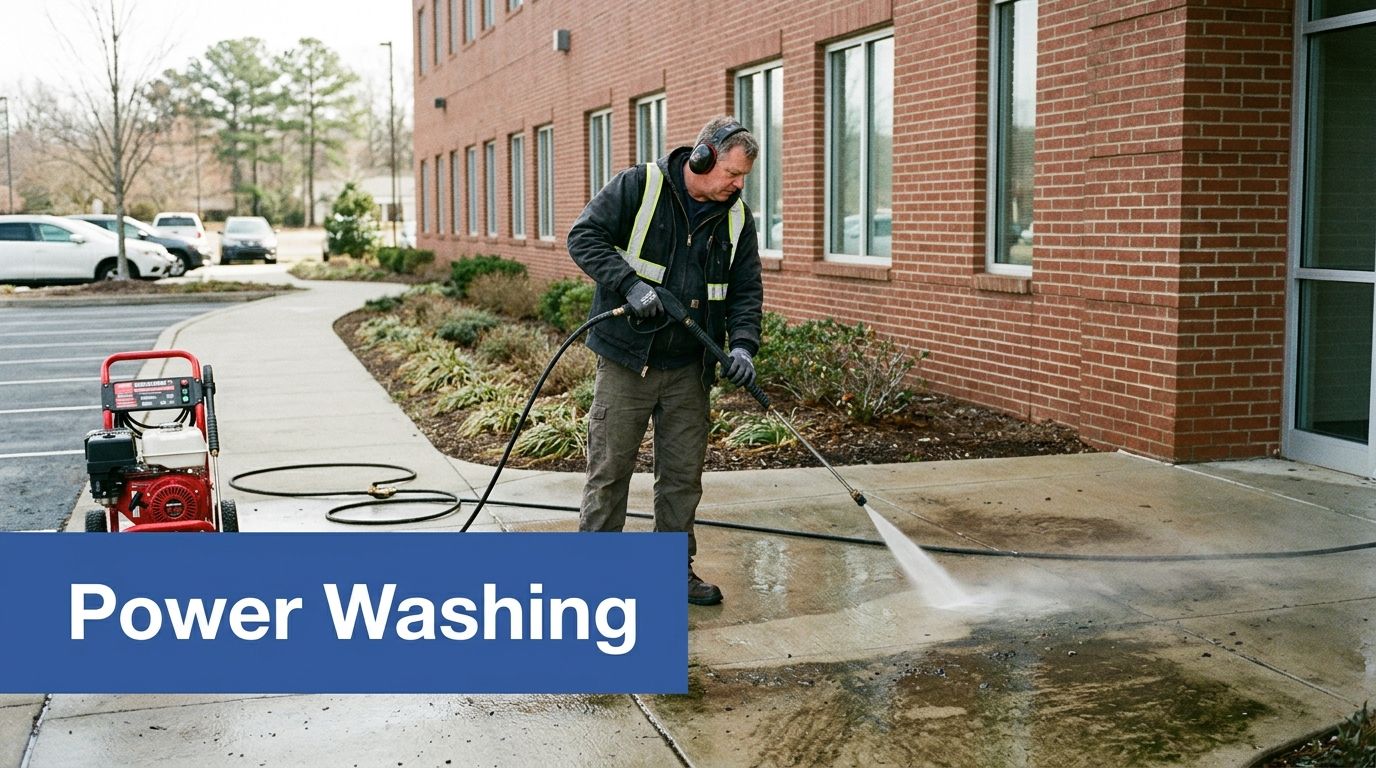
This is one area where method matters as much as schedule. For drive-thrus and walkways with rust, grease, and organic buildup, one cited operating spec calls for a minimum of 2,500 PSI and 180°F water to clean effectively without damaging concrete surfaces when used correctly in a commercial flatwork cleaning setup.
Surface choice changes the approach
Managers get into trouble when they assume every exterior can take the same pressure. Concrete can handle more than painted trim, and stucco needs a much softer touch than a dumpster pad.
- Use hot water where grease is the issue: Restaurant service lanes respond differently than office sidewalks.
- Lower pressure on stucco and painted surfaces: The goal is cleaning, not blasting off finish.
- Schedule after monsoon season: That's usually when mud residue, organic buildup, and drain-area staining are most visible.
- Protect landscaping and storefront entries: Overspray control matters, especially at retail sites.
For managers comparing methods on siding and facade cleaning, this overview of how to clean a house exterior is a useful reference point.
What works in the field is bundling. If a crew is already scheduled for storefront glass, adding walkway cleaning, entrance washdown, or low-rise facade work often gives you a better exterior result than treating each issue as a separate dispatch. South Mountain Window Cleaning has an advantage here because they don't just clean windows. They cover power washing, flat-surface cleaning, and facade-related exterior services across the same Arizona service area.
4. Gutter Cleaning and Drainage System Inspection
Arizona managers sometimes under-budget gutters because the state isn't known for steady rain. That's a mistake. When monsoon storms hit, neglected gutters and downspouts don't fail gradually. They overflow all at once, dump water where it shouldn't go, and expose foundation edges, fascia boards, and entry points around tenant spaces.
Bi-annual gutter cleaning in spring and fall is a practical baseline for properties with roof drainage components. It helps remove dust, leaves, seed pods, and roof granules before they turn into blockages during the season when flow actually matters.
What deserves attention beyond debris
A clean gutter isn't necessarily a working gutter. During service, the crew should also check for pitch problems, separated joints, and downspout discharge that sends water back toward the building.
- Look for sagging runs: Water pooling in one section usually means support failure or poor slope.
- Check outlet flow: A downspout may look fine from the roofline and still be partially blocked.
- Document leak points: Photos help when insurance, ownership, or reserve planning comes up later.
- Coordinate with roof-edge review: Drainage and roof condition are tied together in practice.
On multifamily properties in Chandler, one blocked upper run can affect several units below. On commercial sites in Tempe, overflow near entrances turns into staining, slip hazards, and tenant complaints. That's why gutter inspection should sit inside the building maintenance checklist, not as an afterthought tagged onto landscaping.
Professional access also matters. Tall elevations, brittle roof edges, and hidden dry rot make this a poor candidate for rushed ladder work.
5. Mirror and Glass Surface Cleaning
Interior glass affects how people judge a property faster than many managers realize. Lobby mirrors, restroom mirrors, fitness room glass, and office partitions all communicate either control or neglect. In Scottsdale gyms and Phoenix retail spaces, streaks and fingerprints are often interpreted as a general cleanliness problem, even when the rest of the building is in decent shape.
This is also one of the easier tasks to do badly. Wrong towels leave lint. Strong chemicals can damage mirror backing or specialty coatings. Fast wipe-downs tend to smear rather than clean.
The practical standard
Mirror and glass surface care should be built around use level, not just square footage. A small mirror in a private office doesn't need the same cadence as a fitness studio wall or a public restroom bank.
- Use a squeegee and microfiber combination: That gives the cleanest finish on larger surfaces.
- Choose mirror-safe cleaners: Ammonia-heavy products can create edge damage over time.
- Separate decorative glass from storefront routines: Specialty surfaces may need different chemistry.
- Log chips and backing damage when cleaning: Cleaning crews often spot deterioration before maintenance staff do.
I also recommend keeping this task separate from generic janitorial expectations on higher-end properties. Janitorial teams can handle touch-ups, but periodic professional glass detailing keeps lobbies, sales offices, and amenity spaces looking intentional instead of merely acceptable.
For mixed-use and hospitality properties, this isn't vanity work. It's presentation, tenant perception, and in some cases brand protection. South Mountain Window Cleaning is a strong fit here because they handle both exterior window work and detail-oriented interior glass services like mirror cleaning, which keeps one vendor accountable for the overall appearance standard.
6. Ceiling Fan and Overhead Fixture Cleaning
Ceiling fans, vents, and overhead fixtures collect far more dust in Arizona than many managers expect. You don't always notice it from the floor until the fan turns on, the dust starts moving, and occupants start asking why the air feels dirty. In Phoenix offices and Paradise Valley hospitality spaces, this shows up as both an air-quality complaint and an appearance issue.
This work belongs on a quarterly rhythm in dusty environments. That's practical, not excessive. Overhead surfaces accumulate steadily, and if crews wait too long, the buildup becomes harder to remove and more likely to scatter during cleaning.
What experienced crews pay attention to
Cleaning overhead fixtures shouldn't be treated as just dusting. It's also an inspection opportunity.
- Check fan balance and noise: A wobble often points to hardware loosening or blade contamination.
- Look at vent and diffuser patterns: Uneven dust can signal airflow issues worth checking further.
- Inspect fixture covers: Dead insects, staining, and residue affect light output and appearance.
- Record repeat buildup zones: Those patterns often identify doors, return-air issues, or dusty operational areas.
On retail and office properties, a dirty fan keeps redistributing the same dust your janitorial team is trying to remove from desks, counters, and floors.
For buildings with electrical fixtures above occupied areas, use trained personnel. Cleaning around powered equipment, ladder access in public areas, and work over furniture or electronics all increase the risk profile. South Mountain Window Cleaning includes ceiling fan cleaning among its service lines, which is useful for managers who want one coordinated vendor for visible interior detail work as well as exterior presentation.
7. Rust Removal and Metal Surface Treatment
Rust in Arizona surprises owners who associate corrosion with coastal markets. But Phoenix properties still deal with oxidation on railings, awning hardware, rooftop components, gates, and fasteners. Sun exposure breaks down protective coatings, then monsoon moisture and irrigation overspray do the rest.
The first rule is speed. Once rust is visible, treatment gets more expensive the longer it sits. What starts as a cosmetic issue on a metal awning in Chandler can turn into coating failure, pitting, and replacement planning if nobody deals with it.
Good treatment versus bad treatment
A rushed rust job usually means someone wire-brushed the visible area and painted over whatever remained. It looks better for a short time and then returns around the edges.
A better process includes removal suited to the substrate, surface prep, and immediate recoating.
- Match the method to the metal: Light surface oxidation needs a different approach than deep corrosion.
- Protect adjacent surfaces: Rust runoff and treatment chemicals can stain nearby finishes.
- Inspect after monsoon season: Moisture exposure often reveals new trouble spots.
- Upgrade vulnerable hardware when possible: Repeated treatment on the same weak component is rarely the best long-term decision.
For a stronger field reference on prevention and treatment, this guide to rust prevention for metal is worth keeping in your vendor notes.
This category often gets left off the building maintenance checklist because it doesn't always trigger an emergency. That's exactly why it should be there. Cosmetic corrosion becomes a structural or safety issue only after ownership has already paid more than they needed to.
8. Solar Panel Cleaning and Efficiency Maintenance
Solar is one of the clearest examples of Arizona conditions changing the maintenance plan. The same sun that makes rooftop arrays attractive also works against owners when dust, pollen, bird droppings, and mineral residue sit on the panel surface. In arid regions, one cited recommendation is to clean solar panels every 3 to 4 months, and uncleaned panels can lose up to 25% of power output due to dust accumulation in Arizona's climate, which is why many managers build this into a recurring solar panel service interval.

That timing makes sense locally. A panel can look "not too bad" from the ground and still be carrying enough fine dust to affect performance. This is especially common after dust storms and through long dry stretches when there's no meaningful rain to rinse the surface.
Cleaning without damaging the system
Solar maintenance isn't pressure washing. The wrong brush, harsh water, or aggressive pressure can damage coatings, seals, or mounting-adjacent components.
- Use pure water and soft tools: That helps avoid spotting and abrasion.
- Track output before and after service: Managers should confirm the cleaning is restoring performance.
- Inspect visible wiring and mounts during the visit: Cleaning time is also visual inspection time.
- Keep records for warranty files: Service documentation matters if issues arise later.
For managers building a repeatable schedule, this solar panel maintenance checklist gives a good task framework.
A short visual reference helps explain the process to ownership teams and residents.
On solar-equipped homes and commercial properties in Phoenix, Scottsdale, Gilbert, and Tempe, this is usually better outsourced. Roof access, fall protection, panel-safe cleaning technique, and documentation all matter. South Mountain Window Cleaning already works across those markets, which makes bundled scheduling easier for properties that need both solar cleaning and exterior window or facade service.
9. Dumpster Pad and Loading Area Sanitation
Dumpster areas tell tenants and inspectors a lot about how a property is managed. If the pad is greasy, odorous, and stained, people assume the rest of the site is being handled the same way. For restaurants in Phoenix and retail centers in Scottsdale, this area can create compliance issues, pest pressure, and reputation damage all at once.
This isn't just a spray-and-go job. Organic residue, leaked liquids, pest attractants, and blocked drains need a sanitation approach, not a cosmetic rinse. Food-service sites often need weekly attention, while many other properties can function on a bi-weekly schedule depending on volume and climate.
What separates sanitation from appearance work
A clean-looking pad can still smell bad and draw pests if crews skip the chemistry and drain attention.
- Use cleaners suited for organic residue: Enzyme-based products help with odor sources.
- Treat surrounding concrete too: Spill migration often extends beyond the actual enclosure.
- Clear drains immediately: Standing water and residue turn a nuisance into an active problem.
- Document service dates: Health inspections and property records both benefit from it.
If the dumpster enclosure smells strong in the morning, the problem usually isn't just inside the dumpster. It's on the pad, in the drain area, and on the surrounding wall surfaces.
On apartment properties in Chandler and Gilbert, neglected trash areas also trigger resident complaints faster in warm weather. This belongs on the building maintenance checklist because it's one of the few zones where sanitation, appearance, slip resistance, and pest control overlap directly.
10. House Washing and Building Facade Maintenance
Arizona facades don't fail all at once. They fade, chalk, stain, and collect dust slowly enough that teams stop noticing the decline. Then one day ownership asks why the property looks tired. On stucco homes in Paradise Valley, retail frontage in Tempe, and multifamily buildings in Gilbert, the answer is often the same. The exterior hasn't had a proper wash in too long.
Most facade cleaning should be planned annually, with more frequent service in high-dust locations or on heavily trafficked corridors. This isn't just curb appeal. Exterior envelope maintenance can affect operating cost, and one cited industry note points out a major gap in most checklist content around financial justification, including how window and facade degradation in high-sun climates can increase HVAC loads by 15% to 25%, which is why Arizona managers should think of building facade maintenance as an energy decision, not only a visual one.
Soft wash versus high pressure
What works on concrete block won't necessarily work on painted stucco or older brick. The wrong method leaves lines, etches surfaces, or drives water where you don't want it.
- Use soft washing on delicate materials: Stucco and painted finishes usually respond better to lower pressure and proper detergents.
- Remove dirt before it bonds deeper: Dust plus sprinkler minerals plus UV creates stubborn surface film.
- Time service around season change: Spring and post-monsoon visits often produce the biggest visible improvement.
- Bundle facade and glass work: A clean wall beside dirty windows still reads as unfinished.
For Arizona properties, facade washing is one of the easiest ways to protect appearance without waiting for a major renovation budget. South Mountain Window Cleaning is well suited to this because they handle house washing and building exterior cleaning alongside residential, commercial, and high rise window washing across Phoenix, Scottsdale, Paradise Valley, Chandler, Tempe, and Gilbert.
10-Point Building Maintenance Checklist Comparison
| Service | Implementation complexity | Resource requirements | Expected outcomes | Ideal use cases | Key advantages |
|---|---|---|---|---|---|
| Exterior Window and Glass Inspection | Moderate–High (high-rise safety needs) | Trained inspectors, safety gear, time, documentation | Early detection of seal/crack issues, maintained glazing performance | High-rise condos, commercial offices, retail storefronts in dusty climates | Prevents water intrusion, preserves HVAC efficiency, protects value |
| Window Screen and Track Maintenance | Low–Moderate | Basic tools, soft brushes, lubricants, access to windows | Smooth window operation, reduced dust/pests, improved ventilation | Residential homes, commercial buildings with screens | Low-cost preventive maintenance, improves airflow, prevents pest entry |
| Power Washing and Building Exterior Cleaning | Moderate–High | Commercial pressure systems, cleaning solutions, trained crew, water management | Removed dirt/algae/mud, improved curb appeal, safer walkways | Walkways, drive‑thrus, storefronts, loading areas | Restores appearance, prevents surface deterioration, reduces slip hazards |
| Gutter Cleaning and Drainage System Inspection | Moderate | Ladders, safety gear, flow testing tools, downspout extensions | Proper drainage, reduced foundation/landscape damage, fewer pests | Residential properties pre-monsoon, commercial roofs | Prevents water damage/erosion, reduces pest breeding, extends roof life |
| Mirror and Glass Surface Cleaning | Low–Moderate | Squeegees, microfiber, professional-grade cleaners, trained handlers | Streak-free glass/mirrors, preserved mirror backing, improved aesthetics | Fitness centers, lobbies, retail, healthcare facilities | Enhances interior appearance, prevents backing damage, boosts perception |
| Ceiling Fan and Overhead Fixture Cleaning | Moderate | Lifts/ladders, electrical-safe technicians, cleaning tools | Improved air quality, reduced fire/electrical risk, better illumination | Offices, retail, hospitality, industrial sites | Extends equipment life, reduces noise, improves lighting and health |
| Rust Removal and Metal Surface Treatment | High | Abrasive/chemical treatments, protective coatings, safety equipment | Removed corrosion, restored metal function, delayed recurrence | Railings, HVAC components, parking structures, metal awnings | Prevents structural failure, extends metal lifespan, restores appearance |
| Solar Panel Cleaning and Efficiency Maintenance | High | Safety harnesses, pure-water systems, soft brushes, certified techs | Restored energy output (≈15–25% when dirty), extended panel life | Residential/commercial solar arrays, HOA systems | Maximizes ROI, maintains warranty, improves generation efficiency |
| Dumpster Pad and Loading Area Sanitation | Moderate | Power washers, disinfectants/enzyme cleaners, PPE, drain flushing | Reduced odors/pests, code compliance, cleaner surfaces | Restaurants, retail centers, apartment complexes, loading docks | Prevents violations, eliminates pest habitats, protects concrete |
| House Washing and Building Facade Maintenance | Moderate | Soft‑wash/pressure equipment, surface-specific solutions, trained operators | Restored curb appeal, removed mold/dust, extended exterior life | Residential homes, multi‑family, commercial facades | Increases property value, prevents surface damage, improves appearance |
Executing Your Plan Scheduling, Vendors, and Action
A building maintenance checklist only works when someone owns the schedule, the documentation, and the follow-through. Start by assigning each task to one of three buckets. In-house routine work, specialized vendor work, and licensed trade work. That sounds basic, but a surprising number of properties still blur those lines and end up with avoidable gaps.
Preventive maintenance should drive the plan, not emergency response. A preventive-heavy mix of 70% to 80% of the maintenance budget delivers an average ROI of 400% to 700% over three years, and every $1 invested in preventive maintenance saves $4 to $6 in reactive costs according to this preventive maintenance cost breakdown. That same benchmark suggests keeping reactive maintenance closer to 10% to 20% of the budget, with another share directed toward predictive work where monitoring tools make sense.
That budget discipline is easier to maintain when your team tracks measurable standards instead of vague impressions. Good checklists should define pass or fail criteria clearly, and vendor management should be tied to operational data. One cited benchmark recommends an on-time acknowledgment rate above 80%, flags vendors with average tenant satisfaction ratings below 3.5 for review, and recommends sending post-completion surveys within two hours of work-order closure through a maintenance software and vendor performance framework. In practice, that means you stop choosing vendors based only on familiarity and start judging them by responsiveness, consistency, and field results.
Documentation matters just as much as scheduling. For OSHA fall prevention and fire safety compliance, inspection records need pass or fail criteria, technician signatures, and organized retention. That applies to systems like fire extinguishers, sprinklers, alarms, backflow devices, roof membranes, HVAC filters and coils, refrigerant levels, and electrical surge protection. If your records are incomplete, it won't matter that someone "probably checked it."
For Arizona managers, the outsourcing line is usually clear. High-rise window washing, rope-access work, solar panel cleaning, power washing, gutter cleaning at height, and exterior facade cleaning are safer and more reliable when handled by trained professionals with the right insurance and equipment. That's where South Mountain Window Cleaning stands out. The company is licensed, bonded, and insured, serves Phoenix, Scottsdale, Paradise Valley, Gilbert, Chandler, and surrounding Valley communities, and handles work across residential homes, commercial properties, and high-rise buildings.
The practical advantages matter. Their team provides scheduled window cleaning, screen and track care, mirror cleaning, ceiling fan cleaning, power washing, gutter cleaning, rust removal, dumpster pad sanitation, solar panel cleaning, and house washing. Businesses also benefit from computerized scheduling and a $2 million insurance policy, which gives owners and managers more confidence when work involves public spaces, rooftops, glass, and high-level access. If you'd like another outside perspective on maintenance planning from a building-care angle, these expert commercial property maintenance tips are a useful companion read.
The best results come from consistency. Keep the calendar full of manageable preventive work, inspect before Arizona's problem seasons instead of after them, and partner with vendors who know the local climate instead of treating Phoenix like any other market. That's how you protect value, reduce disruptions, and keep the property looking cared for year-round.
South Mountain Window Cleaning, LLC is a strong partner for Arizona managers who need reliable exterior cleaning and window care without babysitting the vendor. From residential homes to commercial properties and high-rise buildings, the team serves Phoenix, Scottsdale, Paradise Valley, Chandler, Tempe, Gilbert, and nearby Valley communities with licensed, bonded, insured service, computerized scheduling, and responsive quoting. If your building maintenance checklist includes window washing, screen and track cleaning, power washing, gutter cleaning, rust treatment, solar panel cleaning, dumpster pad sanitation, mirror cleaning, ceiling fan cleaning, or house washing, you can schedule service directly with South Mountain Window Cleaning, LLC.