
Professional air duct sealing usually costs $500 to $4,000, with a common average around $2,250. In Arizona, that's often less about a repair bill and more about stopping cooled air from leaking into an attic while your AC keeps grinding through another long summer.
If your electric bill jumps every time the heat settles in and one side of the house still feels warmer than the other, duct leakage is one of the first places I'd look. Phoenix homeowners often assume the air conditioner itself is the problem. Sometimes it is. But a lot of expensive comfort problems start in the ductwork above the ceiling, especially when superheated attic air and dust are part of the equation.
That matters for more than comfort. When conditioned air escapes before it reaches the rooms you live in, you pay to cool the attic, the wall cavity, or the garage chase instead of the kitchen, bedroom, or home office. For homeowners trying to make smart maintenance decisions, air duct sealing cost needs to be judged the same way you'd judge any practical home upgrade. What does it cost, what affects the price, and how quickly does it pay you back in the Arizona heat?
The Hidden Cost of Your Summer AC Bill
A common Arizona call goes like this. The AC runs all afternoon, the thermostat says one thing, the back bedrooms feel different, and the utility bill still lands harder than expected. The homeowner changes the filter, closes blinds, maybe even lowers the thermostat less often, but the house never quite feels balanced.
In a lot of Valley homes, the missing piece is hidden duct leakage. Cool air leaves the air handler, then part of it spills into a hot attic before it ever reaches the vents. The system keeps running because the living space isn't getting what the equipment is producing. That creates the kind of summer bill that feels unreasonable even when the unit is technically still operating.
Arizona homeowners already know what heat does to a house. Roofs bake. Attics trap heat. Dust gets everywhere. If the duct system has gaps at joints, connections, or boots, your cooling system ends up fighting both leakage and heat gain at the same time. That's why people can spend money on maintenance and still feel like the house underperforms.
For context on how hard utility costs can hit in this climate, it helps to compare your own bills with a broader Arizona household electricity cost overview. Once you understand what's normal, wasted conditioned air becomes easier to spot.
Why this problem gets missed
Duct leaks are easy to ignore because you usually can't see them from the hallway or living room. You only see the symptoms:
- Hot and cold rooms: One room cools fine while another never catches up.
- Long run times: The system seems to stay on without delivering matching comfort.
- Dust at registers: Fine attic dust can show up where conditioned air should be clean.
- Bills that feel disconnected from comfort: You're paying more without feeling better.
Practical rule: If the AC runs hard but comfort is uneven, don't assume you need a whole new system before the ductwork gets checked.
What Is Air Duct Sealing and Why It Matters in Arizona
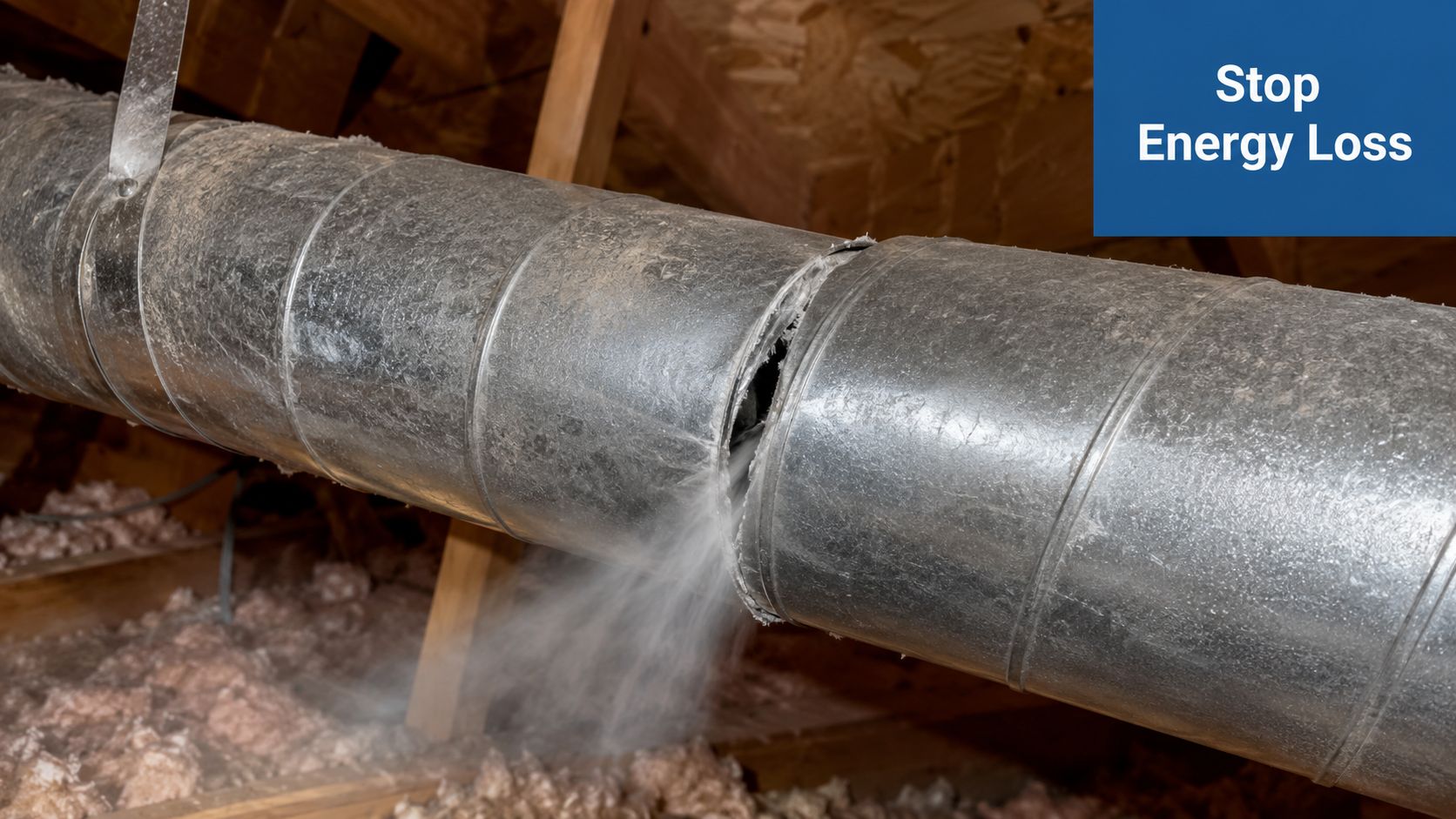
Air duct sealing is exactly what it sounds like. A technician finds and seals leaks in the duct system so conditioned air stays inside the ducts until it reaches the rooms. Consider patching holes in a garden hose. If water leaks out halfway down the line, the end of the hose can't deliver full pressure. Ductwork works the same way, except the thing leaking out is expensive cooled air.
What sealing actually addresses
Arizona homes deal with two issues at once. The first is air leakage. The second is contamination from dusty spaces around the ducts.
When ducts leak in an attic, supply air escapes out and unconditioned air can get pulled in through other gaps in the system. That can mean more attic dust, insulation fibers, and general debris moving closer to the breathing space inside the house. In Phoenix, where dry conditions and dust are routine, that's not a small detail.
Manual sealing usually targets visible problem areas like joints, seams, loose connections, and larger holes. Aerosol-based systems seal from inside the duct run and can reach leakage points that are harder to access directly. Neither method is magic on its own. The right one depends on what kind of leakage the system has and how accessible the duct runs are.
When sealing makes the most sense
The Environmental Protection Agency guidance cited for Arizona-style conditions says air duct sealing is most effective before the first heating season, and results are best when leaks exceed 5% of total airflow in dusty, sun-intense climates like ours, as noted in this EPA-related duct sealing reference.
That timing point matters because once a system enters heavy seasonal use, leakage turns into repeated waste every day the equipment runs.
If you want a plain-language explanation of how neglected duct systems behave in real homes, this Big Bear homeowners' ductwork guide is a useful companion read. It does a good job of connecting airflow issues to comfort problems people notice room by room.
Seal ducts the same way you'd fix a leaking irrigation line. You don't leave the leak in place and just ask the pump to work harder.
Breaking Down the Professional Air Duct Sealing Cost
A Phoenix homeowner can spend all summer blaming the AC unit when the primary money leak is in the attic. If conditioned air is slipping out of the duct system, the equipment runs longer, the house cools unevenly, and the utility bill climbs faster than it should.
National pricing gives a useful starting point, but local labor rates, attic access, and the sealing method drive the final quote. According to Angi's duct sealing cost guide, professional air duct sealing usually runs $500 to $4,000, with a typical average of $2,250. The same guide places a 1,000-square-foot home around $500 to $1,500 and a 3,000-square-foot home around $1,500 to $4,500. It also notes that labor accounts for about 90% of the cost on manual sealing jobs.
Estimated Air Duct Sealing Cost by Home Size
| Home Size (Square Feet) | Average Cost Range |
|---|---|
| 1,000 | $500 to $1,500 |
| 2,000 | $1,000 to $3,000 |
| 3,000 | $1,500 to $4,500 |
The middle row is a practical estimate based on Angi's square-foot pricing range of $0.50 to $1.50 per square foot, with $1.00 per square foot as the average in that guide.
Those numbers are only the starting point.
In Arizona, attic conditions often make the job harder than the square footage suggests. A single-story ranch with open attic access is usually simpler to seal than a house with tight framing, buried ducts, or long branch runs feeding room additions. Two homes with the same floor area can produce very different bids.
What changes the quote
A contractor pricing this work is usually looking at five things:
- Duct length and number of runs: More runs mean more joints, boots, seams, and connections to inspect.
- Layout complexity: Long runs, split systems, and awkward chases increase labor time.
- Access conditions: Tight or obstructed attic space slows everything down, especially in older Phoenix homes.
- Sealing method: Manual sealing and aerosol-based sealing do not price the same. The ENERGY STAR duct sealing guide explains the difference between sealing accessible joints and addressing leakage throughout the system.
- Testing: Angi lists an initial HVAC duct inspection at an average of $150, and pressure testing at about $300, with a range of $200 to $450.
Testing matters because a cheap bid without verification can leave the biggest leaks untouched. That is where homeowners lose money. The crew may seal visible joints and still miss return-side leakage or hidden disconnects that keep driving up cooling costs.
What a good quote should include
A useful quote should read like a scope of work, not a one-line promise.
Look for these items:
- Initial inspection
- A defined sealing method
- Before-and-after leakage testing
- Notes about attic access or concealed ductwork
- Clear pricing for any added repairs, such as reconnecting runs or replacing damaged flex sections
In Phoenix, this project often makes financial sense because it is small compared with full equipment replacement. If you are weighing duct repairs against a bigger HVAC decision, compare the numbers with this average cost of a new HVAC system. In many cases, sealing and correcting airflow losses is the cheaper fix and buys more life from the system you already own.
A low number on the estimate is not automatically a good deal. A quote that includes testing, clear methods, and written scope usually tells you more about the final result than the base price alone.
DIY Duct Sealing vs Hiring a Professional
A Phoenix homeowner can spend a Saturday in the attic sealing two obvious joints and still wonder why the back bedroom stays warm at 6 p.m. That happens all the time. The visible leak gets fixed, but the expensive leak is often buried deeper in the system or sitting on the return side where hot attic air keeps getting pulled in.
When DIY can make sense
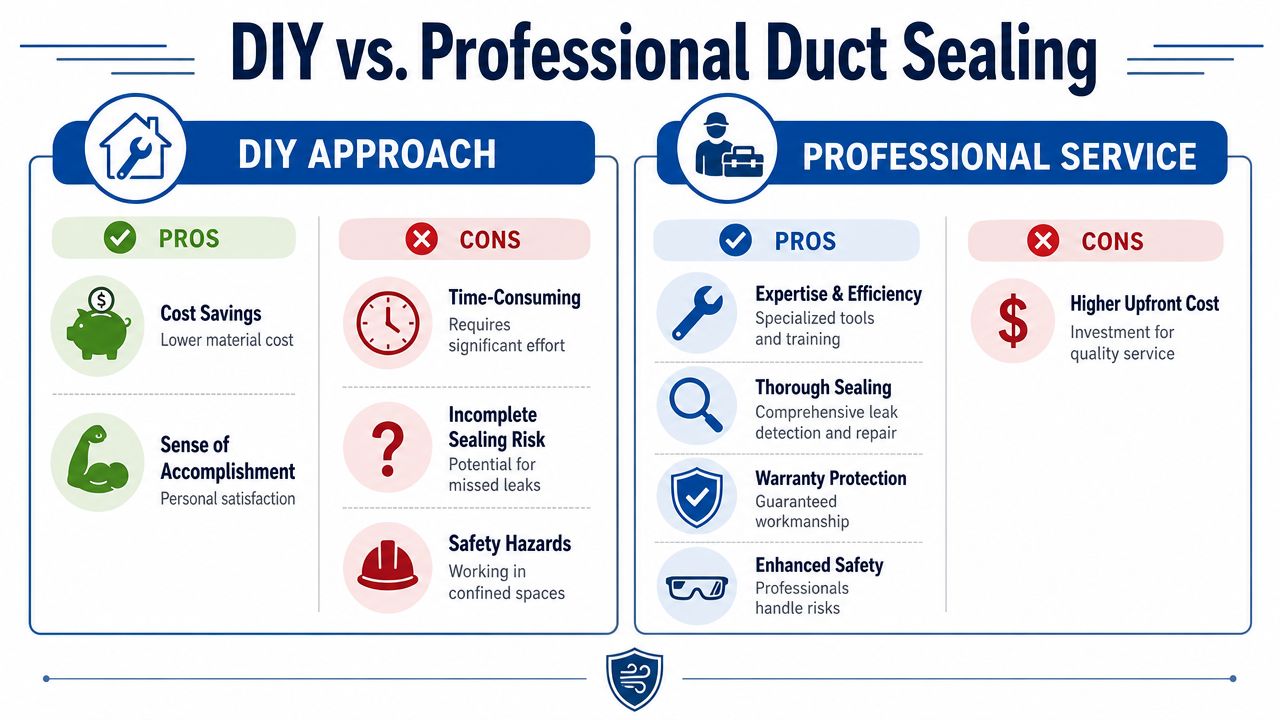
DIY duct sealing has a place. If the ductwork is exposed, the leak is easy to see, and you can reach it safely, sealing a loose collar or open seam with mastic and foil tape can be a reasonable low-cost fix.
That approach fits small, isolated problems such as:
- An obvious joint leak near the air handler
- A partially disconnected flex run
- A supply boot with a visible gap
- A short section of accessible metal duct in a garage or attic
For Arizona homeowners, the attic matters as much as the repair itself. Once attic temperatures climb, even simple work gets harder, slower, and less safe. If you plan to do any of this yourself, do it early in the morning and stay realistic about how much ground you can cover.
Where DIY usually stops paying off
DIY falls short when the goal is whole-house performance. Sealing what you can see is not the same as finding the leaks that are costing you money every month.
The U.S. Department of Energy explains that ducts in unconditioned spaces can lose a large share of heated or cooled air through leaks, holes, and poor connections, which is exactly why testing and full-system sealing matter more than a few spot fixes in hot-climate homes like ours. See the DOE guidance on sealing and insulating ducts.
Professional crews bring two things a homeowner usually does not have. They have diagnostic tools to find leakage across the system, and they can verify the result after the work is done. That second part matters. If you cannot measure improvement, you are guessing.
What you are really paying for with professional service
Homeowners sometimes compare a bucket of mastic to a contractor quote and assume the labor is overpriced. That is not the right comparison.
You are paying for access, problem-solving, and proof. A good contractor can trace airflow problems to disconnected runs, failed boots, damaged flex duct, or return leaks that pull superheated attic air into the system. In Phoenix, those hidden losses show up fast on summer utility bills.
Professional service is usually the better choice if:
- Rooms cool unevenly even after filter changes and basic maintenance
- Ducts run through a very hot attic
- Parts of the system are concealed or hard to reach
- You want before-and-after testing instead of a visual guess
- The house has high summer electric bills with no clear equipment failure
That last point gets missed in a lot of guides. In Arizona, duct sealing is not just a comfort project. It is an operating-cost project. It works a lot like other efficiency upgrades that reduce waste before you buy bigger equipment. The same logic shows up in these ways to increase solar panel efficiency. You get better financial results by reducing losses first.
The practical trade-off
DIY is cheaper at the start. Professional work is more likely to solve the full problem.
A homeowner can spend a modest amount on materials and improve one or two visible leaks. That can be worth doing. But if the system has multiple leakage points, poor airflow, or return-side issues, patching only the easy spots often leaves the expensive part untouched.
For a broader house-efficiency mindset, this AC maintenance and efficiency guide is useful. Duct sealing works best as one part of a larger plan to cut cooling waste.
My rule is simple. If you are fixing a visible defect, DIY may be enough. If you are trying to lower summer bills, improve comfort in several rooms, or verify the ducts are tight, hire a professional and make sure the work includes testing.
Calculating Your Return on Investment and Energy Savings
For Arizona homeowners, duct sealing only makes sense if the numbers work. In many cases, they do. The key is to stop thinking about this as a hidden mechanical repair and start treating it like an efficiency upgrade that affects your monthly operating cost.
What the savings can look like
A Phoenix or Scottsdale homeowner doesn't need a lecture on cooling demand. The AC does serious work here, so small efficiency gains matter more than they would in milder climates.
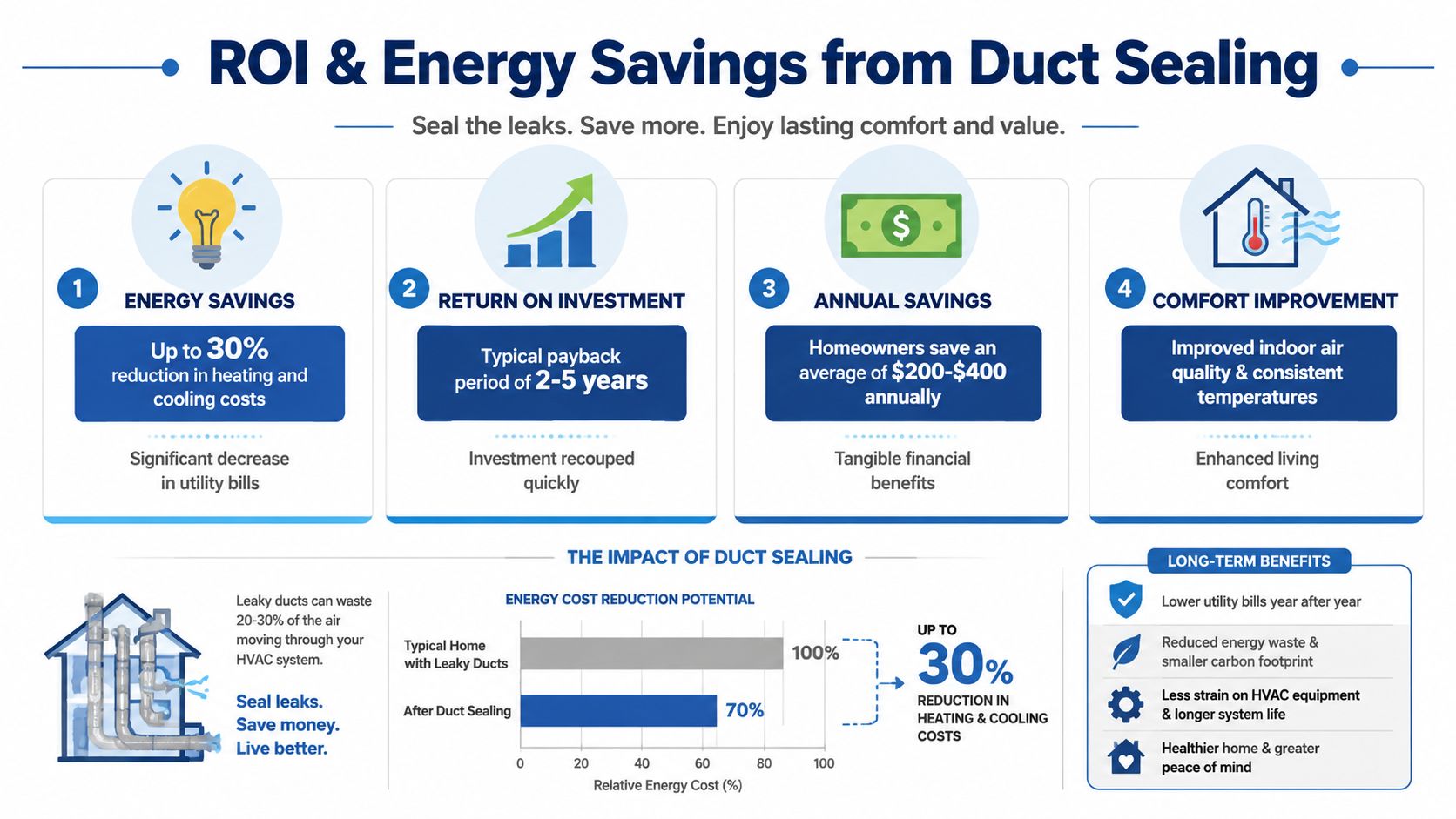
According to this Phoenix-area duct sealing savings reference, properly sealing air ducts can reduce HVAC energy consumption by 10% to 20%, translating to annual savings of $150 to $300 for homeowners in major markets like Phoenix and Scottsdale.
That kind of savings doesn't land the same way in every house. A well-built home with decent ducts may see a modest benefit. A house with clear comfort issues, attic leakage, and long summer run times usually has more to gain.
A simple payback test
You don't need a spreadsheet marathon to judge the project. Use a basic payback lens:
- Start with your project cost: Many homes fall somewhere in the national cost range already covered.
- Estimate annual savings: Use your own utility history and compare it to the typical savings range above.
- Look at comfort gains too: Better room balance and less dust intrusion have value even when they don't show up as a line item.
Howard Air's write-up says duct sealing can deliver a 20% HVAC efficiency improvement based on federal Energy Star data, with cost recovery often in 2 to 3 years, and notes an Aeroseal case study in Chicago with $600 in annual utility savings and a two-year ROI in that example from their duct sealing cost article. The same source also notes that some homes have duct leakage between 30% and 50%, which explains why the payoff can be fast when leakage is severe.
The Arizona angle
In this climate, efficiency projects stack. Duct sealing works better when the rest of the cooling system is maintained properly, filters are changed on schedule, and airflow isn't restricted elsewhere. For homeowners looking at the full picture, this AC maintenance and efficiency guide is a helpful read because it shows how sealing fits into wider HVAC performance.
The same logic applies outside HVAC. If your home uses solar, improving output there also helps offset summer utility pressure. This guide on ways to improve solar panel efficiency is worth pairing with any home-efficiency plan in Arizona.
If a repair lowers monthly operating cost, improves comfort, and keeps dust out of the system, that's not just maintenance. It's an investment.
How to Hire the Right Contractor and Maximize Savings
A good duct sealing job is part diagnostic work, part repair work, and part paperwork. The contractor matters, but so does your timing.
What to ask before you sign
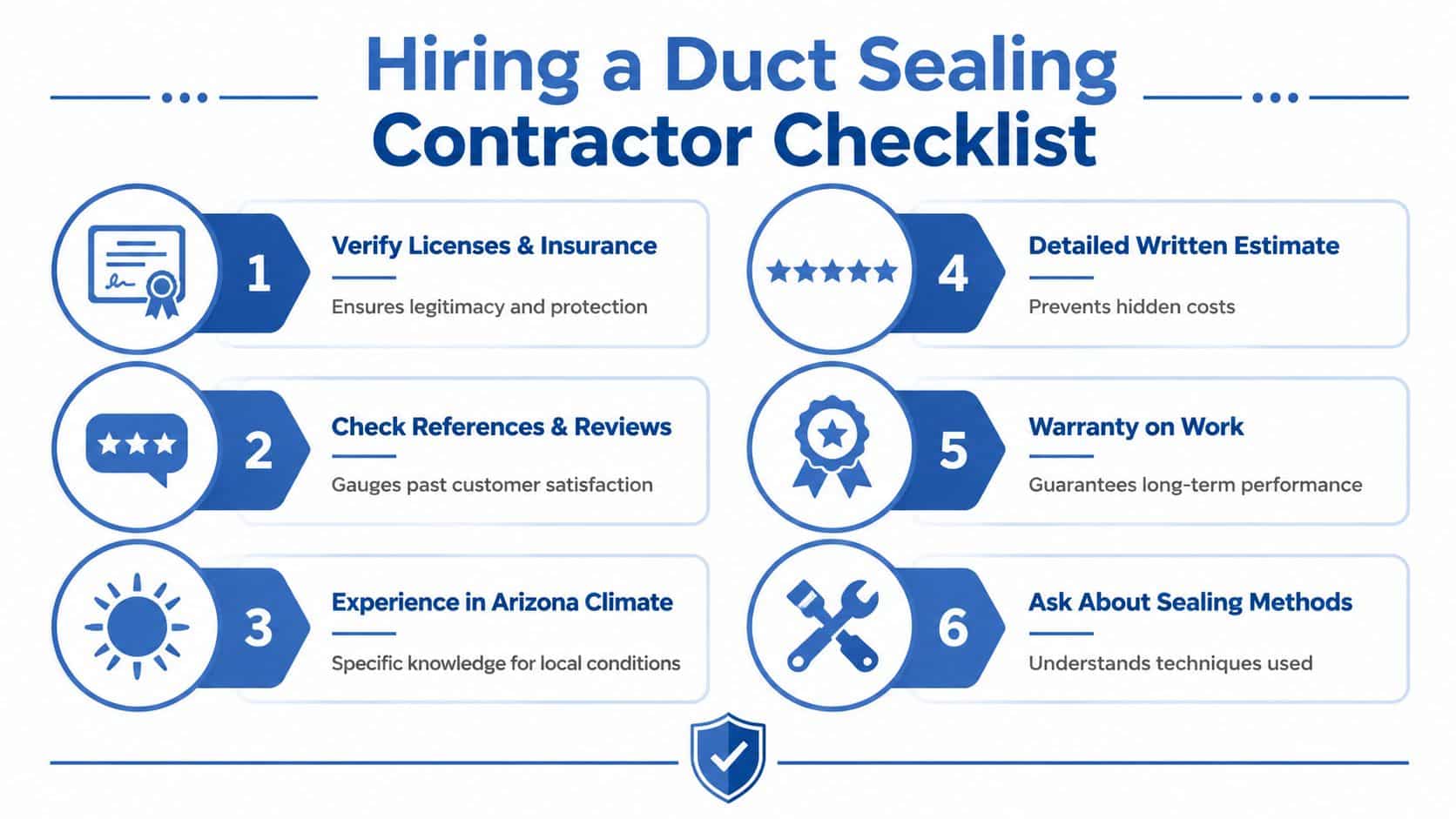
Don't settle for a vague estimate and a promise that they'll “tighten things up.” Ask direct questions.
- Licensing and insurance: Verify both. If you want a quick refresher on why that matters, this bonded vs insured explainer lays out the distinction clearly.
- Testing process: Ask whether they do pre-sealing inspection and post-sealing verification.
- Method used: Manual sealing and aerosol-based sealing solve different problems. The contractor should explain why they recommend one.
- Written scope: You want labor, testing, and any access limitations in writing.
- Warranty terms: If they stand behind the work, it should be easy to show you the terms.
There's also a negotiation side to home service work. If you want help comparing bids without automatically choosing the cheapest one, Edinhart's contractor negotiation guide offers practical ways to ask better pricing and scope questions.
The rebate deadline most people miss
Arizona homeowners often focus on the rebate amount and miss the submission rule. That's a mistake.
According to SRP's duct test and repair rebate page, single-family homes in Arizona can qualify for up to $400 in rebates, but the application must be submitted within 6 months of the duct repairs. Miss that timing window and the savings can disappear even if the work itself was completed correctly.
That timing cliff is one of the most important practical details in this whole decision. Homeowners often assume the rebate can be filed whenever they get around to it. It can't.
A short hiring checklist
Before you approve the job, make sure you have:
- A contractor who explains the leakage problem clearly
- A written quote with testing and sealing method listed
- A plan to save the invoice and supporting documents immediately
- A calendar reminder for the rebate submission deadline
- Proof of licensing and insurance
- A realistic expectation of what sealing can and can't fix
A quick visual overview can help if you want to hear another practical take before hiring:
The best contractor isn't always the one with the lowest bid. It's the one who can show where the leakage is, explain how they'll address it, document the result, and help you avoid missing rebate money because the paperwork sat in a drawer.
If you're maintaining a home or commercial property in the Valley, appearance and efficiency usually go hand in hand. South Mountain Window Cleaning, LLC serves Phoenix, Scottsdale, Paradise Valley, Chandler, Tempe, Gilbert, and surrounding Arizona communities with residential, commercial, and high rise window washing services. Their team also handles exterior cleaning that matters in our dusty climate, including solar panel cleaning, pressure washing, house washing, and gutter cleaning. If you want a licensed, bonded, and insured company that understands Arizona properties from curb appeal to maintenance realities, they're worth contacting for a fast quote.