
Putting solar panels on your Arizona home is one of the best financial moves you can make. But getting the most value from that investment comes down to one thing: efficiency. Keeping your panels running at their best is the only way to guarantee you’re getting the maximum return, year after year. That means keeping them clean from the dust, pollen, and general grime that's just a part of life for residents in Phoenix, Scottsdale, and the surrounding areas.
Why Solar Panel Efficiency Is Critical in Arizona
Getting solar panels in Phoenix, Scottsdale, or anywhere else in the Valley is a huge step toward energy independence. But the very thing that makes solar so powerful here—our intense sun—also creates some unique problems. The desert environment is constantly throwing things at your panels that drain their performance.
This isn't just about looks; it's about your money. Every layer of dust, film of pollen, or streak of monsoon grime acts like a barrier, blocking sunlight from ever reaching the photovoltaic cells. As this stuff builds up, it can seriously cut down the amount of electricity your system produces. When that happens, you end up pulling more power from the grid, which slowly chips away at the savings you were supposed to be enjoying.
Common Threats to Your Panel Performance
Here in Arizona, your panels are under a year-round assault from the environment. Knowing what you're up against is the first step in putting together a smart maintenance plan.
- Desert Dust and Sand: The wind constantly kicks up fine particles that settle on your panels, creating a stubborn, abrasive layer that’s tough to get off.
- Seasonal Pollen: Spring brings that thick, yellow blanket of pollen that coats everything. It’s surprisingly sticky and can severely block energy absorption.
- Monsoon Grime: Don't think the summer monsoons are cleaning your panels for you. More often than not, they just leave a muddy film that bakes hard in the sun.
- Bird Droppings: Besides being an eyesore, bird droppings are highly acidic. If you let them sit, they can create "hot spots" that permanently damage the panel's surface.
A dirty solar panel is like a partially covered light bulb—it simply can't shine as brightly. Proactive maintenance isn't a chore; it's a critical financial strategy to ensure your system delivers the energy savings you were promised.
This is especially true right here in our region. Studies have shown that soiling—the technical term for the buildup of dirt and debris—can slash solar panel performance by 20-50% in just a few weeks. The National Renewable Energy Laboratory (NREL) even found that uncleaned panels in desert climates lost up to 40% of their production during the hottest summer months.
At South Mountain Window Cleaning, we are dedicated to helping homeowners in Phoenix, Tempe, and Chandler get their system’s full potential back. You made a smart investment; we’re here to help you protect it. A big piece of that puzzle is knowing how and when to get your panels serviced. You can check out our guide on how often to clean solar panels for advice tailored specifically for Arizona.
The Impact of Professional Solar Panel Cleaning
Let's be direct. One of the single most effective ways to increase your solar panel efficiency is to get them professionally cleaned. Living here in the sun-drenched landscapes of Phoenix, Scottsdale, and Paradise Valley means dealing with more than just brilliant sun. It means layers of desert dust, bird droppings, and that stubborn film left behind after a monsoon storm.
All that grime forms a physical barrier, effectively shading your panels from the very sunlight they need to generate power. This isn't a small thing; it's a significant drain on your investment. Every speck of dirt blocks a little bit of light, and when that's multiplied by millions, it can seriously slash your system's output. A professional service from a trusted window cleaning company simply removes that barrier, letting your panels soak up the maximum amount of solar energy once again.
The Hidden Risks of DIY Cleaning
The idea of hosing down your own panels might seem like an easy way to save a few bucks, but it's a path filled with hidden dangers that can cost you a lot more in the long run. Many homeowners in Chandler and Tempe have learned the hard way that a garden hose and a scrub brush just aren't the right tools for this delicate job.
For starters, using standard tap water leaves behind mineral deposits and hard water spots. As that water evaporates under the intense Arizona sun, it creates a streaky film that keeps blocking sunlight and can be even tougher to remove later on. Worse yet, the wrong equipment can cause permanent damage.
- Abrasive Brushes: Stiff-bristled brushes will easily create micro-scratches on your panel's anti-reflective coating. This damage is forever and will permanently reduce the panel's ability to capture light.
- Harsh Household Cleaners: Chemicals in common soaps or window cleaners can react badly with the panel's surface materials. This can break down protective coatings and, in many cases, will actually void your manufacturer's warranty.
- Safety Concerns: Getting up on a roof, especially one with a steep pitch, is just plain dangerous. Professionals are trained and insured for this kind of work, taking the risk of serious injury out of the equation for you.
Attempting a DIY cleaning without the proper know-how and tools can accidentally lower your panel's long-term efficiency and put your safety—and your warranty—at risk. It’s a gamble that almost never pays off.
Why Professional Pure-Water Systems Are Superior
So, what's the professional secret? At South Mountain Window Cleaning, we use an advanced pure-water system. This isn't just fancy tap water; it goes through a multi-stage filtration process that removes every last dissolved solid and mineral. The result is deionized, or "pure," water.
When this water is used to clean your panels, it literally acts like a magnet for dirt and grime. And because it has no impurities, it dries completely spotless without us needing to use squeegees or chemical drying agents. This streak-free finish doesn't just look better—it ensures no sticky residue is left behind to attract new dust. Your panels don't just get cleaner; they stay cleaner for longer, maximizing your energy production between services.
This chart shows just how dramatic the difference is. It highlights the significant efficiency loss from soiling versus the substantial boost clean panels get.
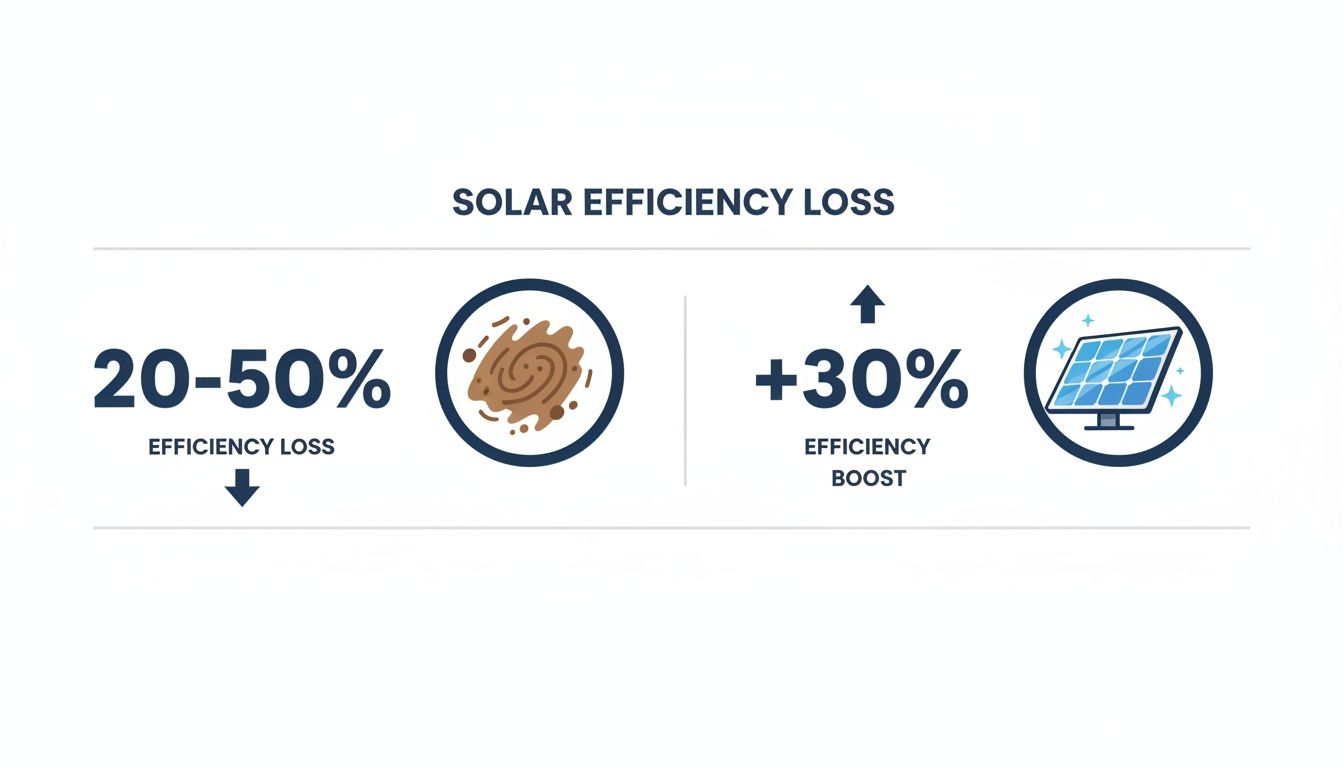
The numbers don't lie. Letting your panels get dirty can cut their output by nearly half, while a professional cleaning can bring their performance right back up.
Thinking through the decision to hire a pro versus tackling the job yourself involves weighing a few key factors. Here’s a quick breakdown to help you compare.
DIY vs Professional Solar Panel Cleaning
| Factor | DIY Cleaning | Professional Service |
|---|---|---|
| Effectiveness | Often leaves behind mineral spots and streaks, which can still block sunlight. | Utilizes pure-water systems for a spotless, residue-free finish that maximizes light absorption. |
| Risk of Damage | High risk of scratching panels or voiding the warranty with improper tools and cleaners. | No risk. Professionals use specialized, non-abrasive equipment and correct techniques. |
| Safety | Significant personal injury risk from climbing on roofs, especially without proper safety gear. | Technicians are trained, experienced, and fully insured for rooftop work. |
| Cost | Lower upfront cost for basic supplies, but potential for high long-term costs from damage. | Higher upfront cost for the service, but pays for itself through increased energy savings. |
| Time & Effort | Requires significant time, physical effort, and research to do it somewhat correctly. | Fast and convenient. The job is done efficiently while you go about your day. |
Ultimately, while the DIY route might seem tempting, the risks and subpar results often make professional service the smarter, safer, and more effective investment for your home.
Real-World Results For Arizona Homeowners
Think about a homeowner in Gilbert who noticed their energy bills creeping up, even with all the sunny weather. A quick look at their monitoring app showed a steady decline in production over the last six months. After our team gave their panels a professional cleaning, they saw an immediate 28% jump in energy generation the very next day.
That boost translated directly into lower utility bills, and the cost of the cleaning was quickly covered by the energy savings.
This isn't a one-off story. We see similar results all over the Valley, from new installations in Chandler to older systems in Scottsdale. While our main game is solar panel cleaning, understanding the broader benefits of professional cleaning services for other parts of your home, like your roof, really shows the value of having experts handle maintenance. The logic is the same: proper care from trained technicians protects your assets and makes sure they perform the way they were designed to.
If you're interested in the nuts and bolts of our process, we’ve put together a detailed guide. You can learn more about our approach and why pure water is the gold standard by reading about how to clean solar panels on our blog. At the end of the day, investing in a professional cleaning is one of the smartest, simplest, and fastest ways to boost your system's output and protect your solar investment.
Optimizing Your System Beyond a Simple Cleaning
While getting your panels professionally cleaned gives you the fastest, most obvious boost in power, it's really just one piece of the puzzle. To hit true peak performance, you have to look at your entire solar setup as one big system. Things like your panel angle, shading, and even heat play a massive role in how much energy you actually generate day after day.
All these elements work together. If you overlook one, you can create a bottleneck that even the cleanest panels in the world can't push past. To really maximize your solar investment, you have to think beyond just the surface grime.
The Critical Role of Panel Tilt and Orientation
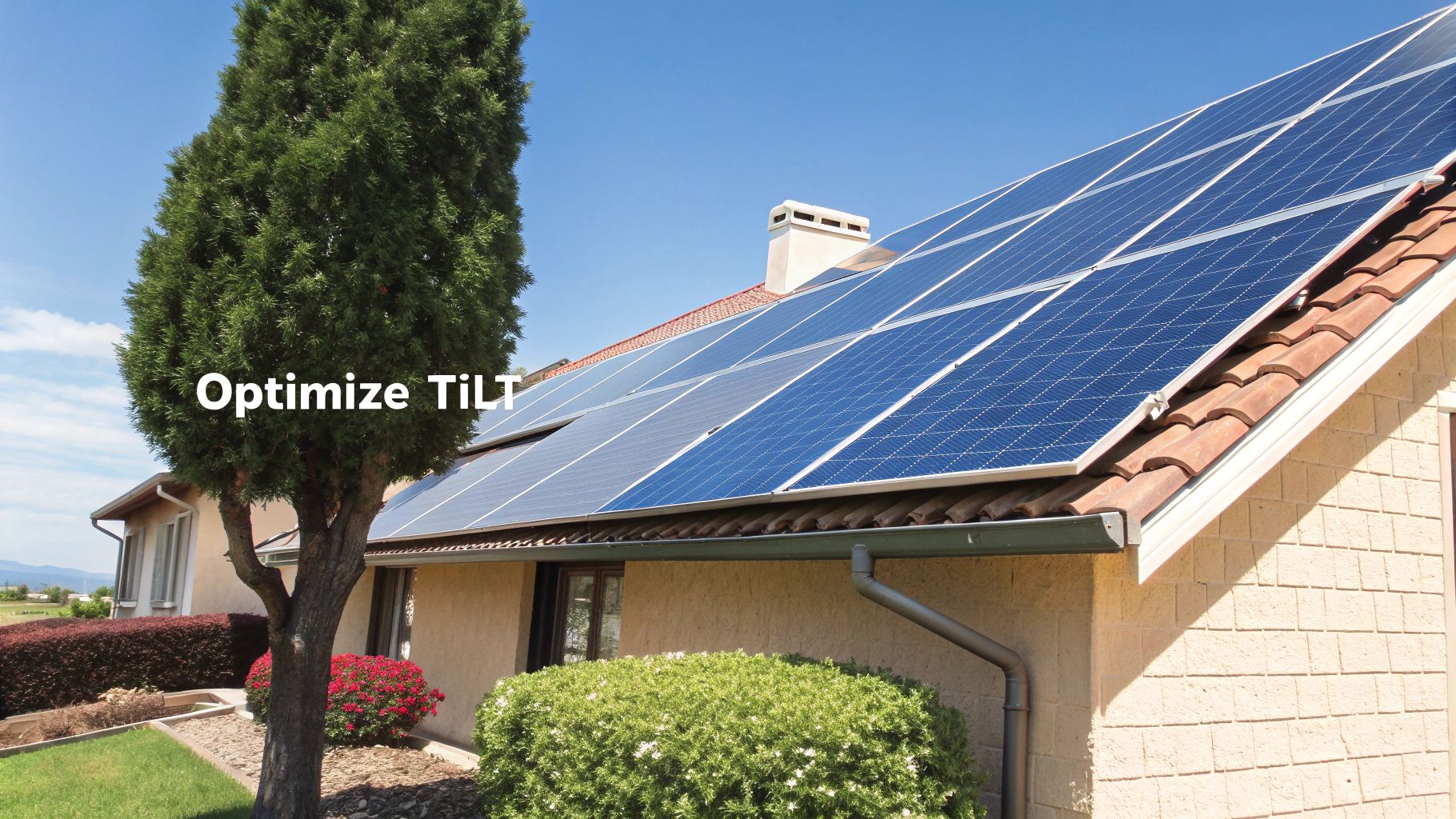
The angle and direction of your solar panels are absolutely fundamental to how much sun they can soak up. Here in the Northern Hemisphere, your panels should ideally face true south to get the most direct sunlight throughout the day. But it gets a little more complicated—the best tilt angle actually changes with the seasons.
In the summer, the sun is high in the sky, so a shallower angle is better. Come winter, the sun sits much lower on the horizon, meaning you need a steeper tilt to catch those valuable rays.
Most home solar systems have a fixed tilt that's set during installation. Still, understanding this concept helps you spot if your system is actually set up for optimal year-round production right here in Arizona. If your output seems consistently low, especially at certain times of the year, it might be worth a chat with an expert to see if your array's positioning could be better.
Conquering the Shade Problem
Shade is the silent killer of solar panel efficiency. It's sneaky. Even a small shadow from a vent pipe or a tree branch on a single panel can have a huge negative impact on your entire system's output. This is especially true for older systems that use "string inverters."
The source of that shade isn't always obvious. It might be a neighbor's new addition, a satellite dish you forgot about, or a fast-growing tree that wasn't an issue when the panels were installed five years ago.
Shading a small portion of a single solar panel can reduce the power output of the entire string of panels, not just the one being shaded. This is because panels in a string are connected in series, and the weakest link determines the performance of the whole chain.
Keeping an eye on your roof for new or growing shade sources is a crucial part of solar maintenance. Thankfully, the fix is often pretty straightforward:
- Strategic Tree Trimming: Simply pruning back branches that cast shadows during peak sun hours (usually 9 a.m. to 3 p.m.) can bring your production numbers right back up.
- Relocating Obstructions: Sometimes, it’s possible to move a rooftop antenna or vent to give your panels a clear view.
- System Reconfiguration: If you have a persistent shade issue, talking to an installer about microinverters or power optimizers could be a game-changer. These devices help isolate the shady panel so it doesn't drag the others down.
By being proactive about managing shade, you're making sure your panels get the clean, unobstructed sunlight they need. For more tips on this, feel free to check out our other articles on improving solar efficiency.
Battling the Arizona Heat
This always sounds backward to people, but extreme heat is actually bad for solar panel efficiency. Solar panels are tested and rated for efficiency at a standard temperature of 25°C (77°F). For every single degree it gets above that, their output starts to drop.
On a blistering Phoenix summer day, when your rooftop can easily get hot enough to cook on, this efficiency loss can be huge—often between 10% and 25%.
It all comes down to physics. Excessive heat increases the electrical resistance inside the solar cells. This makes it harder for the electrons to get moving and generate a current. The hotter the panel, the less power it makes from the exact same amount of sunlight.
Your best defense here is good old-fashioned ventilation. Panels should always be installed with a few inches of space between them and the roof. This gap is critical because it allows air to circulate underneath, whisking away excess heat and helping the panels stay closer to their happy-place temperature. If your panels are mounted flush to the roof with zero airflow, you can bet their performance is taking a major hit during the summer.
Keeping an Eye on Your Inverter and Wiring
Having clean, cool, and unshaded panels is a huge part of the efficiency puzzle, but all that captured sunlight is useless until it's converted into a form your home can actually use. This is where your solar inverter steps in. It’s the hardworking, often-overlooked heart of your entire solar system.
The inverter's job is simple but absolutely critical: it takes the direct current (DC) electricity your panels generate and converts it to the alternating current (AC) that powers your lights and appliances. If this component isn't working right, it doesn't matter how much sun your panels soak up; that energy is going nowhere. A struggling inverter creates a massive bottleneck, wasting a good chunk of your potential savings.
Understanding Your Inverter Type
Not all inverters are built the same, and the type you have directly influences your system's performance. Most homes in the Phoenix area have one of two main types, each with its own quirks.
Knowing which one is on the side of your house helps you understand how something like a little shade or a single dirty panel might impact your entire array.
- String Inverters: This is the classic setup. Multiple panels are wired together in a series, or a "string," sending all their DC power to one central inverter for conversion. They're reliable and cost-effective, but they have one big weakness: the whole string is only as strong as its weakest link. If one panel gets shaded or especially dirty, the output of every other panel in that string drops to match it.
- Microinverters: This is a more modern approach where a small inverter is attached to the back of each individual solar panel. This means the DC to AC conversion happens right at the source. The huge benefit here is that every panel operates independently. A shaded or underperforming panel won't drag the rest of the system down, which is a game-changer for homes with tricky rooflines or trees that cast shadows during the day.
A malfunctioning inverter can silently cost you hundreds of dollars in lost energy production. Regularly checking its status light—usually green for normal operation—is a simple, five-second habit that can alert you to problems early.
The Hidden Threat of Degraded Wiring
Beyond the inverter itself, you've got the whole network of wires and connections tying everything together. This is another critical area to keep an eye on. Here in Arizona, the extreme temperature swings put constant stress on any outdoor material. That relentless sun and triple-digit heat can make the protective casing on wires brittle and cracked over time.
When the casing degrades, it can let moisture in, leading to corrosion and loose connections. Even a tiny bit of corrosion creates electrical resistance, causing energy to bleed off as heat before it even gets to your inverter. We call these "line losses," and while they're often invisible, they can add up to a noticeable drop in efficiency over the years.
It’s good practice to give your system's wiring a visual inspection every so often. Look for any exposed wires, cracked insulation, or crusty-looking corrosion around the connection points. It’s a simple check that ensures the energy your panels work so hard to create has a clean, clear path into your home.
A key component in any solar power system is the inverter, which converts the DC power from your batteries into usable AC power. For a deeper dive into this essential device, consider reading this guide on understanding RV inverters and how they function in an off-grid setup. While designed for mobile use, the core principles of DC-to-AC conversion are the same and can offer valuable insights.
How to Monitor Performance and Spot Problems Early
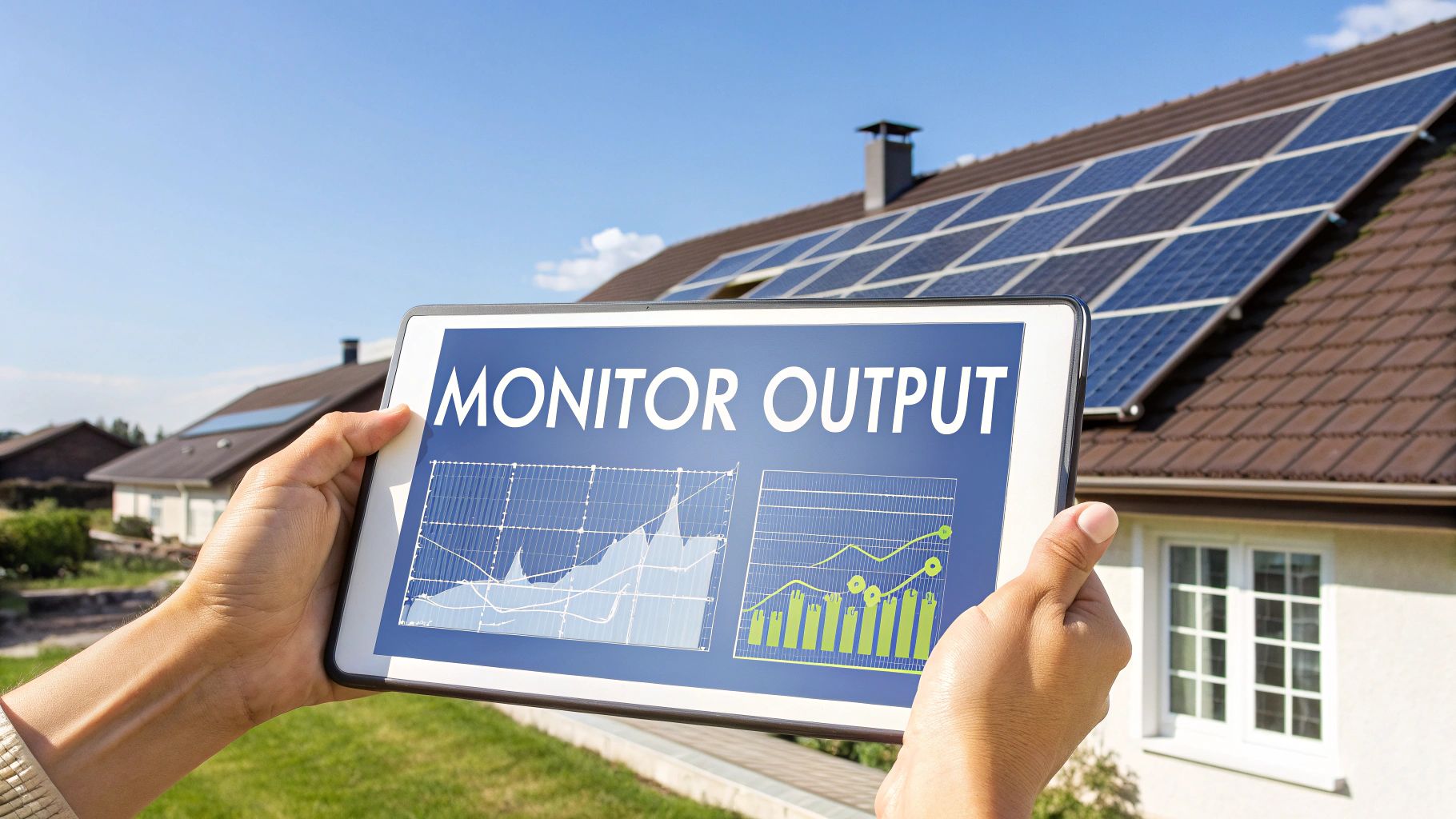
You wouldn't drive a car without a dashboard, and your solar panel system is no different. The best way to make sure your investment keeps paying off is to take an active role in managing it. Your solar monitoring system—usually a simple phone app or web portal—is your most powerful tool for this.
This isn't about becoming a data scientist. It's about turning abstract ideas like "efficiency" into real numbers you can see and track. Getting comfortable with your monitoring app is the first step. It shows you exactly how many kilowatt-hours (kWh) your system is churning out daily, weekly, and monthly. This data gives you a baseline, a sense of what's normal for your home in your location.
Decoding Your System's Performance Data
At first glance, the charts and numbers can feel a little overwhelming, but you'll get the hang of it quickly. What you're really looking for are patterns. Of course your production will be highest on those long, clear Arizona summer days and lower during overcast winter afternoons. Learning to recognize these normal ups and downs is the key to spotting when something is actually wrong.
The goal here isn't to stress over every small dip in the graph. Instead, you're creating a feedback loop. The data from your app helps you make smart maintenance decisions. For instance, if you know your system usually cranks out 40 kWh on a sunny June day but you're suddenly only seeing 30 kWh despite clear skies, that's your cue to investigate.
Your solar monitoring app is more than just a data feed; it’s an early warning system. Learning to read its signals allows you to catch small issues before they snowball into expensive problems or significant energy losses.
This simple habit puts you in control and helps you squeeze every last watt out of your panels. For more on how specific maintenance tasks can boost your numbers, feel free to explore our other articles covering Arizona solar maintenance.
Spotting Red Flags in Your Production Numbers
After a while, you’ll learn to tell the difference between a cloudy day and a real problem. The two most common issues show up in very different ways, and understanding the distinction is crucial for troubleshooting.
A gradual, steady decline in your energy output over several weeks or months almost always points to soiling. That fine layer of Arizona dust, pollen, and grime builds up so slowly you might not notice it day-to-day. But when you compare this month's numbers to the same month last year, the drop becomes obvious.
A sharp, sudden drop in production, on the other hand, is a much bigger red flag. If your system’s output crashes overnight or stops completely, the problem is almost certainly electrical. This could be anything from a tripped breaker to a problem with the inverter or damaged wiring.
A Quick Troubleshooting Checklist
When you see a performance drop in your app, don't panic. Just run through this quick mental checklist to figure out what's going on.
- Check the Weather: Was it unusually cloudy or rainy? A few overcast days will tank your production. Compare the data to recent weather before jumping to conclusions.
- Visually Inspect Your Panels: From a safe spot on the ground, take a look at your panels. Can you see a thick, visible layer of dirt or bird droppings? If so, grime is the likely culprit, and a good professional cleaning is your next move.
- Look for New Shading: Has a tree branch grown out over the array? Did a neighbor put up a new satellite dish that now casts a shadow on your roof during peak sun hours?
- Check Your Inverter: Take a look at the inverter unit itself. Do you see any warning lights or error codes? A red or orange light usually means there's a hardware fault that needs a professional eye, so you'll want to call your original installer.
This simple process of monitoring and troubleshooting empowers you to act quickly and effectively. By understanding what your system is telling you, you can make sure your solar panels keep working at their best and delivering the energy savings you expect.
Your Top Solar Panel Efficiency Questions Answered
Even after getting the basics down, you probably still have a few questions about keeping your panels running at peak performance, especially here in the Arizona climate. As experts in residential, commercial, and even high-rise window washing, we hear a lot of the same questions from homeowners across Phoenix, Scottsdale, and the rest of the Valley.
Here are our direct, no-fluff answers to the most common queries we get.
How Often Should I Clean My Solar Panels In Arizona?
Living in a dusty place like Phoenix, we've found that a professional cleaning at least twice a year is the sweet spot for most homes. A great schedule to follow is once after the spring pollen dump and then again right after the summer monsoons have kicked up all that dust.
If your home is near a farm, freeway, or a new construction site in areas like Gilbert or Chandler, you might want to bump that up to quarterly cleanings. That extra grime builds up fast and can really put a dent in your production.
Can I Use Windex or Soap On My Solar Panels?
Please don't. We strongly advise against using any household cleaners like Windex or dish soap on your panels. It’s a common mistake, but these products leave a sticky residue that becomes a magnet for even more dust.
Worse yet, the chemicals can eat away at the anti-reflective coating on the glass. That’s permanent damage that not only hurts your panels' efficiency forever but could also void your warranty.
The industry standard for a reason is pure, deionized water. Professionals use specialized systems that clean thoroughly without leaving behind any minerals or harmful film. It’s the safest and most effective way to protect your long-term investment.
Will Professional Cleaning Really Save Me Money?
Absolutely. It’s not just a cleaning service; it’s an investment in reclaiming lost power. The National Renewable Energy Laboratory (NREL) has found that dirty panels can lose up to 30% of their efficiency. For a typical Arizona home, that can mean hundreds of dollars in lost energy savings flying out the window every year.
Most of our clients find that the cost of a professional cleaning is quickly paid back by the immediate boost in energy production. It's one of the best high-ROI maintenance tasks you can do for your system.
My Solar App Shows a Drop in Production. What’s the First Step?
Before you panic, just take a quick walk outside and look up at your panels from the ground. If you can see a noticeable layer of dirt, dust, or bird droppings, a good cleaning is almost certainly what you need. This is especially true if you've seen production dip gradually over the last few weeks or months.
If the panels look relatively clean or if the drop in production was sudden and sharp, it's time to check your monitoring app for any error codes. A sudden plunge often points to a hardware problem. In that case, your next call should be to your original solar installer to have them diagnose the issue.
Ready to unlock your solar system's full potential and see a real difference in your energy bills? South Mountain Window Cleaning provides expert, streak-free solar panel cleaning services for residential and commercial properties across Phoenix, Scottsdale, Paradise Valley, Chandler, Tempe, and Gilbert, Arizona. Our pure-water system is the safest, most effective way to boost your efficiency. Schedule your free, no-obligation quote today at https://www.southmountainwindowcleaning.com.