
When you're hiring a professional window cleaning company in the Phoenix area, you'll see the terms bonded and insured. It’s easy to think they mean the same thing, but they offer completely different types of protection for you and your property. Put simply, being insured protects you from accidents, like if a window gets cracked or a worker gets hurt on your property. Being bonded protects you from dishonest acts, like theft, or if the contractor fails to finish the job they promised.
Understanding this difference is crucial whether you own a home in Paradise Valley, a commercial building in Tempe, or manage a high-rise in downtown Phoenix.
Understanding Your Protection
For homeowners and property managers across Phoenix, Scottsdale, and Paradise Valley, figuring out the difference between bonded and insured is the best way to protect your investment. These credentials say a lot about a window cleaning company's professionalism and their financial readiness for the unexpected. While both give you a safety net, they cover very different kinds of risk.
Insurance is an agreement between the contractor and their insurance company. Think of it as the primary defense against the accidental "oops" moments that can happen on a job site, from a residential window cleaning to a complex high-rise project.
A bond is a bit different. It’s actually a three-way agreement between you (the client), the contractor, and a surety company. The surety company is guaranteeing that the contractor will fulfill their contract and act with integrity.
Bonded vs Insured At a Glance
So, when you choose a window cleaning company like South Mountain Window Cleaning that's both bonded and insured, you're getting protection from two different angles. It shows that the company has prepared for both accidental mishaps and issues of professional integrity. It's this dual-layered protection that really separates a trustworthy, reputable service from a risky hire.
To make it even clearer, here’s a quick breakdown of what each one does for you.
| Protection Type | Insured | Bonded |
|---|---|---|
| Who It Protects | The business owner from financial loss due to accidents. | The client from financial loss due to contractor dishonesty or default. |
| What It Covers | Accidental property damage, bodily injuries, and professional errors. | Incomplete work, employee theft, or failure to meet contract terms. |
| Purpose | To cover the costs of unforeseen accidents and mistakes. | To guarantee a contractor's professional integrity and contractual promises. |
This table shows how insurance is for accidents, while a bond is a promise of performance and honesty, backed by a third party.
Essentially, insurance addresses the "what if" scenarios—what if an accident happens? A bond, however, addresses the "what if they don't" questions—what if they don't finish the job or act honestly?
For high-value homes in places like Chandler and Gilbert, or commercial properties throughout the Valley, checking for both credentials isn’t just a good idea; it’s a non-negotiable part of your due diligence. It gives you peace of mind knowing that whether it’s a simple residential window cleaning or a complex high-rise project, you're completely covered.
What Being Insured Means for Your Property Protection
While a bond protects you from theft or unethical work, insurance is all about accidents. It's the financial backstop for all the "what ifs" that can pop up on a job site. For a window cleaning company, being insured means they carry specific policies to handle accidental damage or injuries, protecting your property—and your wallet—from unexpected costs.

Here's a key difference: a bond protects you, the client, from dishonest acts. An insurance policy is really there to protect the business from going under after a costly accident. But that protection is a huge benefit to you. If an uninsured window cleaner causes damage, you could be stuck paying for it yourself or facing a long, expensive court battle to get things right.
The Two Pillars of Contractor Insurance
When you hire a service company like a window cleaner, there are two types of insurance that are absolutely critical. They work together to form a complete safety net for you and the crew on your property.
- General Liability Insurance: This is your protection against property damage and injuries to third parties. Say a technician accidentally scratches an expensive picture window in your Gilbert home, or a ladder slips and dings the stucco on your commercial building in Tempe. General liability insurance is the policy that covers the repairs.
- Workers' Compensation: This one is just as important. It protects you from liability if a worker gets hurt on your property. If a crew member falls from a ladder cleaning your second-story windows, this insurance handles their medical bills and lost wages. Without it, you could be held financially responsible for the accident.
Having solid general liability insurance is a must for any professional contractor. When a company like South Mountain Window Cleaning carries a $2 million general liability policy, it shows they're prepared for anything—especially on big commercial jobs or high-rise buildings where the stakes are higher.
Insurance is the non-negotiable barrier that separates a professional, risk-aware contractor from an unprepared operator. It ensures that a simple accident doesn't turn into a major financial crisis for you, the property owner.
This is exactly why you need to verify a company's insurance before work starts. Any professional business will be happy to show you their Certificate of Insurance (COI) to prove their coverage is active and sufficient. For anyone looking for reliable exterior cleaning, you can get more tips in our guide to finding a top-tier window cleaning service near me. At the end of the day, insurance isn't just a piece of paper; it’s your peace of mind that if an accident happens, it will be handled professionally without costing you a dime.
How a Surety Bond Guarantees Contractor Integrity
While insurance covers accidents, a surety bond protects you from a contractor who is unreliable or dishonest. This is where a bond offers a totally different kind of security. A bond isn't insurance; it's a firm promise of professional conduct and a guarantee that the company will see the job through.
Think of it like a three-way handshake between you (the client), the contractor (like us at South Mountain Window Cleaning), and a surety company. That surety company has already done its homework on the contractor, believes they're financially sound, and is willing to guarantee they'll hold up their end of the deal.
A Promise of Performance and Honesty
At its core, a bond is a pledge that the contractor will work ethically and finish the job just like the contract says. If they don't, the surety company gets involved to make things right for you. Having that kind of financial backing says a lot about a company's commitment to doing business the right way.
Let's say you're managing a big commercial project in Chandler, like a multi-day window washing contract. A performance bond would be your safety net, ensuring the work gets finished on time and to the agreed-upon standards. If the contractor simply walked away from the job, the bond provides funds to bring in another company to finish it.
Another important type is a fidelity bond, which is absolutely essential for any work done inside your home or business. If an employee were to steal something during a window cleaning job at your Paradise Valley estate, this bond reimburses you for the loss. It’s direct protection against employee dishonesty.
A surety bond is basically a character reference backed by cash. It tells you that a third-party financial institution has vetted the contractor and is so confident in them, it's willing to risk its own money to guarantee their performance and integrity.
Just getting a bond is a tough process. Surety companies dig deep into a business’s finances, reputation, and track record. A company that is bonded has already proven it's stable and trustworthy, which is a huge point of difference when you're looking at bonded vs insured service providers.
In fact, the need for this kind of assurance is on the rise. While surety bonds are a smaller piece of the insurance pie, their growth has been outpacing general insurance for two decades straight. You can read more about what’s driving this in Swiss Re's 2023 surety report. This trend shows just how much property owners value a guarantee that a contractor will stand by their word—protecting them from much more than just accidental damage.
Comparing Protections in Real-World Scenarios
Theory is one thing, but what does the difference between bonded vs insured actually mean when a crew is at your home? Let's break it down with a few real-world examples you could easily face as a homeowner or property manager here in the Phoenix area. Seeing how each one plays out makes it crystal clear.
Scenario 1: Accidental Property Damage
Picture this: you've hired South Mountain Window Cleaning for a full window washing at your Scottsdale home. As a technician works on a large picture window with a water-fed pole, they accidentally drag the pole head at the wrong angle, leaving a deep, unmissable scratch across the glass. It’s a pure accident, but your expensive window is now damaged.
This is exactly what general liability insurance is for. The cost to get that high-end window replaced or repaired falls on the window cleaning company's insurance policy, not on you.
The Takeaway: Insurance is for accidents. When a contractor's work unintentionally damages your property, their liability policy is the safety net that covers the cost of their mistake.
Scenario 2: Contractor Theft or Unethical Behavior
Now, let's look at a totally different kind of problem. You bring in a company to clean the windows at your commercial building in Tempe. Later, you check the security footage and see one of their employees stealing valuables from an office. This wasn't an accident—it was a deliberate, dishonest act.
This is where a surety bond, specifically a type called a fidelity bond, kicks in. General insurance won't cover theft by an employee. The bond, on the other hand, is there to protect you from financial losses caused by this exact kind of unethical behavior, reimbursing you for what was stolen.
This flowchart helps show how a surety bond is all about ensuring a contractor's integrity.
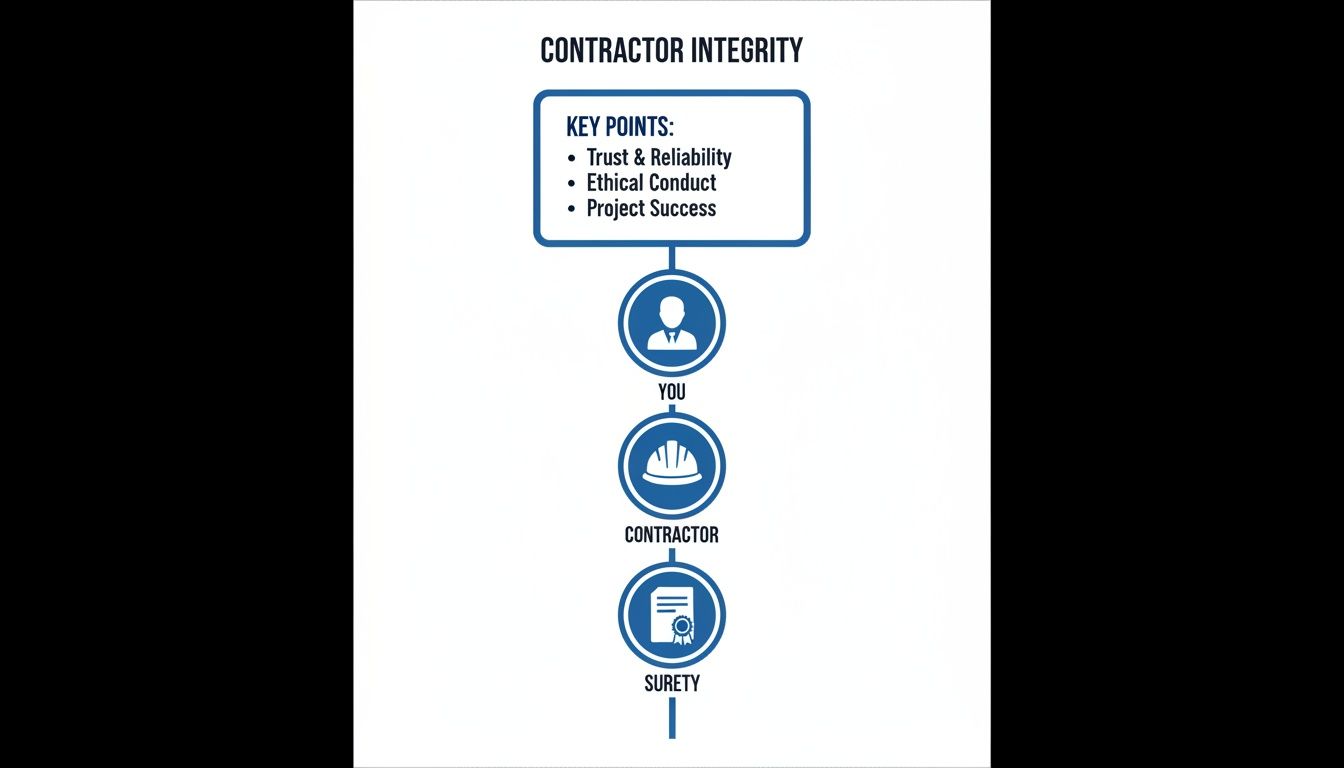
As you can see, the surety company acts as a financial guarantee, giving you a way to recover your losses if the contractor proves to be dishonest.
Scenario 3: Incomplete Work or Abandonment
What if you pay a hefty deposit for a big window and power washing job at your Chandler business, but the contractor vanishes after the first day? They’ve taken your money and abandoned the project, leaving you out of pocket with a half-finished job.
A surety bond (usually a performance or contract bond) is your protection here. The bond is a promise that the contractor will stick to the terms of your agreement. If they don't, you can file a claim against their bond to get your deposit back and help cover the cost of hiring someone else to finish the work.
For more tips on how to vet companies before you hire them, take a look at our guide on finding expert window cleaners near you.
Scenario 4: On-Site Worker Injury
Let's wrap up with a serious situation: a high-rise window cleaning job in downtown Phoenix. One of the technicians loses their footing on your property, falls, and is seriously injured. Who is on the hook for the hospital bills and lost wages?
If the company has the right coverage, their workers' compensation policy handles it. This insurance doesn't just protect their employees; it's also crucial for protecting you from being held liable for injuries that happen on your property. Without it, you could easily find yourself in the middle of a lawsuit.
How to Verify a Contractor Is Genuinely Bonded and Insured
It’s one thing for a contractor to say they’re "bonded and insured," but it's another thing entirely to prove it. Taking a company at its word is a risk you don't have to take. It's your property, and verifying their credentials isn't about distrust—it's just smart business.
Any legitimate company, like South Mountain Window Cleaning, expects you to ask for proof and will have it ready for you, no questions asked. A few simple checks are all it takes to know for sure that you're hiring a true professional who has you covered.

Your Verification Checklist
Don’t worry, you don’t need to be a private investigator to get this done. Here’s a quick checklist to walk you through confirming a contractor's insurance and bonding.
1. Ask to See Their Certificate of Insurance (COI):
This is the official proof of their insurance coverage, issued directly by their provider. A number scrawled on an invoice doesn’t count. When you get the COI, here’s what to look for:
- Active Policy Dates: Make sure the policy is current and won't expire halfway through your job.
- Coverage Limits: Check their general liability and workers' compensation amounts. A serious company like ours carries a $2 million policy because we handle everything from residential homes to high-risk commercial work.
- Your Name as Certificate Holder: For bigger commercial jobs in Phoenix or Scottsdale, you can ask to be named an "additional insured." This gives you direct protection under their policy.
2. Call the Insurance Agent Directly:
The COI will have the insurance agency’s name and phone number on it. This is your most important step. A quick call to the agent is the only surefire way to confirm the policy is active. This simple check protects you from anyone trying to pass off a fake or old certificate.
An insurance policy can be canceled for non-payment any day of the week. Calling the agent directly confirms the coverage you were shown is still active right now, before any work starts on your property.
3. Get the Bonding Information:
Verifying a bond is a little different, as there isn't always a neat certificate. What you need to ask for is:
- The Bond Number: This is the unique ID for their surety bond.
- The Surety Company's Name: This is the financial institution that backs the bond.
With that info, you can call the surety company and confirm the bond is active. This is crucial because the bond is what guarantees the contractor will finish the job they promised—a key difference when you compare bonded vs insured protections. It’s a standard practice in the industry. As noted in a 2024 global market report, many insurers are even starting to bundle different types of coverage together to make things simpler.
By taking these few steps, you can feel confident you’re hiring a professional window cleaning company that has taken every step to protect its clients.
Why Hiring a Fully Protected Company Is the Only Smart Choice
When you’re looking at different quotes for window cleaning, it’s easy to focus just on the price. But choosing between someone who's partially covered and a company that is fully bonded and insured is one of the most important decisions you'll make. Think of it less as an extra cost and more as a non-negotiable part of getting quality, reliable work done on your home or commercial property. It’s what protects your wallet, your property, and ultimately, your peace of mind.
The whole bonded vs insured conversation really comes down to two different kinds of protection. Insurance is there for accidents, while a bond is all about guaranteeing the job gets done right. For us at South Mountain Window Cleaning, our $2 million liability policy is what covers any potential mishap on a Paradise Valley rooftop. Our surety bond, on the other hand, is our promise to you that we'll see every job through to the end, whether it’s a residential window washing in Chandler or a major high-rise project.
The Real Mark of a Professional
A company’s dedication to being fully covered says a lot about its reputation. We build trust by getting out ahead of every possible risk for our clients. It’s why any top-rated business invests in being fully bonded and insured—it’s a clear signal that they stand behind their work and put their customers first. When you see a business with hundreds of five-star reviews, you're often looking at a company that refuses to leave anything to chance.
The value of this kind of complete protection has been proven time and again. After Hurricane Katrina, for instance, making bonding mandatory for reconstruction projects was crucial for holding subcontractors accountable and drastically cut down on jobs being abandoned. It’s a powerful example of how bonding ensures work gets done, especially when it matters most. You can get a sense of the bigger picture in this 2025 insurance market report.
Picking a bonded and insured company is the final, critical step in doing your homework. It’s how you confirm you’re bringing in a true professional who respects your property and backs up their promises with real financial security.
This level of preparation is what separates the pros from the rest. To see what else sets a top-tier service apart, you should check out our guide on the benefits of professional window cleaning.
Frequently Asked Questions
Digging into the details of insurance and bonds can feel a little overwhelming, but it doesn't have to be. We get a lot of questions from property owners in Phoenix and Scottsdale, and getting a handle on a few key differences makes it all much simpler. Let's clear things up.
Is Being Licensed the Same as Being Bonded or Insured?
No, not at all. These are three completely separate things, and it’s important to know what each one does for you.
Think of a business license, like one from the City of Phoenix, as just the legal permission slip for a company to exist. It provides zero financial protection for you, the client.
On the other hand:
- Insured means the company has a policy to cover accidents, like a ladder falling and damaging your property or a technician getting hurt on your site.
- Bonded protects your wallet from a different kind of risk. It covers you if an employee steals something or if the company takes your money but fails to finish the job.
You really want to see all three: licensed, bonded, and insured. It's the trifecta of a professional, trustworthy company.
What if I Hire a Company That Is Only Insured but Not Bonded?
This is a common scenario, and it leaves you partially exposed. If a technician accidentally breaks a window or gets injured, the insurance policy would cover it. That’s good.
But you'd be out of luck if an employee pockets something valuable from your home or if the company vanishes after taking your deposit. You’d have no easy way to get your money back for those issues.
A bond is specifically designed to cover these integrity-related problems. It’s your safety net against dishonest acts or a contractor simply not holding up their end of the deal.
Are Requirements Different for High-Rise Window Cleaning?
Absolutely. The rules for high-rise work are significantly tougher, as they should be.
Cleaning windows on a commercial tower in downtown Phoenix or Scottsdale is a high-risk job. Because of that, property managers almost always demand much higher insurance limits—we’re talking $2 million or more is standard. They'll often require specific performance bonds too, which guarantee the project will be completed safely and correctly.
While the insurance minimums for a single-family home in Gilbert or Tempe are naturally lower, choosing a company that carries this higher level of protection gives you that same critical peace of mind.
For a window cleaning partner that offers complete protection with a $2 million insurance policy and is fully bonded, you can trust South Mountain Window Cleaning. Get your fast, free, and no-obligation quote by visiting us at https://www.southmountainwindowcleaning.com today.