

Your laptop keyboard stops working right before you need to send an estimate, answer an email, or log into a banking site. Or maybe you're using a tablet at a coffee shop, a check-in kiosk, or a touch display at work and there isn't a physical keyboard at all. In those moments, it's often assumed they need a repair, a restart, or a different device.
Sometimes you do. Sometimes you just need the screen keyboard that's already built in.
I run into this kind of confusion a lot. People know how to wash a dusty screen door or spot a clogged window track, but software tools can feel less obvious because you can't see the moving parts. The good news is that a screen keyboard is simple once you know what it is and where to find it. If your physical keys quit, if you're working on a touchscreen, or if you need an easier way to type because of pain or limited mobility, it can get you moving again fast.
If the issue is deeper than typing and the device itself may be failing, it's smart to compare your options with a local repair guide like fast laptop repairs in Sheffield. And if the word “screen” made you think of the mesh on your home instead of the glass on your device, that's fair too. Around Phoenix, a lot of people are also dealing with dusty window and screen door care at the same time.
Introduction When Your Keyboard Quits
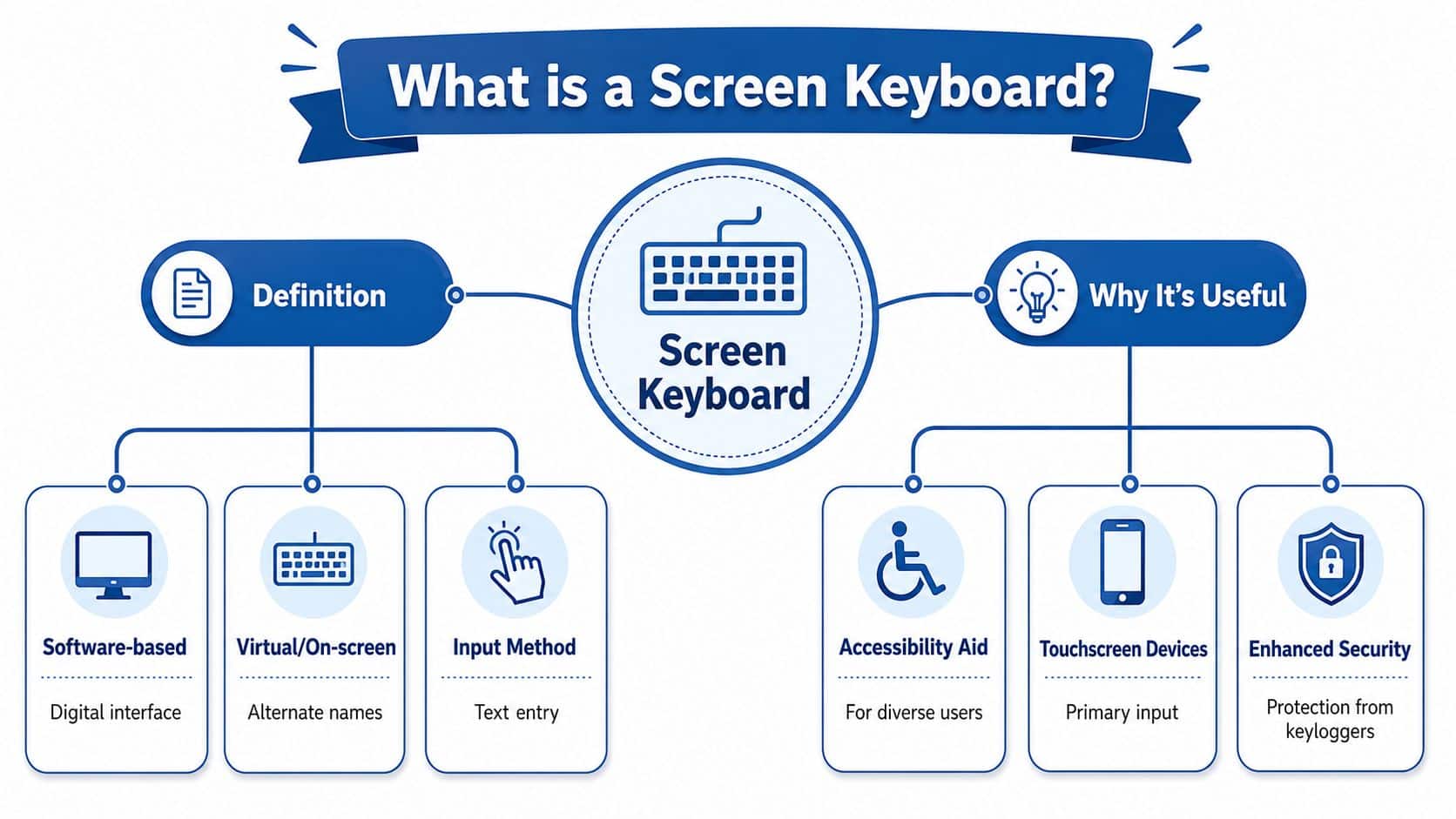
The fastest way to understand a screen keyboard is to think about a regular keyboard that lives inside the device instead of on your desk. It appears when needed, disappears when you're done, and changes shape depending on the task.
A screen keyboard, also called a virtual keyboard, is a software input method that lets you enter characters without physical keys. It's standard on touchscreen-equipped mobile phones, tablets, and pocket computers, and that shift turned text entry from a fixed mechanical tool into a flexible software component, with roots in computing changes that began in the early 1960s according to Wikipedia's virtual keyboard overview.
Where you already use one
You may not think about it much, but screen keyboards show up all over daily life:
- Phones and tablets let you type with your thumbs or fingertip.
- Public kiosks use on-screen keys because a built-in display is easier to manage than exposed hardware.
- Industrial systems often rely on them when a physical keyboard would be awkward, sealed off, or hard to maintain.
- Accessibility setups use them when a traditional keyboard isn't the easiest input method.
A screen keyboard is like a chameleon. It shows up when you need it, changes layout for the task, and doesn't take up space when you don't.
Why it matters
The usefulness goes beyond “backup keyboard.”
A screen keyboard can show a number pad for a PIN, a simpler layout for search, or language-specific characters without swapping hardware. That's one reason it works so well across many devices and use cases. It adapts in software.
That same flexibility is a lot like the difference between fixed hardware and a removable home screen in the window sense. One piece is permanent. The other changes with the job. If you like practical home maintenance comparisons, this same idea of adaptable protection applies to window screen light control and comfort, where the screen changes how the space feels without replacing the whole window.
What Is a Screen Keyboard and Why Is It Useful
Some readers get tripped up by the name. They hear “screen keyboard” and picture a special accessory. It usually isn't an extra product. It's a feature already built into your phone, tablet, or computer.
More than a backup tool
On a touchscreen phone, the screen keyboard is your main way to type. On a Windows PC, it may be a temporary workaround when a keyboard fails. On a kiosk or sealed workstation, it's often the practical replacement for physical keys.
For Windows devices in particular, the built-in On-Screen Keyboard isn't limited to touch. Microsoft notes that it can be used with a mouse, stylus, or even a single physical key or group of keys, and it supports the full set of Windows keyboard language layouts plus context-aware input scopes such as Email Address, Numeric PIN, and Search Field in the Windows On-Screen Keyboard documentation.
Why businesses and public spaces use it
In places where people share devices, a physical keyboard can be one more thing to break, clean, or protect. That's why you often see on-screen input on check-in stations, ordering terminals, and industrial displays.
A few practical reasons stand out:
- Less exposed hardware means fewer external parts in environments where equipment needs to stay enclosed.
- Flexible layouts make it easier to support different languages, symbols, and number entry.
- Touch, pen, and mouse support gives operators more than one way to control the system.
- Better fit for occasional typing helps when the task is entering a name, code, or short search, not writing a long report.
Practical rule: If the device only needs short bursts of typing, a screen keyboard often makes more sense than attaching full-time hardware.
How to Use the Screen Keyboard on Any Device
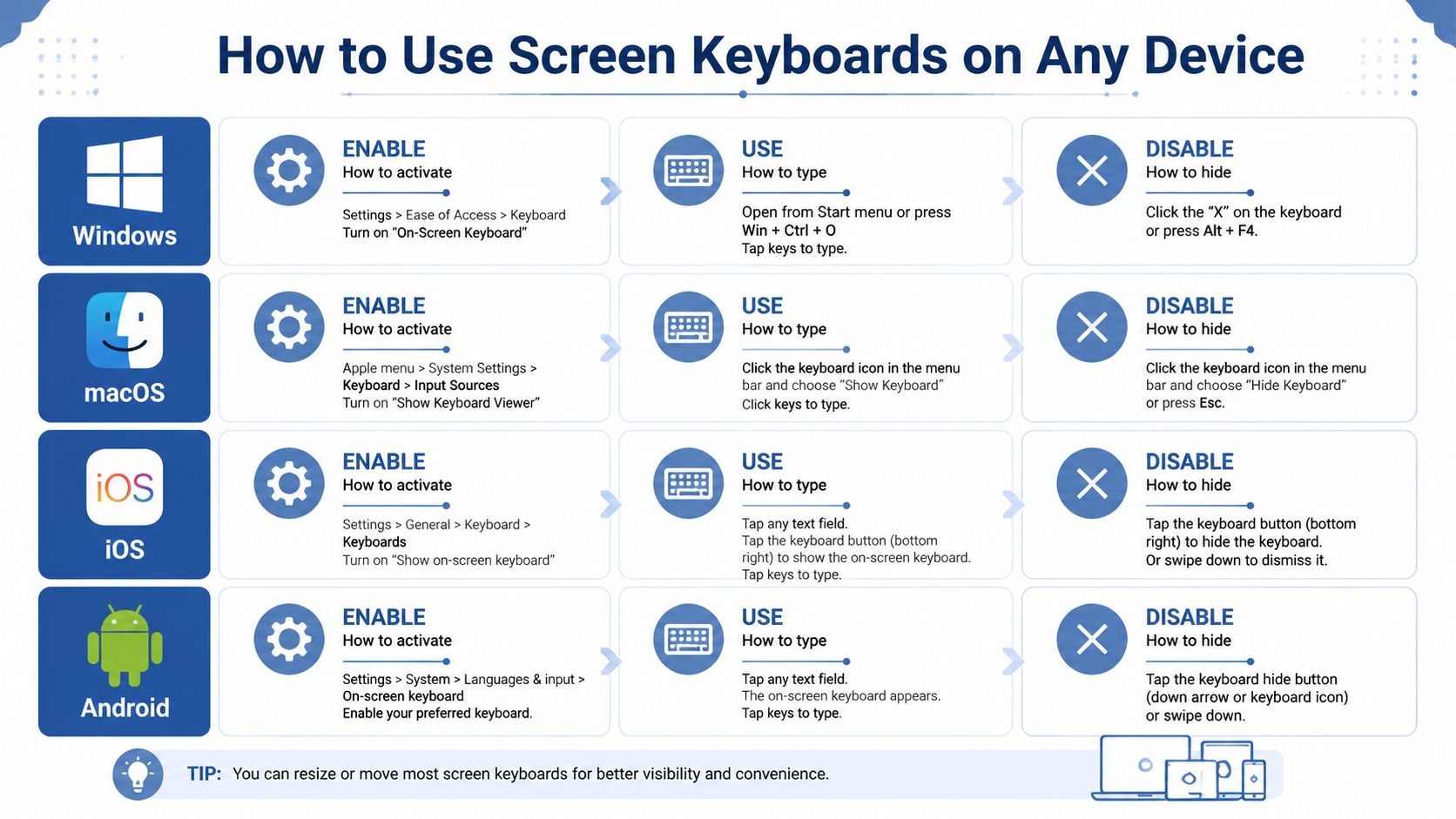
When people can't type, the hardest part is usually not using the on-screen keys. It's finding them. The path varies by device, but the idea is the same. Turn it on, tap where you want to type, and hide it when you're done.
A quick visual helps before the step list.
Windows
If you're on a Windows PC and the physical keyboard isn't responding, start here.
- Open Settings. Search for keyboard or accessibility in the Start menu.
- Turn on the On-Screen Keyboard. The exact menu path can vary by version, but it's generally under accessibility-related keyboard settings.
- Use your mouse, touch, or stylus to click the keys.
- Tap into a text field like a browser bar, password box, or email draft.
- Close or minimize the keyboard when you're finished.
Two details matter on Windows. First, the keyboard isn't only for touchscreen devices. Second, some apps can trigger more specific input layouts, such as a numeric entry area for PIN-style fields, because the feature is integrated into the system's input handling.
If you want to compare that on-screen approach with portable hardware alternatives, this guide from FoldifyCase gives a useful overview of folding Bluetooth keyboards for people who switch between phones, tablets, and travel work.
A short demo can make the process easier to picture:
macOS
Mac users usually run into this through accessibility settings.
- Open System Settings and look for accessibility features related to keyboard input.
- Enable the accessibility keyboard or on-screen typing option.
- Click keys with your mouse or trackpad once it appears.
- Hide it from the same controls when you don't need it.
If it doesn't show up, check whether the feature is enabled system-wide or only in certain input situations.
iPhone and iPad
On iPhone and iPad, the screen keyboard is usually automatic.
- Tap any text field in Messages, Mail, Notes, Safari, or another app.
- The keyboard should slide up from the bottom of the screen.
- Tap the globe or keyboard icon if you use more than one language layout.
- Dismiss it by tapping away, swiping it down on supported devices, or using the hide-keyboard control if available.
If it doesn't appear, restart the app first. If that doesn't help, check whether a hardware keyboard is connected by Bluetooth.
Android
Android works much like iPhone, but menu names differ by device maker.
- Tap into any field where text belongs.
- The keyboard should open automatically.
- Use the settings gear on the keyboard to adjust language, size, or typing style.
- Hide it with the system back control or the down-arrow keyboard button.
When the keyboard doesn't appear
Use this short checklist:
| Problem | What to check |
|---|---|
| Nothing appears in a text box | Make sure the field is actually selected |
| Keyboard worked before but not now | Restart the app or the device |
| Tablet won't show keyboard | Check for a paired physical keyboard |
| Layout looks wrong | Switch language or input method in settings |
If the on-screen keyboard appears but won't type where you expect, the issue is often the selected field, not the keyboard itself.
Customization and Security Tips
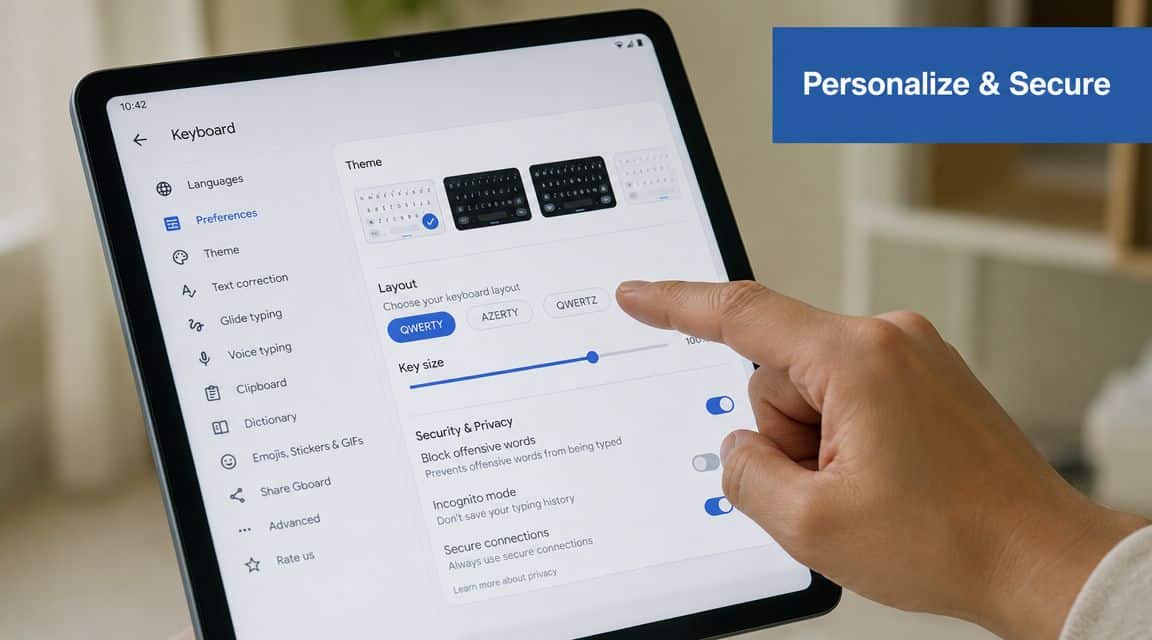
Once the keyboard is working, the next step is making it fit the way you type. Many people then realize the screen keyboard isn't just a fallback. It can be customized.
Change the layout and feel
Most screen keyboards let you adjust at least a few of these:
- Layout choice such as QWERTY or another supported arrangement
- Key size for easier tapping
- Theme or contrast for better visibility
- Prediction and autocorrect to reduce repeated typing
- Swipe or gesture input on many mobile keyboards
The familiar QWERTY layout on most screen keyboards is a direct descendant of a design patented for mechanical typewriters in 1874, and that 140+ year-old standard still shapes modern touchscreen typing according to this keyboard history summary from Das Keyboard. That's why the ability to switch or customize the layout matters. The default wasn't created for today's glass screens.
For home offices and enclosed outdoor areas, people make similar adjustments in the physical world too. They don't always replace the whole structure. They fine-tune it. That's part of why homeowners look into screened-in porch upkeep and function when comfort and usability start slipping.
Build safer habits
People often ask if a screen keyboard is safer for passwords. The honest answer is that it can help in some situations, but it isn't magic.
Use these habits:
- Avoid public devices for sensitive accounts when possible.
- Turn off predictive features if you don't want sensitive words remembered.
- Use private or incognito browsing on shared devices.
- Watch the screen around you in public spaces where shoulder surfing is a bigger risk than the keyboard itself.
Customization isn't only about comfort. A larger layout, simpler language set, or disabled prediction can also reduce mistakes when you're entering sensitive information.
The Power of Accessibility
Convenience is nice. Accessibility is where the screen keyboard becomes indispensable.
For some users, this isn't a backup after coffee spills on a laptop. It's the primary way to communicate, work, search, and stay independent online. A person with limited hand movement may use a mouse, stylus, touch target, or alternative control method instead of pressing physical keys. Someone recovering from a wrist injury may need a temporary option that reduces strain.
Who benefits most
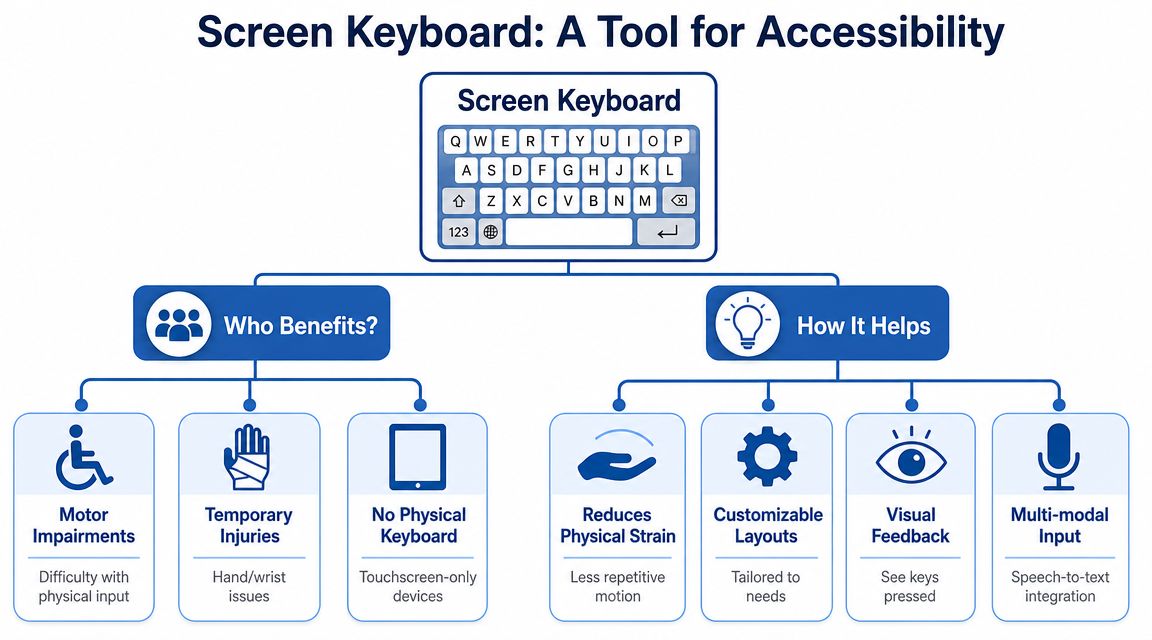
A screen keyboard can make a real difference for several groups:
- People with motor impairments who can't use standard key travel comfortably
- Users with temporary injuries such as a hand, finger, or wrist issue
- Tablet and kiosk users working on devices with no hardware keyboard attached
- People who need visual confirmation of each selection on screen
How access improves in practice
This gets more powerful when a device includes related accessibility tools.
Some systems support dwell-style interaction, where the device clicks after a cursor hovers. Others support scanning methods that move through choices until the user selects the right one with a simplified control. Even when those features differ by platform, the basic value stays the same. The keyboard becomes something the person can approach in the way their body allows.
A screen keyboard doesn't just replace keys. It removes one more barrier between a person and the task they need to do.
That matters in schools, offices, clinics, front desks, and homes. It also matters during recovery. If someone can keep handling messages, forms, and basic computer tasks without forcing painful movement, the tool is doing more than adding convenience. It's preserving access.
From Digital Screens to Crystal-Clear Window Screens
A screen keyboard helps people see and use the right interface at the right time. It can replace failed hardware, simplify typing on touch devices, and open the door to more accessible computing. Once you understand that, the term stops sounding technical and starts sounding practical.
Out here in the Valley, the word screen often means something more physical. It means the mesh on your windows and doors that catches dust, pollen, and the fine grit that seems to settle on everything from Phoenix to Scottsdale to Chandler. In the same way a clear digital interface makes your device easier to use, a clean window screen makes your home easier to enjoy. You get better airflow, a clearer view, and less grime sitting between you and the light.
If long hours at a display are part of your routine, it also helps to find effective computer glasses so your eyes aren't working harder than they need to. And if you're dealing with actual dusty screens at home, this guide on how to clean window screens is a solid place to start. For homeowners who'd rather have the work handled professionally, South Mountain Window Cleaning, LLC provides screen cleaning as part of its residential window cleaning services.
If you're in Phoenix, Scottsdale, Paradise Valley, Chandler, Tempe, or Gilbert and want help with dusty window screens, glass, and exterior buildup, contact South Mountain Window Cleaning, LLC. They handle residential, commercial, and high-rise window cleaning, along with screen and track care for Arizona properties that deal with sun, dust, and everyday buildup.