

You know the setup. The patio looks great in the morning, then by late afternoon the glare gets sharp, the chairs pick up dust, and dinner outside starts with swatting bugs and ends with everyone moving back indoors. In Arizona, a patio can feel usable for only a narrow slice of the day unless it's designed for the climate we live in.
That's where a screen in porch makes sense. Done well, it turns a bare patio or deck into a shaded transition space that feels more livable without pretending to be a sealed room. Done poorly, it becomes another surface that traps dust, rattles in monsoon season, and needs more upkeep than the homeowner expected.
From an exterior cleaning perspective, that difference matters. I see what holds up in Phoenix-area sun, what gets grimy fast, and what owners regret after the first stretch of wind and dust. A screened porch can absolutely be worth it, but Arizona rewards practical choices, not brochure choices.
Enjoying the Outdoors Without the Pests or Sunburn
A lot of Valley homeowners want the same thing. They want to sit outside in the evening with a drink, keep the dogs nearby, and enjoy the yard without getting blasted by low sun or chased in by insects. The patio is already there. What's missing is protection that still feels open.
A screened porch solves that problem better than most quick fixes. Umbrellas shift. Shade sails help overhead but don't stop bugs. A misting setup may cool the air, but it doesn't keep debris out. Screening creates a room-like boundary while still letting in airflow and natural light.
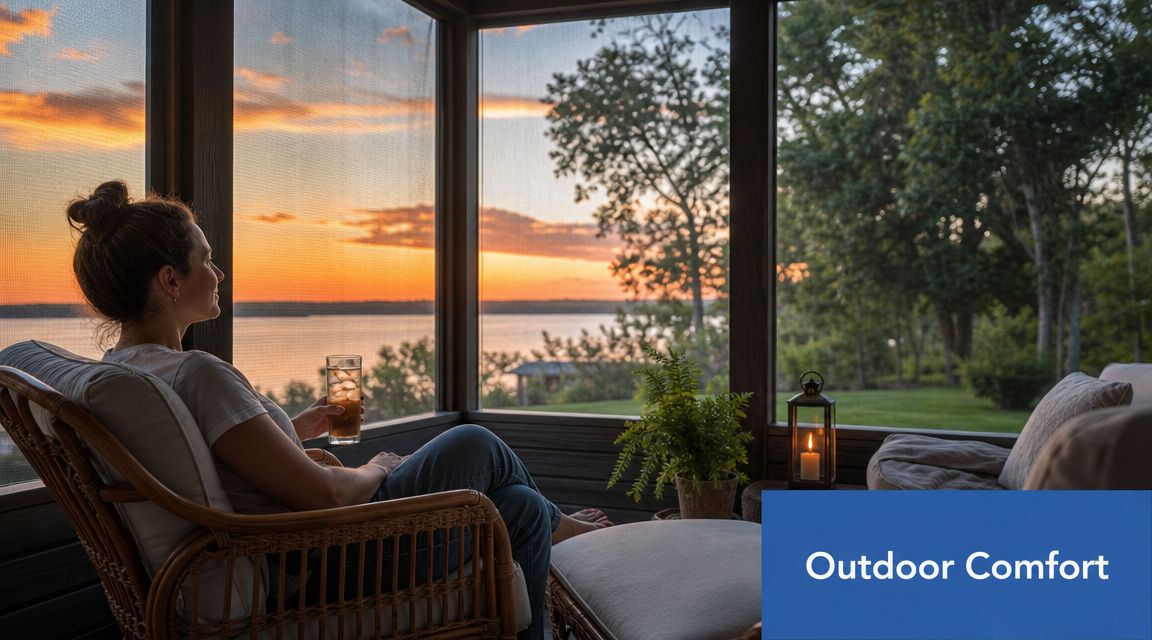
In practical use, the biggest win is consistency. Instead of using the patio only on the perfect days, you get a space that works more often. That's one reason screened-in porches are widely viewed as value-adding outdoor living spaces, with some real-estate benchmarks suggesting as much as a 75% return on investment at resale according to the National Association of Realtors discussion of the reinvented screened-in porch.
What Arizona homeowners usually want from it
Some want an outdoor dining area that doesn't fill with moths and gnats after sunset. Others want a coffee spot that feels sheltered without becoming another enclosed addition. Families often want a cleaner play area where kids and pets can stay outside longer.
If you're still collecting ideas before locking in a design, Lucas Furniture deck ideas is a useful visual reference because it shows different ways an outdoor space can shift from open patio to more protected living area.
A screened porch works best when you treat it like a comfort upgrade, not like a substitute for conditioned indoor space.
That distinction matters in Arizona. A good screen in porch gives you shade, insect control, and a more pleasant place to sit. It does not erase summer heat or stop every bit of blowing dust. The homeowners who are happiest with the final result usually start with those expectations.
Your Porch Blueprint Planning Before You Build
Before picking a screen mesh, frame color, or door style, decide what the porch must do every week. A project built for evening meals looks different from one built for dogs, storage, or a quiet reading space. The purpose drives nearly every smart choice after that.
If you skip that step, you'll end up reacting to problems instead of preventing them. That's how people get a porch that looks nice in photos but feels awkward in daily use.
Start with use, not materials
Ask simple questions first.
- How will you use it most often. Dining needs room for chairs to move. A lounge setup needs deeper shade and better furniture clearance.
- Who uses it. Kids, pets, and frequent guests change door placement, latch choice, and how durable the lower portions need to be.
- When will it be used. Morning coffee on an east-facing patio is one thing. West-facing sunset use in Phoenix is another.
A lot of Arizona homeowners benefit from sketching traffic flow before they talk finishes. Where do people enter from the house. Where do they step down to the yard. Which side gets the strongest sun. Which side takes the most wind during monsoon season.
Treat it as a structural project
This is the point many people underestimate. A screened porch isn't just trim work and mesh. Authoritative building guidance treats it as a serious structural assembly. Plans should show porch size, joists, rafters, posts, headers, guardrail height, ceiling height, and roofing details. That same guidance says the floor system and attached decks should be designed for at least 40 psf live load plus 10 psf dead load, while footings must extend to at or below 42 inches frost depth in the cited handout from the screened porch and 3- and 4-season porch guidance document.
Even if your Arizona jurisdiction handles details differently, the larger lesson holds. This is engineering territory, not just décor.
Practical rule: if the porch has a roof, an elevated floor, or any guard requirement, plan it like a structure first and a screen project second.
Decide early whether this is DIY or contracted work
Homeowners often price the visible materials and forget the hidden costs. Permits, framing corrections, concrete work, paint or powder coating touch-up, door hardware, and cleanup all add complexity. If the existing patio slab is sound but the roof tie-in is questionable, that changes the whole job.
For planning, separate the project into these buckets:
Existing conditions
Check whether you already have a usable slab, deck, roof cover, or posts.Structural needs
Figure out what must be added or reinforced before any screen goes in.Finish expectations
Decide whether you want basic insect control or a cleaner, more integrated look.Maintenance tolerance
Be honest about how often you'll wash screens, sweep tracks, and inspect fasteners.
For broader idea gathering, a comprehensive guide for UK homeowners can still be useful for thinking through layout and enclosure options, even though local codes and climate conditions differ from Arizona.
Homeowners who are debating a more enclosed route may also want to compare screened spaces with a more substantial conversion, such as this look at how to convert a deck to a sunroom. It helps clarify whether you really want open-air screening or something closer to enclosed living space.
Budget for the part you don't see
The visible screen panels get attention because they're what you notice. The long-term success usually comes from the less glamorous pieces. Post anchoring, door alignment, roof drainage, and clean transitions where dust won't pile up all matter more than decorative details.
That's especially true in Arizona, where sun exposure and dust find every weak point. If your planning phase is careful, the finished porch feels simple. If your planning phase is rushed, maintenance starts the day the build ends.
Choosing Materials That Thrive in the Arizona Climate
Arizona is hard on outdoor materials. Sun exposure is relentless, fine dust works into corners and tracks, and monsoon winds expose weak framing and loose screen systems fast. Material choice isn't a finishing detail here. It decides whether the porch stays useful or becomes a maintenance chore.
The biggest misconception is that any screen will create a cooler outdoor room. It won't. A common homeowner expectation is that a screened porch will function that way, but standard screening does little to block fine dust or heat gain, which is a major tradeoff in sunbelt markets like Arizona, as discussed in this year-round porch screening article.
What standard screen does well and where it disappoints
Basic insect screen works for what it was designed to do. It keeps out many bugs, leaves, and larger debris. It also preserves a more open view than heavier screening products.
Where it falls short in Arizona is performance against the things homeowners complain about most:
- Fine dust still gets through
- Heat still builds up, especially on west-facing exposures
- UV exposure keeps working on furniture, paint, and lower-cost materials
- Cleaning frequency goes up after windy periods
That doesn't mean standard screen is a bad option. It means you should choose it for bug control and openness, not for climate control.
Frame choices matter as much as the mesh
In this climate, the frame system often determines how clean and stable the porch feels after a year or two. Untreated or lightly finished wood can still look great, but it asks more from the owner. It can move, crack, or need refinishing sooner under harsh sun.
Powder-coated aluminum usually makes more sense for low-maintenance builds. It handles sun exposure better, stays dimensionally stable, and is easier to wash down. Vinyl systems can work too, particularly where homeowners want lower upkeep, but the overall quality depends heavily on the specific product and installation details.
If you're comparing options in more detail, this guide to the best screen for porch is a helpful starting point for sorting through common screen types and where each one fits.
Arizona Screen Material Comparison
| Material | UV Resistance | Durability | Cost | Best For |
|---|---|---|---|---|
| Standard fiberglass screen | Fair | Moderate | Lower | Basic insect control with open visibility |
| Aluminum screen mesh | Good | Good | Moderate | Homeowners who want a firmer screen material |
| Solar screen | Better for sun exposure | Good | Higher | Patios with harsh glare and stronger afternoon sun |
| Heavy-duty pet-resistant screen | Varies by product | Stronger against impact | Higher | Homes with pets or high-contact lower panels |
This table stays general on purpose. Real-world performance depends on orientation, frame design, and how the screen is secured. In Arizona, a west-facing patio with reflected heat from block walls is much tougher on materials than a shaded north-facing courtyard.
Choose the lower half of the porch for abuse resistance, and the upper half for visibility and airflow. That split approach often holds up better than using one material everywhere.
Match the material to the exposure
A patio in Scottsdale with direct late-day sun needs a different strategy than a shaded Chandler backyard with more tree litter. For many homes, the smartest setup is mixed use of materials and details rather than one all-purpose product.
Consider these practical pairings:
High-sun side walls
Solar-oriented screening or tighter shading strategy helps with glare and furniture protection.Pet and traffic zones
Tougher lower panels reduce tears and dents where paws, chairs, or coolers make contact.Wind-exposed openings
More rigid framing and cleaner attachment systems reduce flapping and rattling.Dust-prone tracks and thresholds
Simpler profiles are easier to clean than deep decorative channels.
What works for low maintenance
From a cleaning standpoint, low maintenance usually means fewer ledges, tighter-fitting doors, durable finishes, and surfaces that can be rinsed or brushed without damage. Fancy trim details may look upscale on day one, but every horizontal groove becomes a dust shelf.
That's why I usually steer people toward durable frame finishes, straightforward profiles, and realistic expectations. In Arizona, the best-looking screen in porch after a few seasons is rarely the one with the most decorative pieces. It's the one built with materials that can take sun, collect less grime, and clean up without a fight.
Navigating Permits and Safety Regulations
Plenty of homeowners want to skip permits because the project feels simple. It's just a patio screen, not a major addition. That assumption causes trouble.
The minute a screen in porch involves structure, roof coverage, attachments to the house, or elevation changes, you're in permit territory in many places. Local departments may also care about setbacks, drainage, and whether the work changes how loads transfer to the existing house or slab.
Why this step isn't optional
Permit review protects you in a few ways. It forces the design to be documented, it catches obvious structural mistakes, and it creates a record of approved work. That matters for safety now and for resale later.
It also keeps homeowners from making a dangerous shortcut with guardrails. Screens are not a safety device. In the cited building guidance, forum commentary notes that guard and handrail loads are typically on the order of 200 lb, which means structural guards must be designed independently of the screening material, as noted in the earlier linked building handout.
If your porch is elevated, assume the guardrail needs to stand on its own. The screen is infill, not fall protection.
What to confirm before work starts
Call your city or county before materials are ordered. Ask direct questions and write down the answers.
- Permit scope. Find out whether the roof, posts, slab changes, electrical, or enclosure all require separate review.
- Zoning limits. Confirm setbacks and whether the enclosed footprint changes lot coverage issues.
- Inspection sequence. Ask when inspections happen so work doesn't get covered too early.
- Guard requirements. Verify what is required if the porch floor is raised.
If you want an example of how code-related planning affects outdoor projects in general, R.E. and Sons' guide to building codes is a useful reminder that even features that seem straightforward still sit inside a code framework.
Skipping permits can create expensive problems later. Buyers ask questions. Appraisers notice changes. Inspectors flag unpermitted work. A screen porch should make a home easier to enjoy, not harder to document.
The DIY Path vs Hiring a Professional Contractor
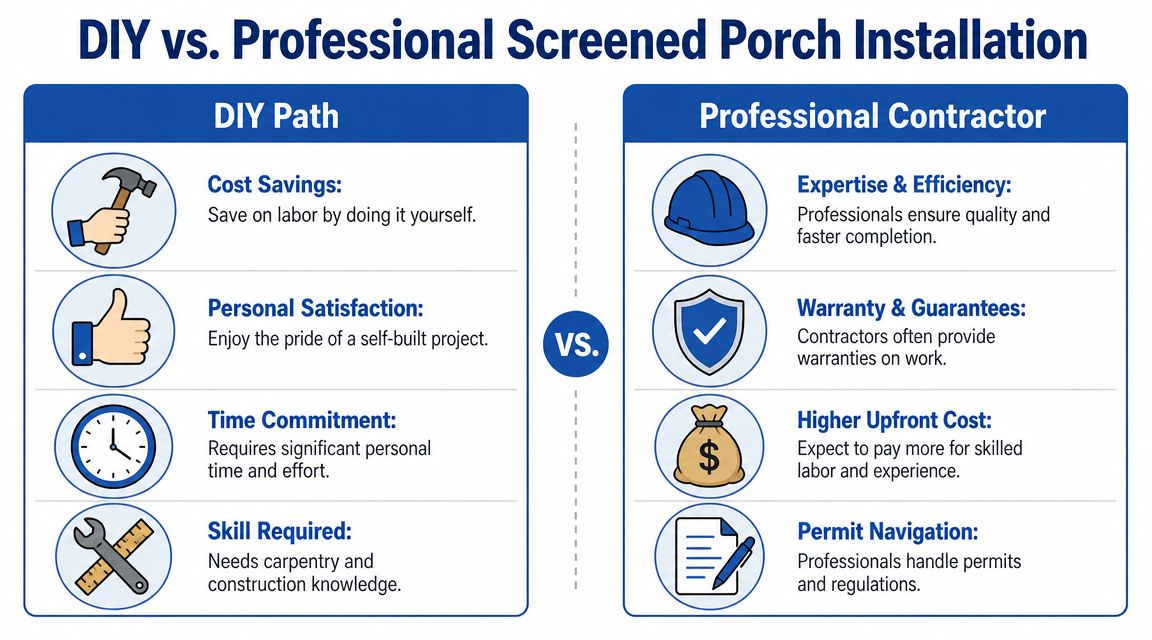
Some screened porches are realistic DIY projects. Others only look that way on video. The difference comes down to structure, layout complexity, and how much tolerance you have for rework.
If the project is limited to screening an already sound covered patio with square openings and a simple door plan, a skilled DIY homeowner may be fine. If posts need to be added, loads need to be checked, or the roof tie-in is messy, hiring a contractor is usually the cleaner path.
Where DIY often goes wrong
The classic mistake is measuring like you're ordering flooring instead of screen system components. One practical guide starts with linear measurement, not area. In that example, the full runs added up to 780 inches, or 65 feet, then were divided by 8-foot component lengths and rounded up to estimate material counts in a Screen Tight-style system, as shown in this screen porch measurement walkthrough.
That method helps because porch elevations aren't simple rectangles. Guardrail sections, repeated wall runs, and partial-height areas can throw off an order fast.
A realistic DIY checklist
Before going the do-it-yourself route, check whether you can handle all of these without guessing:
Accurate layout work
You need consistent measurements across openings, corners, and door clearances.Tool readiness
This usually means more than a drill and ladder. Cutting, fastening, alignment, and trim work all matter.Material handling
Long screen system pieces can be awkward to transport, stage, and keep straight.Patience for rework
Doors sag, spline can ripple, and corners often need a second pass.
For homeowners looking at packaged approaches, a screen kit can simplify planning compared with piecing together every component from scratch.
DIY makes the most sense when the structure is already right and the remaining job is mainly enclosure, not correction.
What a good contractor brings
A professional contractor should do more than install screen. They should evaluate attachment points, flag drainage problems, and account for movement, expansion, and serviceability. Those details are hard to appreciate until something starts rattling, leaking, or collecting dirt in every joint.
Look for these signs during vetting:
Written scope
The quote should specify framing, screen type, doors, finishes, and who handles permits.Local experience
Arizona exposure matters. Ask how they handle sun-facing elevations and wind-prone openings.Insurance and licensing
Don't treat that as a formality.Examples of similar work
Not every patio enclosure contractor builds the same level of finish.
The labor cost is higher, but the risk of building something crooked, under-framed, or hard to maintain drops sharply. For many homeowners, that's the difference between a project they enjoy and one they keep adjusting.
Keeping Your Screened Porch Clean and Maintained
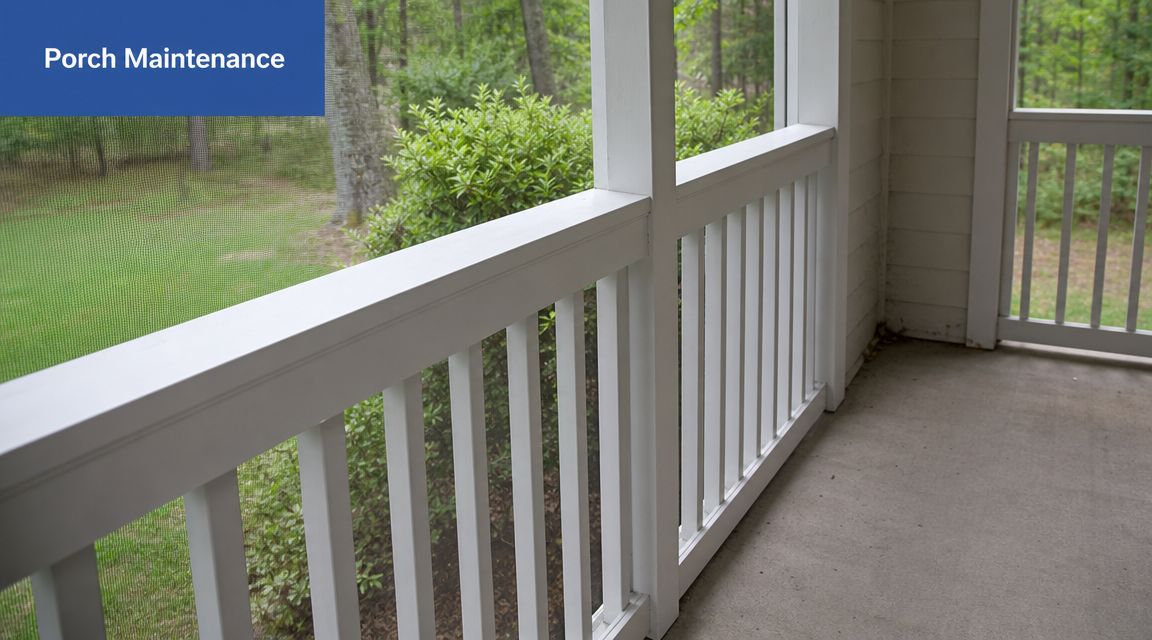
The day a screened porch is finished, it starts collecting Arizona on every surface. Dust settles on horizontal rails, grit packs into tracks, and screens lose clarity slowly enough that many homeowners don't notice until the whole space starts feeling dingy.
That doesn't mean the porch was a mistake. It means maintenance has to be part of the design from the start.
The basic cleaning routine that works
Most porches respond well to a simple, gentle approach. Use a soft brush or brush attachment to remove loose dust first. Then wash with mild soap and water, rinse with low pressure, and let the screen air dry fully.
Tracks and thresholds need separate attention because they trap the abrasive grit that causes wear. A vacuum with a brush attachment works well before wiping down the remaining residue.
A few habits make a big difference:
- Clean after dust storms. Don't let packed grit sit in tracks and corners.
- Inspect screen tension. Loose sections flap more and wear faster.
- Check fasteners and latches. Vibration from repeated wind events can loosen hardware.
- Rinse frames before scrubbing. Dry rubbing dust across a finish can scratch it.
Low maintenance starts with design details
A lot of homeowners think maintenance begins after the build. In reality, the porch either invites easy cleaning or fights it. Some enclosure systems need specific roof slope and careful sealing at joints to manage water intrusion. One system guidance example recommends 1/2 inch per foot roof slope, which shows that long-term maintenance depends heavily on weather management and design, not just screen installation, as shown in this enclosure system discussion.
If water drains poorly, dirt cakes faster. If frames have deep ledges, the dust stays put. If joints are hard to access, routine cleaning gets skipped.
Cleanability is a build feature. Smooth transitions, accessible tracks, and good drainage save work for years.
When to bring in help
A homeowner can absolutely handle routine upkeep. But some porches need a deeper cleaning after monsoon season, after a long stretch of dust, or before listing a home for sale. In those cases, professional screen and track cleaning can save time and reduce the risk of damaging mesh or finishes.
For do-it-yourself guidance first, this page on how to clean window screens lays out a safe process that also applies to many porch screen situations. And if the project needs hands-on service, South Mountain Window Cleaning, LLC provides screen and track cleaning as part of residential exterior cleaning work in the Phoenix area.
This walkthrough is worth watching if you want to see the maintenance mindset in action before tackling your own porch:
A screened porch in Arizona stays enjoyable when the owner respects what the climate does to outdoor surfaces. Keep the cleaning gentle, stay ahead of dust buildup, and fix small issues before they become torn mesh, swollen trim, or gritty doors that never quite shut right.
If you want help keeping screens, tracks, and exterior glass clear in Arizona's dusty conditions, South Mountain Window Cleaning, LLC handles residential exterior cleaning throughout the Valley, including screen and track care that fits the kind of upkeep a screened porch needs.