
The morning after a haboob, a Chandler homeowner steps outside with coffee in hand and sees the north-facing vinyl siding covered in a gray film. The walls look tired, the lap seams hold darker residue, and the irrigation overspray has left spots along the lower trim. The obvious thought is to rent a pressure washer and blast everything clean. That's usually where the trouble starts.
Arizona siding faces a rough combination of alkaline dust, intense UV exposure, monsoon moisture, and hard-water spotting. Dust bonds to PVC, sunlight bakes organic residue into the surface, and humid storm conditions can encourage mildew in shaded seams. Vinyl can hold grime while still remaining flexible enough to warp, crack, or open at the laps when a concentrated jet hits it.
The right vinyl siding cleaning service treats the job as low-pressure preservation, not a contest to see who can use the strongest machine.
Why Vinyl Siding in Phoenix Needs a Different Cleaning Approach
A Phoenix homeowner can wash the siding in spring and still see a gray film return after the next dusty week. Fine desert dust settles along horizontal edges, monsoon residue darkens shaded areas, and irrigation overspray leaves mineral spots near lower trim. Treating every stain with the same pressure setting is how a routine cleaning turns into damaged siding.
Vinyl siding has been used on American homes since the 1950s, with more durable, UV-stabilized formulations becoming common after improvements in the 1970s. Maintenance guidance has generally favored washing instead of repainting, and trade guidance commonly recommends routine service at every one to two years to control buildup. (Dovetail Inc. maintenance review)
Phoenix-area homes need that guidance adapted to local conditions. A Gilbert property may collect alkaline dust along each lap and trim edge. Dense landscaping at a Paradise Valley home can keep a north-facing wall damp enough for mildew staining. Chandler and Tempe properties often have sprinkler overspray that leaves mineral residue ordinary detergent cannot fully remove.

Dust, sun, and monsoon residue
Valley dust is more than loose powder. Alkaline particles cling to textured panels, trim, and lap seams where runoff slows. Strong UV exposure dries the film onto the finish. Monsoon humidity then gives shaded sections enough moisture for biological staining to become noticeable.
A dark mark is not automatically mold. It may be dust, oxidation, irrigation minerals, algae, or several contaminants together. The technician should identify the residue first, then choose the chemistry and rinse method. That diagnosis matters more than arriving with the strongest machine.
Why high pressure backfires
A concentrated spray can deform or crack vinyl panels. Pointing the wand upward, working too close, or forcing water into the laps can push moisture behind the cladding. The problem may remain hidden from the yard while moisture creates a larger building-envelope concern.
Arizona rule: If a contractor discusses maximum PSI before asking about the siding's age, texture, oxidation, and nearby plants, the process is backwards.
Homeowners seeing biological growth can review this guide on how to remove mold from siding to separate surface staining from a broader moisture problem. The correct approach uses low pressure, purpose-selected chemistry, adequate dwell time, and a controlled rinse.
Vinyl remains a major exterior cladding category in the United States. The Freedonia Group projects U.S. demand at 25.8 million squares valued at $1.8 billion by 2025 and estimates the global market at 397 million square meters in 2024. (Freedonia Group vinyl siding industry study) A large installed base means homeowners will keep needing maintenance, even when the product is marketed as low maintenance.
How Professional Vinyl Siding Cleaning Actually Works
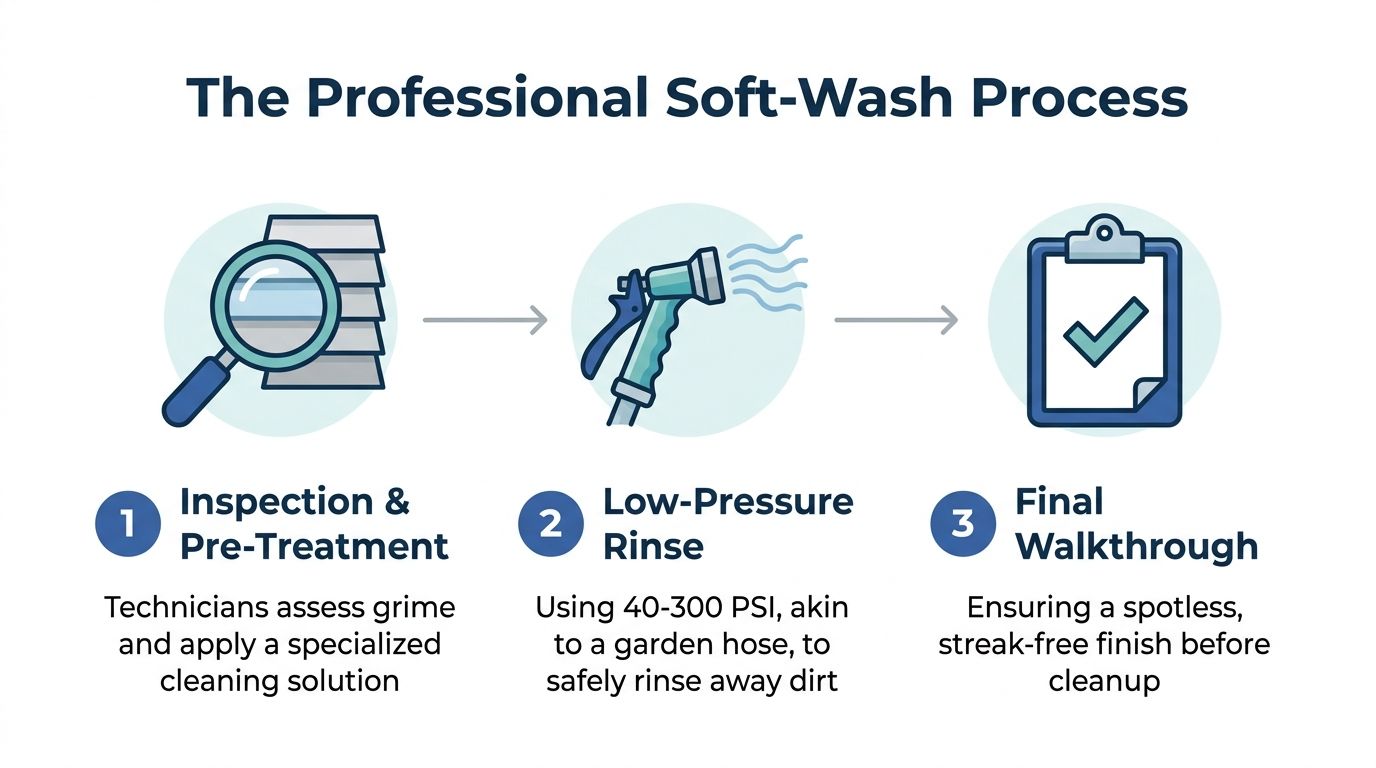
A professional soft wash starts with less force than most homeowners expect. For many residential vinyl siding jobs, the solution is applied at roughly 40 to 300 PSI at the nozzle, so the wall receives something closer to a strong garden-hose flow than a hard pressure-washing strike.
That low pressure doesn't mean the cleaning is weak. The detergent performs the heavy work. The operator uses a wide fan pattern, often with a 40-degree downstream injector setup, to distribute the solution across the panels instead of concentrating the stream on one spot. The result is a controlled layer of cleaning solution that reaches broad areas without driving water into the laps.
Chemistry does the lifting
A typical soft-wash mix uses a sodium hypochlorite surfactant solution, selected and diluted for the material and contamination. The surfactant helps the solution cling to the siding, while the active cleaner breaks down organic staining and loosens the film that dust has attached to.
A technician may allow the solution to dwell for roughly 5 to 10 minutes, watching closely so it doesn't dry on the surface. The time gives the chemistry room to work on mildew, algae, pollen, and embedded grime. In Arizona heat, controlling that dwell period matters because direct sun can flash-dry a solution faster than expected.
Rinse from the top down
After the solution has done its work, the technician performs a low-pressure flood rinse from the top down. The rinse should be broad, controlled, and directed away from the underside of the laps. Manufacturers commonly warn against aiming water upward behind vinyl siding, and recommend soft bristles, careful application, and thorough rinsing. (CertainTeed vinyl siding cleaning guidance)
The principle is straightforward: detergent loosens the residue, and low-pressure water removes it. A stronger rinse isn't automatically a better rinse. Industry guidance places many final rinses around 200 to 500 PSI or similarly low surface pressure, depending on the equipment and siding condition. (Make-Wash vinyl siding operator guide)
Watch the technique, not just the equipment. A good operator keeps the wand moving, avoids a pencil stream, protects nearby surfaces, and rinses until the runoff is clear. That approach is particularly important where Phoenix dust has bonded to UV-baked film.
What a Real Soft-Wash Service Call Looks Like
A competent appointment should feel organized from the first walk-around. The technician shouldn't start spraying before checking the siding, windows, fixtures, and drainage paths.
The inspection comes first
The walk-around identifies oxidation, chalky residue, failed caulk lines, loose panels, and irrigation stains on stucco trim. It also reveals whether the north side has heavier mildew than the sun-exposed walls. Those observations determine the cleaning mix, dwell time, rinse approach, and any areas that need hand treatment.
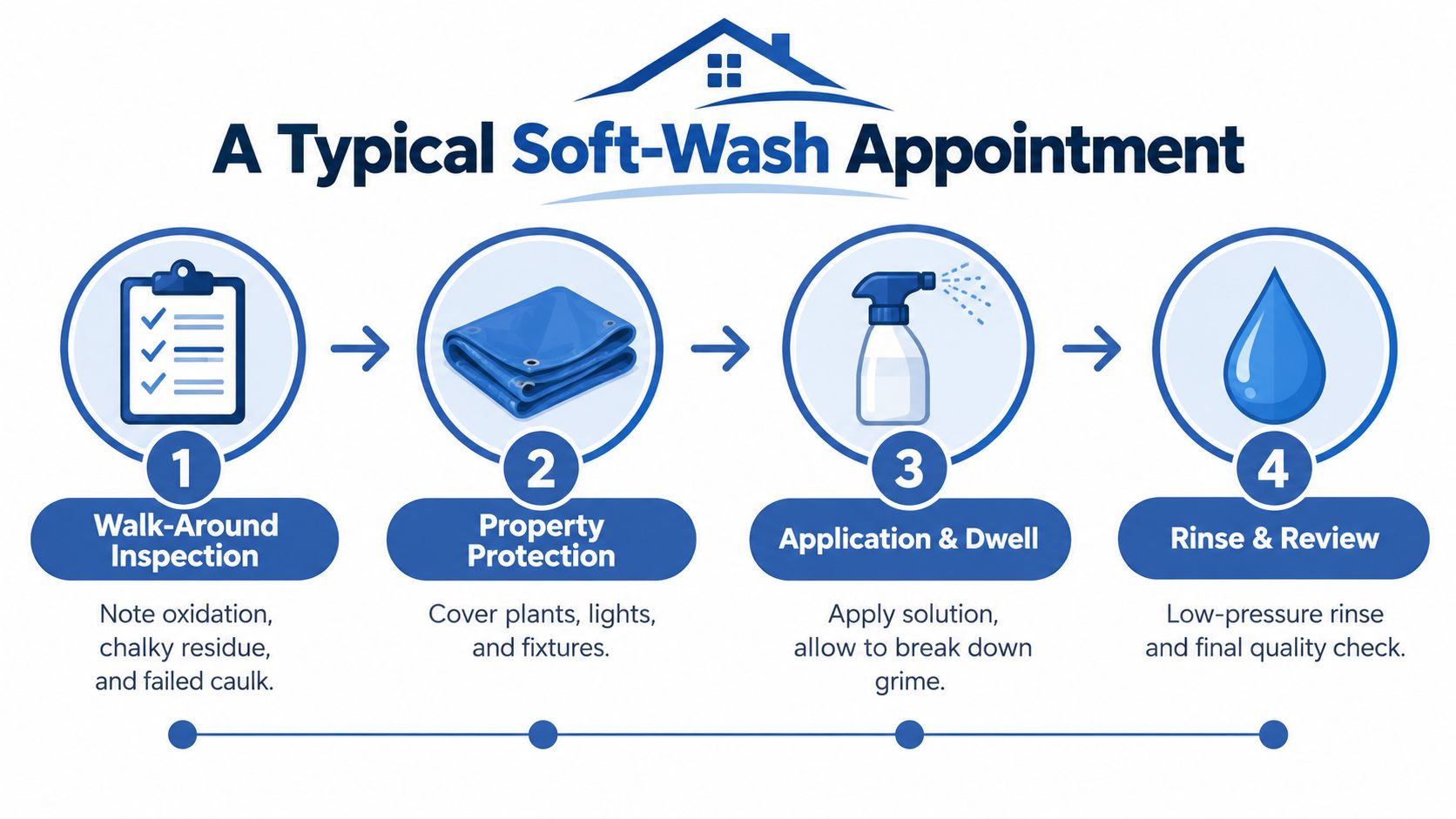
A homeowner can watch for these checkpoints:
Property protection: The crew pre-wets windows, plants, decorative metals, lights, and other sensitive surfaces. Pre-wetting helps prevent the solution from drying quickly and reduces unnecessary chemical contact.
Controlled application: The operator applies detergent from the bottom upward. That direction helps prevent uneven drip lines and gives the technician a visible wet edge while working across the wall.
Measured dwell: The solution sits briefly while the technician watches for drying and adjusts the mix for stubborn areas, such as shaded north-side mildew. Dwell time should be controlled, not ignored.
Low-pressure rinse and review: The crew rinses from the top down, then gives windows, fixtures, plants, and surrounding surfaces a final rinse. A quality-focused company performs a spot-treatment pass for oxidation and rust bleed caused by irrigation.
What you should see before the crew leaves
The final review matters because cleaning can reveal defects that dirt had hidden. A good technician should point out hairline cracks at corners, failed caulk, loose panels, and trim that needs re-securing instead of leaving the property.
For a plain-language explanation of the method, you can review this guide to what soft washing is. The best service calls don't promise that chemistry will remove every mark. Pencil, paint, oil, and tar may require specialized treatment rather than ordinary siding detergent, and the technician should explain that before starting.
Soft Washing Versus Pressure Washing for Vinyl Siding
For standard vinyl siding cleaning in Phoenix, soft washing should be the default. Pressure has a role, but it belongs on selected hard deposits and difficult ground-level areas, not as the automatic setting for an entire wall.
| Factor | Soft Washing | Pressure Washing |
|---|---|---|
| Older or sun-dried siding | Safer choice because chemistry reduces mechanical force | Higher risk of cracking, warping, oxidation streaks, and water intrusion |
| Textured or lapped panels | Wide fan and controlled rinse reach the surface without forcing water upward | Concentrated spray can enter seams and disturb the finish |
| Dust film and pollen | Detergent loosens the bonded film before rinsing | Force may remove loose dirt but can leave bonded residue or mark the surface |
| Algae, mildew, and organic staining | Preferred approach because the solution treats the growth | Mechanical force alone is an inefficient and risky substitute |
| Concrete splash or mineral deposits | May need spot chemistry or hand treatment | Targeted low-pressure rinsing can help on suitable ground-level areas |
| Muddy eaves and hard deposits | Useful for pre-treatment and broad cleaning | Can earn its keep when carefully controlled and kept away from vulnerable laps |
Industry guidance clusters around 1,000 to 1,500 PSI at the surface as an operationally safer window for vinyl siding, with wide 25-degree to 40-degree fan nozzles and a standoff distance of roughly 12 to 18 inches. (Pine Country Windows vinyl siding pressure-washing guidance) That range still demands judgment. A narrow tip, close distance, or upward angle can create damage even when the machine's dial appears reasonable.
Soft washing removes contamination with chemistry. Pressure washing removes contamination with force. Vinyl generally benefits from the first approach.
A homeowner comparing bids can also use this guide to quoting pressure washing to understand why equipment, access, preparation, and scope affect a contractor's estimate. For the siding decision itself, this explanation of whether you should power wash vinyl siding is a useful companion.
The rule is easy to remember: use soft washing for the siding, and reserve targeted pressure rinsing for specific deposits that chemistry cannot remove safely.
Questions to Ask Before You Hire a Vinyl Siding Cleaning Service
Put the contractor on the phone and ask direct questions. You're not being difficult. You're finding out whether the company understands vinyl or only owns a pressure washer.
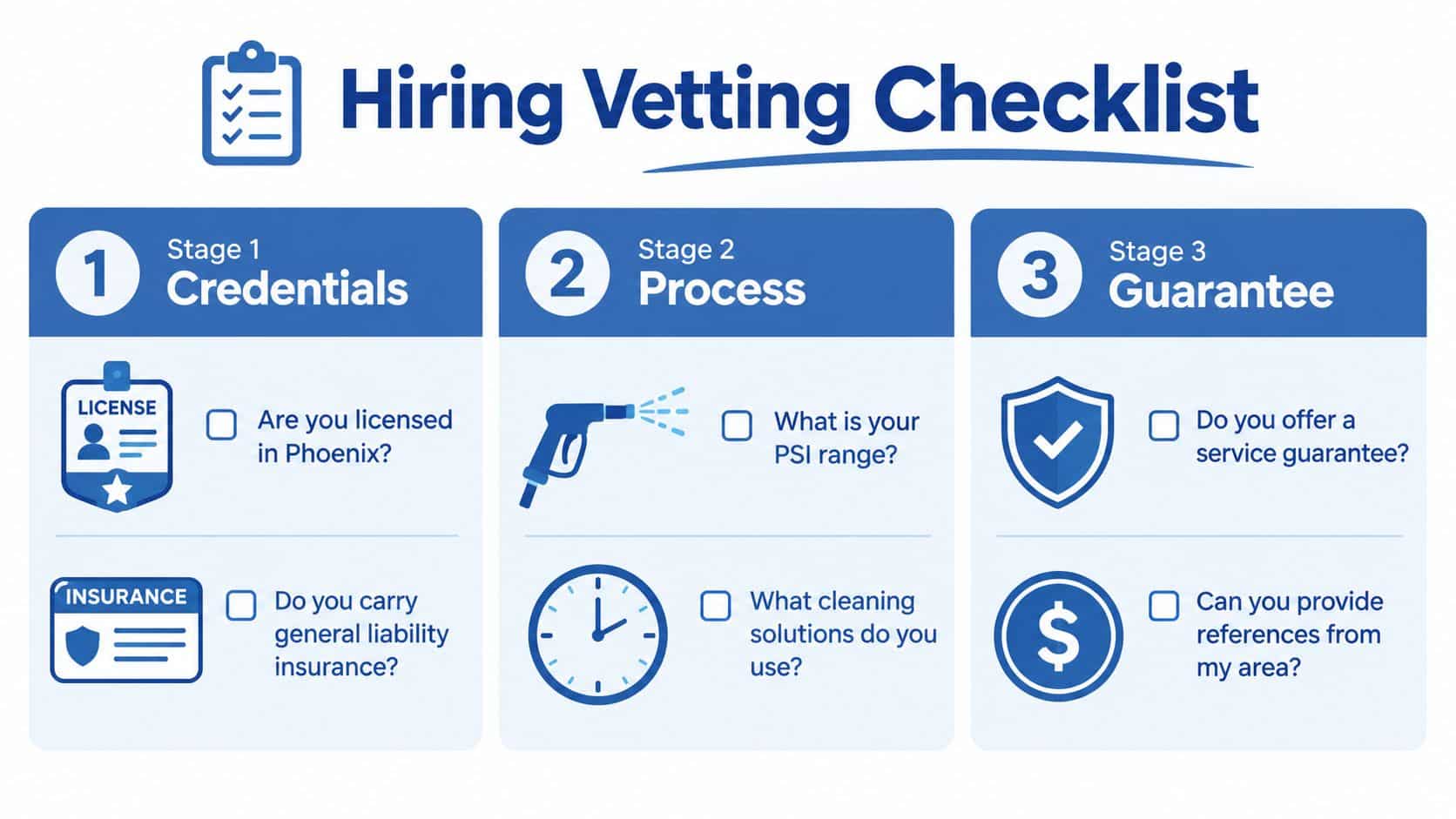
Credentials and coverage
Start with the basics:
- Licensing: Ask whether the company is properly licensed for the work it performs in Arizona and the communities it serves.
- Insurance: Confirm general liability coverage and ask whether workers' compensation applies to employees performing two-story work.
- Experience: Ask how the crew handles aged, chalky, textured, or oxidized vinyl.
- References: Request recent references from Phoenix, Scottsdale, Gilbert, Chandler, Tempe, or nearby areas with similar homes.
A company that works around heights should explain its safety plan without being pushed. That includes ladder footing on gravel Phoenix yards, protection around pool decks, eye protection during chemical application, and containment of rinse water around doors, drains, landscaping, and decorative metals.
Method and preparation
Ask these questions word for word if needed:
“Do you soft wash vinyl siding by default?” A clear answer should include low pressure, a broad spray pattern, detergent, dwell time, and a controlled rinse.
“What PSI range will you use at the siding?” Industry guidance for vinyl commonly centers on low-pressure methods, and the operator should explain how nozzle choice and distance affect the actual force at the wall.
“What cleaning solution do you use, and how do you adjust it?” The contractor doesn't need to disclose a proprietary formula, but refusing to describe the chemistry is a warning sign.
“Do you pre-wet plants, windows, and metal fixtures?” If the answer is no, ask how the company prevents chemical damage and flash-drying in Arizona heat.
Also clarify whether the company brings its own water, where vehicles should park for hose access, and what happens if monsoon weather interrupts the appointment. Ask whether the crew will clean window frames or skip them, since siding wash runoff often reaches those areas.
Warranty language matters
Get separate answers for oxidation streaking and re-soiling within 30 days. Those aren't the same issue, and a vague “satisfaction guarantee” may not tell you what the company will correct.
The hiring checklist below captures the essentials:
Walk away from a contractor who refuses to describe the cleaning solution, promises to blast every surface at one setting, or gives a flat hourly quote without inspecting the property. A real estimate accounts for access, oxidation, protection, and the actual contamination.
What Vinyl Siding Cleaning Costs in the Phoenix Area
A fair quote starts with the property, not a generic price-per-hour formula. Height, roofline complexity, oxidation, landscaping, pools, irrigation staining, and the amount of preparation can change the labor substantially.
Consider a newer single-story home in Gilbert. The siding may have ordinary dust film and light pollen, with straightforward access and little oxidation. The crew can usually focus on protection, application, dwell, and rinse without spending much time on correction work.
An older two-story home in Paradise Valley is different. Sun exposure may have left chalky oxidation, while landscaping and decorative trim require more protection. A retail plaza in Chandler adds long wall runs, customer access, storefront glass, scheduling restrictions, and the need to coordinate around business operations. A small multi-unit property in Tempe with both stucco and vinyl requires separate methods across the same site.
What changes the estimate
- Height and stories: Two-story work takes more setup and safety attention than accessible single-story siding.
- Roofline and access: Complex rooflines, narrow side yards, gates, gravel, and pool areas slow preparation.
- Contamination: Heavy mildew, embedded dust, mineral spotting, rust bleed, and oxidation require more diagnosis and treatment.
- Protection: Dense plants, decorative metals, irrigation equipment, windows, and outdoor furniture increase setup and rinse responsibilities.
- Timing: A job scheduled around monsoon conditions or a commercial operating schedule may require additional coordination.
- Bundled work: Gutter brightening, window rinsing, or other exterior services may change the overall value of the visit.
Be cautious with a low-ball quote. It may reflect skipped pre-wetting, minimal dwell time, no spot treatment, or a rinse that leaves streaks behind. A fair mid-range bid should state the method, identify the surfaces included, explain exclusions, and describe what happens if the crew finds oxidation or loose panels.
Pricing software and service businesses use different structures, so reviewing Bragly price tiers can help you understand how service packages may be presented. For local context, homeowners can also compare the factors discussed in this guide to the cost of pressure washing.
There is no verified Phoenix price range to quote responsibly here. Ask for an itemized estimate instead of accepting an invented per-square-foot promise. An annual maintenance plan may simplify scheduling and help prevent heavy buildup, but its value depends on the home's exposure to dust, shade, irrigation, and storm residue. The cheapest visit isn't necessarily the economical one if the crew leaves oxidation streaks or pushes water behind the siding.
Scheduling, Frequency, and Caring for Your Siding Year-Round
Phoenix homes need a cleaning rhythm based on exposure, not an arbitrary calendar reminder. Vinyl siding commonly needs washing every one to two years, while lighter cleaning may suit homes that collect dust, irrigation mist, or storm residue more often. Those intervals are starting points, not promises. Shaded walls, dense landscaping, and monsoon exposure should determine the plan.
A practical Valley schedule
- Late May: Schedule a pre-monsoon wash to remove winter dust and pollen before summer storms add residue.
- October: Inspect and touch up after monsoon season, especially around lap seams, shaded walls, and lower trim.
- Winter: Check north-facing siding and areas near dense landscaping for mildew or persistent dampness.
- Early spring: Rinse away seasonal dust after the last freeze and inspect caulk, corners, and panel alignment.
- Mid-summer when needed: Treat shaded or irrigated sections if algae streaks return before the rest of the property needs service.
Between professional visits, trim vegetation to keep it six inches away from the siding, redirect sprinklers away from walls, and record the wash date inside a garage cabinet. These small steps limit moisture and debris reaching the panels.
Commercial and high-rise work adds a separate safety concern. OSHA guidance requires independent anchorages for worker safety lines, while roof anchorages used with window-washing devices must be permanent structural components that support intended loading without displacement or deformation. See the OSHA anchorage interpretation. Rope-descent systems also require building owners to provide written confirmation that each anchorage has been identified, tested, certified, and maintained to support 5,000 pounds in any direction for each attached worker. Each worker must use a separate independent personal fall arrest system, as summarized by FallProtect.
Indoor window work near openings requires fall protection when floor-level work is impractical. OSHA guidance calls for a personal restraint system attached to a secure anchorage. Review the OSHA window-opening safety citation before approving that portion of a commercial scope.
Choose a service that uses genuine low-pressure, chemistry-led washing, carries insurance, meets Arizona licensing requirements, and adjusts the schedule to your home's dust, UV, irrigation, and monsoon exposure.
South Mountain Window Cleaning, LLC offers house washing and soft-wash services for residential and commercial properties, plus window cleaning across Phoenix, Scottsdale, Paradise Valley, Chandler, Tempe, and Gilbert. Visit South Mountain Window Cleaning, LLC to request a fast, free quote and discuss a siding-cleaning plan built around Arizona conditions.