
If you live in Phoenix, Scottsdale, Paradise Valley, Chandler, Tempe, or Gilbert, you've probably looked up at your solar panels after a windy week and seen the film of dust sitting on the glass. Or you've heard pigeons under the array early in the morning and realized the problem isn't just on top of the panels. In Arizona, solar panel cleaning and bird proofing isn't a cosmetic add-on. It's basic maintenance.
That matters for homeowners and property managers alike. South Mountain Window Cleaning provides residential, commercial, and high rise window washing services across the Valley, and the same practical mindset applies to solar. The goal isn't to clean for the sake of cleaning. The goal is to protect production, prevent avoidable damage, and stop birds from turning the space under your panels into a nesting site.
Why Your Solar Panels Need Attention in Arizona
A common Arizona scenario goes like this. The power bill feels higher than expected, the panels look dull by mid-summer, and there's scratching, fluttering, or nesting noise coming from the roofline. In the Valley, those usually point to two issues working together: desert dust on the panel face and birds using the gap under the array for shelter.
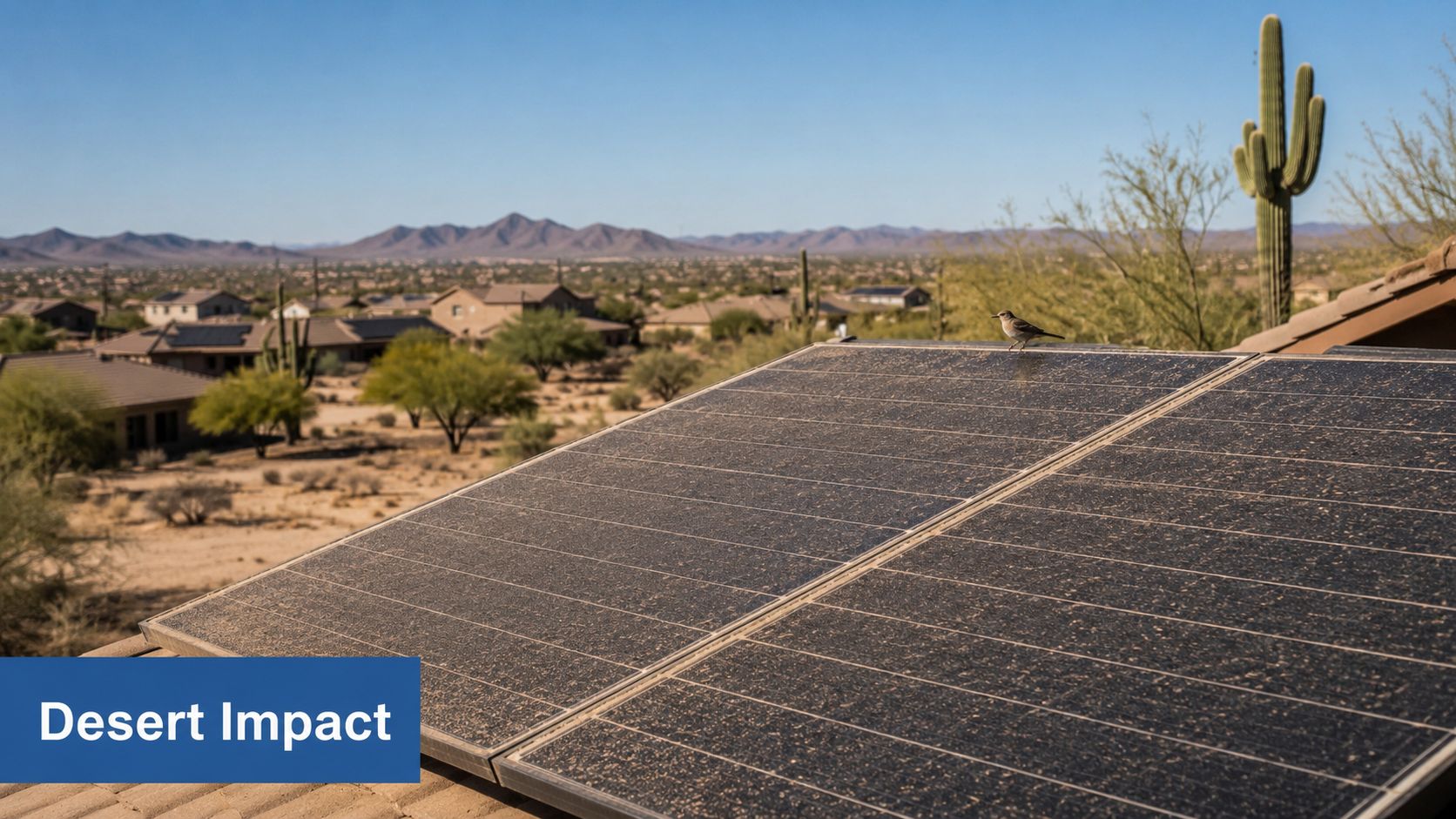
Arizona isn't a forgiving place for exterior surfaces. Fine dust settles fast, especially after wind events, and the long dry stretches don't always give panels the rinse people assume they'll get. At the same time, pigeons and other birds are persistent around roof structures because panels create shade and cover.
What homeowners usually notice first
Individuals often don't start with a close roof inspection. They notice clues:
- A visible dust layer: Panels look hazy instead of dark and reflective.
- Bird activity: You hear movement, cooing, or see droppings collecting near panel edges.
- A change in system behavior: Output appears lower than expected, or the savings don't match what you're used to seeing.
- Mess around the home: Droppings on patios, walkways, and walls often mean birds are nesting above.
The practical issue is that these two problems feed each other. Dust reduces light transmission. Birds add droppings and debris, which are more damaging than simple dust because buildup can block irradiance unevenly and create problem spots on the panel surface.
Practical rule: In Arizona, solar panels are low-maintenance, not no-maintenance.
The climate is the reason. As noted by this Arizona solar cleaning overview, solar panel cleaning in Arizona is essential to ensure maximum energy production, protect the investment in the solar power system, and prolong its lifespan, because intense sun and frequent dust deposition accelerate efficiency loss if panels aren't regularly maintained.
Why ignoring it gets expensive
Neglect usually starts small. A little dust doesn't seem urgent. A few birds under the panels don't seem like a system problem. Then the debris builds up, droppings bake on, and the cleanup becomes harder and riskier.
For commercial properties and large homes, the stakes are even more obvious. A dirty array on a retail roof, multifamily property, or office building isn't just a maintenance issue. It's an operating-cost issue. That's why a practical solar maintenance plan in Arizona needs both parts working together: proper cleaning on the panel face and real bird exclusion around the array.
Safe and Effective Solar Panel Cleaning Methods
Cleaning solar correctly is mostly about restraint. The wrong tool, the wrong time of day, or too much pressure can do more harm than the dirt you're trying to remove.
Start with safety and shutdown
Before anything touches the panels, handle the system safely.
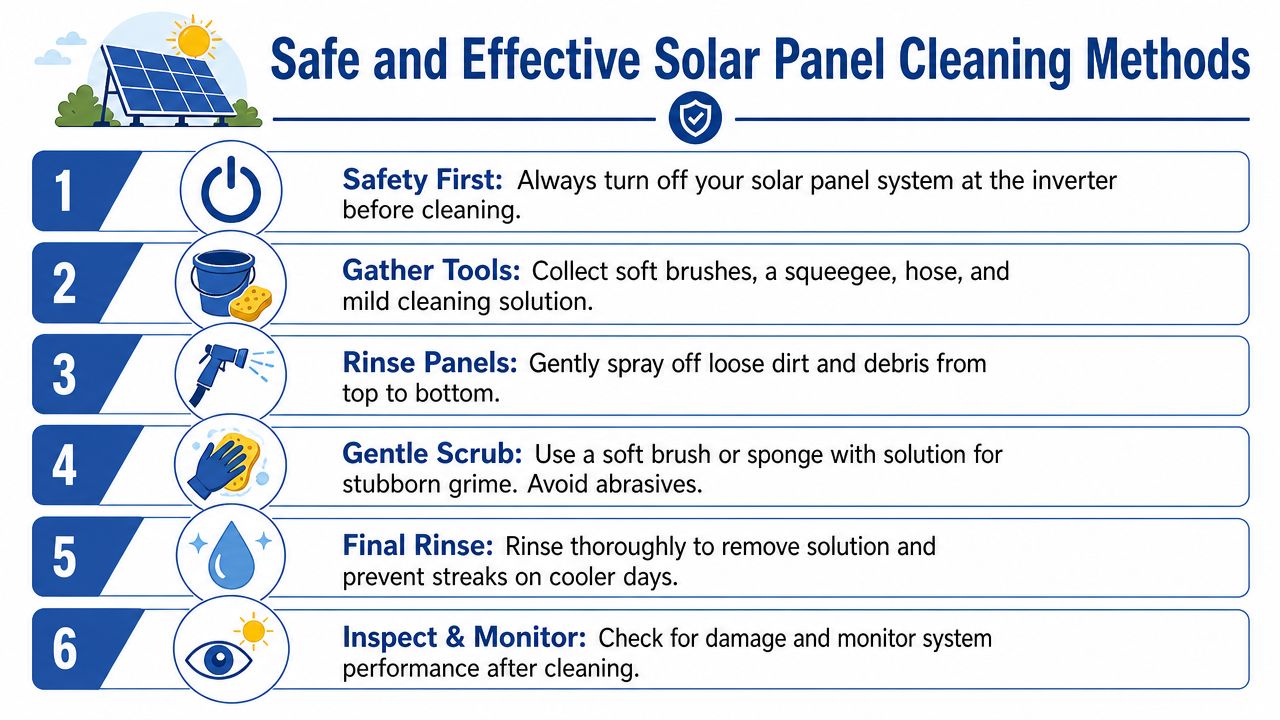
- Turn off the system at the inverter before cleaning.
- Work in the cool morning or later evening so glass isn't hot.
- Stay realistic about roof access. If the roof is steep, high, brittle, or awkward around tile, the cleaning method should change from DIY to professional service.
- Don't step on panels. Weight on the glass and frame can create damage that isn't always visible right away.
A lot of homeowner mistakes happen before the washing even starts. They drag a ladder onto tile, lean too hard against the gutter, or try to rush through it at midday.
Use the right tools and skip the wrong ones
Good solar cleaning tools are simple:
- Soft-bristle brush for loose grime
- Non-abrasive sponge or mop head
- Hose with gentle flow
- Squeegee for controlled water removal where appropriate
- Pure or deionized water systems for a spot-free professional finish
What doesn't belong on solar panels:
- Pressure washers
- Abrasive pads
- Harsh soaps
- Glass cleaners with additives
- Metal blades or scrubbers
A basic homeowner rinse can remove loose dust. The professional difference is water quality. Hard water leaves mineral spotting, and in Arizona that residue can become its own film. That's one reason many exterior cleaning pros prefer purified water systems for panel glass.
For a deeper walkthrough of the process, South Mountain Window Cleaning has a practical guide on how to clean solar panels safely.
Heavy debris changes the equation. Light dust may not justify aggressive cleaning, but droppings and compacted grime do.
That lines up with UC San Diego research summarized here, which found that panels left uncleaned for 145 days during a summer drought lost 7.4% of efficiency, while heavy debris such as bird droppings can cause substantial non-linear power loss.
A short visual demonstration helps if you want to see the cleaning process in action:
The cleaning method that works
The most reliable sequence is straightforward:
- Rinse first: Knock off loose dust from top to bottom.
- Agitate lightly: Use a soft brush or sponge on bonded dirt, especially around lower edges where grime collects.
- Rinse again thoroughly: Any leftover residue dries into marks.
- Inspect as you go: Look for cracked components, loose nesting material, and concentrated droppings.
If you're dealing with bird droppings, don't attack them dry. Let water soften the deposit first, then work it loose gently. Scrubbing baked droppings with force is how people scratch panel surfaces or damage coatings.
What actually doesn't work
A few methods sound efficient but aren't.
| Method | Why it fails |
|---|---|
| Pressure washing | Too aggressive for seals, edges, and surrounding roof materials |
| Dish soap and hard scrubbing | Leaves residue and increases risk of surface wear |
| Cleaning at midday | Water flashes off fast and can leave spotting |
| One quick rinse only | Fine Arizona dust often needs a second pass |
Good solar panel cleaning and bird proofing starts with safe handling. If the panels are accessible and only dusty, a gentle rinse may be enough. If there are droppings, nest debris, or access hazards, the method has to get more deliberate.
The Arizona Maintenance Schedule When and How Often to Clean
There isn't one schedule that fits every roof in the Valley. A home near open desert in Scottsdale or Paradise Valley will load up with dust differently than a tighter neighborhood in Tempe or Chandler. Homes with active bird traffic also need a different plan than homes with clean rooflines and little perching activity.
The baseline that makes sense in Arizona
For most homes in Arizona, cleaning every three to six months is the recommended schedule, with six months described as the ideal rhythm for many homes in Scottsdale and Paradise Valley to keep corrosive dust from bonding to the glass.
That's a useful starting point, not a blind rule. In practice, six months works when the array stays mostly free of droppings, the roofline doesn't attract pigeons, and the panels get at least some natural rinsing. Three months makes more sense when the home sits in a dust-heavy pocket, near active construction, or under regular bird pressure.
Adjust for seasons and roof conditions
Arizona homes usually need schedule changes based on what happened on the roof.
- After wind events: Inspect for a visible dust film and edge buildup.
- After monsoon activity: Check for mud spotting, debris, and anything trapped under the panel perimeter.
- During long dry stretches: Watch for bonded dirt that no longer rinses off naturally.
- If birds are active: Move from routine scheduling to condition-based cleaning and proofing.
The smart approach is to combine calendar scheduling with visual inspection. If the glass still looks clean and there's no concentrated debris, you may stay on the longer cycle. If you see droppings, nests, or grime collecting in corners, waiting for the next preset appointment usually costs more than it saves.
For homeowners who want a more detailed planning guide, this page on how often to clean solar panels in Arizona is a useful reference point.
If your roof gets both dust and birds, don't separate the problem into two service calls months apart. Inspect the glass and the panel perimeter at the same time.
A practical schedule by property type
A simple field-tested rhythm looks like this:
| Property situation | Practical schedule |
|---|---|
| Light dust, little bird activity | Start around every six months |
| Dusty exposure or nearby open land | Move toward every three months |
| Visible droppings or active nesting | Clean as needed and install exclusion promptly |
| Commercial roofs with larger arrays | Inspect more often and schedule by site conditions |
Generic online advice often proves inadequate here. Arizona roof conditions change fast, and the right interval depends on what's accumulating and where. The best schedule is the one that prevents bonded dust, keeps droppings from sitting, and catches bird activity before it turns into a larger cleanup.
Bird Proofing Your Panels: Solutions That Work
You wash the panels, they look better for a week, and then the pigeons are back under the array by the weekend. That cycle is common in Phoenix. Dust is one problem. Birds turn it into an ongoing maintenance issue because they keep adding droppings, feathers, and nest material in the same shaded pocket under the panels.
Mesh skirting is the primary fix
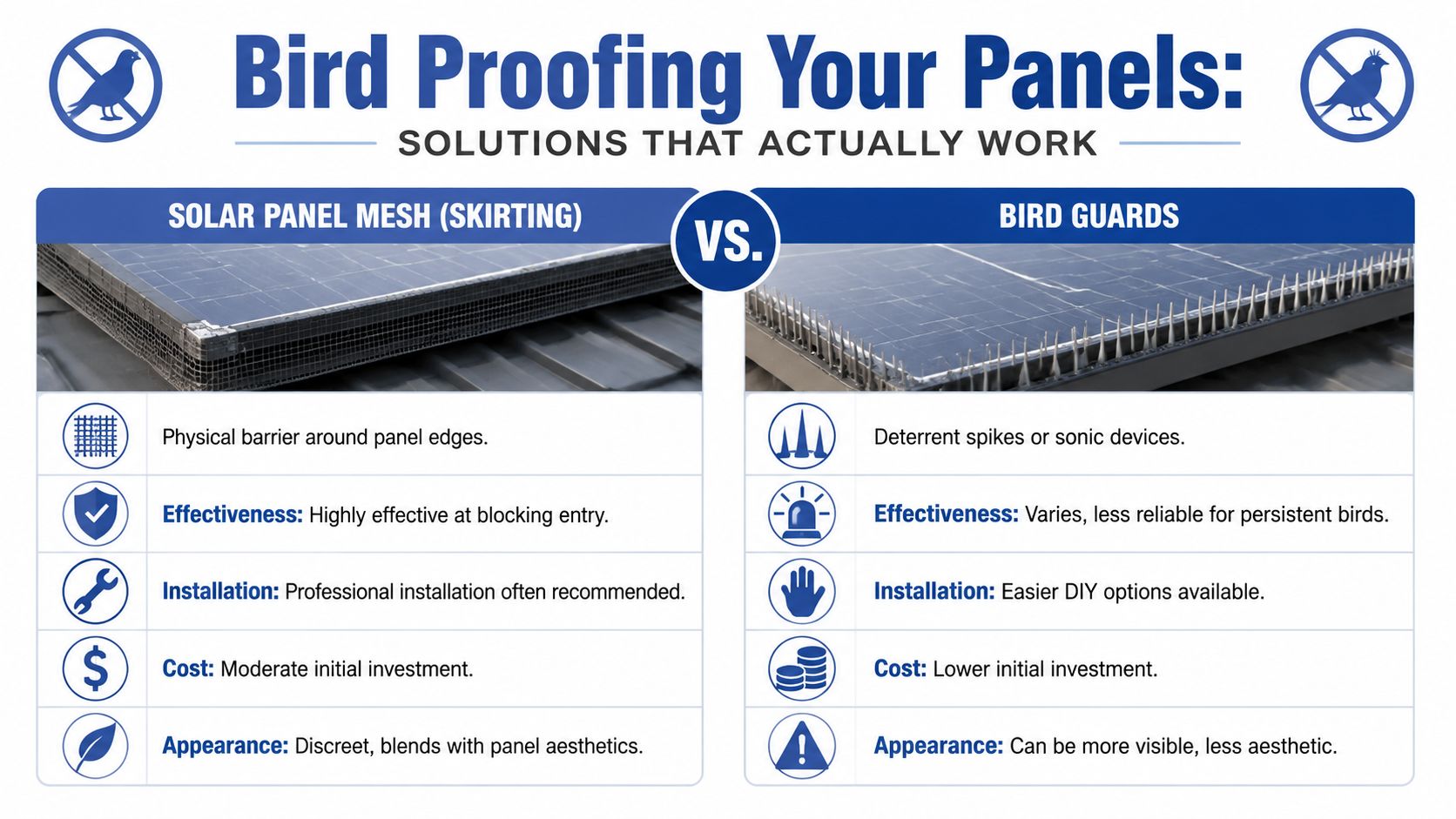
For Arizona homes, the most reliable method is solar panel mesh, also called skirting. It closes off the gap around the array so pigeons cannot get into the shaded cavity underneath. In our climate, that matters because once birds claim that space, they keep returning unless the entry point is physically blocked.
The result depends heavily on installation quality. A practical review of field installation pointed out a detail many homeowners miss. No gap between the prongs and the roof tile should exceed 50 mm, or pigeons can still squeeze through. That same review showed using a 50 mm polystyrene ball from certain kits to check the gap during installation in this bird-proofing review video.
A perimeter can look finished and still fail. One loose corner, one high spot over a curved tile, or one missed gap near conduit is enough.
Spikes and deterrents are secondary tools
Spikes, reflective pieces, and similar deterrents can help on parapets, ridge lines, and favorite perch spots near the array. They have a place. They just do a different job.
They do not seal the underside of the system, and that is the part pigeons want. If birds are already nesting under the panels, visual or perch deterrents alone usually fade in effectiveness fast. Use them to reduce surrounding roof activity, not as a substitute for exclusion at the panel edge.
Bird waste creates a different kind of problem
Dust usually spreads out across the glass. Bird droppings are concentrated, sticky, and slower to wash off. According to this panel maintenance analysis, heavy buildup from bird droppings can cut efficiency significantly, and the same source notes that droppings may contribute to hot spots over time.
That is why cleaning and proofing need to be handled together. If the birds stay, the mess comes back.
The order of work matters
The cleanest bird-proofing jobs follow a straightforward sequence:
- Check the array for active bird pressure by looking for droppings, feathers, nesting material, and repeated bird traffic.
- Remove nests and contaminated debris first so waste is not trapped under the panels after exclusion.
- Clean the affected roof sections and panel edges before closing the perimeter.
- Install mesh with tight, consistent contact around every side of the array.
- Inspect corners, tile transitions, and roof penetrations where small gaps are easy to miss.
Skipping the cleanup step causes problems later. Sealing birds out while leaving nesting debris in place traps odor, bacteria, and waste under the system. If there is already active nesting, a service that handles solar bird nest removal is a better fit than treating it like a basic panel wash.
Early proofing costs less than cleanup and retrofit
Homeowners usually call after they hear scratching, see feathers on the patio, or notice droppings collecting below the array. By that stage, the job is larger. It includes inspection, nest removal, sanitation, and exclusion, not just adding mesh.
Prevention is simpler than cleanup. If bird pressure is already common on your block, adding exclusion early usually saves money and mess later.
For readers comparing how professionals handle persistent bird pressure on other structures as well, these Newmarket bird control experts give useful context on building-level exclusion methods.
DIY vs Hiring a Professional in the Phoenix Area
Some solar jobs are realistic for a homeowner. Others aren't. The right choice usually comes down to roof access, the level of buildup, whether birds are involved, and how much risk you're willing to take on.
Cost is only one part of the decision
For Arizona homes, professional solar panel cleaning costs approximately $100 for a one-story home and $200 for a two-story home due to access difficulty, according to this Arizona service pricing reference. That same reference notes that services use plain water to improve production.
Those numbers matter, but they don't answer the whole question. A homeowner with a low-slope one-story roof and light dust may decide a careful rinse is worth doing personally. A two-story tile roof with active pigeons is a different situation entirely.
DIY vs. Professional Solar Panel Maintenance
| Factor | DIY Approach | Professional Service |
|---|---|---|
| Safety | Works best only on easy-access roofs | Better suited for steep, high, or awkward access |
| Equipment | Basic hose, soft brush, household tools | Purpose-built tools, purified water systems, safety procedures |
| Cleaning quality | Good for light dust if done carefully | More consistent on bonded grime, spotting, and edge detail |
| Bird issues | Often incomplete if nesting is active | Better for cleanup plus exclusion work |
| Time | Takes personal time and planning | Outsourced, scheduled, and usually faster |
| Risk of mistakes | Higher if wrong tools or methods are used | Lower when technicians know roof and panel handling |
When DIY makes sense
DIY cleaning is reasonable when all of these are true:
- The roof is easy to access safely
- The panels have light dust only
- There are no active nests or droppings baked onto the glass
- You can clean during cool hours with the right soft tools
If any of those are false, the value of DIY drops fast. A lot of people save money on the cleaning itself and then create a bigger problem with roof damage, mineral spotting, or incomplete bird exclusion.
The job changes the moment the roof becomes dangerous or birds are involved. At that point, “simple maintenance” usually isn't simple anymore.
For homeowners comparing home maintenance priorities, it's similar to work like air duct cleaning. Some upkeep tasks look straightforward from the ground, but the results depend heavily on the right equipment and process.
When hiring out is the practical call
Professional service makes the most sense when the roof is high, tile is fragile, access is awkward, or the array needs more than a rinse. That includes heavy dust, droppings, nest material, and any cleanup around panel edges. In those situations, the service isn't just labor. It's risk reduction.
For homeowners pricing out the difference, this page on the cost to clean solar panels helps frame what you're paying for, especially on larger or harder-to-access homes. South Mountain Window Cleaning, LLC is one local option for panel cleaning using exterior-cleaning equipment and procedures that fit Arizona conditions.
Protecting Your Investment A Long-Term Strategy
A Phoenix system can look fine from the ground and still be losing ground on two fronts at once. Dust cuts panel performance gradually. Pigeons turn the shaded space under the array into a repeat mess if they find an opening and keep using it.
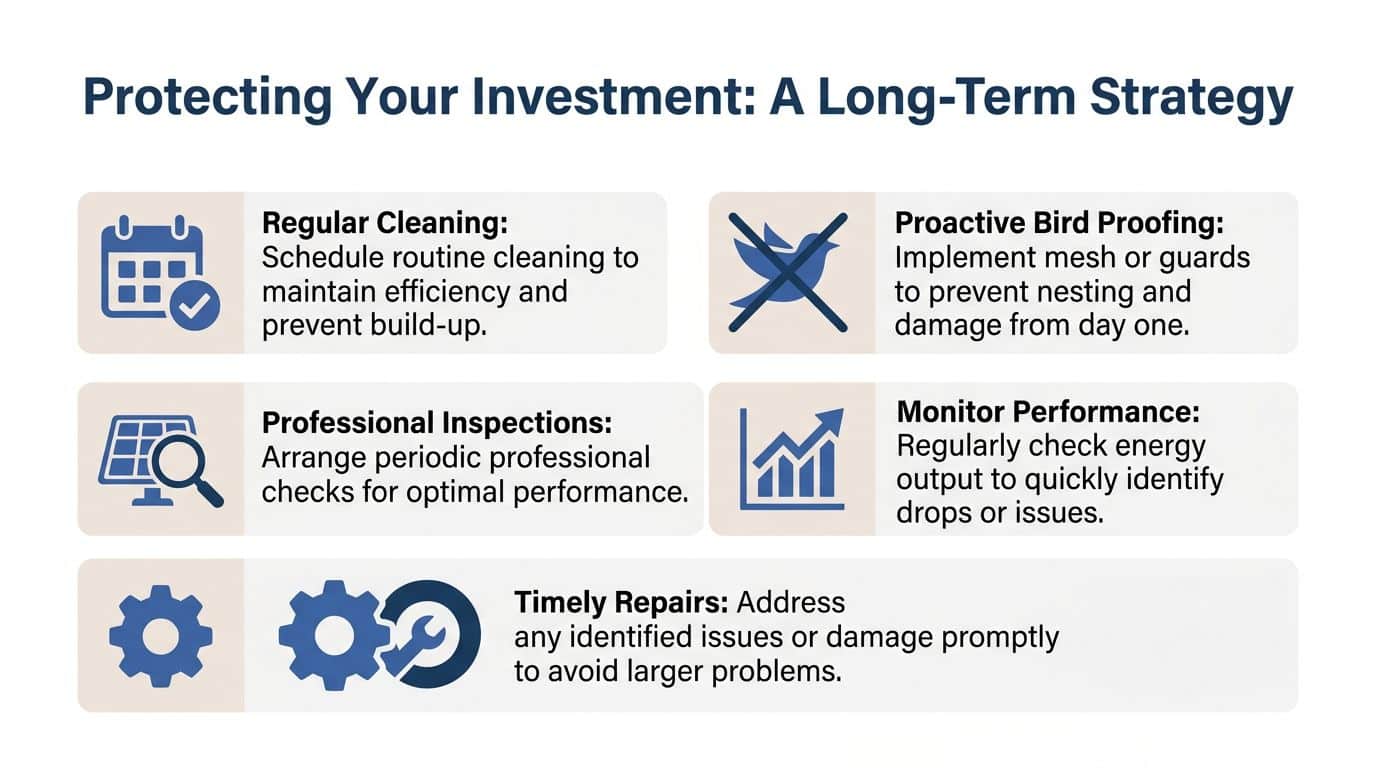
The long-term plan is simple. Check the system regularly, clean based on what is on the panels, and close off bird access before cleanup becomes a recurring bill. In Arizona, those three steps work together. Cleaning the glass while leaving birds under the array usually means the problem returns. Installing exclusion without paying attention to dust, droppings, and runoff leaves performance and appearance issues behind.
Think in cycles, not one-time cleanings
A practical Arizona maintenance cycle includes three habits:
- Routine inspection: Watch for dust film, droppings, edge buildup, and signs of birds moving under the panels.
- Condition-based cleaning: Clean when the panels need it, especially after long dry stretches, heavy wind, or visible buildup that will not rinse off cleanly.
- Permanent exclusion where needed: If pigeons or other birds are using the array, block access with a proper long-term barrier instead of paying for repeated cleanup.
That last step saves the most frustration. Homeowners often keep cleaning around the same nesting site because the entry point never got addressed. The result is more droppings, more debris, and more time spent on the same section of roof.
The timing decision that affects long-term cost
Bird proofing is usually cheaper and cleaner to handle early. If a home has heavy pigeon traffic, a roof design with protected corners, or nearby structures where birds roost, it makes sense to plan for exclusion before nesting starts. Retrofitting after birds settle in usually means more cleanup, more labor, and a harder install.
Arizona adds another variable. Some homes can go a long time with no bird pressure at all. Others get hit fast because the roofline and neighborhood make the array an easy shelter. The right call depends on the property, not a generic schedule.
Clean glass protects production in the short term. Bird exclusion protects the next several service visits too.
For existing systems, the best strategy is early response. A light layer of dust is one job. Baked-on droppings, nest material, and staining around panel edges are a different job with more cleanup and more risk of damage if it is handled poorly. Owners who catch problems early usually spend less and deal with fewer surprises.
If your panels are dusty, your roofline has active bird traffic, or you want a safer plan than climbing up there yourself, contact South Mountain Window Cleaning, LLC for a free quote. They serve homeowners, commercial properties, and high rise buildings across Phoenix, Scottsdale, Paradise Valley, Chandler, Tempe, and Gilbert, Arizona with practical exterior cleaning services that fit the Valley's dust, sun, and roof-access challenges.