
A Phoenix property manager can step onto a rooftop in the morning and see the problem immediately. Dust has filmed the west-facing glass, hard-water marks remain near the lower panes, and yesterday's wind pushed grit into the window frames. Tenants still need clear views, pedestrians need protection below, and the cleaning crew needs a safe way to reach every elevation.
High rise windows aren't oversized residential panes. They form part of the building enclosure, manage daylight and solar exposure, and depend on anchors, suspended equipment, glazing coatings, seals, frames, and drainage paths. In the Valley, a practical maintenance plan starts with access and inspection, then matches the cleaning method to the façade, the season, and the building's operating needs.
Why High Rise Windows Need a Different Plan in Phoenix
A dusty tower in Phoenix can look like a straightforward cleaning job from the sidewalk. From the roof, the picture changes. The crew may find different anchor layouts on each elevation, a stepped podium that blocks a direct descent, glazing that reacts differently to intense sun, and ledges where monsoon grit collects. A good plan accounts for those conditions before anyone moves equipment toward the edge.
Arizona dust also changes how quickly glass loses its appearance. Fine particles settle on broad curtain-wall surfaces, while rain can turn that dust into spots and streaks. South- and west-facing elevations often receive more direct sun, so deposits become more visible and interior complaints about glare or heat may appear alongside ordinary dirt.
Practical rule: Treat the first visit as an access and façade review, not just a request for clean glass.
That review should identify the available rigging, the safest route to each elevation, the glass and frame conditions, pedestrian-control needs, tenant schedules, and areas that may remain inaccessible. A written scope should distinguish ordinary soil from mineral deposits, failed seals, damaged coatings, or panes that require another trade.
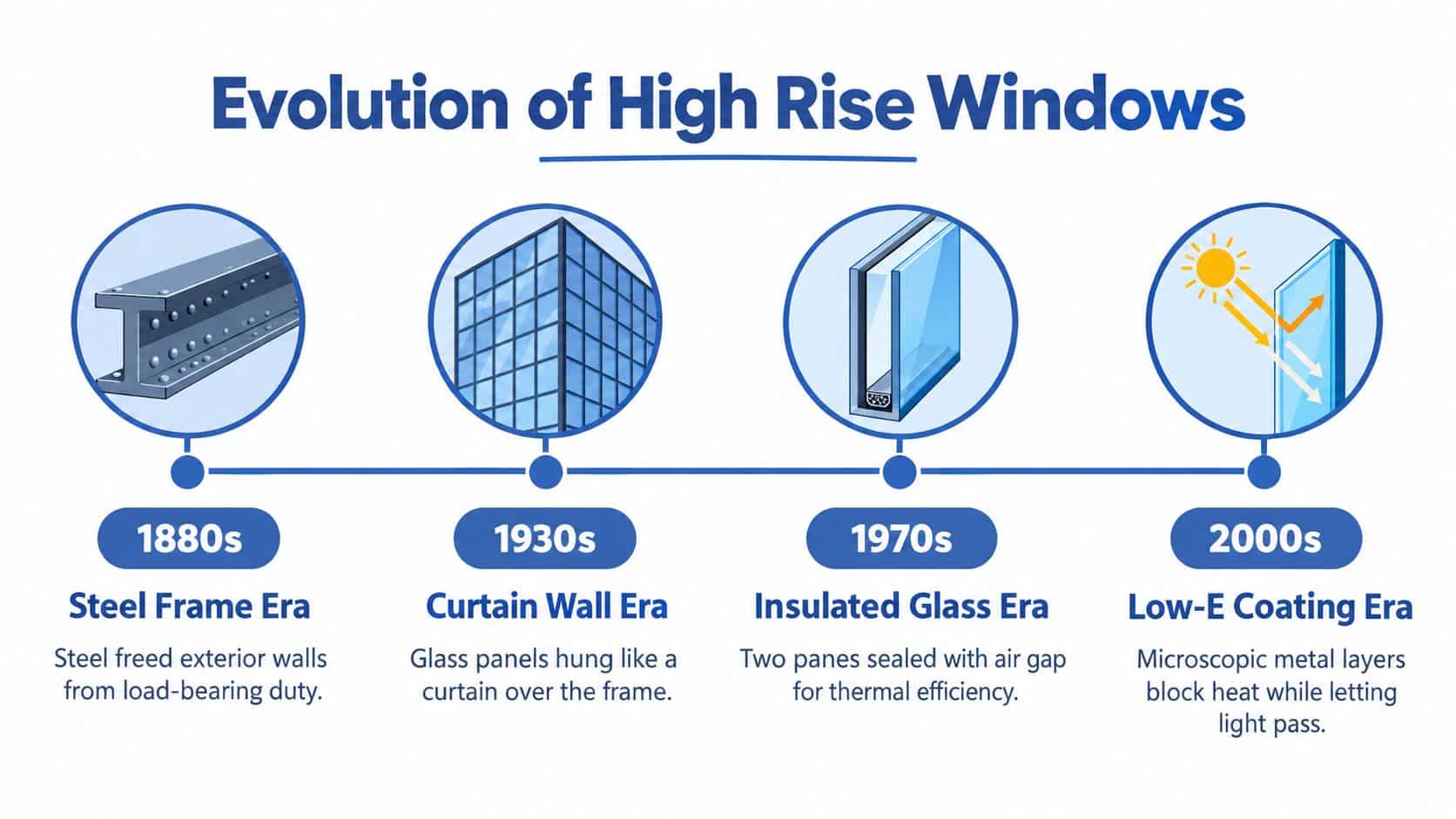
High rise windows became a defining architectural feature because steel framing separated a building's structural skeleton from its exterior enclosure. The change made walls lighter and more open, and it eventually produced the curtain wall, a non-load-bearing exterior skin attached to the frame. That history explains why cleaning can affect more than curb appeal. The crew is working on a major part of the building's envelope.
South Mountain Window Cleaning provides residential, commercial, and high rise window washing services in Phoenix, Scottsdale, Paradise Valley, Chandler, Tempe, and Gilbert. Its broader Arizona window cleaning service is relevant to owners who manage different property types but want one consistent approach to glass, access planning, and recurring exterior care.
What Makes a Window a High Rise Window
Start with the building's structure. Older masonry buildings depended on thick walls to carry weight, so openings had to stay relatively limited. Steel framing changed that rule. The first steel-frame skyscraper, Chicago's Home Insurance Building, was completed in 1885 at approximately 10 stories and 42 meters, or 138 feet, according to a history of steel-frame skyscraper construction.
Once the frame carried the load, the outer walls could act like a protective jacket over the skeleton. Those panels still block weather and shape the indoor environment, but they do not perform the same structural job as load-bearing masonry. That outer layer is the curtain wall, a non-load-bearing exterior skin attached to the frame.
From small openings to transparent façades
The shift did not happen all at once. The Hallidie Building in San Francisco, completed in 1918, is identified as the earliest building with an all-glass curtain wall on one street façade. Milwaukee's A.O. Smith Research Building, completed in 1928, became the first multistory structure with a full glass curtain wall.
Early tall buildings usually had modest window coverage, often around 20% to 40% of the façade. The Fine Arts Building in Chicago reached about 40% glazing in 1885, the Equitable Building in New York about 25% in 1915, and the Chrysler Building about 32% in 1930. Later modernist towers pushed much farther, with façade transparency commonly reaching 50% to 75%. Lake Shore Drive Apartments in Chicago reached 72% in 1951, and Lever House in New York reached 53% in 1952. These figures are documented in the skyscraper reference.
Why the structure changes maintenance
More glass means more exposed surface for sun, dust, water, and wind. In Phoenix, that also means more attention to coatings, gaskets, mullions, pressure plates, drainage paths, and the access system behind the visible pane.
A curtain wall can look uniform from the street while behaving differently from floor to floor. One elevation may have deep setbacks, another may need a suspended platform, and a third may be reachable only with a lift or rope access. Cleaning frequency and equipment choice follow those physical conditions, not the building's name or total floor count.
Common Materials Vulnerabilities and Warning Signs
High-rise glazing is a system, not a single piece of glass. The visible pane works with the frame, seals, mullions, gaskets, coatings, and drainage paths. In Phoenix, intense sunlight can stress sealants and frames, while dust and hard water leave deposits that obscure the difference between surface contamination and a deeper failure.
A low-emissivity coating or other solar-control treatment can limit heat transfer or solar gain, but the rating belongs to the glass system. Cleaning won't change that rating. It can, however, remove deposits that hide coating damage, improve visual inspection, and reveal whether a problem follows the pane, the frame, or the surrounding wall.
Clean glass and healthy glazing aren't the same thing.
Solar heat gain deserves particular attention on exposed façades. A 2025 high-rise-office study reported dynamic solar heat-gain coefficients of approximately 0.32 to 0.54 for cadmium-telluride semi-transparent photovoltaic glazing, compared with about 0.46 to 0.67 for the conventional insulating glass units in its comparison. The study is summarized in this high-rise photovoltaic glazing analysis. A lower coefficient can reduce heat entering perimeter zones, but orientation, shading, frame condition, and glazing specifications still matter.
What to record after cleaning
Use the cleaned façade as a diagnostic opportunity. Record the elevation, approximate exposure, soiling speed, symptom location, and whether the issue appears on the glass or at the frame.
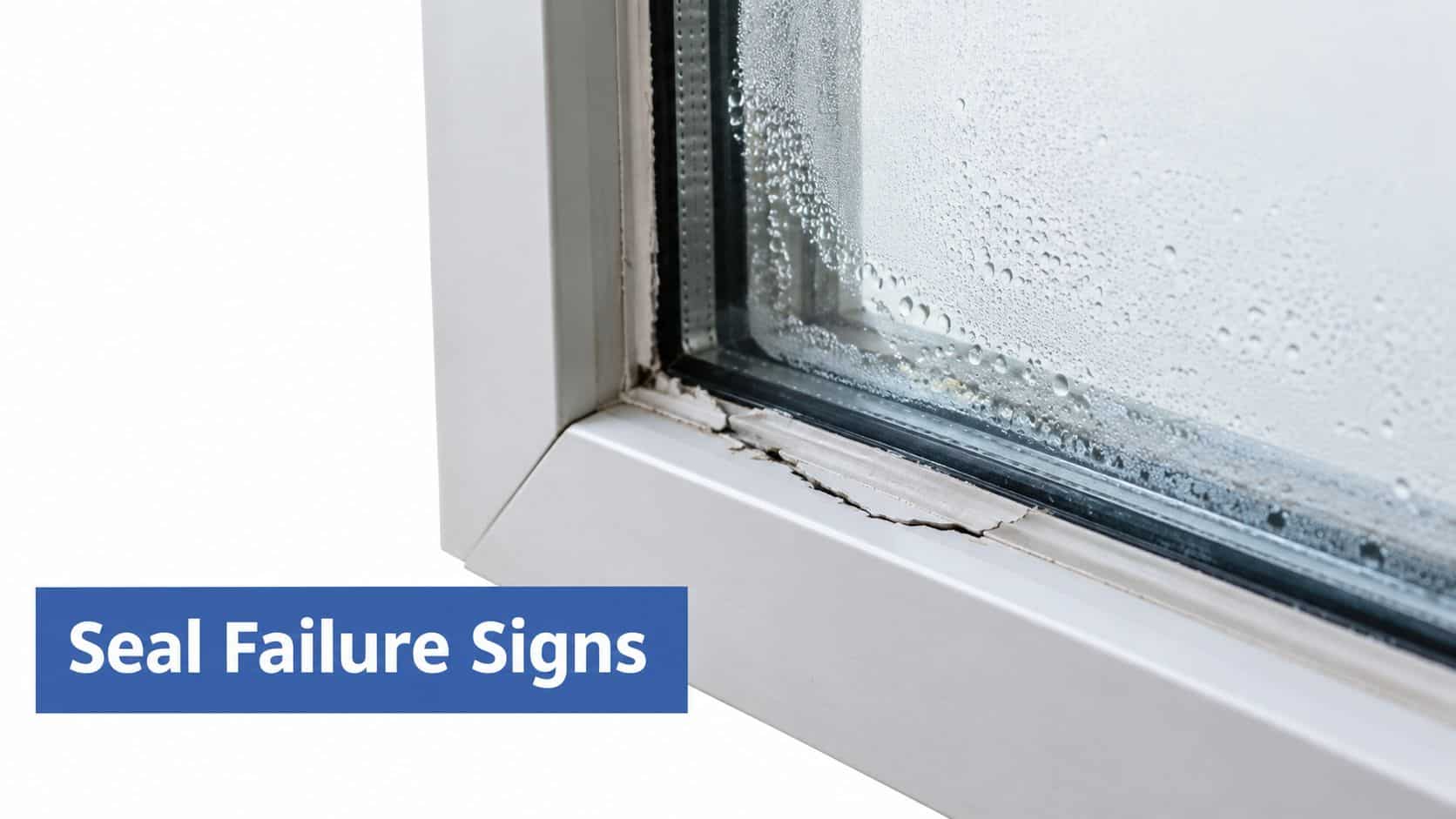
- Fogging between panes: Persistent condensation inside an insulating-glass unit can indicate seal failure rather than ordinary dirt.
- Mineral spotting: White or cloudy deposits may remain after routine washing and may require a controlled restoration method. South Mountain's guidance on mineral deposits on glass helps separate surface treatment from replacement decisions.
- Cold or hot perimeter zones: Uneven comfort near the glass can point to solar exposure, degraded seals, frame conduction, or other envelope conditions.
- Cracked sealant and blocked drainage: Damaged joints or blocked paths can allow water to collect where it shouldn't.
- Uneven glass temperatures: A persistent pattern by orientation or mullion may deserve review by a façade engineer or energy auditor.
For managers involved in renovation or replacement decisions, a resource covering windows and doors for contractors can help explain how frames, glazing choices, and installation details fit together. A cleaner can document visible conditions, but replacement design and envelope diagnosis belong with the appropriate building professional.
How Professionals Clean Tall Glass Safely
The right method depends on the façade and the access infrastructure. A sheer downtown face with certified roof anchors creates a different work plan from a stepped podium, a recessed courtyard, or a low section blocked by landscaping and traffic lanes.
| Method | Best For | Key Limit |
|---|---|---|
| Two-point suspended scaffold | Broad, relatively continuous façades with usable roof-level rigging | Requires sound anchors, tiebacks, stabilization, inspections, and controlled platform movement |
| Rope access | Irregular elevations, narrow setbacks, and locations where a platform can't travel easily | Requires trained technicians, engineered access planning, and careful rescue preparation |
| Boom or aerial lift | Podiums, lower elevations, courtyards, and areas with suitable ground access | Needs stable ground, clearance, traffic control, and protection from tip-over and falling-object hazards |
| Pure-water pole system | Reachable glass, selected lower sections, and work where water-fed cleaning can avoid a suspended platform | Reach and wind conditions can limit use, and the water system must produce suitable rinse quality |
A two-point suspended scaffold, often called a swing stage, is efficient on a continuous curtain wall. It isn't automatically suitable just because the building has roof equipment. The crew must verify anchor condition, tieback points, platform capacity, stabilization, and the route to each elevation.
Rope access can fit a façade with architectural interruptions. Technicians descend on separate lines and work around details that would stop a platform, but the plan must include reliable anchors, communication, exclusion zones, and a practical rescue method.
An aerial lift works well where the ground can support it and the boom can reach the glass without forcing the operator to lean or climb. A pure-water system uses treated water to reduce spotting during the rinse, making it useful on reachable sections and selected tall areas where the equipment can be positioned safely.
The cheapest method on paper can become the most expensive choice if it can't reach the panes, protect pedestrians, or operate safely on the actual façade.
Managers can review window-washing equipment for high-rise buildings before comparing bids. Ask each contractor to identify the access method by elevation, not merely list “high-rise cleaning” as one line item.
Safety Standards Insurance and Access Checks
A pre-bid review should begin before the crew arrives with ropes, platforms, or a lift. For two-point suspended scaffolds, OSHA requires fall protection when the platform is 10 feet or more above a lower level, including both a personal fall-arrest system and a guardrail system. OSHA also addresses sway protection, tiebacks, and competent-person supervision in its two-point suspended scaffold requirements.
Tiebacks must connect to structurally sound building anchors. Vents, electrical conduit, standpipes, and other piping aren't acceptable substitutes. The tieback should generally be perpendicular to the building face unless an opposing-angle arrangement is specifically used.
Run the roof-level review first
A building manager can ask for these records before approving the scope:
- Anchor documentation: Confirm the location, condition, certification, and intended use of roof anchors.
- Rigging layout: Match lifelines, tiebacks, davits, and platform travel to each elevation.
- Inspection records: OSHA says suspension ropes must be inspected before each work shift and after an event that could affect their integrity. The OSHA suspended-scaffold FAQs also address support-device capacity, including surfaces capable of supporting at least four times the imposed load at rated hoist load, or at least one-and-a-half times the imposed load at stall capacity, whichever is greater.
- Rescue access: Identify how a worker will be recovered after a power failure, equipment problem, injury, or suspended-platform incident.
- Training and supervision: Suspended scaffolds must be erected, moved, dismantled, or altered under competent-person supervision.
Permanently installed powered platforms require a written emergency plan covering power failures, equipment failures, and other emergencies. OSHA also specifies stabilization approaches and states that, with intermittent stabilization, the maximum vertical interval between building anchors is three floors or 50 feet, whichever is less, as described in its powered-platform safety fact sheet.
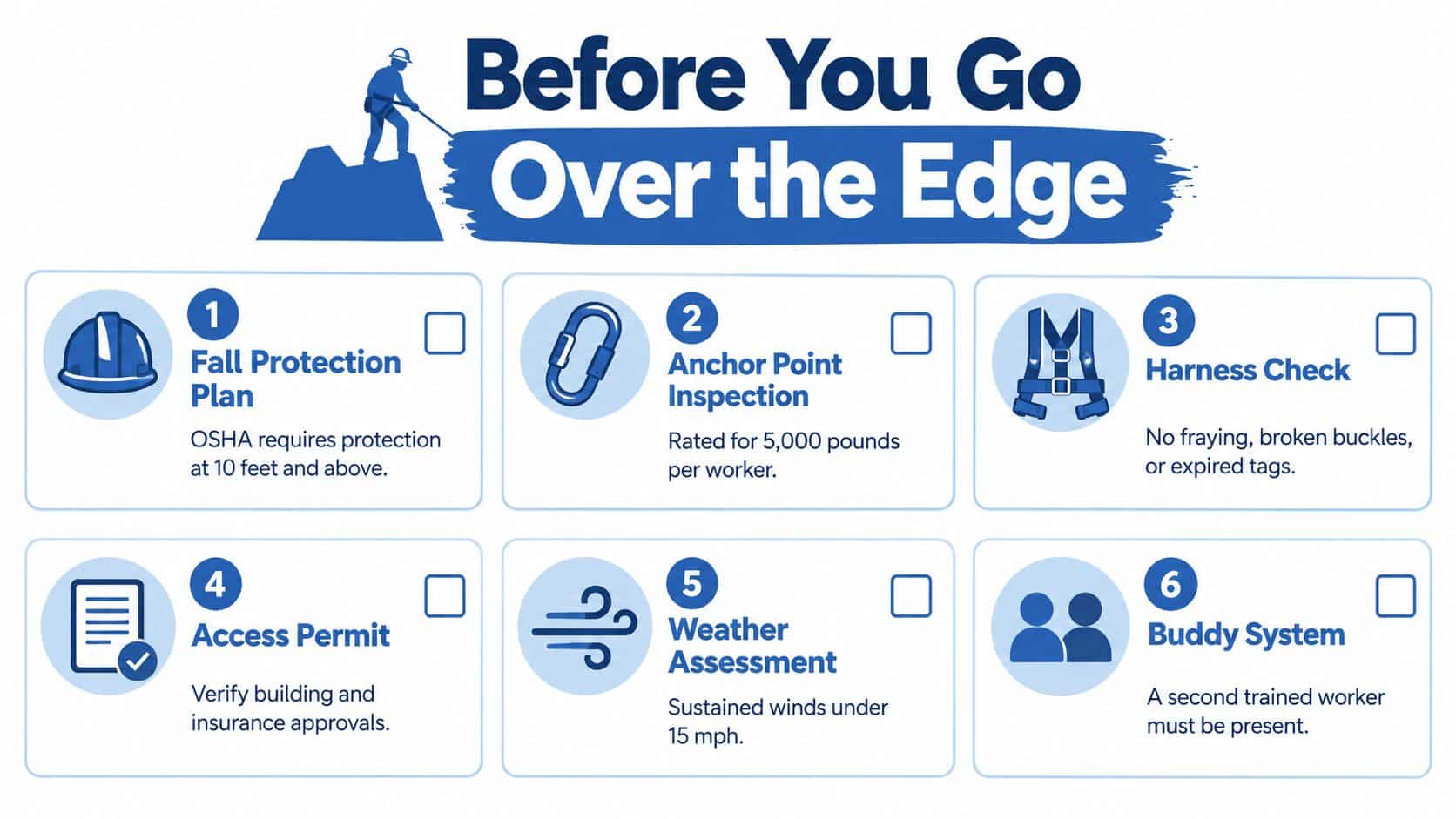
Aerial-lift work has its own controls. Operators should inspect the work zone, keep gates closed, stand on the platform floor, avoid climbing or leaning over guardrails, and never use ladders or planks for extra height. OSHA's aerial-lift guidance also addresses harness or restraint use, falling objects, and tip-over hazards.
Insurance documentation should match the property's vendor requirements. Ask for current certificates, workers' compensation information, training records, and the contractor's written procedures. A commercial provider may carry a $2 million insurance policy, but the manager should verify the actual certificate and confirm that the coverage applies to the planned work.
Scheduling Frequency Costs and Arizona Pricing
Phoenix cleaning schedules should follow the building's exposure, not a generic calendar. Dust, pollen, hard-water deposits, intense sun, and monsoon weather affect elevations differently. A west-facing glass wall beside an open lot may need attention sooner than a shaded courtyard, while a storm can leave fresh spotting across previously clean panes.
Commercial properties often use a recurring rhythm that may range from quarterly service to monthly attention on prominent or heavily exposed elevations. Post-storm touch-ups can make sense when appearance matters to tenants, visitors, retail customers, or residents. The right interval comes from observing how quickly each elevation soils and how much the deposits affect visibility, comfort, and appearance.
What drives a high-rise quote
Height is only one part of the estimate. A contractor may also account for:
- Access type: Suspended platforms, rope access, aerial lifts, and water-fed poles require different labor and equipment.
- Anchor condition: Missing, inaccessible, or undocumented anchors can require additional review or alternate access.
- Pane count and layout: Repetitive curtain-wall bays differ from balconies, setbacks, operable windows, and architectural fins.
- Water treatment: Pure-water systems and deionized-water production affect equipment planning and rinse quality.
- Tenant coordination: Work around occupied offices, residences, hotels, and retail spaces may require phased access and notices.
- Ground controls: Lifts, sidewalks, entrances, and drive lanes may require barricades or traffic coordination.
A transparent proposal should separate routine cleaning from restoration, hard-water treatment, sealant observation, lift rental, and inaccessible areas. A low price that excludes difficult elevations isn't comparable to a complete scope.
Energy decisions belong in the same long-term conversation, but cleaning shouldn't be presented as a substitute for glazing upgrades. Research on vacuum-insulating-glazing retrofits in studied Hong Kong high-rise scenarios found modeled energy savings of 12.5% to 29.7%, heat-gain reductions of up to 85.3%, and an estimated payback of 5.8 to 8.6 years. Those findings come from the vacuum-glazing building-performance study, and they shouldn't be transferred directly to a Phoenix property without local modeling.
Control the long-term spend
Computerized scheduling can help a manager coordinate recurring visits, tenant notices, access windows, and post-service records. Bundling screens, tracks, pressure washing, solar-panel cleaning, or exterior flat-surface work may reduce duplicated mobilization, but each service should remain clearly scoped.
The most useful budget record is an elevation-based maintenance history. Note the date, method, weather interruption, difficult access point, visible glazing issue, and recommended follow-up. Over time, that record helps distinguish a normal dust cycle from a façade problem that deserves engineering attention.
How to Vet a Contractor and Keep Glass Clear
A strong contractor conversation starts with the building, not a sales slogan. Ask who will inspect the access system, which method applies to each elevation, what happens if wind interrupts the work, and how the crew will document panes that can't be reached. Request proof of licensing, bonding, insurance, safety training, and relevant high-rise experience.
The written scope should name the glass areas, frames, sills, screens, tracks, water-treatment method, access equipment, pedestrian controls, tenant coordination, weather policy, and exclusions. It should also identify inaccessible panes instead of implying that every window will receive identical service.
Questions that reveal preparation
- Who checks the anchors? Look for a clear answer about roof anchors, tiebacks, davits, lifelines, and current inspections.
- What happens on a windy day? The contractor should explain when work stops, how the appointment is rescheduled, and whether tenants receive notice.
- How are hard-water marks handled? Ask whether restoration is included or quoted separately.
- How will the crew protect the ground? Confirm exclusion zones, equipment placement, and falling-object controls.
- What does the guarantee cover? A satisfaction guarantee should explain the response process rather than appear as a badge.
- Can you review references? Look for comparable towers, occupied properties, and buildings with similar access constraints.
Cleaners can remove ordinary soil and document visible seal damage, mineral deposits, failed coatings, and blocked drainage paths. They shouldn't promise that another wash will fix condensation between panes, persistent perimeter cold, overheating, or recurring moisture at a mullion. Those symptoms may require a façade engineer, glazing contractor, or energy auditor.
For exterior glass with specialty coatings or water-repellent treatments, managers can also review these glass balustrade maintenance tips for general care considerations. The exact maintenance method still needs to match the installed product and the manufacturer's requirements.
Clear glass improves visibility, but the inspection record protects the building.
Valley questions managers ask
Will monsoon rain clean high rise windows? Usually not completely. Rain can dilute dust in some places while leaving spots and deposits where water dries on the glass, frames, or ledges.
Can hard-water stains be removed during routine washing? Light deposits may respond to appropriate treatment, but established mineral buildup may need a separate restoration scope and a test area.
How much tenant notice is needed? It depends on the building's rules, access route, noise, pedestrian exposure, and whether workers will pass windows occupied by residents or staff. Set the notice process in the written plan.
What if wind stops the job? The contractor should explain the stop-work decision, tenant communication, equipment shutdown, and rescheduling process before work begins.
What if the glass is spotless but rooms still overheat or condense? Treat that as a possible glazing or envelope issue, not a cleaning failure. Record the elevation, season, orientation, and symptom location, then refer the condition to the appropriate specialist.
South Mountain Window Cleaning, LLC offers residential, commercial, and high rise window washing across Phoenix and the Valley, with specialized access planning, safety-trained technicians, pure-water systems, and computerized scheduling. Visit South Mountain Window Cleaning, LLC to request a fast, free quote and build a maintenance plan around your anchors, glazing, dust cycles, and tenant needs.