
48% of gutter components failed a capacity test for a 10-year storm in an evaluation of historic gutter systems, and 76% failed the 100-year test, according to a Maine Historic Preservation Commission white paper on gutters and climate. Wooden channels did even worse: 8 of the 9 tested failed at the 10-year return period, and all 9 failed at 100 years.
That finding reframes the whole subject. A gutter can look clean, drain without complaint in a drizzle, and still be structurally unable to move the water a real storm delivers. The culprit isn't always leaves. It's the outlet size, the slope, the hanger spacing, the discharge point, and the ground the water finally lands on.
So treat the gutter as the visible section of a longer drainage path: roof edge, channel, outlet, downspout, splash zone, grade, foundation. A clean channel with a blocked outlet is a bathtub bolted to your fascia. A clear downspout that dumps water against the wall is a slow foundation problem with good drainage upstream.
The work splits into two jobs that get confused constantly. Cleaning restores flow through an otherwise sound system. Repair restores the structure that carries the flow. Most failed gutters I'd diagnose have a bit of both, and the order matters.
Matching Gutter Symptoms to Cleaning or Repair
Aviva reported in October 2024 that 46% of surveyed people had not checked their guttering during the previous year, and 22% said they never checked it at all, per the insurer's winter-readiness survey release. That's a UK survey population, so read it as a benchmark rather than a universal rate. The habit it describes travels: gutters get attention only after water has already landed somewhere expensive.
The first task on any inspection is diagnosis, not cleaning. What you can see narrows the work to one of two categories, and getting that wrong is how people end up paying for a clean every six weeks on a system that needs two hangers replaced.
| Symptom | Usually means | Action | Work needed |
|---|---|---|---|
| Debris in gutters after storms | Leaves, grit and seed pods blocking flow | Clear debris and flush downspouts | Cleaning |
| Water spilling over the edge during rain | Blocked outlet or poor slope | Clear outlet, then check slope with a level | Cleaning, then repair if slope is wrong |
| Drips at seams or joints | Failed sealant or loose joint | Reseal or replace the joint | Repair |
| Sagging sections or gutters pulling from fascia | Failed fasteners or rotted backing | Replace fasteners and fascia backing, then rehang | Repair |
| Water pooling near the foundation | Short or misdirected downspout | Extend discharge at least 5 feet from the foundation | Repair |
| Staining or peeling paint on fascia | Recurring overflow at a seam or outlet | Locate the overflow point and correct it | Repair |
| Holes or rust-through in metal gutters | Corrosion | Patch small holes or replace the section | Repair |
Debris after a storm is the easy case, and the only one where a clean is the entire answer. Overflow during rain is where most owners guess wrong: the outlet is the first restriction to check, because a partly blocked outlet narrows the whole system to the size of that opening, and the water backs up and spills at end caps and seams long before the channel itself is full. Only after the outlet runs free does slope become the suspect.
Drips at a joint mean a sealant has aged out or two sections have worked loose, and that's repair work with a dry surface and the right sealant. Sagging or a gutter line that waves away from the fascia is a fastener and backing problem. Rehanging onto soft wood buys you one season.
The rule I'd apply: if the same symptom returns within a few weeks of a clean, stop treating it as a debris problem.
Water pooling near the foundation is a discharge problem even when the gutter is spotless, because a downspout that ends at the wall delivers the roof's entire load to the worst possible place. Fascia staining and peeling paint report overflow that has been happening for months at one specific point. Holes and rust-through mean the metal is finished in that section and a patch is a holding action, not a cure.
How to Clean Gutters Without Missing the Outlet
Gutter performance is governed by hydraulic capacity, not by channel width. The USDA Natural Resources Conservation Service guidance on roof runoff structures sizes systems against a selected design storm and requires gutters, outlets, downspouts and collector pipes to each have capacity equal to or greater than the calculated peak flow. For ordinary applications the cited standard uses a 10-year, 5-minute rainfall event, with an example value of roughly 0.17 cubic feet per second per 1,000 square feet of roof area. That is why a wide channel with a small outlet still overflows: the outlet, not the trough, sets the ceiling.
Here's the sequence I'd run on a single-story home, in order, with the reason each step exists.
- Set the ladder on firm, level ground and stay behind the rail. Every gutter injury I'd trace back to a reach, not a height. Work the section nearest you, climb down, move the ladder, and repeat. Compacted gravel, wet pavers and sloped beds all disqualify a spot.
- Take the debris out by hand or with a plastic scoop, and bag it. Shingle grit, seed pods and decomposed leaf sludge weigh more than people expect. Dropping it off the roof edge stains the finish below, and leaving it on the roof surface feeds the next clog.
- Clear the outlet and the first two feet of every downspout. This is the step that gets skipped and the one that controls overflow. A partly blocked outlet becomes the system's governing restriction and pushes water out at seams, end caps and behind the fascia.
- Flush from the high end with a garden hose, not a pressure washer. A pressure washer drives grit into seams and can unseat a joint that was holding. Hose pressure lets you watch where water pools and where it leaves.
- Run water down each downspout and stand at the bottom. Free discharge at the outlet with no backup at the top is a pass. Gurgling, a slow trickle or water reappearing at a foundation means a buried line is crushed or blocked.
- Read the sediment lines and standing water. A clean channel that holds a puddle after the flush has a slope problem, and that's a repair item no amount of scooping will fix.
- Photograph each outlet, seam and fastener that looks suspect. A dated photo taken in dry weather is the only reliable way to tell a new failure from one that was already there.

A finished flush tells you plainly whether the job is done. Water should move steadily downhill toward the outlet, leave the downspout in a full stream, and land on grade that carries it away from the wall. If any part of that sentence fails, you're not finished.
Water entering the gutter faster than it leaves the downspout is the definition of an unfinished clean.
If you'd rather see the safe-setup side in more detail, this walkthrough on how to clean gutters safely covers ladder placement and tool choice.
Repair Checks for Slope, Fasteners and Seals
A leak that returns after resealing usually isn't a sealant failure. A run that has sagged reverses the intended fall, holds a standing film of water, keeps the seam wet, speeds corrosion, and pulls on the same hangers that were supposed to hold the pitch. Replacing the sealant on that run fixes the drip for a few weeks and nothing else.
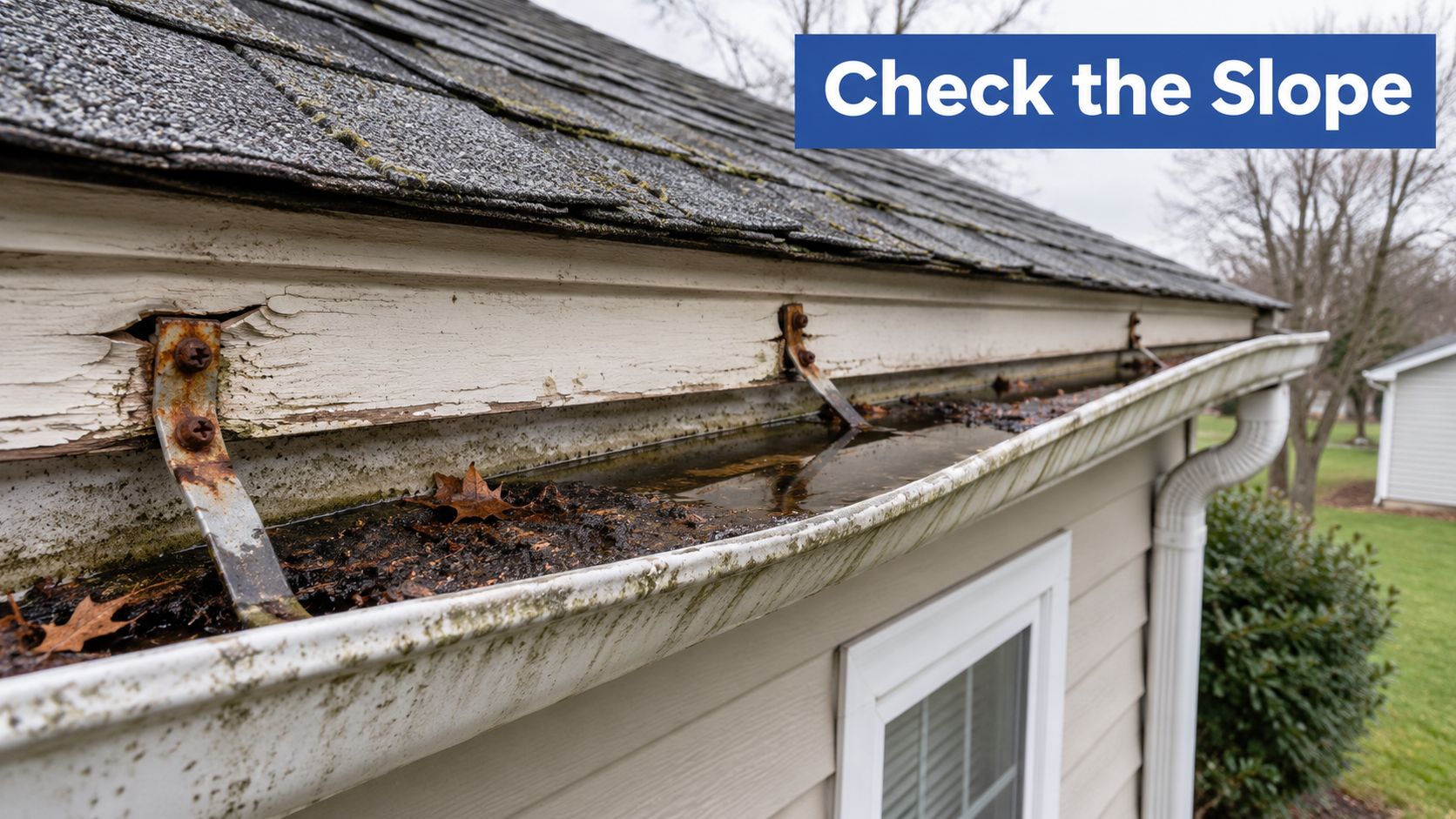
Standing water in the channel is the signature. Water that sits instead of shedding has told you the geometry is wrong, and geometry is a repair question.
The reference values below come from Building America guidance on gutters and downspouts, which sets a minimum slope of 1/16 inch per foot toward outlets, downspouts roughly every 20 to 50 feet, and discharge at least 5 feet from the foundation or into a properly designed underground catchment at least 10 feet away. Those are the numbers a repair should be measured against, not eyeballed.
The numbers a repair has to hit
| Component | Reference value | How to check |
|---|---|---|
| Gutter slope | Minimum 1/16 inch per foot toward the outlet | Level along the full run |
| Downspout spacing | Roughly every 20 to 50 feet | Measure runs against roof drainage area |
| Discharge distance | At least 5 feet from foundation, or 10 feet to underground catchment | Measure and check that grade slopes away |
| Fasteners and fascia | No movement under a firm pull, sound wood | Pull-test each hanger and probe fascia for soft wood |
| Seams and pinholes | No drips during a dry-run hose test | Run water through each section and mark leaks |
| Downspout flow | Clear discharge with no backup at the top | Flush each downspout and watch the outlet |
Hangers and fascia are one system. A hanger that moves under a firm pull is either under-driven or biting into wood that has gone soft, and soft wood gets replaced before anything is rehung. Probe the fascia with a screwdriver at each hanger location; if the tip sinks easily, the backing is done. Small holes in metal gutters take a compatible patch, with fiberglass tape bedded in epoxy adhesive as the standard pairing, applied to a clean, dry surface.
The order of work is not negotiable. Fix the structural backing, re-pitch the run and verify it with a level, then reseal, then retest with water. Resealing a gutter that still sags fails again within a season, and you'll pay twice.
Warning Signs That Need a Professional
A clean that doesn't hold is the clearest signal that the fault sits deeper than debris. When a system has been cleared and one joint has been sealed, and water still goes where it shouldn't, the next step is diagnosis rather than another tube of sealant.
- Overflow that continues after the outlet and downspouts are clear. The restriction has moved, which means capacity, slope or outlet size is the problem now.
- A gutter that has pulled away from fascia that yields under a probe. Soft backing means the fasteners have nothing to hold, and no rehang will last on rotten wood.
- Staining, dampness or eroded soil along the wall below a run. Water is reaching the building envelope, and that's a repair with a deadline attached.
- Water pooling against the foundation after the discharge has been extended. The grade is sending water back toward the house, which is a drainage fix, not a gutter fix.
- A run that won't hold a level after rehanging. Reversed pitch that returns immediately points to a structural or installation fault.
- Granule loss on shingles or stained trim at the roof edge. Overflow is backing up under the eave, and the roof covering is taking the damage.
These matter most in storms. A system that handles ordinary rainfall can still fail when rainfall gets intense, because capacity, outlet condition and material deterioration decide the outcome, not how clean the channel looked last month.
Stop patching when the same symptom returns within a few weeks of a clean and a reseal. Ask for a written assessment that covers slope, outlet size and downspout capacity together, in one document.
What a Professional Gutter Visit Protects
A paid visit should be worth more than a bucket of debris, so judge it by what gets checked. In order: the outlet and downspout cleared with controlled water rather than a rake, slope measured with a level across the full run rather than at one spot, pull tests on each hanger with a probe into the fascia behind it, discharge distance measured against the 5-foot and 10-foot standards, and grade inspected for water running back toward the foundation.
You should come away with a written assessment that sorts every finding into cleaning, repair or referral, with photos of each outlet and seam so the next visit has something to compare against. That record is what turns a recurring leak into a diagnosed fault.
The protection is concrete. An outlet cleared before storm season prevents the overflow that rots fascia and stains stucco, and one rehung hanger keeps a run from peeling away in a gust. Scope shifts with property type: a single-family home gets a channel-and-downspout service, a commercial building with scuppers and roof drains needs those interiors cleared as well, and a multi-unit property needs each drain traced because one blocked line floods several entries. When a finding belongs to someone else, the technician should name the trade, roofer, mason or drainage contractor, instead of patching around it.
Cost is easier to plan when you know what drives it, and this breakdown of what gutter cleaning costs explains how run length, roof access and downspout count change a quote.
Why Phoenix Roof Drainage Fails Differently
Picture a south-facing run on a Gilbert two-story. From April through June it collects a fine, compacted layer of dust, roof grit, seed pods from the palo verde over the driveway, and whatever the wind carries in. Nothing washes it out, because nothing falls. Then the first monsoon cell drops a month of rain in forty minutes onto a channel that is half full of material that behaves like wet concrete.
Most seasonal advice assumes leafy, high-rainfall regions where an annual leaf clean-out is the whole ritual. That advice doesn't fit here, because the failure isn't leaves rotting in a trough. It's fine sediment cementing itself around an outlet, plus a year of dust on the roof.
The city's own monsoon guidance tells property owners to clean roof drains and scuppers so water doesn't accumulate on roofs, and its green-stormwater guidance covers managing gutter outfalls so they don't erode the ground below and inspecting connected drainage components for clogs, leaks, cracks and damage.

That overflow is the moment the damage happens, and it's the moment a whole-path inspection is meant to prevent.
The drainage path a Phoenix inspection follows
Gutter condition comes first, then the downspout discharge point, then scuppers and roof drains, then the splash zone under each downspout. From there: erosion beds, stucco exposed to standing water, and whether grade pushes water toward or away from the slab. A clean channel on a property where the downspout dumps into a bed that slopes back to the wall hasn't solved anything.
- Inspect before the season starts, not after the first storm has already tested it.
- Flush each path with controlled water, through gutter, outlet and downspout, and watch the ground where it lands.
- Photograph vulnerable outlets so post-storm damage can be separated from pre-existing wear.
- Recheck after the first major storm, since that's when new blockages reveal themselves.
Open drainage alternatives have their own maintenance profile, and a comparison of alternatives to gutters is worth reading before assuming a channel is the only option. When water gets under the roof edge, into stucco or toward a foundation, the job has left gutter work behind and belongs to a roofer, mason or drainage contractor.
Gutter Guards and the Maintenance They Still Need
Guards are sold as the end of gutter maintenance, and they aren't. They reduce clogging, and they change where the debris sits, which is often on the roof covering above the guard rather than inside the channel.
Fire exposure is where the trade-off stops being cosmetic. Guidance on gutter guard options and where the debris goes notes that dry debris in an unprotected gutter can act as tinder under eaves, and that combustible options such as PVC, foam and brush guards aren't suitable for fire resistance under the International Wildland-Urban Interface Code. Noncombustible metals and tightly woven metal mesh are the better choices where wildfire is a real exposure.
| Guard type | Debris handling | Fire exposure | Upkeep still needed |
|---|---|---|---|
| Open screen | Stops leaves, lets fine grit pass | Fire resistance depends on material; check for tinder under eaves | Clear debris from screen and roof edge |
| Micro-mesh | Stops fine grit and shingle granules | Noncombustible metal mesh is preferred for wildfire zones | Brush roof edge and flow-test downspouts |
| Solid cover | Sheds most debris over the edge | Fire rating varies by product; confirm before purchase | Clear debris that collects on top and check seams |
| Combustible insert (PVC, foam or brush) | Traps fine debris inside | Not suitable for wildfire-prone roof edges | Remove and inspect often because debris can ignite |
The useful question isn't whether guards work. It's which guard suits this roof pitch, this vegetation, this fire exposure and this person's willingness to climb a ladder. A pine overhead behaves nothing like a palo verde, and a solid cover over a low-pitch roof sheds differently than a screen on a steep one.
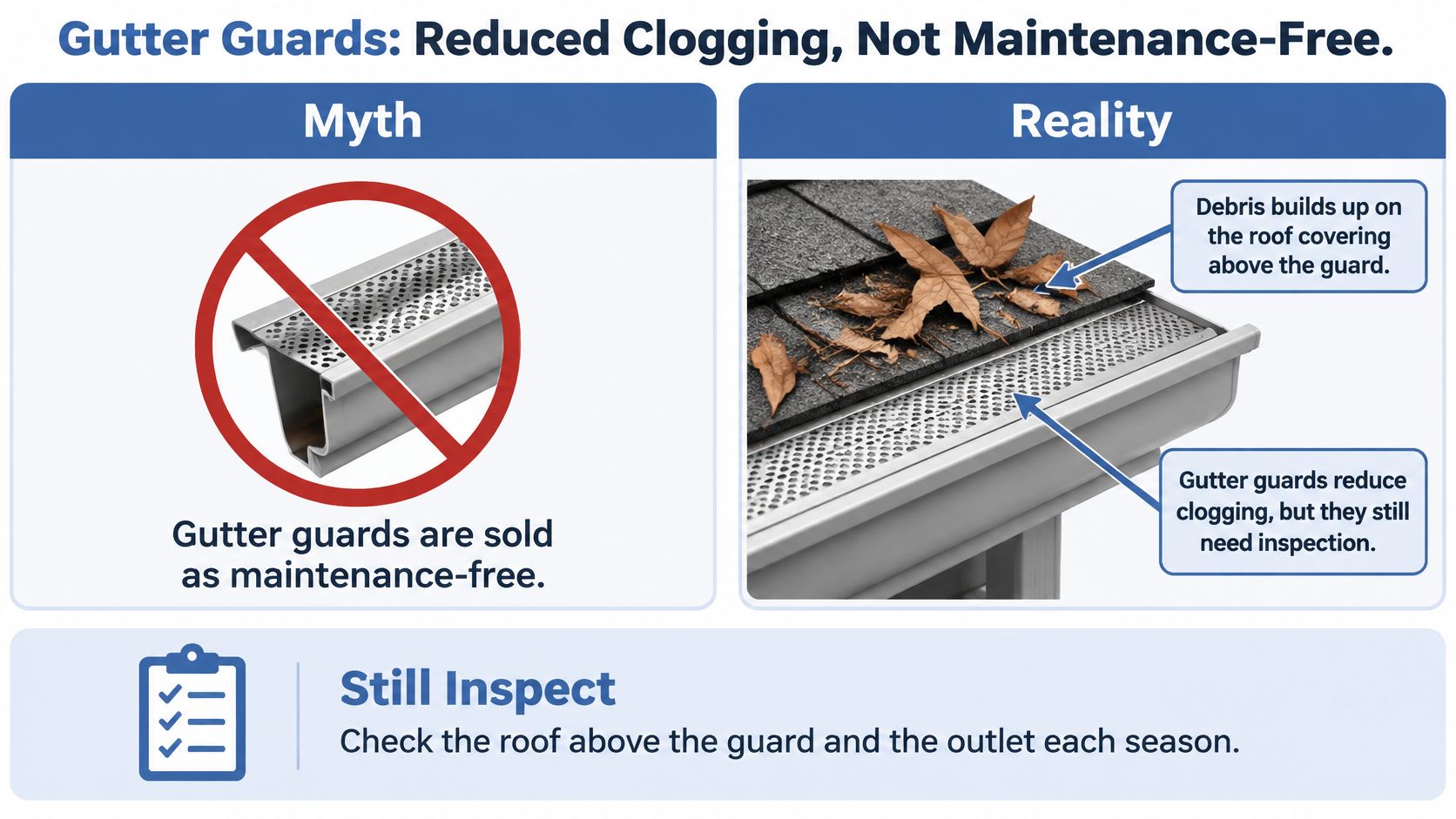
Whichever type goes on, the service plan afterward has to include roof-edge clearing, downspout flow testing, fastener and seal inspection, and a look for overflow during heavy rain. Run those checks on the same schedule as the rest of the drainage path rather than inventing a separate one, because the guard protects the channel and does nothing for the outlet below it.
Ask where the debris goes, not just whether the guard works. That answer decides how much of your maintenance budget you actually saved.
A maintenance calendar helps here, and this guide on how often to clean gutters is a reasonable starting point for setting one.
Confirm Your Gutter Plan Before the Next Storm
A gutter can look clean and still fail during a storm. The full drainage route matters: water must pass through the channel and downspout, then discharge away from the building without pooling against the foundation.
- Match the symptoms to the right service. Debris calls for gutter cleaning. If the gutter has incorrect slope, loose fasteners, leaking seams or poor discharge, contact a qualified gutter or drainage contractor for structural repairs. Cleaning cannot correct those problems.
- Schedule inspections before the monsoon and heavier rain season. Keep dated photos and record whether water flows through the outlet. Comparing records helps distinguish a new problem from one that was already present.
- Escalate persistent warning signs. Overflow after the outlet is clear, soft fascia, water at the wall or a run that will not hold level calls for professional assessment. More sealant will not fix an underlying slope or fastening problem.
South Mountain Window Cleaning, LLC offers gutter cleaning, house washing, rust removal, dumpster pad cleaning for commercial buildings, and flat-surface cleaning. Structural repairs, including slope corrections, fastener work and sealing, belong to a qualified gutter or drainage contractor. For a fast, free quote on cleaning needs, call (480) 519-9327.
If you are budgeting several exterior jobs, Estimatty's window cleaning pricing guide explains how window-cleaning quotes are built, making it easier to compare line items rather than totals alone.
Check the whole drainage path, from the gutter outlet to the foundation grade, before the next storm tests it. Cleaning supports that system, but it cannot make a defective route drain correctly.