
You're standing on the patio after a summer storm, watching rain spill over the front edge of the gutter in a sheet. The downspout a few feet away is barely trickling. Most of the water is landing beside the slab, exactly where you don't want it.
That scene explains why exterior gutter cleaning isn't a cosmetic wipe. You're clearing a drainage path so roof water leaves the building in a controlled stream, and you're proving it flows before the next storm tests it.
Exterior Gutter Cleaning Schedules and 2026 Costs
After that storm, the fix starts with a simple definition. A complete cleaning clears the open channel, end caps, elbows, downspout inlets, and outlets, then proves flow with a hose. Wiping the outside face or rinsing the fascia can improve appearance, but neither one tells you whether water can get out.
Start with the default case and work outward from there. A single-story home with light debris is the baseline for timing and price because access is straightforward and the trough fills slowly.
How to Read the Cost Table
For 2026 planning, use a hypothetical budgeting example to compare your home against that baseline. For example, at $0.75 to $1.75 per linear foot, a single-story home with about 150 feet of gutter would fall near $115 to $260, while a two-story example at $180 to $400 reflects added height, pitch, or packed debris. DIY supplies in a comparable example, gloves, a scoop, and hose time, might run $30 to $80, but that figure leaves out fall risk and your own time.
Those example numbers only help if you pick the right row first. Count your stories, look at tree cover, and note whether guards are installed before you compare prices.
| Property | Clean when | What changes the price |
|---|---|---|
| Single-story, light debris | Spring and late fall | Ladder reach and downspout count |
| Two-story or steep roof | Twice a year plus after major storms | Height, pitch, and setup time |
| Heavy trees or seed pods | Three to four times a year | Repeat fills and slow scooping |
| Guards already installed | Yearly inspection and outlet flush | Guard lift or surface debris |
| Low-rise commercial | Documented spring and fall | Access, exclusion zones, debris volume |
If you're in the first row, spring and late fall is your starting schedule. Ladder reach and the number of downspouts move the price because each outlet adds flushing and testing time.
Move to the second row when height or a steep roof enters the picture. You'll still clean twice a year, but you'll add a check after major storms, and you'll pay for safer setup rather than faster scooping.
Heavy trees push you to three to four visits because pods and leaves refill corners quickly. Guards change the job to a yearly inspection and outlet flush, while low-rise commercial work needs documented spring and fall visits so a manager can show the work happened.
Valley adjustment: Add one extra visit after a heavy monsoon rain or a dust-laden wind, even if your regular date is weeks away.
Costs follow the drainage path, not the shine on the metal. Once you know your row, the next question is where that water should go after it leaves the roof.
How Roof Water Should Leave the Building
A roof can shed rain correctly only if the water has a clear route from the edge to the ground. The gutter catches runoff, and the downspout turns it into one concentrated stream. That stream should move away from the wall, not pool beside it.
The diagram shows how water passes from the roof through the gutter and downspout toward its discharge point.
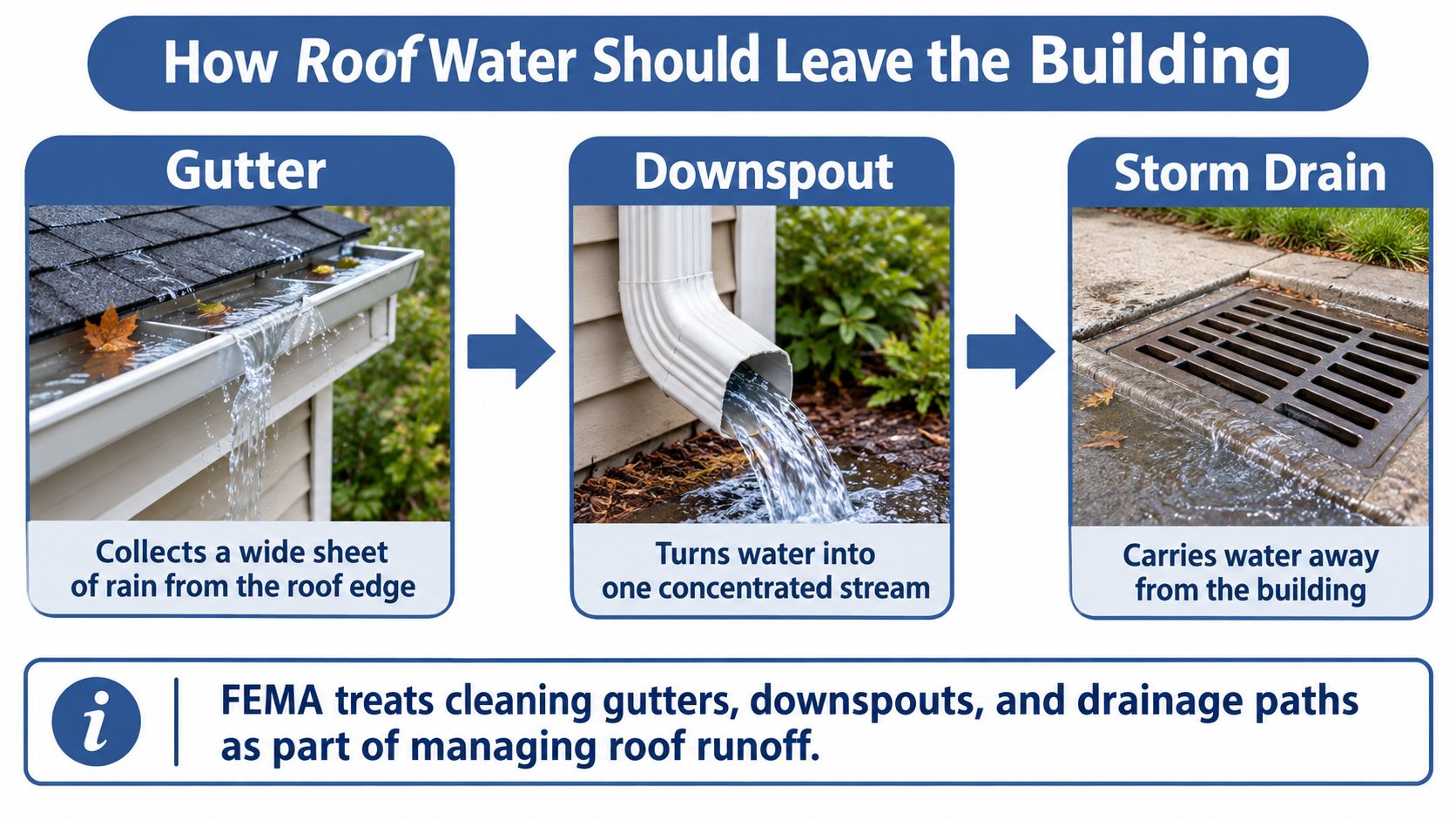
Follow a raindrop's route: it runs down a shingle or tile, falls from the drip edge into the trough, then travels along the gutter's slight slope to an outlet. The downspout carries it through elbows to a discharge point where the ground can direct it away from the building.
Where That Path Breaks Down
The FEMA fact sheet on sloped roof systems explains that gutters and downspouts are generally sized for regular rainfall, but extreme rain can overwhelm them, especially when vegetation or debris blocks the route. Routine inspections help catch debris and loose connections before they interrupt drainage.
Leaves, grit, and seed pods can narrow the trough. Water then backs up and spills at a low point, often beside the foundation rather than through the outlet. Soil that stays wet near a slab, crawl space, or finished lower level can give water a route indoors, while repeated runoff may erode nearby walkways.
A proper inspection follows the whole path. Check the channel, end caps, elbows, inlet, and outlet, then look at where water lands. If you are considering a building without gutters, compare the practical alternatives to gutters before removing an existing drainage route.
Check the Outlet and Discharge
Keep downspouts and elbows clear, and route water through a connected drainpipe where practical. If the drainage runs underground, its discharge should end well away from the foundation. A short splash block may still leave water close enough to soak back toward the building.
Once debris is clear, run water through the system and watch the outlet. An empty-looking trough can hide a blocked elbow, while a seam may leak only when water flows through it. The test confirms whether the entire route works, not just whether the gutter looks tidy.
Branches and gutter guards can reduce some debris, but fine roof grit can still reach the outlets. Guards change the inspection task: check their surfaces and openings, then confirm that water can still pass into the downspouts.
When roofers are handling storm-related calls after hours, 24/7 call answering for roofers can help keep urgent requests from going unanswered.
How Often Valley Gutters Need a Real Flush
A national calendar gives you a floor, not a finished Valley schedule. The City of Portland maintenance document recommends cleaning gutters two times per year and checking them more often when trees are present. Use that as your measurable baseline, then adapt it to desert debris and storms.
That guidance also links clogged gutters and downspouts to concrete and foundation erosion, basement or crawl-space leaks, siding and shingle rot, damaged eaves, and rust caused by standing water. Frequency matters because standing water and overflow keep working between visits.
A Desert Version of Twice a Year
Build your year around three triggers instead of two fixed dates alone.
- Spring visit: Clear winter debris, pollen, and grit before heat bakes sediment into corners and outlets.
- Monsoon visit: Clean just before the season or right after the first hard storm, when fine dust and palo verde or mesquite pods can pack a trough.
- Post-wind check: Inspect after strong wind reloads guards and inside corners, even when no tree overhangs your roof.
Tree work changes how fast that refill happens. If overhanging branches keep dropping pods into the trough, check the best time to trim trees so pruning supports your cleaning schedule instead of fighting it.
Measure the Discharge Every Time
On each visit, confirm every downspout is open and measure where water lands. Portland's guidance specifies discharge at least 2 feet away from crawl spaces, porch steps, garages, or walkways, and at least 6 feet away from basements, retaining walls, or oil tanks.
Don't assume the original layout still works. Desert grading, added patios, and shifted splash blocks often pull outlets back toward the slab. Measure again, run water, and watch whether the stream moves away or pools.
If a trough overflows during an ordinary rain, don't wait for the next calendar date. That overflow is your schedule telling you the interval is too long for the debris load above that roofline.
When a Ladder Is the Wrong Tool
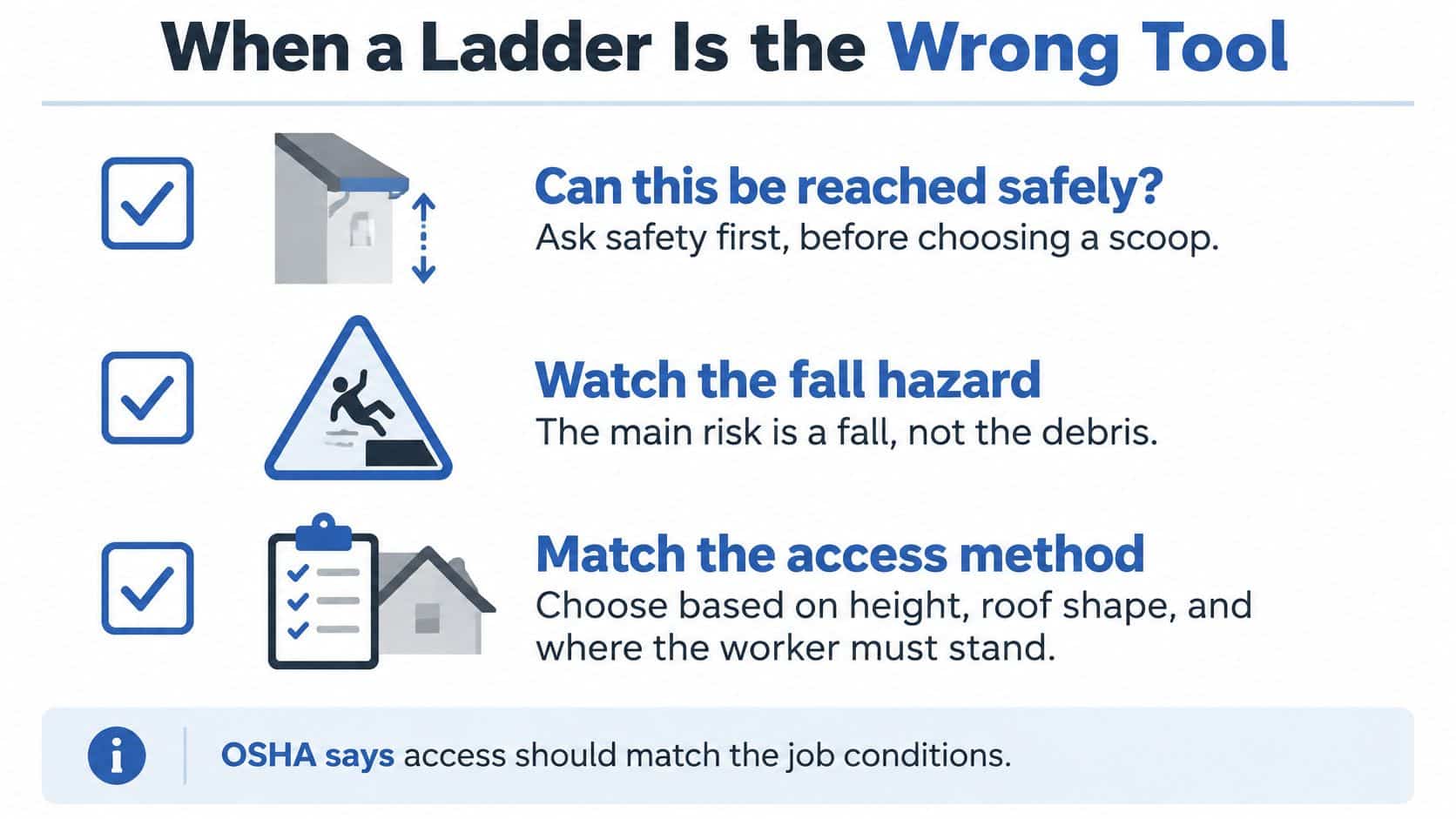
Careful ladder tips aren't enough. The first question isn't which scoop to buy, it's whether you can reach the work safely from a stable position. If the answer is no, the debris problem is smaller than the access problem.
The checklist below puts that safety decision before any tool choice.
What a Safe Ladder Setup Requires
The OSHA ladder safety guidance requires ladders to be inspected before use for structural damage, missing rungs, contaminated surfaces, and defective safety devices, with damaged ladders removed from service. For extension-ladder access to an upper level or roof, OSHA specifies that the ladder extend at least 3 feet above the landing.
Climb facing the ladder, keep three-point control, and stay centered between the rails. Set the feet on firm, level ground, keep people out of the drop zone below, and don't lean sideways to grab a far corner. Moving the ladder takes less time than recovering from a fall.
Ground-based tools can help with light debris on low rooflines, and it's worth understanding how to clean gutters without a ladder before you assume climbing is your only option. Looking from the ground with binoculars, though, isn't the same job as pulling a guard or clearing a blocked elbow.
Stop and Hire Conditions
Stop before you climb when any of these apply.
- Steep or fragile roofing: Tile, brittle shingles, or a patio cover can break underfoot or block a safe ladder set.
- Power lines nearby: Overhead lines crossing the work area turn a metal ladder and wet debris into a serious hazard.
- Soft or sloped ground: Ladder feet that sink or slide remove the stable base the whole setup depends on.
- Wet and windy weather: Monsoon residue leaves rungs slick and gusts push a worker who is already reaching.
If you have to overreach to finish a corner, the ladder is in the wrong place or it's the wrong access method for that building.
Commercial and taller buildings need more than a taller ladder. Managers should expect a written access plan, trained technicians, exclusion zones, and fall protection matched to the work classification, which can include guardrails, safety nets, or a personal fall-arrest system.
Our cleaning team members undergo extensive window cleaning safety training, and that same access-first thinking applies before anyone leaves the ground. After any safe cleaning, still run water through the system, because a clear-looking trough can conceal a blocked downspout.
What Gutter Guards Still Leave Behind
Guards don't retire the cleaning job. They change it.
The photo below shows the part homeowners miss from the driveway, debris sitting on top of a guard where it can block entry to the trough.

In the This Old House gutter guards survey, 58% of respondents cleaned gutters at least twice a year before installation. Afterward, 41% still cleaned annually, 43% still cleaned twice or more per year, and only about 17% reported never needing cleaning.
That split answers the wrong question quickly. Don't ask only whether guards work, ask what maintenance your specific guard system still requires. Fine dust sits on the cover, sediment slips through into the downspout, and elbows or buried outlets clog while the trough looks tidy.
Four Checks in Order
Work through these checks in sequence so you don't flush debris deeper into the system.
- Clear the guard surface: Brush off pods, grit, and matted dust so rain can enter instead of sheeting over the edge.
- Flush each downspout: Run water until it exits freely at the bottom, not as a slow trickle.
- Run a controlled flow test: Send water across a roof section or into the trough and watch seams and corners for overflow.
- Inspect the hardware: Check hangers, slope toward the outlet, and drip-edge alignment so water feeds into the gutter rather than behind it.
The short video below shows how a flow check reveals problems a ground-level glance won't catch.
In the Valley, repeat these checks after a dust storm and after the first hard monsoon rain. Photograph any blocked outlet so you, or a property manager, have a record of where the system failed. That documentation is part of the broader importance of gutter maintenance for commercial preventive care.
Remove a guard section only when flushing can't clear an elbow or water spills over a sag you can't correct from outside. Guards may reduce scooping, but they increase the importance of inspection and flow verification.
DIY Work Versus a Hired Crew
Price alone won't make this choice for you. The decision rests on reach, proof, and who carries the risk. If access fails the safety gate, the comparison ends there.
The comparison below separates a manageable weekend job from work that belongs with a trained crew.
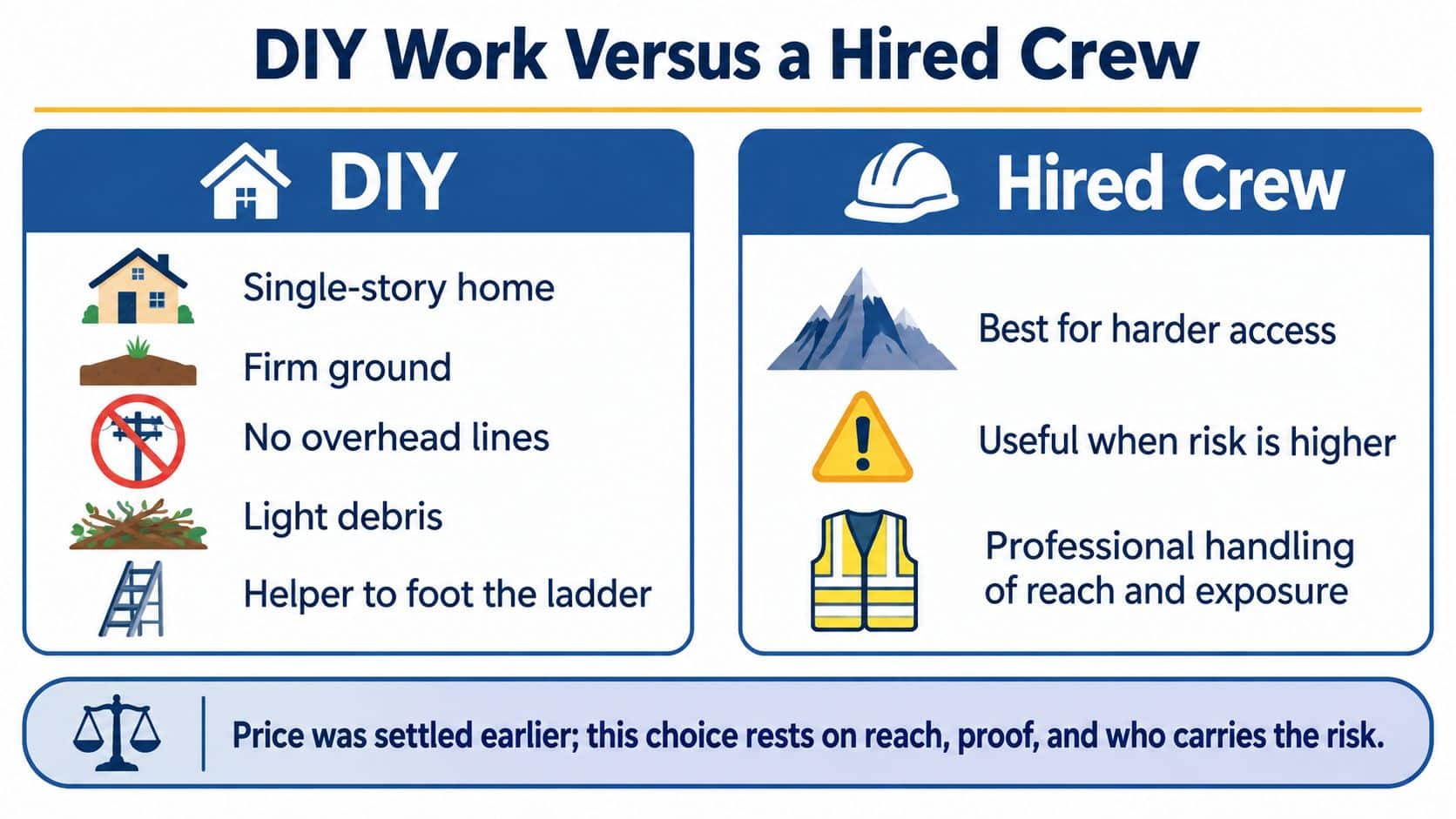
DIY fits a single-story home with firm ground, no overhead lines, light debris, and a helper to foot the ladder. Plan to bag debris as you go and flush every outlet yourself. If you can't test flow at each downspout, you haven't finished the job.
A hired crew is the better default for two stories, steep or fragile roofs, heavy pods, guards that must be lifted, and any commercial frontage with people below. Expect the crew to bring its own ladders or a lift, set a drop zone, haul debris off site, and finish with a hose test you can watch.
| Criterion | DIY | Hired crew |
|---|---|---|
| Best fit | Single story, firm ground, light debris | Two stories, steep or tile roofs, commercial frontage |
| Typical time | 1 to 3 hours for a small home | Half a day or less for many homes, longer with heavy debris |
| Flow proof | Hose each outlet yourself | Hose test at the end of the visit |
| Debris | Bag and haul it yourself | Crew removes it from the site |
| Fall exposure | You carry it | Trained access, exclusion zone, insured work |
| Guards | Easy only if a section lifts from the ground | Lift, flush, and reset with the visit |
| Paper trail | None unless you photograph outlets | Schedule, access plan, and a stated return if flow fails |
Questions That Reveal a Real Service
Ask who is insured and whether technicians are safety-trained. Ask how the crew will reach high corners and what happens if a buried outlet can't be cleared in one visit. Those answers tell you more than a low first quote.
Look for a guarantee that names a return visit if flow fails, not a vague promise of spotless metal. Tightening obviously loose hangers may be in scope, but confirm it before work starts.
A debris-packed two-story or small commercial run takes longer once setup and flow checks are included. That extra time is usually where the value sits, because it buys safe access and proof the system drains.
Schedule Exterior Gutter Cleaning in the Valley
A single-story home with firm ground and outlets you can flush safely may be suitable for a DIY cleaning. Two stories, a steep or tiled roof, guards that need lifting, or overflow after a storm can make a hired visit the safer choice.
For homes and businesses from Phoenix and Scottsdale through Paradise Valley, Chandler, Tempe, and Gilbert, South Mountain Window Cleaning offers gutter cleaning alongside house washing, rust removal, garbage bin cleaning, and flat surface cleaning. Sharing these details when requesting a quote can help clarify which exterior services you need.
What to Include When You Ask for a Quote
Describe the features that affect access and the work involved:
- Linear footage: Share an estimate if available, or describe which rooflines have gutters.
- Stories and roof type: Mention steep pitches, tile, patio covers, and tight side yards.
- Guards and outlets: Say whether guards are installed and whether any downspouts run underground.
South Mountain Window Cleaning offers a fast and free quote for cleaning needs. Ask the provider how each downspout will be reached and what they will do if a buried outlet does not clear. Underground blockages may need attention beyond cleaning the gutter channel, so clarify the next step before work begins.
Choose timing around local conditions: spring, monsoon season, and checks after strong winds are useful prompts to inspect drainage. A clear channel matters most when rain arrives, so avoid waiting for an overflow to schedule the work.
If your gutters overflowed in the last storm or your two-story roofline isn't a safe ladder job, South Mountain Window Cleaning, LLC can clear the channels and outlets, flush the downspouts, and handle related exterior work such as house washing and flat surface cleaning. Visit South Mountain Window Cleaning, LLC to request a fast, free quote for gutter cleaning in Phoenix, Scottsdale, Paradise Valley, Chandler, Tempe, or Gilbert.