
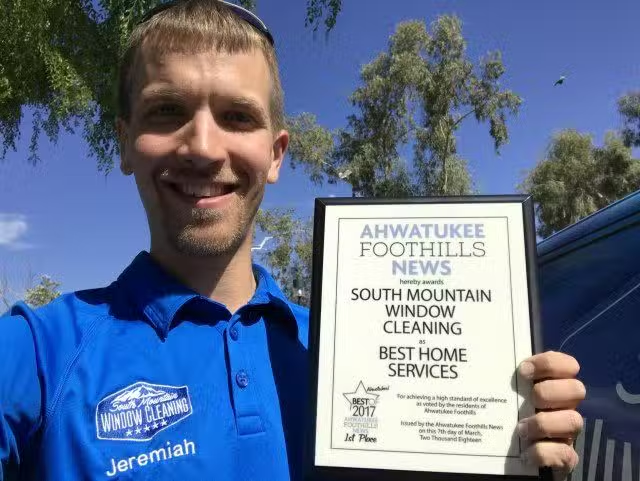
A Phoenix homeowner notices it in the afternoon sun. The glass looked clean when the crew packed up, but now the west-facing windows reveal streaks, mineral haze, and a few corners nobody reached. A commercial property manager may see the same problem in a lobby, storefront, or high-rise corridor, only with tenants and visitors noticing it first.
A customer satisfaction guarantee gives the customer a clear answer to the uncomfortable question, “What happens if the job isn't right?” In Arizona, that answer needs to account for dust, intense sunlight, hard-water deposits, screens, tracks, access limitations, and the difference between a two-story home and a high-rise building. A useful guarantee isn't a slogan. It's an operating promise with a defined result, response process, and remedy.
What a Customer Satisfaction Guarantee Really Means for Your Windows
A Phoenix-area property manager stands in a sunlit lobby and points toward floor-to-ceiling glass. From the entrance, the windows look acceptable. From the side, the light exposes a cloudy pattern of hard-water spots left by a previous crew. The manager isn't asking for perfection in the abstract. They want to know whether the cleaner will return, what the return visit includes, and how quickly the problem will be resolved.
A customer satisfaction guarantee answers those questions in advance. It is a specific, time-bound commitment by a service provider to re-clean, credit, or refund a job when the finished result doesn't meet an agreed service standard. For window cleaning, that standard should address the defects customers see:
- Glass quality: Streaks, residue, missed edges, and visible spotting at normal viewing distance.
- Detail work: Frame drips, dirty sills, neglected corners, and tracks that were included in the proposal.
- Handling: Screens returned to their proper position and free from damage caused by the service.
- Scope: Interior glass, exterior glass, high-access areas, solar panels, or exterior washing only, based on the signed work order.
That makes the guarantee different from a friendly promise to “take care of it.” It also isn't a manufacturer warranty, which generally concerns a product defect over time. Nor is it a generic refund policy designed for returned merchandise. A service guarantee deals with whether a completed job met its promised outcome.
Field rule: If a customer can't tell what qualifies, how to report it, or what remedy follows, the guarantee is incomplete.
Arizona conditions make precision more important. Hard-water mineral deposits may require treatment rather than ordinary glass cleaning. Dust can settle on wet frames and sills. Sunlight can reveal marks that were difficult to see in shade. A guarantee should explain which conditions the crew can correct and which pre-existing damage, etching, or construction residue requires a separate treatment.
For a home or business considering professional window cleaning in the Phoenix area, the practical test is simple. Could the written promise hold up on a ladder, in a parking lot, or during an HOA meeting? South Mountain Window Cleaning should be able to point to the same scope, response window, and remedy on the website, proposal, invoice, and technician checklist.
From Promise to Trust Signal
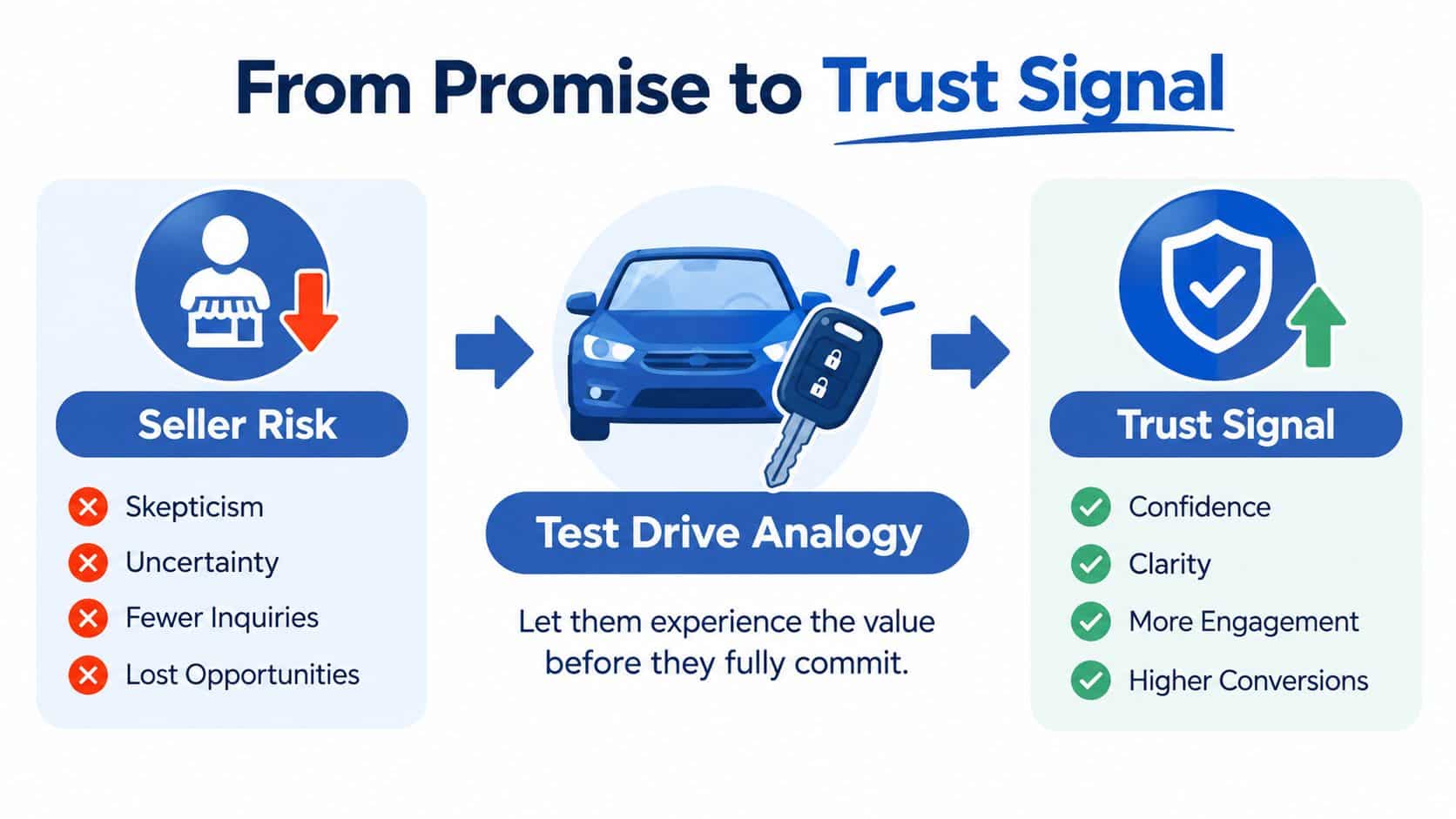
A satisfaction guarantee works much like a test drive. The buyer can't fully judge the vehicle before driving it, so the seller reduces the risk of trying it. A window-cleaning customer faces a similar uncertainty. They can review photos, a quote, and a service description, but they won't know whether the west-facing panes are streak-free until the crew finishes and the changing light exposes the result.
A credible guarantee communicates three things at once.
- The technical layer: The provider will re-wipe, re-clean, treat, credit, or refund the affected service when the agreed standard wasn't met.
- The procedural layer: The customer knows how to report the concern, what evidence helps, and when the request must be made.
- The reputational layer: The business has enough confidence in its work to put the promise in writing and accept responsibility for a reasonable correction.
The procedure matters as much as the promise. A customer who receives a generic “100% satisfied or your money back” statement still has practical questions. Does the company need photographs? Does the customer contact the office or the technician? Does a callback cover one pane, an entire elevation, screens, tracks, or a separate hard-water treatment? A usable policy removes that uncertainty before frustration grows.
A warranty usually addresses defects in materials or workmanship over a stated period. A return policy governs a product that a buyer sends back. Window cleaning is neither. The customer buys a performed service, and the result depends on glass condition, access, weather, water quality, and the agreed scope.
A clear guarantee can sit alongside other trust signals, including licensing, insurance, reviews, safety procedures, and transparent pricing. Businesses building their broader credibility may also find Growth 4 Trades trust tips useful for thinking about proof, communication, and consistency. For customers evaluating bonded versus insured contractors, the distinction is practical too. Protection and financial responsibility don't replace a quality remedy, while a quality remedy doesn't replace appropriate insurance.
Why Guarantees Change How Customers Choose a Cleaner
A customer satisfaction guarantee changes the perceived cost of making a bad choice. Without one, a homeowner or property manager may worry that an unsatisfactory job will lead to an argument, a second invoice, or no response at all. With clear terms, the customer can compare cleaners on the expected result and the recovery process, not just the initial quote.
Economics research on refund promises found that enforced guarantees made buyers significantly better off and increased overall efficiency, while unenforced guarantees reduced trust. The same research reported that only 17% of requested refunds were honored, an important warning that credibility depends on enforcement, not wording alone (economics research on guarantee credibility). A promise that disappears when a customer calls creates more distrust than no promise at all.
That dynamic is visible in Phoenix service buying. Two quotes may appear similar until one provider explains how it handles streaks, inaccessible panes, hard-water spotting, or a missed screen. A property manager also has to consider the cost of coordinating another visit, notifying tenants, and explaining a poor result to an owner. A defined callback process reduces that operational risk.
The retention trade-off
A guarantee can support repeat service because a customer who sees a problem handled promptly has evidence that the relationship is manageable. That customer may be more willing to schedule recurring window cleaning, add solar panel cleaning, or refer a neighbor. The re-clean itself has a cost, but the larger business question is whether the recovery protects future work.
One industry synthesis reports that unconditional guarantees can raise retention by 10% to 15%, while the frequently cited retention rule says a 5% increase in retention can lift profits by 25% to 95% (service-guarantee retention analysis). Those figures are benchmarks from broader service research, not a forecast for a particular Arizona cleaner. They show why owners should evaluate callbacks as both a cost and a source of retained business.
| Customer Metric | Without Guarantee | With Clear Guarantee |
|---|---|---|
| Perceived purchase risk | Customer carries most of the risk | Provider shares responsibility for the stated result |
| Response to visible streaks | Customer may complain publicly or switch | Customer has a defined route to request correction |
| Quote comparison | Price may dominate the decision | Scope, remedy, and response process become differentiators |
| Repeat maintenance decision | Depends heavily on the first impression | A well-handled callback can reinforce confidence |
| Internal learning | Defects may remain hidden | Claims create specific quality-control information |
The trade-off is real. A loose policy can attract bad-faith claims, encourage complaints about excluded pre-existing damage, or turn every preference into a free add-on. The answer isn't to remove the guarantee. Use photo documentation, a reasonable reporting window, signed scope confirmation, and separate language for mineral etching, contractor damage, and requested work outside the proposal.
Anatomy of a Strong Window Cleaning Guarantee
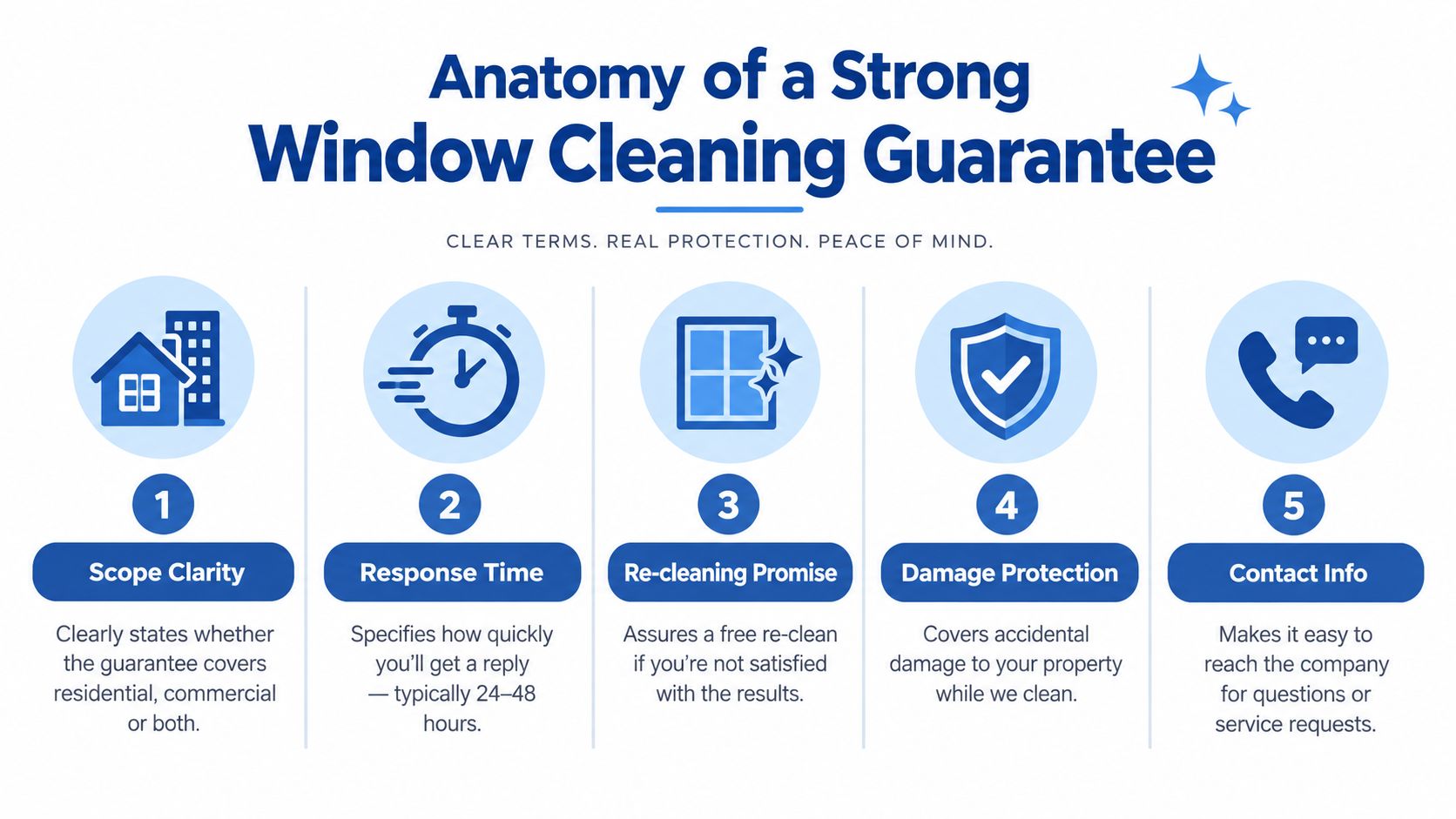
A strong policy starts with scope. A residential customer may purchase interior and exterior glass, screens, tracks, mirrors, or ceiling fans. A commercial account may require storefront maintenance, high-rise access, post-construction cleanup, solar panel washing, or power washing. The guarantee should attach to the services listed on the work order, not to every surface on the property.
Five clauses that prevent confusion
- Scope clarity: State exactly which surfaces and tasks are covered. If hard-water treatment is excluded unless purchased, say so.
- Reporting window: Give customers a defined period to identify a service issue. A short, practical window helps connect the complaint to the crew, weather, and site condition.
- Remedy: Explain whether the first response is a spot clean, re-wipe, full redo, hard-water treatment review, credit, or another agreed correction.
- Exclusions: Identify pre-existing scratches, mineral etching, failed seals, paint, construction debris, brittle screens, and damage caused by another contractor.
- Documentation: Keep the proposal, before-and-after photos, technician notes, customer sign-off, and callback result in one record.
A technician should photograph pre-existing conditions before touching the glass. That record protects the customer and the company when sunlight later reveals etched mineral damage that ordinary cleaning cannot remove. Clear contract language also helps service businesses keep promises consistent across proposals and invoices. A useful example of how a field-service agreement can organize scope and obligations appears in these contract terms for pool care.
Copy-ready wording
Residential version
We stand behind the window, screen, and track services listed on your work order. If you identify visible streaks, missed areas, or a service detail included in the agreed scope that wasn't completed, contact us within the stated reporting period. We'll review the concern, document the condition, and return to correct the covered issue at no additional charge. Pre-existing damage, mineral etching, failed glass seals, contractor damage, and work outside the agreed scope aren't covered unless separately approved.
Commercial version
For the services and areas identified in this proposal, we will address documented workmanship concerns reported within the stated service window. Our response may include spot cleaning, re-wiping, re-cleaning the affected area, or another remedy appropriate to the agreed scope. The customer and provider will use the work order, site photos, and service notes to distinguish a correctable service deficiency from pre-existing condition, access limitation, material defect, or excluded treatment.
The website, proposal, invoice, and professional window cleaning service description should use compatible definitions. The service contract should reference the covered areas, reporting method, response window, exclusions, access responsibilities, payment treatment, damage-reporting process, and any separate pricing for restoration work. Avoid language that promises an unlimited warranty for every condition on a property.
Running the Guarantee on Every Job
Paper doesn't create trust on its own. The crew has to make the promise visible in the way the job is prepared, performed, inspected, and documented.
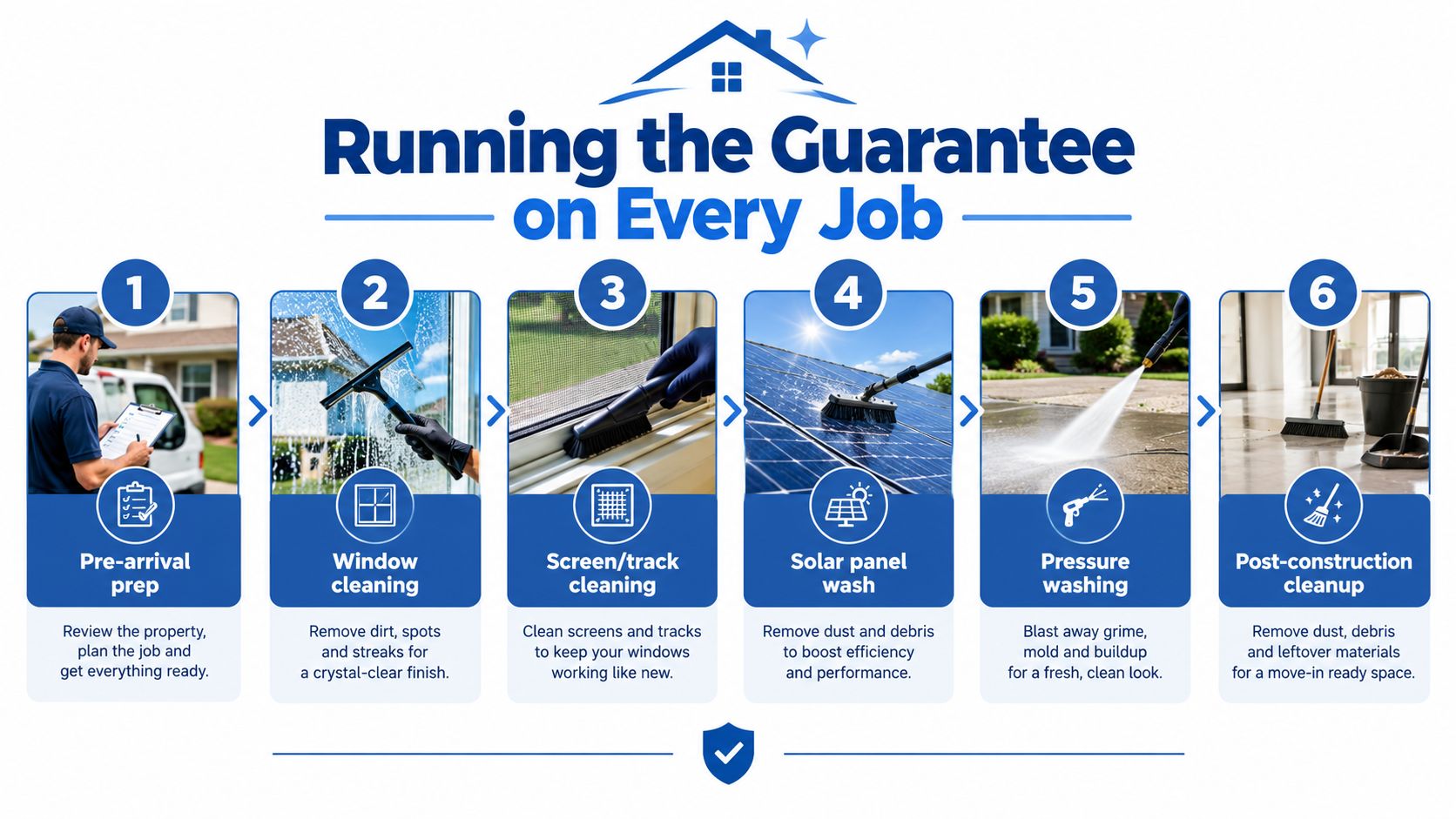
Before arrival, the office confirms the service scope, access requirements, parking arrangements, water availability, and contact person. The technician records existing scratches, etched spots, damaged screens, oxidation, paint, and difficult access with timestamped photographs. For a high-rise or multi-story property, the work plan should identify anchor, ladder, lift, or water-fed-pole requirements before the crew starts.
The field standard
On ordinary glass, technicians may use a professional mop and squeegee technique, followed by a visual inspection from several angles. Pure-water or deionized-water systems are useful for exterior panes where a spot-free rinse matters, particularly in dusty and hard-water-prone conditions. They don't erase etched mineral deposits, so the technician must distinguish removable residue from damage in the glass.
Screens and tracks need their own check. A screen that was removed, brushed, or washed must be returned securely. Tracks should be wiped when included, and the technician should identify trapped construction debris or deteriorated materials that require additional work. Solar panel cleaning, pressure washing, and post-construction cleanup need their own scope notes because the risk of residue, overspray, and surface damage differs from standard glass cleaning.
The complaint script
When a customer points out a problem, the technician shouldn't debate the observation from the ground. A calm response keeps the conversation factual:
- Acknowledge: “Thanks for showing me the area. I'll inspect it with you.”
- Document: Photograph the pane, viewing angle, frame, screen, and surrounding condition.
- Classify: Decide whether the issue is a correctable service miss, a pre-existing condition, or work outside the agreed scope.
- Resolve: Re-clean immediately when the correction is safe, in scope, and practical. Ask the office to authorize a return when access, treatment, equipment, or scheduling requires more planning.
- Close the record: Note the complaint, action taken, customer response, and any follow-up appointment in the job system.
A same-day correction shouldn't vanish as an informal favor. Logging it tells the owner whether one technician needs coaching, one route has unusual mineral buildup, or a proposal repeatedly understates the work. The window cleaning company service overview should match the operational reality customers experience at the property.
Measuring Results and Closing the Loop
A guarantee becomes a quality-control system when every claim produces usable information. The owner needs to know whether callbacks come from rushed detail work, unclear scope, difficult glass, poor access planning, or customer expectations that the proposal never defined.
Track each claim against the original job, service type, crew, property, weather conditions, and complaint category. Useful categories include streaks, hard-water spots, missed tracks, screen issues, frame drips, and damage concerns. Keep the categories stable so the monthly review shows patterns instead of a collection of inconsistent notes.
The operating dashboard
| Metric | What It Measures | Target Range |
|---|---|---|
| Claim rate per 100 jobs | How often customers report a covered concern | Establish a baseline, then reduce recurring causes |
| First-pass resolution percentage | How many issues are fixed during the initial response | Improve through inspection and technician coaching |
| Average days to close a callback | Speed from complaint to documented resolution | Keep as short as access and safety allow |
| Revenue lost to free re-cleans | Direct labor and scheduling cost of callbacks | Review by service type and cause |
| Repeat-customer rate after a claim | Whether recovery preserves the relationship | Compare with customers who had no claim |
| Top three complaint categories | Which defects deserve process changes | Focus training on the largest recurring sources |
Don't set targets without a baseline. A new operation may need several review cycles before it can tell the difference between a normal exception and a systemic failure. A mature route can set internal goals for fewer callbacks, faster closure, and stronger repeat booking without presenting those goals as industry facts.
Review the dashboard monthly. If missed tracks dominate residential callbacks, change the checklist and quote language. If hard-water complaints cluster around certain properties, offer treatment as a separate line item and photograph the condition before work. If high-rise issues involve access rather than cleaning technique, revise the site walk and equipment plan.
Academic service-marketing research describes guarantees as formal performance promises that can encourage dissatisfied customers to complain, giving the provider defect information that would otherwise become silent churn. The same discussion describes improved customer satisfaction at Radisson after its service guarantee was adopted, with continued improvement over time as feedback informed process correction (service guarantee and quality improvement research). The lesson for exterior cleaning is direct. A callback isn't useful until someone records its cause and changes the work.
When 100 Percent Is Too Vague
“100% satisfaction guaranteed” sounds reassuring until a property manager asks three practical questions. What result is measured? How soon must the issue be reported? What exactly will the company do if the customer disagrees with the result?
A blanket phrase doesn't answer those questions. It can also create conflicting expectations on recurring or site-based work, where lighting, access, weather, glass condition, and service scope vary from property to property. A homeowner may use “satisfaction” to mean removing old mineral etching, while the cleaner understands the job as routine dust and residue removal. Neither side benefits from discovering that difference after payment.
Use observable service levels
A better promise describes conditions a customer and technician can inspect. Examples include streak-free interior glass under normal viewing conditions, screens returned and seated correctly, tracks wiped when included, exterior surfaces free of detergent film, or a documented response to a reported deficiency. A high-rise agreement may define which elevations are accessible and what happens when wind, tenant access, or building rules prevent completion.
Recent service-guarantee trends in telecom have moved toward concrete commitments such as same-day technician visits, outage credits, no annual contracts, and transparent pricing rather than broad satisfaction language (specific service guarantees in customer experience). The same principle applies to window cleaning. Specific terms are easier to sell, perform, audit, and defend.
| Promise Type | Example Language | Customer Can Verify? | Crew Can Meet It? |
|---|---|---|---|
| Vague guarantee | “You'll be completely satisfied” | Not without a shared definition | Not without a measurable scope |
| Glass standard | “Included glass will be inspected for visible streaks and residue” | Yes, using agreed viewing conditions | Yes, with a final inspection |
| Screen standard | “Included screens will be returned securely to their original positions” | Yes, by checking fit and placement | Yes, when screens are serviceable |
| Response standard | “Reported covered concerns receive a documented response within the stated window” | Yes, through call and job records | Yes, if scheduling and access are defined |
| Restoration promise | “Mineral etching will be treated only when separately approved” | Yes, through the proposal | Yes, because the work has a defined scope |
A narrower guarantee often creates more confidence than an unlimited one. The crew knows what it must deliver, the buyer knows what protection exists, and the contract leaves less room for a dispute about personal preference.
Putting Your Guarantee to Work This Week
A window-cleaning owner can tighten the policy in one working session:
- Publish the same wording: Place the guarantee on the website, signed work order, invoice, and door-hanger.
- Equip every van: Post the complaint script where technicians can see it: acknowledge, photograph, schedule, and log.
- Set the response process: Offer a return within the stated service window, with a practical internal goal of 24 to 48 hours when access and safety permit.
- Review the dashboard: Examine claim frequency by service type, neighborhood, and crew each month.
- Set an internal benchmark: An owner may choose a callback goal of under 5% of jobs as a management target, then revise it after collecting a reliable baseline.
- Train the office: Mention the guarantee before discussing price, and explain exclusions without sounding defensive.
- Check the risk language: Review insurance certificates, liability terms, access limits, and exclusions so the promise isn't mistaken for an unbounded warranty.
- Start the feedback loop: Publish the refreshed language, train the team, and schedule a 30-day review of claim causes and closure times.
The policy should make it easier for a good customer to get a correction and harder for an unclear expectation to become a dispute. That balance protects the relationship while giving the crew a standard it can meet.
South Mountain Window Cleaning, LLC offers residential, commercial, and high-rise window washing, along with screen and track care, solar panel cleaning, power washing, and related exterior services across Phoenix, Scottsdale, Paradise Valley, Chandler, Tempe, and Gilbert. Visit South Mountain Window Cleaning, LLC to request a quote and discuss a cleaning scope backed by a clear satisfaction process.