
Most single-story homes pay about $150 to $300 for a gutter cleaning in 2026, and most two-story homes run $250 to $480, built on $0.60 to $1.20 per foot of gutter with a $100 to $150 service minimum sitting underneath it. The footage table below sorts common property types into those bands, so you can place your own house before anyone quotes it.
So why does the neighbor with the same roofline get a number 40% lower than yours? Because footage is a measurement, not a price. A calculator that stops at linear feet hands you a confident figure built on a guess you made about your own gutters, and then the quote arrives with height, debris load, access and add-ons attached to it.
What follows is how the number gets built: the measurement first, the per-foot math second, and the named line items that separate a firm quote from a rough one. Some of it is uncomfortable news about where a cheap number comes from.
Working Out Your Gutter Footage Without Roof Plans
Most homeowners don't have roof plans, and the gutter cleaning cost calculator they find online usually asks for footage, then assumes one. The gutter cleaning cost calculator at Roofing Calculator HQ notes that existing tools commonly assume roughly 125–200 feet of gutter on a typical home and apply per-foot rates, while rarely addressing irregular roof designs, detached garages, patios, additions, or multiple gutter heights. That's where the estimate starts drifting, and it's fixable in about fifteen minutes.
Five steps to a footage range you can trust
- Walk every straight roofline run at ground level. Measure the wall line beneath each run with a tape or a phone measuring app, and write down the height of that run as you go. Ground-level pacing lands within a few feet on most rectangular homes, which is accurate enough for pricing.
- Add the eave overhang. On most stucco and frame homes the gutter hangs 12 to 24 inches past the wall line, so the run is longer than the wall you measured. Skip this and a 200-foot house prices as a 185-foot one.
- Keep run heights separate. A second-story run above a one-story roof is ladder work, and it prices higher at identical footage. Enter it as its own line rather than folding it into the total.
- Include every structure with a roofline. Detached garage, covered patio, casita, pool ramada, shop. These are the runs owners forget and crews find on arrival.
- Total the runs and grade your confidence. If you walked the whole perimeter, say so. If you eyeballed the back of the house from a window, mark it low confidence and expect the quote to move toward the top of your range.
Typical footage by property type
| Property type | Typical footage | Extra runs people forget |
|---|---|---|
| Small single-story, 1,000–1,300 sq ft | 110–150 ft | Detached garage adds 40–60 ft |
| Standard single-story, 1,400–1,800 sq ft | 125–200 ft | Covered patio adds 30–50 ft |
| Larger single-story, 1,900–2,400 sq ft | 200–260 ft | Casita or pool ramada adds 30–80 ft |
| Custom or multi-building property | 320–500 ft | Shop, guest house and stables quoted separately |
The right-hand column is the one that costs people money. Every property type hides a run that isn't on the main roofline, and that missing 40 to 60 feet is often the difference between the row you picked and the price you got.
Why a neat single number is a false precision
A 180-foot hip roof with a dozen short runs and four valleys can take an hour longer than a 180-foot gable with two long runs, even though the footage matches exactly. Roof shape and pitch change access time even when total feet don't change at all, which is why a per-foot model can be less fair than a measured, time-and-access model on complicated properties.
Enter your footage as a range, something like 175 to 190 feet, and expect a good estimator to price the upper half of it. On multi-building sites, ask for per-building lines rather than one residential average spread across the whole property.
Gutter Cleaning Cost Calculator Estimate
The arithmetic behind the number is short enough to do in your head once you have a footage range. Here's the whole engine.
- Footage first. Use the range from your walk, not one round figure. A range is honest; a single number pretends to a precision you don't have.
- Multiply by $0.60 to $1.20 per foot. That spread covers ordinary light debris at the bottom and heavier loads or a longer walk-around at the top.
- Apply the minimum. If the result falls below $100 to $150, the visit bills at the minimum. The drive, the ladder setup and the debris hauling cost about the same on a small house as a large one.
- Multiply by 1.3 to 1.6 for a two-story roofline. Every run has to be worked twice, once up and once down, and the ladder gets moved more often.
- Add the separately priced items. Heavy debris, blocked downspouts, access obstacles and guard removal each carry their own number.
Run it on a 175-foot single-story home and you get $105 to $210 before add-ons. A single-story home with 150 to 200 feet of gutter typically lands at $100 to $240, and the same footage on two stories lands at $130 to $385.
Price by footage and stories
| Gutter length | One-story home | Two-story home | Typical time on site |
|---|---|---|---|
| 100 ft | $100–$150 | $130–$240 | 1–1.5 hours |
| 125 ft | $100–$150 | $130–$240 | 1–1.5 hours |
| 150 ft | $100–$180 | $130–$290 | 1.5–2 hours |
| 200 ft | $120–$240 | $160–$385 | 2–2.5 hours |
| 250 ft | $150–$300 | $195–$480 | 2.5–3.5 hours |
| 400+ ft or multiple buildings | $240–$480+ | $320–$770+ | 4+ hours |
Find your footage on the left, choose the column that matches your roofline, and read across. Time figures are planning estimates. Expect quotes toward the upper end when debris is heavy, access is tight, or the home hasn't been cleaned in several years.
What the standard price covers
A standard visit covers the roof-side scoop, a trough flush, a downspout check and debris bagged and hauled away. It usually excludes unclogging blocked downspouts, guard removal and repairs. In Phoenix, wind-blown dust and shingle grit push most jobs into the middle of the band rather than the bottom.
Practical rule: when your home falls between two rows, budget the higher row. On-site quotes rarely land at the bottom of a published range.
What Changes the Quote From House to House
Gutter cleaning doesn't sit outside the household budget, it sits inside a growing one. Harvard's Joint Center for Housing Studies reported that U.S. spending on maintenance for owner-occupied homes reached $105 billion in 2023, a 61% increase from 2019 in nominal terms, with average maintenance spending at approximately $1,200 per owner that year. Those national totals aren't a gutter rate and shouldn't be read as one. They show why per-house pricing matters: upkeep is a real, growing line in the budget, and a single national average tells you nothing about your roofline.
Every real quote is built from five inputs: footage, height, debris load, access and add-ons. Footage sets the base. The other four move it, sometimes dramatically.
| Cost factor | Typical price effect | Why it changes the quote |
|---|---|---|
| Gutter length | $0.60–$1.20 per foot, subject to the $100–$150 minimum | Base labor and the volume of debris handled |
| Stories above ground | +30–60% over a one-story price | Ladder setup time and slower movement along the run |
| Heavy or packed debris | +20–50%, or $50–$150 | Scooping by hand instead of blowing out the trough |
| Blocked downspout | Its own line on the invoice, priced per downspout | Separate flush, sometimes partial disassembly |
| Roof pitch and shape | +10–25% | Hip roofs, valleys and many short runs slow access |
| Access obstacles | +$50–$200 | Repositioning around pools, gravel, landscaping and power lines |
| Gutter guards | Per-section charge to remove and reset | Extra labor before and after the cleaning |
| Rust, sagging or leaks | Quoted as repair, not cleaning | Re-pitching or refastening added to the visit |
Two 180-foot homes, $190 apart
Take a clear single-story ranch with 180 feet of gutter and open access on all four sides. At $1.08 per foot that's $195, comfortably inside the published band.
Now take the house two streets over, same 180 feet, but two stories with a pool cage against the back wall, sloped gravel beds under the ladder line and heavy packed pine debris in the troughs. Start at $195. Two stories add roughly 45%, which puts it near $283. Packed pine debris adds about 20% for hand scooping, so $340. The pool cage and gravel beds need repositioning on both levels, another $45. The quote lands at $385.
The gap between those two homes isn't one factor. It's a stack, and every layer in it is a named line on the invoice.
A quote that totals $195 on the second house isn't cheaper. It's a shorter list, and the missing lines show up later as a revised price on the driveway.
When you compare two quotes, compare the line items before the total. Ask whether height, access and debris are listed separately, because a company that names them will usually hold the number it gave you.
Why Access and Safety Push the Price Up
Ladder work is the risk center of this job, not padding bolted onto the invoice. A CDC-indexed study of ladder reaching during a simulated gutter-clearing task observed 104 older adults and found overreaching in 40% of participants, accounting for 13% of all extended reaches beyond the ladder. Remaining debris, ladder position, elapsed task time and a person's own reaching tendency all shaped the behavior, and together the measured factors explained only about 20% of the variability in reaching. The study calls ladder falls a significant public-health concern and notes that falls from height produce severe injuries.
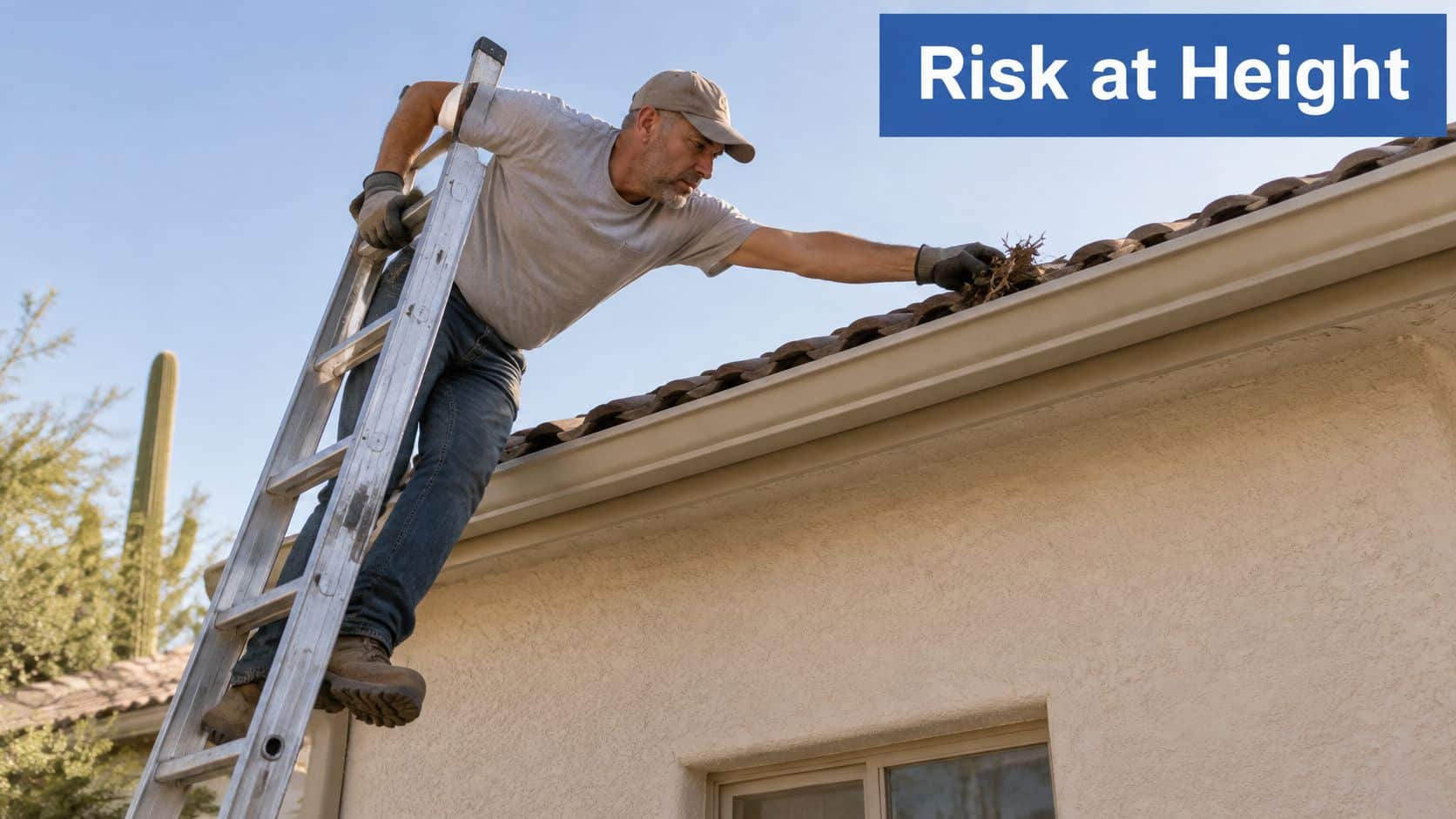
That 20% figure is the part worth sitting with. Even in a controlled task, most of what drives a person to lean too far goes unmeasured, which means the crew's margin for error comes from method, not from care.
Where the risk turns into a line item
- Two-story runs mean more ladder moves and slower travel along each section.
- Roofs steeper than 6/12 push the work from a ladder onto the roof plane, which requires harness work.
- Ground sloping away from the wall forces footing adjustments on nearly every set.
- Gravel xeriscape or pool decking under the ladder line means wide, flat footing pads and careful repositioning.
- Power lines or palm fronds near the roofline add clearance planning before any work starts.
- Solar panels on the roof plane rule out walking through certain sections entirely.
A careless crew works around those conditions with bravado. A trained one stabilizes the ladder footing, refuses to reach past the ladder hips, puts a harness on for roof-level access, keeps a spotter on tall runs, and sends technicians who've been trained in ladder safety. Our team members undergo extensive window cleaning safety training, which is the reason a height surcharge gets paid out in minutes on site rather than in risk.
On commercial and high-rise properties, the access question stops being about ladders. OSHA's powered-platform fact sheet requires fall-arrest systems on working platforms and stabilization anchors no more than three floors or 50 feet apart, whichever is less. For rope descent, the anchorage rules require each anchor point to hold at least 5,000 pounds in any direction per attached employee, identified and certified by the building owner before use. If you're cleaning gutters from a ladder, spend ten minutes on how to clean gutters safely before you climb anything.
Debris, Monsoon Season and Desert Conditions
A Valley gutter doesn't fill with wet leaves the way a Midwest gutter does. It fills with dust, and the dust waits for rain.
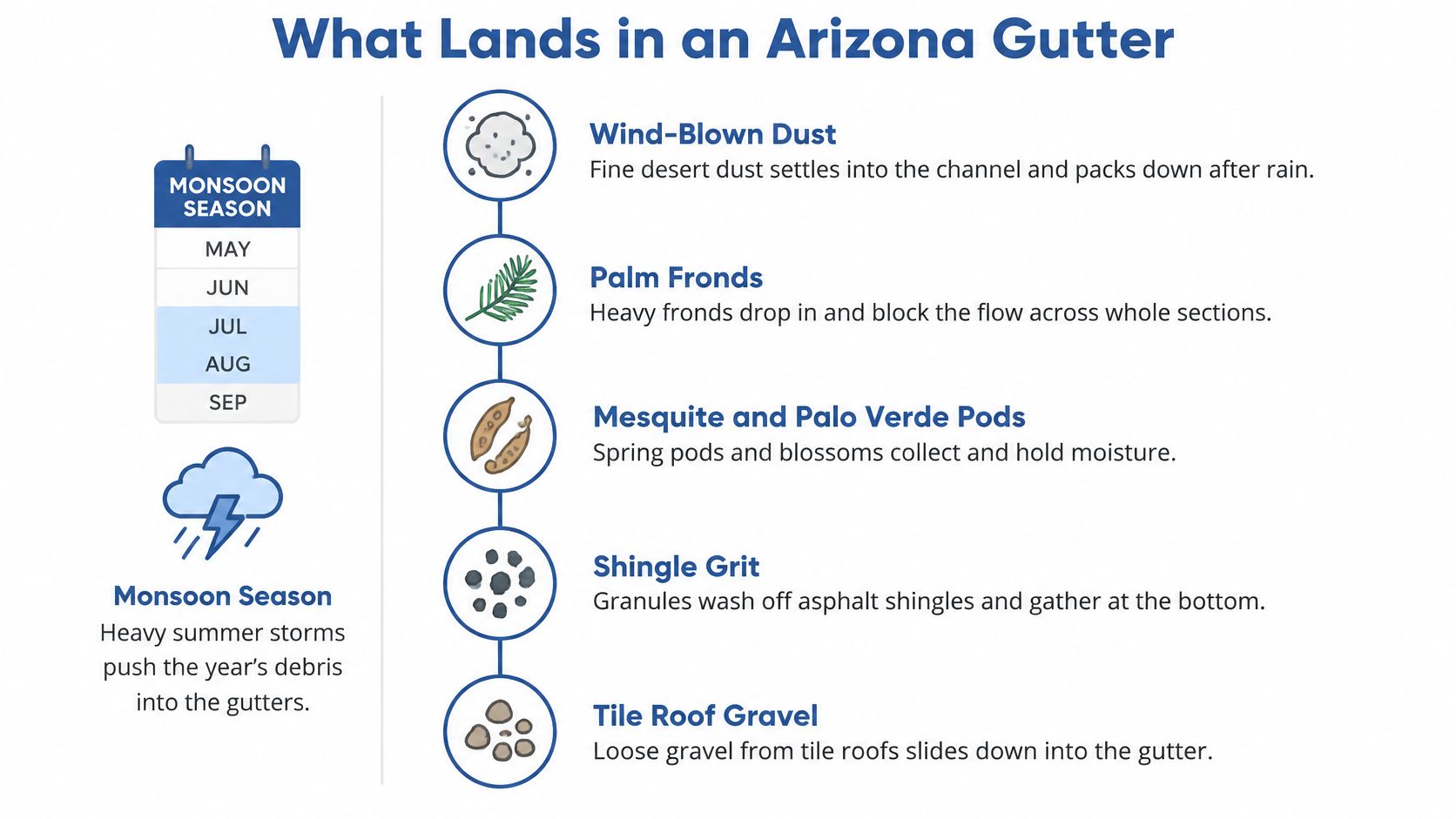
The pattern is documented. NOAA's technical memorandum on Phoenix dust storms reports that Phoenix averaged approximately 2.8 dust storms per year from 1948 through 2015, concentrated mainly between June and September, and the most recent 30-year period studied still averaged about 1.6 summer dust storms annually. A National Weather Service climate summary for Phoenix puts the area at sunshine averaging 86% of possible sunlight across the year, ranging from about 78% in January and December to 94% in June.
A Valley year in the gutter
Spring brings pollen, palo verde blossoms and mesquite seed pods. Dust settles into the channel through the dry months and packs down against the hangers. Then the first monsoon downpour hits a trough that's half full, water backs up under the shingles and down the stucco, and the overflow pools at the foundation.
That sequence is what the schedule should be built around: two cleanings a year across the Valley, one in late spring before the monsoon and one in late fall after it. Homes with little tree cover and no nearby palms can often run once a year. Waiting for plants to grow into the gutter is how a $200 maintenance visit turns into fascia repair.
What deferred cleaning costs: fascia rot where water sits against the board, soffit staining that no amount of washing removes, moisture at the foundation, mosquito breeding in standing water, and gutter sections pulled loose by the weight of soaked debris. If you're timing the visits, the best time for gutter cleaning lays out the seasonal window.
Timing note: the second cleaning of the year is usually cheaper than the first, because the debris load is lighter and the trough hasn't packed.
Downspouts and Gutter Guards in the Yearly Cost
The clean itself is only part of the invoice. Downspout clearing and guard work sit outside the base price, and a gutter cleaning cost calculator guide from Koira puts downspout clearing around $50–$150 and guard-related work around $30–$80, which explains why a guard-equipped property can still produce a substantial bill.
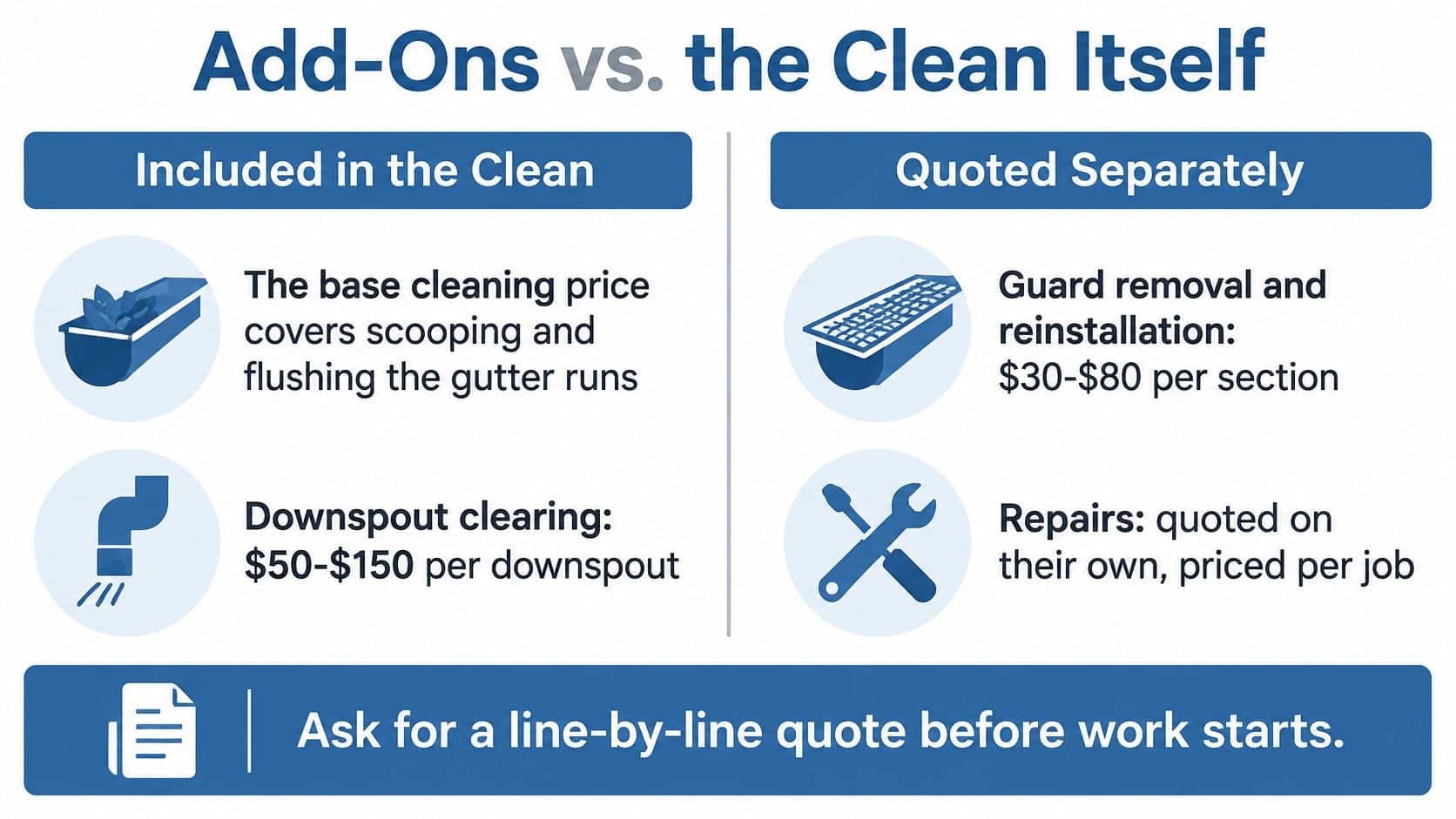
So run the annual comparison on a 200-foot single-story home. Without guards, two cleanings at about $260 each total $520, with scooping and a downspout check on both visits. With guards, one guard-service cleaning at $320 covers lifting, washing and resetting the panels. Add the chance of a $100 downspout flush and the year lands at $320 to $420.
| Scenario | Visits per year | Main labor type | Annual spend |
|---|---|---|---|
| No guards, cleaned twice a year | 2 | Scooping, trough flush and bagging | $520 ($260 per visit) |
| Guards, one guard-service cleaning | 1 | Lifting, washing and resetting panels | $320 |
| Guards plus a downspout flush | 1 | Panel service plus a $100 flush | $420 |
When guards pay back and when they don't
Guards cut scooping, then shift that labor into lifting, rinsing and refitting panels. In a desert yard they also trap fine grit and seed pods that still have to be flushed out, and a screen full of dust doesn't drain any better than an open trough full of it.
They pay back on properties that shed heavy leaf and seed-pod debris and get cleaned often. They don't pay back where the yard sheds little, where the guard type is difficult to remove, or where downspouts block anyway for reasons that have nothing to do with the gutter channel.
Here's the test to run: if guard servicing costs more per year than the cleanings it replaces, the guard isn't saving money. It's moving the same labor into a different line.
Any calculator worth using should show the annualized figure, the expected number of visits and the add-ons, not a single per-visit number. If you want to see how the visit itself breaks down, the best gutter cleaning covers what a complete service should include.
Ask for a Firm Quote Before You Book
Five minutes of prep gets you a firm number instead of a range. Gather these before you call anyone.
- Your footage range, from the ground-level walk, split by height.
- Story count and any second-story runs above a lower roof.
- One phone photo of each roofline, taken from the yard. Photos settle more arguments than descriptions do.
- The number of downspouts and where each one discharges.
- The guard type, if panels are already fitted, plus a note on whether they lift out or clip in.
Then ask the questions that separate a firm quote from a rough one.
- Is the price fixed if debris turns out heavier than expected?
- Does it include downspout flushing, or is that a separate line?
- Are guards removed and reset at no extra charge, and if not, is the fee per section or per foot?
- Is debris hauled away, or left at the curb for you to deal with?
- Are height and access listed separately, and who carries insurance for ladder and roof work?
Get the quote in writing and compare two of them on line items rather than totals. The company that names height, access and debris has priced the job it will do.
South Mountain Window Cleaning, LLC quotes gutter cleaning alongside window washing, house washing, solar panel cleaning and the rest of its exterior work across Phoenix, Scottsdale, Paradise Valley, Chandler, Tempe and Gilbert. We give a fast, free quote for any cleaning need, and you can schedule an estimate or service online in a couple of minutes. For guarded systems and sagging runs, gutter cleaning and repair covers what falls outside a routine visit.
Take the quote that names its line items over the cheapest total. The low number is usually just a shorter list.
South Mountain Window Cleaning, LLC handles gutter cleaning, window washing, house washing, solar panel cleaning and flat surface cleaning for homes and commercial properties across the Valley, and the same per-foot logic in this guide is what we price from, whether your place is in Phoenix, Scottsdale, Paradise Valley, Chandler, Tempe or Gilbert. If you'd rather have a firm number than a range, send us your footage and a photo of each roofline and we'll turn it into a line-by-line quote. Visit South Mountain Window Cleaning, LLC to book your pre-monsoon cleaning before the summer schedule fills.