
A typical residential window-washing quote can start at $4 to $8 per pane for one side, $8 to $15 for both sides, $50 to $85 per technician hour, or $0.15 to $0.50 per square foot of exterior glass. Treat these as starting rates, not final prices. Buyers increasingly expect clear pricing before they hire, so show how labor, access, travel, and glass condition affect the quote. A low pane rate that ignores those costs can leave too little time for the job or turn a profitable visit into an unprofitable one.
2026 Window Washing Rates You Can Defend
For standard residential panes in Phoenix, Scottsdale, Chandler, Tempe, Gilbert, and Paradise Valley, start with $4 to $8 for one side and $8 to $15 inside and out when the glass is a normal slider or double-hung and the technician is already on the property. Those are planning rates for reachable, maintenance-level glass. They assume light Arizona dust, no mineral crust, no storm windows, and no screen or track detail bundled in for free. The moment panes stop looking alike, the pane rate stops being your safest tool.
A solo technician billing time usually needs $50 to $85 per hour on the clock, including ladder setup, moving drop cloths, filling a bucket, and walking the property at the end. Don't price only squeegee time. Recurring commercial glass is often clearer at $0.15 to $0.50 per square foot of exterior glass, or at a verified crew-hour, once the facade is ground-level or reachable with a water-fed pole from a safe position. Big storefront lites punish a per-pane menu because one pane can be several times the glass of a bedroom window.
Pick One Unit You Can Measure Every Time
Use panes when panes are similar and countable from photos or a quick walk. Use square feet when storefronts, office exteriors, or curtain walls make pane counts meaningless. Use technician hours when the first visit has unknowns, mixed access, heavy soil, or post-construction debris and you need protection against a bad guess. Use a flat visit price only after you've timed the stop and know the route.
Set a Valley trip minimum of $75 to $150 so a three-window call still covers the truck, unloading, and paperwork. If the glass math lands above the minimum, the minimum disappears into the total. If it lands below, charge the minimum or pass.
Practical rule: Choose the one unit you can measure the same way on the first visit, the quarterly visit, and the rebid a year later.
Don't paste the residential pane rate onto high-rise, lift, or rope work. Those jobs are projects, and they commonly run two to four times ground-level labor once access, extra crew, equipment moves, and safety planning are real. Screens, tracks, gutters, solar panels, and hard-water restoration stay off the base rate. Quote them as separate lines so the customer can accept or decline them without arguing about the glass price.
2026 planning rates for Phoenix-area window washing
| Pricing unit | Typical 2026 range | Use it when | Do not use it when |
|---|---|---|---|
| Per pane, one side | $4-$8 | Ground-level homes with similar panes | Floor-to-ceiling or high-rise glass |
| Per pane, inside and out | $8-$15 | Standard sliders and double-hung on a residential stop | French doors, storms, or heavy mineral stains |
| Per technician hour | $50-$85 | Mixed panes, odd access, or first-time unknowns | You cannot control crew speed or scope creep |
| Per square foot of glass | $0.15-$0.50 | Recurring storefronts and office exteriors | One-time restoration or rope access |
| Minimum trip charge | $75-$150 | Small Valley stops under an hour | The glass alone already exceeds the minimum |
| High-rise or lift project | About 2-4x ground labor | Ladders, lifts, stages, or rope | A flat residential pane menu |
If two units give you two answers, don't average them to feel nice. Keep the higher figure when access was guessed from the street. You can lower a recurring price later with timed data. Raising it after you've trained the customer to expect a loss leader is much harder.
How to Price a Window Job from Labor Up
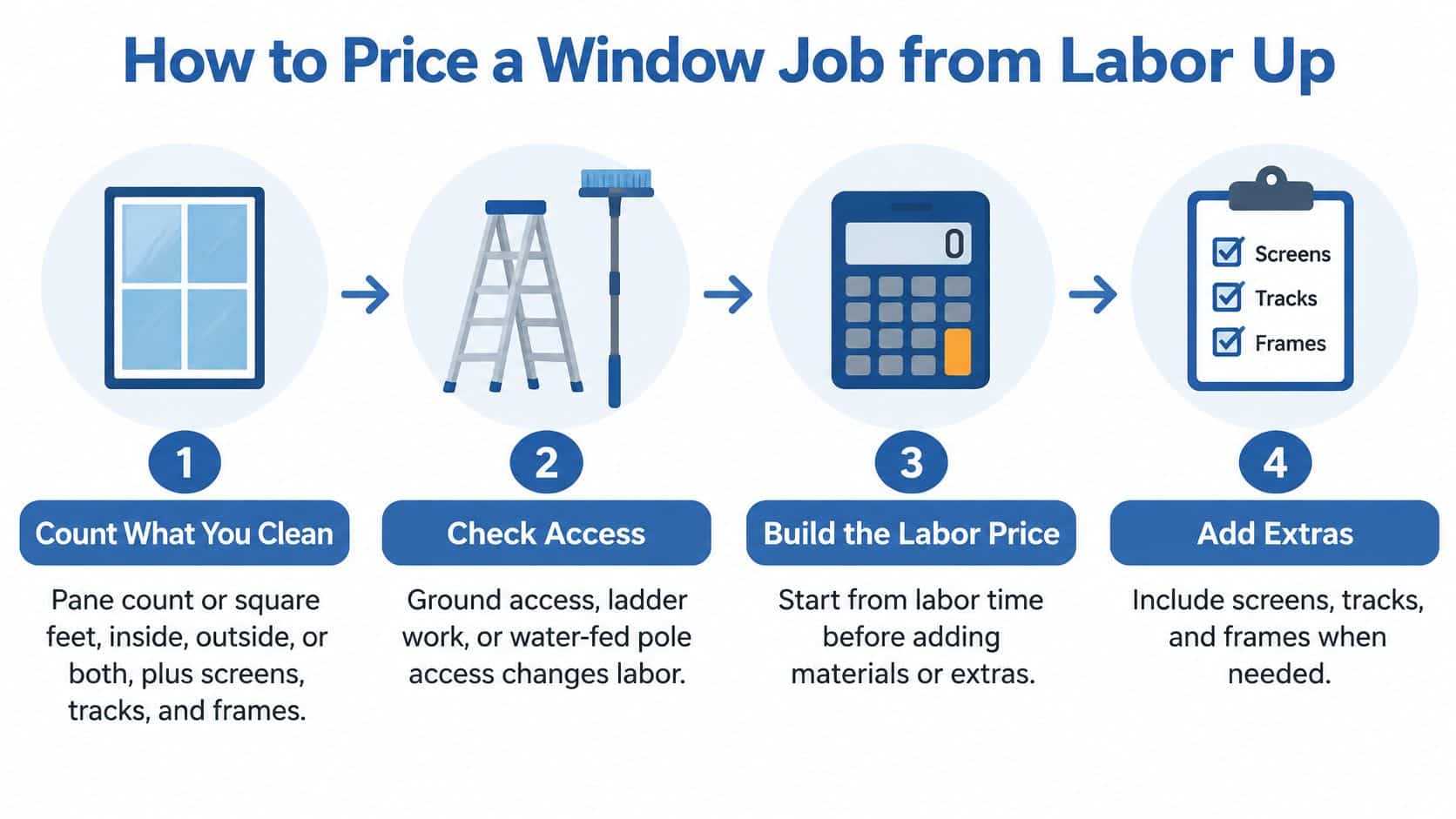
Price from labor up, then sanity-check against the pane or square-foot range. If you start with the customer's hoped-for total and work backward, you'll talk yourself into free setup, free driving, and free rework. If you want a broader framework for building service prices from costs instead of guesses, AmaJova's guide to pricing services is a useful companion to the job-level math below.
The Eight Steps in Order
- Count what you'll clean. List panes or square feet, inside, outside, or both, plus screens, tracks, and frames. In the Valley, sun screens and dusty tracks are often the main complaint, not the glass.
- Note access before you promise a rate. Call it ground, ladder, water-fed pole, lift, or rope. Note tile roofs, desert landscaping, locked gates, and second-story glass over patios, and flag whether Arizona dust or hard-water spots will slow the first pass.
- Turn quantity into time. Divide the quantity by a production rate you've timed. An ISSA cleaning-time guide expresses the same logic as square footage divided by production rate per hour, times 60. As a planning example, a careful exterior tech might clear 10 to 15 residential panes an hour, while a pole route on light soil can move faster and a filthy first-time track job much slower.
- Multiply hours by crew size. Two technicians for two hours is four labor hours, even if the customer sees a two-hour visit. A second person on ladder or lift work isn't a luxury. That's often the safety plan.
- Load the wage. The U.S. Bureau of Labor Statistics profile for janitors and building cleaners reported a median wage of $17.71 per hour in May 2025, and it identifies washing windows and glass as part of the occupation's duties. That's a wage benchmark, not a bill rate. If only 60% of paid time is revenue-producing, direct productive labor alone effectively costs about $29.52 per billable hour before insurance, equipment, vehicles, management, and profit.
- Add overhead and profit. Payroll taxes, workers' compensation, liability insurance, fuel, poles, squeegees, uniforms, software, quoting time, supervision, and gaps between jobs all ride on that hour. That's how a defensible billable hour lands in the $50 to $85 band unless the route is unusually dense.
- Compare with the unit range. Run the pane or square-foot math beside the labor math. Keep the higher figure when access, soil, or interior obstacles were guessed rather than walked.
- Replace the guess after visit one. Write quoted hours beside actual hours. Your next Phoenix-area bid should use your crew's measured production, not a national forum rate.
For technique questions that affect time, such as reach and setup on tall glass, our guide to washing high windows safely and efficiently shows why access minutes belong in the estimate.
The common pitfall is pricing only the glass the customer can see. Setup, screens, tracks, water treatment, quality control, and return visits decide whether the job paid.
Don't skip step 8 because the first job went fine. One easy Ahwatukee ranch can make your rate look brilliant, then a two-story in Paradise Valley with screens, tracks, and sprinkler spots eats the whole week. Track production by building type and frequency, and you'll know which jobs to raise, which to keep, and which to stop chasing.
Add-Ons That Change a Phoenix Quote
Treat the base rate as glass only, then stack what the Valley throws at a crew. Start with the truck. The IRS standard mileage rates page set the business mileage benchmark at 70 cents per mile for 2025. At that benchmark, 40 business miles correspond to $28.00, whether the loop runs through Phoenix, Scottsdale, Paradise Valley, Chandler, Tempe, Gilbert, or a mix of them. That's a tax benchmark, not a mandatory customer charge, but it's a clean internal way to price driving crews, water-fed equipment, ladders, and safety gear. Fold it into the trip minimum rather than hoping the next stop pays it back.
Height Is a Separate Decision
Above one story, ladder or pole work often adds 25% to 50% because setup, repositioning, and slower detailing eat the hour. A lift day shouldn't be a slightly higher pane price. Put rental, delivery, pickup, ground protection, and a second technician on their own line, and say who handles tenant or traffic coordination. Lift, stage, and rope work at two to four times ground labor plus equipment keeps you from donating the access system.
Screens commonly add $2 to $5 each and tracks $3 to $8 each when they're washed and Detailed, not flicked with a dry brush. That's especially true for sun screens, which hold Valley dust and need careful handling. Our page on sun screen cleaning in Phoenix, Arizona explains why that work shouldn't be buried in a glass-only number. Gutters, if you offer them, get a separate per-foot or per-story line.
Quote adders beyond the base glass rate
| Condition | Typical adder | Put it on the quote as |
|---|---|---|
| Valley driving | $28.00 for 40 miles at the $0.70 benchmark | Trip minimum or mobilization |
| Second-story ladder or pole | 25%-50% over ground glass | Height premium |
| Lift, stage, or rope | 2-4x ground labor plus equipment and an extra technician | Access system, not a pane rate |
| Screens | $2-$5 each | Screen cleaning line |
| Tracks | $3-$8 each | Track detail line |
| Hard water or sprinkler spots | $8-$25 or more per pane | Restoration, separate from maintenance |
| Gutters on the same visit | Per foot or per story | Gutter line, not included glass |
| Quarterly route vs one-time | About 10%-20% under one-time | Recurring visit price |
Condition Beats Optimism
Hard-water and sprinkler spots are routine on Arizona glass, and they're restoration, not maintenance. At $8 to $25 or more per pane, sometimes with a second visit, they need test-spot language so nobody promises etched glass will come back perfect. Commercial storefronts on busy corners may also need an after-hours or mobilization adder when the crew can't work the sidewalk during business hours.
Recurring monthly or quarterly work can sit 10% to 20% under a one-time clean because the route is already sold, setup is known, and soil is lighter. Don't give that discount on the first filthy visit.
The cheapest per-pane bid can cost more once screens, a return trip, or a lift are excluded.
Say that plainly on the quote. A customer comparing totals line by line will usually accept an adder they understand. They'll fight a surprise.
Three Valley Jobs Priced End to End
Worked examples beat abstract ranges because they show where the total came from, and what would change it. Use these three as patterns for how much to charge for washing windows on similar Valley stops, then swap in your own timed production.
Job One and Two
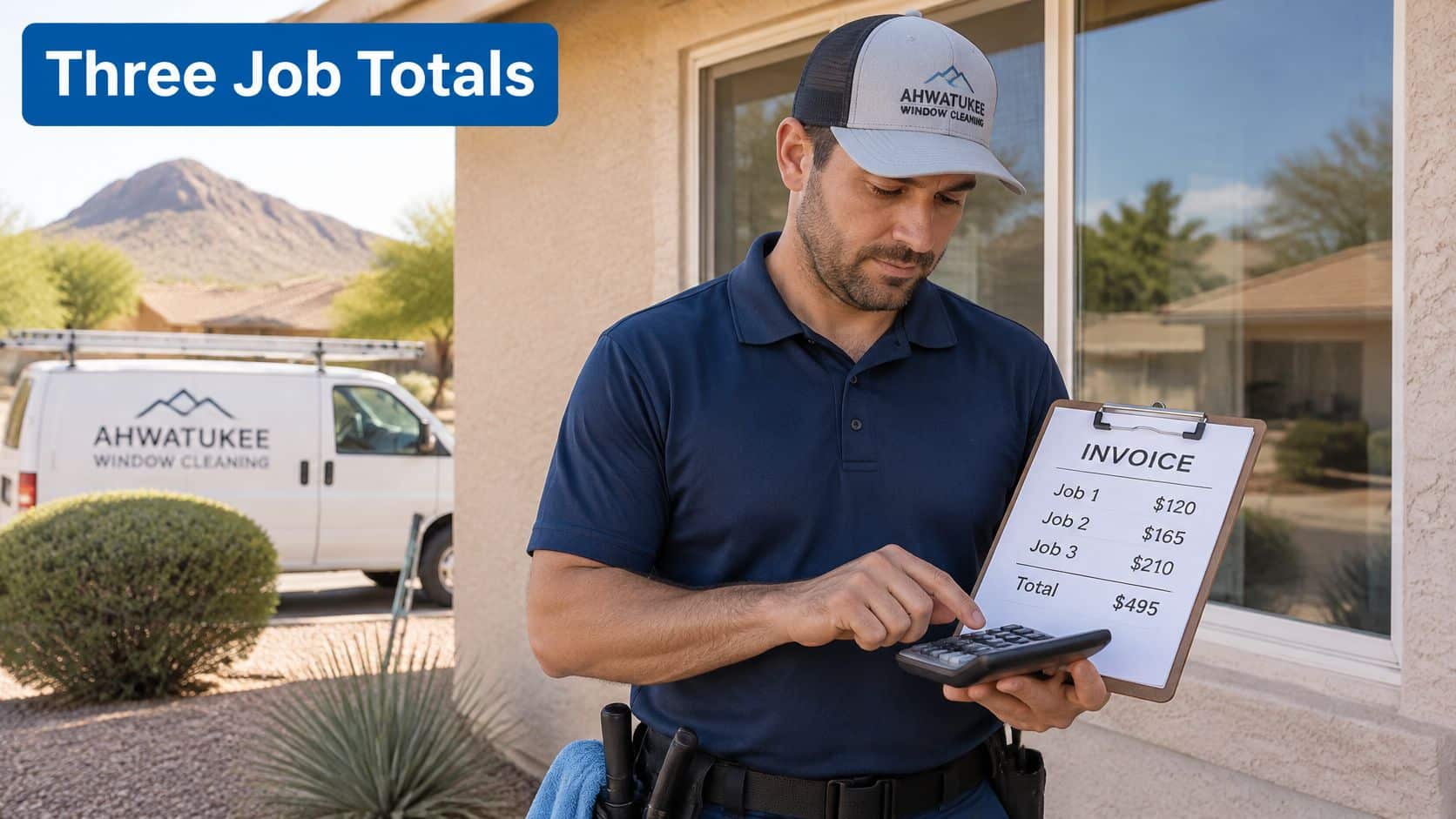
Ahwatukee single-story. Say the house has 22 standard panes, inside and out, light dust, easy hose access. At $10 per pane, the glass math is 22 x $10 = $220. That total already clears a $150 trip minimum, so the quote is $220 if screens stay in the garage. Add 22 screens at $3 each and the same stop becomes $286. The exclusion that changes it is screens, not some vague difficulty fee.
Chandler storefront. Say the shop has about 400 square feet of exterior glass on a quarterly route. At $0.25 per square foot, the visit is $100, which works only if pole work stays on the sidewalk and soil is maintenance-level. A post-construction scrub with tape, stickers, and dust is a different job. Bill it at crew time, for example two crew-hours at $70 = $140, and don't force it into the quarterly rate.
If you're building that kind of recurring route, our breakdown of pricing commercial window cleaning by visit and scope shows how frequency should change the number.
Job Three and the Safety Line
Paradise Valley two-story. Say there are 18 panes, inside and out, with ladder work on the rear elevation. Start at a $12 base pane rate, add a 40% height premium, and you get about $302 before stains. Six panes carry irrigation spots. At $15 extra per affected pane, restoration adds $90, for a first-visit total near $392. Later visits can drop the restoration line if the glass holds and sprinklers are adjusted.
That Paradise Valley total assumes a short ladder with no drop over 6 feet. For anything higher, stop using pane math. Safety guidance on high-rise window washing standards notes that OSHA fall-protection rules generally apply when workers face falls of more than 6 feet, and it identifies 5,000 pounds of required anchor capacity per worker for a properly rated anchor in a personal fall-arrest system. A full-body harness, lanyard or self-retracting lifeline, inspections, training, and a rescue plan belong in the price as their own line.
Three Valley jobs priced end to end
| Job | Scope and setup | Exclusion that changes it |
|---|---|---|
| Ahwatukee single-story | 22 panes inside and out at $10 = $220. Screens at $3 each would bring it to $286 | Screens left in the garage |
| Chandler storefront | About 400 sq ft exterior glass on a quarterly route at $0.25 per sq ft = $100 per visit | Pole work off the sidewalk or construction soil |
| Paradise Valley two-story | 18 panes at a $12 base plus 40% height premium = about $302. Six restored panes at $15 add $90, for about $392 | Fall-arrest gear if drops exceed 6 feet |
State the exclusion in each example, every time. That's what keeps a fair total from turning into an argument in the driveway.
Quote Checklist Before You Send a Number
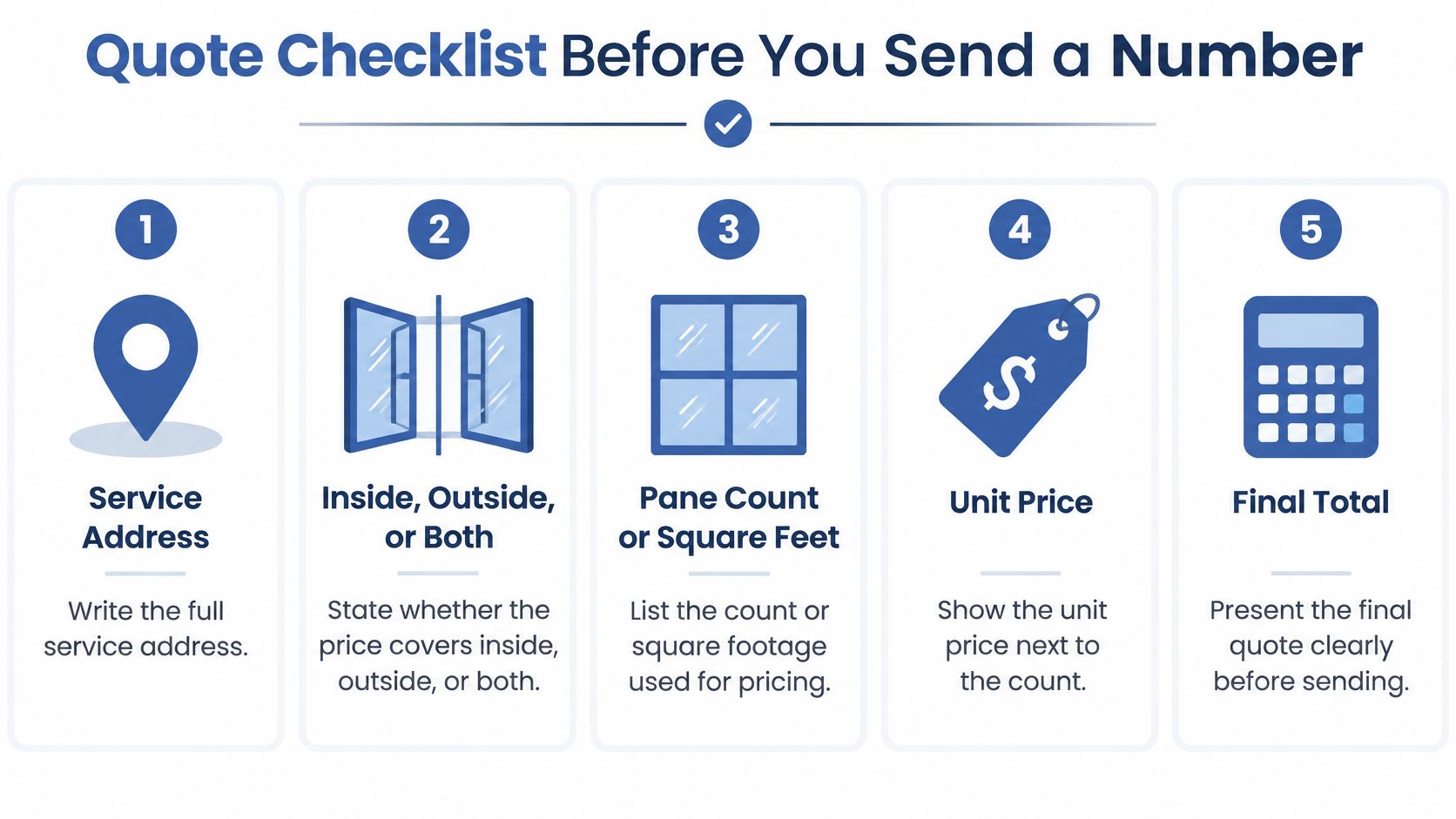
Send a quote a property manager can compare without calling you for translation. Normalize competing bids by total glass area, labor hours, access method, mobilization, and service frequency so two totals sit on the same basis. A vendor with a higher unit rate may finish faster, include frames or tracks, or bring documentation the cheaper bid leaves out. Per-pane numbers alone won't tell the owner that.
Paste This Order Into Your Estimate
- Service address and sides. Write the full address and whether the price is inside, outside, or both.
- Quantity and unit. List pane count or square feet, the unit price beside it, and the glass subtotal.
- Separate detail lines. Price screens, tracks, frames, gutters, hard-water restoration, and solar panels only when they're in scope.
- Access method. Name ground, ladder, water-fed pole, lift, stage, or rope, and say who provides roof permission, water, lift placement, and tenant notice.
- Trip and timing charges. Show mobilization, after-hours work, and any minimum that applies.
- Frequency. State one-time, monthly, or quarterly, and note that a one-time price doesn't lock the recurring route price.
- Exclusions. Exclude construction dust, paint, oxidation, and failed seals unless a restoration line is approved. For dust and debris work, our post-construction window cleaning scope shows why that separation matters.
- Definition of done. Use one plain sentence, such as edges wiped and no streaks in normal daylight. Say rework to that standard is included and new stains aren't.
Commercial and High-Rise Additions
Group the safety assumptions at the end so a facility manager can forward them to risk or legal without hunting. Name a trained crew for the access method, fall protection when the drop is over 6 feet, anchor and roof-access responsibility, rescue planning, weather delays, and insurance that matches the building contract. An uninsured low bid doesn't remove that risk. It pushes the risk back onto the owner.
Overrun rule worth copying: If anchors, tenant access, or soil differ from the walkthrough, work stops for written approval before extra labor starts.
Add photo-based completion records for multi-tenant and high-rise work when the manager won't be on site. Then keep the first visit's actual hours beside this sheet. A quote that never gets checked against the clock is just a guess with better formatting.
Stay Competitive and Decide on Your Next Quote
Don't match the lowest pane price a neighbor quotes. Match a competitor only when the scope matches, with the same sides, same soil level, and screens clearly in or out. A cheap unit rate that forces a second trip, leaves tracks dirty, or excludes the lift isn't cheaper. It's a smaller job wearing a lower number.
If you want to study how rivals present their scope before you adjust your own, a structured way to compare competitors' Google Business Profiles can show what they emphasize, what they leave vague, and where your written quote can be clearer. Don't copy their price. Copy the discipline of checking what the customer sees.
Let Density Fund the Discount
Build each week by geography so Scottsdale and Paradise Valley stops share a day and Chandler, Gilbert, and Tempe share another. Density is the discount you can afford because the truck earns more per mile and the crew spends less paid time driving. A quarterly customer on an existing route can pay less per visit than a one-time customer across the Valley. That's not favoritism. That's arithmetic.
Raise one-time prices in the dusty pre-monsoon stretch and after storms, when glass, tracks, and screens take longer and every caller wants the same week. Offer the lighter quarterly price once the glass is on a rhythm and soil stays maintenance-level. Never publish one number for homes, storefronts, and towers. The access systems, insurance exposure, and scheduling constraints aren't the same business just because they all involve a squeegee.
When a prospect asks for the cheapest windows, restate the inside-and-out range and the trip minimum, then ask two questions: how many panes, and how many stories. You'll learn in ten seconds whether you're pricing a ranch, a route stop, or a project.
Review the Jobs That Missed
Review five finished jobs a month. If actual hours beat the quote by more than about 15%, fix the production rate or the height adder, not the customer. Hold the line on restoration and lift days, where discounting hurts most and a small miss becomes a full day of unpaid labor.
I would price tomorrow's stop this way: pick the unit you can verify, run the labor-up steps, put miles and height on their own lines, and send the checklist quote before loading the truck. If the math lands under the trip minimum, charge the minimum or decline the stop. A polite no is cheaper than a busy loss.
Owners who would rather skip that math should book a crew that prices Valley work and writes scope down. We provide a fast and free quote for cleaning needs, offer a 100% satisfaction guarantee on residential window cleaning services, and customers in Phoenix and Scottsdale can call us at (480) 519-9327. Our Guadalupe base and Scottsdale office serve residential, commercial, and high-rise glass across the Valley. Ask any bidder, including us, to show inside versus outside, screens, tracks, and access in the price before you approve it.
If you want your next window quote to show pane count, access, screens, and frequency in plain lines instead of one mystery total, contact South Mountain Window Cleaning, LLC for a fast, free quote on residential, commercial, or high-rise glass. Tell us how many stories you have and whether hard-water spots, screens, or tracks are part of the job, and we'll price the visit the same disciplined way described above.