
A Phoenix homeowner notices the skylight above the stairwell looks cloudy, even after the rest of the windows have been cleaned. The glass is out of reach, the roof is steep, and a ladder inside the house won't solve the exterior grime. Before reaching for a pole or calling for a quick wash, it helps to know what a skylight cleaning service should include, and how the work can be done safely.
A skylight isn't just another pane of glass. Its location, glazing material, roof access, and role in bringing daylight indoors all affect the right cleaning method. For homes and commercial properties around Phoenix, dust exposure also makes condition a more useful guide than a one-size-fits-all calendar. Here's what to consider, from the cleaning scope to safety planning and choosing the right level of service.
Why Skylights Need More Thought Than a Regular Window
A homeowner can often inspect a standard window from the ground or reach it from inside. A skylight is different. It sits in or near the roof, where the approach may involve a ladder, roof access, and a fragile glazing assembly. The surface might be glass, acrylic, or polycarbonate, and it may be surrounded by a frame, seals, flashing, and an interior light well.
That matters before anyone starts cleaning. A skylight that appears sturdy may not be designed to carry a person's weight. Even a short job can put a worker close to an unprotected opening, while the wrong tool or cleaner can scratch or haze plastic glazing. The type of skylight also affects access and technique, so it's useful to identify the skylight style before arranging service.
For a Phoenix-area homeowner, the first decision isn't which soap to use. It's whether the skylight can be cleaned safely from inside, whether exterior roof access is necessary, and what the material can tolerate. A reachable interior surface with light dust is a different job from a high, sloped exterior pane with baked-on mineral residue.
Start with access, not the cleaning solution. A contractor who asks about roof conditions and skylight type is planning the work. A contractor who quotes only by counting panes may be overlooking the hardest part.
Commercial properties add another layer. A warehouse, retail space, office, or condominium may have several skylights, controlled lighting, roof equipment, or a building-maintenance system. Before booking, know whether the request is for interior cleaning, exterior cleaning, or both, and ask how the crew will reach each surface. A professional service should make those details clear before work begins.
What a Skylight Cleaning Service Actually Cleans
A thorough service starts with the surface but doesn't end at the glass. The technician should identify the glazing material and the type of buildup before choosing an applicator or cleaning solution. Dust and pollen film may come off with gentle washing, while bird fouling and mineral deposits may need a different dwell time or treatment.
Match the method to the residue
Exterior glass can carry airborne dust, pollen, bird droppings, and hard-water spotting. Interior glass may have a film from condensation or household residue. Mineral haze is especially important to assess: surface deposits may respond to careful cleaning, but damage etched into the glazing won't necessarily disappear with another pass.
A pure-water system can rinse exterior surfaces without leaving the residue associated with mineral-heavy tap water. A soft, non-abrasive applicator helps lift grime, followed by a careful rinse or squeegee finish where the glazing and access method allow. For acrylic or polycarbonate, confirm that the product and tools are approved for that material. Abrasive pads can leave scratches that cleaning won't fix.
The frame and surrounding edge deserve attention, too. A technician can wipe accessible frame surfaces and seals to remove loose debris, while looking for obvious signs of damage. Cleaning isn't a repair: a cracked seal, loose component, or cloudy space between panes needs to be documented rather than scrubbed as if it were dirt.
Include the light well when it's accessible
The interior shaft, or light well, can collect dust and cobwebs that affect appearance even after the exterior pane is clean. Ask whether the quoted work includes interior glass and reachable light-well dusting, or only the exterior surface. Those are separate tasks, and a clear estimate should say which are included.
A useful written scope identifies the surfaces to be cleaned, the glazing-safe method, and any areas excluded because they're inaccessible or unsafe. That makes it easier to compare quotes and confirm what the technician completed.
Daylight Performance and Energy Savings Explained
Clean skylights support a building's daylighting system. Dust, pollution, biological growth, and mineral deposits can reduce the light entering through the glazing. In a building that uses daylight-responsive controls, less incoming light can also change when the controls call for electric lighting.
A U.S. National Institute of Standards and Technology study modeled skylight daylighting across multiple roof-area configurations. In those modeled cases, systems covering approximately 2% of roof area produced the lowest total modeled energy use, with broadly similar performance as coverage increased through 10%; skylights reduced electric-energy consumption by as much as 77% compared with buildings without daylighting (NIST's skylight daylighting study). That 77% is a modeled maximum, not a guaranteed result. Climate, orientation, glazing, shading, lighting controls, occupancy, and HVAC operation all influence actual performance.
Other research reinforces the need for a building-specific view. A Lawrence Berkeley National Laboratory publication describes more than 2,000 DOE-2.15 energy simulations across 14 U.S. climate zones. Findings summarized by the American Council for an Energy-Efficient Economy reported lighting savings as high as 26% for offices and 58% for retail buildings when dynamic daylight and skylight technologies were paired with appropriate controls (the simulation publication). Those figures aren't a promise for every property. They show why skylight performance depends on the building and its control strategy.
A field study of 32 commercial buildings with skylights and photocontrols found measured lighting-energy savings equal to 98% of theoretical savings; its model included a dirt factor for accumulation on skylights and inside light wells (the field study). For a property manager, the practical takeaway is to treat cleaning as part of maintaining the daylighting asset. Record cleaning dates and visual condition, and compare them with light levels or lighting-system performance when that information is available.
Rooftop Safety and Fall Protection on Skylight Jobs
A skylight cleaning job on a commercial roof is fall-hazard work. A skylight can look like a solid walking surface while remaining unable to support a worker, so technicians must not assume the glazing is load-bearing. CDC/NIOSH guidance calls for compliant screens or fixed railings to protect skylight openings. Where a worker is exposed to an unguarded or uncovered opening more than 6 feet above a lower level, the guidance calls for a personal fall-arrest system, along with guarding or securely covering openings exposed during the work (CDC/NIOSH skylight safety guidance).
What to establish before roof access
Before work starts, the building owner or contractor should identify skylight locations and establish whether each assembly is trafficable. The work plan should document roof-access permission, approved routes, the condition of screens or guardrails, suitable anchor points, and how the crew will avoid loading the skylight. If fall-arrest equipment is required, a harness alone isn't a complete plan: compatible equipment, suitable anchorage, clearance, trained users, and rescue arrangements matter.
Passive protection, such as engineered screens or guardrails, reduces reliance on a worker making the right move at every moment. A contractor should be able to explain the controls for the specific roof, not just say that the crew wears harnesses.
High-rise work also has distinct equipment and operating requirements. OSHA's powered-platform standard covers permanent exterior building-maintenance systems used for tasks such as window cleaning, and requires a written emergency plan for power failures, equipment failures, and other emergencies (OSHA's powered-platform fact sheet). OSHA's suspension-scaffold rules require fall protection for employees working more than 10 feet above a lower level. They also set support-device strength requirements and require a competent person to inspect ropes before each workshift and after events that could affect rope integrity (OSHA's suspension-scaffold guidance).
Put the access method, hazard controls, and emergency plan in writing. For a broader look at building-specific planning, review this overview of high-rise window-cleaning safety. Ask for documented procedures, technician training, and insurance evidence before roof work is scheduled.
DIY, Residential Pro, and High Rise Service Compared
The right service tier depends on the surface, access, and risk, not on how dirty the skylight looks. A reachable interior pane may be manageable for a careful homeowner. A high exterior pane or a commercial roof calls for a different level of planning.
| Service Tier | Best For | Access Method | What to Verify |
|---|---|---|---|
| DIY, interior only | Reachable interior glazing with mild film | Stable indoor access using a suitable non-abrasive tool | Glazing material, safe reach, and cleaner compatibility |
| Residential professional | Elevated exterior skylights on a house | Planned roof or exterior access | Insurance, access method, and material-safe cleaning |
| Commercial or high-rise crew | Commercial roofs, multiple units, or elevated building façades | Site-specific roof access, building-maintenance equipment, rope access, or suspension scaffold | Written safety plan, training, fall protection, rescue arrangements, and insurance |
DIY makes sense only when the work stays safely indoors and the glazing is reachable without leaning, climbing onto furniture, or stepping onto a roof. Use a soft applicator and a cleaner approved for the surface. If you can't identify the material or reach it without overextending, stop rather than improvising with a long pole from an unstable position.
For a single-family home, a professional can assess exterior access, roof pitch, glazing type, and contamination before choosing a method. The quote should make clear whether it includes only the skylight exterior or also interior glass and the light well.
Commercial and high-rise work isn't a larger version of a household wash. The crew needs an access plan, appropriate equipment, and controls suited to that building. If the contractor can't explain how workers will stay clear of skylights and other roof hazards, the price alone isn't a sound basis for hiring.
How Often Arizona Skylights Really Need Cleaning
In Phoenix, dust loading is a better maintenance trigger than a generic quarterly schedule. The city identifies PM10 as particulate matter 10 micrometers or smaller in diameter, commonly consisting of dust, and notes that the Phoenix area's PM10 concentrations exceed EPA National Ambient Air Quality Standards. Dust from paved and unpaved roads contributes to the problem (Phoenix's air-quality and dust information). That makes visible condition and site exposure useful signals for homes and businesses across the Valley.
A skylight near construction, an unpaved access road, industrial activity, or agricultural dust may need closer monitoring than one sheltered from those sources. A dusty light well can also affect how bright the space feels, even when the exterior glazing looks acceptable. After a dust storm, check for haze or deposits rather than automatically booking a service by the calendar.
Use observable triggers
Consider an inspection or cleaning when you notice:
- Visible haze or spotting that remains after light surface dust is removed.
- Dust in the light well or cobwebs that make the interior shaft look dirty.
- Changes in daylight controls, such as lights switching on sooner than expected.
- Nearby construction or heavy dust exposure that leaves a fresh film on roof surfaces.
- A change in solar output when the property also has photovoltaic panels.
The Department of Energy says airborne dust and particulates can reduce photovoltaic-system output and recommends accounting for soiling in solar-generation estimates. Its PVWatts soiling calculator assumes an average loss of 2% of power potential, but actual losses depend heavily on local weather and site conditions (the Department of Energy's solar guidance). That figure applies to the calculator's solar soiling assumption, not to skylights. The useful comparison is the decision process: observe the property, consider exposure, and clean when buildup or performance indicates a need.
A maintenance record can be simple. Take consistent photos, note visible contamination, and record when the skylight is cleaned. For a companion perspective on residential glass maintenance, see how often to clean windows. The goal is to avoid both extremes: unnecessary roof access and letting a meaningful buildup go unaddressed.
What Happens During a Professional Skylight Cleaning Visit
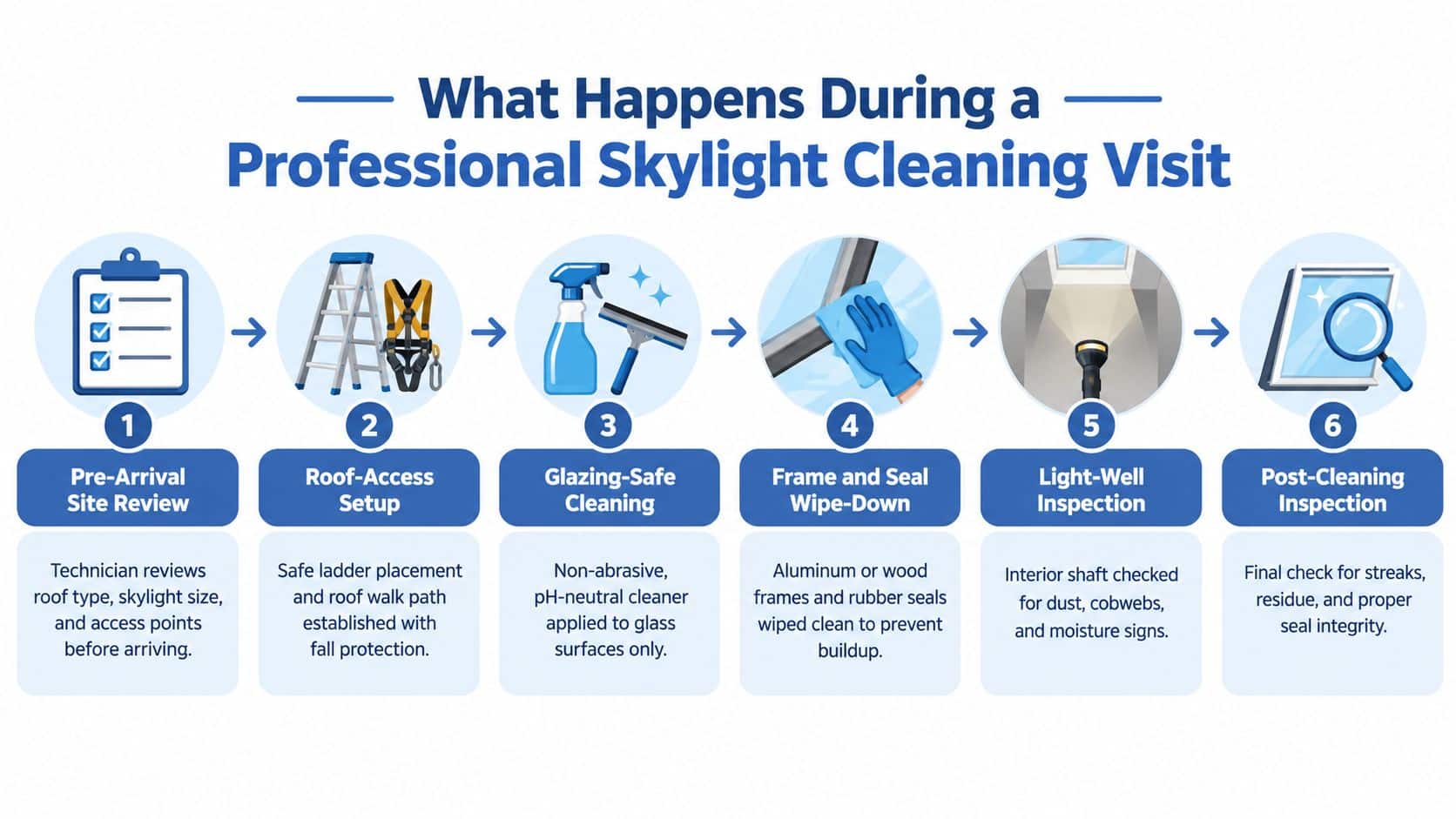
A reliable visit starts before the technician arrives. The estimate should identify the skylights, glazing material if known, access route, and whether the work includes interior glass, exterior glass, frames, seals, light wells, screens, or solar panels. Price can depend on skylight count, height and roof pitch, access method, glazing material, contamination, and any additional services included. Ask for those factors to be described rather than relying on a quote based only on the number of units.
The visit generally follows a planned sequence, although the safe method may vary by property. The technician reviews site conditions, sets up access and fall protection, then cleans using tools and products suited to the glazing. Afterward, the technician checks for residue and records visible defects that cleaning can't resolve.
What the written estimate should cover
Confirm that the scope states which surfaces are included and how the crew will reach them. If light-well dusting or screen cleaning is excluded, the estimate should say so. The technician should also know what products are appropriate for the material and avoid abrasive tools that could damage plastic glazing.
After cleaning, ask for a brief condition report. It should flag concerns such as cracked or deteriorated seals, fogging, visible damage, or moisture between panes. Those conditions may need a glazier or other specialist, not more cleaning.
A short video can help explain the workflow visually, but it doesn't replace a property-specific safety assessment.
Before scheduling, make sure the written estimate matches the work you expect. A clear scope prevents confusion about whether the price covers one side or both, whether the light well is included, and how the crew will access the roof.
Insurance, Warranty, and Final Checklist for Hiring
Before approving a skylight job, ask for proof of general liability insurance and workers' compensation where applicable. Request a written safety plan that identifies the access method, roof hazards, fall protection, and emergency procedures. For commercial work, confirm that any platform, scaffold, or other building-maintenance equipment is suitable for the property and maintained for the task.
The cleaning specification should name the glazing material where known and rule out incompatible chemicals or abrasive tools. Ask how the provider handles a missed area or a streaked finish, and get the workmanship terms in writing. South Mountain Window Cleaning lists a 100% satisfaction guarantee and a $2 million insurance policy; its window-cleaning insurance information is available for customers who want to review the company's coverage details.
A practical pre-approval checklist
- Coverage: Request current insurance documentation and clarify who is responsible for workers on site.
- Safety: Confirm the roof-access method, fall-protection controls, and rescue planning.
- Scope: Make sure the estimate states which glass, frames, seals, and light wells are included.
- Materials: Ask how the crew will protect glass, acrylic, or polycarbonate from scratching or chemical damage.
- Documentation: Request a record of completed work and visible conditions that need separate repair.
- Scheduling: For a commercial property, confirm how appointments and access coordination will be managed.
South Mountain Window Cleaning provides residential, commercial, and high-rise window washing in Phoenix, Scottsdale, Paradise Valley, Chandler, Tempe, and Gilbert. The company also uses computerized scheduling for business customers. Whether you manage a retail roof, an office, or a home with a skylight in a hard-to-reach spot, provide the property type, skylight access details, and the surfaces you want cleaned when requesting an estimate.
South Mountain Window Cleaning, LLC provides residential, commercial, and high-rise window washing for Valley properties, with skylight cleaning scoped around access, glazing, and site conditions. Request a free quote for your home or building in Phoenix, Scottsdale, Paradise Valley, Chandler, Tempe, or Gilbert by visiting South Mountain Window Cleaning, LLC.