
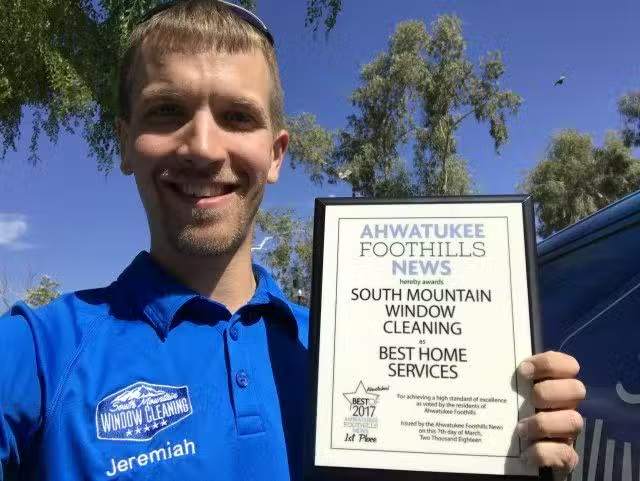
A Phoenix property manager can usually spot the problem before anyone files a complaint. Dust has settled across the storefront, afternoon sun exposes pale mineral marks, and tenants start wiping interior glass with paper towels that leave their own trails behind. The question isn't only how to make the panes look clear tomorrow. It's how to clean commercial windows without damaging coatings, creating a pedestrian hazard, or sending a crew onto a façade with an unverified access system.
Commercial glass responds to water quality, soil type, surface preparation, access planning, and inspection discipline. Arizona's wind, dust, intense sunlight, and mineral residue make shortcuts especially visible. The practical approach below covers the equipment a crew should stage, the cleaning sequence that works, the safety documentation managers should require, and the maintenance schedule that keeps a property from operating in complaint mode.
What Commercial Window Cleaning Really Involves
A walk around a dusty Phoenix office or retail center often reveals several different problems at once. The glass may carry airborne grit, sprinkler residue, fingerprints, bird droppings, or construction film. Frames and tracks can hold debris that turns into dirty runoff, while interior-side smudges reduce the impression of cleanliness even when the exterior has just been washed.
That's why commercial window cleaning is a building-operations task, not merely a janitorial add-on. ASHRAE preventive-maintenance guidance calls for inspection of occupied-side windows and skylights when dirt, smudges, or fogging materially reduce daylight transmission. A facility team should also remember that dust comes from inside as well as outside. The U.S. Environmental Protection Agency's indoor-air-quality maintenance guidance identifies sources such as occupants, furnishings, plants, cooking, printing, smoking, and cleaning products.
Practical rule: Clean glass is a visible maintenance signal, but the inspection around it often reveals the more important building problem.
In Phoenix, a dusty pane can look acceptable in soft morning light and noticeably hazy by afternoon. Sunlight highlights residue, while wind pushes loose soil into seals, sills, and adjacent façade surfaces. Consistent maintenance helps preserve visibility and daylight access, supports tenant presentation, and gives managers a chance to notice failed seals, fogging, coating damage, or recurring deposits before they become a larger building-envelope issue.
The work ahead comes down to four decisions:
- Choose the right tools and method: Match hand tools, purified water, chemicals, and access equipment to the glass and elevation.
- Execute the clean in the right order: Remove loose soil, control agitation, squeegee runoff, and inspect from several angles.
- Manage safety and access: Separate routine storefront work from high-rise operations involving anchors, platforms, harnesses, and rescue planning.
- Maintain the property proactively: Schedule service around exposure, occupancy, tenant needs, and observed glass condition.
Tools and Equipment a Commercial Job Demands
A competent crew stages equipment before anyone approaches the glass. The kit should reflect the building, not a generic checklist. A small storefront may need hand tools and a safe extension pole, while a multi-story office requires tested access equipment, fall protection, water treatment, communication devices, and records.
Stage the hand tools first
Use squeegees in several sizes so the rubber can follow narrow mullion bays and broad panes without excessive overlap. Microfiber or soft-yarn washers loosen soil without dragging abrasive particles across the surface. Buckets, applicators, clean detailing cloths, and compatible scrapers complete the basic hand kit.
Scrapers require judgment. A blade can remove a contaminant, but it can also scratch glass, damage coatings, or catch a weak edge. Never treat a scraper as a substitute for identifying the soil and confirming that the surface can tolerate the method.
Prepare solutions and water
A mild, non-abrasive detergent is the starting point for routine glass. Keep a documented spot-treatment method for mineral deposits, construction residue, and other difficult soils. The solution must be compatible with the glass, frames, coatings, seals, and nearby materials.
For water-fed work, stage the purification system, hose, brush, fittings, and a TDS or conductivity meter. Professional-grade squeegees and pure-water systems are part of the commercial kit used by South Mountain Window Cleaning, LLC. Teams can also review equipment for high-rise window cleaners when evaluating specialized access needs.

Match access gear to the elevation
Extension poles and water-fed poles can reduce ladder use on lower buildings, but they don't remove the need to inspect overhead hazards, slippery surfaces, electrical exposure, traffic, and falling-object risks. Ladders belong only where the surface, reach, footing, and work area support their use.
Suspended platforms, rope-access systems, anchors, tie-backs, harnesses, exclusion barriers, and communication equipment require a separate pre-job plan. A manager shouldn't accept a general equipment list as proof that the proposed access method fits the building.
Keep inspection aids available
A TDS meter verifies purified water rather than asking a technician to judge purity by appearance. Bright inspection lighting, mirrors, clean microfiber cloths, and a way to photograph defects help crews distinguish a missed streak from a damaged seal or coating. That record becomes useful when a tenant reports recurring fogging or a manager needs to decide whether the next action belongs to cleaning or capital maintenance.
The Cleaning Process Step by Step
The reliable sequence starts before water touches the pane. A technician identifies the soil, checks the glass type and coating condition, examines frames and seals, and looks for damage that cleaning won't repair. Loose dust, cobwebs, and debris should be removed first so wet agitation doesn't turn them into abrasive slurry.
Inspect, loosen, and control the runoff
Pre-rinse or soak the pane with clean water and a mild, non-abrasive detergent. Work with a soft washer and light pressure. The purpose is to suspend soil, not grind it into the surface.
Exterior elevations should be cleaned from the highest level downward. That keeps dirty runoff from crossing glass already finished below. On a typical pane, the washer loosens the solution, and a clean squeegee removes it promptly. Wipe the rubber edge as needed, detail the perimeter with microfiber, and keep frames and sills from feeding dirty water back onto the glass.
The temptation to increase pressure appears when mineral residue or construction material remains. Resist it. ASTM cleaning guidance frames the job as a soil-removal problem constrained by glass composition. The appropriate response is a rational, substrate-specific choice among aqueous, detergent, solvent, or mechanical methods, with the least impact on the glass. The ASTM commercial glass-cleaning guidance supports that controlled approach.
Know what never belongs on the pane
Do not use muriatic acid or hydrofluoric acid on commercial glass. Don't drag metal tools across the surface, and don't use razor or broadknife blades as a routine shortcut. Those methods can scratch glass, etch the surface, or damage coatings.
For stubborn spots, isolate the affected area, document the method, test compatibility where appropriate, and re-clean only the necessary section. Randomly switching chemicals or applying more force can turn a removable deposit into permanent damage.
Water-fed poles change the contact method. The brush still agitates the surface, but the final rinse relies on purified water that can dry without leaving mineral residue within the required quality range. This is useful for suitable lower elevations and some difficult-to-reach areas, but the pole doesn't replace a hazard assessment or a careful inspection.
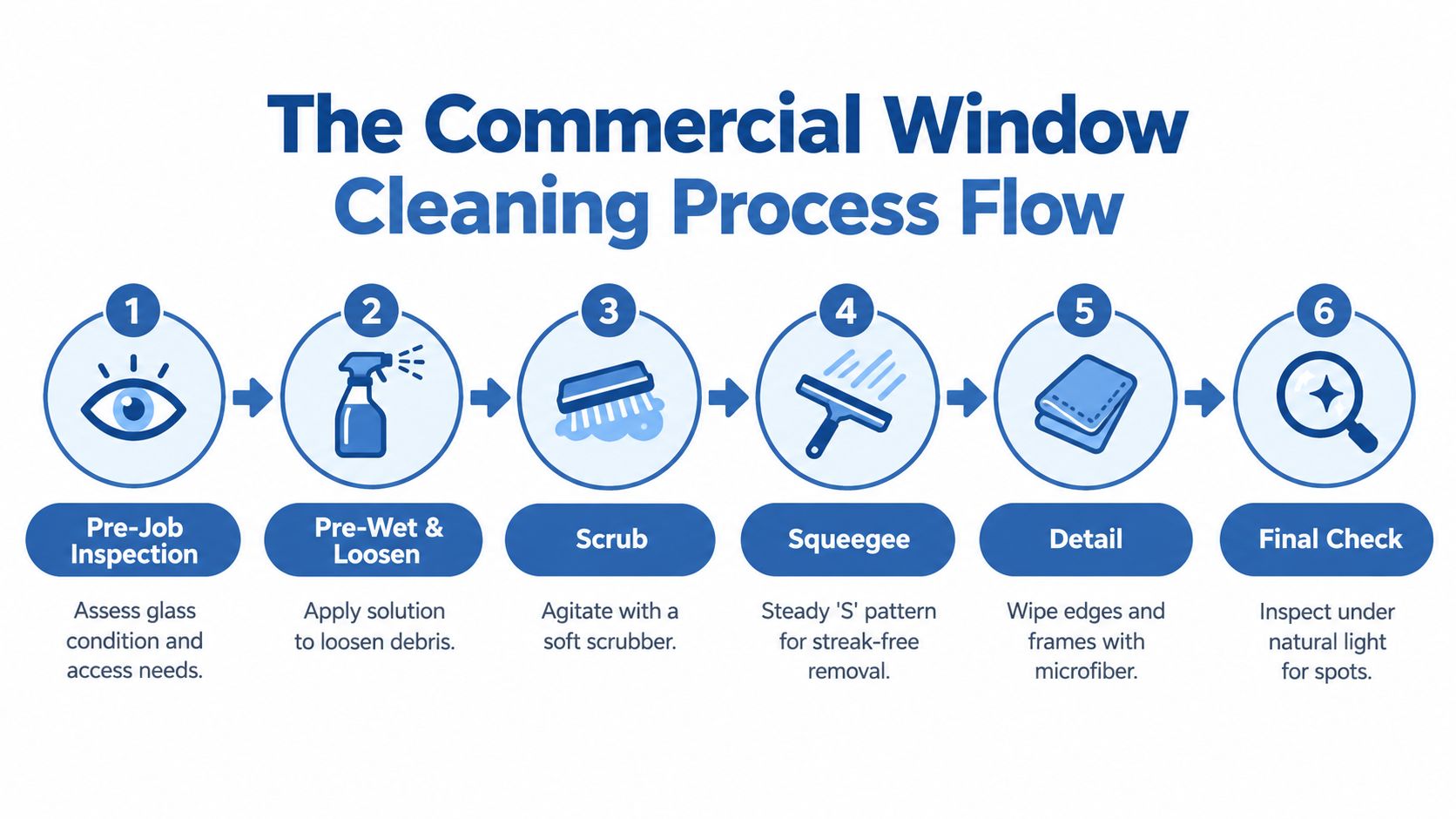
A final check should use reflected daylight from multiple angles. Move across the elevation, inspect edges and corners, and re-clean isolated streaks before leaving the area. A pane that looks perfect from one position can reveal residue when the sun or surrounding façade changes the reflection.
The following video offers a visual reference for the movement and sequence involved:
Safety Protocols and High-Rise Considerations
“Insured” doesn't mean an access system is safe. Insurance addresses financial exposure under a policy. It doesn't confirm that a roof anchor was inspected, a suspension rope is correctly rigged, a worker can operate a platform, or a rescue plan exists for the specific façade.
Falls from height account for 65% of window-cleaning fatalities, and 85% of reported high-rise accidents are attributed to harness failure or improper harness use, according to an industry summary that should be treated as a risk indicator rather than a complete government census because federal data commonly group window washers with broader building-cleaning occupations. The same source notes that broader building and grounds cleaning and maintenance occupations recorded 356 fatal work injuries in 2024, compared with 337 in 2023. These figures don't replace a site assessment, but they make one conclusion unavoidable: appearance and safety must be managed together. Industry safety summaries on window cleaning provide context for that risk.
Divide responsibilities at the building interface
The building owner or manager should provide verified information about anchors, tie-backs, roof access, façade restrictions, tenant conditions, and emergency contacts. The contractor must confirm that the proposed method, crew competency, equipment, weather plan, and rescue procedures fit the actual site.
Managers should request:
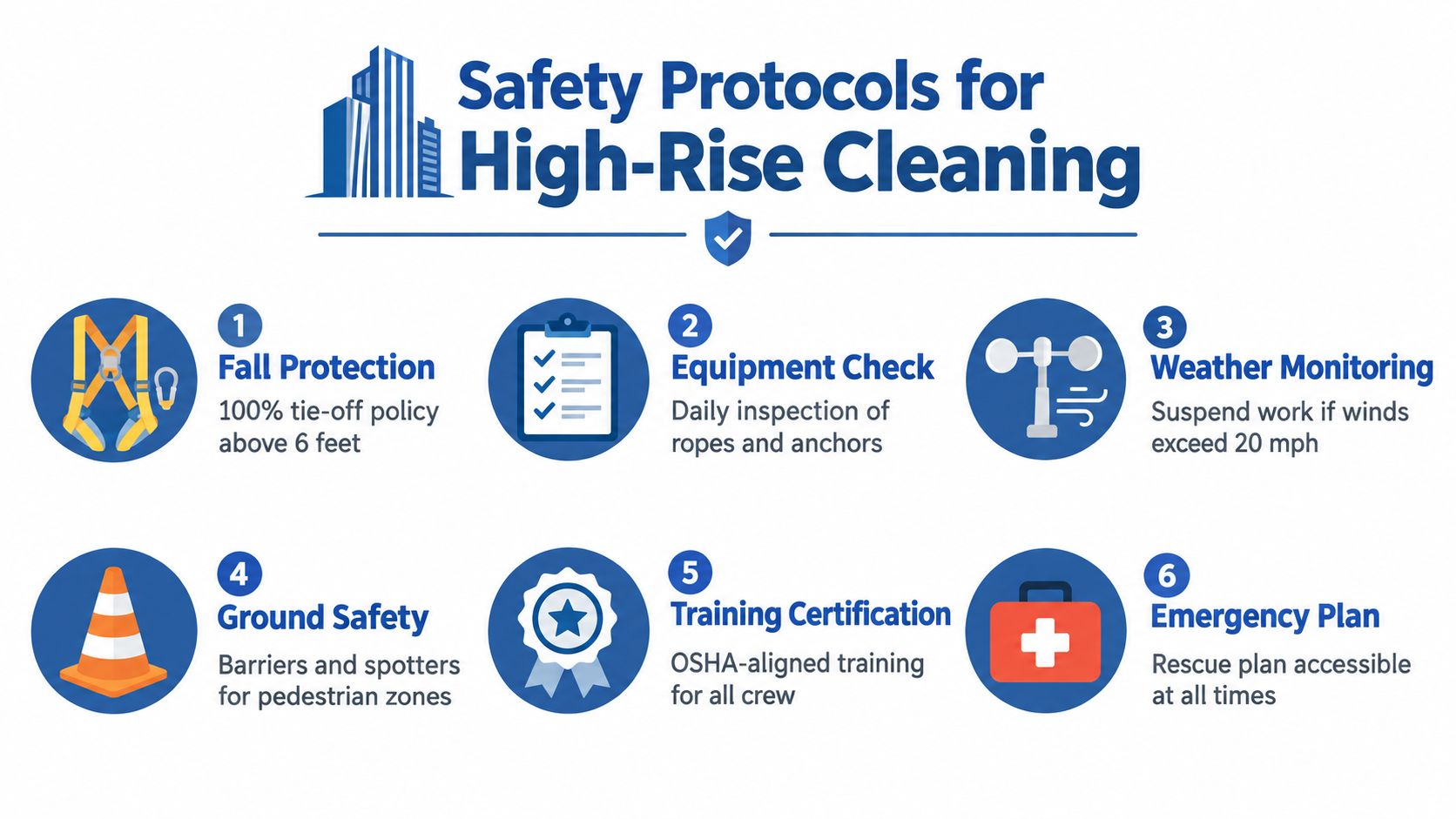
- Anchor documentation: Inspection records and written assurance that the building's safety devices are suitable and compliant for the planned work.
- Training verification: Records showing that workers are trained for the access equipment and fall-protection systems they will use.
- Pre-shift inspection logs: Checks for ropes, harnesses, platforms, hoists, connectors, poles, hoses, and communication equipment.
- Ground controls: Exclusion zones, barriers, spotters where needed, pedestrian routing, and falling-object controls.
- Emergency procedures: A site-specific rescue plan covering power loss, equipment failure, worker suspension, medical events, and communication.
OSHA's powered-platform guidance requires fall-arrest systems for employees working on platforms, competent-person training, and a written emergency plan covering power failures, equipment failures, and other emergencies. Where intermittent stabilization is used, the maximum vertical interval between building anchors is three floors or 50 feet, 15.3 meters, whichever is less. The OSHA powered-platform factsheet explains these requirements.
Treat wind and rigging as stop-work issues
OSHA requires each suspension rope and its connecting hardware to support at least six times the maximum intended load under the specified hoist-load conditions. Two-point and multipoint scaffolds must be secured against sway when a competent person determines stabilization is necessary. Work during storms or high winds is prohibited unless a competent person determines conditions are safe and workers have fall-arrest systems or wind screens. OSHA's suspended-scaffold rule makes weather checks and controlled stoppages part of the job, not an inconvenience.
The International Window Cleaning Association advises that transportable ground-rigged suspended platforms shouldn't be used above 300 feet unless continuously stabilized, and elevations above 130 feet require stabilization provisions. Operators must continuously monitor wind and weather and stop when conditions become excessive, as outlined in the IWCA high-rise suspended-scaffold guidance.
For a detailed high-rise service overview, managers can review high-rise window cleaning and compare the proposed method with the building's actual access documentation.
Water Quality, Pure-Water Systems, and Spot Treatments
In Arizona, the water in the tank can determine what the glass looks like after the sun hits it. A crew may scrub thoroughly and still leave spots if dissolved minerals remain in the final rinse and evaporate on the pane. Dust adds another layer of trouble because it can mask mineral residue during the wash and make it obvious once the surface dries.
The National Glass Association's pure-water guidance sets an objective benchmark. Water used for both washing and rinsing should contain no more than 20 parts per million of total dissolved solids, or TDS, when the final rinse is allowed to evaporate from the glass. The same guidance associates 20 PPM with roughly 40 microsiemens per centimeter on a conductivity meter. See the pure-water guidance and TDS threshold for the measurement standard.
Verify the water instead of guessing
Reverse osmosis and ion exchange can reduce dissolved minerals before the water reaches the brush. A technician should test the output with a TDS or conductivity meter and record the reading when pure-water cleaning is used. Visual clarity alone doesn't prove that the rinse will dry without spotting.
Managers comparing treatment equipment may find the overview of Labs USA water purification systems useful for understanding filtration and purification options. Commercial window crews still need to select equipment for their own water source, production demands, maintenance practices, and access method. The system only works as intended when filters, resin, hoses, fittings, and meters are maintained.
Field observation: Phoenix sunlight doesn't create mineral spots. It exposes the residue that poor water control left behind.
Treat deposits locally and carefully
Construction residue, sprinkler marks, and bird droppings need different handling from ordinary dust. Start with the mildest documented method compatible with the substrate. Don't reach for acid, don't press harder, and don't spread a small defect across an entire elevation.
Frames, tracks, screens, and sills deserve attention because tenants often notice dirt there before they analyze the glass. Remove accumulated debris without forcing it into seals, protect nearby finishes, and manage dirty water so it doesn't dry on painted surfaces or masonry. The pure-water window cleaning systems used for suitable exterior work can reduce spotting risk, but they don't eliminate the need for inspection and controlled agitation.
Frequency, Scheduling, and Minimizing Business Disruption
A schedule should follow exposure and use, not a generic promise that every building needs the same service. Street-facing retail and restaurant glass usually needs monthly attention because fingerprints, dust, food-related soil, and customer visibility make deterioration obvious. Most office parks can begin with quarterly service and adjust after observing how quickly dust and spotting return.
Upper-floor glass on low-rise offices may fit a semi-annual to annual routine when exposure is modest. High-rise façades are better managed by condition and access cost, with ground-level entrances, lobbies, and tenant-facing areas handled more often than remote elevations. These are operating starting points, not substitutes for inspecting the actual property.
Schedule around people and access
Pre-notify tenants, post signs, coordinate with security and other vendors, and establish pedestrian exclusion zones before work begins. For occupied buildings, pre-opening and after-hours windows can reduce interruptions, but the chosen time must still provide safe lighting, weather conditions, and communication.
A facility communication and engagement app can help distribute notices, collect issue reports, and keep maintenance messages visible to tenants and staff. The tool matters less than the process. Someone must own the notice, confirm that affected areas are clear, and document changes when access or weather disrupts the plan.
Keep a maintenance record
Record the cleaning date, elevations completed, observed soil, TDS readings where pure-water methods are used, access-equipment checks, incidents, and corrective actions. A simple history lets the next manager see whether a deposit is recurring, whether one orientation dirties faster, and whether the contractor completed the planned scope.
Cleaning also belongs inside the wider facility-maintenance program. If occupants report heat gain, glare, condensation between panes, or poor comfort after the glass is clean, escalate the issue instead of adding another wash. Lawrence Berkeley National Laboratory's 2025 commercial window research estimates that nationwide commercial window upgrades could produce about 4% to 6% site-energy savings in a typical building and as much as 26% in buildings with the greatest savings potential, as reported in the 2025 commercial window market report. Cleaning supports visibility, daylight access, inspection, and coating preservation, but it isn't a replacement for glazing, shading, sealing, or HVAC work.
Managers can use this commercial window cleaning frequency guide to build a starting schedule, then refine it using actual inspection records.
Pro Tips, Common Pitfalls, and a Quick Quality Checklist
Most failed commercial cleans come from a small set of preventable decisions. Crews leave residue because they don't control squeegee runoff, scratch panes because they use blades without identifying the surface, or create streaks because they inspect only from one angle. Harsh chemicals can damage coatings even when the glass looks clean immediately afterward.
Use this quick diagnostic:
- Streaks and residue: Re-clean the isolated area with a clean washer and properly maintained squeegee. Check whether runoff migrated from an upper pane.
- Mineral spotting: Verify water quality first, then use a documented, substrate-specific spot treatment. Don't apply stronger chemistry at random.
- Scratches: Stop using metal tools and identify the source. Cleaning won't reverse damage.
- Fogging between panes: Treat it as a seal or glazing concern, not surface dirt.
- Persistent heat gain or glare: Consider shading, glazing, coating, sealing, or HVAC evaluation rather than repeating the wash.
- Interior condensation: Record where and when it occurs, then involve the facility or building-envelope team.
A vendor or in-house crew should be able to answer these questions before closing the job:
- Safety: Were anchors, tie-backs, access equipment, weather, exclusion zones, and emergency procedures verified?
- Water: Was purified rinse water tested when the method required it?
- Sequence: Did the work proceed from higher elevations downward, with loose soil removed first?
- Surface protection: Were coatings, frames, seals, and adjacent materials checked for compatibility?
- Inspection: Was the glass reviewed against reflected daylight from multiple angles?
- Occupancy: Were tenants, pedestrians, security, and other vendors protected from disruption?
- Records: Were the date, scope, readings, equipment checks, incidents, and corrective actions documented?
A clean pane should be the visible result of a controlled process, not a lucky pass with a squeegee.
South Mountain Window Cleaning, LLC provides commercial, residential, and high-rise window washing across Phoenix, Scottsdale, Paradise Valley, Chandler, Tempe, and Gilbert, including interior and exterior glass, screen and track care, pure-water cleaning, and specialized high-rise access. Visit South Mountain Window Cleaning, LLC to request a fast, free quote and set up a recurring service plan built around your building's exposure and operating schedule.