

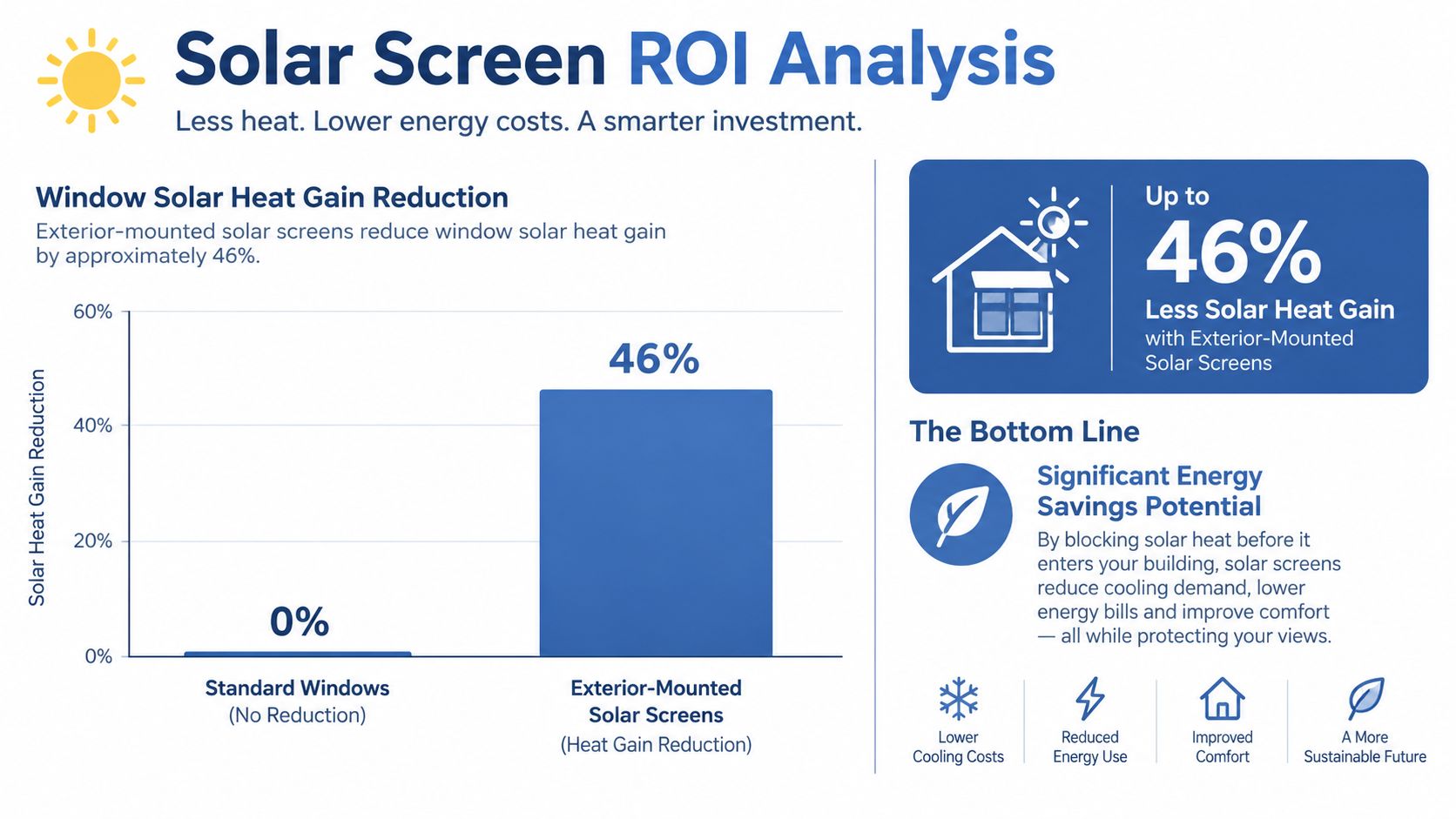
Exterior-mounted commercial window screens can reduce window solar heat gain by approximately 46%, compared with about 14% for interior-mounted screens. In Arizona, that difference can make screen placement a building-performance decision, not merely a choice between keeping insects out and letting air in.
A Phoenix retail manager usually notices the problem in the wrong order. First, the storefront looks dull. Then customers struggle to see through dusty mesh, a screen corner starts pulling loose, or an employee reports that the glass-side seating area feels unusually hot. By the time someone asks about replacement, the screen has already become a maintenance issue, a comfort issue, and potentially an energy issue.
Commercial window screens need to be evaluated as part of the façade. Mesh type, mounting position, openness, frame condition, cleaning access, glazing, and exposure to Phoenix dust all affect whether a screen performs or merely hangs in front of the glass. The right assembly can support solar control, occupant comfort, appearance, and insect protection. The wrong one can reduce visibility and airflow while delivering little measurable benefit.
Understanding Commercial Window Screens as Building Assets
A west-facing Phoenix storefront with dusty, sagging mesh sends a message before tenants ever complain about heat. Customers see a neglected façade, employees lose a clear view through the glass, and the screen may no longer sit tightly enough to control sun exposure consistently. In Arizona, intense sunlight and fine dust turn a minor screen defect into an operating concern faster than they would on a shaded residential window.
Commercial screens serve offices, retail properties, hotels, healthcare buildings, and other facilities judged by appearance and daily performance. The broader window-screen market was estimated at $4.8 billion in 2025 and projected to reach $7.6 billion by 2034, with a projected 5.3% compound annual growth rate, according to this window screen market analysis. Commercial applications represented approximately 32.1% of the 2025 market, implying an estimated commercial segment value of about $1.54 billion. These figures are directional market-sizing data from an industry report, not audited government statistics.
Why commercial assemblies differ
Residential mesh is often selected by habit. Commercial assemblies are specified around durability, energy performance, corrosion resistance, frame compatibility, and building requirements. A hotel may need clean sightlines and quick servicing. A medical office may require controlled ventilation and a consistent exterior appearance. A retail property may place greater emphasis on glare, heat, and the storefront's appearance from the parking lot.
The screen also affects building performance beyond insect control. Mesh openness, frame fit, mounting position, glazing, and exposure determine how much visibility, airflow, solar control, and occupant comfort the assembly can provide. A loose corner or clogged surface can undermine those functions even when the frame still appears intact.
Fiberglass suits many standard applications because it is lightweight, corrosion-resistant, relatively inexpensive, and easy to install. That does not make it the right choice for every Arizona façade. Areas exposed to repeated contact, harsh sun, or demanding solar control may require a different specification.
Practical rule: Treat the screen, frame, glazing, and cleaning plan as one operating system. Replacing mesh without checking the assembly often produces a clean-looking result that still performs poorly.
Property managers can use a commercial building maintenance checklist to place screen inspection alongside glass, tracks, entrances, and exterior surfaces. In Phoenix, a screen that looks acceptable from the ground may still hold fine dust or be losing tension at the corners. Regular inspection finds those faults before tenants or customers report them.
Screen Material Types and Their Performance Characteristics
Material selection should start with the building's exposure and use, not with the lowest quoted price. A screen outside a low-traffic office window has different demands from one protecting a frequently opened hospitality door or a sun-exposed retail façade.
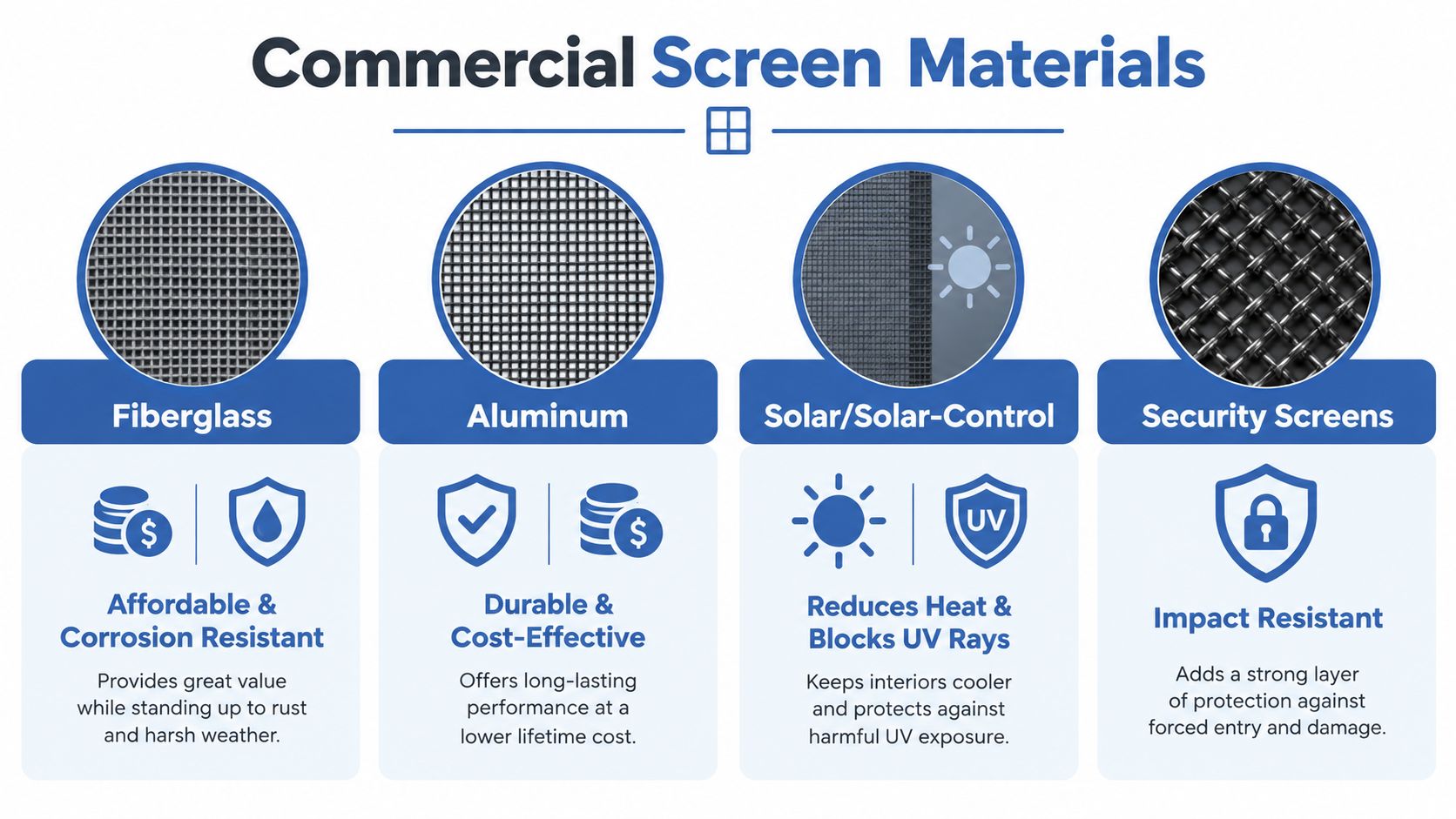
Four practical categories
Fiberglass is the common starting point. It's lightweight, corrosion-resistant, relatively inexpensive, and simple to install. It suits ordinary insect control where the screen won't face repeated impact or demanding solar-control requirements. Its flexibility can help it tolerate incidental contact, but it can lose tension or degrade when exposed to harsh sun and frequent handling.
Aluminum provides a firmer, more rigid mesh for areas that see more contact. It can be a sensible choice around commercial doors, service areas, and openings that need greater physical stability. The trade-off is that metal mesh can affect visibility and may require careful finish and corrosion evaluation in the surrounding environment.
Solar-control screens are selected for heat and glare management rather than basic insect exclusion. Their value depends on measurable properties such as solar heat-gain coefficient, visible transmittance, reflectance, absorptance, and openness factor. A darker mesh may look like the obvious choice, but color alone doesn't tell you how the completed assembly will perform.
Security screens address impact resistance and forced-entry deterrence. They aren't interchangeable with ordinary insect mesh, and they may restrict airflow, daylight, and outward visibility more noticeably. Use them where the security requirement justifies those compromises, not as a default upgrade for every window.
| Material Type | Best For | Solar Control | Durability | Cost Range |
|---|---|---|---|---|
| Fiberglass | Standard insect protection and light-duty commercial openings | Basic | Light to moderate | Lower |
| Aluminum | Higher-contact areas needing rigid mesh | Moderate, depending on finish and design | Moderate to high | Moderate |
| Solar or solar-control mesh | Sun-exposed façades, glare control, and cooling-load management | High when properly specified | Moderate to high | Higher |
| Security mesh | Impact resistance and forced-entry deterrence | Variable | High | Higher |
A low-cost mesh can become expensive if it needs repeated removal, repair, or cleaning because the material doesn't suit the opening. Before approving a product, compare frame strength, replacement availability, visibility, ventilation, and access for service. A useful guide to choosing the best screen for a porch can help clarify the basic material trade-offs, though commercial façades usually require a more formal specification.
Key Specifications That Matter for Commercial Installations
A product sample can look excellent in a hand, yet perform poorly once installed across a dusty, sun-facing building. Property managers should ask for specifications that describe the complete screen assembly, not just a color name or a claim that the mesh is “sun blocking.”
Start with mesh and strand dimensions
Mesh density affects insect exclusion, airflow, daylight, and visibility. Strand diameter affects physical durability and the amount of open view through the screen. Denser mesh and thicker strands can improve filtration or resistance to damage, but they also reduce free-air movement and may make the glass look darker.
A representative fiberglass screen used in technical testing had an 18 × 16 mesh pattern, an approximately 0.38 mm, or 0.015 inch, strand diameter, and an openness factor of 0.58. It was installed outside the glazing with a sealed perimeter and an air gap of about 20 mm, or 0.8 inch, according to the technical screen-performance document.
Evaluate the assembly in order
Confirm the openness factor. This indicates how much of the mesh is open space. Lower openness can support stronger solar control, but it can also reduce visibility, daylight, and ventilation.
Ask for solar measurements. For a sun-control product, request SHGC, solar transmittance, solar reflectance, solar absorptance, and visible transmittance. These values are more useful than relying on charcoal, bronze, or silver color descriptions.
Check the screen-to-glass relationship. Exterior mesh intercepts radiation before it reaches the glazing. The air gap, frame design, and cavity behavior influence heat buildup and convection near the glass.
Inspect the perimeter seal. Bypass airflow around an unsealed frame can undermine the screen's intended shading performance. Corners, fasteners, gaskets, and attachment points need to remain tight.
Match the frame to the façade. Verify wind exposure, operable-window clearances, emergency-egress requirements, cleaning access, and replacement logistics. A screen that works on a ground-floor storefront may not be serviceable on an upper-level office window.
Specification advice: Compare complete fenestration assemblies by orientation and glazing type. A screen's reported performance doesn't automatically equal whole-building savings.
In Phoenix, the best technical specification is the one that balances heat reduction with tenant views, daylight, ventilation, maintenance access, and safe operation. A very tight mesh may control more sun while making an operable window less useful. That trade-off should be decided before installation, not discovered after tenants complain.
Repair Versus Replacement Making the Right Call
A torn screen may need only a focused repair. Small localized tears, loose spline, or a damaged corner clip can usually be addressed while the frame remains square and the mesh still holds tension. Repair is a practical choice when the screen is relatively new, the surrounding hardware is sound, and the assembly is costly or difficult to access.
Replacement is worth considering when multiple defects appear simultaneously, frames are bent or corroded, or the building's performance requirements have changed. Pulled corners, brittle mesh, repeated spline failures, and broad areas that no longer sit flat indicate an assembly nearing the end of its service life. Fixing one defect may leave the remaining components close to failure.
Deciding Between Repair and Replacement
| Condition | Repair usually makes sense | Replacement deserves priority |
|---|---|---|
| Mesh damage | Small, isolated tear | Multiple tears or widespread degradation |
| Frame | Square and stable | Bent, corroded, or loose |
| Tension | Mesh remains evenly tensioned | Mesh sags across a large area |
| Performance need | Existing product still suits the façade | The building now needs solar or security control |
| Access cost | Easy ground or interior access | Repeated elevated-access visits are required |
Access conditions change the cost calculation for commercial properties. At a multi-story building, specialized suspended access for each service visit can make repeated small repairs more expensive in labor and coordination than a planned replacement program. Grouping work during one scheduled access window often gives the property manager better control over disruption and service costs.
Replacement also creates an opportunity to correct a poor original specification. Examples include an exterior screen without a dependable perimeter seal or mesh that blocks more useful daylight than the façade requires. The replacement should suit the window, attachment points, operating method, and Arizona exposure.
A darker or denser screen can reduce glare while limiting outward visibility and airflow. A heavier frame may withstand service demands longer, yet it can conflict with existing tracks or attachment points. For screens protecting operable windows, confirm that occupants can open, close, remove, and secure the system as intended.
Inspect a representative sample from each façade before approving a building-wide order. Compare shaded, south-facing, west-facing, ground-level, and upper-level elevations. Then group repairs and replacements by building zone, access method, and performance objective. That process preserves usable screens, identifies recurring installation problems, and prevents every opening from being treated as identical.
Energy Savings and Return on Investment from Solar Screens
Solar screens can support a commercial energy strategy, but the ROI calculation has to begin with the façade rather than a universal promise. Orientation, glazing, window-to-wall ratio, openness factor, interior temperature complaints, glare, HVAC schedules, and utility data all affect the result.
Exterior-mounted screens reduce solar heat gain more effectively than interior-mounted screens because the exterior mesh intercepts, reflects, or absorbs radiation before it reaches the glass. The documented comparison is approximately 46% reduction for exterior-mounted screens versus about 14% for interior-mounted screens, and one technical study reported an exterior-screen reduction in U-value of roughly 7%, as summarized by the Pacific Northwest National Laboratory window-attachment guidance.
Use the data without overpromising
A Washington, D.C., building-energy analysis found that window screens reduced cooling energy use by 21% to 29% compared with an unshaded house, with results varying according to screen density and glazing. The analysis also found a seasonal trade-off. Fixed shade screens left in place throughout all 12 months can increase heating energy use by blocking useful winter solar gain, while retractable screens operated during the cooling season produced the greatest net energy savings. Those findings shouldn't be transferred directly to every Phoenix property, but they show why climate, glazing, orientation, and operation matter.
For a practical ROI review, collect:
- Baseline utility data: Compare cooling-period consumption before installation with a comparable post-installation period.
- Façade exposure: Separate south- and west-facing windows from shaded or north-facing areas.
- Comfort complaints: Record hot workstations, glare reports, and rooms where blinds stay closed.
- Product specifications: Document openness factor, visible transmittance, SHGC-related data, reflectance, and frame sealing.
- Maintenance condition: Note whether dust, tears, or loose tension could reduce the intended performance.
Property managers comparing options can also review green building insights from Facility Management Insights for broader operational context. The screen itself isn't the whole ROI. Reduced cooling demand may combine with better tenant comfort, fewer glare complaints, improved appearance, and more controlled daylight.
For Arizona utility budgeting, use actual property bills rather than a generic estimate. The average electric bill in Arizona can provide general context, but a building-specific baseline is the number that should guide an investment decision.
Maintenance and Cleaning for Arizona's Dusty Climate
Phoenix screens collect more than ordinary outdoor dirt. The City of Phoenix identifies ozone and particulate pollution as primary air-quality concerns and specifically lists dust and smoke as local problems. PM10 means airborne particulate matter measuring 10 micrometers or less in diameter, and windblown particulate can settle on storefront mesh, office windows, frames, tracks, and entry surfaces.
Dust changes how a screen looks and how occupants see through it. It can also alter optical performance, restrict airflow, and increase the buildup that must be removed during the next service. A screen that remains intact but heavily coated may no longer deliver the appearance or solar-control behavior the property manager expected.
A practical cleaning sequence
Inspect before wetting. Check for tears, loose spline, bent corners, blocked weep paths, and screen movement. Wet cleaning a failing frame can turn a small defect into a replacement problem.
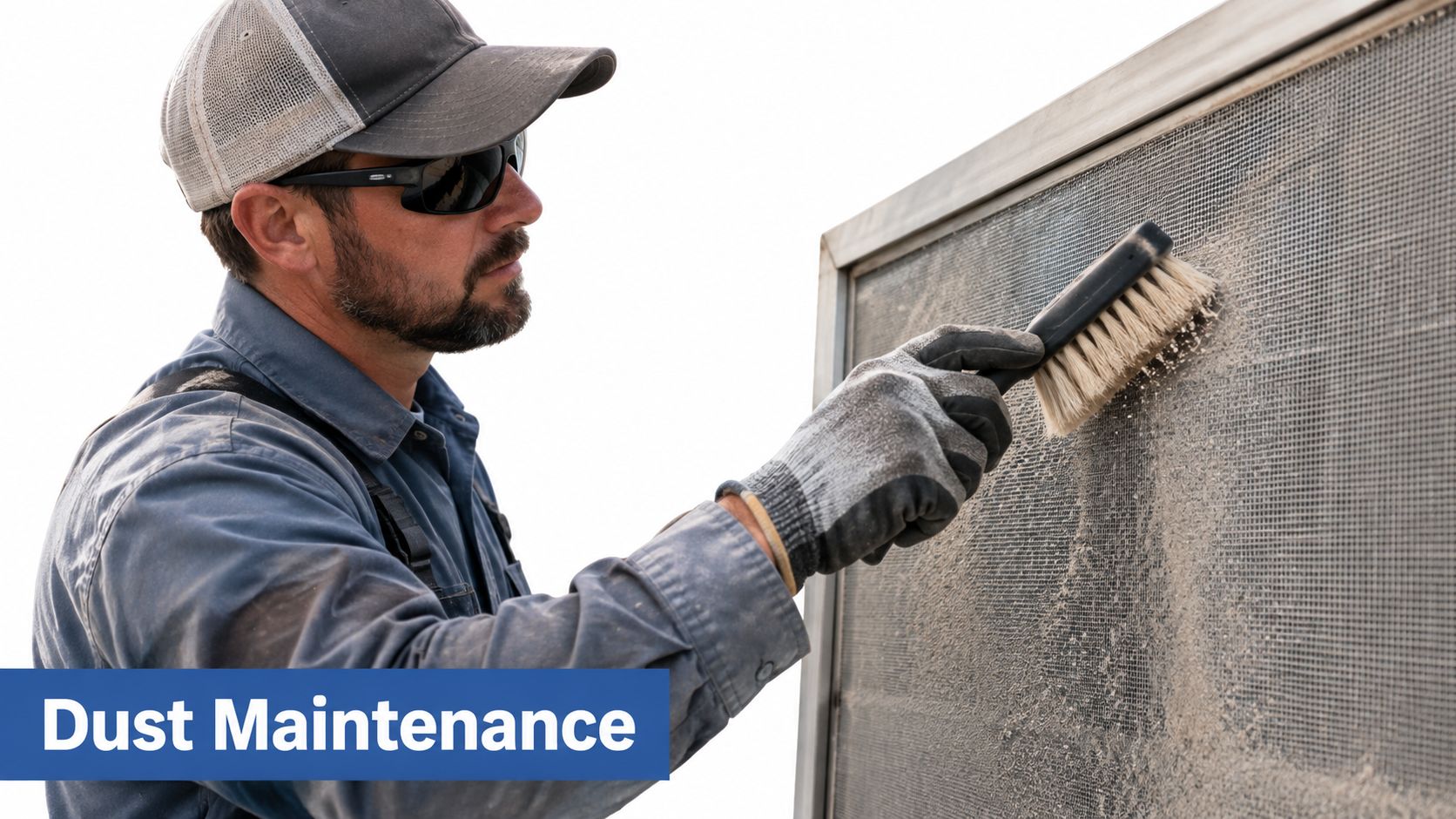
Remove loose dust gently. Use a soft brush or low-impact method that won't stretch the mesh. High-pressure water can deform frames, drive contamination into joints, or force water behind the screen.
Clean with controlled water. Pure-water systems can help reduce spotting on nearby glass when the equipment and access method suit the building. The goal is to remove particulate without grinding it into the mesh.
Rinse and inspect the tracks. Dust in tracks can prevent proper screen removal, seating, and locking. Track cleaning belongs in the same service visit, not as an afterthought.
Record defects by elevation. Note which screens face prevailing dust exposure, parking areas, loading zones, or high-traffic entrances. That record makes future scheduling more accurate.
The City of Phoenix air-quality information supports recurring maintenance because windblown dust can accumulate between appearance-based cleanings. Properties in Phoenix, Scottsdale, Tempe, Chandler, Gilbert, and Paradise Valley should plan around local dust events rather than waiting for glass complaints.
A detailed guide to cleaning window screens can help staff understand the difference between light upkeep and professional service. Screen cleaning should be coordinated with exterior glass work when access is already being arranged, provided the contractor can safely handle removal, elevation, and reinstallation.
Working with Professional Screen Installation and Maintenance Services
Commercial screen maintenance isn't a larger version of residential cleaning. It involves access planning, frame handling, façade protection, worker safety, weather decisions, and a documented method for returning each screen to service. On high-rise properties, a ladder-based approach may be unsuitable from the start.

For suspended work, OSHA states that employees on a two-point adjustable suspension scaffold must have both a guardrail system and a personal fall-arrest system. OSHA's powered-platform guidance also requires a compliant fall-arrest system and a written emergency plan addressing power failures, equipment failures, and other emergencies, as detailed in its two-point suspended scaffold requirements.
A property manager should ask how the contractor will handle:
- Building access: Identify roof anchors, tie-in points, staging areas, interior protection, and screen storage.
- Worker protection: Confirm the planned fall-protection system, equipment inspections, rescue access, and emergency procedures.
- Weather decisions: Establish wind monitoring, stop criteria, and postponement procedures before workers reach the façade.
- Screen control: Label or map removed screens so each unit returns to the correct opening and orientation.
- Condition reporting: Separate cleaning defects from replacement recommendations, with photographs and location notes.
The work plan should match the building. A ground-floor retail strip may need careful removal, soft-brush cleaning, track service, and reinstallation. A high-rise office tower may need suspended access, façade coordination, anchor review, and a schedule that avoids tenant peak hours. DIY work often fails because it treats screen care as a simple wash job while overlooking the access method and the consequences of a dropped, bent, or incorrectly seated panel.
The video below offers additional visual context for professional window-cleaning work:
South Mountain Window Cleaning, LLC provides commercial and high-rise window washing, screen and track care, and exterior cleaning for properties in Phoenix, Scottsdale, Paradise Valley, Chandler, Tempe, and Gilbert. Its commercial service model includes computerized scheduling, pure-water equipment, and a stated $2 million insurance policy, while high-rise work must still be evaluated against the building's specific access and safety requirements. The right contractor should give the property manager a written scope, access plan, inspection findings, and a clear distinction between cleaning, repair, and replacement.
South Mountain Window Cleaning, LLC offers commercial window washing with screen and track care for retail properties, offices, hospitality facilities, and high-rise buildings across the Valley. Visit South Mountain Window Cleaning, LLC to request a fast, free quote and set up a maintenance plan suited to Arizona dust, sun exposure, and building access needs.