
A lot of Arizona property owners hit the same wall. You roll out the pressure washer because the driveway looks rough after dust, tire marks, sprinkler rust, and a little monsoon grime. Ten minutes later, you're still working one skinny pass at a time, your arms are getting tired, and the concrete somehow looks worse because now it has clean lines next to dirty ones.
That's where a power washing surface cleaner starts to make sense. It isn't just a faster attachment. It's a different way to clean flatwork, and the difference matters on Valley properties where you're dealing with broad driveways, pool decks, sidewalks, restaurant pads, stamped concrete, pavers, and even areas near rooftop solar.
South Mountain Window Cleaning provides residential, commercial, and high rise window washing services in Phoenix, Scottsdale, Paradise Valley, Chandler, Tempe, Gilbert, Arizona. For property owners in those areas, the question usually isn't “Do surface cleaners work?” It's “Will this one work with my machine, on my surface, for my kind of mess?”
Why a Wand Stalls on a Flat Driveway
Saturday morning in Phoenix. The driveway has that familiar gray film on it, plus a few dark tire arcs where the car turns in. Near the garage, there's orange sprinkler staining. Out by the sidewalk, wind-blown dust has settled into the texture of the concrete.
Most homeowners grab the wand first because that's the part they already own.
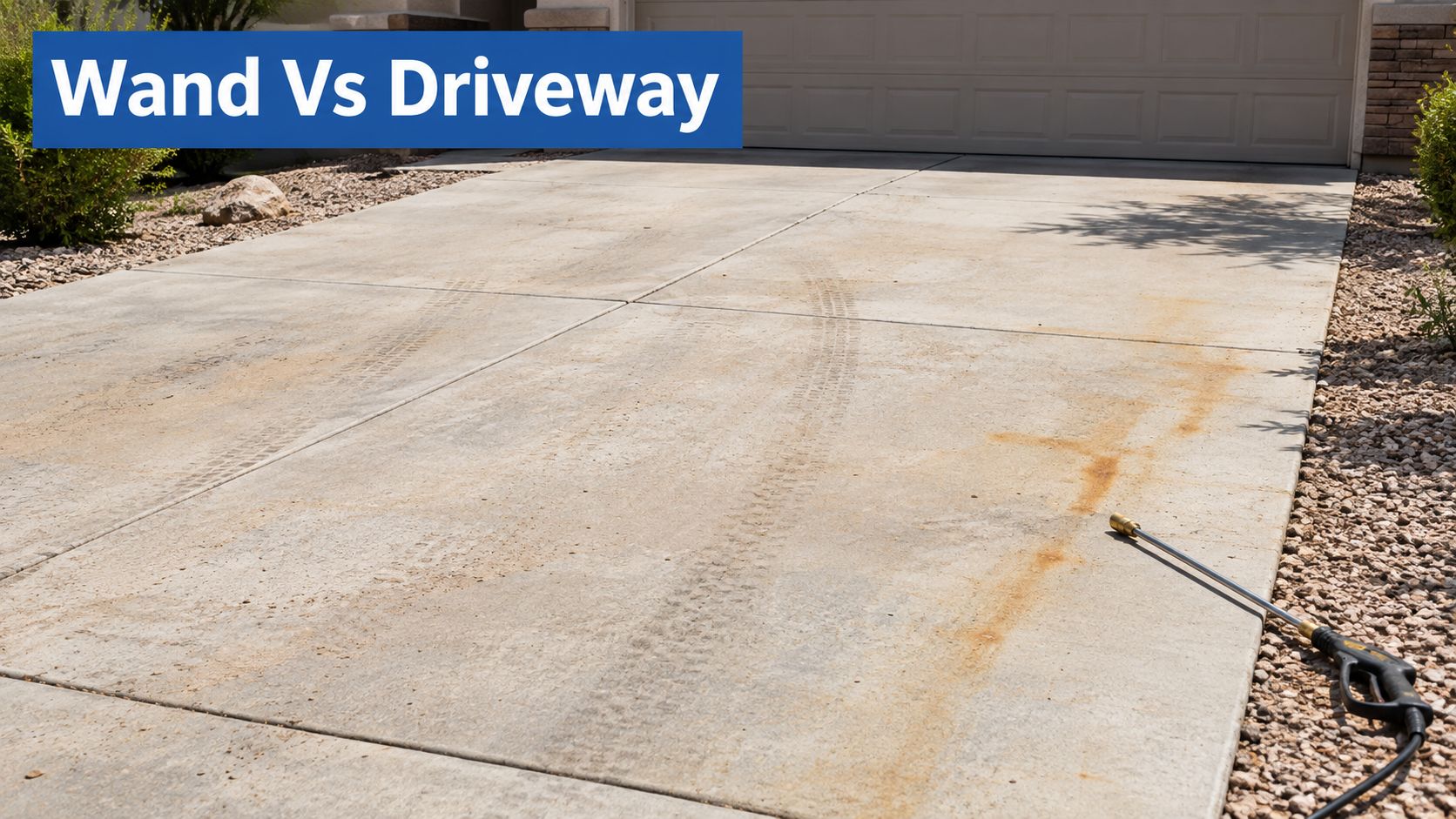
A wand works fine for edges, corners, vertical walls, and spot treatment. On a full driveway, it starts fighting you. One nozzle throws a narrow fan, so you have to move at the same speed, keep the same height, and overlap each pass the same amount. Miss by a little, and the concrete shows it.
Why stripes happen
Flat concrete punishes inconsistency. If you slow down in one spot, that patch gets more dwell time. If you lift the wand slightly, the cleaning power changes. If you angle too sharply, you can carve a brighter line into softer finishes.
That's why people get the “zebra stripe” look. The surface isn't cleaner overall. It's just unevenly cleaned.
A wand asks the operator to be the machine. A surface cleaner lets the machine handle the consistency.
Arizona surfaces make that even more obvious. Sun-baked concrete can hold onto embedded grime. Broom-finished and stamped concrete can also show wand marks fast if your distance changes from pass to pass. The more decorative the finish, the less forgiving it tends to be.
The tool that fixes the wand problem
A power washing surface cleaner was built for this exact job. Instead of one visible fan pattern, it uses spinning nozzles under a housing so the water hits the slab evenly across the cleaning path. That cuts down on striping, keeps overspray lower, and saves your shoulders on large pads.
If you're looking at broad concrete areas first, like a two-car driveway or long front walk, a good starting point is to see how driveway pressure washing service is typically handled on flatwork rather than trying to treat the whole slab like a detail job with a wand.
Parts of a Power Washing Surface Cleaner
If you set one on the shop floor and point at it piece by piece, the design makes a lot of sense. Every part exists because wand washing has a weakness.
What you're actually looking at
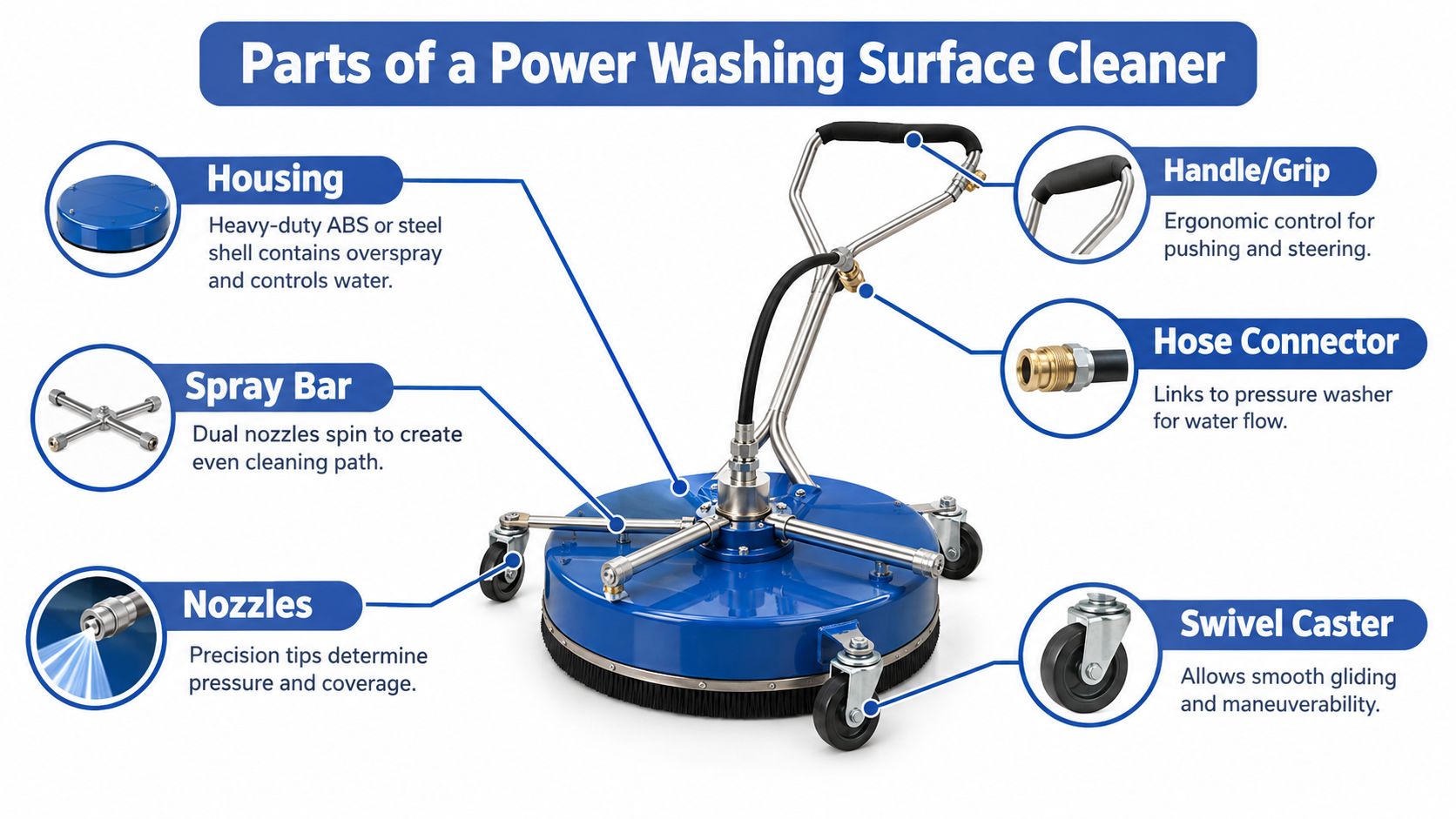
The housing is the round or rectangular shell. On many units it's heavy-duty ABS or steel. Its job is simple. It contains overspray and helps keep dirty water from blasting back onto your shoes, the wall, or the parked car nearby.
Inside that housing sits the spray bar. Water pressure drives it. There's no motor in the deck. Once water enters the bar and exits through angled nozzles, the bar spins and sweeps the surface in tight circles.
The parts that do the real work
Here's how the main pieces break down:
- Spray bar: Usually a dual-nozzle or multi-nozzle arm that rotates under pressure. Twin nozzles help balance torque and keep the head from chattering across the slab.
- Nozzles: These are the precision tips that determine how the machine divides pressure and flow. Wrong nozzles can wreck performance fast.
- Swivel inlet: This lets the hose connect without twisting up every time you turn the cleaner.
- Wheels or casters: They set the working height and help the housing glide instead of dragging.
- Skirt or splash guard: This flexible edge traps spray and grit so the cleaning path stays controlled.
- Handle bar or frame: The operator uses this to steer, push, and keep the deck level.
Why the design feels easier to use
A good cleaner glides because the deck rides on a thin cushion of water. That's also why balance matters. If one nozzle wears faster than the other, the bar can lose its smooth feel and the finish can get patchy.
Practical rule: If a surface cleaner starts pulling to one side, chattering, or leaving odd arcs, check the nozzles before you blame the machine.
For larger properties and routine exterior maintenance, it also helps to understand the broader tool setup around hoses, fittings, nozzles, and commercial accessories. That's the same equipment logic discussed in this overview of commercial power washing supplies.
Why Surface Cleaners Beat Wand Washing
A long driveway looks simple until you try to clean it with a wand. The fan pattern is narrow, your overlap changes as your arms tire, and every small change in height shows up as a lighter or darker lane once the slab dries. On broad flatwork, a surface cleaner solves a control problem more than a power problem.
Earlier sizing guidance in the article already showed the usual production ranges by head size and flow. The practical lesson is the part Arizona owners often miss. A wider deck only helps when the washer can feed it enough GPM to keep the spray bar working evenly. If the flow is short, the job slows down, stripe risk goes up, and the larger head can feel worse instead of better.
Three places the surface cleaner wins
First, it cleans a full circular path under the housing instead of asking the operator to paint the concrete line by line with a wand.
Second, it evens out human error. A wand depends on steady pace, steady height, and careful overlap on every pass. A surface cleaner handles that more like a lawn mower handles grass. You still steer it, but the tool keeps the cutting path consistent.
Third, it keeps water and grit better contained. That matters on Valley properties where overspray can hit stucco walls, storefront glass, parked vehicles, pool decking, or rock landscaping near the slab.
| Metric | Wand Washing | Surface Cleaner |
|---|---|---|
| Coverage pattern | Narrow fan, operator-controlled overlap | Wide, even cleaning path under a housing |
| Stripe risk | Higher if pace or height changes | Lower when flow and nozzles are matched |
| Overspray control | More open spray | Better contained by the deck and skirt |
| Operator fatigue | Higher on broad flatwork | Lower on long passes |
| Best use | Edges, corners, vertical areas, spot cleaning | Driveways, sidewalks, patios, pads, walkways |
The labor difference shows up fast on real jobs. A restaurant patio, school breezeway, or HOA sidewalk still needs edge work with a wand, but the wide open center goes much faster with a surface cleaner because the tool builds consistency into each pass.
That said, “faster” is not the whole buying decision. Arizona properties add three trade-offs that matter just as much. You have to match GPM to head width, not just chase the highest PSI sticker. You have to know when grease, gum, or food spills need hot water instead of a bigger deck. You also have to protect finishes that can scar or haze if the setup is wrong, especially stamped concrete, pavers, coated surfaces, and even nearby solar equipment that should never be treated like standard flatwork.
Surface cleaners beat wand washing on flat concrete because they make the result more even, more repeatable, and less tiring. They do not replace judgment. They work best when the machine, the surface, and the soil all match the tool.
Matching PSI and GPM the Right Way
Most renters and first-time buyers stare at the PSI sticker. That's understandable, but it's only half the story. Pressure helps break the bond between dirt and the surface. Flow, measured as GPM, carries the loosened debris away and keeps the spray bar spinning at the speed it needs.
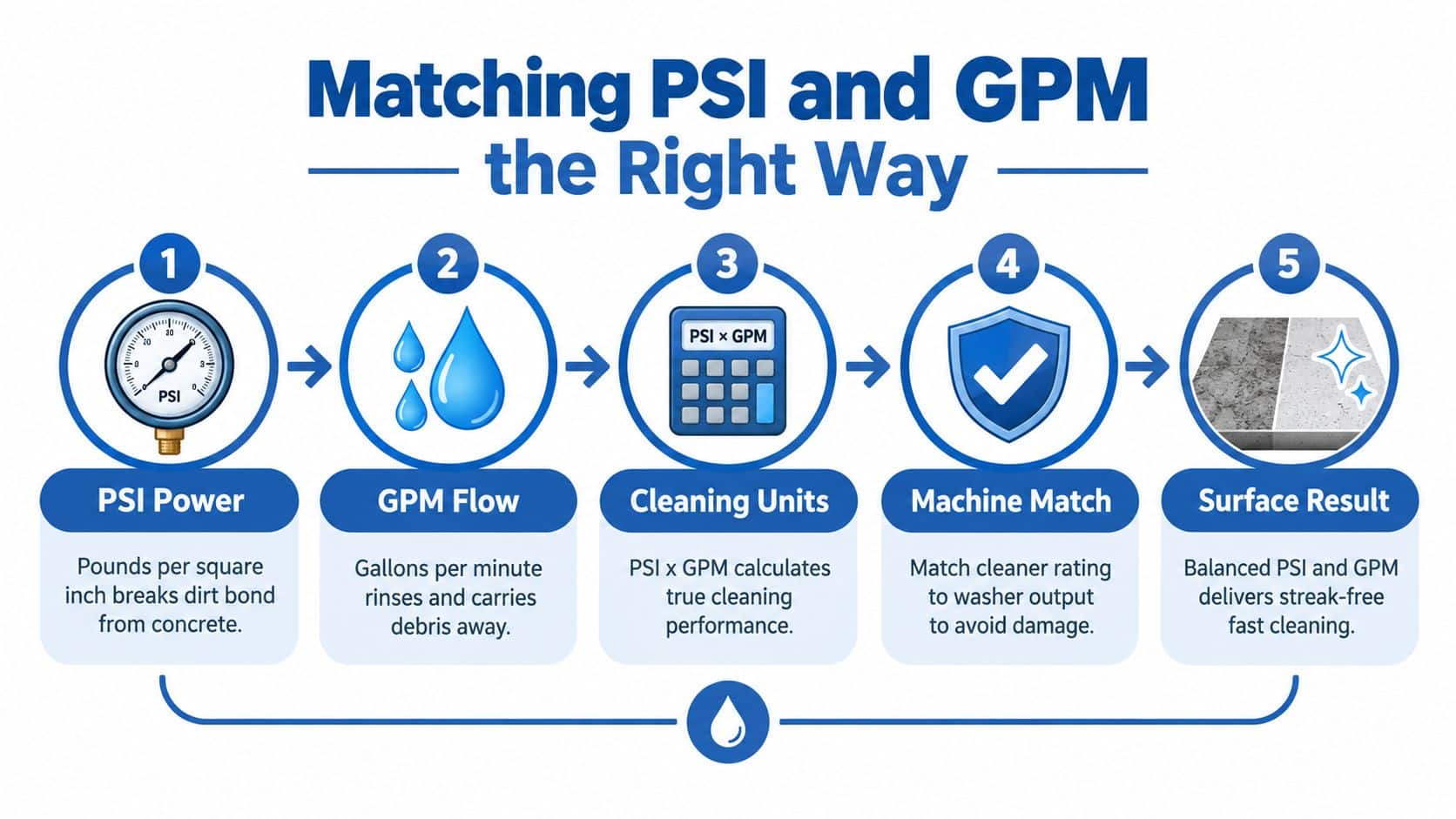
Think of it this way. PSI is the scraper. GPM is the rinse hose. If you have scraping force but not enough water volume, the head may spin poorly, stall, or leave stripes.
Why low flow causes trouble
Recent compatibility guidance notes that surface cleaners work best at 2500+ PSI and 2.5+ GPM, while another manufacturer FAQ frames surface cleaning at about 1500 PSI, 3.5 GPM, and 5,250 to 15,000 cleaning units, which shows why flow matters as much as pressure when matching a washer to a deck size, as explained in this surface cleaner compatibility guide.
That's where buyers get tripped up. A machine can look strong on paper because the PSI is high, but if the GPM is modest and the cleaner head is too large, the rotor won't stay happy.
Here's a quick visual if you want to see the relationship in action:
A practical match for the real world
A 24-inch surface cleaner is typically matched to a pressure washer delivering at least 13.25 L/min (about 3.5 GPM) at 3000 PSI, with a 4000 PSI maximum and 30 L/min maximum flow, according to this 24-inch Whirl-A-Way specification. The reason is mechanical, not marketing. The rotating head needs enough water volume to keep the spray bar moving evenly. If flow is too low, the cleaner can stall and leave striping.
Don't buy deck width first. Match the deck to the pump you already have.
If you're comparing service options instead of attachments, this is also where a contractor with the right machine setup can make the difference between a clean slab and an afternoon of swirl marks. One practical example is South Mountain Window Cleaning, LLC, which handles flat-surface power washing as one service option alongside window cleaning and exterior maintenance.
Picking a Surface Cleaner Width
Width changes how a job feels in your hands. A cleaner that is too wide for your machine or too bulky for the space will fight you the whole time. A cleaner that fits the pump and the property will track smoothly, much like using the right mower deck for the yard instead of forcing the biggest one through every gate.
The mistake Arizona buyers make is focusing on inches first. Width matters, but water volume decides whether that width is useful. A larger head needs more GPM to keep the spray bar spinning evenly and the cleaning path consistent. If flow is light, the head may slow down, leave striping, and make a big driveway take longer instead of less time.
Width is really a fit question
A 24-inch head can be a smart choice on open concrete. It can also be the wrong choice on a home with side yards, pool fencing, planters, and tight turns near garage walls. Valley properties often mix broad flatwork with awkward pinch points, so the "best" width is usually the one you can keep moving without constant stops, lifting, and repositioning.
That is why facility managers and homeowners should check the property before they shop.
- Measure the narrowest access point. Side gates, walkway returns, bollards, and furniture gaps matter more than the widest part of the driveway.
- Match head size to GPM, not PSI alone. High pressure with modest flow can still leave a larger cleaner underfed.
- Leave room for edge work. Even a well-sized surface cleaner will not replace the final wand pass along borders, drains, posts, and corners.
- Consider the surface itself. Decorative concrete, pavers, and cool-deck areas often reward a more controlled pass than an oversized head.
A practical way to choose
Smaller heads usually make sense for tighter residential layouts and mixed surfaces. Mid-size heads often fit the widest range of Arizona driveways, patios, and HOA walkways. Large heads earn their keep on open commercial pads where access is simple and the washer has the flow to support them.
That last point trips people up. A wide head is only productive on wide-open ground with enough water behind it.
The rule that saves the most frustration
Choose the head that fits the smallest repeated pass on the job, not the biggest open patch. If you will spend half the day turning sideways to clear posts, backing out of narrow runs, or feathering around stamped sections, the larger deck is costing time, not saving it.
For Arizona properties, width is also a surface-protection decision. A head that is easy to control helps you avoid scarring softer decorative areas and reduces the temptation to rush across pavers or textured finishes. That matters just as much as cleaning speed.
Surface Cleaner Uses Across Arizona Properties
Arizona gives flat-surface equipment a real workout. The dirt isn't just “dirt.” It's fine dust, hard water residue, windblown organics, grease near commercial entries, and seasonal buildup that bakes into concrete under full sun.
Where they make the most sense
On residential jobs, surface cleaners are a natural fit for broom-finished driveways, front walks, back patios, and many pool-deck paths. On commercial sites, they shine on sidewalks, retail entries, HOA walkways, loading areas, and broad pads where a striped finish looks sloppy to tenants and customers.
A few Arizona-specific examples come up all the time:
- Driveways and front walks: Good for long, open concrete where dust, tire marks, and organic staining collect.
- Pool-deck traffic lanes: Useful on the flat walking areas around the pool, especially where people track in grime and mineral residue.
- HOA paths and community sidewalks: Helpful where crews need controlled overspray and consistent appearance.
- Restaurant approaches and service pads: Better than wand work when broad concrete needs a more even finish before spot treatment.
- Sports courts and recreation pads: Strong fit for large open hard surfaces where visual uniformity matters.
Where Arizona property care gets more technical
Some flat areas sit close to stucco walls, decorative stone, metal gates, and glass. That's one reason property managers often think in terms of keeping outdoor surfaces safe while cleaning, not just getting them bright. This short piece on keeping outdoor surfaces safe is useful because it frames cleaning as part of surface care, not just stain removal.
Solar-related properties add another layer. Dust accumulation on photovoltaic panels can reduce system efficiency by up to 30 to 50%, according to research on solar cell cleaning. That doesn't mean you should roll a surface cleaner over the panels themselves. It does mean the surrounding flat roof walkways, access paths, and service areas often deserve attention so maintenance crews can work on cleaner, safer footing.
For a broader look at jobs where this equipment fits, flatwork categories like driveways, sidewalks, patios, and commercial pads are well represented in flat surface cleaning examples.
When a Surface Cleaner Is Not Enough
A surface cleaner is excellent at one kind of work. Broad, hard, mostly level surfaces with the right machine behind it. Trouble starts when people treat it like a universal answer.
Grease and contamination need a different plan
For greasy commercial pads, restaurant drive-thrus, and dumpster areas, heat changes the game. Independent guidance notes that hot water at roughly 200 to 250°F is what breaks down petroleum and heavy grease at the molecular level, making it more effective than standard cold-water flat-surface cleaning for those jobs, as discussed in this power washing FAQ on grease cleaning.
That's why a cold-water surface cleaner can leave a greasy area looking half-done. It may remove loose soil but struggle to fully cut bonded oils.
If the contamination is oily, the question isn't just “surface cleaner or wand.” It's whether the job needs hot water, detergent, or both.
Surfaces that need another method
Some surfaces are poor candidates for a rolling high-pressure deck. Here's a practical breakdown:
| Surface / Stain | Best Method | Why a Surface Cleaner Falls Short |
|---|---|---|
| Greasy drive-thrus and dumpster pads | Hot-water pressure washing with detergent | Cold-water deck cleaning may not break down bonded grease effectively |
| Stamped or colored concrete | Lower-pressure washing, detergent, and careful rinsing | High pressure can mark texture or affect the finish |
| Pavers with polymeric sand joints | Gentle cleaning and targeted rinsing | Rotating jets can blow joint sand out |
| Vertical block walls and stucco | Wand or soft-wash approach | Surface cleaner housings are built for flatwork, not walls |
| Solar panels | Brush, purified water, or panel-safe cleaning method | A pressure deck is the wrong tool for panel surfaces |
| Tight corners, curbs, stair edges | Wand work | The deck can't reach or ride properly |
Don't force the wrong tool
Experience matters more than horsepower. Decorative hardscapes common in Phoenix, Scottsdale, and other Valley communities can look tough, but they aren't all pressure-tolerant in the same way. If you're cleaning sealed concrete, colored finishes, pavers, or anything near sensitive glazing and trim, the safest move is usually to choose the method around the surface first, then the machine.
Maintenance Safety and Final Checklist
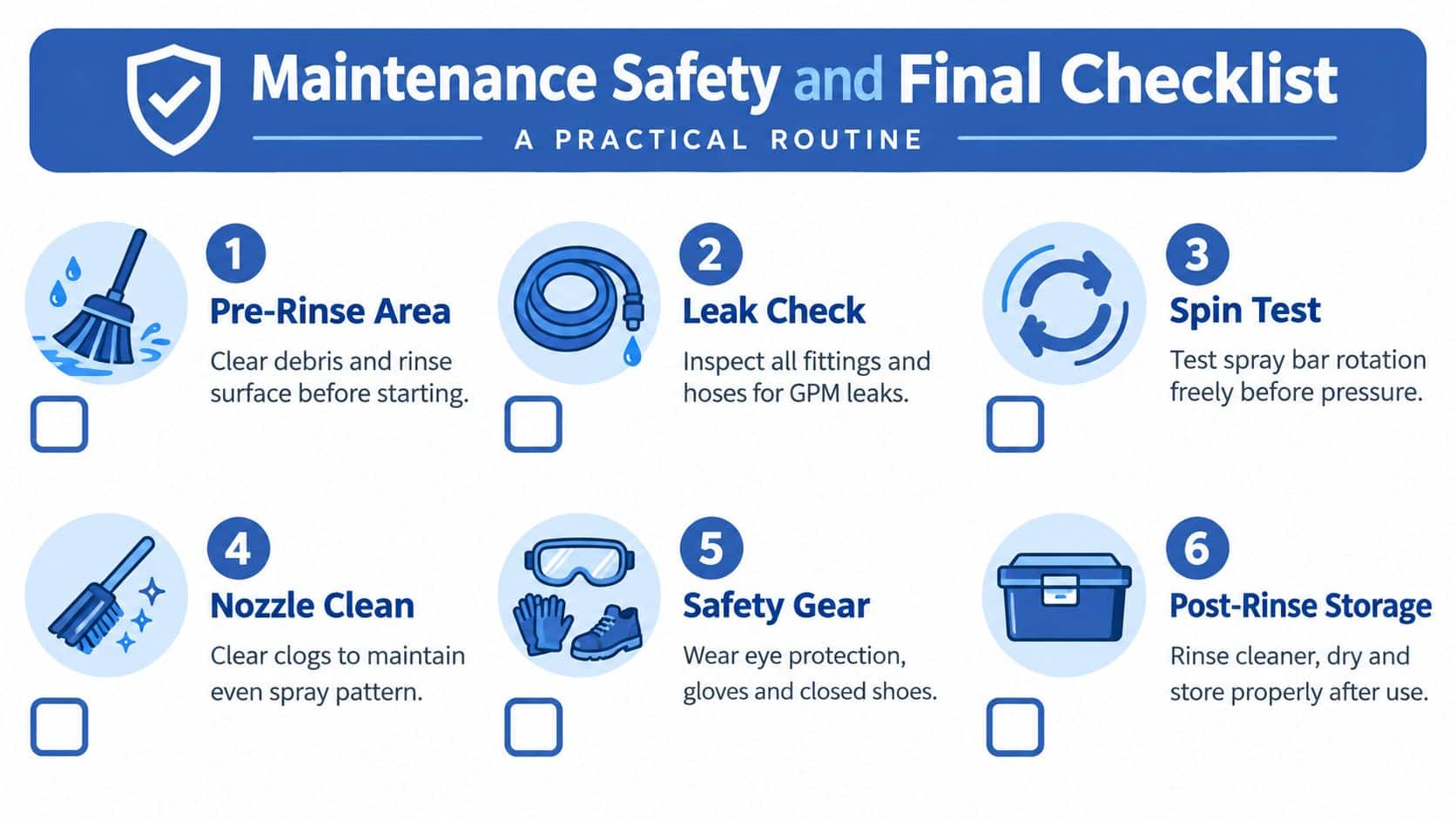
A surface cleaner doesn't ask for complicated maintenance, but it does reward routine. Most ugly results come from small preventable issues. A worn nozzle, a partial clog, a leaking fitting, or a deck that's being pushed too aggressively.
Before you pull the trigger
Start with the ground, not the machine. Sweep off gravel, loose leaves, and anything the deck can catch and fling around. Then pre-rinse the area so you're not grinding dry grit under the housing.
Next, check the setup:
- Hose fittings: Look for drips or loose quick-connects.
- Nozzle condition: Uneven wear changes the spray pattern and bar balance.
- Free spin: With the machine off, make sure the bar isn't jammed.
- Surface check: Make sure the slab, coating, or jointed surface is suitable for this tool.
Safer operating habits
Keep the cleaner level and moving. Don't lift one side to “dig in.” That defeats the whole point of even cleaning. Closed-toe boots, gloves, eye protection, and hearing protection are common-sense gear whenever you're running a pressure washer.
A few habits prevent most problems:
- Control distance: Let the wheels or casters hold the intended height.
- Mind runoff: Direct dirty water away from entries, parked vehicles, and delicate beds.
- Use the wand for detail work: Don't try to jam the deck into corners or against vertical walls.
- Flush after use: Clean water through the bar helps clear residue before storage.
For decorative surfaces, maintenance doesn't stop at washing. Sealed and stamped finishes often need gentler cleaning and periodic protection. If you're dealing with decorative slabs, this guide on how to clean and seal stamped concrete is a useful companion because it explains why appearance and surface life go together.
A saveable final checklist
Print this mentally before every job:
PPE ready
Eye protection, gloves, boots, and hearing protection if the washer is loud enough to warrant it.Machine matched
The washer's PSI and GPM fit the cleaner head you're using.Surface approved
Concrete, coating, or paver condition has been checked so you're not using the wrong method.Nozzles verified
Both nozzles spray evenly and the bar spins freely.Runoff managed
Dirty water won't pool where people walk or flow where it shouldn't.Post-rinse done
Flush the unit, drain it, and store it so the housing and bar dry out properly.
One last note for mixed-use properties. If you ever need cleaning inside loading areas, garages, or service spaces, indoor work changes the runoff and safety conversation completely. This overview of indoor power washing conditions gives a good sense of why containment matters so much more there.
If you'd rather skip the equipment matching, test passes, and surface-risk guesswork, South Mountain Window Cleaning, LLC handles exterior cleaning that overlaps directly with this kind of work, including driveways, walkways, commercial flatwork, dumpster pads, building exteriors, window cleaning, and solar panel cleaning. To see the full service range for Phoenix, Scottsdale, Paradise Valley, Chandler, Tempe, and Gilbert, visit South Mountain Window Cleaning, LLC.