
You're watching the first heavy monsoon storm roll across the Valley. Rain hits the roof, runs toward the gutters, and then spills over the edge in muddy sheets because dust, roof grit, and seed pods have formed a dam. Within minutes, stucco is streaked, soil is washing away, and water is collecting near the foundation.
That scene is common enough to make gutter cleaning in Phoenix a seasonal home-protection task, not an occasional cosmetic chore. Phoenix's dry climate creates a different maintenance pattern from wetter cities. Debris sits in place through long dry stretches, then sudden monsoon rainfall tests every gutter, downspout, hanger, and seam at once.
Why Phoenix Homes Still Need Clean Gutters
A Phoenix gutter can sit dry for months, collecting fine dust, roof grit, and windblown plant material. Then a monsoon burst arrives and asks that same channel to move a large volume of water quickly. Phoenix averages only about 7.2 to 7.22 inches of precipitation per year, with June typically near 0.0 to 0.02 inches and August the wettest month at about 0.9 to 0.93 inches, according to the National Weather Service Phoenix climate documentation. The low total hides the maintenance problem: long dry storage followed by sudden runoff.

What happens during a clogged-gutter storm
Fine dust may look harmless until it mixes with mesquite pods, palo verde litter, roof granules, and leaves. The material settles in corners and near outlets. Rain then turns the loose layer into a heavy, compacted mass that narrows the route water needs.
The first visible sign may be overflow at the roof edge. From there, water can stain stucco, soak fascia boards, erode garden beds, or collect near the foundation. A sagging gutter also makes the roofline look uneven and neglected, which affects curb appeal.
Cleaning does not correct every drainage problem. It does give runoff a clear path through the gutter and downspout, making it easier to spot damaged hangers, separated seams, or poor discharge locations during inspection. Homeowners and property managers can also use home maintenance real estate APIs to organize property-care information alongside physical checks.
For the broader reasons this work protects a home, see this guide to the importance of gutter maintenance.
Practical rule: In Phoenix, schedule attention around the combination of dry debris buildup and sudden water loading, not rainfall totals alone.
How Desert Dust and Monsoon Rain Create Clogs
A gutter can look clear from the ground while its most important passage is already restricted. The trouble often begins where the wide channel narrows, especially at the outlet, elbows, and downspout connections. These points work like tight bends in a pipe. Water slows, grit settles, and plant debris has fewer routes out.
A partly blocked downspout can send water backward through the entire gutter run. During a storm, that trapped water may spill over the roof edge instead of moving toward the discharge point. The result can include stained stucco, wet fascia, shifted hangers, or erosion near the place where runoff leaves the downspout.
Why the downspout deserves special attention
Fine desert dust creates a second problem after rain. Once damp sediment sits against metal, it can keep moisture near seams, joints, and fasteners. Repeated exposure may increase corrosion risk, turning a blockage into a possible repair issue.
The gutter channel is only one part of the drainage path. A cleaning is incomplete if material is removed from the top but the downspout remains restricted. Loose debris can also be blown from one roofline area to another without confirming that water can pass through the system.
Effective work follows the debris through the whole route. Dry material is removed by hand, the downspout is flushed, and the system receives a flow check. That process helps reveal separated joints, damaged end caps, loose hangers, or an outlet that discharges too close to the home.
Phoenix-area service guidance from Grizzly Rain Gutters' Phoenix cleaning service supports checking the system before and after the storm season, since those visits address different conditions. A homeowner can use the same decision rule: inspect the narrow points, confirm downspout flow, and look for corrosion before treating the job as finished.
When to Schedule Gutter Cleaning in Phoenix
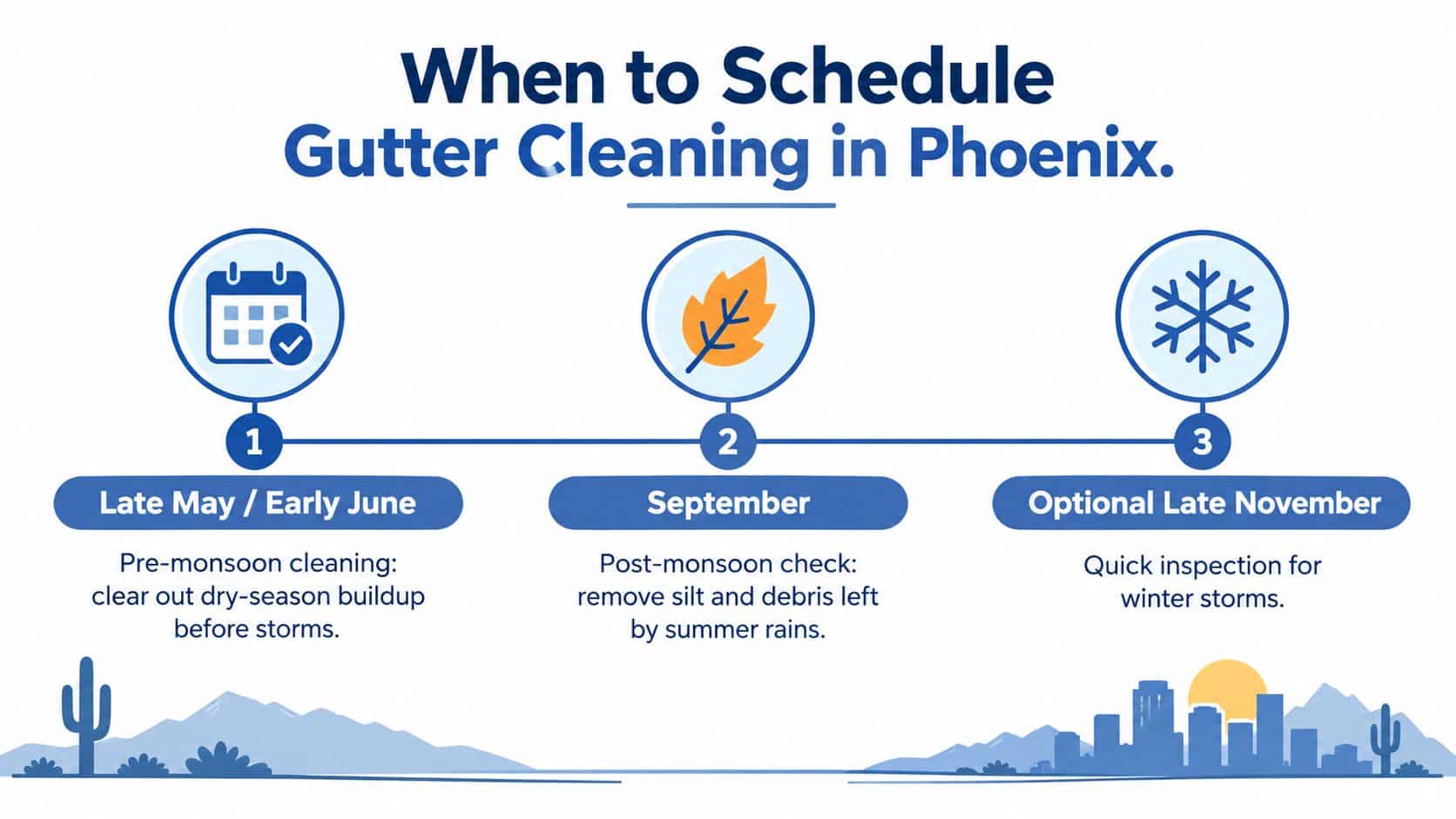
A Phoenix gutter calendar works best as a two-season system, not a once-a-year reminder. Book the first cleaning in late May or early June, before Arizona's monsoon season starts on June 15. Removing dry-season dust, roof grit, and litter beforehand keeps stormwater from pressing that material into outlets and elbows.
The second service window is October or November, after summer storms, wind, and shifting debris have tested the drainage system. Clearing leftover silt then also gives you a chance to spot movement or wear at hangers, joints, end caps, and seams.
A practical calendar for homeowners
- Late May or early June: Remove dust, roof grit, pods, and litter before monsoon storms.
- June 15 through September 30: Watch for overflow, sagging, or water spilling from corners during storms.
- October or November: Clear storm-season residue and inspect connections for movement or damage.
- Between visits: Check the roofline after windy weather, especially where trees overhang the roof.
The exact interval depends on your dust load. Homes near mesquite, palo verde, palms, or other debris-producing trees may need closer checks. Blowing dust and nearby construction can fill gutters faster too. Treat overflow, a silent downspout, or staining below the gutter as a prompt for service rather than waiting for the next date.
The pre-monsoon visit is like clearing a funnel before pouring water through it. Skip that preparation, and compacted debris can restrict flow during the season's heavy rainfall. Skip the post-monsoon visit, and silt or loosened connections may remain unnoticed through the next dry stretch. Use this Phoenix guide to the best time for gutter cleaning to match the appointment to your roof, trees, and exposure.
Here's a useful visual explanation of how roof drainage and cleaning decisions fit together:
DIY vs Hiring a Pro in Phoenix What to Weigh
DIY gutter cleaning can make sense for a comfortable homeowner working on a straightforward, single-story property with stable ground, accessible gutters, and light debris. It becomes a different decision when the roof is steep, the home has multiple levels, the downspouts are difficult to reach, or the work requires repeated ladder moves in Arizona heat.
The main comparison isn't just price. It includes fall exposure, equipment, liability, time, and whether the person doing the work can identify hidden damage instead of removing visible debris.

A side-by-side decision
| Factor | DIY Approach | Professional Service |
|---|---|---|
| Safety | You manage ladder placement, balance, heat, and roof access. | A trained crew brings safety procedures and purpose-fit equipment. |
| Tools | You may need a ladder, gloves, scoop, hose, and access tools. | The crew arrives with cleaning and flushing equipment suited to the property. |
| Liability | You carry the consequences of a fall or accidental property damage. | You can verify the company's insurance before work begins. |
| Inspection | You may notice obvious debris or leaks. | A thorough service can also check flow, hangers, seams, and connection points. |
| Time | You supply the labor and cleanup. | The crew handles removal, testing, and jobsite cleanup. |
| Best fit | Accessible, low-risk gutter sections and confident homeowners. | High, complex, fragile, or difficult-to-access systems. |
OSHA's general-industry fall-protection rules are relevant to exterior work performed at height, with protection required at 4 feet or more above a lower level in the situations covered by the standard. The rules address guardrails, safety nets, personal fall arrest systems, and powered platforms, as summarized by the National Window Cleaning Authority's safety guidance.
For a DIY job, never treat a ladder as a substitute for a plan. Keep your feet and hands secure, avoid working when heat or wind makes concentration difficult, and don't reach sideways to save a ladder move. If the setup feels improvised, hiring a professional is the safer choice. These safe gutter-cleaning methods offer additional preparation guidance.
What to Expect From a Professional Gutter Cleaning Crew
A professional service should do more than remove the material that's easiest to see. The benchmark is a complete drainage check, from the upper gutter channel through the downspout discharge point.
The service sequence
First, the crew assesses access and condition. Technicians should look at roof height, ladder positions, gutter guards, visible sagging, loose hangers, corroded areas, seams, and end caps. A clear quote should explain what the service includes before work starts.
Next, workers remove debris by hand. Hand removal lifts out compacted dust, rocks, roof grit, seed pods, and organic material without redistributing it across the roof. The crew should collect the waste and leave surrounding areas orderly.
Then, they clear the downspouts and elbows. These narrow sections often determine whether the whole system works. A gutter can look clean at the top and still fail if the outlet remains restricted.
Finally, the crew flushes and tests the system. Phoenix-area guidance identifies full-system flushing after dry debris removal as a critical part of restoring drainage capacity. A flow test shows whether water travels through the gutter, downspout, and discharge point.
What to verify before booking
Ask whether the quote includes downspout flushing, visual inspection, cleanup, and documentation of problems. Request proof of insurance, especially for work at heights. Arizona doesn't appear to require every window-cleaning business to carry general liability insurance statewide, although local jurisdictions may request proof when issuing a business license, as explained by this Arizona insurance overview for window cleaners.
South Mountain Window Cleaning provides residential, commercial, and high-rise exterior cleaning in Phoenix, Scottsdale, Paradise Valley, Chandler, Tempe, and Gilbert. Its listed services include gutter and downspout cleaning, and the company identifies itself as licensed, bonded, and insured. You can use this Phoenix gutter cleaning pricing guide to prepare questions about access, scope, and the quote.
Hiring checkpoint: A credible crew should be able to explain how it will verify downspout flow, not just how it will remove visible debris.
High-rise or building work requires an even more careful safety review. OSHA-aligned rope-access guidance calls for each worker to use a separate independent personal fall-arrest system, with anchorages capable of supporting at least 5,000 pounds per attached worker, according to this rope-access safety reference. For rope-descent systems, OSHA's rule limits use above 300 feet unless no other access method is feasible or another method creates a greater hazard, as described in this suspended-access planning guide.
Keep Your Gutters Flowing and Your Home Looking Its Best
Gutter care works best as part of a broader exterior routine. Phoenix dust settles on glass, screens, stucco, roof surfaces, solar panels, and hardscape, so a home can have clean gutters while still looking weathered. Coordinating gutter service with window cleaning, house washing, roof observation, and other exterior work creates a more complete inspection of the building envelope.
Start with a simple seasonal checklist:
- Before monsoon: Schedule gutter and downspout cleaning, then confirm discharge points direct water away from the foundation.
- During storms: Watch from the ground for overflow, dripping seams, or water pouring from corners.
- After monsoon: Look for sagging sections, stained stucco, loose hangers, and sediment left near outlets.
- Throughout the year: Trim branches that overhang the roof and keep growth from blocking downspout exits.
Don't use gutter guards as a reason to ignore the system. Guards can reduce the amount of debris entering the channel, but dust and fine sediment can still collect on top or move into openings. The roofline still needs inspection, and the downspout still needs a flow check when symptoms appear.
Curb appeal also depends on the details people notice from the street. Straight gutters, clean fascia, clear windows, washed walkways, and unstained stucco make the property look cared for. Businesses planning a broader exterior presentation can also review resources about digital ads for pressure washing while organizing recurring maintenance around customer visibility.
The seasonal plan is straightforward. Clear the system in late May or early June, monitor it through the June 15 to September 30 monsoon period, and schedule a post-monsoon inspection in October or November. If overflow or sagging appears sooner, act before the next storm tests the same weak point.
South Mountain Window Cleaning, LLC offers gutter cleaning and downspout clearing along with residential, commercial, and high-rise window washing in Phoenix, Scottsdale, Paradise Valley, Chandler, Tempe, and Gilbert. Visit South Mountain Window Cleaning, LLC to request a quote and schedule exterior maintenance before the next monsoon storm.