
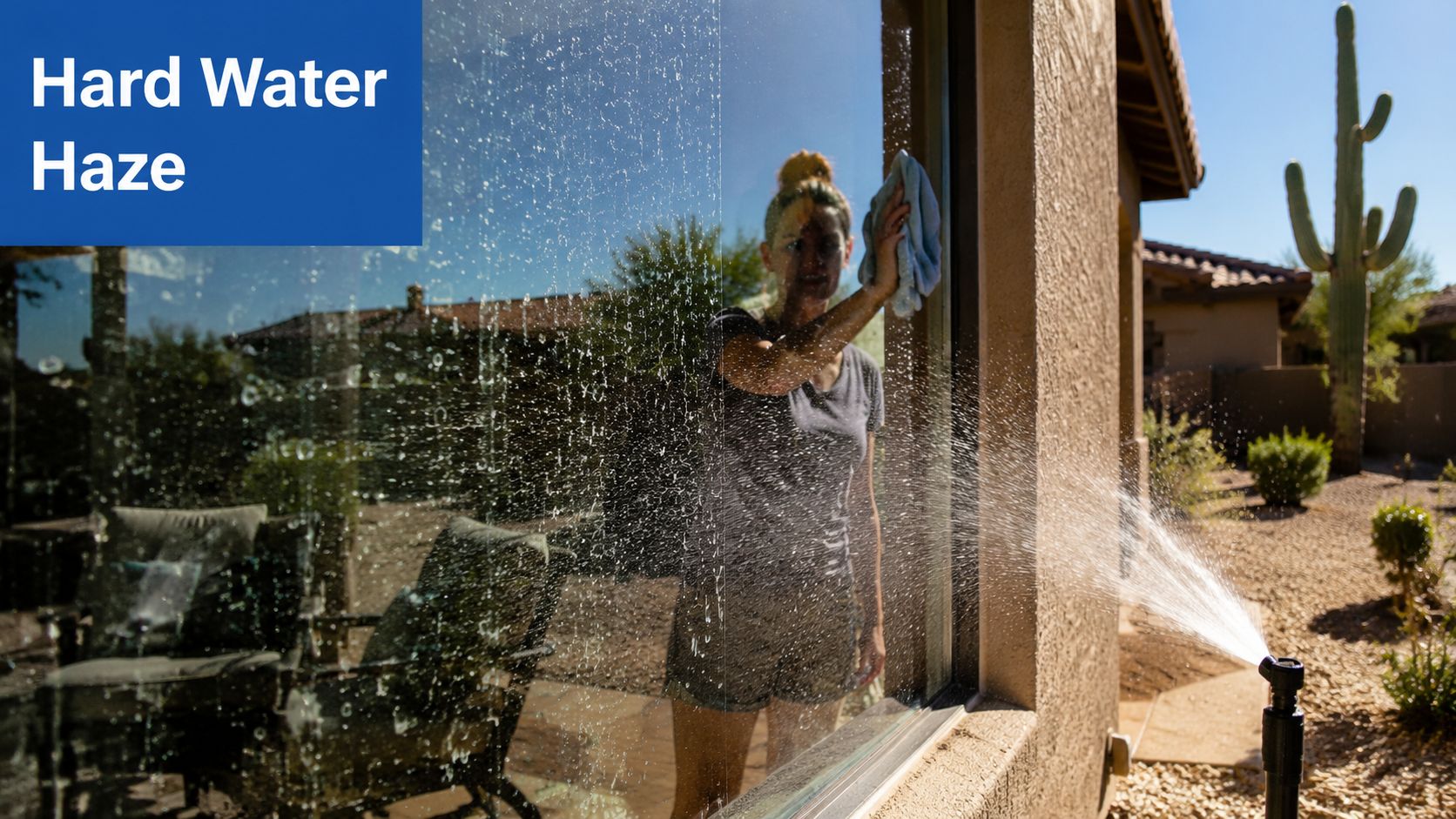
You wash the windows in the morning, admire the clear glass, and find white freckles across the pane by afternoon. In Phoenix and Scottsdale, that often happens after a sprinkler head turns slightly, a pool deck throws mist toward the house, or a monsoon shower leaves runoff on a sun-heated window. The glass may be clean, but the water that dried on it wasn't.
Window cleaning water spots are usually a mineral problem before they're a cleaning problem. Calcium and magnesium remain after water evaporates, and repeated wet-dry cycles can turn a few dots into a cloudy film. The important question isn't which cleaner to use. It's whether the residue is still sitting on top of the glass, or whether the glass has already been etched.
Why Arizona Windows Get Spotted After Cleaning
A homeowner in Phoenix can have a south-facing window cleaned on a hot July afternoon, then watch sprinklers drum against it before the glass has even had time to stay clear. The pane dries quickly in direct sun, and the dissolved minerals in that water remain as small white marks. The same pattern appears around Arcadia lawns, Scottsdale pool decks, and commercial storefronts near heavily irrigated landscaping.
Arizona glass gets hit by several drying events that ordinary dirt doesn't explain. Sprinkler overspray delivers tap or irrigation water directly to the pane. Monsoon runoff can carry dust and fine soil onto storefront glass. Poolside mist can reach siding and windows well above the deck, leaving deposits that look like streaks from a poor cleaning job.
Heat speeds up the problem
Arizona's heat doesn't create the minerals, but it shortens the time available to remove them. A droplet left on warm glass can evaporate before anyone notices it, leaving the residue fixed in place. Each later wet-dry cycle adds another layer, so the original spotting becomes a dull haze rather than a few isolated dots.
Hard-water regions such as Arizona can have average hardness cited at 150 to 500 mg/L as calcium carbonate equivalent, compared with a cited U.S. average of 60 to 120 mg/L (Set To Shine explains the difference in regional water hardness). That contrast helps explain why Phoenix and Las Vegas windows are particularly vulnerable after irrigation or rain runoff.
Practical rule: If sprinklers are hitting the glass, a clean window can spot again almost immediately. Treat the spray pattern as a maintenance issue, not as proof that the cleaning failed.
A recurring spot pattern is useful information. It points toward a water source, drying exposure, or delayed maintenance. Once the source is identified, the solution becomes more durable than wiping the same pane every time it clouds over.
What Window Cleaning Water Spots Are
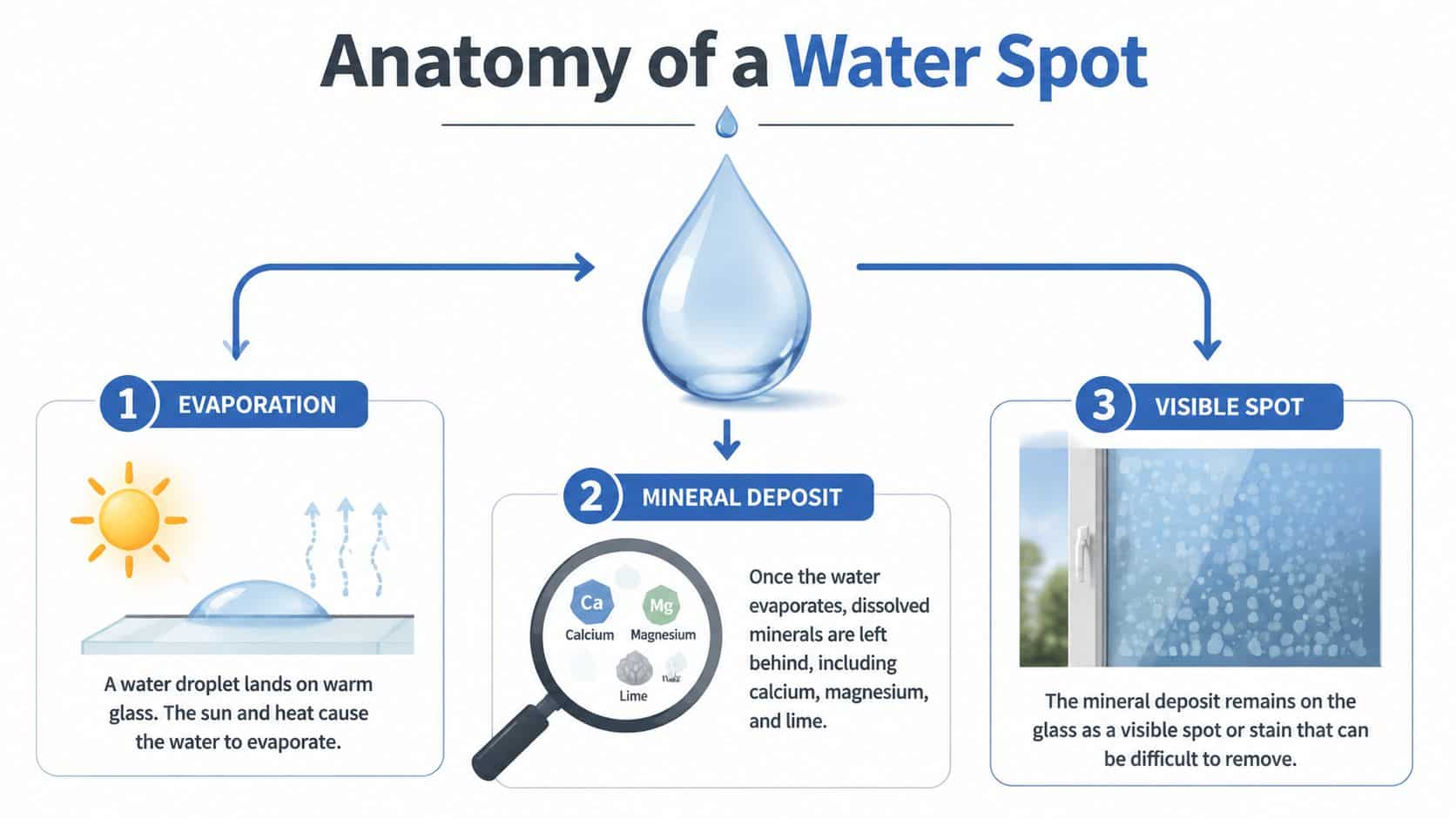
A water spot starts with a droplet. Water lands on warm glass, the liquid evaporates, and the dissolved material stays behind. The residue usually includes calcium and magnesium, which leave cloudy white dots, drip lines, or a chalky film, as described by G&S Window Cleaning's explanation of hard-water stains.
The glass is not dirty in the same way a dusty sill is dirty. A standard glass cleaner may take off oils and fingerprints while leaving the mineral layer in place. That is why a pane can feel freshly cleaned and still show pale rings when the sun hits it.
From deposit to damage
Fresh deposits sit on the surface and can often be dissolved or lifted. If the minerals stay through repeated exposure, they can bond with the glass or etch it. At that point, the job shifts from stain removal to glass restoration.
The wet-versus-dry test is the useful dividing line. If the haze changes or disappears while the glass is wet, the water is masking the surface irregularity, which points to removable residue. If it looks the same wet and dry, the surface may be etched, and ordinary cleaning will not bring it back, as Glide Cleaners outlines in its hard-water stain diagnostic.
People often blame cleaner streaks because the marks show up after a window wash. In practice, the rinse water may have dried before the technician could remove it, especially on hot exterior glass. The problem is the mineral load left behind by evaporation, not necessarily a film from the cleaning solution.
For a closer look at the surface problem, see mineral deposits on glass. The difference is straightforward. A deposit can sometimes be dissolved, while etching has changed the glass itself.
Where the Mineral Water Comes From
Arizona windows often reveal the source of the water that dried on them. Dots limited to lower panes usually point to irrigation spray. A horizontal band on poolside glass suggests splash or mist, while soil-colored streaks after a storm indicate runoff rather than ordinary washing.
Water hardness varies by supply and property, so the visible pattern matters more than a generic hardness label. Irrigation water can be especially troublesome when the same panes receive spray day after day.
Arizona Mineral Water Sources Compared
| Source | Typical Hardness | Drying Pattern | Glass Impact |
|---|---|---|---|
| Irrigation sprinklers | Varies by supply and system | Repeated wet-dry cycles on fixed panes | Can quickly turn spots into cloudy buildup |
| Municipal tap water | Varies by location | Occasional droplets, hose rinsing, or runoff | May spot when left to dry, especially in direct sun |
| Monsoon runoff | Varies with dust and soil carried by rain | Irregular sheets, drips, and splash marks | Mineral residue mixed with grit can scratch during aggressive wiping |
| Pool splash | Varies with source and pool chemistry | Fine mist or isolated splashes near the deck | Can leave persistent residue on nearby glass and frames |
Irrigation systems are usually the repeat offender. A sprinkler head that reaches the window creates the same wet-dry cycle every day, giving residue repeated chances to build. Tap water may cause no trouble when removed promptly, but droplets left on hot exterior glass can dry into spots before anyone notices.
Pool splash needs attention around both the pane and its edges. Fine mist can settle on frames, seals, and adjacent glass, where later wiping may drag loosened grit across the surface. Monsoon runoff brings a different problem, because dust and soil can make an aggressive cleaning pass more likely to scratch.
The practical fix starts with the source. Adjust sprinkler heads, change watering direction, shield exposed panes, and dry glass after unavoidable spray. A water softener can address some water conditions. Homeowners comparing treatment options can review water softener installation from Stultz Plumbing San Antonio, but treatment does not replace keeping spray off the glass or removing droplets before they evaporate.
Removable Residue or Permanent Etching
Don't start with a scrub pad. Start by finding out what you're looking at.
Choose a small, representative area of the pane. Mist a clean microfiber with distilled water, wipe the haze evenly, and allow the glass to dry. If the mark lightens or disappears, the deposit is likely still on the surface. If it remains unchanged after wetting, drying, and a second gentle pass, etching becomes more likely.
Read the glass in reflected light
Sunlight at a low angle can reveal differences that disappear when you look straight through the window. Surface residue tends to look like a film or collection of dots. Etching often reads as a dull, uneven patch that catches reflected light irregularly.
Run a clean, dry fingertip across the tested area only after loose grit has been removed. Smooth glass with visible haze usually suggests surface residue. A faint tooth or pitted feel suggests that the glass surface has changed. Don't use pressure to confirm the texture. Aggressive rubbing can create scratches that weren't there before.
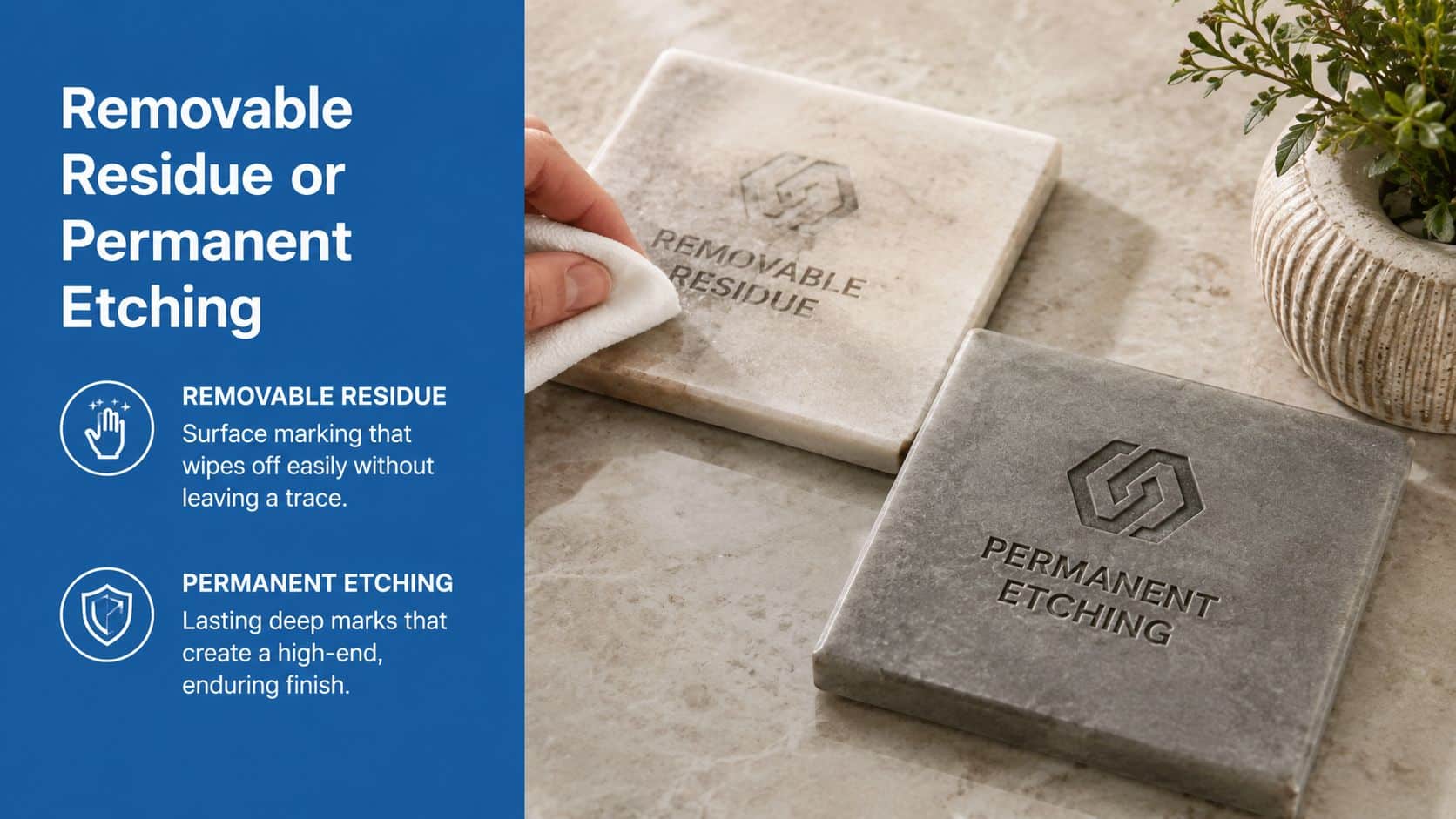
The appearance can also provide a timeline clue. Fresh spots are often removable because the minerals haven't bonded strongly. A haze that looks identical wet and dry may need polishing or, in severe cases, replacement, as described in this hard-water stain removal guidance from Power Wash Dallas.
The diagnostic answer controls the treatment. If water changes the appearance, work on the residue. If water changes nothing, stop escalating household cleaners and assess the glass for etching.
This distinction matters on coated or Low-E panes. A method that's acceptable for bare, uncoated glass can damage a coating, and repeated acid treatment won't reverse a surface defect that chemistry can no longer reach.
Removal Methods That Work on Hard Water Spots
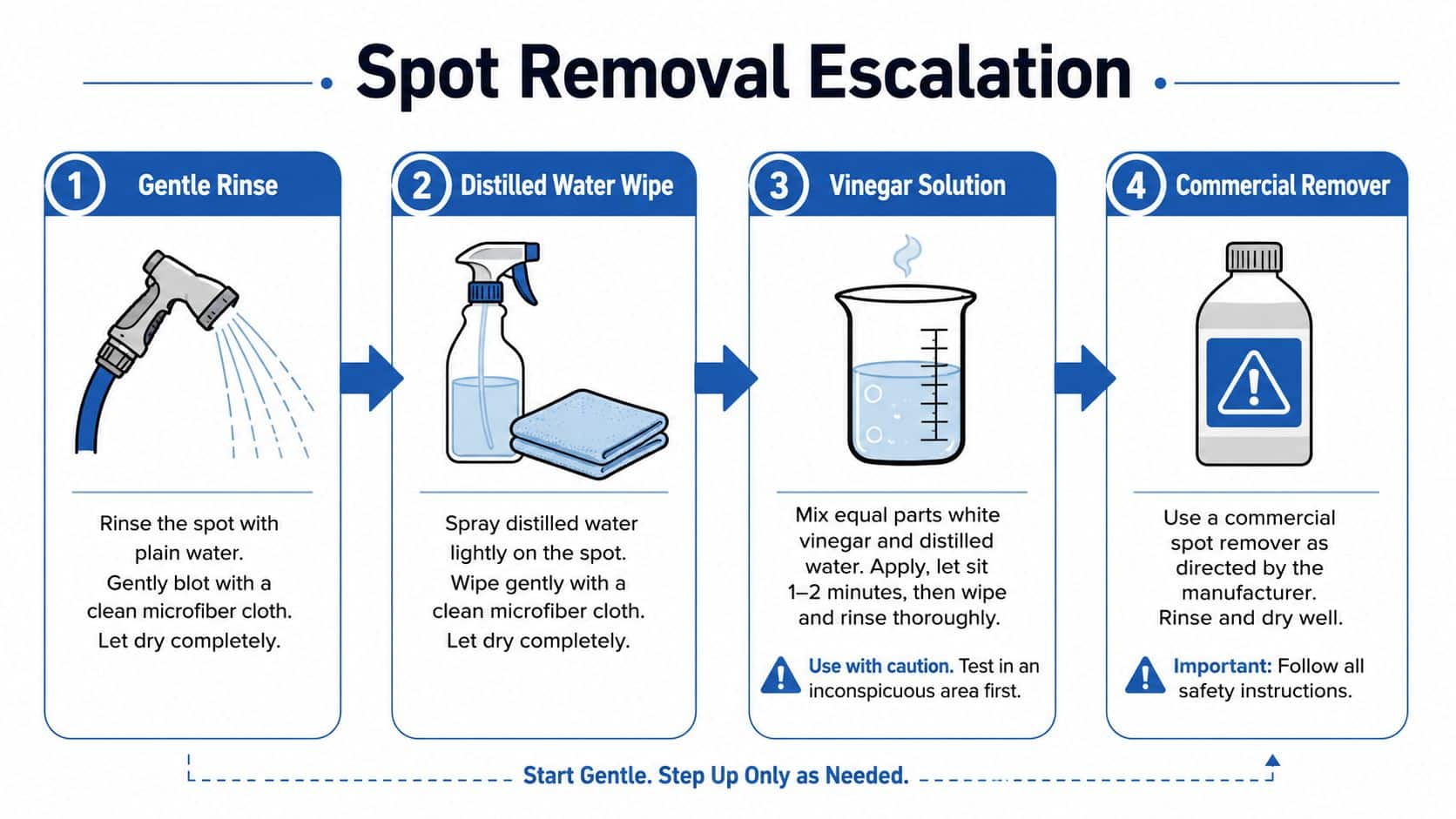
Use the least aggressive method that solves the problem. Stop when the pane tests clear. More product and more pressure aren't signs of better technique.
Start with removal, not abrasion
Rinse away loose dust first. On a fresh spot, a clean microfiber and a squeegee may lift the residue without chemistry. Work on a cool pane, use even pressure, and dry the glass before minerals have another chance to settle.
If the haze remains, mix one part white vinegar with one part water. A verified household guide recommends a 15 to 20 minute dwell time, followed by agitation, rinsing, and a distilled-water rinse (HowStuffWorks describes the vinegar approach). For field work on hot Arizona glass, a shorter 60 to 90 second dwell is a more cautious starting point. Never allow the solution to dry, and keep it off anodized frames and tinted film.
Escalate carefully
For stubborn but removable mineral film, a citric-acid remover or a glass-safe commercial product such as CLR or Lime-A-Way may be appropriate. Follow the product label, keep the dwell brief, and neutralize the surface with clean water. Test an inconspicuous area first, particularly if the window has a coating, film, painted frame, or delicate seal.
The same logic applies to other mineral deposits in the home. For example, homeowners dealing with appliance scale can review how to descale a Keurig safely from PureHQ Inc. The chemistry may differ by surface, so don't transfer appliance-cleaning instructions directly to architectural glass.
Mechanical polishing belongs at the end of the escalation path. Cerium-oxide paste and a felt pad can address light etching on suitable, uncoated glass, but poor technique can create distortion or scratches. Avoid abrasive scrubbing pads, magic erasers on coated Low-E panes, hydrochloric acid, and any product left to dry.
For a focused service overview, see how to remove hard water stains from windows. If the pane stays unchanged through the wet test, don't keep repeating vinegar applications. The surface may need professional evaluation rather than stronger chemistry.
Prevention That Stops Spots From Coming Back
Spot prevention works best as a cycle. The four useful levers are rinse-water quality, physical drying, surface protection, and water-source control. A coating by itself won't compensate for a sprinkler that hits the same south-facing pane every morning.
| Method | How It Works | Best For | Limitations |
|---|---|---|---|
| Pure-water cleaning | Removes dissolved solids before the final rinse dries | Exterior glass exposed to irrigation, dust, and hard water | Requires suitable filtration equipment and correct technique |
| Squeegee drying | Physically removes water before evaporation | Any pane after washing, rain, or overspray | Must be repeated after exposure |
| Hydrophobic or oleophobic coating | Encourages water to bead and roll away | Glass that needs additional resistance to recurring spotting | Compatibility and application quality matter |
| Irrigation adjustment | Stops the mineral source from reaching the pane | Sprinkler-facing windows and landscaping zones | May require changing heads, arcs, or irrigation design |
Pure-water systems commonly use reverse osmosis and deionization. The verified source describes pure water as measuring 0 ppm on a TDS meter, meaning dissolved minerals aren't left behind when the water dries (Premier Exterior Clean explains pure-water cleaning). That makes it especially useful for exterior windows that can't be towel-dried easily.
Squeegee technique still matters. Pull from the top down, keep the rubber edge clean, and avoid dragging grit across the pane. A professionally applied hydrophobic or oleophobic coating can reduce how readily water sheets across the glass, but it isn't a substitute for redirecting spray.
Start at the source. Adjust sprinkler heads away from windows, lower the arc, or replace a problem zone with drip irrigation. On a poolside lot, control splash and mist. On a dusty commercial property, coordinate glass cleaning with exterior-wash schedules.
Property owners comparing broader water-treatment approaches can also read about Northern Colorado water hardness fixes from SouthRay Kitchen & Bath. The local conditions differ, but the maintenance principle is the same: address the mineral load and the exposure pattern together.
A practical prevention plan may combine professional pure-water cleaning with irrigation repairs and prompt drying. Hard water solutions for Arizona glass can help frame that work as recurring maintenance instead of repeated emergency stain removal.
When Professional Window Cleaning Is the Smart Call
DIY treatment has reached its limit when the haze stays unchanged during the wet-versus-dry test, returns within days, or appears on coated or Low-E glass after standard cleaning. Those signs point toward either an ongoing exposure problem or damage that household cleaners can't correct.
Second-story windows, sloped panes, and high-rise glass add a safety issue. A ladder placed on uneven ground or a reach that forces the wrong angle can cause a fall, while an improvised scraper or abrasive pad can permanently mark the pane. The risk isn't justified when the work requires water-fed poles, controlled access equipment, or trained restoration technique.
A professional changes more than the labor. The technician can test the residue, rinse with deionized pure water, and determine whether a mineral remover is appropriate. If light etching remains on compatible uncoated glass, cerium-oxide polishing may improve the surface. Deep etching may require a glass specialist or replacement rather than another cleaning pass.
South Mountain Window Cleaning, LLC serves residential, commercial, and high-rise properties across Phoenix, Scottsdale, Paradise Valley, Chandler, Tempe, and Gilbert. Its professional window cleaning company services include pure-water cleaning and hard-water spot work, which fits situations where access, coatings, or recurring exposure make DIY treatment a poor trade-off.
A Simple Routine to Keep Glass Spot-Free
Keep the routine short and repeatable:
- Check monthly. Look first at sprinkler-facing panes, lower elevations, poolside glass, and windows beneath roof or siding runoff.
- Dry after storms. After monsoon rain, use a clean microfiber and squeegee to remove fresh water before it evaporates.
- Rinse problem elevations quarterly. Use pure or appropriately filtered water where mineral spotting returns most often.
- Test before treating. Wet a small area and compare the appearance while wet and dry. Choose residue removal or professional evaluation based on that result.
- Inspect annually. Look for haze that no longer changes when wet, dull reflected patches, or a roughened feel that may indicate etching.
The routine is less about chasing every dot and more about catching the source early. Redirect sprinklers, keep grit off the pane, and don't polish glass until you've confirmed that chemistry alone won't remove the deposit.
If the glass stays hazy after gentle treatment, if the pane is coated or difficult to access, or if spotting returns almost immediately, call a professional rather than increasing pressure or chemical strength.
South Mountain Window Cleaning, LLC provides residential, commercial, and high-rise window washing in Phoenix, Scottsdale, Paradise Valley, Chandler, Tempe, and Gilbert, including pure-water cleaning and hard-water spot removal. Visit South Mountain Window Cleaning, LLC to request a fast, free quote and get a maintenance plan built around your property's irrigation, glass exposure, and access needs.