

After a hard Arizona monsoon, a lot of owners walk the property and spot the same thing, a fresh line in a brick wall they swear wasn't there last week. Sometimes it's a harmless hairline. Sometimes it's the first clue that a wall has been moving for months, and the heat, sun, and sudden water got it to show itself.
That's why cracks in brick wall should be treated like a maintenance triage problem, not a panic button. In Phoenix, Scottsdale, Paradise Valley, Chandler, Tempe, and Gilbert, I see the same pattern over and over, dry-season shrinkage, monsoon moisture, thermal cycling, and old mortar all working on the wall at once. The trick is knowing what's normal movement, what's cosmetic wear, and what's a real structural complaint.
Why Brick Walls Crack in the First Place
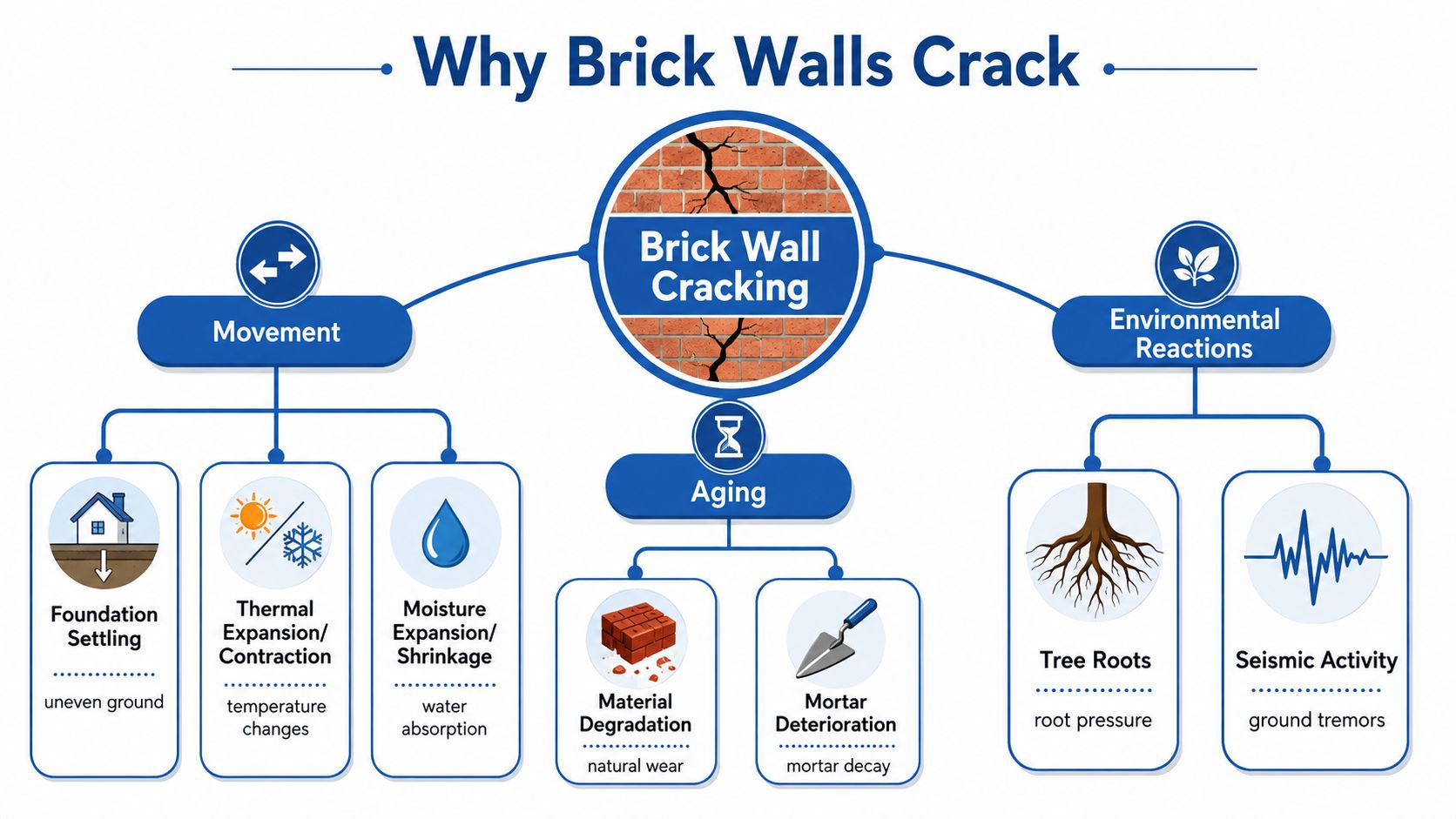
A homeowner usually sees the crack before the wall gives away the cause. A hairline near a window can show up after a hot spell, then a rain event, then more sun, and the brick starts telling you where the stress has been building. In Arizona, that pattern is common, and it is why brick walls have to be read as working assemblies, not fixed surfaces.
Movement is part of how masonry behaves
Brick and mortar do not move in the same way. Heat, moisture, and soil movement all push and pull on the wall face differently, which creates stress inside the masonry. The National Park Service lists differential foundation settlement, drying shrinkage, ambient thermal and moisture variation, improper support over openings, freeze-thaw cycles, corrosion, differential movement between materials, salt expansion, and bulging or leaning walls as common causes of cracking in brick masonry NPS brick masonry problems.
That matters in the Valley because the wall is always reacting to dry heat, sudden monsoon moisture, and whatever is happening at the footing below it. A technical guide on brickwork says changes in the water content of clay soils account for up to 90% of cracking problems in houses Residential Reports cracking in brickwork. In practice, that means the crack you notice on the face of the wall often starts with movement in the ground or at the base of the structure.
Aging makes small movement easier to see
Older brickwork cracks because time exposes weak spots. A masonry report found that cracking is common in older brick buildings, and it recorded crack widths ranging from very fine openings to much wider separations LIHA-PRES masonry report. That does not mean every older wall is failing. It means visible cracking is common enough that aging masonry should be checked with a practical eye, not ignored.
Practical rule: in older walls, the question is rarely “why is there any crack at all?” It is “is this crack stable, or is it still moving?”
For a homeowner checking around windows, drainage, and grade, the most useful companion step is a quick look at how water leaves the house. A clear drainage path can reduce pressure on the wall, and this French drain maintenance guide is useful when you are trying to keep stormwater from loading the foundation after monsoon bursts.
Brick walls also shift from their own early-life changes. A masonry reference notes that brick can show irreversible expansion over time, with a large share of that change happening early in the material's life LIHA-PRES masonry report. That is one reason a newer wall can still develop small cracks or joints that look imperfect without any dramatic failure behind them.
If you want a plain-language overview of how nearby structural movement shows up inside a home, the Corinthian Surveyors London guide is a useful read for spotting related interior clues.
Reading a Crack Like a Professional
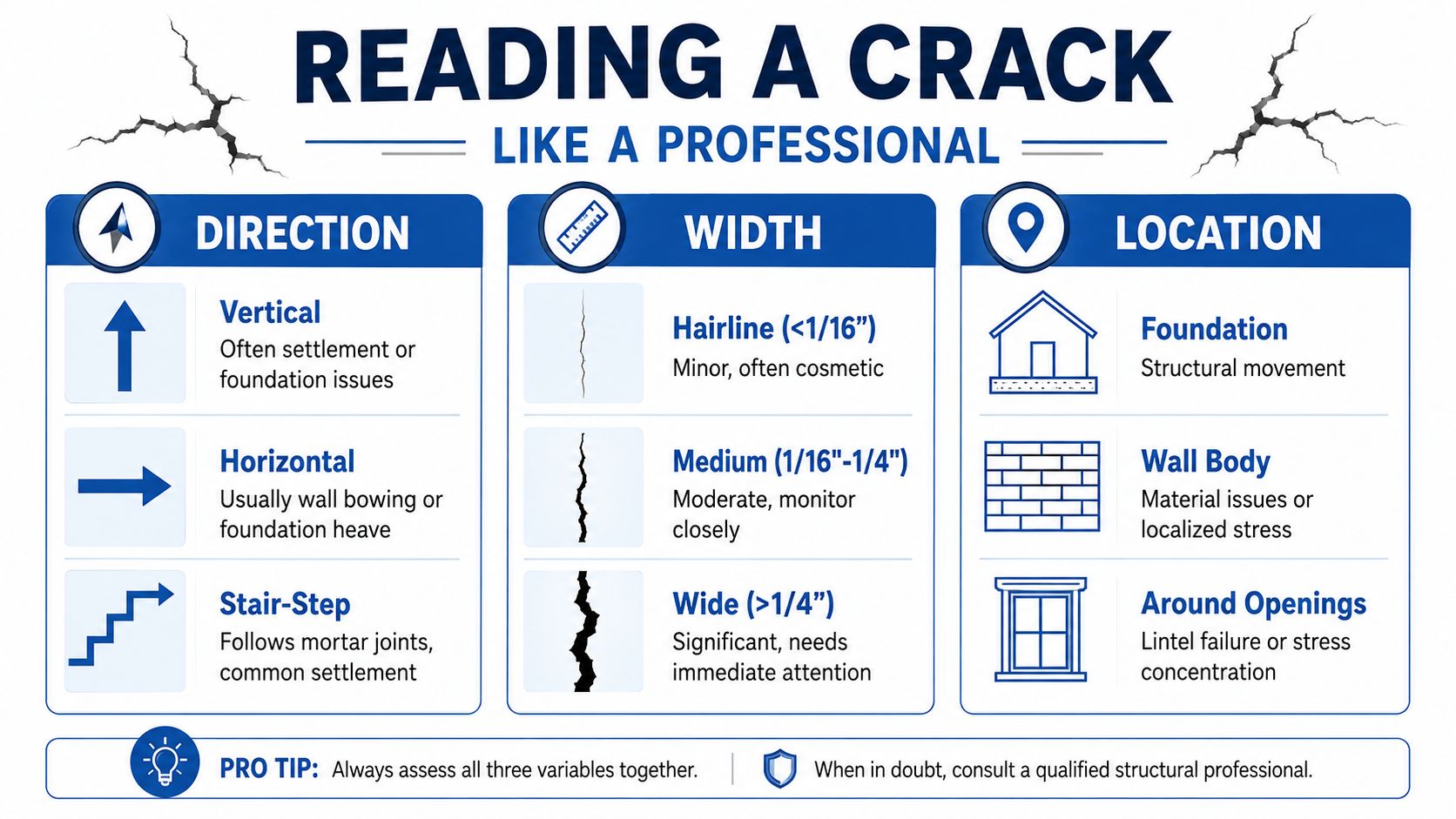
A good mason starts with direction, width, and location. Those three clues usually tell you whether you are looking at a finish defect, a movement crack worth watching, or a wall that needs professional attention.
Direction tells you how the wall is being stressed
A stair-step crack that follows mortar joints usually points to movement in the support below or alongside the wall. A vertical crack can come from settlement, thermal expansion, or shrinkage. A horizontal crack gets the most attention from me because it often reflects lateral pressure acting on the wall.
That lines up with engineering guidance. Differential foundation settlement often produces diagonal cracks, in-plane shear can produce diagonal cracking too, and heavy out-of-plane forces can create horizontal cracks when a wall is not designed for that load Engineering LibreTexts masonry distress_and_Load-Bearing_Walls/3.05:_Bearing_Wall_Distress_Conditions_and_Repair_Methods/3.5.01:_Distress_in_Masonry_Walls). On the job, that means a crack's shape is evidence, not decoration.
Width and location narrow the diagnosis
Width matters because masonry references treat small openings very differently from active gaps. A major benchmark says cracks up to 0.1 mm in brick walls are generally too narrow to contribute meaningfully to rainwater ingress, while a 1962 study found 0.1 mm to 4–5 mm cracks were important to rain penetration GOV.UK wall analysis review. That is a real threshold, not a guess.
Location matters just as much. Cracks at the base of a wall raise different concerns than the same crack up near the roofline. Cracks near doors and windows often point to stress concentration around openings, while cracks in the wall body may stay local unless they repeat in multiple places.
Mark the ends of the crack with pencil, write today's date, and check it again in 30 to 60 days. If it grows, it changed from a static blemish to an active movement issue.
A few quick cues help with triage:
- Vertical and thin: often lower urgency, but still worth tracking if it is new.
- Diagonal or stair-step: usually more suspicious, especially if it spreads.
- Horizontal near the bottom: treat as serious until proven otherwise.
- Around openings: watch for lintel or support issues.
For homeowners who already inspect exterior surfaces, the same eye used to catch pavement distortion can help here. The asphalt surface assessment tips show how professionals read cracks by pattern, width, and change over time, even though the material is different.
Common Crack Types and What They Signal
A cracked brick wall in Arizona usually needs triage, not guesswork. Sun, dry air, monsoon wetting, and fast temperature swings all leave different marks, so the pattern tells you a lot before anyone starts opening joints or sealing anything.
The patterns I pay attention to first
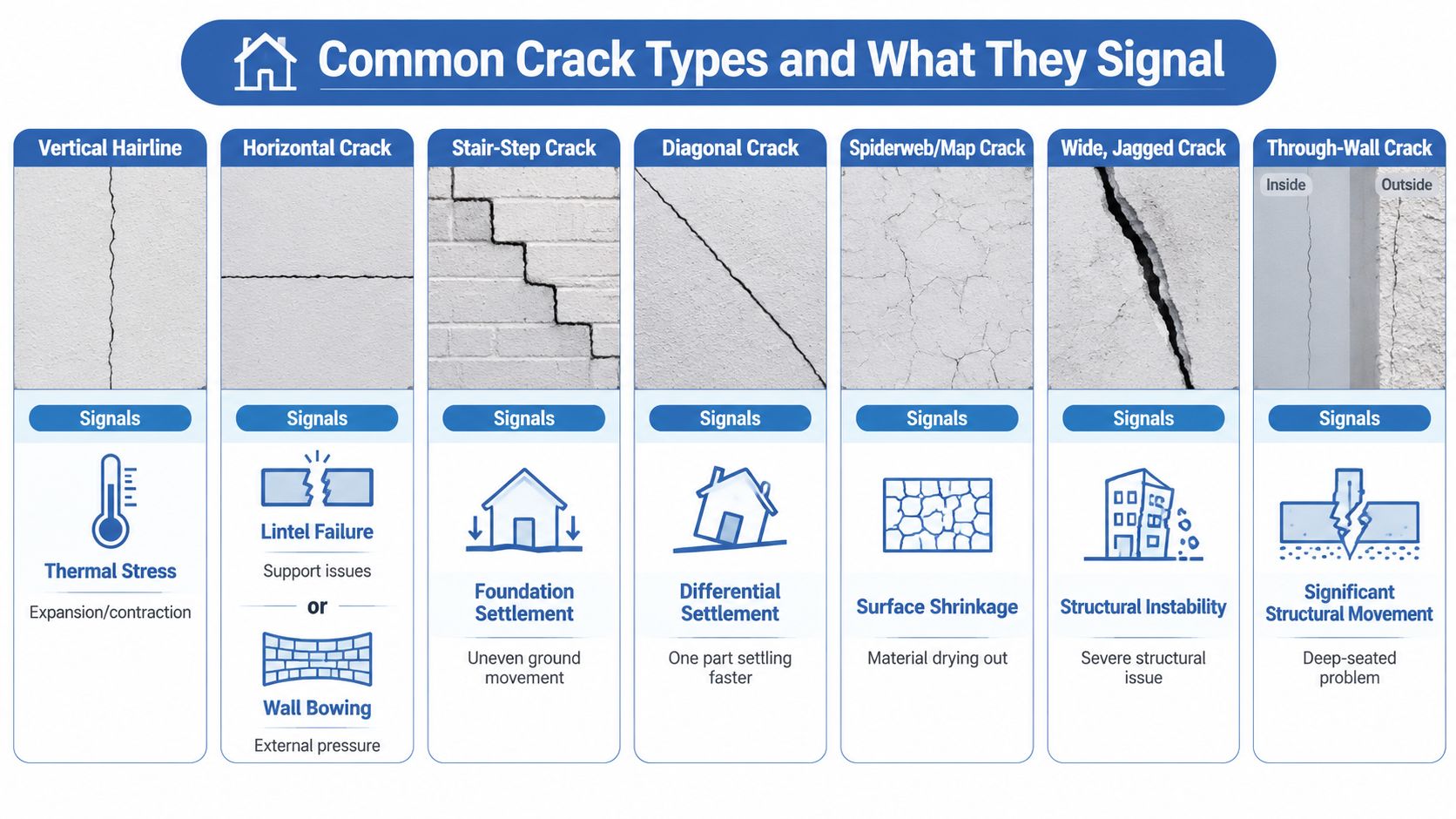
A vertical hairline crack is often tied to thermal stress, especially when the width stays even and the wall is not showing other movement. In our climate, that can come from normal expansion and contraction, and it may stay cosmetic if it does not change. A stair-step crack that follows mortar joints usually points toward differential movement below the wall, which is why I look closely at nearby grade, drainage, and any history of washout.
A diagonal crack near an opening often means the structure is loading that corner unevenly. That can show up around windows, doors, and wall returns where stress collects instead of spreading out. A horizontal crack deserves more caution, especially if it is near a basement wall, retaining wall, or any area where soil or water pressure could be acting on the masonry. Engineering references describe horizontal cracks as a sign of heavy out-of-plane force or bowing, and that is the kind of movement that can worsen Engineering LibreTexts masonry distress.
What looks minor, what gets documented, what gets escalated
A spiderweb or map crack on the surface is often shrinkage or weathering, especially if it stays shallow. In dry, sun-baked conditions, that kind of surface checking can come from the finish aging faster than the wall behind it. A wide, jagged crack is a different matter because the irregular shape usually means the wall has lost uniform behavior. A through-wall crack visible on both sides points to deeper movement and should be treated as a structural problem until a qualified person says otherwise.
The National Park Service notes that brick masonry problems can come from several causes, and the practical point is simple. A crack's shape does not tell the whole story, so the repair has to match the mechanism, not just the appearance NPS brick masonry problems. That is why a one-size-fits-all sealant rarely solves the underlying issue.
If a crack is new, widening, or repeating at the same spot, do not just patch it. Document it and compare it after the next heat cycle or storm.
For rooflines, balconies, and other exterior areas where water management matters, I have found that clean surfaces help people see the actual pattern instead of guessing through dirt and efflorescence. South Mountain Window Cleaning's guide on what soft washing is fits that maintenance mindset, because visible walls are easier to inspect correctly. The same habit shows up in the asphalt surface assessment tips, where pattern, change, and surface condition matter as much as the crack itself.
I will also say this plainly. A crack that looks ugly is not always structural, and a neat crack can still be active. That is why judging by appearance alone misses so much.
Cosmetic vs Structural and How to Tell the Difference
I see this call go wrong in both directions. A homeowner spots a thin crack in a brick wall and shrugs it off, or they see a line and assume the wall is failing. In Arizona, both reactions miss the actual job, which is triage. Dry heat, sharp sun, and monsoon moisture swings can make a wall show cosmetic cracking, and they can also expose movement that needs a deeper repair.
The width threshold helps, but it does not settle the question
A crack's width gives you a starting point, not a verdict. If a crack is so fine that it is almost hairline, it may be mostly a finish issue. If the opening is wider, keeps changing, or lets in water, it moves out of the cosmetic category fast. A useful outside reference is the guide by Awesim Building Consultants, because it keeps the focus on whether the crack is stable and how the wall is behaving, not just on how it looks.
The trade-off is simple. A crack that stays put can often be watched, cleaned, or sealed. A crack that opens again after heat, rain, or seasonal movement needs more than patch material. That is why I never judge a brick wall from the width alone. A small line in a loaded corner, beside a window, or along a recurring path can matter more than a wider crack in a quiet area that has not changed.
Other symptoms usually tell the fuller story
Step back and look at the whole exterior. Doors that stick, windows that drag, mortar that separates in the same place, bulging brick, or cracks that keep returning all point to movement that is not just on the surface. On Arizona homes, I also pay attention to staining and dust lines, because a dirty wall can hide whether the crack is active or just old.
When the finish is readable, the wall is easier to judge. That is one reason clean surfaces matter before any repair decision. If the wall has chalking, flaking, or residue near the base, a maintenance pass such as the work described on South Mountain Window Cleaning's exterior foundation paint page can help reveal whether the problem is in the coating, the mortar joint, or the brick itself.
A structural issue usually shows itself in more than one place. A cosmetic issue usually stays local and quiet. The difference is not perfect, but it is practical, and in the field that is what saves time and money.
Use the wall, not just the crack, to judge risk
A crack that looks ugly is not always structural. A clean, narrow line can still be active if the wall keeps moving. That is why I pay attention to pattern, repetition, and change over time before I call anything cosmetic. If the crack is stable and the rest of the wall behaves normally, it often belongs in the maintenance bucket. If the wall tells a bigger story, the repair has to address movement first.
DIY Repairs You Can Realistically Do Yourself
A hairline crack on an Arizona brick wall can look worse than it is, especially after a hard monsoon, a week of intense sun, or a stretch of dry heat that shrinks old mortar. The first job is still the same, separate a stable cosmetic issue from a wall that is still moving. If the crack is shallow and the surrounding brick stays in place, a homeowner can often handle the repair with care and the right materials.
The jobs that make sense for careful hands
Repointing makes sense when the mortar joints have failed but the brick units are still solid. You rake out the loose mortar to the right depth, match the mortar type as closely as you can, and pack in fresh masonry mortar so the joint can shed water again. On older walls, a patch that is too rigid can create a harder failure line, so matching the original assembly matters more than making the joint look perfect.
Flexible masonry caulk is a practical choice for stable hairline cracks where a little movement is expected. It will not restore structure, but it can block water entry and keep dust from working into the crack. Epoxy injection is more specialized and is usually reserved for cracks that need bonding as well as sealing, so it stays in the DIY category only if you are comfortable with the material and the crack is stable.
Spalled patching fits small surface losses where the face of the brick or mortar has broken away. Clean out the loose material, use compatible patch mortar, and keep the repair tight to the damaged area. If you are removing mortar haze or old residue before patching, the process described in our cleaning mortar off brick guide can help you prep the surface without grinding into sound brick.
What to avoid
Do not seal a crack that is still moving and expect the fix to hold. The patch usually pops loose, traps moisture, or forces the crack to open beside the repair instead of at it. Avoid aggressive grinding wheels on old brick too, especially on historic or softer masonry, because it is easy to remove more material than you meant to take off.
A few tools make the work cleaner and safer:
- Margin trowel: for packing mortar into narrow joints.
- Joint raker or oscillating tool with control: for removing failed mortar without chewing up the brick.
- Masonry brush and spray bottle: for cleaning dust and dampening the joint.
- Caulk gun: for controlled application on stable, narrow cracks.
- Ladder or scaffold: only if the wall can be reached safely without overreaching.
If a crack follows a load path, widens, or keeps coming back after repair, stop at cleanup and bring in a pro. Repointing a wall that needs stabilization usually wastes time, and on Arizona exteriors it can leave you with another failure once the next round of heat and moisture hits the wall.
Professional Repair Methods Worth Paying For
There's a point where skill, equipment, and liability move the job out of DIY territory. That's especially true when the crack is tied to foundation movement, wall bowing, or repeated water intrusion.
The methods pros use when the wall needs more than a patch
Tuckpointing is more refined than basic repointing. A mason removes deteriorated joints and rebuilds the appearance and weather resistance of the mortar lines, which is useful when the wall needs both function and a clean finish. It's a better fit when the brick itself is still sound and the joints are what's failing.
Wall stitching is used to stabilize a crack by placing steel bars or helical rods across the fracture. The aim isn't just to hide the crack, it's to help the wall resist further separation. That work belongs with a mason or engineer who understands where reinforcement can go without creating new stress.
Epoxy or polyurethane injection is used when the crack needs sealing and, in some cases, structural bonding. The material choice depends on whether the crack is dry, active, or exposed to water. A foundation contractor or structural repair specialist usually handles this type of work.
Underpinning is the heavy repair reserved for foundations that have moved enough to threaten the building. It's not a wall patch. It's a foundation correction, and it requires a structural diagnosis first.
What these repairs really cost you in effort, not just money
The cost trade-off isn't only dollars. A good pro job takes inspection, material matching, access planning, and sometimes interior patching after the exterior repair is done. That's why the cheapest quote is rarely the safest one if the wall is still active.
For exterior care, moisture control matters just as much as the repair itself. Flashing, sealants, clean gutters, and careful wash methods all help protect the finished wall after the repair is complete. In some cases, a maintenance-focused service such as South Mountain Window Cleaning's window and exterior wash work can help keep the wall readable and easier to inspect, but that's maintenance support, not structural repair.
If you're also removing staining or buildup around the repair area, avoid blasting the wall with high pressure. Brick and mortar need water management, not punishment, and a cleaned surface makes it easier to spot whether the crack is still changing.
Prevention and Maintenance That Actually Work in Arizona
A lot of brick cracking in Arizona gets blamed on the brick, but the wall is usually reacting to water, heat, and poor drainage around it. That's why prevention is less about one magic coating and more about keeping the whole exterior assembly stable.
The habits that actually extend wall life
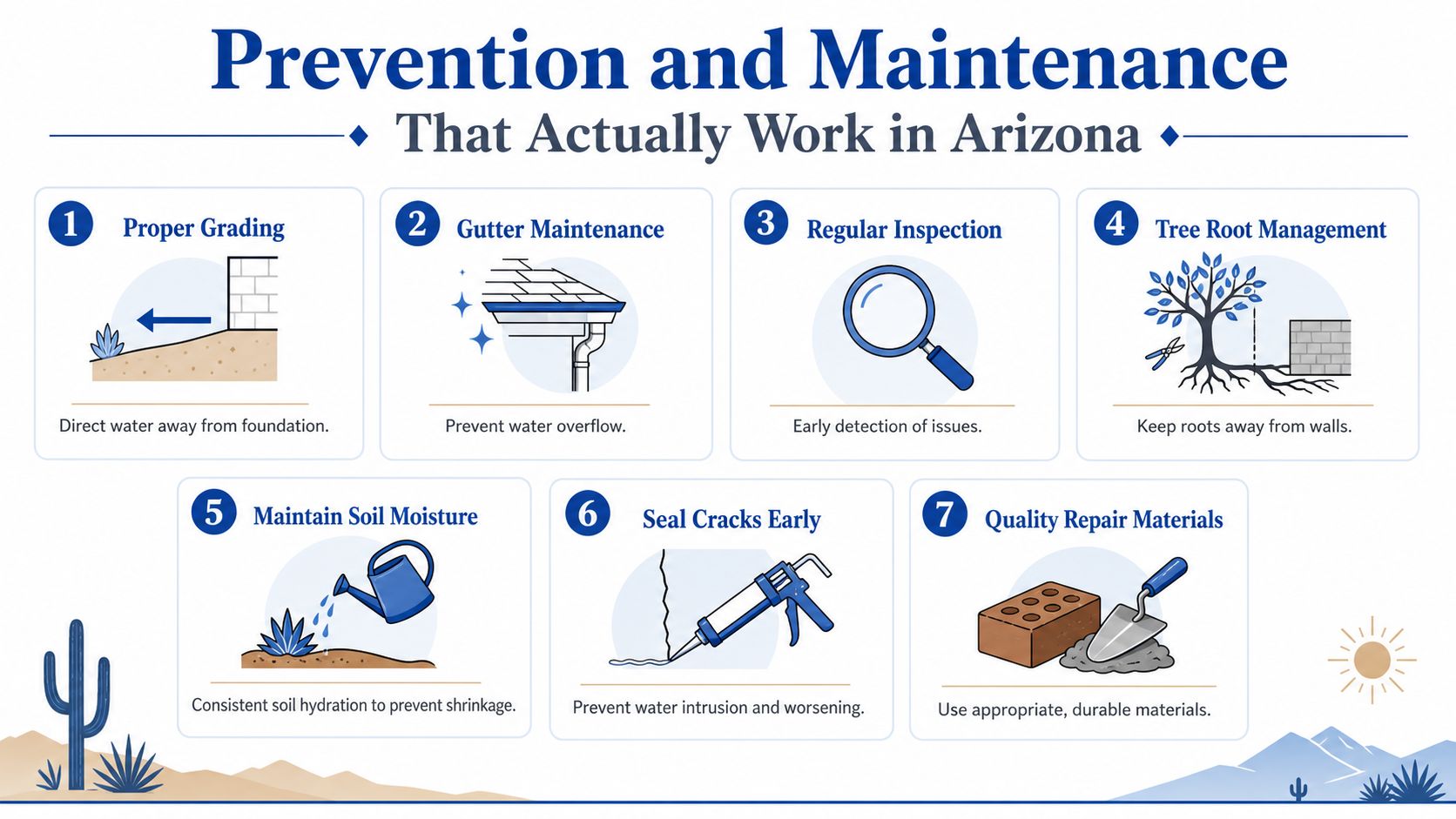
Proper grading keeps water from hanging around the foundation after monsoon storms. Gutter maintenance matters because overflow dumps water where the wall can't use it. Regular inspection catches movement before it turns into a repair bill.
Tree root management helps keep the soil movement from getting erratic near the wall. Maintain soil moisture sounds odd in a desert city, but consistent moisture is easier on clay soils than extreme dry-wet swings. Seal cracks early only after you know the crack is stable, because sealing is about blocking water, not pretending movement doesn't exist.
Quality repair materials matter because the wall has to breathe and move a little. Breathable masonry sealants can be useful, but heavy coatings that trap moisture create their own problem. That's especially important under strong sun, where a sealed wall can heat up and stress the finish layer.
A common mistake is to clean brick with too much pressure. Power washing can help a wall look better, but aggressive spray can erode mortar, drive water into joints, and reveal or worsen cracks that were already waiting to show. Soft washing is usually the safer choice on delicate exterior surfaces, especially where you need to clean without stripping the wall.
For homeowners and property managers who already rely on scheduled exterior care, routine cleaning and inspection overlap. A clean wall is easier to read, easier to photograph, and easier to compare over time. That makes crack monitoring a lot more practical after dust, pollen, soot, and monsoon residue are removed.
Best maintenance mindset: don't wait for a crack to become a project. Watch it, document it, and control the water around it.
If you manage residential or commercial property in the Valley, South Mountain Window Cleaning, LLC can help with the exterior cleaning side that keeps walls visible and easier to inspect, including window washing, power washing, gutter cleaning, and other surface maintenance that supports routine property care.
If you're dealing with cracks in brick wall surfaces, grime, or staining around the same areas, South Mountain Window Cleaning, LLC can help keep the exterior clean so you can spot changes early and maintain curb appeal at the same time. Visit South Mountain Window Cleaning, LLC to schedule exterior cleaning that fits Phoenix-area homes, storefronts, and commercial properties.