
If you live in Phoenix, Scottsdale, Chandler, or Gilbert, you've probably looked up at your solar panels after a dust storm and thought the same thing every Arizona homeowner thinks: those things are filthy. After a haboob rolls through, the panels go from glossy black to chalky brown. Then the sun comes out, the heat bakes everything in place, and you're left wondering whether that layer of dust is costing you real money or just bothering you every time you look at the roof.
That's where the online advice gets messy. One article says rain handles it. Another says clean them all the time. Both can be true depending on where you live. Arizona is not coastal California, and it's not a rainy climate where regular showers do half the work for you.
The practical question isn't whether dirt can reduce output. It can. The key question is is solar panel cleaning worth it for your specific roof, tilt, dust load, and energy value. In Arizona, that answer depends less on generic national advice and more on what lands on your panels between monsoon events and long dry stretches.
The Dusty Dilemma for Arizona Solar Owners
A common Arizona pattern goes like this. Your panels looked decent in early spring. Then wind picked up, pollen started sticking, and by monsoon season a dust storm pushed a fresh layer of fine desert grit across the whole array. A little rain followed, but instead of rinsing the panels clean, it left streaks and mud spotting.
That's the moment most homeowners start asking whether they should book a cleaning or just wait for the next storm.
The honest answer is that both instincts make sense. Some dirty panels don't lose enough production to justify paying for routine service. Others absolutely do, especially when the grime isn't just loose dust anymore. If you want a closer look at the kinds of buildup that matter most, this breakdown of solar panel efficiency loss is a useful place to start.
What Arizona owners are really deciding
This usually comes down to three real-world questions:
- How dirty are the panels: A light haze of dust is different from caked mud, pollen film, bird droppings, or residue that has baked on for weeks.
- Will weather clean them for free: In the Valley, rain often rinses loosely settled dust, but it doesn't always remove sticky grime.
- Does the math work on your roof: A small gain may not justify service on one home, while the same gain can matter more on a larger array or a property with chronic buildup.
In Arizona, the visual test matters more than people think. Clean-looking panels and truly clean panels are not always the same thing, but obviously dirty panels rarely improve by being ignored.
Homeowners in Phoenix and Scottsdale tend to run into the same frustration. National advice often treats cleaning like an all-or-nothing rule. On actual roofs here, it's a judgment call. The right approach is to match the cleaning decision to Arizona conditions, not to a generic blog written for a completely different climate.
How Dirt Really Affects Your Solar Panel Output
Solar panels need sunlight hitting the photovoltaic cells through the glass. When dust, pollen, droppings, and grime sit on that surface, less light gets through. The industry term for that is soiling loss.
The easiest way to think about it is a windshield. If your windshield has a light film of dust, you can still see through it. If it has mud spots, oily residue, and baked-on debris, visibility drops fast. Solar panels work the same way. Some dirt is minor. Some dirt blocks enough light to matter.
Light dust versus stubborn buildup
Not all dirt behaves the same way on a roof in Arizona.
- Loose dust: Often settles evenly and may rinse off partly with rain or slide off a steeper panel.
- Pollen and fine particles: Can stick more than homeowners expect, especially when mixed with moisture.
- Bird droppings: Create concentrated blocked spots rather than a uniform film.
- Baked-on grime: This is the problem layer. Heat can set residue onto the glass so a quick rinse doesn't remove it.
That's why “my panels got rained on” and “my panels got cleaned” are not the same thing.
A major California data point is useful here because it shows why blanket advice can be misleading. A UC San Diego study found that panels left uncleaned for 145 days during a summer drought lost 7.4% efficiency, and the researchers estimated cleaning a typical 5-kilowatt residential system midway through that period would add only about $20 in electricity value. Under those conditions, most homeowners wouldn't recoup the cost of paid washing.
Why cleaning method matters
Even when cleaning is worth doing, the method matters. Hard water can leave mineral residue behind, which is why professionals often use purified water systems rather than spraying panels with ordinary tap water and hoping for the best. If you want a simple explanation of why spot-free water matters in exterior cleaning, this SwiftJet car wash system guide gives a good overview of deionized water and residue-free rinsing.
For homeowners focused on output, the more useful question is not “Are my panels dirty?” It's “What kind of dirt is on them, and will a normal rain remove it?” For a broader practical view, see these ways on how to increase solar panel efficiency.
Practical rule: Loose dust usually creates a smaller problem than sticky residue. If the panel surface looks filmed over rather than just dusty, weather alone often won't fix it.
Calculating Your Break-Even Point The ROI of Cleaning
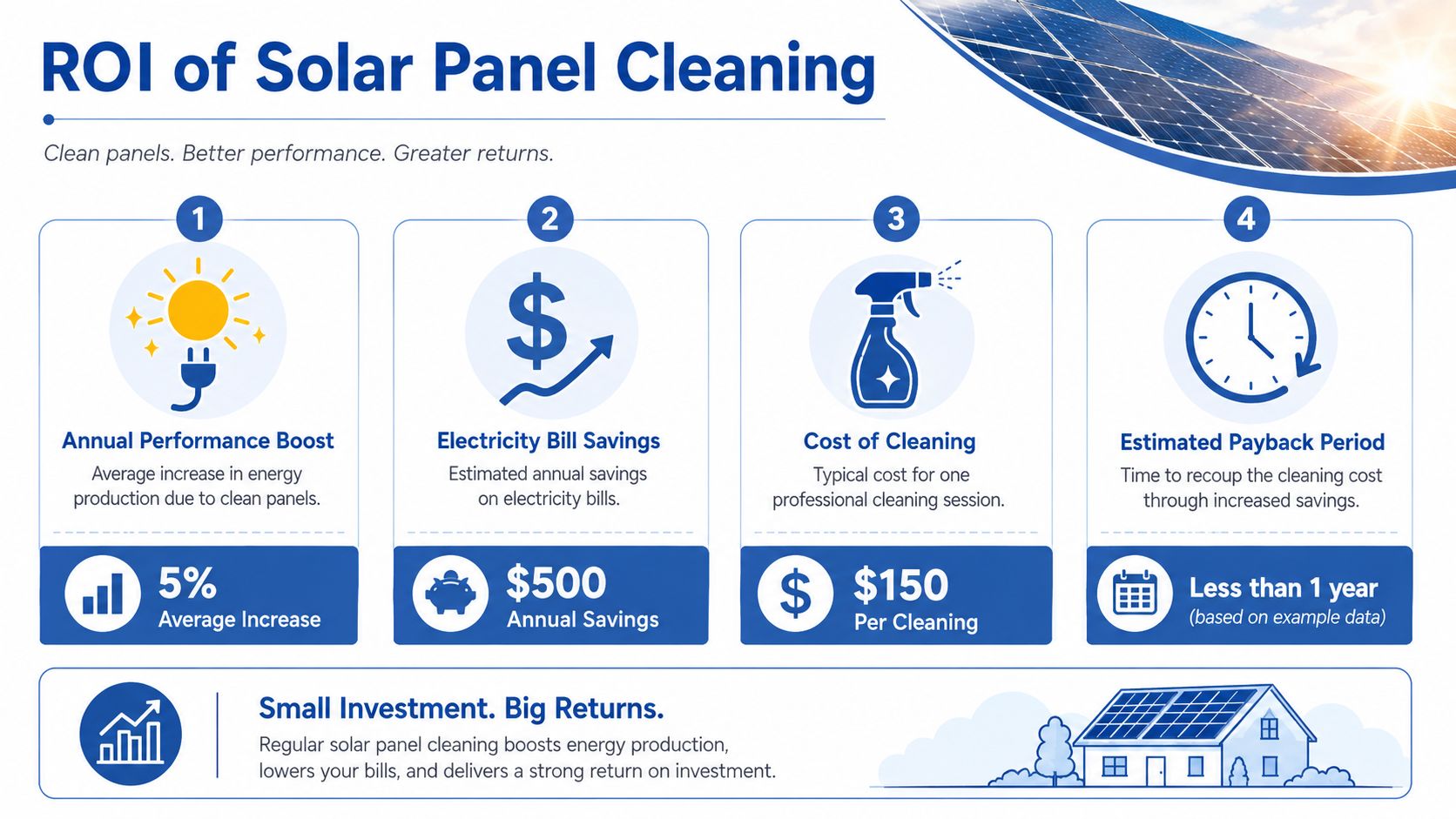
The math is simpler than often thought. You're trying to answer one question: Will the value of the extra electricity from cleaner panels exceed the cost of the cleaning?
Here's the framework.
The simple formula
Use this:
Value of added electricity from cleaning = estimated output improvement × the value of the power your system produces
If that value is higher than the cleaning price, the service makes sense financially. If it's lower, it may still be worth doing for maintenance reasons, but not purely for short-term return.
The hard part is estimating the gain accurately. That's where a lot of homeowners get led astray. Marketing language often assumes a dramatic improvement. Real-world results can be modest.
One useful benchmark comes from an Arizona result cited in an independent industry summary. In that review, an Arizona study found cleaning dust and dirt from panels produced about a 1% performance improvement, and the same summary notes that if cleaning improved annual generation by about 2%, the extra electricity value for a typical household would be around $80 per year. It also notes that twice-yearly cleaning could cost roughly $400, which makes it a net loss in ordinary conditions. You can review that discussion in this analysis of whether cleaning your solar panels makes a difference.
A practical way to estimate your own case
Start with your monitoring app and your electric bill.
Look for a drop after visible soiling
If output trends down after a dust event, and weather hasn't really rinsed the array, cleaning moves higher on the list.Separate dirt from equipment issues
Dirty panels reduce production. So do inverter issues, shading changes, and damaged components. If the drop seems sharp or unusual, don't assume dirt is the only cause.Use a conservative estimate
If you're not sure what cleaning will recover, assume a modest gain rather than a dramatic one. Conservative math prevents disappointment.Compare that value with the service quote
That's your break-even point.
When the numbers usually work better
Cleaning tends to make more financial sense in these situations:
- The array is larger: Even a small percentage improvement can matter more when more power is at stake.
- The buildup is visibly heavy: Thick dust film, droppings, or baked residue usually create a stronger case than a faint haze.
- The panels sit low or flat: Those systems often hold grime longer.
- The site gets repeated dust exposure: Homes near open lots, construction, high-traffic roads, or wind corridors usually see more accumulation.
A smaller residential system with light dust may not justify frequent service. A larger home in Chandler near active development, or a commercial property in Phoenix with chronic rooftop buildup, can be a different story.
If you want pricing context to compare against your own production value, this page on the cost to clean solar panels helps frame what to evaluate.
Don't ask whether cleaning always pays. Ask whether cleaning pays on your roof, with your dirt, at your current production value.
Why Arizona Is a Special Case for Solar Cleaning
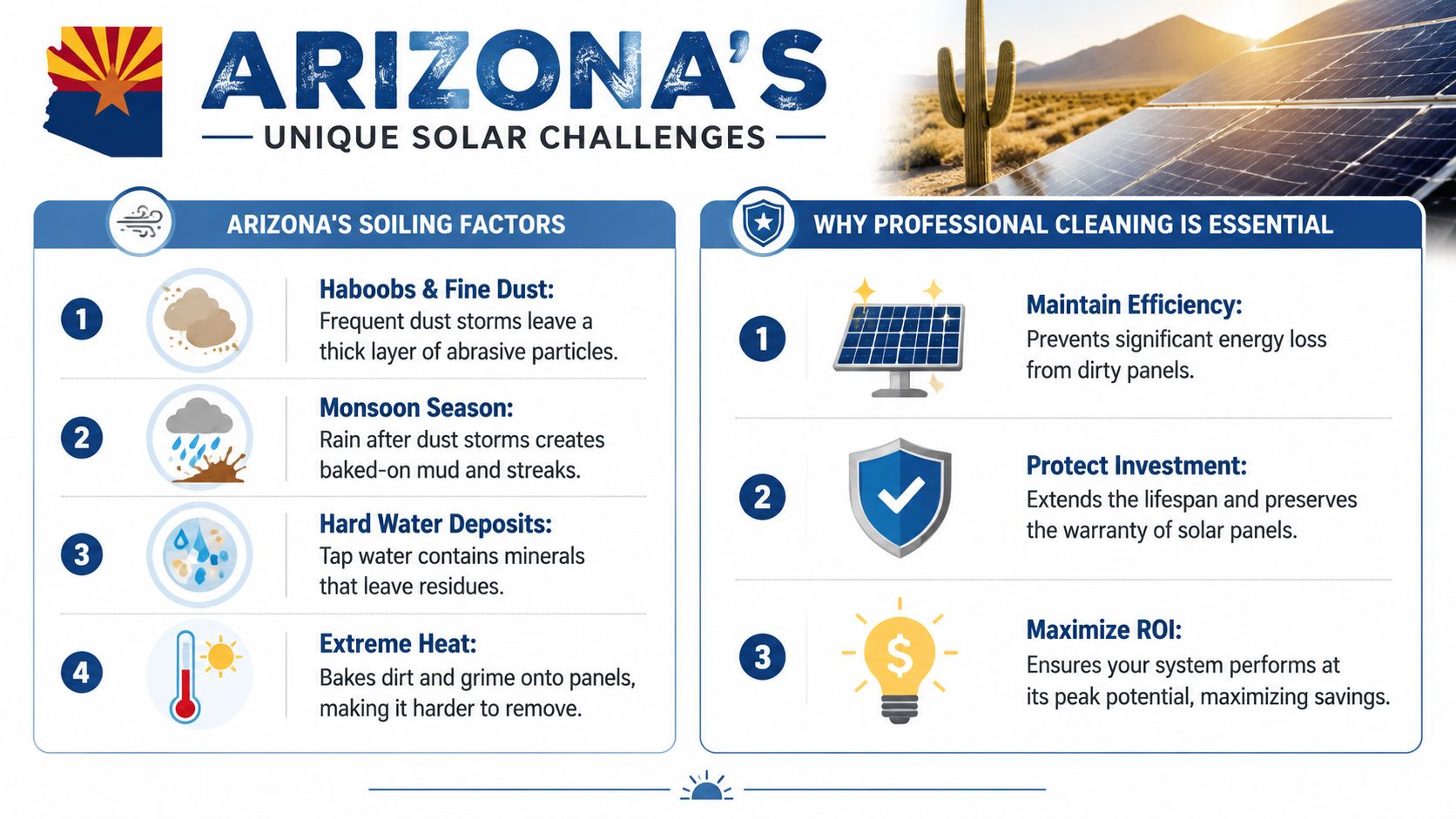
Arizona changes the conversation because the dirt here isn't just ordinary dust settling gently on a roof. It's wind-driven fine particulate, spring pollen, long dry periods, and monsoon moisture that can turn loose dust into a thin mud film. Then the sun goes to work and bakes that residue onto the glass.
That's why broad national advice often feels incomplete to Valley homeowners. It may be technically correct, but it doesn't reflect what a roof in Phoenix or Paradise Valley sees after months of heat and blowing dust.
Rain helps less than people think
A useful rule from mainstream solar maintenance guidance is that panels tilted above 10° often self-clean reasonably well with rainfall, while flat or low-tilt arrays may need more regular washing. That same guidance also notes more frequent dust and wildfire-smoke residue in desert markets, creating sticky soiling that rain does not fully remove. That point is summarized in this article on whether solar panels need cleaning.
That matters in Arizona because many Valley installations sit on rooflines where runoff and panel angle don't always work in your favor.
Arizona-specific conditions that change the equation
A few local factors push Arizona owners away from generic “let the rain handle it” advice:
- Haboob dust: Fine particles spread evenly and can settle into a stubborn film.
- Monsoon follow-up rain: Instead of a full rinse, it can leave mud spotting and streaking.
- Wildfire smoke residue: Smoke mixed with dust and pollen can create a stickier surface layer.
- Low-tilt installations: These often hold onto grime longer than steeper arrays.
Roofs matter too. Homeowners who already pay attention to roof debris, drainage, and buildup usually make better decisions about solar cleaning because they understand how Arizona weather treats exposed surfaces. If that's relevant to your property, these tips for maintaining your Arizona roof are a useful companion read.
The local truth most owners learn the hard way
In coastal or rainy markets, waiting can be reasonable. In the Phoenix area, waiting often means more baking, more residue, and a harder cleaning later. That doesn't mean every system needs routine service on a fixed schedule. It means Arizona owners should be skeptical of any advice that assumes rain is a reliable substitute for maintenance.
A brief shower can rinse dust. It usually won't remove grime that has already bonded to the surface after heat, pollen, and storm residue mix together.
That's the special-case reality here. Arizona doesn't automatically make cleaning worth it every time. It does make the “rain will take care of it” answer less reliable than many homeowners hope.
DIY Dangers vs Professional Peace of Mind
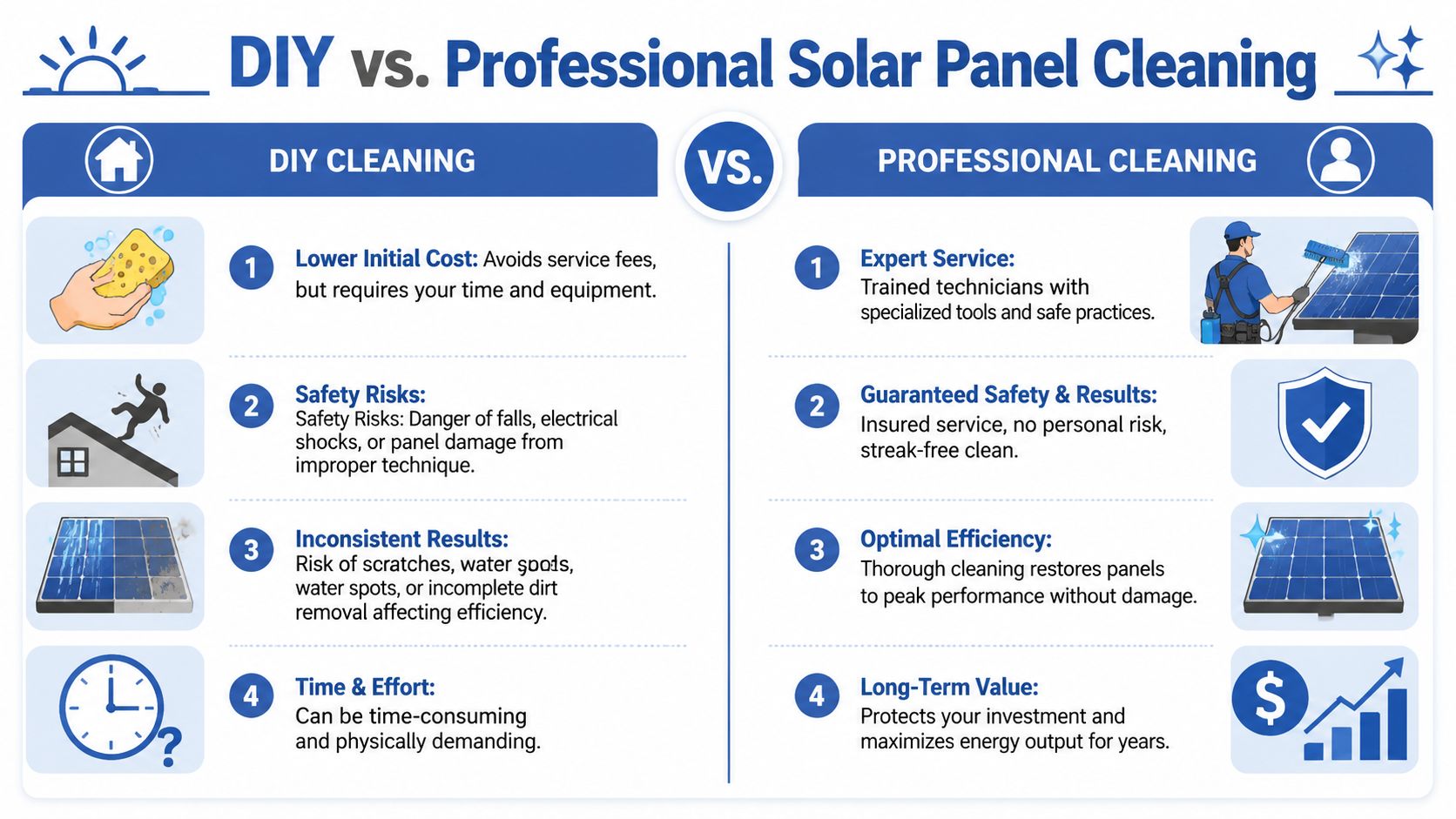
A lot of homeowners start in the same place. They look at the roof, think “it's just dirt,” and assume they can spray the panels off on a Saturday morning. Sometimes that works. Sometimes it creates scratches, spotting, or a much riskier roof situation than expected.
The true comparison isn't free versus paid. It's risk, method, and final result.
Where DIY makes sense and where it goes sideways
DIY may appeal if your panels are easy to access and the buildup is light. But Arizona roofs add complications fast.
| Approach | What works | What can go wrong |
|---|---|---|
| DIY cleaning | Minor surface dust, ground-level visual checks, basic rinsing if manufacturer guidance allows | Falls, streaking, hard-water spotting, wrong tools, accidental damage |
| Professional cleaning | Safer roof access, purified water, consistent results, inspection-minded process | Service cost has to make sense for your situation |
A few mistakes show up over and over:
- Using abrasive tools: Anything rough can mark the glass.
- Using pressure carelessly: Too much force around edges and seals is asking for trouble.
- Cleaning in peak heat: Water can evaporate too fast and leave residue behind.
- Treating tap water like purified water: In Arizona, mineral spotting is a real issue.
What professionals actually change
A professional crew doesn't just save you time. They change the cleaning method. That usually means proper roof access, controlled tools, and purified water that doesn't leave mineral deposits on the surface.
For homeowners deciding whether to tackle it themselves, this guide on how to clean solar panels lays out the key method and safety issues to think through first.
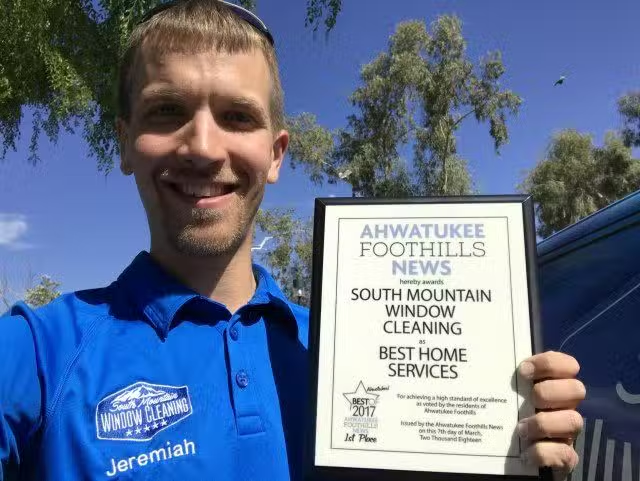
If you hire out the work, one local option is South Mountain Window Cleaning, LLC, which provides solar panel cleaning along with other exterior cleaning services in the Phoenix area. The important point isn't the company name. It's whether the crew uses the right water, follows roof safety practices, and avoids methods that can leave the panels worse than they found them.
Your Decision Checklist When to Call a Pro
Most homeowners don't need a complicated formula. They need a quick way to decide whether the panels are in the “leave them alone” category or the “this is worth addressing” category.
Use this checklist after a dust storm, a long dry stretch, or any time your monitoring app looks off.
Visual signs that cleaning is worth considering
Walk outside and look at the array from the ground if you can do it safely.
- You can see a film, not just a little dust: A uniform dull layer often means more than cosmetic dirt.
- There are obvious mud spots or streaks: That usually points to dust plus light rain rather than a true rinse.
- Bird droppings are sitting in multiple spots: Localized blockage can be more serious than it looks.
- The panels still look dirty days after weather passed: If the residue remains, rain probably didn't solve it.
Production clues that matter more than appearance
Visual dirt matters, but output matters more.
Ask yourself:
- Did production seem to dip after a storm or extended dusty period
- Does the system usually recover after rain, but this time it didn't
- Is the drop likely dirt-related rather than shade or equipment trouble
If the answer to several of those is yes, cleaning deserves a closer look.
Field check: If panels look blotchy, filmed over, or streaked after weather, don't assume they're “clean enough.” Arizona rain often rinses. It doesn't always clean.
Property factors that push the decision
Some homes and buildings need more attention than others.
- Low-slope or flat installs: These hold grime longer.
- Dust exposure from roads, desert edges, or construction: More airborne debris usually means more buildup.
- Large arrays: Small efficiency losses matter more when spread across more panels.
- Hard-to-access roofs: The danger of DIY rises quickly when the roofline is steep, tall, or awkward.
Commercial property managers should also think beyond simple appearance. If a rooftop is already part of a regular exterior maintenance plan, it often makes sense to inspect the panels whenever the roof and drainage areas are being checked.
When waiting is reasonable
Sometimes the best move is to do nothing for now.
Wait if the panels have only a light dust layer, recent rain rinsed them well, production looks normal, and there's no obvious sticky residue. In those cases, immediate service may not change much.
Call a pro when the dirt is visible, the buildup looks bonded to the glass, or the production trend and roof conditions suggest you're not dealing with a simple cosmetic layer anymore.
Schedule Your Solar Panel Cleaning with South Mountain
If your panels have reached the point where waiting on the weather doesn't make sense, the next step is straightforward. Get them cleaned with a method that removes the grime without adding mineral spots, scratches, or roof risk.
For Arizona homes and commercial properties, that usually means purified water, the right tools for glass surfaces, and technicians who know how to move safely on hot, dusty rooflines. It also means being realistic about the reason for the service. Sometimes cleaning is about immediate ROI. Sometimes it's about removing baked-on grime that rain hasn't touched and protecting the condition of the array going forward.
South Mountain Window Cleaning serves homeowners and businesses across Phoenix, Scottsdale, Paradise Valley, Chandler, Tempe, and Gilbert. The company is licensed, bonded, and insured, and handles solar panel cleaning as part of a broader exterior cleaning service lineup that includes residential, commercial, and high-rise work.
A quick look at the company in action helps if you want to see the kind of exterior service approach involved.
If you're trying to answer the question “is solar panel cleaning worth it,” the most honest answer is still: it depends. But in Arizona, the decision gets easier when you look at the right things. Visible buildup, low-tilt panels, storm residue, and output drops all push the answer toward yes. Light dust on a system that's still performing normally may not.
The key is to stop guessing. Check the condition of the panels, compare that with your production trend, and get a quote when the signs point to real buildup rather than ordinary desert dust.
If your solar panels in Phoenix, Scottsdale, Paradise Valley, Chandler, Tempe, or Gilbert look filmed over after dust, pollen, or monsoon residue, contact South Mountain Window Cleaning, LLC for a fast, free quote. Their team handles residential, commercial, and high-rise exterior cleaning with purified-water methods, safety-trained technicians, and service built for Arizona roofs.