
Pure-water window cleaning is window cleaning with water purified by reverse osmosis, deionization, or both, delivered through a water-fed pole and brush so the final rinse leaves no detergent and very few dissolved minerals on the glass. Wash and rinse water should contain 20 ppm TDS or less, but preventing new spots isn't the same as removing old stains.
If water alone can leave glass clear, why does rinsing a window with the garden hose so often make it look worse? The difference isn't how wet the glass gets. It's what remains after the water disappears, and whether the marks were already bonded to the surface before cleaning began.
What Pure Water Window Cleaning Is and Why Glass Spots
Pure-water window cleaning uses a brush to loosen dirt and a low-mineral rinse to carry it away, without needing detergent for the finish. It's mainly suited to exterior glass, including skylights, conservatories, and upper windows where direct squeegee access is awkward.
Consider a Phoenix storefront beside an irrigated planting bed. A sprinkler wets the bottom panes, the sun dries the droplets, and pale rings become visible. Someone rinses the glass with a hose, but once it dries, there are still marks.
The hose may have carried away loose dust. It also delivered another supply of dissolved minerals.
What evaporating water leaves behind
Ordinary water can contain calcium, magnesium, sodium, chloride, sulfate, bicarbonate, and silica. These dissolved materials aren't necessarily visible while the glass is wet. When water evaporates, they can remain as rings, haze, or a thin mineral film.
Think about dissolving salt in water on a glass dish. The liquid can look clear, but drying doesn't make the salt disappear. Water leaves; the dissolved material stays.
A kettle's chalky crust offers another familiar comparison. Heating and repeated water use make mineral buildup easy to see, but the underlying lesson also applies to windows: clear-looking water isn't mineral-free water.
For household context beyond windows, the Ring Hot Water hard water guide is a useful companion resource when considering water treatment. Window cleaning has a narrower purpose, treating the water used on the glass rather than necessarily treating the entire property's supply.
Hardness isn't the same as dirt
The USGS water-quality guidance classifies water above 180 mg/L as calcium carbonate as very hard. That classification describes the water's hardness, not how dusty the window is or whether the pane needs restoration.
In an arid setting, sprinkler overspray and evaporation can make mineral deposits especially noticeable. However, appearance alone can't identify the water supply's hardness. Testing is more useful than assuming every Arizona property has identical water.
Practical rule: A clean rinse prevents the rinse water from adding mineral residue. It doesn't establish that every existing mark can be washed away.
A technician still needs to scrub the glass and rinse away loosened contamination. Purification doesn't replace brush contact, and more aggressive scrubbing isn't automatically the answer to a bonded deposit.
For a homeowner sorting out recurring rings, our explanation of window-cleaning water spots helps distinguish the maintenance concern from the cleaning method. Ask what water will reach the glass and how its purity will be checked at the brush, rather than accepting the presence of a filtration unit as proof of a spot-free rinse.
Purity Benchmarks Behind a Spot-Free Rinse
Total dissolved solids, usually shortened to TDS, describes the concentration of dissolved material in water. A field TDS meter provides an operational check on whether the treatment system is delivering sufficiently low-mineral water, although it doesn't measure dirt left on the window.
The distinction matters. A favorable meter reading supports the rinse-water claim; it doesn't certify brush technique, frame cleanliness, or the condition of the glass.
Purity benchmarks for spot-free pure-water cleaning
| Measure | Target or threshold | What it means on glass |
|---|---|---|
| Untreated tap water | Not acceptable for this technique under the IWCA architectural-glass guidance, which specifies 20 ppm TDS or less for wash and rinse water | Dissolved solids can dry as visible spots |
| Wash and rinse water, IWCA architectural-glass guidance | 20 ppm TDS or less, under the guidance linked above | Limit intended to prevent spotting and streaking |
| Commonly targeted output | 0-10 ppm TDS, according to Cultivate's deionized-water cleaning explanation, which also identifies the preferred range and reprocessing threshold below | Range commonly targeted for pure-water cleaning |
| Preferred output | 0-5 ppm TDS, in the same technical explanation | Wider margin for spot-free drying |
| Reprocess threshold | Above 10 ppm TDS, in that explanation | Residual ions may dry as spots or streaks |
| High-purity deionized water, lab reference | About 18.2 megohm-centimeters at 25°C, or 0.055 microsiemens per centimeter, according to Fresh Water Systems | Reference point, not a field target |
| Very hard water, USGS | Above 180 mg/L as calcium carbonate, under the USGS classification | Signals a substantial hardness load requiring treatment |
Read the measurements correctly
The architectural-glass ceiling and the tighter operating targets aren't contradictory. A contractor can choose a more conservative field target to allow room for changes in water quality as resin becomes exhausted or operating conditions change.
The laboratory reference uses resistivity and conductivity, not the same units as the field TDS targets. It illustrates how little ionic material highly purified water contains; it isn't a specification homeowners need to demand for routine window washing.
Hardness and TDS also aren't interchangeable. Hardness primarily concerns calcium and magnesium, while TDS covers a broader dissolved load. In hard-water markets such as the Phoenix area, both matter, but they answer different questions.
Ask for a reading at the brush, not just at the storage tank. Compare the demonstrated result against the table's reprocessing line, and remember that even excellent water still needs an effective wash-and-rinse technique.
How Reverse Osmosis and Deionization Strip Minerals
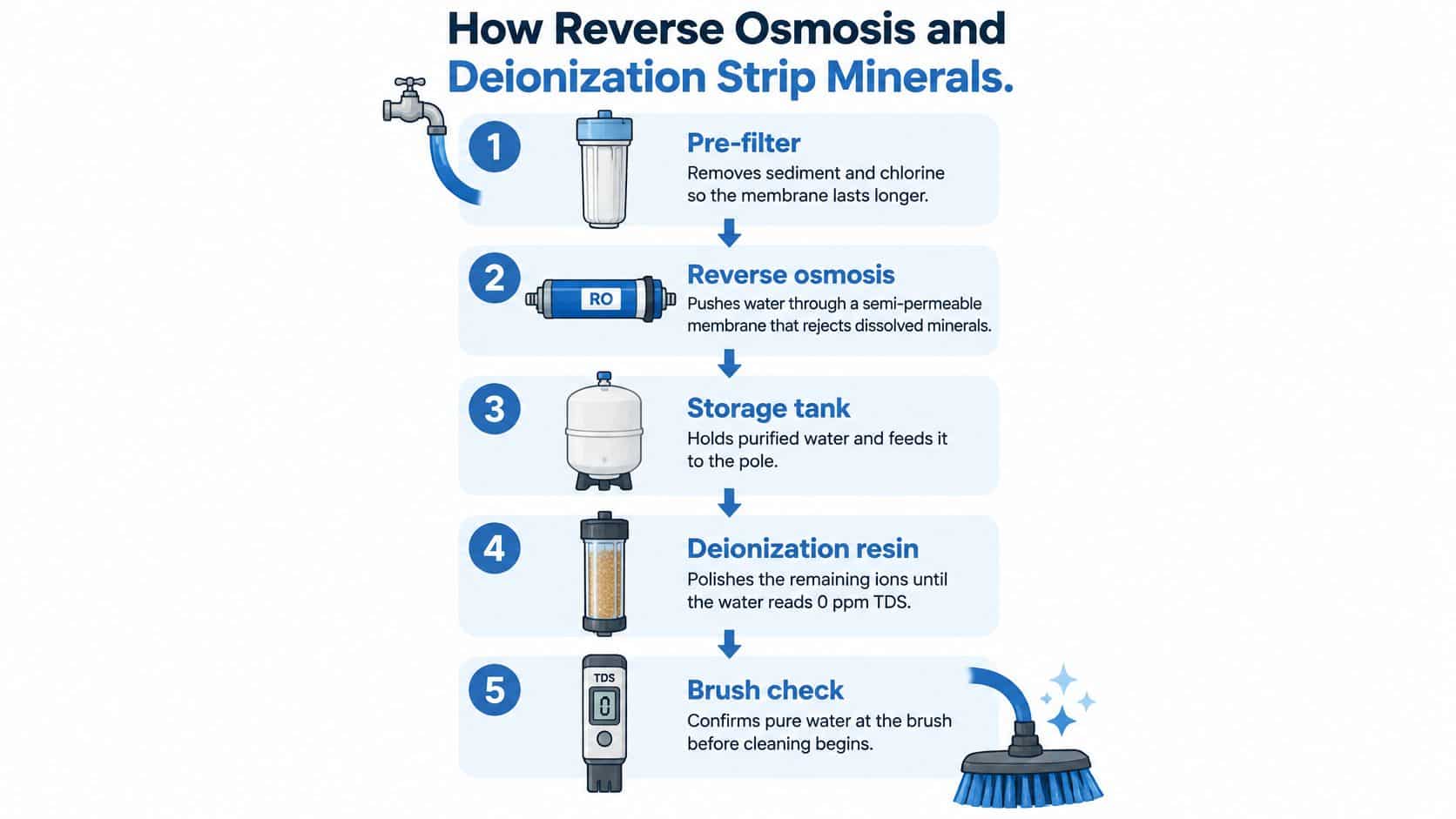
Follow the water from the incoming hose and the treatment process becomes easier to understand. A combined system removes much of the mineral load first, then treats the remaining charged material before delivering the rinse.
The National Window Cleaning Authority describes reverse osmosis reducing dissolved solids by approximately 90%-99%, with deionization polishing water to roughly 0-5 ppm TDS; it also describes poles commonly reaching about 65 feet, or approximately 20 metres.
From supply water to the brush
Pre-filtration protects the treatment equipment. A sediment cartridge catches particles, while suitable carbon filtration removes chlorine where the system requires it. These stages help protect the downstream membrane rather than producing the final low-mineral rinse on their own.
Reverse osmosis separates much of the dissolved load. Pressure pushes water through a semipermeable membrane. Treated water passes through, while a separate reject stream carries away concentrated contaminants.
Deionization removes remaining charged ions. Ion-exchange resin trades dissolved ions for hydrogen and hydroxide ions, which combine into water. This polishing stage deals with material left after membrane treatment.
Storage provides a working supply. A tank can hold treated water until the crew needs it. Some layouts place final DI polishing after storage, so the exact arrangement isn't identical on every vehicle.
Delivery moves the water to the cleaning head. A pump or suitable supply pressure sends water through the hose to the pole-mounted brush. A check at the delivery end verifies the water the technician will use.
The process diagram shows a configuration with storage before final DI polishing and a brush-end quality check.
A sieve followed by a magnet
Think of RO as a very fine sieve handling the bulk load and DI as a magnet collecting the last charged traces. Neither analogy is literal, but together they explain why the stages complement each other.
RO reduces the work left for the resin. DI finishes the ionic cleanup rather than forcing the membrane alone to produce the final result.
A long pole makes the hose path important: water must stay suitable all the way to the brush, not merely when it leaves a treatment cartridge. When reviewing a system description, identify where treatment ends, where storage sits, and where the final quality measurement is taken.
How a Water-Fed Pole Cleans a Window
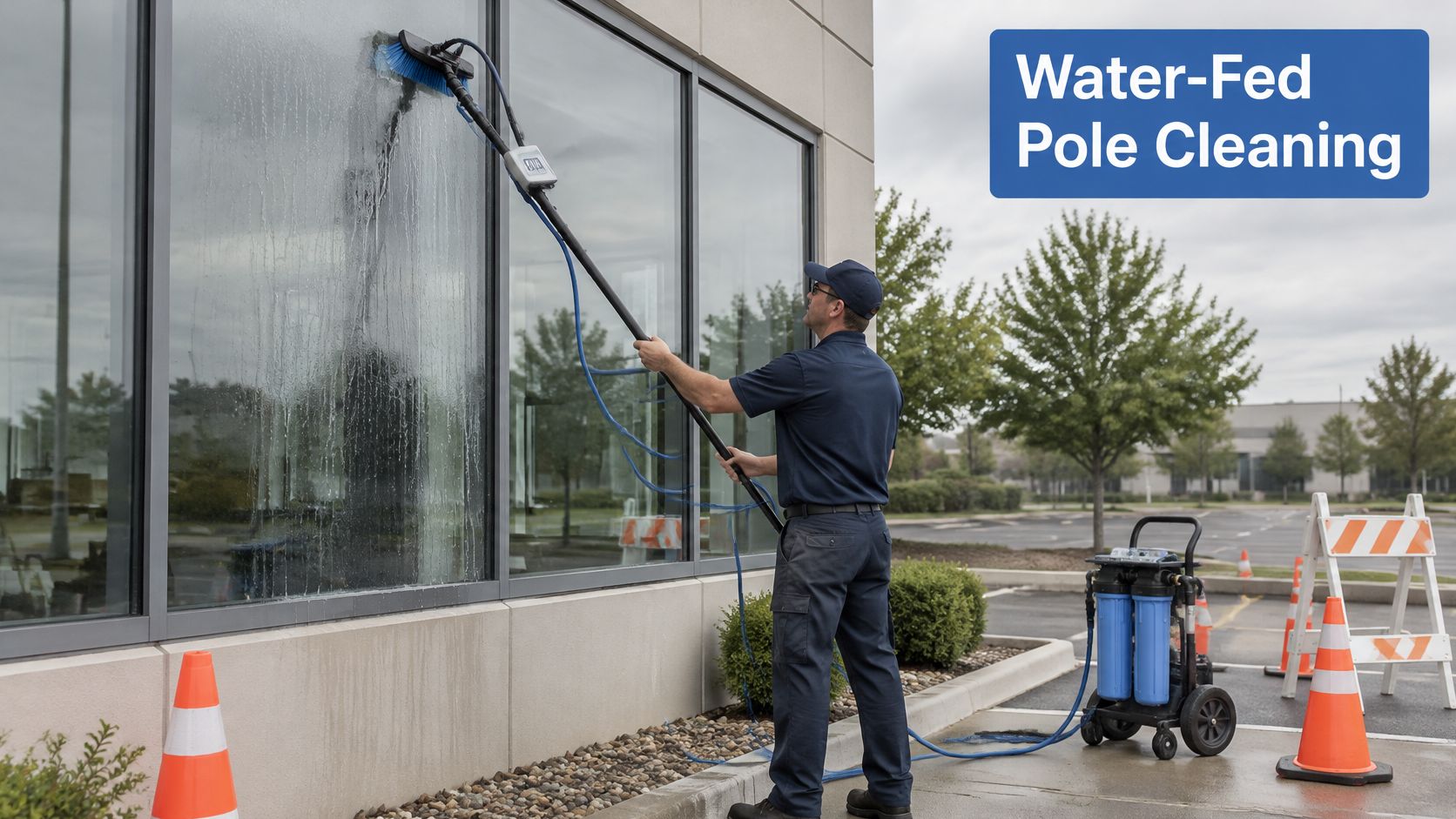
A water-fed pole is a telescopic pole fitted with a brush and a way to deliver purified water. The IWCA definition and safety principles discussed in Unger's water-fed cleaning guidance emphasize competent operators, equipment checks, barricades, weather limitations, and clearance from overhead power lines; certain carbon-pole configurations can reach up to five stories, but that isn't a universal building-access rating.
The equipment lets a technician scrub and rinse from a ground position where the site permits it.
A controlled cleaning sequence
Inspect and verify. Check the pole sections, clamps, hose, connections, brush, and water supply, then record the brush-end TDS reading. The common mistake is assuming yesterday's acceptable water proves today's output is suitable.
Control the work area. Assess wind and weather, barricade the cleaning zone, and establish clearance from overhead power lines. Ground-based work still creates hazards for pedestrians, especially around wet paving and trailing hoses.
Wet before scrubbing. Apply water before moving the brush across the pane so it doesn't drag dry grit over the surface. Starting with a dry, dirty brush is an avoidable slip.
Agitate with overlapping passes. Work in manageable sections, maintaining brush contact across the glass and paying attention to edges. Rushing the middle while barely touching the corners leaves contamination behind.
Rinse from the top down. Carry loosened dirt off the pane with a thorough purified-water rinse. Skipping the upper edges or stopping while dirty runoff remains can leave streaks and corner deposits.
Allow natural drying. Leave the properly rinsed exterior glass to air-dry rather than wiping it with a towel that may transfer lint or residue. Watch for dirty frame runoff before declaring the pane finished.
Recheck and record. Retest the water before packing away and note any surface defects or deposits requiring separate attention. Without that closing check, a change in water quality may go unnoticed.
The video provides another view of the equipment and cleaning method.
Reach isn't the only safety decision
Wind can make an extended pole difficult to control. Electrical hazards, unstable footing, restricted access, and façade geometry can also rule out a ground-based approach even when the glass appears within reach.
Our team members undergo extensive window-cleaning safety training. For planning access, the explanation of reach window cleaning helps distinguish pole access from work requiring other equipment.
A good finish is judged after drying, with the glass viewed in revealing light, not merely while a sheet of water makes it look clear.
Where Pure Water Works and Where It Falls Short
Purified water controls dissolved minerals in the rinse. It doesn't chemically dissolve everything attached to glass, and it can't repair damage within a pane or sealed unit.
That boundary separates maintenance cleaning, pre-treatment, and restoration. The Health and Safety Executive's window-cleaning guide describes purified water delivered through a brush and also warns that wind, defective equipment, and overhead power lines remain operational concerns. Neither the cleaning result nor the site assessment should depend on purification alone.
What pure-water cleaning removes and what needs separate work
| Surface condition | What pure-water cleaning does | What to quote separately |
|---|---|---|
| Dust, pollen and light soil | Removed by brush and rinse | Routine maintenance, identified in the base scope |
| Fingerprints and oily film | Often needs extra passes or pre-treatment | Repeat service or pre-treatment |
| Bird droppings and bug residue | Removed when fresh; baked-on residue may stay | Hardened-deposit treatment |
| Hard-water scale or etching | Not removed by purified water alone | Glass restoration assessment |
| Paint and construction debris | Usually not removed | Separate removal method |
| Failed seal or fogged glass | Not a cleaning issue | Repair or glass replacement |
Match the method to the mark
Routine dust and pollen are a good match for brush agitation and rinsing. Arizona's dusty conditions make scheduled maintenance useful because technicians can remove ordinary soil before a window accumulates a more difficult mixture of dirt and hardened residue.
Oily films behave differently. They may resist wetting or smear under the brush, so the technician needs to assess whether additional agitation or a glass-compatible pre-treatment is appropriate. Dried bird waste and insect residue may need soaking and targeted treatment rather than heavier pole pressure.
Mineral scale, paint, and construction debris belong in a separate discussion. Our hard-water solutions resource helps explain why deposit removal shouldn't be treated as an automatic part of ordinary washing. Etching may remain even after removable deposits are addressed, and restoration assessment doesn't guarantee full recovery.
First visits and recurring maintenance
A neglected window can reveal more defects once dirt no longer conceals them. A recurring maintenance visit starts from a different surface condition, so the same cleaning method can produce a more consistent appearance without promising to reverse previous damage.
Before booking, gather these details:
- Surface material: Note dust, grease, sprinkler rings, paint, or other visible contamination.
- Cleaning history: Explain whether the glass receives regular attention or has been neglected.
- Mark location: Identify whether the haze appears on an accessible surface or between the panes.
- Written scope: Separate routine washing from deposit removal, restoration assessment, and repair.
Trade-offs in Water Use, Waste and Resin Costs
Pure-water cleaning isn't automatically impact-free because it uses less detergent. The treatment equipment consumes resources before the water reaches the window.
As AXEON Water Technologies explains, incoming water quality affects treatment choice and operating cost: RO produces a reject stream, while DI resin is consumed as it removes ions. Higher-TDS feed places a greater load on the resin.
Reverse osmosis, deionization, and combined treatment
| System | What it removes | Main operating cost | Best fit |
|---|---|---|---|
| Reverse osmosis | About 90%-99% of dissolved solids, with a reject stream, using the membrane performance described by the National Window Cleaning Authority | Reject water and pump energy | High-TDS feed where reducing the mineral load first saves resin |
| Deionization only | Charged ions, polishing toward 0-5 ppm TDS using the same authority's described polishing range | Resin, consumed faster in hard or high-TDS water | Already low-TDS water or a small polishing load |
| RO plus DI | RO takes the bulk load and DI polishes to roughly 0-5 ppm TDS under that treatment description | Reduced resin demand compared with DI-only, plus reject water | Arizona properties with hard feed water requiring consistent field output |
Pump energy, replacement cartridges, resin, reject-water handling, and repeated rinsing all belong in an honest comparison. The benefits can include reduced detergent use and fewer ladder or lift operations, but neither benefit justifies calling the process universally green or risk-free.
Questions worth asking before work begins
- Brush-end TDS: What reading can the technician demonstrate? Equipment labels alone don't establish output quality.
- Treatment technology: Is the system RO, DI, or combined? The answer should match the incoming water and workload.
- Water consumption: What consumption is expected per visit or window? Include treatment water, not just the final rinse.
- Reject-water handling: Where will the reject stream go? Disposal needs to suit the property.
- Resin replacement: What triggers a change? Monitoring should guide maintenance before quality deteriorates.
- Stop-work conditions: When will the crew decline pole work? Wind, electrical exposure, and unsafe access need clear limits.
Buying advice: Compare the complete method, including treatment, rinsing, waste handling, and access controls, rather than choosing on the word pure alone.
Choose Pure-Water Cleaning for Your Arizona Property
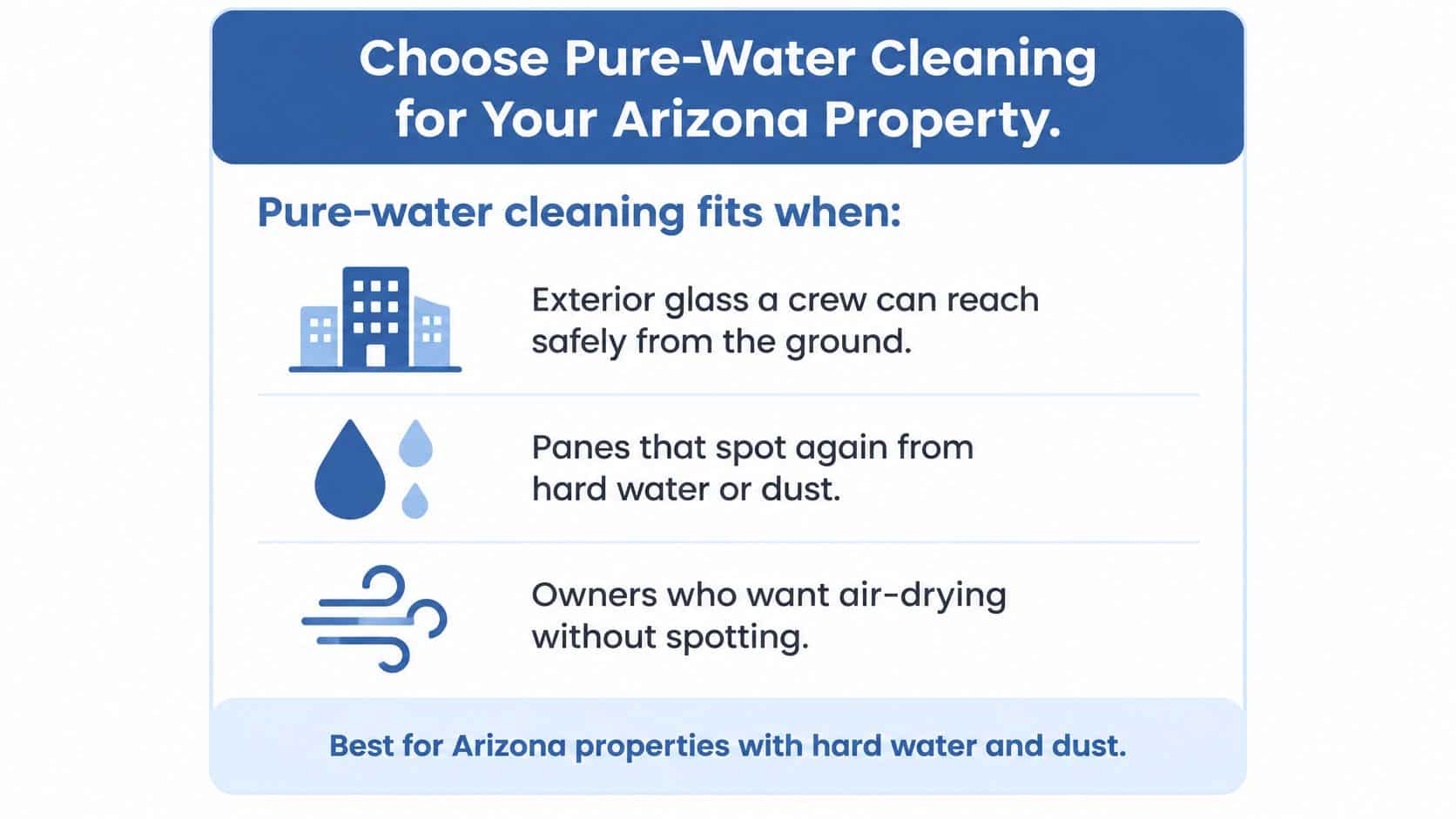
Pure-water cleaning fits exterior glass a crew can safely reach from the ground, especially when owners want a low-residue rinse without squeegee contact at height. Existing scale, etched surfaces, hardened paint, and construction contamination still require a separate assessment.
These property conditions help identify a suitable application.
Match the visit to the property
- Scottsdale home: Sun-facing glass with irrigation rings needs deposit assessment, sprinkler adjustment, and an appropriate maintenance plan.
- Gilbert or Chandler storefront: Dust accumulation and customer-facing appearance help determine the maintenance interval.
- Paradise Valley or Tempe façade: Rated pole reach, ground access, and building geometry determine whether pole work is suitable or high-rise access is needed.
Service location matters too. For a separate vehicle-cleaning errand, VIP Car Wash's wash location on Connector Road provides location context; building-window work instead requires an assessment at your own property.
South Mountain Window Cleaning, LLC provides residential, commercial, and high-rise window washing in Phoenix, Scottsdale, Paradise Valley, Chandler, Tempe, and Gilbert, Arizona. Our services also include power washing, solar panel cleaning, house washing, and Christmas light installation; commercial window cleaning is available weekly, monthly, quarterly, or as a one-time service.
For window cleaning in Phoenix, make one clear request this week: a brush-end purity reading and a written price separating maintenance from restoration.
South Mountain Window Cleaning, LLC offers window washing for homes, storefronts, commercial properties, and high-rise buildings, with the cleaning method matched to the glass and access conditions. Visit South Mountain Window Cleaning, LLC for a fast, free quote, and describe any sprinkler spots, stubborn deposits, or difficult-to-reach panes so the proposed work addresses the right problem.