
Most Phoenix-area homeowners pay $250 to $400 per professional cleaning, and annual budgets often run $600 to $1,500 because desert dust calls for more frequent service than national guides suggest. In the Valley, the quote usually looks smaller than the bill for a roof repair, but it's still worth understanding what you're paying for before you climb up there or sign a maintenance plan.
A dusty array can make a brand-new solar system feel older than it is. Around Phoenix, Scottsdale, Paradise Valley, Chandler, Tempe, and Gilbert, the main question isn't whether panels get dirty, it's how often they need attention and whether the cleaning bill earns its keep in output.
What Solar Panel Cleaning Costs in Phoenix Today
A typical Phoenix homeowner who just got a solar quote is usually looking at a familiar range. For a straightforward residential visit, $150 to $500 per cleaning is the common market band, and many single-story homes land around $250 to $350 per visit (Solar Clean Hub pricing guide). That's the number most Valley homeowners should keep in mind before comparing bids.
The local reality, though, is harsher than the national average suggests. In dry, dusty parts of Arizona, annual budgets often move into the $600 to $1,500 range when panels need 3 to 4 cleanings per year instead of just one, especially in the desert Southwest (Earth Energy Log homeowner guide). That's the part generic cost pages miss, because Phoenix isn't a rainy-market maintenance case.
A practical first read on the quote
If your roof is easy to access and your system is modest, the quote often feels reasonable. If your panels sit on tile, steep slopes, or multiple roof planes, the price climbs because the crew spends more time on setup and safety, not because the glass itself changed.
A useful local benchmark is that professional residential cleaning commonly starts at about $200 and is often quoted in the $200 to $500 band for typical service calls (Angi 2026 cost guide). Consumer pricing guides also cluster around $100 to $350 on the lower end, while some companies impose a minimum charge of $75 or more (ConsumerAffairs solar cleaning page, Yelp 2026 cost page). That minimum matters on smaller systems because the trip fee can drive the total more than the labor.
In Phoenix, the quote is less about the glass and more about roof access, safety setup, and how long the dust has been baking on.
How Companies Price the Job
A Phoenix quote usually starts with the way the company bills the visit, then the roof access, panel count, and dirt load decide where it lands. That matters here because desert dust does not behave like light household dust. It bakes on, spreads unevenly, and changes the amount of time a crew spends on the roof. If you know the pricing model, you can tell whether the number reflects real labor or just a broad estimate.
The four models you're most likely to hear
Per-panel pricing is the easiest model to compare across providers. Some companies set a $100 to $150 base fee plus $8 to $15 per panel (SolarCalculatorHQ), and others describe the average as about $8 per panel or roughly $320 for 40 panels (AirTasker solar panel cleaning cost). That approach works well when the array size drives the labor more than the roof layout does.
Per-visit pricing is common for homeowners who want one number upfront. It often falls in the $150 to $500 range, with simpler setups near the lower end and steeper or tiled roofs higher up (Solar Clean Hub pricing guide). Per-system pricing usually does the same thing under a flat quote, because the contractor is pricing the trip, the setup, and the cleaning together instead of line by line.
Square-foot pricing shows up less often in residential work, but it still appears in larger property bids and some multi-building jobs. It gives the company room to estimate labor density, setup time, and safety work across a broader roof area. If that figure comes in without an explanation, ask for the panel count and a note on access instead of trying to compare square footage by itself.
Rule of thumb: if the contractor can't tell you how many panels are included, you're not comparing the same job.
| Common Solar Panel Cleaning Pricing Models | Typical Range | Best Fit |
|---|---|---|
| Per panel | about $8 to $15 per panel, or $100 to $150 base plus panel count (SolarCalculatorHQ, AirTasker solar panel cleaning cost) | Larger residential arrays |
| Per visit | about $150 to $500 per cleaning (Solar Clean Hub pricing guide) | Standard homes and repeat service |
| Per system | often bundled into one flat quote | Simple roofs with easy access |
| Minimum trip fee | $75 or more minimum charge (Yelp) | Small systems and one-off service |
For larger properties, pricing gets more specific because the work is scheduled around access, labor planning, and recurring service rather than a one-time stop. South Mountain Window Cleaning's commercial solar panel cleaning page is a straightforward example of that approach. If you're comparing how a service business scales its route and crew capacity, Growth 4 Trades scaling advice is a useful planning reference.
What Drives the Price Up or Down
The quote changes fastest when the roof is harder to work on. A single-story shingle roof with open access is one job. A two-story tile roof with awkward panel placement, safety tie-offs, and limited water access is another, and the difference shows up in labor time right away.
The main cost levers
System size is the simplest driver. Smaller residential arrays with easy access usually stay on the lower end, while larger or harder-to-reach systems cost more because the crew spends more time on the roof and more time rinsing each panel. Panel count matters for the same reason, since a 20-panel roof is a much smaller job than a 40-panel roof once access, buildup, and rinse time are included. That lines up with the ranges noted earlier in homeowner pricing guides.
Access and roof geometry matter just as much. Steep roofs, tile roofs, and multi-surface layouts slow the crew down because every move takes more setup and more caution. The same number of panels can cost more if the tech has to spend extra time staging ladders, managing fall protection, or working around parapets and HVAC equipment.
Soiling severity changes labor too. Panels that have gone a long time without washing collect more baked-on dust and grime, which takes more dwell time and more careful rinsing. In the Valley, that matters because a layer of dust can cut output enough that a delayed cleaning does not just look dirty, it leaves power on the table until the glass is cleared.
Safety requirements also raise the price. Fall protection, roof steepness, and difficult access increase the labor cost because they increase both risk and time on site. On larger systems, the economics shift even more, since access method and water logistics can drive the bill as much as the cleaning itself, as shown in the IEEE comparison of cleaning approaches for a 100-MW plant in central Saudi Arabia (IEEE study).
Practical rule: if the quote jumps after the contractor asks about roof pitch, tile, and access, that's normal. If it jumps without any explanation, ask for the reason in writing.
DIY Versus Hiring a Pro in the Desert
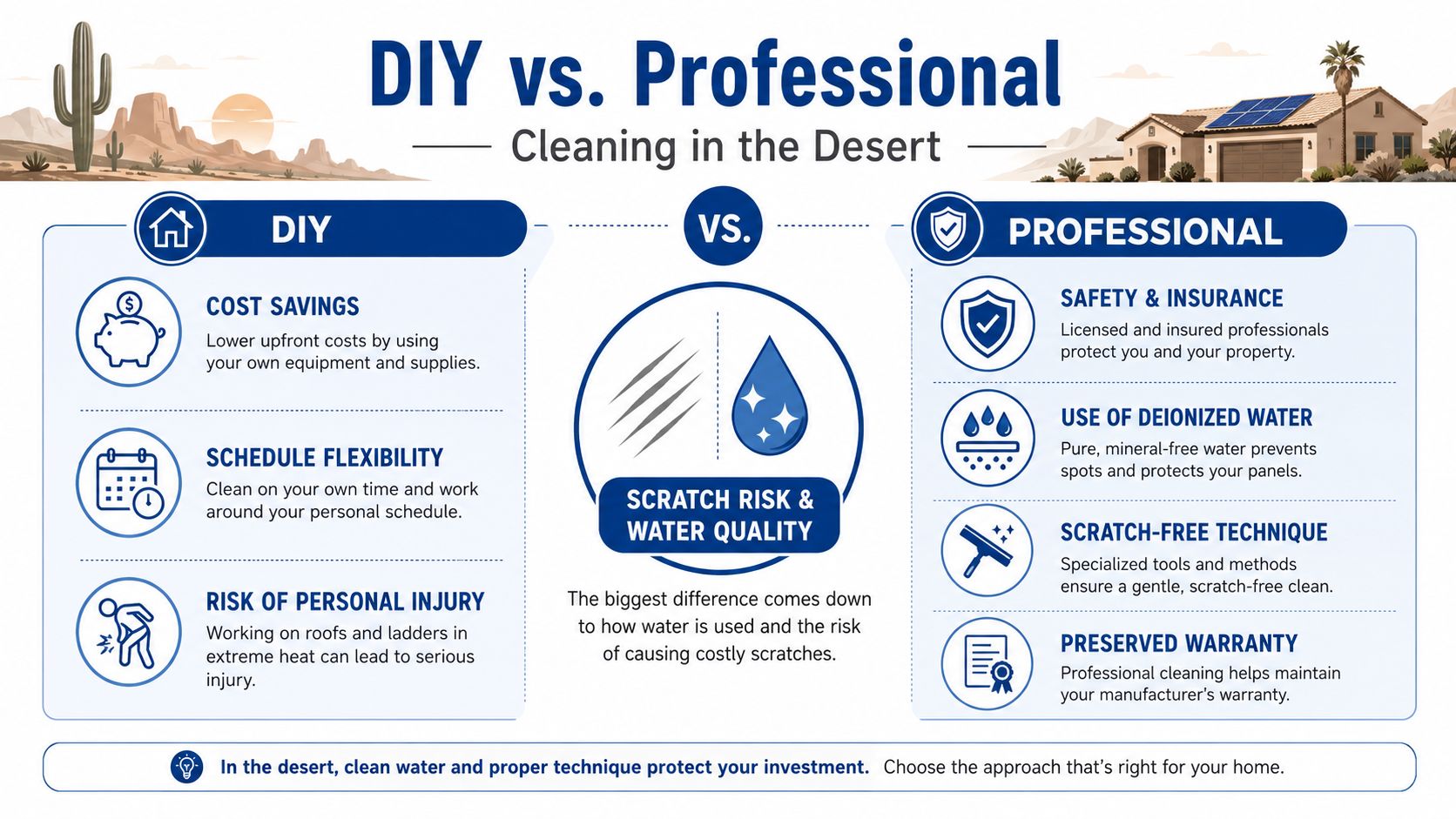
DIY looks cheap until you count the roof, the water, and the time. A homeowner can save the service call, but the trade-off is safety, consistency, and the chance of leaving behind spots or scratches that defeat the point of cleaning in the first place.
What changes when you do it yourself
The biggest difference is risk. Ladder work on tile roofs is where a lot of homeowners get uncomfortable, and for good reason. Tile can crack, steep slopes are unforgiving, and a wet roof in the morning isn't where you want to test balance.
Water quality is the second issue. Tap water can leave mineral spotting, which matters more in hard-water climates and on glass that's supposed to shed dust cleanly. Professional crews usually bring better rinse methods, and that helps avoid the streaking problem that turns a quick DIY job into a second round of work.
Scratch risk is the one homeowners underestimate. The wrong brush, a pressure washer, or even a gritty pad can mark the surface or disturb seals. That's why some crews use soft tools and controlled rinse methods instead of brute force.
For a typical Arizona home with 20 to 30 panels, the time cost can be significant even before you touch the roof. Counting setup, cleaning, and careful rinsing, it's not a five-minute chore. If you're repeating it several times a year, the time burden starts to look like a hidden maintenance bill.
If you're uneasy on ladders, the safest choice is usually the one that keeps you on the ground.
For homeowners who want a detailed walkthrough of the process, South Mountain Window Cleaning's how to clean solar panels page is a useful reference point, especially if you're comparing DIY technique to a professional visit.
How Often to Clean and What the Energy Payback Looks Like
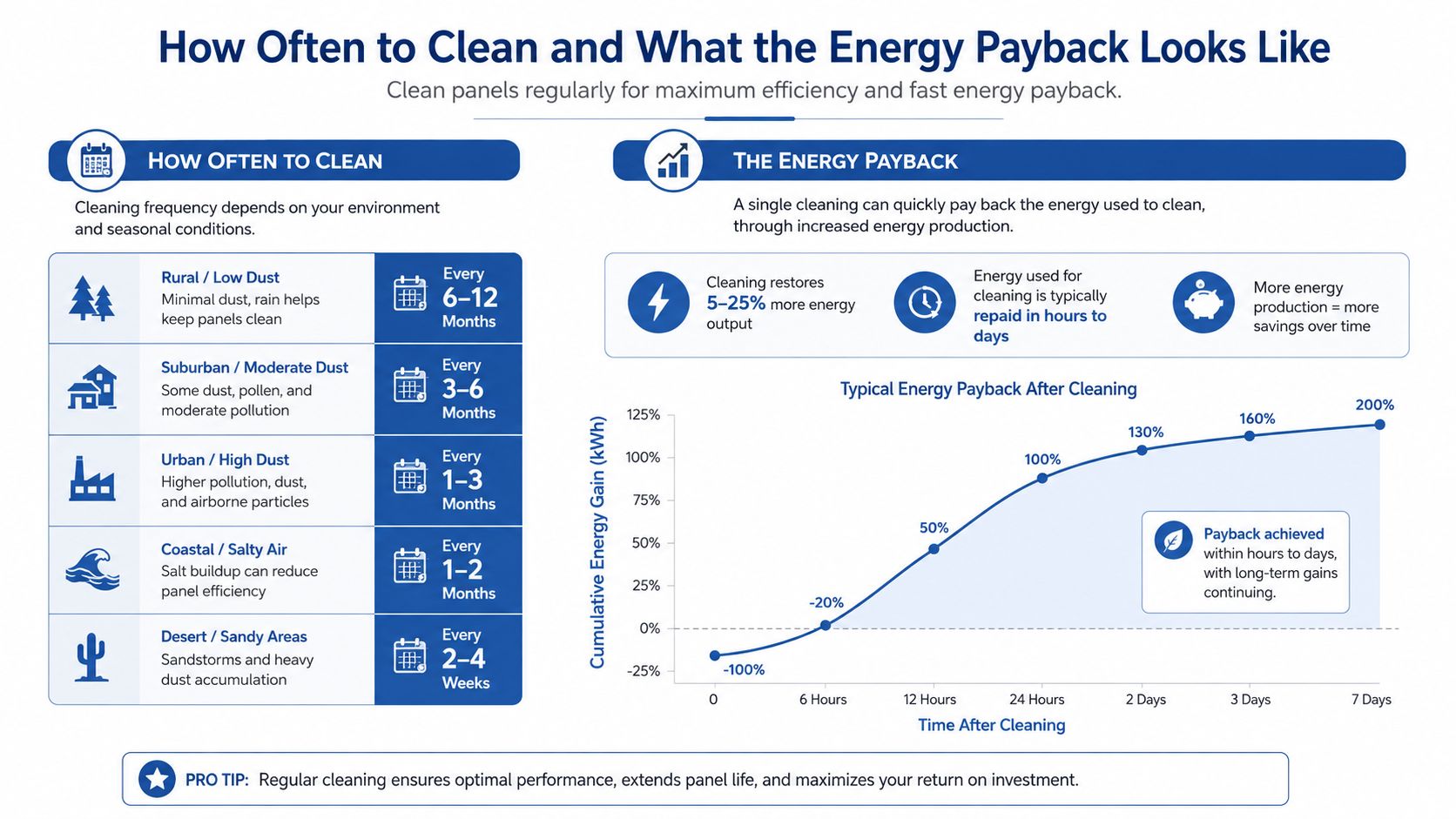
Phoenix doesn't behave like a rainy climate, and the cleaning schedule should reflect that. Many desert-market guides recommend 3 to 4 cleanings per year in dusty, dry regions, while milder regions can get by with far less frequent service (Earth Energy Log homeowner guide). That difference is the core reason Arizona budgets run higher than the national averages people see online.
The payback question is the real decision
The smartest question isn't just, “What does cleaning cost?” It's, “Will cleaning pay for itself in energy output?” UC San Diego engineers found that cleaning is often not economically justified in many low-soiling or high-rain settings, which is exactly why Phoenix should be evaluated on a different basis (UC San Diego report). In the Valley, the soiling environment is harsher, so the economics tilt more often toward routine maintenance.
A simple break-even check works like this. Estimate the value of the extra energy a dirty panel was losing, then compare that annual gain to the cleaning bill. If the cleaned output is worth more than the visit, the service makes sense. If not, you're cleaning for appearance, resale presentation, or long-term maintenance preference, not payback.
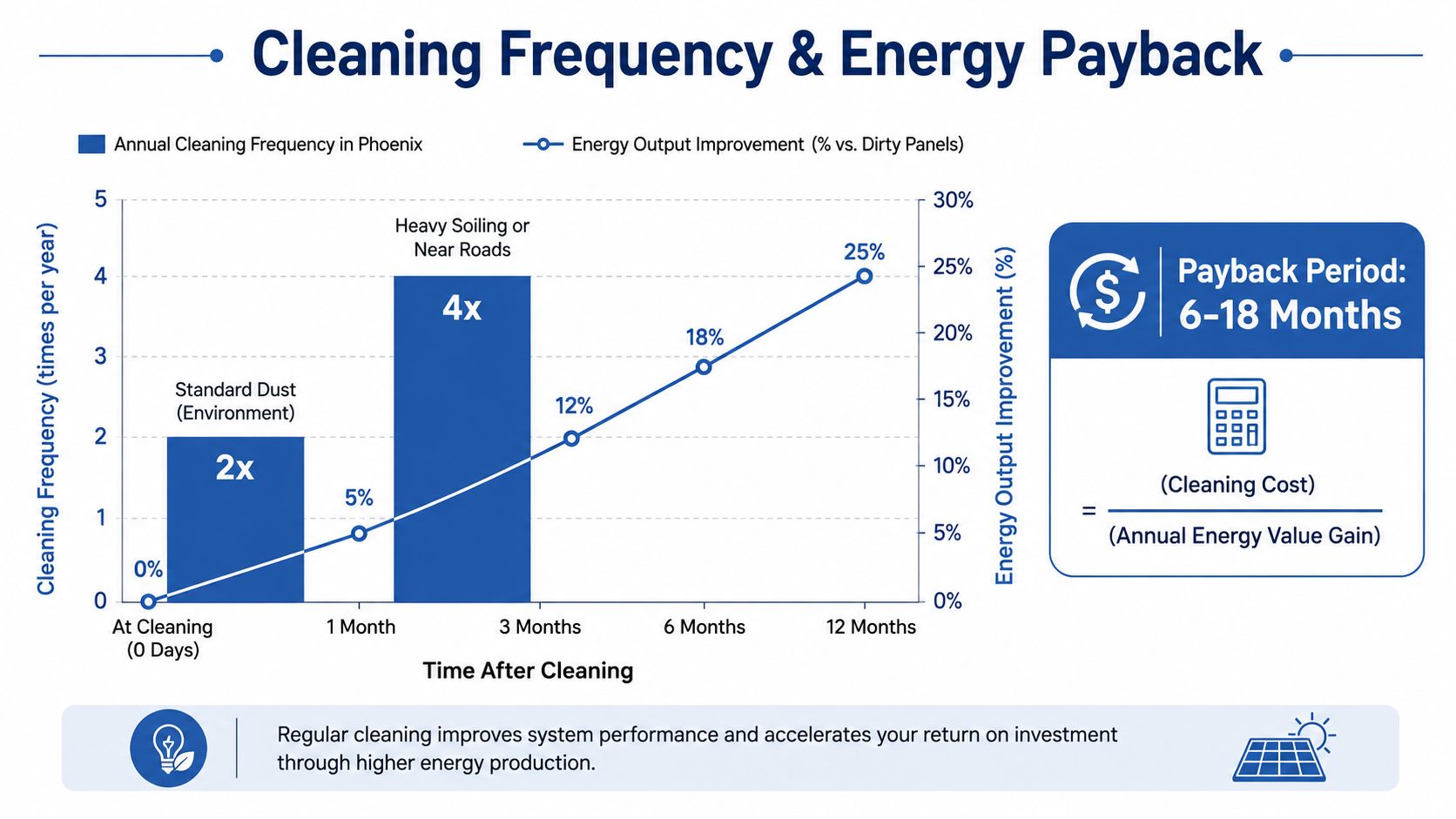
That's also why the same price can be rational in one ZIP code and wasteful in another. A homeowner in a wetter area may never recoup a frequent cleaning schedule, while a Phoenix homeowner near dust, road traffic, or agricultural debris may see the opposite.
For a local maintenance benchmark, South Mountain Window Cleaning's how often to clean solar panels page fits the same logic, because frequency should follow soiling severity, not a generic national calendar.
Realistic Phoenix Area Price Examples
A single-story Ahwatukee tract home is the cleanest example. If the roof is accessible, the system is modest, and the panels haven't been neglected for long, the quote often lands in the lower residential band. In practice, that means a straightforward visit price with a small premium for dust buildup, not a complicated access fee.
A larger two-story Paradise Valley property with tile roof usually pushes the number up. Tile slows the crew, two-story access adds setup, and the quote often includes more time for ladder placement and safety prep. On that kind of home, the final bill is often shaped more by roof conditions than by panel count alone.
A small commercial flat roof in Chandler or Tempe usually looks different again. The service may be priced as a recurring maintenance line rather than a one-off residential visit, because the owner cares about uptime, optics, and predictable scheduling. For those jobs, mobilization and access can matter as much as the cleaning pass itself.
South Mountain Window Cleaning also offers a solar panel cleaning cost guide that local owners can compare against their own roof layout and service expectations.
If you're trying to compare what that looks like in practice, a trusted estimator or field team will usually spell out the roof type, number of panels, and access difficulty before they land on a price. For broader service coordination, tools like Exayard landscaping estimating software are useful examples of how field businesses organize site-specific quotes, even though solar cleaning still needs human judgment on the roof.
How to Get an Accurate Quote and What to Expect On Site
Give the contractor the details that change the job. Panel count, roof type, story count, last cleaning date, water access, and any known safety concerns are the basics. If you leave those out, the quote is more likely to land low and then rise once the crew sees the roof.
A thorough visit should start with a quick pre-walk and visual check. The tech should look for access issues, note heavy bird droppings or built-up dust, and confirm the cleaning method before anything touches the glass. Then the crew should use soft brushes, controlled rinsing, and a spot-free water system when appropriate.
The point is not just to make the panels look good. It's to remove debris without leaving minerals behind or creating new damage in the process. That's why licensed, bonded, and insured contractors with documented safety training matter, especially when the roof is steep, tiled, or difficult to reach.

Ask for the method, not just the price. A good quote tells you how the panels will be cleaned, not only what it'll cost.
South Mountain Window Cleaning's service model fits that expectation because the company already handles residential, commercial, and high-rise exterior work across the Valley, including solar panel cleaning as part of a broader maintenance program.
Smart Ways to Decide and Common Phoenix Questions
The easiest decision framework is simple. Easy-access single-story homes usually fit a lower per-visit budget and can often be cleaned on a regular schedule. Two-story roofs, tile roofs, and heavily soiled arrays need a higher budget band and more careful timing. Commercial sites should think in terms of recurring service and output protection, not one-off convenience.
For Phoenix homeowners, the most common follow-up questions are practical ones.
Does monsoon dust matter? Yes, because it adds to the normal desert buildup and changes how quickly panels get dirty.
Do bird droppings justify a call sooner? They do, because localized buildup can affect performance faster than a thin dust layer.
Will a warranty require professional cleaning? Sometimes the concern isn't the warranty language itself, but whether the cleaning method could cause damage. That's why technique matters.
Should panels be cleaned before a home sale? Often yes, if you want the system to present well and avoid a buyer seeing obvious neglect. Clean panels don't close a deal by themselves, but they remove an easy objection.
For owners weighing whether the service is worth it at all, South Mountain Window Cleaning's is solar panel cleaning worth it page is a useful next read, especially if you're trying to decide between routine upkeep and waiting another season.
For solar reps and property teams comparing maintenance messaging with sales conversations, the field sales playbook for solar reps also helps frame how homeowners think about value, not just price.
If you're in Phoenix, Scottsdale, Paradise Valley, Chandler, Tempe, or Gilbert and your panels are already carrying a film of dust, get a quote that reflects your roof, your panel count, and your actual access conditions. South Mountain Window Cleaning, LLC handles residential, commercial, and high-rise exterior cleaning across the Valley, including solar panel cleaning, and you can visit South Mountain Window Cleaning, LLC to request a straightforward estimate for your property.