

You're probably here because you've had one of these moments: your phone has the photo album, the laptop has the slide deck, or the tablet has the app you need to show everyone, and the TV sitting on the wall would make the whole thing easier. But then the menu names don't match, one device says “Cast,” another says “AirPlay,” and a third says nothing useful at all.
That confusion is normal. Screen mirroring sounds simple, but the choice of method matters more than generally perceived. The best option for an iPhone in a living room isn't always the best option for a Windows laptop in a conference room or an Android phone in a classroom.
What Is Screen Mirroring Anyway
Screen mirroring is the wireless version of holding up a live digital photocopy of your device's screen on a larger display. If you open Photos on your phone, the TV shows Photos. If you swipe to the next picture, the TV follows. If you rotate the device, the display usually reacts too.
That's why screen mirroring feels so direct. It isn't sending a file first and then asking the TV to open it. It's copying what your device is doing in real time.
A simple example helps. Say you're on the couch and want to show vacation photos from your iPhone to family on the TV. With screen mirroring, everyone sees exactly what's on your phone as you browse. The same idea works for a laptop during a team meeting, a tablet during a classroom lesson, or a phone when following a workout on a larger screen.
What people usually expect
It's often thought that screen mirroring should work like flipping a light switch. Tap a button, pick a screen, done. Sometimes it does. Sometimes the problem isn't your phone at all. It might be the TV, the receiver, the network, or the room setup.
That's why it helps to think of screen mirroring as a chain. Your device, the wireless connection, and the display all have to cooperate.
Screen mirroring is less about one magic button and more about getting the right pair of devices to speak the same language.
If you've ever struggled with odd on-screen controls or hidden input tools, this quick guide to a virtual keyboard setup can also feel familiar. The feature exists, but the name and location often vary by device.
Why it matters
Screen mirroring is useful when you need to show the whole screen, not just one video. That includes:
- Presentations: Show slides, notes, web pages, and live demos.
- Photos and apps: Share content that doesn't live in a TV app.
- Teaching and training: Walk people through steps as they happen.
- Everyday convenience: Make small screens easier for a room full of people to see.
Mirroring Versus Casting Understanding the Key Difference
The most common mix-up is treating screen mirroring and casting like they're the same thing. They're related, but they solve different problems.
Screen mirroring copies your full screen. Casting usually tells the TV or streaming device to fetch and play one piece of content on its own.
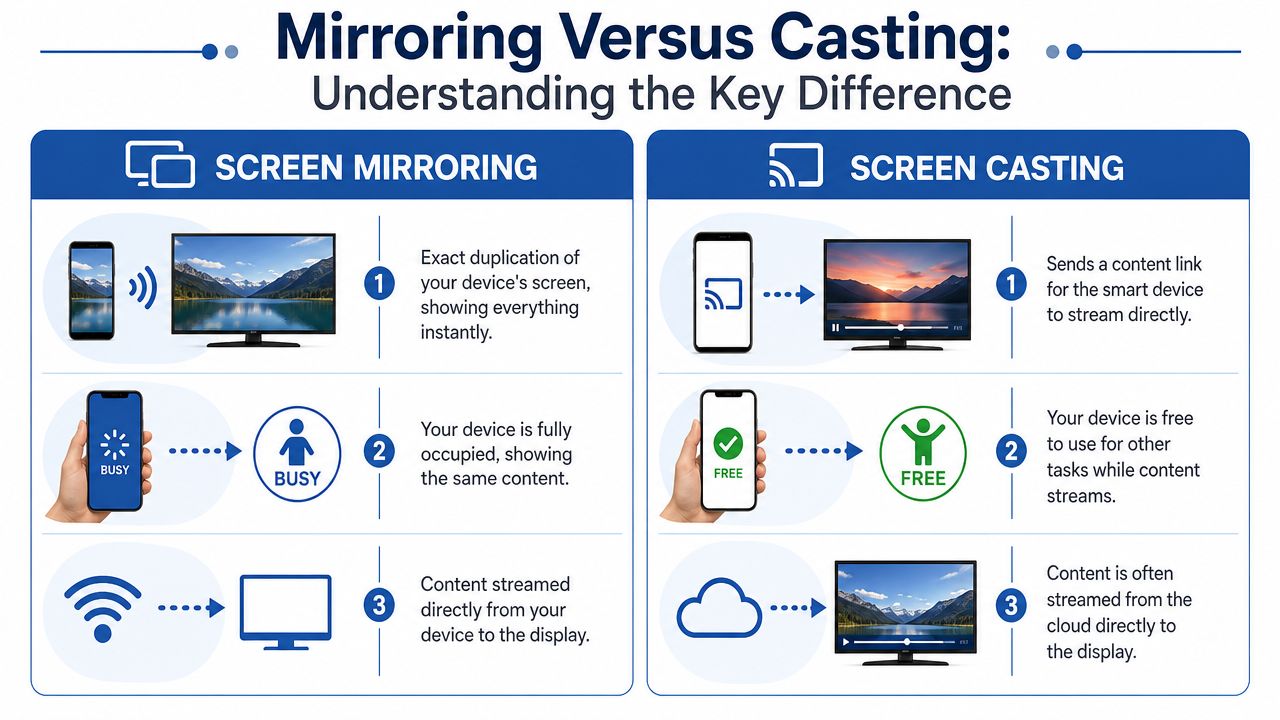
A simple analogy
Mirroring is like putting your phone under a document camera in a classroom. Whatever is under the camera appears on the big screen immediately.
Casting is more like handing the TV a note that says, “Play this YouTube video.” Your phone starts the process, but the TV or streaming device handles the playback.
That difference changes how each method feels in daily use.
When mirroring makes more sense
Mirroring is the better choice when what matters is the whole screen experience:
- App demos: You need people to see taps, swipes, menus, and pop-ups.
- Web browsing: You're moving between tabs or showing a live site.
- Photos and documents: You want to control the display manually.
- Video calls or whiteboarding: The interaction matters as much as the content.
The downside is that your device is busy doing all the work. If a text notification appears, the audience may see it too. If you switch apps, the TV shows that switch.
When casting is smarter
Casting is better when the content itself matters more than your screen:
- Streaming a movie: The TV can often play it more smoothly on its own.
- Playing music: Your phone can keep acting like a remote.
- Long-form video: You don't have to leave the sending device awake and active.
Practical rule: If you want people to see what you're doing, mirror. If you want the TV to just play something, cast.
Why people get frustrated
A lot of “screen mirroring doesn't work” complaints are really “I tried to mirror when I should have cast,” or the reverse. If your goal is a live walkthrough, casting can feel limited. If your goal is a clean movie night, mirroring can feel clunky.
Choosing the right method first saves time before you ever touch the settings menu.
Comparing the Core Technologies AirPlay Chromecast and Miracast
Three names come up over and over: AirPlay, Chromecast (also called Google Cast), and Miracast. Each has its own personality, and the best one depends less on hype and more on your devices and your situation.
AirPlay for Apple-heavy setups
AirPlay usually feels easiest when your world already revolves around Apple devices. If you use an iPhone, iPad, Mac, and Apple TV, or a TV with AirPlay support, the menus are usually clear and the pairing process tends to feel polished.
AirPlay is a strong choice for:
- Homes with Apple devices
- Teachers or presenters using a MacBook
- Sharing photos, slides, or app demos from an iPhone or iPad
Its biggest advantage is consistency inside the Apple ecosystem. Its biggest limitation is obvious too. It's less ideal when the room includes lots of non-Apple hardware.
Chromecast for mixed and web-based use
Chromecast fits best when you use Android devices, Chrome browsers, or smart TVs with Google features built in. It's especially handy when your workflow starts in the browser or in apps that already support casting.
Chromecast is often a smart pick for:
- Android phones and tablets
- Chrome browser tab sharing
- Teams that use mixed devices
- Media playback where the TV can stream directly
If your need is “show this tab” or “send this video,” Chromecast often feels more flexible than people expect.
Miracast for direct screen-to-screen links
Miracast deserves more attention because it solves a specific problem that the other options don't always handle well. A technically important distinction is that Miracast uses the Wi‑Fi Direct peer-to-peer standard, so it can mirror a screen without needing a local Wi‑Fi network; the source device captures the video stream, encodes it (commonly with H.264), and sends it to a receiver that converts it back into an HDMI-compatible signal, as explained in this Miracast technical overview.
That makes Miracast useful when:
- The local network is unreliable
- You're in a room without normal Wi-Fi access
- You want a more direct connection between device and display
- You're using compatible Windows or Android hardware
This direct link can reduce dependence on router quality. But it also means performance depends heavily on the wireless path between those two devices.
Miracast isn't “better” in every room. It's better in the rooms where the network itself is the problem.
Which one should you choose
A quick way to decide is to ask one question first: what's already in the room?
If the room is mostly Apple, use AirPlay. If it's mixed and browser-driven, Chromecast is often the easiest path. If the network is the weak point and your devices support it, Miracast can be the rescue option.
Screen Mirroring Technology Comparison
| Feature | AirPlay | Chromecast (Google Cast) | Miracast |
|---|---|---|---|
| Best fit | Apple ecosystem | Mixed devices and Chrome users | Direct compatible device-to-display links |
| Typical use | iPhone, iPad, Mac to Apple TV or supported TV | Android apps, Chrome tabs, media streaming | Windows and some Android screen mirroring |
| Whole-screen mirroring | Yes | Sometimes, depending on device and app | Yes |
| Media casting strength | Good | Strong | Less central to its design |
| Local Wi-Fi usually needed | Often yes | Often yes | No, it can work through Wi‑Fi Direct |
| Best for | Simplicity in Apple setups | Flexibility and app support | Rooms where network access is limited |
A Practical Setup Guide for Your Devices
Years ago, awareness ran ahead of everyday use. In 2013, The NPD Group reported that 40% of smartphone and tablet owners were aware of screen mirroring, but only 7% used it. The same report noted that 3% used Apple AirPlay for mobile-to-TV mirroring, according to this NPD Group screen mirroring report. The good news is that today's setup process is usually much easier than that early era made it seem.
A fast visual guide helps before you open settings.
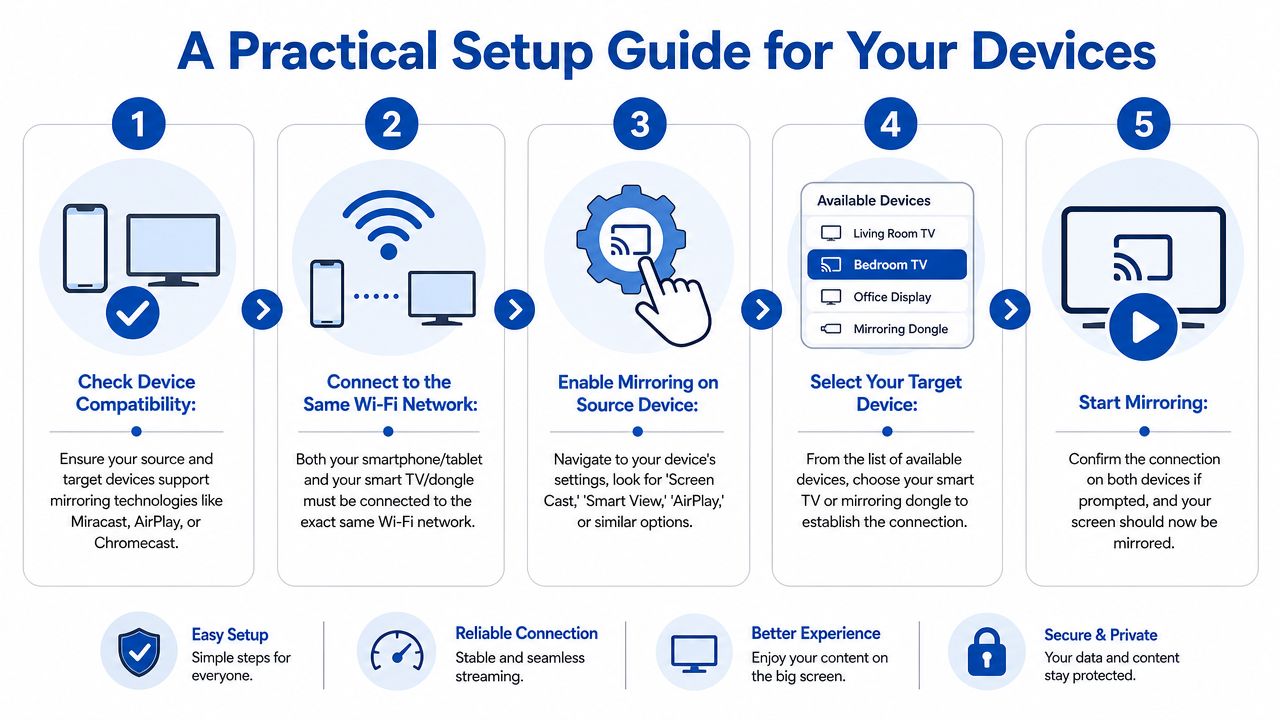
Start with the right question
Before tapping anything, ask: am I trying to mirror the full screen or send one video? That answer decides whether you should look for AirPlay, Cast, Smart View, Screen Share, or a similar menu.
If your setup feels messy, use this simple check:
- Identify the sending device: iPhone, iPad, Mac, Android phone, or Windows PC.
- Identify the receiving device: smart TV, Apple TV, Chromecast, projector, or wireless display adapter.
- Check whether they support the same language: AirPlay, Chromecast, or Miracast.
iPhone and iPad
On iPhone or iPad, screen mirroring usually lives in Control Center.
- Open Control Center: Swipe down from the top-right on most newer iPhones and iPads.
- Tap Screen Mirroring: You'll usually see a list of available displays.
- Select the target display: Choose your Apple TV or AirPlay-compatible TV.
- Enter a code if prompted: Some TVs show a pairing code.
- Stop mirroring from the same menu: Return to Control Center and disconnect.
This route is best when you want to show the whole device screen, such as photos, a recipe app, or a live walkthrough.
For people who often work with on-screen controls, a good side reference is this guide to a screen keyboard workflow, since both features can hide in utility menus rather than obvious app lists.
Here's a short video if you want to see the process in action.
Mac
On a Mac, look in the menu bar for the screen mirroring or display control.
A typical flow looks like this:
- Open Control Center or the display icon
- Choose Screen Mirroring
- Pick your AirPlay-compatible display
- Decide whether to extend or duplicate if that option appears
Mirroring duplicates your screen. Extending turns the TV into a second display. For presentations, duplication is usually simpler. For multitasking, extending can be more useful.
If you're presenting, duplicate the screen first. It removes one whole category of “Why can't they see what I see?” problems.
Android phones and tablets
Android doesn't always use the same label across brands. Samsung may say Smart View. Other devices might say Cast, Screen Cast, Wireless Display, or Screen Share.
Try this sequence:
- Open Quick Settings: Swipe down from the top of the screen.
- Look for a casting or mirroring tile: It may be hidden under edit buttons.
- Select the display
- Approve the connection if asked
If you don't see the option right away, use Settings search and type “cast” or “mirror.” Brand-specific wording causes a lot of avoidable confusion.
Windows PCs
Windows often works best in office and classroom situations because it can connect to compatible wireless displays directly.
A common method is:
- Press Windows + K: This opens the Connect panel on many systems.
- Choose the display from the list
- Approve the connection on the receiver if needed
- Use display settings to duplicate or extend the desktop
Choose Duplicate when everyone needs to see the same thing. Choose Extend if you want a second workspace and know how to manage two screens.
Troubleshooting Common Screen Mirroring Problems
The mistake people make is assuming every bad screen mirroring experience is a software issue. Sometimes it is. Sometimes the room, the display panel, or the network is the culprit.
This checklist catches the most common problems quickly.
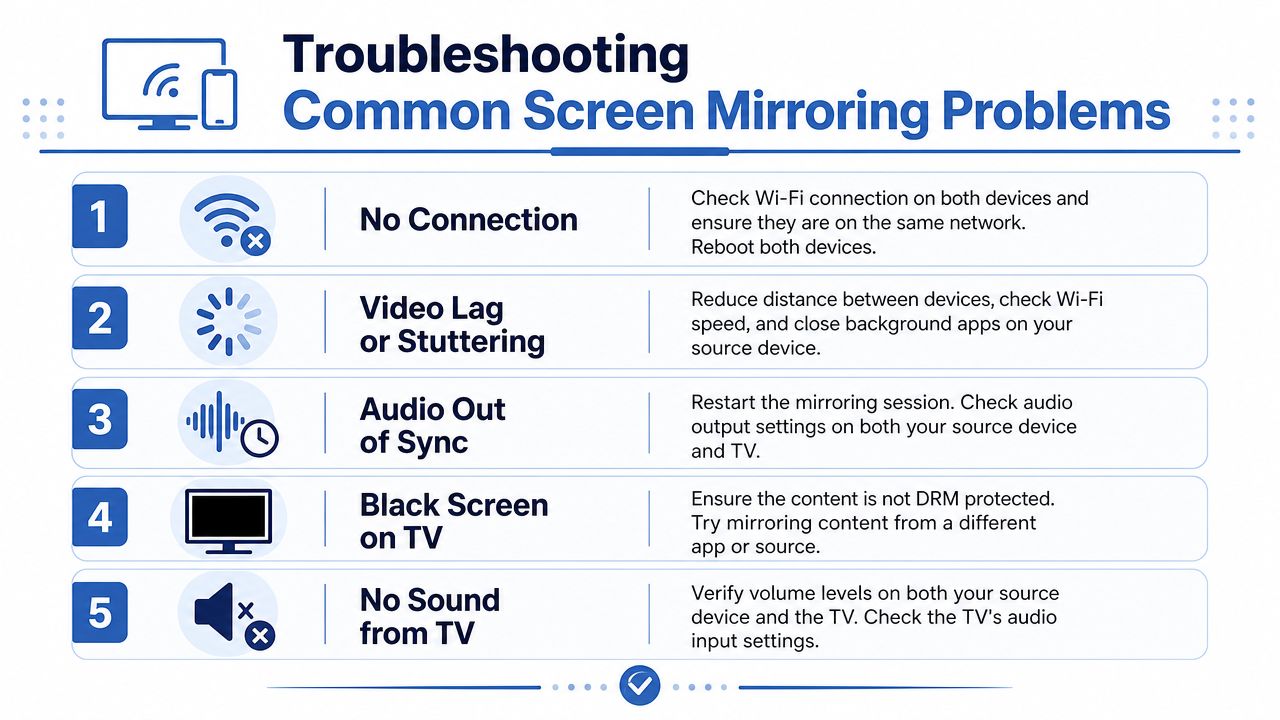
When the connection fails
If devices can't see each other, start with the basics before changing advanced settings.
- Restart both devices: Phones, laptops, TVs, and dongles often recover after a clean restart.
- Confirm the right input or receiver mode: Some TVs require you to open a specific AirPlay, Cast, or screen-share input first.
- Recheck compatibility: A device can support streaming apps without supporting full mirroring.
When video lags or stutters
Lag usually means too much work is happening somewhere in the chain.
Try these fixes:
- Move closer to the display: Distance and obstacles matter.
- Close background apps: Your phone or laptop may be juggling too much.
- Lower the workload: Mirroring a simple slide deck is easier than mirroring a busy game or a high-motion video.
- Switch methods if possible: If mirroring is rough, native casting might play more smoothly for media.
When the picture looks bad only from some seats
This one surprises people. A mirrored display can look fine from the center of the room and still look washed out from the side. A frequently overlooked issue is viewing angle. LCD viewing angle is measured as the off-center angle where image quality degrades, and poor off-axis visibility can make people think the mirroring system failed when the display is the limiting factor, as described in this LCD viewing angle explanation.
So if a meeting room audience says the screen is unreadable, ask where they're sitting before blaming the app.
A mirroring problem that affects only side seats is often a panel problem, not a phone problem.
Fast diagnosis order
Use this order when you want a quick answer:
- Can the devices find each other at all
- Does the connection stay stable
- Is the issue motion-related, audio-related, or visibility-related
- Does the problem happen with one app or everything
- Does the problem change when people move to a different viewing position
That last question catches more “mystery bugs” than is commonly anticipated.
Security and Privacy Best Practices
Screen mirroring feels casual, but it can expose more than you intended. The danger isn't just a hacker-style scenario. It's often something simpler, like a text message preview popping up during a meeting or the wrong TV being selected in a shared office.
That matters more as these display technologies move into larger commercial use. A 2026 market report estimated the smart mirror market at USD 2.0 billion in 2025, projected USD 2.3 billion in 2026, and forecast USD 5.6 billion by 2035, with a 10.5% CAGR from 2026 to 2035. The same report valued the U.S. market at USD 448.2 million in 2025 with a projected 9.9% CAGR through 2035, according to this smart mirror market projection. As these tools spread, privacy stops being optional.
Habits that prevent awkward mistakes
A few small habits go a long way:
- Hide notifications: Turn on Focus mode, Do Not Disturb, or presentation mode before you connect.
- Close private tabs and apps: Banking screens, inboxes, and message threads shouldn't be one swipe away.
- Verify the display name: In shared environments, don't tap the first screen name you see.
- Disconnect when finished: Don't leave a mirrored session running after the meeting ends.
Network quality affects privacy too
A flaky connection can push people into risky workarounds, like reconnecting repeatedly on open networks or trying unfamiliar devices in a rush. If you want a plain-English explanation of unstable network behavior, these Premier Broadband networking insights on jitter are helpful. They explain why a connection can look “available” and still behave poorly.
If you use shared computers or public displays often, it's worth reviewing your device's input and privacy tools too, including basics like an on-screen keyboard setup when you need to enter passwords more carefully in visible spaces.
Treat screen mirroring like a live microphone. If it's active, assume the room can see what you do next.
Creative and Practical Uses for Screen Mirroring
Once you stop thinking of screen mirroring as “phone to TV for videos,” it becomes much more useful. It can turn a small personal device into a shared workspace, a teaching screen, or a family activity hub.
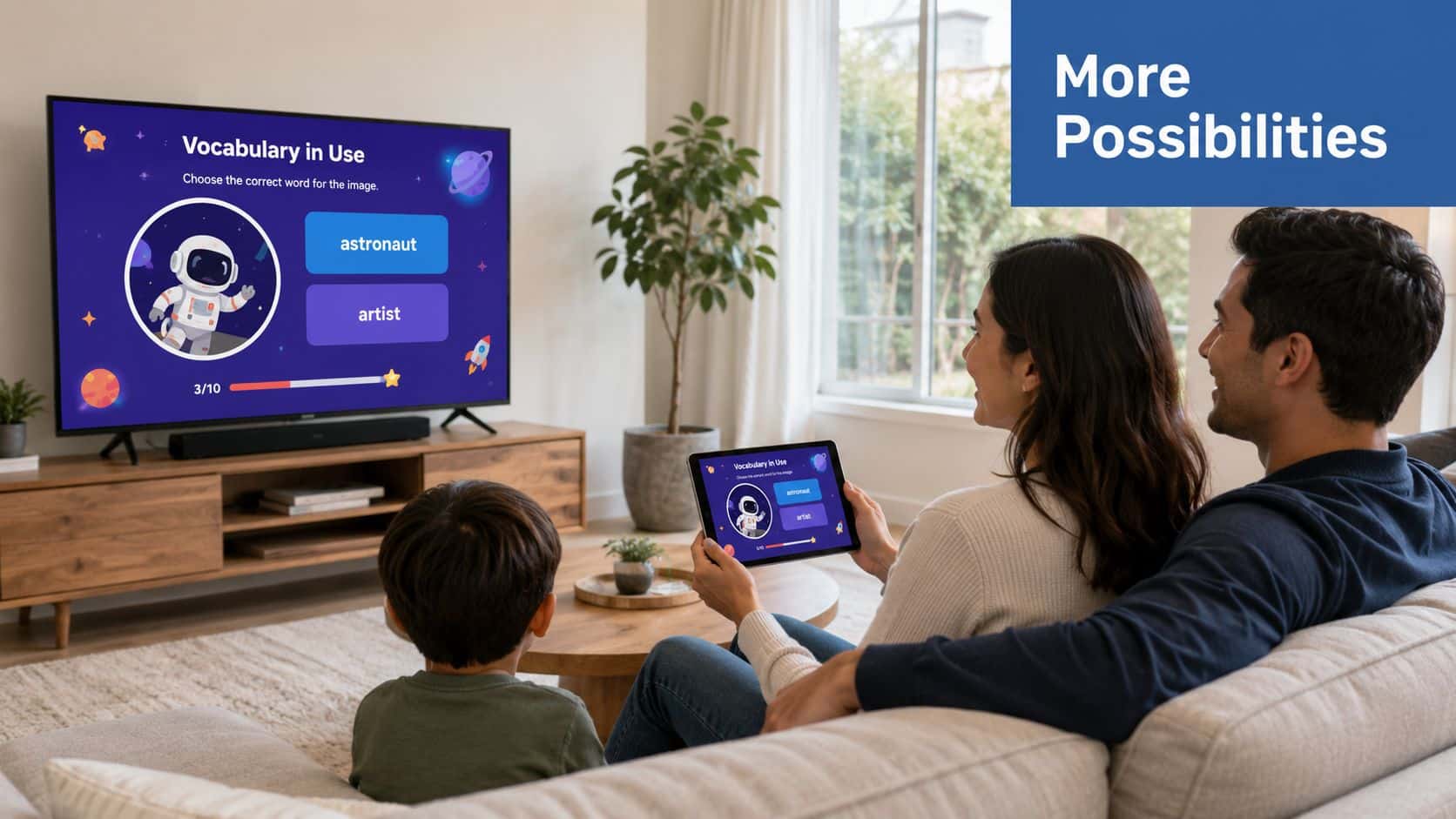
At home
Mirroring works well for:
- Family photo reviews: Scroll through albums together instead of passing one phone around.
- Cooking and fitness apps: Keep instructions visible from across the room.
- Learning games for kids: Turn a tablet exercise into a shared activity.
- Mobile gaming on a larger display: Best when responsiveness matters less than the fun of a bigger screen.
At work and in shared spaces
In offices, classrooms, and event rooms, mirroring is really part of room design. As mirrored content gets used more often on projectors and large displays, image quality depends on the physical setup. Guidance from Elite Screens notes that keeping the projected incidence angle under 5° is important for retro-reflective screens, which is a useful reminder that room geometry can matter as much as the connection itself in projector-based setups, as explained in this projector placement guide.
That's why good presentations don't just start with “Can I connect?” They also ask, “Can everyone see this clearly?”
The bigger takeaway
Screen mirroring sits at the intersection of devices, networks, and room experience. If your team is rethinking how those pieces fit together, this article on embracing new network technology offers a useful broader perspective on collaboration and connectivity.
The smartest users don't pick one method forever. They match the method to the moment. AirPlay for Apple rooms, Chromecast for flexible media and browser workflows, Miracast when direct device-to-display links solve the problem.
If you manage a home, storefront, office, or high-rise property in the Phoenix area, clean glass makes every screen, view, and shared space look better. For professional exterior cleaning, window washing, and scheduled property care, contact South Mountain Window Cleaning, LLC.