
You've scrubbed the orange-brown marks from a driveway, patio, walkway, or building exterior, only to watch them return after the next wet spell. That pattern is common because rust removal from concrete isn't always a surface-cleaning problem. The stain may come from a rusty object sitting on the slab, or from iron, tie wire, aggregate, or reinforcing steel below the surface.
The right response starts with diagnosis. A mild cleaner can handle superficial discoloration, while aggressive acid or pressure can permanently roughen decorative concrete without solving corrosion underneath. The practical sequence is simple: identify the source, test a small area, choose the least damaging effective method, and call a qualified exterior-cleaning team when access, runoff, or structural concerns make DIY work unreasonable.
Understanding Rust Stains on Concrete
A homeowner often notices isolated orange spots beneath patio furniture, along a driveway edge, or below a concrete wall. If the stain wipes away as loose powder and doesn't return, surface contamination may be responsible. Moisture can carry iron particles from metal furniture, irrigation, fertilizer residue, construction debris, or nearby equipment into the pores of unfinished concrete.
Recurring marks deserve closer attention. Rust commonly develops around embedded tie wire, fasteners, reinforcement, or corroding metal. It can also originate in the concrete mix itself. Concrete Society guidance on localized surface rust staining identifies pyrites in aggregate and pieces of tying wire left in formwork as possible sources. Cleaning the visible color without locating that material often produces only temporary improvement.
Surface contamination versus embedded corrosion
Embedded steel creates a different failure pattern. As steel corrodes, the rust occupies more volume than the original metal and places stress on the surrounding concrete. A historic-concrete presentation explains that rust is 6 to 10 times less dense than steel and connects that expansion with cracking and recurring staining. The technical explanation of rust expansion in concrete is useful when a stain appears beside cracks, spalls, or exposed reinforcement.
Look for these clues before applying chemicals:
- Likely surface rust: A small, isolated mark with no crack, raised edge, or visible metal source.
- Possible embedded iron: A stain that reappears after thorough cleaning or emerges from a pinhole, joint, or exposed aggregate.
- Possible active corrosion: Rust accompanied by cracking, flaking, spalling, or exposed reinforcement.
A useful diagnostic reference is what causes rust stains on concrete. If the stain is embedded or structural, repeated vinegar, lemon juice, or acid treatments may etch the slab while leaving the cause untouched.
Practical rule: If rust keeps returning from the same point, stop escalating the cleaner. Investigate the metal source first.
Preparing Safely with PPE and Tools
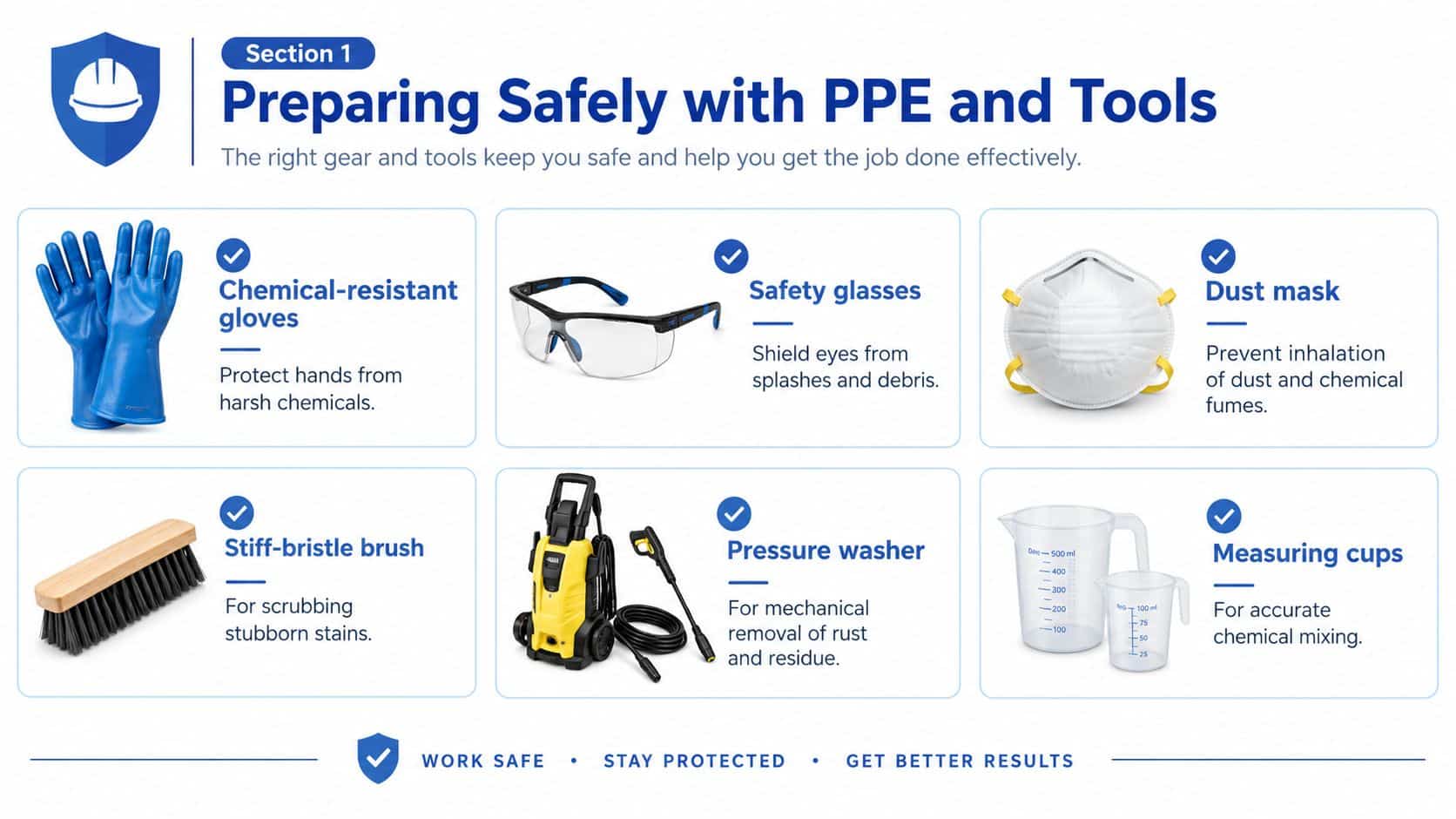
Before opening a rust remover or starting a pressure washer, assemble the safety gear and control the work area. Use chemical-resistant gloves, safety glasses, a suitable dust mask or respirator, long sleeves, and sturdy closed-toe boots. Keep children, pets, and bystanders away, and work with good ventilation whenever a product label requires it.
Set up before applying anything
Clear furniture, planters, tools, and vehicles from the area. Sweep away grit because loose debris can interfere with chemical contact and become hazardous under pressure. Protect landscaping, painted walls, metal fixtures, and nearby drains with appropriate barriers, and plan where rinse water will go before you begin.
Use stiff nylon brushes, plastic scrapers, measuring cups, a low-pressure sprayer, and an adjustable pressure-washer nozzle. Nylon removes residue without leaving metal fragments that can create new marks. Plastic scrapers help lift dried product or poultice material without gouging the surface.
Ladder work and working at height require extra planning. Review ladder safety equipment before working near windows, roofs, or upper-level concrete. Chemical exposure also deserves the same disciplined approach used for other restoration hazards, including the ventilation, containment, and protective-equipment concerns described in this resource on the dangers of mold remediation.
Never mix acids or combine cleaners unless the product manufacturer explicitly permits it. Pre-wet the concrete when the label or method calls for it, keep the treated area manageable, and arrange clean water for immediate rinsing. A controlled setup protects people, plants, adjacent finishes, and the concrete itself.
Chemical Methods for Surface Rust Removal
Light surface rust doesn't always require a strong product. Household acids such as vinegar or lemon juice can sometimes loosen minor discoloration, but they're inconsistent on porous concrete and may provide only temporary improvement when iron is embedded. Commercial gels and oxalic-acid products offer more predictable chemistry, provided the label specifically approves the surface.
| Method | Ingredients or Product | Pros | Cons |
|---|---|---|---|
| Household treatment | Vinegar or lemon juice | Accessible and mild for small surface marks | Can be slow, uneven, or ineffective on embedded rust |
| Commercial gel | A concrete-safe proprietary rust remover | Consistent formulation and controlled application | Product instructions vary, and testing is still necessary |
| Oxalic-acid solution | Oxalic-acid rust remover mixed according to its label | Effective for iron staining and suitable for targeted treatment | Requires PPE, careful dwell control, and thorough rinsing |
Apply the mildest effective option
Start by cleaning a small test patch. Pre-wet the concrete, apply the product evenly, and avoid letting concentrated liquid run onto untreated areas. Household treatments can be brushed into a small stain, then rinsed thoroughly after the product has had time to work. Don't assume a longer dwell will improve the result. Prolonged contact can alter color or texture.
For a commercial gel, follow the manufacturer's dilution and dwell instructions rather than creating a stronger mixture. Gels can be useful on vertical or detailed surfaces because they're less likely to run, but they still require containment and complete removal.
A field-tested workflow for an oxalic-acid or proprietary remover is to pre-wet the surface, apply approximately 100 to 200 square feet per gallon, keep the working area no larger than 200 square feet, allow roughly 5 minutes of dwell time, agitate stubborn spots with a stiff-bristle brush, and flush thoroughly with high-pressure water. These application details are documented in the rust remover technical sheet.
Use enough solution to keep the working area uniformly wet. Dry spots can produce patchy results, while over-application increases runoff and surface risk. If staining remains, repeat the cycle rather than immediately switching to a harsher acid. Concrete rust-removal methods can help you compare product-based approaches before treating a visible or decorative slab.
Surface warning: Stronger acid isn't automatically better. The federal preservation guidance notes that muriatic and phosphoric acid methods can roughen concrete.
Mechanical and Pressure Washing Techniques
Pressure washing works best as part of a sequence, not as a substitute for diagnosis. Use chemistry to loosen iron deposits, then use controlled water pressure to remove the dissolved residue. Blasting a dry stain first can spread contamination, strip a sealer, or expose weak paste on the concrete surface.
Control the spray
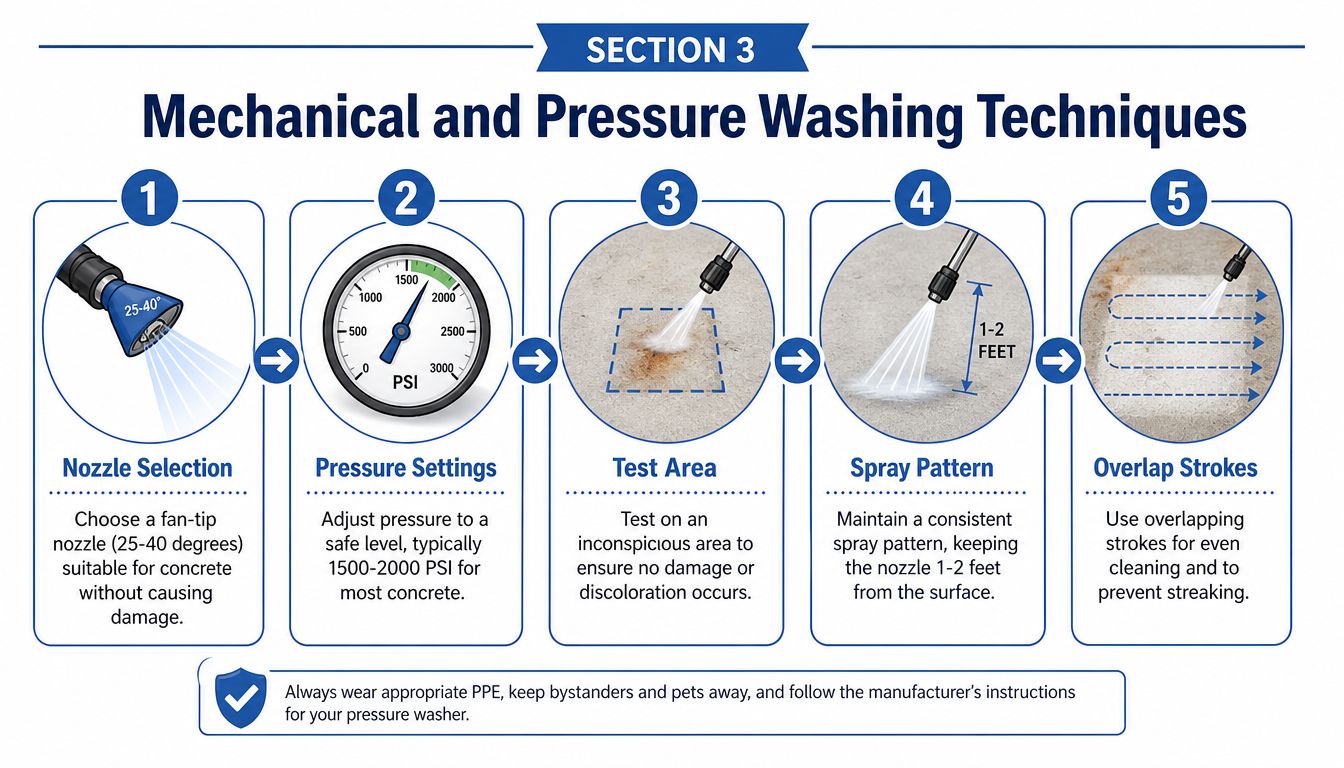
Choose a fan-tip nozzle rather than a concentrated zero-degree stream. A broad spray pattern distributes force and lowers the chance of cutting lines into the slab. Start at a distance, test an inconspicuous area, and move closer only if the surface tolerates the treatment.
Keep the wand moving at a steady pace. Overlapping passes help prevent zebra-striping, while stopping in one place can create a visible clean spot or etch mark. Direct runoff away from walls, landscaping, windows, drains, and unprotected metal.
Manual tools still matter. A stiff nylon brush is appropriate for stubborn residue on ordinary concrete. A plastic scraper can lift softened deposits or dried treatment from a flat area. Avoid aggressive wire brushing on decorative finishes because metal can scratch the surface or become embedded, creating another source of discoloration. Guidance for deep stains favors chemical extraction and poulticing, while crimped or knotted wire tools are reserved for heavy rust on structural steel rather than decorative concrete.
Treat a small section, rinse completely, and inspect after drying. If the stain is still visible, repeat the controlled chemical and mechanical cycle. Don't increase pressure because the first pass was disappointing. Returning color may indicate that the iron source sits below the surface.
The video below demonstrates the general movement and setup considerations involved in pressure washing concrete surfaces.
When to Test and Use Poultice for Deep Stains
A poultice is appropriate when ordinary washing removes the surface color but leaves a shadow, or when rust continues to migrate from porous concrete. It holds a stain-lifting compound against the surface long enough to draw contaminants outward. That makes it slower and more labor-intensive than a wash, but often safer than repeatedly increasing acid strength.
Test before committing to the full area
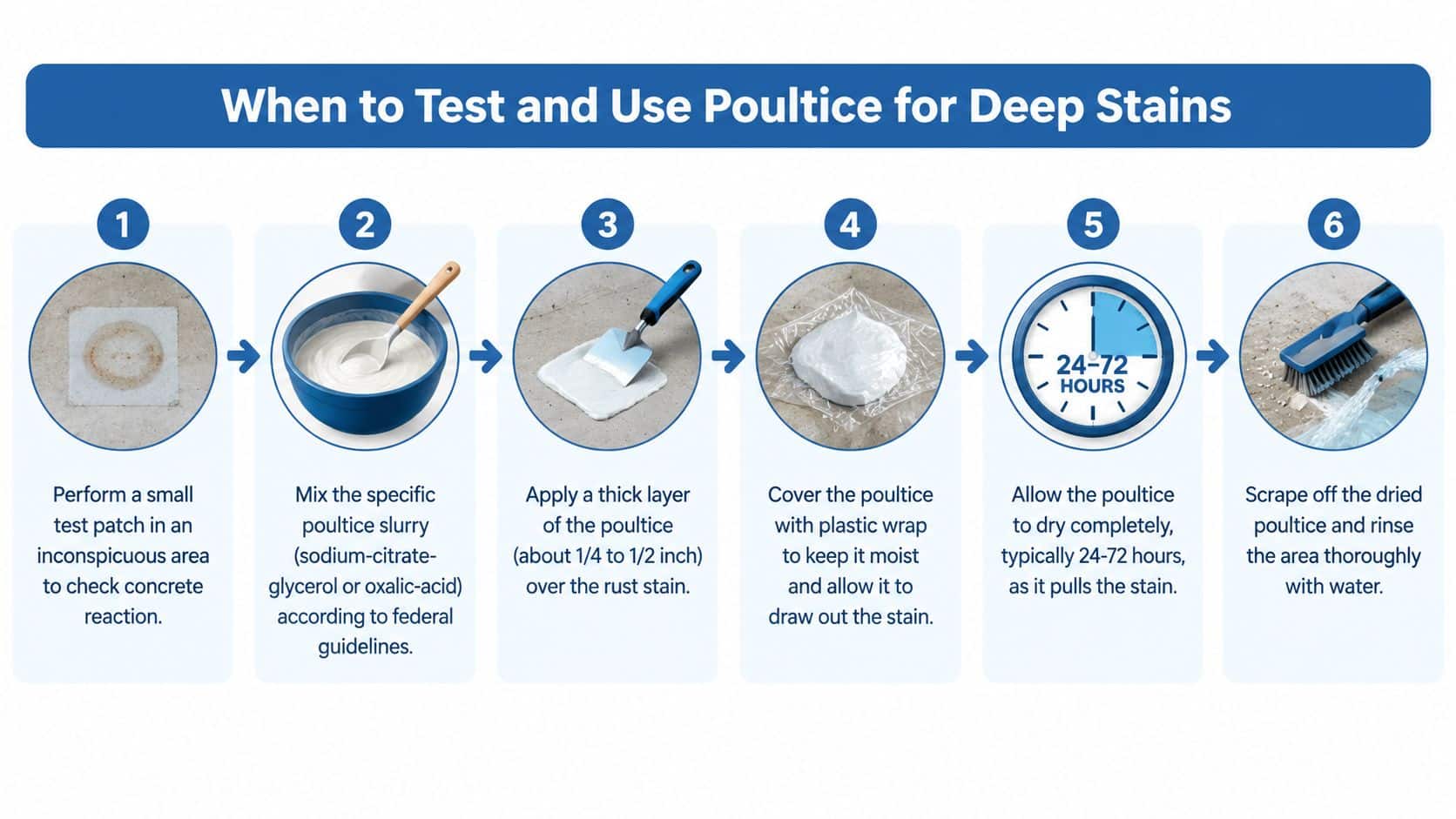
Choose a hidden patch with the same finish, color, sealer, and exposure as the stain. Wet it, apply the proposed poultice, allow it to dry, remove it gently, and inspect the result. Colored, sealed, polished, or historic concrete can react differently from plain gray concrete.
For deep iron stains, federal preservation guidance gives a sodium-citrate and glycerol formulation using 11 ounces by weight of sodium citrate, 2 quarts of lukewarm water, and 2 quarts plus 12 ounces of glycerol. The paste is applied to wet concrete, allowed to dry, then scrubbed and rinsed. The federal poultice guidance and recipe also indicates that treatment may need repetition.
Build and remove the poultice carefully
Mix the selected slurry according to the applicable guidance or product instructions. Add an absorbent carrier such as diatomaceous earth or talc when the method calls for a workable paste. Spread it evenly across the test area and keep the surrounding surface protected from drips.
Let the poultice dry fully before removal. Scrape it up with a plastic tool, brush away residue using a soft or stiff nylon brush as appropriate, and rinse thoroughly. Inspect only after the concrete dries, because wet surfaces can conceal uneven color.
If the stain lightens but remains, repeat the cycle rather than making the mixture arbitrarily stronger. If the result is patchy, check for inconsistent thickness, dry spots during application, inadequate rinsing, or a deeper metal source. Cracks, spalling, and exposed reinforcement call for restoration assessment, not endless cosmetic cleaning.
Prevention and Maintenance Tips
Rust prevention starts with moisture control and source removal. Inspect the slab, joints, nearby metal furniture, irrigation heads, downspouts, and drainage paths. If runoff repeatedly crosses the same area, cleaning alone won't solve the problem.
A breathable, pH-neutral concrete sealer can reduce absorption while preserving the appearance of suitable concrete. Recent guidance warns that hydrochloric acid can damage decorative or sealed surfaces when it remains in contact too long, while routine inspections and compatible sealers reduce the need for harsh treatment. This guidance on concrete rust and surface protection supports testing both the cleaner and the sealer before broad application.
Use a simple maintenance rhythm:
- Inspect regularly: Look for new orange marks, cracks, exposed metal, and standing water.
- Rinse early: Remove iron-bearing dust, fertilizer residue, and runoff before deposits settle into pores.
- Protect contact points: Keep rusty furniture, tools, carts, and equipment off damp concrete.
- Watch joints and edges: Trapped metal and recurring moisture can concentrate staining in these areas.
- Maintain drainage: Redirect irrigation and roof runoff so water doesn't repeatedly cross the same slab.
Sealing won't repair active corrosion. If a stain returns from one point, address the embedded material or damaged concrete before applying another protective coating.
Hiring Professional Services in Arizona
DIY rust removal makes sense for a small, accessible, unsealed spot. It becomes a poor trade when the area is large, the finish is decorative, runoff could affect landscaping, or the stain is tied to high-up windows, walls, balconies, or other hazardous access.
South Mountain Window Cleaning provides residential, commercial, and high-rise window washing services in Phoenix, Scottsdale, Paradise Valley, Chandler, Tempe, Gilbert, and communities across Arizona. Its crews also handle exterior surface cleaning and rust-removal work, with pure-water systems used for glass and professional equipment selected for the surface being treated. High-rise work requires particular care. The ANSI/IWCA I-14.1 standard applies when window cleaning takes place more than 48 inches above grade or an adjoining flat surface, so building owners should confirm that the service method and safety plan match the property.
Commercial scheduling matters too. Class A office towers commonly need exterior cleaning four times per year, with interior glass cleaned monthly or bi-monthly, according to this commercial window-cleaning frequency guide. For complex staining or access conditions, review rust removal services near you and request a site-specific quote.
South Mountain Window Cleaning, LLC offers residential, commercial, and high-rise exterior cleaning, including concrete rust removal, power washing, and window care across the Phoenix area. Visit South Mountain Window Cleaning, LLC to request a free quote and arrange a practical assessment before the stain or access problem becomes more difficult.