
Dust settles overnight in Phoenix. Sprinklers leave a mineral line on lower panes. By the time the sun hits the glass, those spots look baked in. Homeowners notice it when the morning light turns hazy instead of bright. Property managers notice it when storefront glass stops looking sharp from the curb.
That's why phoenix window cleaning services matter more here than in a lot of other markets. Clean glass isn't just about appearance. In Arizona, it's part of routine property care. The broader industry reflects that shift. The U.S. window washing industry was valued at $2.9 billion in 2024 and employs over 100,000 people, showing how professional window cleaning has moved from a luxury to an essential maintenance service, especially in climates with dust and hard water challenges like Phoenix, according to industry data on window washing market size and employment.
A good buyer's guide should help you separate basic glass wiping from real professional service. The difference usually shows up in three places: how thoroughly the work is done, how safely the crew operates, and whether the company understands what Phoenix weather does to windows, frames, screens, and solar panels over time.
Your Guide to Crystal Clear Views in the Valley
A lot of people call for service after the same moment. They clean one window themselves, step back, and realize the glass still looks cloudy. The problem usually isn't effort. It's buildup. Desert dust, pollen, screen debris, and hard water staining don't respond well to a spray bottle and paper towels.
That's also why expectations need to be realistic. Some glass just needs a maintenance clean. Other windows need restoration work because sprinklers, runoff, or neglected deposits have started to bond to the surface. A professional should be able to tell the difference quickly and explain what's possible without overselling.

What Phoenix owners usually need
Most Valley properties don't have just one issue. They have a combination of them.
- Desert dust on exterior glass that returns fast in open, windy areas
- Hard water spotting on windows near irrigation lines or pool decks
- Dirty screens and tracks that transfer grime back onto clean glass
- Sun exposure that makes residue and streaks more visible
- Access challenges on entry arches, stairwells, atriums, and upper floors
Clean windows in Phoenix don't stay clean by accident. They stay clean when the cleaning method matches the type of buildup on the glass.
For homeowners, that means better light and a cleaner view. For commercial buildings, it means presentation, routine upkeep, and less frustration when tenants or customers notice neglected glass before anything else.
How to use this guide
Use the rest of this guide the same way a careful buyer would approach any property service. Look at scope first. Then look at method. Then look at price. Finally, check the risk side, especially insurance and safety if your building goes higher than basic ground-level work.
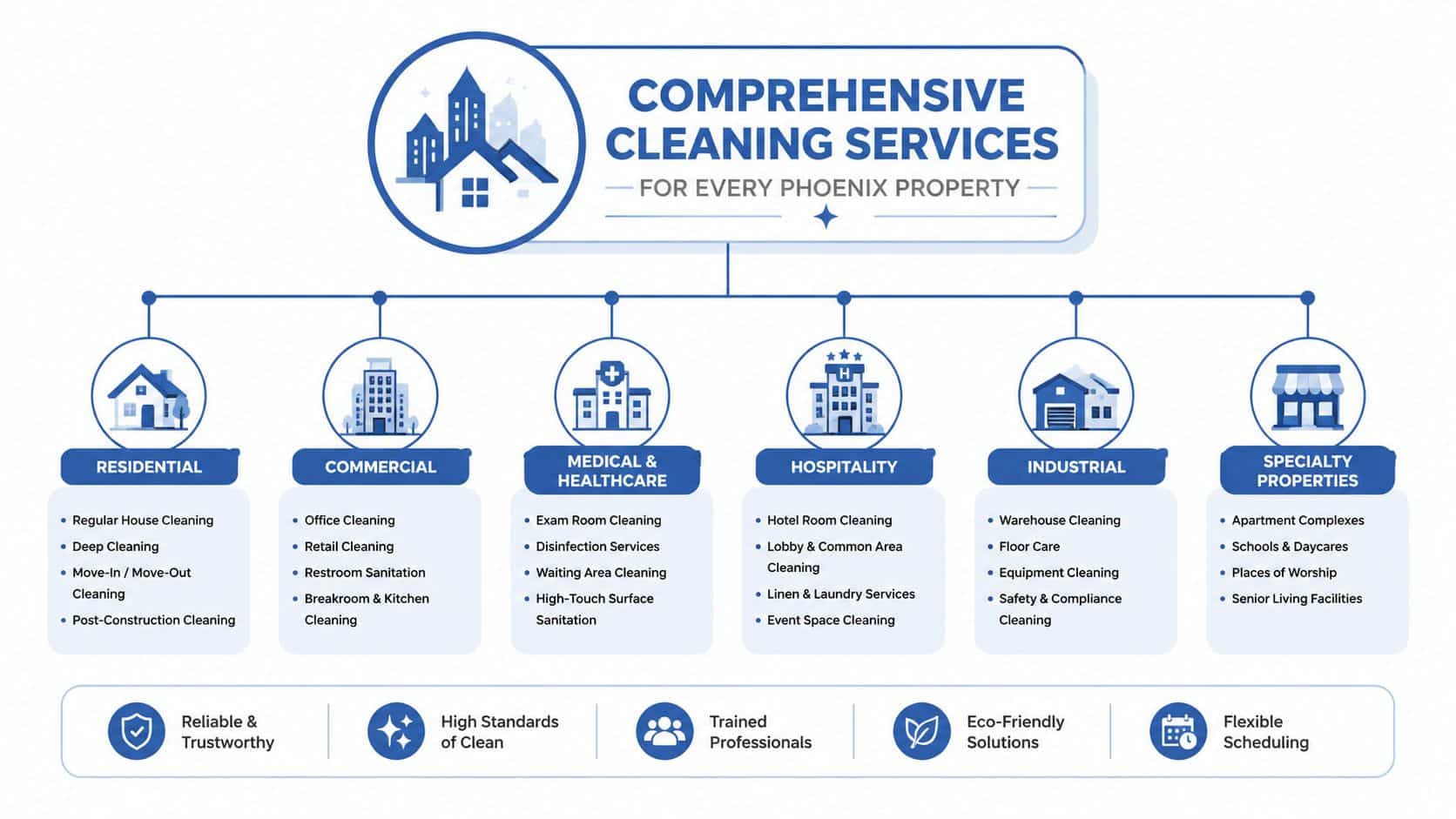
Comprehensive Cleaning Services for Every Phoenix Property
Phoenix properties don't all need the same kind of window cleaning. A single-story home in Gilbert, a retail center in Tempe, and a multi-level commercial property in Scottsdale all create different access, scheduling, and maintenance issues. Good service should reflect that.
Residential work that covers more than glass
For houses, the job usually starts with interior and exterior window cleaning, but that's rarely the full need. If screens are dusty and tracks are packed with debris, freshly cleaned glass won't look clean for long.
Common residential service items include:
- Inside and outside glass cleaning for everyday haze, fingerprints, and outdoor buildup
- Screen cleaning so wind doesn't blow trapped dust back onto the panes
- Track and sill cleaning to remove dirt, dead insects, and compacted debris
- Mirror cleaning for bathrooms, gyms, and dressing areas
- Ceiling fan cleaning when homeowners want a broader interior refresh
If you want a clear overview of what a full service appointment can include, this guide on what professional window cleaning includes is useful because it breaks down the scope beyond just the glass itself.
Commercial service depends on consistency
Commercial clients usually care about two things first. Appearance and reliability. Storefronts need clean front glass because customers see it before they see your service. Office and mixed-use properties need recurring maintenance because irregular cleaning tends to create bigger problems later.
The most common commercial requests include storefront glass, office windows, glass entry systems, partitions, and scheduled route service. The right schedule depends on traffic, regional dust, irrigation overspray, and how visible the glass is from the street.
Consider this practical approach:
| Property type | Main priority | Typical service focus |
|---|---|---|
| Retail storefront | First impressions | Entry glass and frequent maintenance |
| Office building | Professional appearance | Exterior routes and lobby glass |
| Restaurant or hospitality | Guest-facing cleanliness | Front windows, doors, partitions |
| Multi-tenant property | Tenant satisfaction | Shared-area glass and scheduled upkeep |
High-rise and specialty exterior cleaning
High-rise work is its own category. It isn't just “regular window cleaning, but taller.” Access planning, crew training, site conditions, and safety oversight matter much more.
That often includes exterior glass on upper floors, difficult architectural glass, atrium panels, and areas where ladders alone aren't the right tool. Some properties also bundle related exterior services so they can solve multiple appearance issues in one visit.
On commercial sites, the most efficient appointment is usually the one that handles the visible glass and the surrounding exterior surfaces at the same time.
That's why many owners also request power washing, flat-surface cleaning, dumpster pad sanitation, house washing, gutter cleaning, rust removal, and solar panel cleaning as part of a broader maintenance plan.
The Science Behind a Streak-Free Shine
The biggest mistake in Phoenix window cleaning is treating local water like it's harmless. It isn't. If the rinse water still contains minerals, you're often leaving behind the next round of spotting as the glass dries.
Phoenix's hard water can leave mineral deposits that reduce light transmission through glass by up to 25%, and professional pure-water systems can filter water to 0 parts per million of dissolved solids, producing a spot-free rinse that can last 4 to 6 times longer than traditional methods in dusty conditions, according to this explanation of Phoenix hard water and pure-water cleaning performance.

Why pure water matters here
A pure-water system typically pushes source water through filters that remove the dissolved minerals responsible for spots. Instead of washing the window and then dragging minerals back across the surface during the rinse, the cleaner finishes with purified water that dries clean.
That matters most on:
- Exterior residential windows exposed to irrigation and dust
- Large fixed panes where streaks show easily in direct sun
- Upper-floor glass where reduced ladder use improves safety
- Commercial facades that need consistent, repeatable results
For many exterior jobs, water-fed pole cleaning is the more practical method. It allows the technician to scrub frames and glass from the ground, rinse thoroughly, and let the purified water dry clear.
What works and what doesn't
Traditional squeegee work still has a place. Interior glass, detail work, and certain restoration jobs often call for hand tools and close inspection. But for broad exterior maintenance in Phoenix, pure-water cleaning usually solves the problem more cleanly and with fewer residues left behind.
A simple comparison helps:
| Method | Best use | Limitation |
|---|---|---|
| Squeegee and mop | Interior glass, close-detail work | Can reintroduce residue if rinse water is poor |
| Pure-water fed pole | Exterior maintenance and upper glass | Not every stain can be fixed with routine washing alone |
| Abrasive DIY cleaning | Almost never recommended | Can scratch glass or damage coatings |
One practical example is the guide to what professional window cleaners use, which outlines why pros carry both pure-water equipment and traditional hand tools instead of relying on one method for every surface.
The trade-off most buyers miss
A streak-free result isn't only about the final pass. It's about choosing a process that fits the contaminant. Dust needs safe removal. Mineral deposits need the right chemistry or restoration approach. Paint specks, adhesive, and oxidation each call for different tools.
Practical rule: If a cleaner promises every stain will come off the same way, they're probably describing a sales pitch, not a process.
Understanding Window Cleaning Prices in Phoenix
A fair quote depends on scope, even though a fast estimate is often desired. Two homes with the same square footage can have very different window cleaning needs. The same goes for two commercial properties with similar frontage.
What actually changes the price
The biggest cost drivers are usually the number of panes, the size and type of windows, the condition of the glass, and how difficult the windows are to reach. A ground-floor picture window is straightforward. A cluster of divided-light panes above landscaping or a stairwell takes more time.
Other factors often include:
- Interior and exterior service versus exterior-only cleaning
- Screens, tracks, and sills if those are included in the visit
- Hard water buildup that needs more than basic maintenance cleaning
- Access conditions such as ladders, poles, lifts, or restricted pathways
- Service frequency because neglected glass usually takes longer to restore
Why cheap pricing often costs more
Low quotes can hide missing scope. A homeowner thinks they're paying for a full cleaning, but the crew only wipes the glass and skips the screens and tracks. A business manager books a storefront service, then finds out later that difficult panes weren't included.
That's why line-item clarity matters. Ask what the estimate covers. Ask whether interior glass is included. Ask how the company handles hard water staining and whether the quote assumes basic maintenance or heavier buildup.
Here's a useful way to compare estimates:
| Question to ask | Why it matters |
|---|---|
| Is this interior, exterior, or both? | Prevents scope confusion |
| Are screens and tracks included? | Changes labor time and final appearance |
| Is hard water removal separate? | Restoration is different from routine cleaning |
| What access equipment is expected? | Impacts labor and job planning |
If you're trying to understand how companies structure per-window pricing, this resource on window cleaning cost per window gives a practical starting point.
A better way to judge value
The right quote is the one that matches the work you need. For a homeowner, that means no surprises on service day. For a property manager, it means a scope that your tenants, staff, or customers will notice after the crew leaves.
Why Insurance and Safety Protocols Matter
A low quote looks very different after a ladder slips, a pane is scratched, or a worker is injured on your property. For Phoenix homeowners with tall entry glass and for managers responsible for commercial buildings, window cleaning is partly a maintenance decision and partly a liability decision.
That risk increases with height, access limits, foot traffic, and the need to work around tenants, customers, or employees. Many providers do not clearly explain the certifications, training, or insurance required for higher-risk work. That leaves property owners guessing about who pays if there is damage, an injury claim, or a problem with the method used on site.

What insurance protects you from
Insurance affects what happens after a mistake, but it also tells you something about how a company operates before work starts. Serious contractors expect to document coverage, meet vendor requirements, and plan jobs with the property owner's exposure in mind.
The practical concerns usually include:
- Property damage claims if tools, hoses, ladders, or access equipment damage glass, frames, stucco, flooring, or landscaping
- Worker injury exposure during ladder work, roof access, or other cleaning at height
- Vendor compliance requirements for HOAs, managed communities, medical offices, retail centers, and office properties
- Proof of coverage before work begins, especially on commercial sites
If you want a plain-English overview of why cleaning businesses need this protection in the first place, Estimatty's article on protect your cleaning company with insurance is a helpful outside reference.
Safety shows up in the method
Anyone can say a crew is careful. A professional company can explain how the job will be done, what equipment fits the building, where the fall risks are, and what conditions would change the plan.
In Phoenix, that matters more than many buyers expect. Rooftop layouts, hard desert surfaces, irrigation lines near access points, sun-baked seals, and high winds can all affect safe window cleaning. A method that works on a one-story ranch home may be a poor choice for a three-story property or a busy commercial frontage.
High-rise and commercial work raises the stakes further. Water-fed poles are useful in the right conditions. Some buildings call for different access equipment, tighter site controls, and stricter documentation. If a contractor gets vague when you ask about coverage, training, or fall protection, keep looking.
One good screening question is whether the company can explain the difference in bonded vs insured contractor protections. Those terms are often grouped together, but they protect you in different ways.
The Core Buying Decision
For a basic residential visit, the consequences of a bad hire are usually smaller, but they still matter. For multi-story homes, commercial properties, and high-rise buildings, the decision carries more exposure for the owner or manager.
Clean glass is the visible result. Safe job planning, current coverage, and clear documentation are what protect the property behind the scenes. That is why many Phoenix clients do not just ask what the service costs. They ask who is insured, how the work will be performed, and whether the company can operate on site without creating an avoidable liability problem.
What to Expect When We Visit Your Property
Most clients don't want surprises. They want the crew to show up when scheduled, confirm the work, clean carefully, and leave the property in better condition than they found it. That's a reasonable expectation, and a professional process should make the visit feel straightforward from the first call to the final walkthrough.
Before the appointment
The process usually starts with a quote request. For some properties, especially standard homes, a company may be able to give a fast estimate based on the window count and service details. More complex homes, commercial sites, and multi-level buildings often need an on-site review.
Good communication matters here. Clear arrival windows, confirmation messages, and scope notes reduce confusion before anyone unloads equipment. For service businesses trying to tighten up this part of the customer experience, these home service customer communication strategies offer practical ideas that apply well to scheduling and follow-up.
On service day
A professional visit should feel organized, not chaotic. The crew should confirm the agreed scope before starting and note any existing issues such as damaged screens, failed seals, stubborn staining, or access limitations.
A typical service flow looks like this:
- Arrival and walkthrough so both sides agree on what's being cleaned.
- Site protection such as careful ladder placement and interior care where needed.
- Glass, screen, and track work based on the selected service.
- Detail check for edges, corners, and visible remaining debris.
- Final review so the client can inspect the finished result.
A smooth appointment usually comes from preparation, not speed. Fast is fine. Rushed is not.
What a professional crew should do well
You should expect courtesy, clear answers, and attention to the property itself. That includes being careful around landscaping, furnishings, entry floors, and tenant or family traffic.
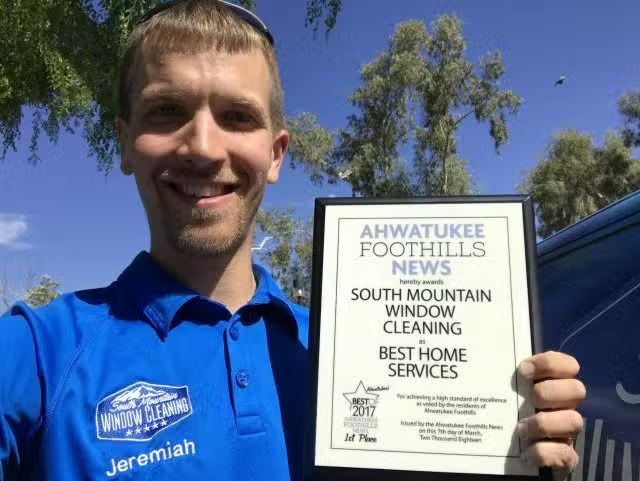
For larger sites, it also means working around operating hours, public entry points, and safety-sensitive areas without making a mess of the day. One company that provides this broader mix of residential, commercial, and high-access exterior cleaning in the Valley is South Mountain Window Cleaning, LLC. The practical point for buyers is to choose a provider that can define the process before the job starts, not after a problem appears.
Frequently Asked Questions and Service Areas
In Phoenix, clean glass does not stay clean for long. Dust, irrigation minerals, monsoon residue, and intense sun all work against it, so the right service plan depends on the property, not a generic schedule.
How often should windows be cleaned in Arizona
Frequency comes down to exposure and standards. A home tucked into a quiet neighborhood with limited overspray can often go longer between visits than a property near open desert, active roads, or heavy sprinkler use. Storefronts, offices, and other public-facing buildings usually need recurring service because dirty glass affects appearance faster and more noticeably.
Is solar panel cleaning really worth it
Often, yes. In Phoenix, dust buildup can cut performance enough to justify professional cleaning, especially on panels with easy sun exposure and frequent soil accumulation. The key is using the right method so panels are cleaned without scratching surfaces or leaving residue behind.
Can hard water stains always be removed
No. Some mineral staining sits on the surface and responds well to restoration work. Some has already etched the glass. In that case, cleaning can improve the appearance, but it cannot return the pane to new condition. A professional should inspect the damage first and tell you which result is realistic.
Do businesses need a different cleaning plan than homes
Yes. Residential scheduling is usually based on preference, views, and seasonal buildup. Commercial scheduling has more at stake. Tenant expectations, customer traffic, storefront appearance, access timing, and liability all matter. On larger properties, especially multi-story and high-rise buildings, the service plan should also match the site's safety requirements and insurance documentation.
Service areas
Phoenix
Scottsdale
Paradise Valley
Chandler
Tempe
Gilbert
If you manage a home, storefront, office, or high-rise property in the Valley, ask direct questions before you hire any crew. Ask how they access the glass, what insurance they carry, how they protect your property, and what happens if they find damaged screens, failed seals, or etched glass. Those details matter as much as the cleaning itself.
South Mountain Window Cleaning, LLC serves Phoenix-area properties with that standard in mind. If you want a no-pressure estimate, request a quote, review the scope, and make sure the plan fits the way Arizona glass gets dirty.