

Orlando residents often notice their windows when the light changes. Morning sun hits the glass, yesterday’s rain dries, pollen settles again, and what looked fine from inside suddenly looks hazy, streaked, or spotted. In Central Florida, clean glass rarely stays clean by accident.
That’s why orlando window cleaning isn’t just about appearance. It’s part of routine property care in a climate that puts glass under constant pressure from humidity, afternoon storms, tree debris, sunscreen-like mineral residue, and intense sun that makes every flaw more visible. Homeowners want clearer views and less buildup around frames. Property managers want buildings that look maintained before a tenant or customer says a word.
Why Crystal Clear Windows Matter in Orlando
Orlando’s climate is hard on glass in ways many owners underestimate. Rain doesn’t always “clean” windows. It often leaves behind airborne grime, pollen, and residue that dries unevenly. Add high humidity and strong sun, and even a recently cleaned pane can start looking dull fast.
For homes, that means weaker curb appeal and a view that never feels as sharp as it should. For storefronts, offices, and hospitality properties, it changes how the whole building reads from the sidewalk or parking lot. Clean glass signals attention to detail. Dirty glass suggests the opposite.
The market reflects that demand for appearance and maintenance. The global window cleaning services market was valued at USD 151.18 billion in 2025 and is projected to grow to USD 162.35 billion in 2026, according to Fortune Business Insights on the window cleaning services market. Property owners are spending more on upkeep because presentation and asset protection matter.
What Orlando property owners are really dealing with
A few patterns show up again and again in this market:
- Humidity haze: Moisture hangs in the air and gives grime more opportunity to cling to glass.
- Rainy-season spotting: Frequent storms leave windows looking inconsistent, especially on sun-facing elevations.
- Pollen and organic film: Spring buildup settles quickly on both glass and screens.
- Harsh light exposure: Bright Florida sun makes streaks, water spots, and missed edges obvious.
Practical rule: If your windows look acceptable only in shade, they’re due for professional cleaning.
Property owners who treat window cleaning as preventive maintenance usually get better long-term results than those who wait until the glass looks bad from the street. That’s especially true when service includes frames, tracks, screens, and the right method for the glass surface.
For a broader look at why routine service matters, this guide on the benefits of window cleaning lines up closely with what experienced contractors see in the field.
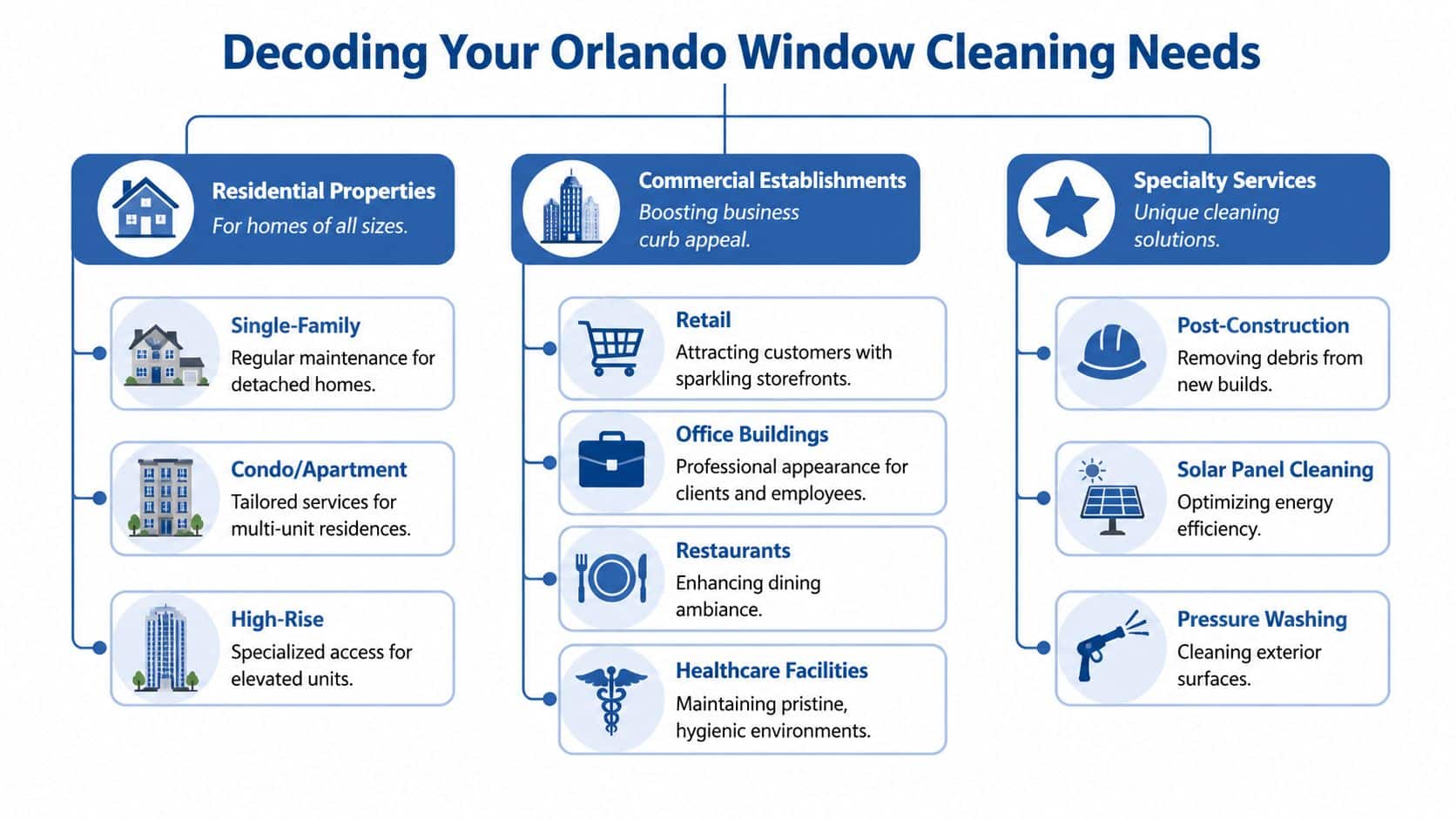
Decoding Your Orlando Window Cleaning Needs
Not every property needs the same service plan. A lakefront home, a retail storefront, a mid-rise condo, and a hotel all collect dirt differently. The right approach starts with the building type, access, and what “clean” has to accomplish.
Residential properties
Homeowners usually start with appearance, but the main issue is buildup in the details. Screens trap pollen. Tracks collect grit and moisture. Lower panes pick up irrigation splash and lawn debris. Upper panes often look cleaner than they are because you don’t view them up close.
Single-family homes need a method that balances glass cleaning with frame and screen care. Condos and upper-level units introduce access issues, HOA coordination, and safety requirements that change the equipment needed. In Orlando, houses shaded by oak trees or surrounded by landscaping often need more frequent touch-ups than homes in more open lots.
A strong residential service should account for:
- Exterior exposure: Trees, traffic dust, sprinkler overspray, and storm runoff all leave different residue.
- Interior use: Pets, handprints, cooking film, and condensation matter more than many owners expect.
- Window style: French panes, transoms, sliders, and hard-to-reach foyer glass all change labor and tools.
Commercial buildings
Commercial glass has a different job. It’s part of the customer experience. Retail needs clear storefront visibility. Office buildings need consistency across elevations and entry areas. Restaurants need front glass that stays presentable between rushes.
In Orlando, commercial properties also deal with a tourism-driven expectation of presentation. If the windows at the entrance are smeared, dusty, or visibly spotted, customers notice before they read a sign or speak to staff. That’s why many businesses do better with recurring service instead of occasional cleanup.
Clean storefront glass does two things at once. It improves visibility from outside, and it makes interior lighting work harder for you at night.
High-rise and multi-story work
Window cleaning ceases to be a simple maintenance task and becomes a specialty trade. Access planning, anchor points, drop zones, weather monitoring, and technician training all matter. On taller buildings, the wrong vendor can create safety, liability, and scheduling problems quickly.
Property managers should ask whether the provider handles suspended work, rope descent, lift access, or water-fed pole work depending on the building design. A company that’s excellent on low-rise office parks may not be qualified for a tower or atrium.
Solar panel and specialty cleaning
Solar owners often focus only on the panels, but the surrounding glass and exterior surfaces usually age visually at the same time. If a property has skylights, glass railings, canopies, or solar arrays, it makes sense to evaluate them together.
Panel cleaning also requires a careful touch. Abrasive scrubbing, the wrong chemicals, or rushed rinsing can create more problems than they solve. Specialty work is where professional process really separates itself from generic exterior cleaning.
The Science Behind a Lasting Streak-Free Shine
The difference between average results and professional results often comes down to the water itself. Traditional methods can still work well in skilled hands, especially on interiors or detail work, but exterior glass in a bright, humid climate exposes every shortcut.
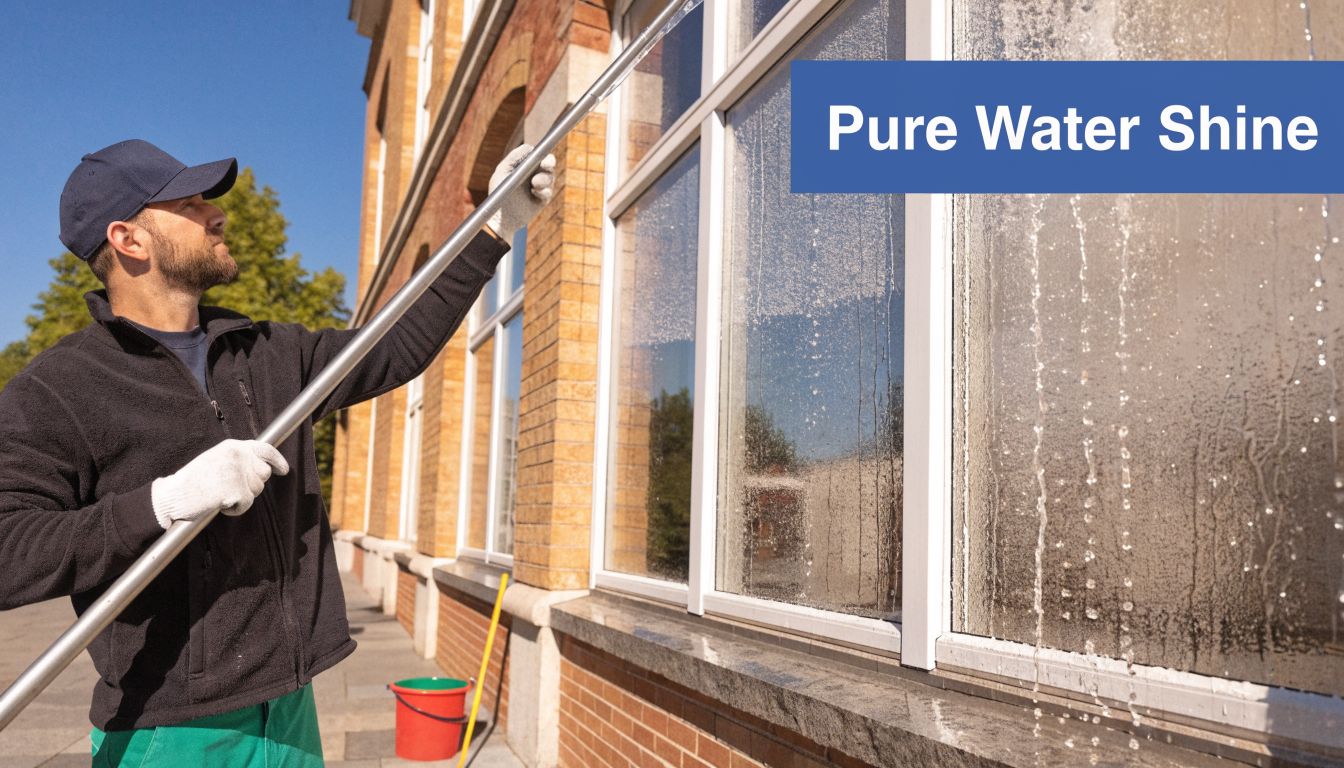
If you clean a window with mineral-heavy water, you’re often putting new residue on the glass while trying to remove the old residue. It’s the same reason a car looks worse after being rinsed with poor-quality water and left to dry in the sun. Minerals stay behind.
Why pure-water systems work
A pure-water system filters water so dissolved solids are removed before the cleaning starts. That usually means reverse osmosis followed by deionization. The result is water clean enough to lift dirt and rinse away without leaving mineral spotting behind.
According to EverClean’s explanation of pure-water window cleaning systems, pure-water systems using deionized water at 0-10 ppm TDS can result in 30-50% longer residue-free intervals compared to traditional methods. The same source notes that this matters even more in Orlando because the area averages 2,600 sunny hours annually, and UV exposure can etch hard water spots into the glass.
That’s a real trade-off in the field. Soap-and-squeegee work gives a technician precision around edges, cutups, and interiors. Pure water shines on exterior maintenance, upper windows, awkward architectural glass, and properties where mineral spotting is the main enemy.
What works and what doesn’t
Some methods hold up well in Orlando. Some don’t.
- Works well: water-fed poles with purified water for exterior maintenance on accessible elevations.
- Works well: hand detailing for interior panes, divided lights, and first-time restoration cleans.
- Doesn’t work well: blasting dirty glass with untreated hose water and hoping rain handles the rest.
- Doesn’t work well: using household detergents that leave residue behind in direct sun.
A good contractor knows when to combine methods instead of forcing one system onto every job. If exterior glass has oxidation, paint specks, heavy organic film, or baked-on residue, pure water may be part of the solution, not the entire solution.
Later in the process, it helps to see the equipment in action:
For owners comparing service providers, this overview of pure-water window cleaning systems is worth reviewing because it shows why equipment quality affects results, not just speed.
Expert Scheduling for Orlando's Climate
A generic “once or twice a year” schedule doesn’t fit Orlando well. The local climate changes what lands on the glass and how fast it becomes visible. Smart scheduling follows conditions, not a canned calendar.

Spring and early summer pressure
Spring usually brings pollen, seed debris, and the first stretch of weather where buildup becomes obvious in the light. If your property has screens, this is often when they need attention as much as the glass does. Cleaning the pane but leaving a dirty screen in place gives you a half-finished result.
By early summer, frequent rain changes the maintenance pattern. Windows don’t always get dirtier overnight, but they get inconsistent. One elevation may still look sharp while another develops spotting and runoff marks. That’s when recurring service starts making more sense than occasional full resets.
Rainy season and storm planning
During the wetter months, the best schedule is usually one that keeps the property from sliding too far between visits. Waiting until every pane looks bad creates more labor and more chance that residue has had time to bond to the surface.
For commercial properties and larger homes, it helps to think in terms of trigger events:
- After a heavy pollen cycle: clear screens, sills, and exposed exterior glass.
- After prolonged storms: inspect for spotting, algae staining around frames, and runoff trails.
- Before major property events: clean entry glass and highly visible elevations first.
- After storm debris: remove organic residue before it hardens in the sun.
Rain isn’t the enemy. Drying dirty water on hot glass is.
What a practical schedule looks like
The right cadence depends on tree cover, irrigation, traffic, and how visible the windows are to guests or customers. A storefront on a busy corridor needs a different plan than a tucked-away residence with shaded elevations.
The best approach is to build the schedule around exposure. If you’re not sure where to start, this guide on how often to clean windows gives a useful framework for matching service frequency to property conditions.
The Business Case for Commercial Window Cleaning
Commercial window cleaning isn’t just a line item. It affects how a property presents, how consistently it photographs, how tenants judge management, and whether customers feel a business is attentive or tired. In Orlando, where competition is visual and first impressions happen fast, exterior glass carries more weight than many operators expect.

Retail and hospitality properties feel this first. Guests notice entry glass, patio enclosures, partition glass, and the brightness of the space from the curb. Office and mixed-use properties feel it differently. Their issue is consistency. One dirty corner or streaked lobby elevation can make the whole property feel unevenly maintained.
Safety is part of the value
The business case gets even stronger on multi-story and high-rise work because risk management enters the picture. This isn’t a task to hand to the cheapest bidder with a ladder and a pickup.
According to ProMatcher’s Orlando window washing cost and safety overview, adherence to OSHA 1910 standards is critical for high-rise operations, falls account for over 70% of industry fatalities, and proper safety protocols include systems rated for 5,000 lbs and $2M liability coverage. For property owners, that’s not abstract compliance language. It’s the difference between a controlled operation and unnecessary legal exposure.
A capable commercial provider should be able to explain:
- How technicians access the building: lift, rope descent, suspended scaffold, or water-fed pole.
- What weather limits apply: especially in storm-prone conditions.
- How the site is protected: pedestrian control, staging, and communication with tenants.
- Which insurance documents are current: not promised later, but available for review.
If a contractor can’t explain their safety plan clearly, they probably don’t have one that will hold up under scrutiny.
Insurance matters before anything goes wrong
Property managers should also understand what liability coverage protects. If you oversee a commercial site and want a practical insurance refresher, this breakdown of essential coverage for Florida companies is useful background before approving any vendor.
Clean glass improves presentation. Qualified service protects the owner while that work gets done. The two belong together.
How to Choose Your Orlando Window Cleaning Partner
Most hiring mistakes happen before the cleaning starts. Owners compare quotes without comparing methods, insurance, access capability, or what’s included in the scope. In orlando window cleaning, the cheapest number often leaves out the exact things that determine whether the result lasts.
A better approach is to vet the company the way you’d vet any skilled trade. Ask who’s doing the work, how they’re trained, what system they use, and whether they’re prepared for the specific property type you manage.
What to verify before you hire
Use a shortlist that goes beyond price.
- Insurance first: Ask for current proof of liability coverage and verify that it matches the level of risk on your property.
- Training and safety: For upper-level or commercial work, ask how technicians are trained and what procedures they follow on site.
- Equipment fit: A serious provider should be able to explain when they use squeegees, scrapers, water-fed poles, or pure-water filtration.
- Scope clarity: Confirm whether screens, tracks, frames, hard water residue, and interior glass are included or quoted separately.
- Review consistency: Look for detailed customer feedback about communication, punctuality, and whether the work held up after the visit.
The labor itself has value. According to Fish Window Cleaning’s industry overview, professional high-rise window cleaners in Orlando earn an average of $16.90 per hour, with higher rates for top earners. That reflects the skill and risk involved, and it’s one reason low-priced bids deserve a closer look.
Estimated Orlando window cleaning costs for comparison
Treat ranges as a conversation starter, not a fixed quote. Building design, access, frequency, and condition change pricing fast.
| Service Type | Estimated Cost |
|---|---|
| Residential exterior window cleaning | Varies by home size, pane count, access, and condition |
| Residential interior and exterior service | Higher than exterior-only due to labor and detail work |
| Storefront recurring service | Usually priced by frontage, frequency, and glass condition |
| Mid-rise or high-rise window cleaning | Priced based on access method, safety setup, and building complexity |
| Screen and track cleaning | Often quoted as an add-on or bundled with full service |
| Hard water stain removal | Usually separate from standard maintenance cleaning |
| Solar panel cleaning | Priced by panel count, roof access, and soil level |
For a benchmark of what a qualified contractor should look like, review a professional window cleaning company page and compare that standard against every bid you receive.
Orlando Window Cleaning FAQs
How often should windows be cleaned in Orlando
It depends on exposure. Homes with trees, sprinkler overspray, or full sun usually need more frequent service than shaded properties. Commercial storefronts and customer-facing buildings usually benefit from a recurring schedule because visibility and presentation matter every day.
Is it worth cleaning windows during the rainy season
Yes. Rainy season cleaning still makes sense because the job is to remove built-up dirt, pollen, film, and residue. Clean glass handles normal rain better than dirty glass, and scheduled service prevents buildup from baking into the surface when the sun returns.
What’s the difference between standard cleaning and restoration
Standard cleaning removes everyday soil, dust, fingerprints, and normal residue. Restoration addresses bonded contaminants such as hard water staining, paint specks, construction debris, or oxidation that won’t come off with a normal wash.
Are pure-water systems always the best choice
Not always for every surface and every detail task. They’re excellent for many exterior applications, especially where mineral spotting is a recurring problem. Interior glass, divided panes, or restoration work often calls for hand detailing and a more targeted approach.
What should commercial property managers ask first
Start with insurance, access method, and safety procedures. After that, review scope, scheduling reliability, and communication. If the provider can’t explain those clearly, keep looking.
Can one company handle windows, pressure washing, and solar cleaning
Many can, but only if they have the right tools and training for each service. It’s better to hire a company with proven exterior maintenance systems than one that treats every surface the same way.
If you want a fast, expert quote for residential, commercial, high-rise, or solar cleaning, contact South Mountain Window Cleaning, LLC. Their team serves Arizona properties with licensed, bonded, and insured service, pure-water systems, professional scheduling, and a 100% satisfaction guarantee.