

The window sticks halfway up. You look into the track and there it is, a soft green line in the channel, thicker in the corner where the screen sits and the frame overlaps. A paper towel takes off most of it. Three weeks later it's back, and this time there's a dark patch at the end of the track that wasn't there before.
That pattern, green returning to the same corner of the same window, is the whole diagnosis. Moss growing in window tracks is rarely a sign that the glass is dirty. It's a sign that the channel is staying wet long enough for a plant to live there. In the Phoenix area that usually means something else is supplying the water: an irrigation head pointed at the glass, a weep hole packed with silt, a seal that's let go, or condensation on a frame that runs colder than the room. Clean the surface and you'll be back in the same corner next month. Fix the water and the green stops coming back.
Identify What Is Growing in the Track
Green is the worst identifier in this job. Almost every track that gets called moss on sight turns out to be one of five different things, and only one of them is moss. It could be a slimy smear of algae, a fuzzy black patch of mold, a crusty mineral ring from hard water, or a dry grey mat of dust and lint that's been wet and dried a hundred times. The name decides whether you scrub, flush, or pick up the phone.
| Appearance | Most likely growth | First step |
|---|---|---|
| Green or dark green clumps or leafy mats, firm and damp | Moss | Loosen and remove, then clean and dry the channel |
| Slimy film that smears when wiped | Algae | Clean with mild detergent, then correct the wet source |
| Black, grey or white fuzzy patches with a musty smell | Mold | Stop routine cleaning, check for hidden moisture, call a professional if the area is large |
| Crusty white or brown deposits with no living tissue | Mineral or hard-water buildup | Scrub with a soft brush and mild cleaner |
| Grey or brown dry mat, no green colour | Organic dust and debris | Vacuum, wipe, then check the drainage path |
Three checks that settle the diagnosis
- Is the track still wet a day after rain? A channel that's damp long after the weather clears isn't draining, and no cleaner fixes that.
- Is the growth on the outdoor side only? Outdoor-only growth points to rain, sprinkler overspray or debris in the weep slot. Growth on the inside glass points to condensation and indoor humidity instead.
- Is it back within a few weeks of a clean? Fast return means the water source never went away. Slow return on a north-facing window is closer to ordinary maintenance.
Moisture that condenses on cold window surfaces encourages biological pollutants indoors, and the EPA's guidance on controlling moisture in a home notes that persistent dampness around windows can also point to leaks or inadequate ventilation rather than a cleaning failure.
Practical rule: if the same corner greens up twice in two months, you're looking at a water problem, not a hygiene problem.
Growth stops being a maintenance item when it leaves the channel. A musty smell, fuzzy patches spreading onto the frame or the sill, paint bubbling at the corner, or water beads reappearing days after a dry spell all mean moisture is sitting inside the assembly. Black mold on window sills covers how that pattern develops on the sill itself, and if the growth has moved into framing, this walkthrough for Marion County homeowners facing wood mold explains what remediation involves and when to stop treating it as surface cleaning.
Why Narrow Tracks Hold Moisture and Moss
The glass is dry after rain, but the channel beneath the sash still feels damp. That difference explains why moss can persist in a window track: the glass is exposed to moving air, while the recessed channel stays shaded and sheltered. Rain, hose water, dew and condensation collect there. Pollen, dust, leaf litter and cottonwood fluff settle into the corners, creating a damp layer that holds water longer than bare vinyl or aluminum.
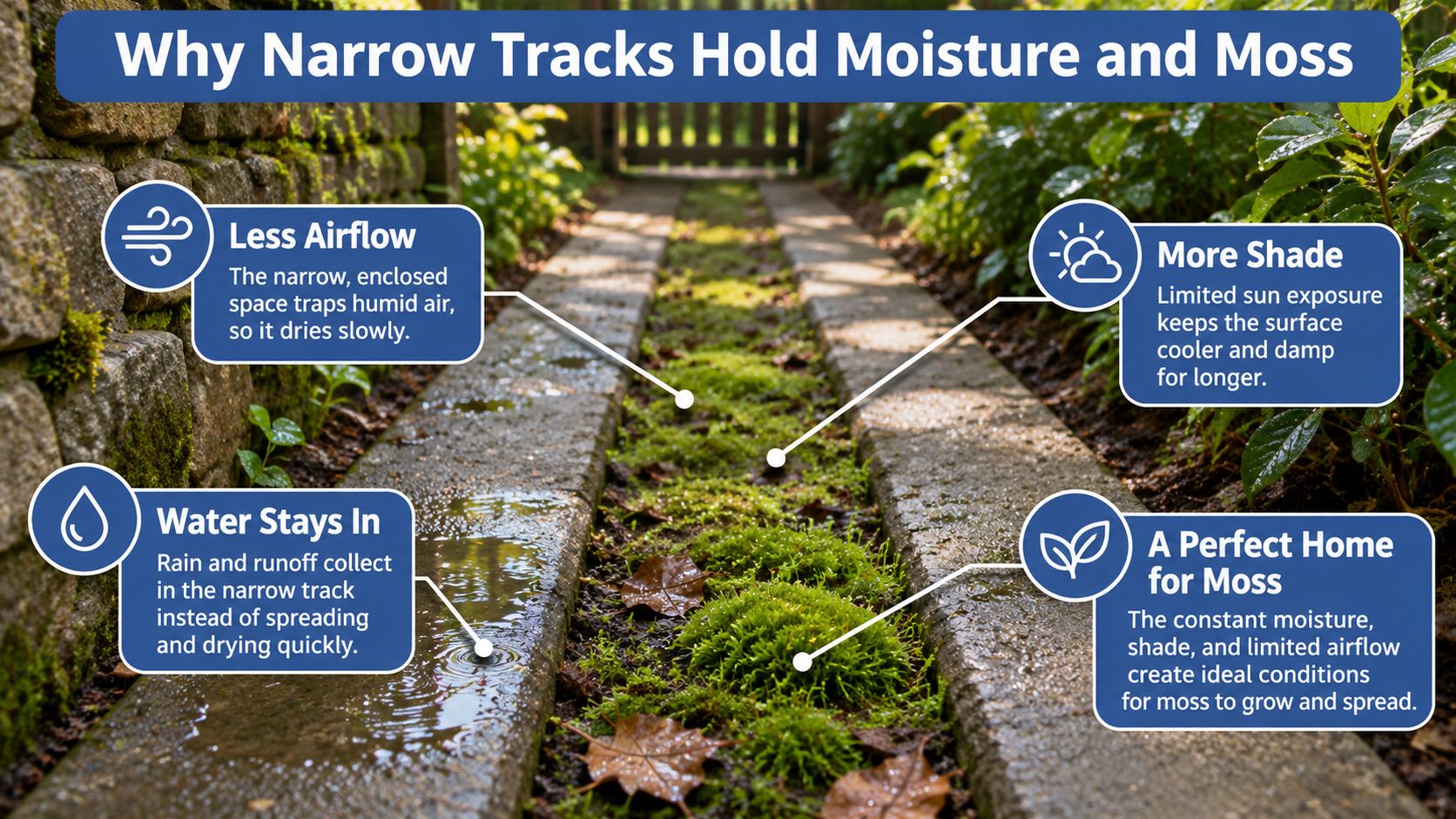
Within the window track, the combination matters: narrow, shaded, poorly ventilated surfaces stay damp long enough to support growth.
A little sediment makes that sheltered space more hospitable. Even when the exposed surface looks dry, material packed into a corner can retain moisture underneath. Judging the channel by the appearance of the glass misses the part that dries most slowly.
Why a thin film is enough
Moss absorbs water and nutrients across its surface rather than relying on roots to draw them from soil. Rain, mist and dew can supply that moisture. The building conservation research from RWTH Aachen identifies water retention, surface structure and porosity as factors in moss colonization on building materials, including the moisture held by recessed or uneven surfaces.
In a track, damp silt provides a moisture-retaining surface where growth can establish. The practical consequence is straightforward: removing the visible plant while leaving that sediment behind leaves part of its growing environment intact.
The wet and dry cycle in three stages
- A wet event reactivates what survived. Rain, sprinkler water or a window wash wets the channel again. Surviving moss can resume activity when moisture returns.
- Sediment gives it a grip. Trapped dust, mineral grit and organic fibre hold moisture and help keep growth lodged in the channel. A smooth frame surface offers little advantage when wet debris covers it.
- The dry spell doesn't finish it off. Mosses can become metabolically inactive as they dry and resume photosynthesis when conditions allow, a response discussed by Ohio State's moss ecophysiology lab.
Dry-looking growth is not necessarily dead.
Afternoon warmth may leave the moss grey and brittle while residue beneath it remains damp. Overnight dew can wet the channel again. Condensation can also form where a cold window surface falls below the dew point, adding moisture without rainfall.
The useful test is whether the channel dries between wet periods. If it stays damp for days after rain, cleaning alone will have limited staying power. Removing moss and sediment clears the surface; restoring drainage and addressing the water supply changes the conditions that let it return.
Moisture Sources That Bring Moss Back
Rain that leaves a track wet after the rest of the sill has dried is the first clue. Six moisture sources cause nearly every repeat case, and the order matters because drainage faults keep feeding the growth while cleaning habits only change how often you notice it.
| Moisture source | How to check it | Fix |
|---|---|---|
| Blocked weep holes | Water pools in the track after rain; a thin wire clears the opening | Clear openings so water drains outward |
| Failed or gapped seals | Wet streaks run down the frame or sill after rain | Reseal or replace the weatherstrip or caulk |
| Sprinkler overspray | Track is wet each morning, with growth on the sprinkler side | Redirect heads so water misses the glass and track |
| Condensation on cold glass | Beads of water on the inside glass on cool mornings | Ventilate and keep indoor relative humidity below about 50 percent |
| Trapped cleaning water | Puddles after washing with no rain | Dry the channel fully and avoid soaking it |
| Debris dam | Leaves or packed dust in the corners | Remove debris, then rinse once drainage is open |
Start with the top two rows, because they change how the window behaves. A weep slot packed with silt holds water in the channel after every rain. A seal that has pulled away lets water run down the frame or sill into the same channel. Neither problem is solved by harder scrubbing. A sprinkler aimed at the glass creates the same cycle on a timer, which means the track gets wet even during a dry spell.
The clip below shows a track being worked loose and flushed, which is the order that keeps growth from coming straight back.
Moss is a visible sign of a persistently humid microclimate. Built-environment research compiled in the International Journal of Technology reports that moss growth is favored at relative humidity above 80 percent and temperatures below 25°C, particularly during germination. The practical point is simple: sustained dampness matters more than one wet event. A brief splash is manageable when the channel drains and dries. A track that stays damp for days gives moss the conditions it needs to return.
Removing the growth without correcting the source is how a track ends up back in the same condition a month later. Where the channel itself has lost its drainage, window track repair comes before cleaning, not after it.
How to Remove Moss from a Window Track
The removal sequence below matters more than the products. Each step exists to keep detached growth and dirty water from ending up somewhere worse than the track.
- Glove up and protect your eyes. Nitrile gloves and safety glasses, because moss and mold residue irritates skin and eyes, and a brush at head height splashes.
- Vacuum the dry material out first. A crevice nozzle or shop vac pulls loose grit, dead growth and dust out of the channel. Skip this and every later step turns sediment into mud that spreads into the corners you haven't reached.
The infographic maps the sequence; the steps here explain the reason behind each one.

- Loosen the mat from the far end toward the weep holes. A nylon brush or plastic track tool, worked in one direction, so detached material travels outward along the channel instead of deeper into the frame.
- Lift the clumps out by hand and bag them. Living fragments left in the channel can re-root, so remove them rather than brushing them into the drain slot.
- Scrub the channel and corners with mild dish soap and a microfiber cloth. A few drops in warm water is enough. Avoid bleach on painted or anodized frames, where it can stain and dull the finish, and it does nothing about the moisture feeding regrowth. Landlords juggling the same problem across several units will find these spray-on mildew remover tips for landlords useful for the wall and ceiling side of the job.
- Rinse only after confirming the weep holes drain freely. Pour a cup of water in and watch it leave. If it sits, flushing pushes water toward the wall.
- Extract the standing water. A wet vacuum or a dense sponge, then a towel, because trapped water reactivates any fragment you missed.
- Dry the channel and leave it open to air for 24 hours. Prop the sash or leave the screen off so outside air reaches the bottom of the track.
What a finished track looks like
Run a white cloth along the bottom of the channel. No green fibres, no brown smear, no standing water, and the drainage slots open enough that a trickle of water exits while you watch. If any of that fails, the job isn't finished.
The most common slip is scrubbing hard with a soaked pad and never drying the channel afterward. That leaves the moss dead and the habitat intact.
Don't use a pressure washer on a window track. The jet forces water through the weep holes and behind the frame, and it can chew up vinyl and aluminum finishes. Test any cleaner on an unseen inch of track before you use it across the whole channel.
Prevention Schedule by Track Exposure
Prevention here isn't a calendar rule. It's an interval matched to how much water and debris one specific track receives. Two windows on the same house can need different schedules: the one beside the flower bed catches overspray and soil splash, the one under the patio roof catches leaves and shade.
| Track exposure | Clean and check every | Main reason |
|---|---|---|
| Shaded tracks near irrigated beds | 4 weeks, plus after each irrigation change | Overspray is the most common moisture source |
| Ground-floor windows beside planters | 4 weeks | Soil splash carries organic matter and spores |
| Shaded north or east windows | 4 to 6 weeks | Shade keeps the channel damp for longer |
| Tracks under overhangs or patios | 6 weeks | Leaves and debris collect and dam the drainage |
| Sun-exposed tracks in dry climates | 8 weeks | Dust is the main load and moisture is low |
The five-minute check that sets the interval
- Run a finger along the bottom of the channel. Grit means sediment is building. Dampness means it isn't drying.
- Look for water beads and green fibres in the corners and along the weep slot.
- Pour a cup of water into the channel and watch whether it leaves through the weep holes.
- Note where the growth sits. One side only points at the sprinkler head on that side.
- Write down the date and what you found.
Four events should pull a track onto a shorter interval: a storm that drove rain sideways into the frame, a change to the irrigation schedule or head positions, a new planting bed close to the glass, or a second appearance of growth in a spot you already cleaned.
A schedule only pays off if the results get recorded. A note on each visit showing damp or dry, grit or clean, and drainage open or blocked tells you within two months whether the interval is working or whether the track needs the repair that cleaning keeps postponing.
Windows that green up on a quarterly cycle are usually being cleaned on a schedule built for dust, not for moisture. How often windows should be cleaned is worth revisiting when the check results keep saying the same thing.
Decide Between a DIY Clean and a Pro Visit
A DIY clean is reasonable when the growth sits inside the channel, the track dries within a day, there is no musty smell, and there is no wet staining on the frame or wall. Those conditions point to surface growth fed by ordinary moisture. Most single-window cases fit that pattern, especially where the track drains freely after rain or irrigation.
Cross any of those lines and the job changes. Fuzzy black patches, water entering the frame or wall, growth returning within two weeks after two cleanings, or the same pattern on several windows all point to a source above a track clean. Multiple units showing identical growth usually means a building-wide issue, such as irrigation coverage, a failing envelope detail, or drainage that was never open. A property manager should log that as a maintenance inquiry, not a bigger cleaning order.
What a professional visit should confirm
A proper visit proves the weep holes drain, checks seals and sprinkler heads while the channel is open, cleans with a method that protects the finish and does not drive water inward, and writes down what was found so the next interval is based on evidence. High-rise façades are a separate conversation. Exterior work from powered platforms on tall buildings is governed by federal worker-safety rules requiring fall protection and an emergency plan. None of that belongs to anyone with a ladder and a spray bottle.
If growth returns twice in the same spot after two proper cleans, stop cleaning and start looking for the water.
South Mountain Window Cleaning, LLC provides residential, commercial, and high-rise window cleaning across the Valley, including Phoenix and Scottsdale. Residential service includes inside and out glass, screen cleaning and repair, track cleaning, tinting, ceiling fans, coach lights, and mirrors. The company backs residential window cleaning with a 100% satisfaction guarantee. Phoenix and Scottsdale customers can reach the office at (480) 519-9327, and the residential window cleaning side of the business handles the track cleaning described here.
One action for this week: after the next rain, walk the windows that face the sprinklers, run a finger through each track, pour a cup of water into the channel, and watch the weep holes. If they do not take the water, you have found a likely reason the green keeps coming back.
South Mountain Window Cleaning, LLC cleans tracks as part of its residential and commercial window service. If the same corner keeps turning green after a proper clean, request a free quote at South Mountain Window Cleaning, LLC. A clean may restore the channel, while a repeat problem may call for a closer look at the conditions feeding it.