

You've seen the crews from the street, moving across a downtown Phoenix tower while everyone else is starting the workday. Then you search for high rise window washing jobs, find a few short listings, and wonder whether a strong back and a willingness to work at height are enough to get hired.
They aren't. This is a specialized commercial trade built around access planning, fall protection, weather judgment, equipment inspection, and consistent glass work. The people who advance usually aren't the ones with the flashiest resume. They're the ones who show up early, inspect every connection, follow the rigging sequence, and know when conditions are unsafe.
What High Rise Window Washing Jobs Actually Are
A high-rise applicant often starts with the wrong picture. You might drop off an application at a Phoenix cleaning company after watching a crew work on a downtown tower and assume the job is a version of storefront cleaning. In practice, high-rise window washing is commercial exterior maintenance on buildings typically four stories and up, where the access system and fall-protection plan matter as much as the squeegee technique.
The work is also different from industrial rope access on turbine blades, bridges, or tanks. A window-cleaning technician is usually responsible for glass, frames, screens, and façade access, not every industrial inspection or repair task performed by a rope team.
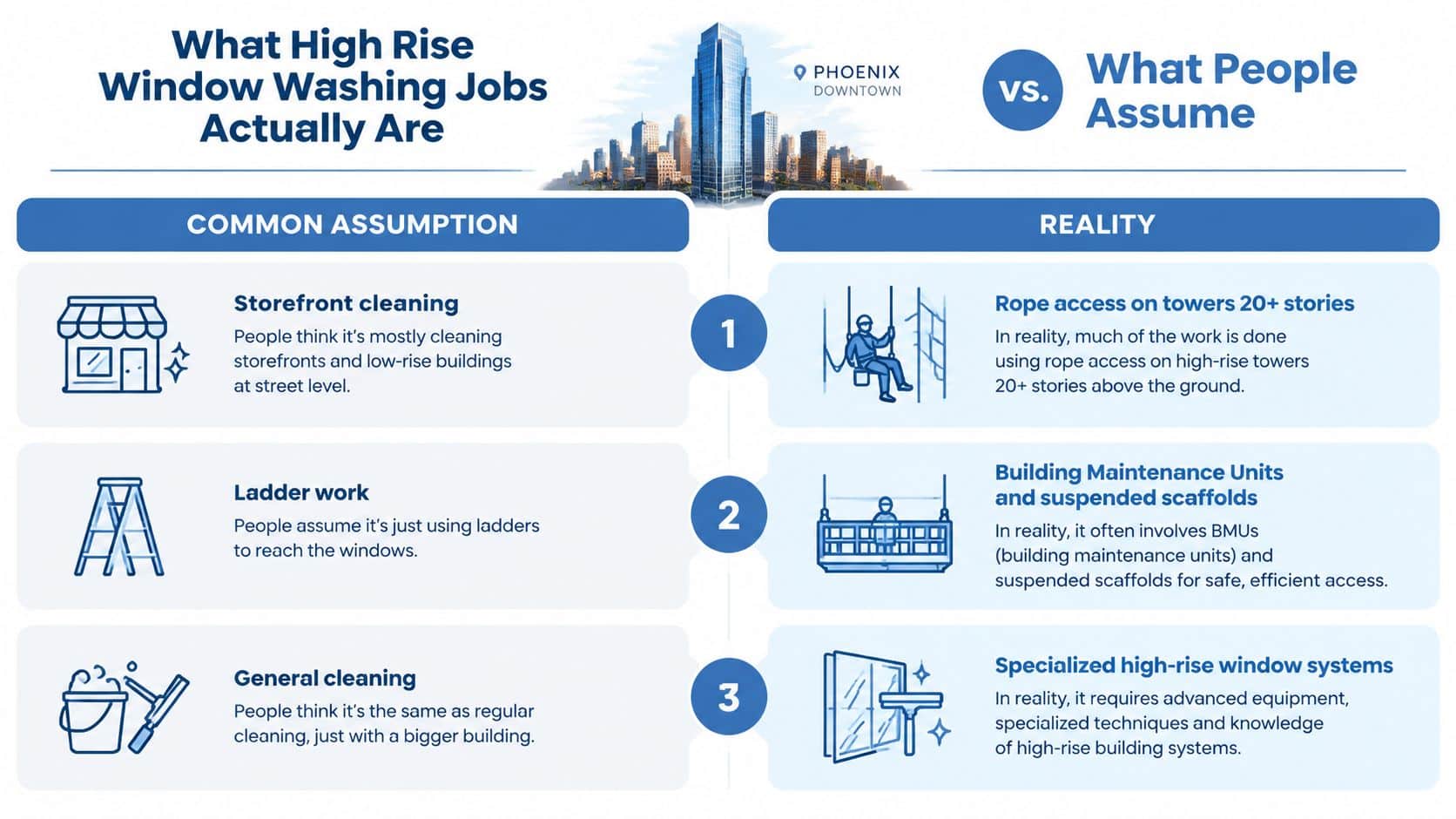
The three access methods
Most commercial high-rise work uses one of three delivery methods:
- Rope descent systems: Technicians descend from roof-level anchors using a working line and an independent safety line. This method offers flexibility around corners, setbacks, and irregular façades, but it demands disciplined anchor checks and backup protection.
- Suspended power platforms: Building Maintenance Units and swing stages carry workers along the façade. They can provide a stable working position and handle routine coverage efficiently when the building has a suitable permanent system.
- Bosun chairs and ground-based booms: A bosun chair supports a single technician during controlled descent, while a boom lift provides a platform from below where site access, reach, and ground conditions allow it.
In Arizona, many commercial jobs rely on RDS from the roof, particularly where the building has accessible anchor points and the façade doesn't justify a powered platform. That makes anchor documentation, independent fall arrest, and weather decisions part of the daily job, not an occasional compliance exercise. A crew may clean beautifully and still fail the job if the access setup is careless.
For building-specific service details, review South Mountain Window Cleaning's high-rise window cleaning services.
Decide whether the trade fits
Typical employers include exterior-maintenance contractors, property-management vendors, and some unionized building-service shops. The schedule is physical and controlled by the building, tenants, heat, and wind. Phoenix crews often start early to avoid the worst daytime conditions, and the job can involve repeated roof access, ladder movement, harness work, hauling water, and long periods of repetitive hand motion.
Practical rule: If you dislike harnesses, early starts, or repeated equipment checks, pay attention to that before paying for rope training.
This is a working trade, not a YouTube stunt. The right first step is to observe a legitimate crew, ask what access systems it uses, and decide whether the routine suits your body and schedule.
Certifications, Safety Rules, and the Equipment You Must Know
A new hire usually learns the job in a specific order. First comes fall protection and the site plan. Then come anchors, ropes, rescue procedures, and equipment inspection. Glass technique matters, but nobody should trust a technician with a drop until that person understands how the entire access system works.
OSHA's fall-protection framework drives anchor decisions. Under the cited requirements, an anchorage must support at least 5,000 pounds per attached worker, and building owners must provide written confirmation that each anchorage has been identified, tested, certified, and maintained. The framework also calls for a separate fall-arrest backup, annual inspection, and anchor certification at least every ten years. The OSHA anchorage and suspended window-washing guidance explains how those requirements shape modern RDS work.
An anchor attaches to a structural system or engineered arrangement. It doesn't attach to parapet coping, decorative railing, or any convenient piece of roof hardware. The competent person has to verify the approved location, inspect the condition, check the paperwork, and stop the setup if the information doesn't match the physical site.
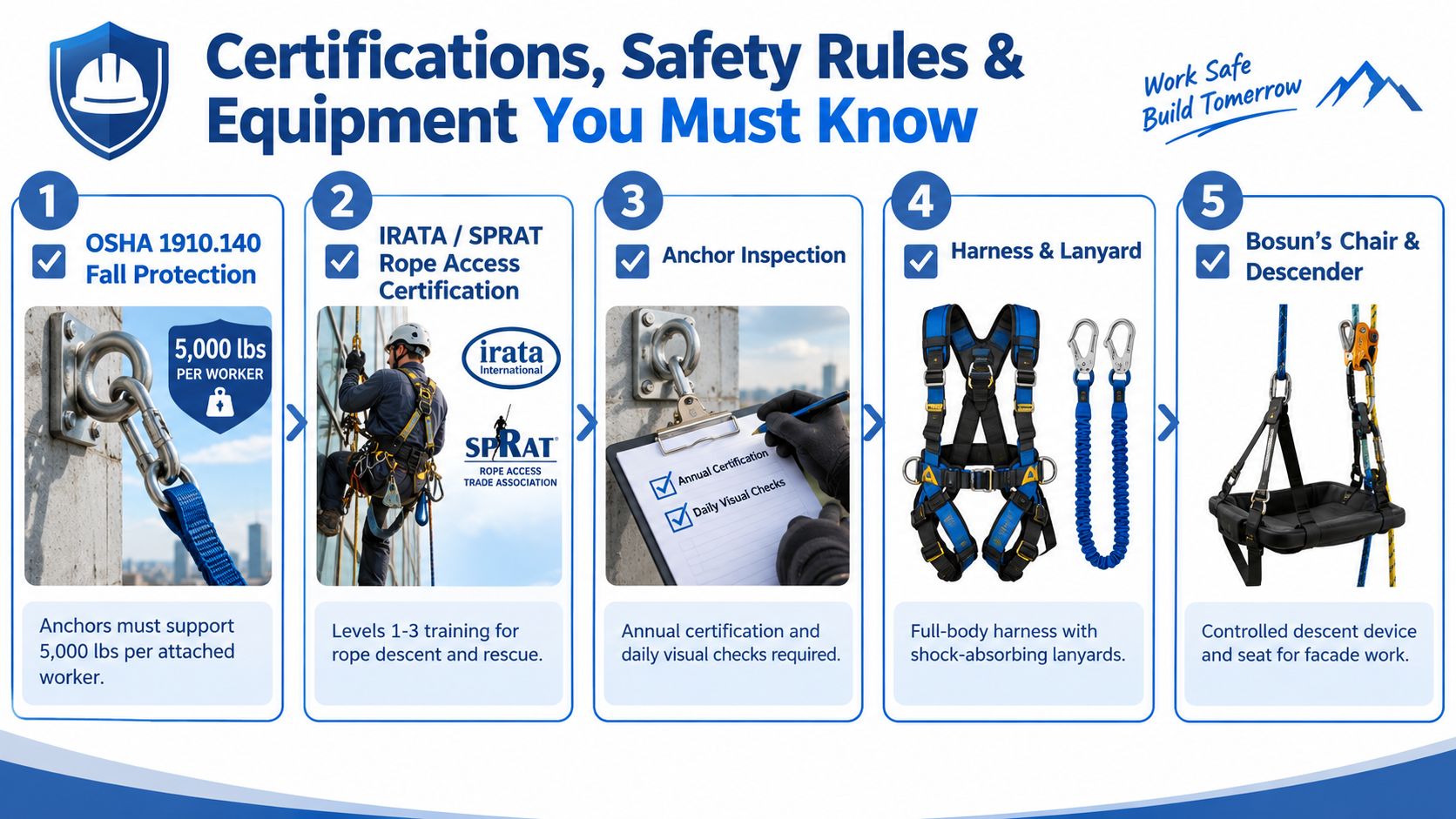
Certifications employers recognize
Arizona contractors commonly look for training that demonstrates more than general comfort with heights.
- SPRAT: Levels 1 through 3 establish a progressive rope-access path, from supervised technician work to more advanced rescue and supervision responsibilities.
- IRATA: This international rope-access system is widely recognized and gives employers a clear way to evaluate rope skills and progression.
- IWCA Working at Heights: This can make sense as an entry-level route for RDS-focused window cleaners who need height-safety training before pursuing broader rope-access credentials.
- OSHA awareness: The powered-platform standard covers permanent installations dedicated to building maintenance and requires fall-arrest protection. It doesn't cover temporary suspended scaffolds used for construction work, so applicants need to understand which standard applies to the equipment in front of them. The OSHA powered-platform factsheet gives the basic distinction.
Equipment knowledge is practical, not decorative
A serious candidate should be able to name and inspect a two-rope descent system, including the working line, safety line, backup belay device, bosun chair, descent controller, helmet, and full-body harness with a sternum D-ring. You should know what abrasion, cuts, contamination, missing labels, damaged stitching, and incorrect connectors look like.
Ontario's rules provide a useful example of how detailed competent supervision can become. They require a competent supervisor for employers and contractors using suspended scaffolds, boatswain's chairs, or similar single-point equipment, and require primary suspension lines and lifelines to hang vertically while protected from abrasion. Those principles are directly relevant to anyone learning professional suspended access. Review the Ontario window-cleaning access and fall-protection requirements for a clear example.
Pure-water poles have also changed the work. On buildings up to about six stories, a ground-based water-fed system can remove the need for a rope drop when the façade and perimeter allow safe reach. Anchor rules still govern any anchor setup, however, and pure water doesn't eliminate site assessment, pedestrian control, or weather judgment.
Before enrolling, ask the provider exactly what the course includes. The practical path described by many contractors is a 40-hour SPRAT Level 1 course, followed by written and practical testing, then supervised field experience. A contractor may expect at least 200 logged hours before allowing a technician to lead a drop. Those requirements are expensive in time and money, but they're more useful than a certificate that never puts you on real equipment.
For equipment examples used in high-rise work, see this guide to equipment for high-rise window cleaners.
Pay, Schedule, and Career Progression in Arizona
Pay conversations in Phoenix should be specific, but they also need honest context. The verified material for this trade doesn't establish reliable Arizona wage bands, weekly-hour averages, or contractor revenue figures, so a responsible applicant should verify current offers directly through employers and job boards rather than treating informal ranges as guaranteed market rates.
The same principle applies to career progression. A technician with no supervised access experience is not interchangeable with a lead who can inspect anchors, brief a crew, manage a suspended platform, and make a stop-work decision. Certification helps, but employers pay for reliable judgment and production under actual site conditions.
A practical pay comparison
Use this table as a qualification framework, not as a promise of current wages. Confirm the hourly offer, overtime policy, travel expectations, benefits, and whether training time is paid before accepting a role.
| Role | Hourly Pay (USD) | Typical Weekly Hours | Notes |
|---|---|---|---|
| Entry-level technician | Verify with employer | Verify with employer | Usually works under a lead and learns setup, inspection, and glass technique |
| Rope-access technician | Verify with employer | Verify with employer | Certification and logged hours can improve eligibility |
| Lead climber | Verify with employer | Verify with employer | Responsible for crew execution, access decisions, and job documentation |
| Pure-water pole technician | Verify with employer | Verify with employer | Often has less rope-access overhead, but still requires site discipline |
| Foreman or estimator | Verify with employer | Verify with employer | Combines field knowledge with scheduling, client communication, and pricing |
Phoenix, Scottsdale, and Tempe schedules are shaped by heat, dust, wind, tenant access, and building operating hours. Commercial crews commonly begin early, while lobby glass, post-construction cleaning, and emergency work may require a different schedule. High-rise façade work is often planned around weather windows because gusts can turn a controlled descent into a shutdown.
The Arizona trade-off
Arizona's dry climate creates recurring cleaning demand from dust and mineral deposits. That can support steady commercial maintenance work, but it also increases the physical toll. A technician may spend a long shift in sun, handle hoses and poles, repeat the same shoulder movements, and then return the next morning for another route.
A career path can move from technician to lead climber, then foreman, operations manager, estimator, or owner. The fastest advancement usually goes to workers who can do more than descend and clean. Learn scheduling, site reports, customer communication, equipment logs, and production planning. Those skills let you move from being a pair of hands to being someone the contractor can trust with a building account.
For commercial service requirements and recurring maintenance options, review commercial window cleaning in Phoenix.
Building a Resume That Gets You Hired
Commercial-cleaning HR managers use a resume as a screening tool. They want to know whether you can work at height, whether you've touched the relevant systems, and whether a supervisor can trust you around a client's property. A generic statement such as “hard worker with good attitude” won't answer those questions.
Start with a direct summary:
Qualified to work at heights, with OSHA fall-protection awareness, [SPRAT or IRATA level], and hands-on experience with [bosun chair, suspended scaffold, pure-water pole, or water-fed telescoping system].
Only include credentials you hold. If you've completed training but haven't worked from a rope system, say that clearly. Honest limits are safer and more credible than inflated experience.
Write bullets a property manager can use
Your experience section should show the work, the access method, and the scale. Where you have accurate records, include:
- Building height: State the number of stories or the elevation range you worked on.
- Production: Record square footage cleaned, drops completed per shift, or the number of buildings serviced.
- Equipment: Name the bosun chair, swing stage, boom lift, pure-water pole, descent controller, or rescue system you used.
- Responsibility: Explain whether you performed inspections, controlled the ground perimeter, completed job documentation, or worked under a lead.
A current OSHA 10 or 30 card, an updated aerial-lift card, supervisor references, and a clean background check can help you pass an initial filter. Don't list a friend as a “professional reference” unless that person directly supervised your work.
For help turning field duties into clear achievement bullets, use this resume experience guide for developers. The same writing principle applies here: describe what you did, with the equipment, environment, and result stated plainly.
Prepare for the interview demonstration
Expect practical questions. The interviewer may ask how you feel about heights, ask you to inspect a harness, or give you a dropped-squeegee scenario. Don't bluff.
Say that you'd inspect the harness before use and remove damaged equipment from service. For a dropped tool, explain that you'd stop the work, secure the area, notify the lead, and follow the company's dropped-object procedure. If you haven't worked a specific system, say so and explain what training you've completed instead.
Where to Find Openings Right Now
A Phoenix job search works better when you treat it like a trade search rather than a general cleaning search. Start with organizations and vendors that understand suspended access, fall protection, and commercial service contracts. Generic listings can be useful, but they often flatten the difference between storefront work and rope-access work.
Build a one-week search route
On Monday, check trade association channels such as the International Window Cleaning Association, the Building Service Contractors Association International Arizona chapter, and the IWCA Canada-US job board. These channels can attract employers who already understand training and safety documentation. Read each posting for access-method language, required cards, travel, and whether the role is residential, commercial, or high-rise.
On Tuesday, call industrial-cleaning staffing agencies such as Labor Finders, Tradesmen International, and Aerotek facilities. Don't say only that you want a cleaning job. Say:
“I'm looking for commercial exterior maintenance or work-at-height openings in the Phoenix area. I have [your actual credential], I'm available for supervised rope or suspended-platform work, and I can provide a resume and supervisor references.”
That wording helps the recruiter place you in the right category.
Go after the property side
Property-management companies, HOA vendors, Class A office buildings in Downtown Phoenix and Tempe, and residential service marketplaces can all create demand. Ask who handles façade cleaning, whether the building uses a BMU or suspended platform, and which contractor currently services the glass. Don't trespass onto a roof or approach a crew during a drop. Ask for the maintenance supervisor or vendor coordinator and leave a clean, one-page resume.
Union and apprenticeship routes deserve attention as well. Painters and Allied Trades DC 741 may offer a longer path for applicants who want formal training, structured progression, and broader building-service exposure.
Search local service providers through window cleaners near you in Phoenix, then use the listed company information to identify contractors serving the buildings and neighborhoods where you want to work.
Use a direct cold-call script
A useful script is short:
“Hello, my name is [name]. I'm looking for entry-level commercial window-cleaning or work-at-height openings. I have [credential or relevant experience], I'm available for early starts, and I'd like to leave a resume for the maintenance supervisor. Who handles exterior-glass vendor hiring?”
Call during normal office hours, not while crews are setting up. Follow up once, then keep moving. Hiring in this trade often depends on timing, availability, and whether a supervisor needs a dependable person immediately.
Your First 90 Days on the Job
Your first three months should have one objective: become useful without becoming a safety problem. The lead should see that you can follow instructions, protect equipment, communicate clearly, and repeat the correct process even when the work is hot, slow, or uncomfortable.
Days one through thirty
Arrive early enough to change, inspect your gear, and listen to the briefing before the crew moves to the roof. Watch the rigging sequence twice before touching hardware. Learn the daily harness inspection, anchor verification process, rope routing, edge protection, ground-control setup, and shutdown procedure.
During this phase, don't chase speed. Ask where the rescue plan is, who has authority to stop the job, and how the crew documents equipment issues. Complete the employer's background process and any required respirator fit testing. A good lead would rather correct a careful new hire than repair the habits of someone trying to look experienced.
Days thirty-one through sixty
The second month is for controlled skill building. If you don't already hold the relevant suspended-scaffold operator card, ask whether the company can provide the training. Request cross-training on pure-water systems, especially for mid-rise façades and tall lobby atriums where ground-based access may be more efficient.
Your first solo drop should happen only under a lead's observation and only after the company's competence requirements are met. Log the work accurately. Record the building, access method, conditions, equipment used, and any correction the lead made. Those notes become evidence of progress when you ask for more responsibility.
Days sixty-one through ninety
By the third month, choose a credential or skill that supports the next position. Options can include working-at-heights rescue training, aerial-boom operation, suspended-platform competence, or better production and documentation skills. Volunteer for valuable commercial contracts, but don't volunteer to bypass supervision or work beyond your authorization.
Ask directly: “What do I need to demonstrate to become a lead technician?” A useful supervisor should be able to name the missing skills, whether that's rescue knowledge, customer communication, equipment inspection, or consistent production.
The reality check is simple. This trade involves sun-baked shifts, repetitive motion, early starts, and genuine fall exposure. The safety system controls the risk, but it doesn't make the work casual. If you want a practical career that rewards discipline, physical ability, and steady skill growth, high rise window washing jobs can provide a clear path. If you're looking for occasional adventure without routine checks and accountability, choose a different line of work.
South Mountain Window Cleaning, LLC offers residential, commercial, and high-rise window washing across Phoenix, Scottsdale, Paradise Valley, Chandler, Tempe, and Gilbert, using planned access methods and professional equipment for difficult glass. Visit South Mountain Window Cleaning, LLC to request a fast, free quote for safe, scheduled window and exterior-cleaning service.