
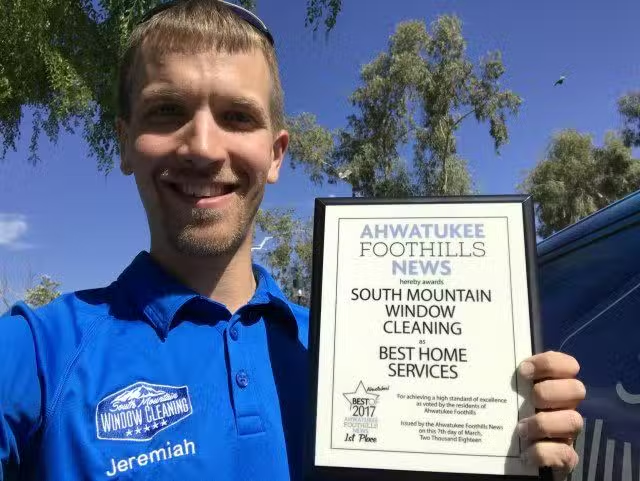
A Phoenix lunch rush tells the whole story. Cars stack under a hot canopy, the pavement throws glare back into the windshield, and a worker is trying to keep the lane from looking like a grease trail after the morning prep. By the time the third pickup rolls through, the apron already has gum spots, syrup drips, and dust ground into the concrete.
That's why drive thru cleaning in Arizona is not just about curb appeal. On a busy site, the lane is part of the customer path, the employee path, and the slip-risk surface all at once. In Phoenix heat, dust and oils set fast, and if nobody keeps after them, they stop looking like fresh stains and start acting like embedded residue.
For restaurant operators, retail managers, and property owners across the Valley, the question isn't whether the lane should be cleaned. It's how to clean it without pushing runoff into the wrong place, without leaving slick residue behind, and without creating a paper trail headache after the fact. The work has to hold up in practice, not just in a sales pitch.
A Phoenix Drive-Thru at Lunch
At noon on a weekday, a quick-service lane in Phoenix can look clean from the street and still be a mess underfoot. A customer drops a drink lid near the speaker post, a delivery truck leaves a dark tire arc at the turn, and a few feet away the curb line collects dust that the wind keeps feeding back into the concrete. By 1 p.m., the surface already tells you what the morning looked like.
That's the part often overlooked. The lane isn't just where cars pass through, it's where food residue, vehicle grime, and foot traffic meet in one narrow strip of concrete. A stained apron doesn't just make a place look tired, it makes the surface harder to clean the next time because heat bakes the contamination deeper into the texture.
Practical rule: if the lane looks fine from the road but feels slick near the menu board or pickup window, it's already overdue for attention.
The Valley adds its own twist. Dust settles fast, monsoon humidity changes how residue behaves, and summer service volume means the same problem keeps coming back if nobody sets a maintenance rhythm. That's why property teams usually end up treating the lane as a recurring operational task, not a once-a-year cosmetic fix.
For owners and managers, the day-to-day issue is simple. Customers notice first impressions, employees deal with the surface, and the property takes the liability if the lane is ignored. On a Phoenix site, that combination is hard to fake for long.
What Drive-Thru Cleaning Actually Covers
Drive-thru cleaning is a specialized slice of exterior cleaning, not a standard parking-lot rinse. It usually includes the concrete apron, curbs, queue lane, ordering area, pickup window zone, menu board base, speaker pedestal, dumpster-adjacent surfaces, and canopy drip zones where grease and dust tend to collect. In practice, crews also end up cleaning the transition points where customer cars stop, turn, and idle.
The soils in Arizona lanes are predictable, but they're stubborn. You'll see oxidized grease, drink syrup, gum, tire marks, food splatter, and construction dust that blows in from nearby work and settles into every seam. A basic rinse will move loose dirt, but it won't reliably break down bonded residue on its own.
A proper scope should spell out what gets cleaned and what doesn't. If the vendor is only bidding “pressure wash the lane,” that's too vague for a commercial site where window frames, aluminum trim, nearby glass, and drainage paths all matter.
The boundary matters too. Drive-thru cleaning can pair well with parking lot pressure washing when the same crew is already on site, and South Mountain Window Cleaning's parking lot pressure washing page is the kind of adjacent service many operators bundle with lane work. But the lane job ends where the glass and building envelope begin, and if the site also needs exterior glass, that should be scoped separately.
A well-written scope keeps everyone honest. It tells the crew where the contamination is, tells the manager what to expect, and prevents the common problem of a lane looking rinsed but still feeling dirty a day later.
How a Professional Crew Cleans the Lane
The best jobs start before water ever hits the concrete. A crew should walk the lane, spot trip hazards, check signage condition, and mark the heavy-soil areas before anything gets wet. That first pass matters because it tells the techs where runoff needs to go and which surfaces need protection.
Dry sweeping comes next, and it's not optional on a dusty Phoenix site. Loose grit, trash, and leaf litter need to come off the surface before detergent or pressure washing starts, or they just turn into slurry and spread across the lane. After that, crews pre-treat the worst grease and gum with the right degreaser, then give heavy buildup a little mechanical agitation where needed.
The rinse has to be controlled. A practical benchmark for high-soil exterior cleaning is about 4 to 6 GPM at 3,500 to 4,000 PSI as outlined in commercial restaurant exterior cleaning guidance, which gives enough flow to move debris while still delivering the pressure needed to shear bonded grime. Too little flow and the loosened contamination just hangs around in the texture. Too much aggression and you risk pushing soil into corners, coatings, or nearby finishes that weren't supposed to be blasted.
Clean from the building outward, not the other way around. If the sidewalk or customer path gets rinsed first, the lane just drags dirty water back across the finished area.
That sequencing is where a lot of cheap jobs fall apart. Crews should keep chemicals off aluminum trim and window frames, rinse toward the intended drainage path, and finish with a walk-through that checks for residue, standing water, and any surface damage that was hidden by the dirt. For owners comparing bids, that final inspection step is the difference between a wash and a documented service visit.
Food Safety, Slip Risk, and Documentation
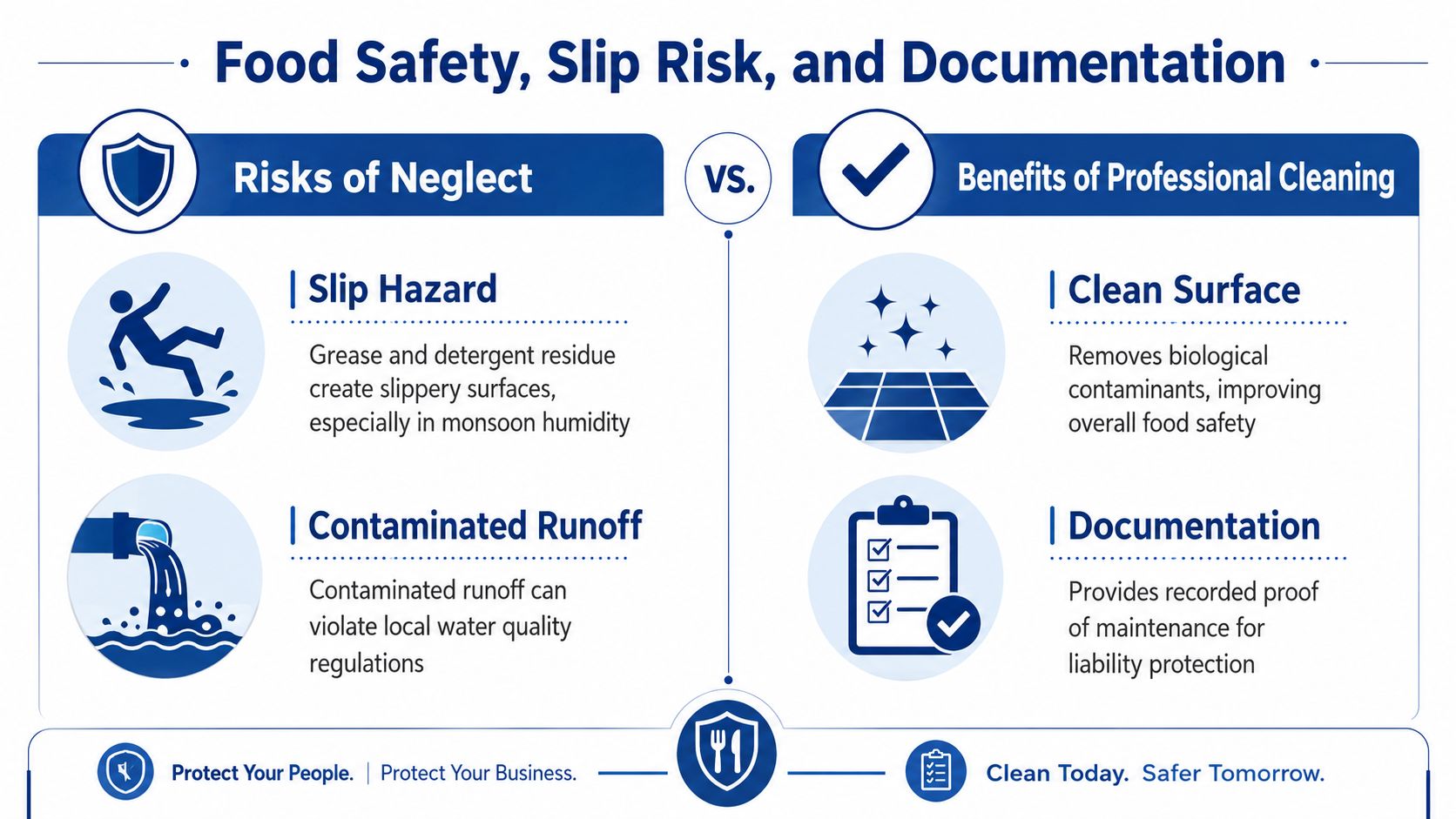
A drive-thru lane is a food-safety surface even when nobody labels it that way. Grease, sugar, detergent residue, and rinse water collect where staff and customers walk, brake, and turn, and Phoenix monsoon humidity can make that film slick fast. The hazard is practical, not hypothetical, because wet concrete, tracked-in contamination, and constant stop-and-go traffic all work against traction.
EPA guidance summarized by CleanLink says operators usually have two compliant choices for wash water in food-service settings, either let it evaporate without reaching soil, streets, or storm drains, or vacuum it up for proper disposal CleanLink's summary of EPA guidance on fast-food lane cleaning. In field work, the cleaner option is usually a recovery setup, because it removes the surface contamination and keeps process water from drifting into stormwater infrastructure.
Documentation matters for the same reason. A post-service record gives a property manager something concrete to show an insurer, a franchisor, or a tenant group when somebody asks when the lane was last maintained. It also helps when two tenants share a drive-thru and each one wants proof that the other side's mess did not become a shared liability issue.
Useful habit: take before-and-after photos, note the date, list any drainage concerns, and keep the report with the site file.
A lot of marketing pages stop at curb appeal. Operators need answers about cleaning intervals, runoff control, and what to do after a spill or a complaint. The lane has to be managed as a maintained surface, not just a cleaner-looking one.
If the site also has a dumpster-adjacent problem, it makes sense to coordinate that work with a dumpster pad cleaning service rather than treating the pad as an afterthought. The contamination patterns overlap, but the paperwork should still show exactly what got cleaned and what stayed outside scope.
How Often to Schedule Drive-Thru Cleaning
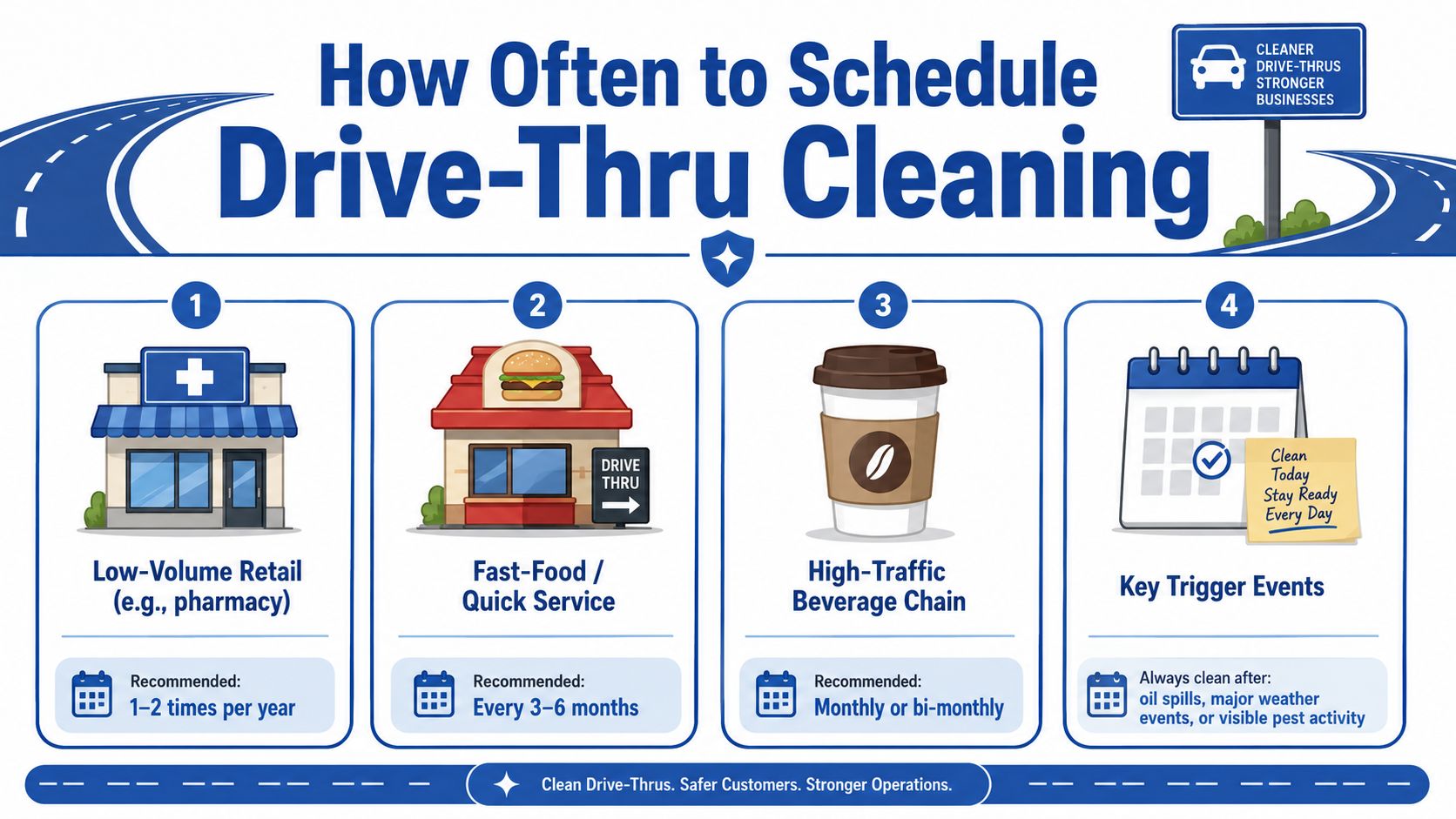
Drive-thru frequency should follow traffic and soil load, not a guess. A low-volume lane can sometimes hold together with a few professional visits a year, while a high-turn restaurant needs service much more often because grease and dust never really stop landing on the surface. The more stops, turns, and idle time the lane gets, the faster residue starts to settle into the concrete.
Phoenix weather changes the calendar too. Pre-monsoon cleanings help clear the dry-season buildup before summer storms spread it around, and post-haboob rinses make sense when dust storms lay a new layer over everything in a single afternoon. Summer tourist traffic also tends to push more use through the site, which means the lane can look tired long before the end of the season.
A good operator watches for early warning signs. Dark tide lines near the speaker post, gum returning quickly in the queue, or a pickup zone that always looks dull after rain are all signals that the current schedule is too light. Those are not cosmetic problems, they're clues that the soil load is outrunning the maintenance plan.
If the same stain keeps showing up in the same spot, the cleaning interval is probably too long or the runoff path is wrong.
For multi-site owners, a seasonal deep clean works best when it's paired with a steady maintenance rhythm rather than used as a rescue move. That's especially true on shaded canopies and high-traffic quick-service sites, where grime builds faster than management teams usually notice from the office.
Costs, Contracts, and What to Expect
Pricing for drive thru cleaning makes the most sense when you think in contract models, not mystery numbers. One-off deep cleans are usually priced per visit, because the crew has to account for site condition, access, water recovery, and the amount of pretreatment the lane needs that day. That model is useful when a property is fighting a bad stain, a big event, or a sudden inspection deadline.
Recurring contracts change the math. Monthly retainers usually trade a higher annual commitment for more predictable scheduling and a lower per-visit burden, while quarterly programs sit in the middle for sites that need regular maintenance but not constant attention. The right choice depends on how fast the lane soils over and how much front-end planning the property team can handle.
| Model | Typical Cadence | Best Fit | What to Confirm |
|---|---|---|---|
| One-off deep clean | As needed | Properties with a visible buildup problem or a one-time reset | Scope, water recovery, gum removal, drainage control |
| Quarterly program | Every few months | Mid-volume lanes that need regular maintenance without monthly service | What's included, after-hours access, post-service report |
| Monthly retainer | Monthly | High-traffic lanes with heavy grease, dust, or constant customer use | Scheduling priority, contamination hotspots, documentation format |
Most commercial bids should spell out labor, hot-water setup, degreaser, wash-water recovery, and a post-service report. The price usually moves fastest when the lane has gum clusters, dumpster-pad crossover, or after-hours work that requires a tighter access window.
For broader commercial exterior work, a provider like South Mountain Window Cleaning, LLC also offers pressure washing for commercial buildings, which can make bundled scheduling easier when the lane, sidewalks, and building frontage all need attention on the same visit. That kind of coordination saves setup time, but only if the vendor writes the scope clearly enough for everyone to know what gets cleaned first.
Choosing the Right Vendor in the Phoenix Area
A real commercial vendor should answer a few questions without hesitation. Ask for Arizona contractor licensing, a current certificate of insurance with commercial general liability that meets your property requirements, and a written water-management plan that explains how runoff will be contained or recovered. If the crew can't explain their safety training or show local references from similar sites, keep looking. Ask whether they also handle broader commercial property maintenance work, because a vendor that understands the whole site usually treats the lane, sidewalks, and surrounding hardscape with the same care.
The red flags are usually obvious once you know them. Door-to-door canvassing, cash-only invoicing, vague scopes, and unmarked crews often point to a residential outfit trying to scale up without the right commercial habits. In Phoenix heat, that kind of shortcut work tends to show up fast in the form of streaks, missed edges, and poor cleanup.
A strong vendor should also give you before-and-after documentation after each visit. That record helps with tenant conversations, insurance files, and internal maintenance logs, especially when the lane has shared access or multiple decision-makers. It also gives you something concrete to compare when a stain returns, a drain backs up, or a tenant says the work was incomplete.
Here's the call I'd make on a site walk:
- Licensing first: verify the company is set up to work commercial sites in Arizona.
- Insurance next: confirm the certificate matches the property's requirements, not just a generic policy.
- Water plan: ask how they handle runoff, recovery, and storm-drain protection.
- Site history: ask for references from restaurants, retail centers, or other drive-thru properties.
- Documentation: require photo proof and a written completion note after service.
If the vendor can't speak plainly about these points, they're not ready for a busy drive-thru lane. In this market, the crew that knows how to manage dust, heat, and runoff is usually the one that will protect the surface longer. That kind of vendor is also easier to coordinate with when the property team wants one plan for the lane, the walkways, and the rest of the exterior.
Common Questions From Arizona Operators
Can drive-thru cleaning happen during business hours? Sometimes, but off-hours is usually easier because it keeps customers away from wet surfaces and gives the crew room to control runoff. If the lane has to stay open, the vendor should stage the work so the customer path stays safe and clearly separated.
What if the same stain keeps coming back? That usually means the soil source is still active, or the surface texture is holding residue. A recurring spot near the menu board, pickup window, or turn radius should be treated as both a cleaning issue and a drainage or spill-pattern issue.
How do shared drive-thru lanes work with multiple tenants? Put the service in writing and make sure each tenant gets a copy of the completion record. Shared access means shared risk unless the vendor documents exactly what was cleaned and what stayed outside scope.
Can window washing and lane cleaning be done together? Yes, and that often makes sense when a property wants to reduce setup costs and limit repeated access to the site. The trick is sequencing, glass and frame work should be protected from overspray, and the lane should still be handled as a separate surface with its own water-control plan.
South Mountain Window Cleaning, LLC handles exterior cleaning for commercial properties across the Valley, including drive-thru lanes, walkways, and building exteriors. If your site needs cleaner concrete, better runoff control, and documentation that fits a real maintenance file, visit South Mountain Window Cleaning, LLC and request a quote for your Phoenix-area property.