
A Phoenix property manager usually notices the dumpster area when something has already gone wrong. A tenant emails about a sour smell near the back entrance. A restaurant customer mentions flies by the service alley. A maintenance tech flags a slick patch beside the enclosure after a trash pickup. What looked like a minor housekeeping issue turns into a safety, tenant-relations, and operations problem.
That's why a professional dumpster pad cleaning service belongs in the same conversation as exterior washing, walkway cleaning, and routine site maintenance. At commercial properties, the dumpster area collects grease, leaked liquids, food residue, and grime that basic hosing won't remove. In Phoenix, heat only makes those conditions harder to ignore.
Your Dumpster Area Is More Than Just an Eyesore
The pattern is familiar. The dumpster enclosure sits behind the building, out of view from leasing tours and customer entrances, so it gets less attention than storefront glass or sidewalks. Then the complaints start. Odor travels farther than people expect, especially when waste sits in high heat. Once residue builds up on the pad and enclosure walls, every trash day stirs the problem back up.
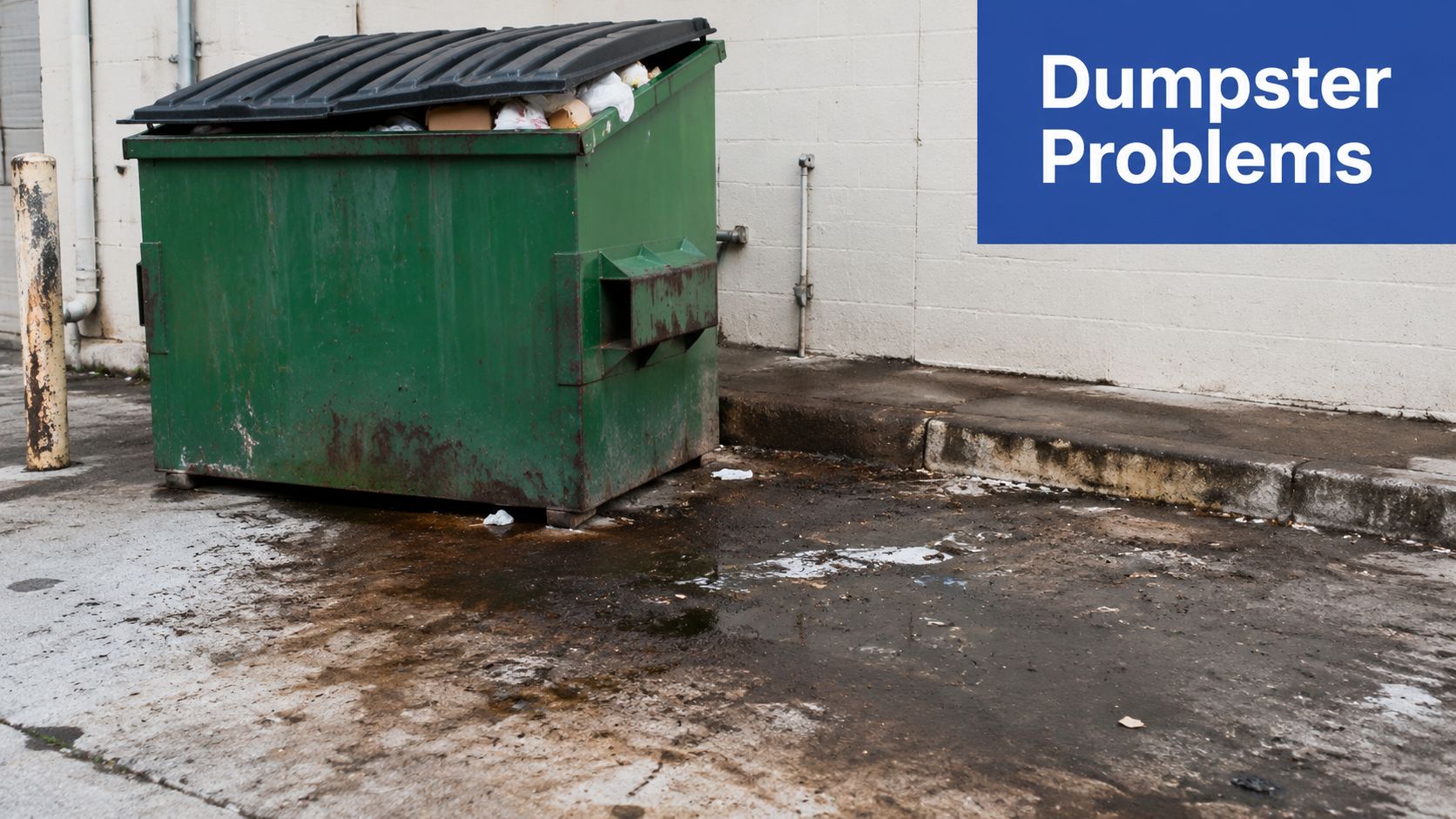
A neglected dumpster area also changes how people judge the rest of the property. Tenants may never say, “Your waste enclosure is hurting your image,” but they do notice smells, stains, insects, and slippery concrete. For retail centers, office properties, restaurants, and multifamily sites, that back-of-house area still affects the front-of-house experience.
Why more owners are treating it as a real maintenance category
This isn't a fringe service anymore. Independent market data values the dumpster pad cleaning market at $68 million in 2022 and projects 6.8% compound annual growth through the forecast period, reflecting growing demand for professional hygiene-focused service rather than basic waste hauling alone, according to Data Insights Market research on dumpster pad cleaning services.
For property managers, that growth makes sense. Dumpster pad cleaning isn't just about appearance. It sits at the intersection of sanitation, site safety, odor control, and vendor accountability. It also pairs naturally with broader commercial building exterior cleaning services when you're trying to keep the whole property consistent.
A dirty dumpster area rarely stays an isolated problem. It spills into tenant satisfaction, housekeeping workload, and service complaints.
What a Professional Cleaning Service Actually Includes
A real dumpster pad cleaning service is more than spraying water on concrete for a few minutes. The job should address the entire contamination zone, not just the center of the slab.
What should be cleaned
At most commercial sites, the service area includes:
- The concrete pad itself, where grease, food residue, and leaked liquids soak into the surface
- Enclosure walls, which collect splashback, staining, and odor-holding residue
- Gates and hardware, where grime builds up from repeated contact and runoff
- The exterior of the dumpster or compactor area, where residue transfers during loading and pickup
- The area just outside the pad, especially where runoff, drips, or foot traffic spread contamination
If a contractor only talks about “rinsing the dumpster spot,” that's usually a warning sign. The operational problem often lives on the walls, along the edges, and around the dumpster wheels and gate swing path.
What the work process should look like
A professional crew typically starts by clearing loose debris and checking where wastewater will go. Then they apply degreasers or detergents to break down the buildup before pressure washing. On food-heavy sites, many providers also include a deodorizing or sanitizing step because visual cleanliness alone doesn't solve the odor issue.
A few practical questions help separate a surface rinse from a real service:
- Do they pre-treat grease and organic buildup before washing?
- Are they cleaning the walls, gates, and surrounding splash zones too?
- Do they address odor control after washing?
- How do they manage wastewater and runoff?
Practical rule: If the vendor can't describe the sequence of prep, wash, recovery, and post-treatment, they probably don't have a reliable process.
There's also a larger compliance angle. Properties that produce food waste often run into overlapping sanitation concerns, and managers benefit from understanding grease trap legal duties because upstream waste handling affects what ends up leaking onto the pad. Cleaning helps, but source control matters too.
The Power Washing Process Equipment and Methods
The biggest mistake in this category is treating dumpster pad cleaning like ordinary flatwork washing. It isn't. The soils are different, the odors behave differently, and the equipment matters far more than many buyers realize.
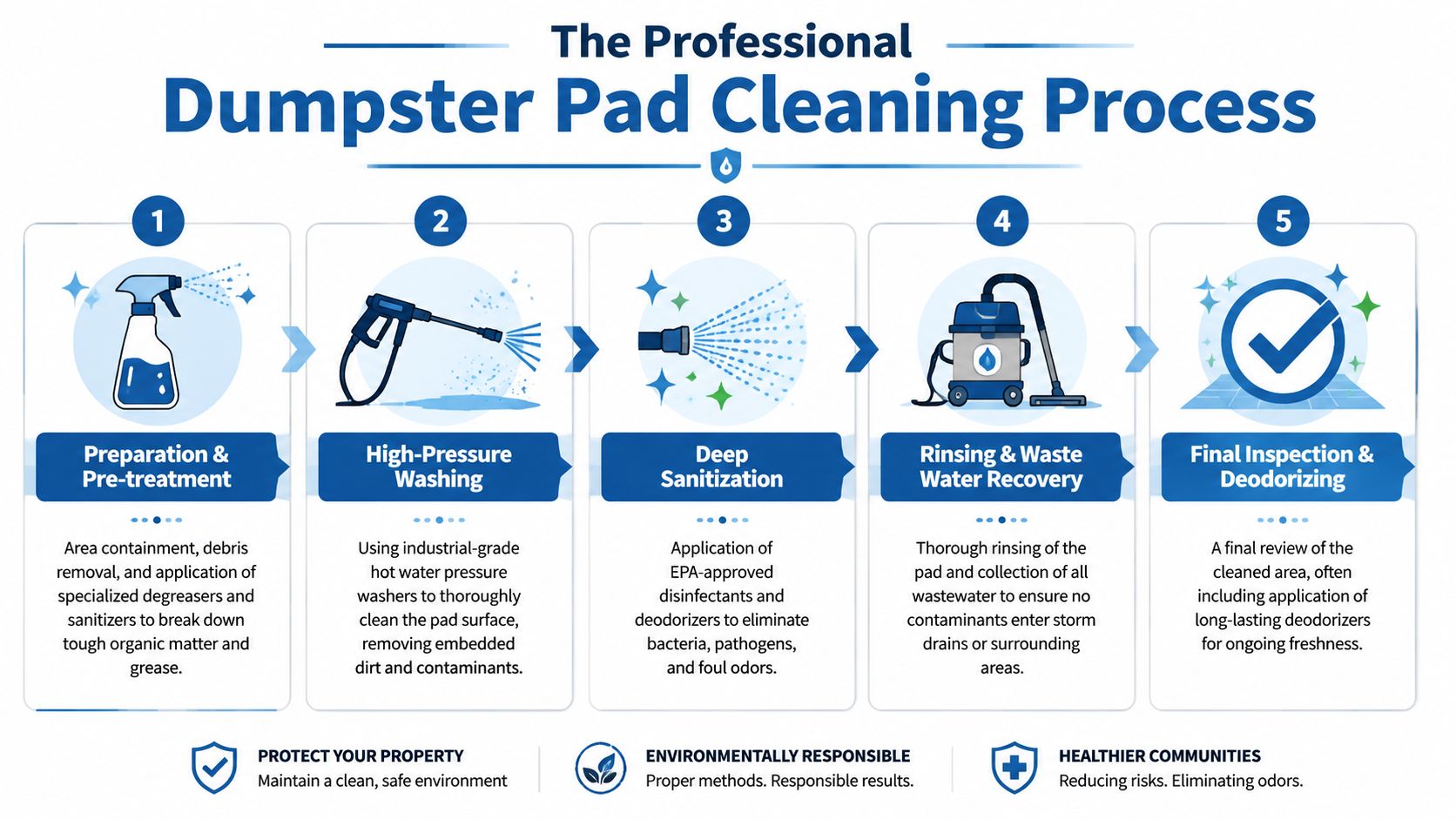
Early in the process, it helps to see the workflow visually.
Why hot water matters
Field professionals consistently stress that hot-water pressure washing is necessary for greasy dumpster pads because heat softens and helps emulsify oily and synthetic residue that cold water struggles to remove. That technical distinction is outlined in discussion from working contractors at Pressure Washing Resource on dumpster pad cleaning.
That point matters when you're vetting vendors. A contractor with a cold-water machine may still remove loose dirt and some staining, but heavy restaurant residue, old grease, and sticky organic film often need heat to release properly from the surface.
Buyers often benefit from a clearer understanding of the difference between power washing and pressure washing. In practical terms, heat changes the result on grease-heavy pads.
Chemical strength and cleanup time change with buildup
Not every site needs the same approach. With routine maintenance, a dumpster pad can often be cleaned in 15 to 30 minutes per site, while heavy buildup may require a stronger detergent mix than the usual 8 oz per gallon. One field example describes increasing to 16 oz per gallon for thick grease, which improves release but demands careful mixing and full dissolution, as noted by PowerWash field guidance on dumpster pad cleaning.
That's a useful benchmark because it shows why neglected pads cost more time and more chemical to restore. A site kept on maintenance can be serviced efficiently. A site left alone until it smells bad becomes a restoration job.
Here's the process many experienced crews follow:
| Stage | What happens | Why it matters |
|---|---|---|
| Pre-inspection | Check buildup, drainage, and access | Prevents runoff mistakes and missed contamination |
| Pre-treatment | Apply degreaser or detergent | Loosens grease before pressure hits the surface |
| Hot-water washing | Clean pad, edges, walls, and gates | Removes residue that cold water can leave behind |
| Rinse and recovery | Control wastewater | Helps keep contaminants out of drains and surrounding areas |
| Final treatment | Deodorize or sanitize as needed | Improves odor control and operational cleanliness |
A working example of the process is shown below.
What doesn't work well
Several shortcuts create disappointing results:
- Cold-water-only washing leaves greasy film behind on many commercial pads.
- Too little dwell time on detergent means the crew is trying to blast away contamination instead of breaking it down first.
- No wastewater plan turns a cleaning job into a runoff problem.
- Infrequent service after a heavy initial cleanup lets the pad slide right back to the same condition.
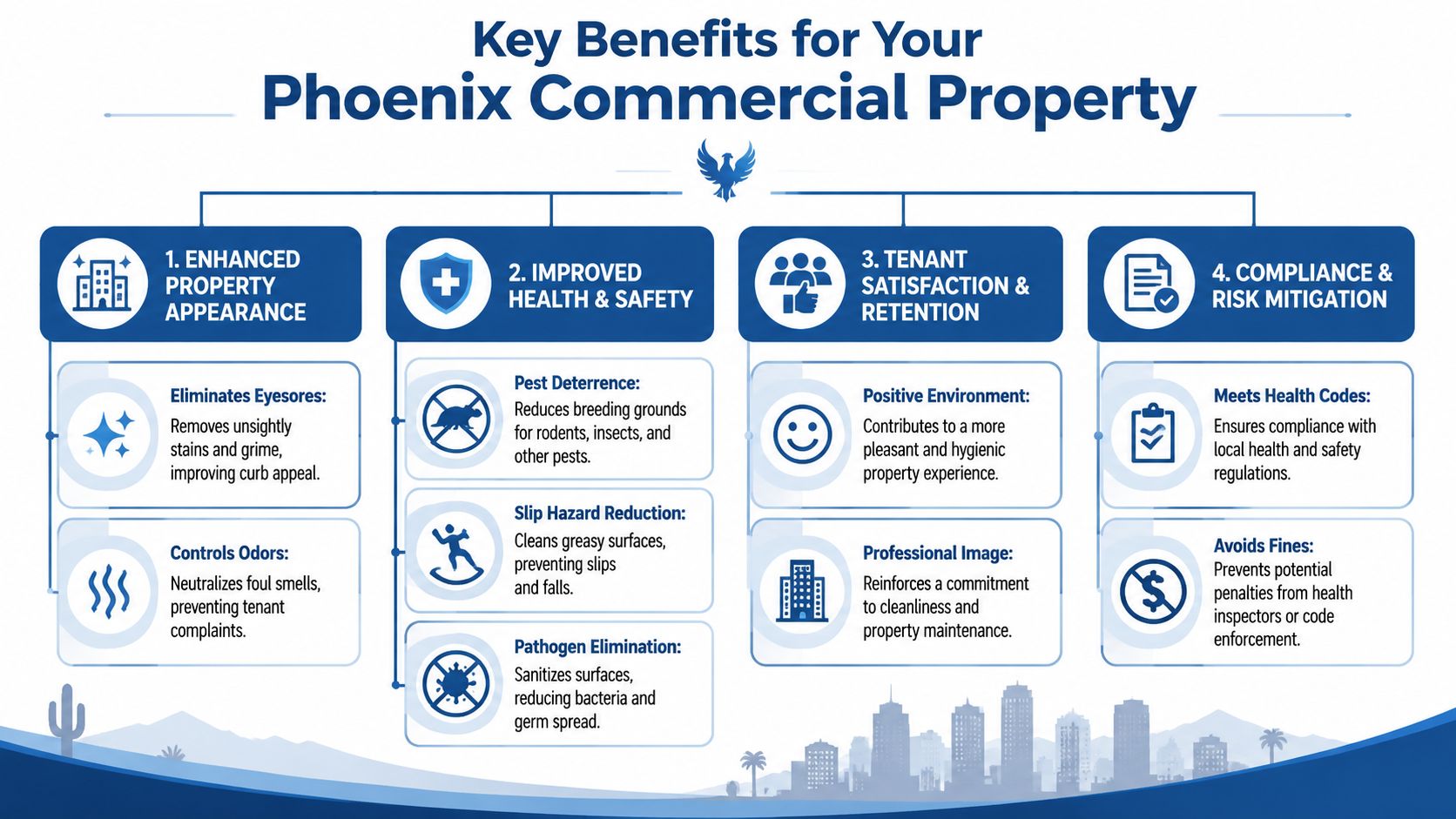
Key Benefits for Your Phoenix Commercial Property
A clean dumpster enclosure looks better, but appearance is only the first layer of value. The business case is stronger when you connect the work to risk reduction, tenant comfort, and fewer operational headaches.
Safety improves when grease stops building up
Dumpster pads become dangerous when leaked liquids and grease create slick walking surfaces. That risk affects janitorial staff, maintenance teams, trash haulers, vendors, and anyone cutting through the service area. Slip hazards don't need a dramatic puddle. A thin greasy film is enough.
For managers, this is one reason dumpster washing fits naturally into broader power washing benefits for commercial properties. Exterior cleaning is often judged by appearance, but the better reason to schedule it is hazard reduction.
Odor and pest pressure usually start with residue
A visually cleaner pad can still perform poorly if grease, leakage, and waste handling issues remain. The stronger services combine hot water, disinfectants, and wastewater capture to help reduce bacteria, persistent odors, and pest activity, according to Enviro-Master's discussion of dumpster cleaning service outcomes.
That's important in Phoenix commercial settings where heat accelerates odor problems and turns a small waste-area issue into a property-wide complaint. The best result usually comes from pairing cleaning with better dumpster management, lid discipline, and fast response to leaks.
Clean concrete helps. Clean concrete plus controlled waste practices works much better.
Tenant experience changes more than managers expect
People notice the back side of a property when it smells bad or feels neglected. Office tenants notice it during smoke breaks and service entries. Retail staff notice it during deliveries. Restaurant operators notice it because their own staff works around it every day.
A maintained dumpster area supports a more professional site standard. It tells tenants and visitors that the property team handles details before they become visible problems.
Compliance and inspection readiness get easier
Most managers don't call for a dumpster pad cleaning service because they enjoy spending money on the trash area. They call because they want fewer complaints, safer conditions, and fewer surprises during inspections or ownership walk-throughs.
That's the right mindset. The service isn't just cosmetic. It supports a cleaner operating environment, especially when the provider manages wastewater properly, uses the right equipment, and aligns the cleaning schedule with the site's actual waste load.
Scheduling Frequency and Understanding Pricing
The most common scheduling mistake is buying a generic package. A property manager asks for “monthly service” because it sounds reasonable, but monthly may be too frequent for one site and not nearly enough for another.
The better approach is to build a risk-based schedule around what the property produces.
Match the schedule to the property type
Industry guidance commonly points to quarterly service for standard commercial contracts, while higher-waste sites such as busy restaurants may need bi-weekly or weekly cleaning. The same source notes an initial cleaning fee around $300 followed by recurring service around $250 per visit, which reflects the difference between restoring a neglected pad and maintaining a cleaner one over time, based on Southeast Softwash guidance on dumpster pad cleaning pricing and frequency.
A practical way to think about cadence:
- Restaurants and food-heavy tenants often need the most frequent service because grease and organic waste accumulate faster.
- Grocery and hospitality properties usually benefit from closer monitoring because odor complaints can escalate quickly.
- Office parks and lower-waste retail sites may perform well on a longer interval if the enclosure is managed properly.
- Multitenant properties often need schedule adjustments when one tenant creates most of the waste load.
What should trigger more frequent cleaning
Don't wait for the annual budget cycle to revisit the schedule. Change it when the site gives you evidence.
Consider increasing frequency when you see:
- Recurring odor complaints near the enclosure or loading area
- Visible grease tracks extending beyond the pad
- More frequent pest activity around the waste area
- Leaking bags or overflowing bins between hauler visits
- Summer conditions exposing weak maintenance routines
If the dumpster area only gets attention after complaints, the schedule is already too light.
How to budget for the real problem, not just the cleaning line item
A lower cleaning frequency can look efficient on paper while creating bigger costs elsewhere. Pest complaints, maintenance callouts, extra janitorial labor, and tenant frustration all come from the same neglected area. For managers comparing those downstream costs, outside references like Crown Point pest control estimates can help frame how sanitation issues often trigger separate vendor spend.
If you're budgeting across the full exterior scope, it also helps to compare the broader context of commercial pressure washing costs. Dumpster pads are usually a recurring maintenance item, not a one-time rescue.
Here's a simple decision guide:
| Property condition | Likely approach |
|---|---|
| Heavy buildup, odor, staining | Start with an initial deep cleaning |
| Moderate activity, food-related waste | Move to recurring service on a tighter interval |
| Standard commercial waste, few complaints | Use a longer maintenance cycle and monitor |
| Sudden increase in pests or smell | Reassess frequency and waste-handling practices |
A Checklist for Choosing Your Cleaning Provider
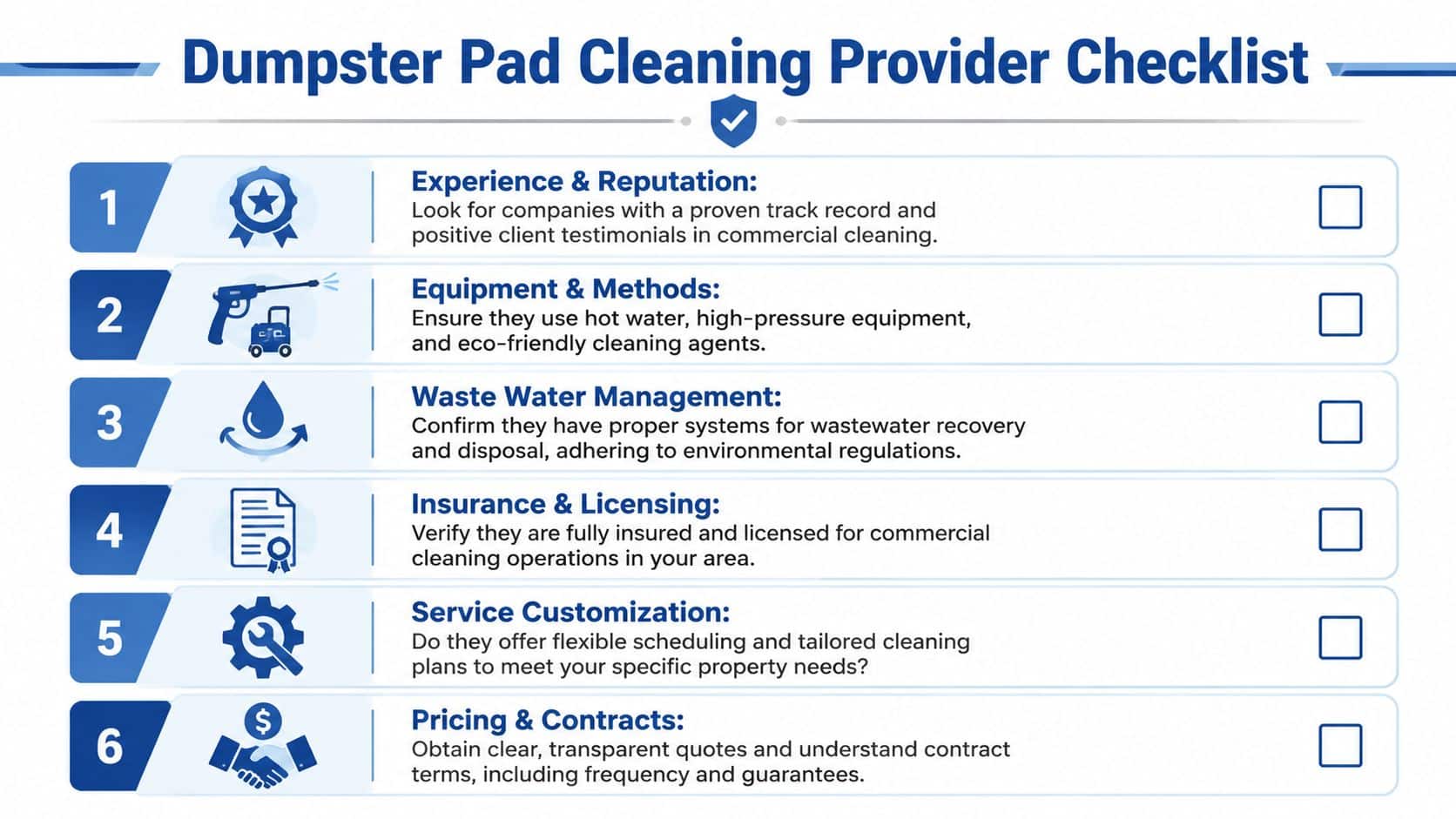
Choosing a dumpster pad cleaning company isn't just about price. This is one of those services where poor execution can leave you with runoff issues, incomplete cleaning, or a pad that looks better for a day and smells bad again by the weekend.
Questions worth asking before you sign
Use a shortlist that focuses on operational basics:
- Do they use hot water equipment for grease-heavy commercial cleaning?
- How do they handle wastewater so contaminants don't end up where they shouldn't?
- Will they clean the enclosure walls, gates, and surrounding splash areas, or just the slab?
- Can they describe their chemical process for routine buildup versus thick grease?
- Do they carry current insurance and work regularly on commercial properties?
The provider should answer those questions clearly and without sales fluff.
What separates a reliable vendor from a risky one
Look for signs of a company that understands recurring commercial service, not just residential pressure washing. That includes scheduling discipline, familiarity with access issues, coordination with property staff, and a repeatable process.
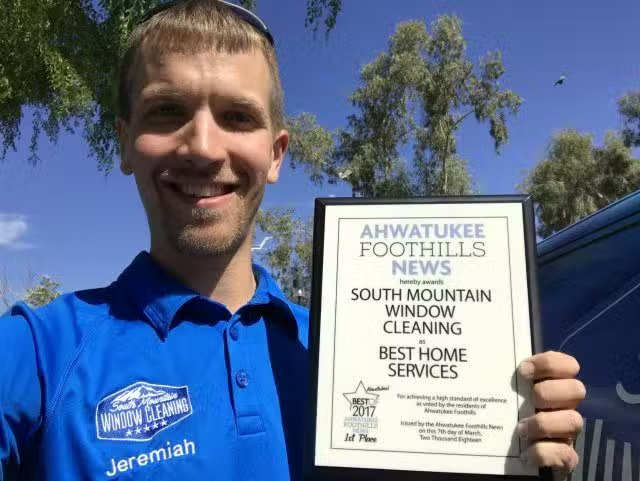
From the publisher side, South Mountain Window Cleaning, LLC offers full-service power washing that includes dumpster pads, along with commercial exterior cleaning for properties across the Valley. That kind of service mix can be useful when a manager wants one vendor to handle multiple exterior maintenance tasks instead of piecing together separate crews.
Buyer check: Ask what they do when the pad has thick grease, active odor, and limited drainage control. The quality of that answer tells you a lot.
A short approval checklist
Before approving any provider, confirm these items:
- Insurance documentation is current and matches commercial work.
- Equipment matches the job, especially hot-water capability.
- Scope is written clearly, including walls, gates, and post-treatment if needed.
- Wastewater handling is addressed in plain language.
- Service frequency is customized to your property instead of pushed as a generic package.
Invest in a Cleaner Safer Property Today
A neglected dumpster area chips away at property standards in ways tenants, customers, and staff feel long before ownership sees a report. Regular cleaning helps control odor, reduce slippery buildup, and support a more professional site.
For Phoenix-area managers, the smart move is to treat the dumpster pad like any other risk-sensitive exterior surface. If you're reviewing vendors, resources such as the Prestonwood Commercial Landscape Services guide to commercial landscaping insurance can also help you think through contractor vetting more broadly, especially around liability and documentation.
If you manage a commercial property in Phoenix, Scottsdale, Paradise Valley, Chandler, Tempe, or Gilbert, South Mountain Window Cleaning, LLC can help you build a practical dumpster pad cleaning schedule based on your property type, waste load, and maintenance goals. Reach out for a fast quote and a service plan that fits the way your site operates.