
The call comes in while the crew is already on site. A commercial washer has gone soft, then sputtered, then quit, and now the sidewalk still needs to be finished before tenants open or a manager starts asking why the job isn't done. In that moment, the question isn't just who can fix it, it's whether the machine can be saved fast enough to protect the schedule and the margin.
That's the practical side of commercial pressure washer repair near me. In Phoenix, the heat, dust, hard use, and constant turnover of trailer units, skid units, and portable machines turn small faults into expensive delays if nobody reads the failure correctly. If you run properties, storefronts, wash lanes, parking lots, or exterior maintenance routes, the smartest move is usually not panic, it's a clean diagnosis, a clear decision on repair versus replacement, and a local service call only when it earns its keep.
When a Pressure Washer Failure Stops Your Business Cold
A shopping center in Phoenix doesn't care that the washer chose today to fail. The tenant walk-through is still on the calendar, the sidewalk still has rinse marks, and the property manager still wants the storefronts ready before the afternoon traffic builds. That's why pressure washer downtime feels bigger than a broken tool, it becomes a scheduling problem, a labor problem, and sometimes a client-retention problem.
Commercial operators usually don't lose the whole day because of a dramatic breakdown. More often, the machine loses pressure, starts pulsing, or won't fire consistently, and the crew keeps trying to make it work because the job is half-finished. That's where money leaks out, through idle labor, repeat trips, and the temptation to keep troubleshooting long after the fault has become obvious.
Practical rule: once the machine stops producing stable pressure, stop treating it like a nuisance and treat it like an asset decision.
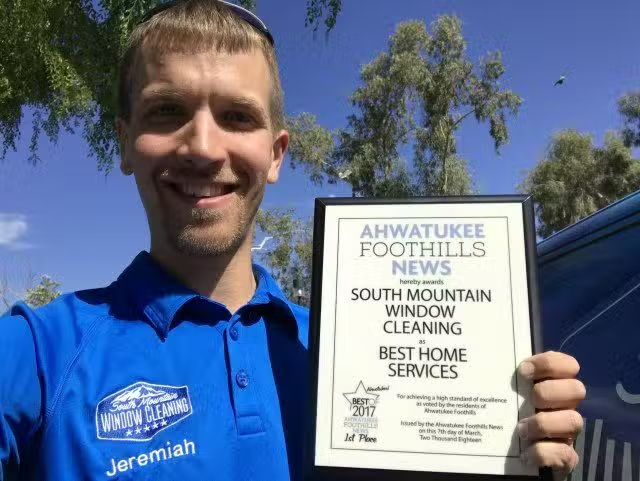
For operators who also manage exterior cleaning across glass, concrete, and entryways, the right local help often sits inside a broader service relationship. South Mountain Window Cleaning handles commercial power washing alongside window cleaning, so a facility manager isn't always starting from zero when the washer goes down, and that can matter when the route is already tight. commercial power washing services near me
The useful mindset here is simple. First, isolate the failure. Second, decide whether the issue is a quick field correction, an on-site technician job, or a teardown that belongs in a shop. Third, ask whether the machine is still worth repairing at all if the same fault has already put the schedule in jeopardy more than once.
The Diagnostic Sequence That Saves a Service Call
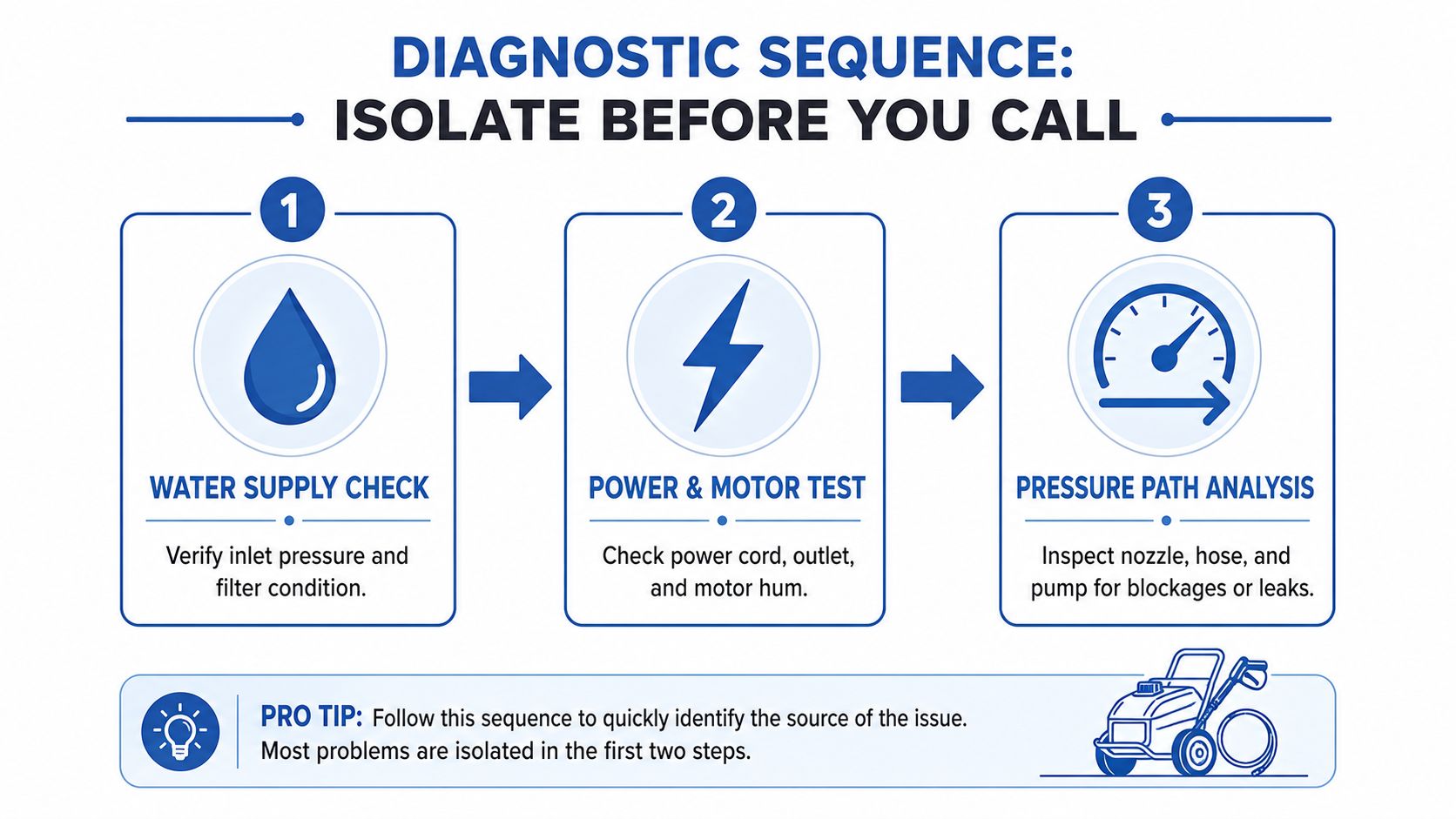
Start with water before you touch anything else. A pressure washer can look dead when the problem is a starved inlet, a dirty filter, or a supply issue that never gave the pump a fair shot. Landa's service inspection checklist puts inlet flow, nozzle wear, hose condition, pump oil, unloader wear, voltage, and switch checks near the center of the diagnostic process, which is exactly where they belong in the field too. Landa service and repair inspection points
Water supply first
Check the inlet filter, the source water, and the hose feeding the unit. A healthy system should sound steady, not strained, and the pump shouldn't be fighting bubbles, surging, or a weak supply line. If the washer is set up at a wash bay or behind a strip center, a kinked hose or restricted feed can look like pump failure when it isn't.
Power and motor second
Then move to the engine or motor. Confirm that the gas unit is at full throttle or that the electric unit is pulling properly, and look at breaker behavior, switch response, and any signs of electrical instability. A machine that hums but won't load normally is telling you something different from one that doesn't respond at all.
Pressure path last
Only after water and power check out should you move to nozzles, hoses, quick-connect O-rings, the unloader, and the rest of the pressure path. If the nozzle is worn, the hose is leaking, or the unloader is sticking, the machine may still run but won't deliver usable pressure.
For a quick service visit, that same sequence helps the technician arrive with the right parts instead of guessing at symptoms. If you're also buying consumables, the local supply side matters, and a good place to keep on hand for the basics is a dedicated commercial supply source like commercial power washing supplies. That won't fix a failed pump, but it can keep small losses from becoming service calls in the first place.
Common Failure Modes in Commercial Pressure Washers
Commercial washers usually fail in familiar ways, not mysterious ones. The job is to match the symptom to the likely cause before money gets spent on parts that were never at fault.
A dumpster pad job that starts with good spray and ends in weak, sputtering flow often points to a nozzle issue, inlet restriction, or hose problem. A car wash lane that loses steady output may be fighting an unloader, air in the line, or a pressure-set problem upstream of the pump. A unit that seems fine for ten minutes and then overheats is often being pushed past what the cooling or electrical side can support.
Symptom to likely cause
- Weak spray at the wand: look first at the nozzle, the inlet filter, and the hose. A clogged tip or restricted feed is cheaper than a pump teardown and should be ruled out early.
- Pressure that pulses or surges: suspect the unloader, worn seals, or air in the line. If the washer has been running with poor water supply, stop before the pump gets hurt.
- Leaks at connections: worn O-rings and hose fittings are common on commercial rigs that get loaded, unloaded, and dragged daily.
- Overheating or shutdown: check motor load, voltage stability, and whether the unit has been forced to run outside its normal duty cycle.
- Burning smell or no response: that moves the problem toward electrical failure, motor damage, or a deeper internal issue that needs a technician.
A machine that keeps being “babied” back into service often costs more than the first repair made it seem.
If you run trailer-mounted equipment, vibration, road dust, and hose wear all add up, which is why mobile systems need tighter inspection habits. A practical reference for how transportable commercial equipment is moved and supported is a commercial power washer trailer setup, especially when the washer rides with other tools and water-fed accessories.
South Mountain Window Cleaning also offers commercial power washing, including drive-thrus, walkways, and building exteriors, so the failure mode isn't just theoretical, it shows up in daily route work and fast turnaround on real sites. commercial power washer trailer
The Repair Versus Replace Decision Most Guides Skip
Repair is not always the cheapest answer. It's only the best answer when the machine can come back into service without turning the next failure into another outage.
The first question is downtime. If a unit is down on a busy retail property and there's no backup, even a modest repair can be the right move because lost hours are the cost. If there's a spare unit ready to roll, the calculation changes, and a deeper repair can wait for the shop instead of forcing a rushed field fix.
Repair versus replace decision matrix
| Factor | Lean Repair | Lean Replace |
|---|---|---|
| Failure history | First or isolated fault | Repeated seal, electrical, or pump problems |
| Parts access | Parts are in stock or easy to source | Parts are delayed, discontinued, or uncertain |
| Downtime pressure | Fast restoration is possible | The job can run on a backup unit |
| Condition of frame and core components | Solid structure, serviceable pump and motor | Frame damage, worn core systems, or multiple failing subsystems |
| Root cause | Simple wear item or calibration issue | Water-starvation damage, burnt windings, or repeated internal wear |
The hard truth is that some units are already telling you they're finished. Repeated seal failure, water-starvation damage, burnt windings, and a frame that's no longer worth rebuilding are all signs that repair money can disappear fast. In those cases, the lowest quote isn't the best answer if the machine is going to fail again under load.
A good technician should be able to explain the decision in hours and parts, not slogans. If the recommendation sounds vague, press for the failure history, the expected service life after repair, and what part of the system is being preserved. That's where a commercial buyer protects the budget.
For a separate look at how exterior-service budgets get built out, this commercial pressure washing cost page is a useful companion when you're comparing repair spend against ongoing route work.
In-Shop Service Versus On-Site Repair
The right service model depends on the fault, not on convenience alone. A hose leak at a back lot is a different job from a pump that needs teardown, alignment checks, or major internal parts replacement.
Aqua Engineers frames the choice around severity, transportability, downtime cost, and parts availability, which is the same logic commercial operators use in the field. If the unit can stay on site and get back to work with a hose swap, calibration, or electrical correction, on-site repair usually wins. If the fault requires deeper disassembly, more parts, or a more controlled diagnostic setup, the shop becomes the better call. Industrial equipment servicing framework
The other issue is coverage. Mobile repair fleets often work by regional radius, not by city limits, so response time depends on where the truck is staged and how far the job sits from the home base. A regional service area can reach far beyond a single metro boundary, which matters if your route stretches into outer Phoenix Valley communities or if the machine is hard to haul.
For transport-heavy equipment, it helps to understand how haulers and trailers influence service logistics, and that's where a practical reference like the earlier guide from ANTS Trailers is useful. It's not about selling transport gear, it's about knowing when the machine belongs on a trailer to the shop versus getting a mobile technician to the site.
If the unit is leaking, misfiring, or shutting down from a simple external cause, don't pay for shop teardown unless you need it.
When you call, describe the failure like an operator, not like a guess. Say whether pressure drops under load, whether the motor hums, whether the breaker trips, whether water supply is steady, and whether the problem is constant or intermittent. That short description often decides whether the dispatcher sends the right kind of help the first time.
Questions Worth Asking Before You Hire a Repair Tech
A clean repair usually starts with a clean first call. Property managers don't need a long conversation, they need clear answers, a price structure they can defend, and a technician who knows commercial equipment instead of just general handyman work.
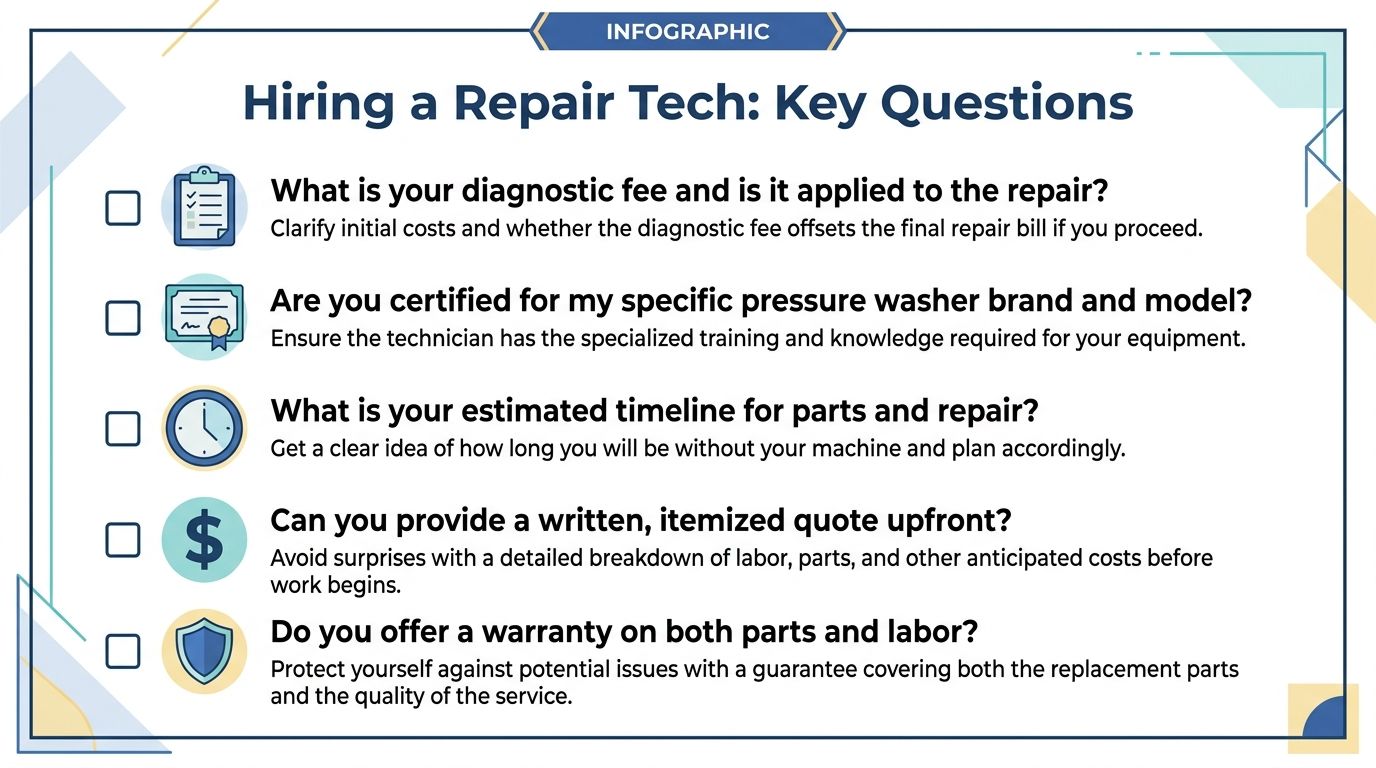
Use the first call to sort out the basics:
- What diagnostic fee do you charge, and does it apply to the repair? This tells you whether the visit is a true service call or just a paid estimate.
- Have you worked on my brand and model before? Brand familiarity matters when the fault sits in the pump, burner, motor, or control side.
- Do you carry common parts on the truck? If the answer is no, ask what usually has to be ordered and how long that delay tends to be.
- Will I get a written, itemized quote? That protects you from vague labor bundles and surprise add-ons.
- Do you warranty parts and labor? If the work has no warranty, you're carrying all the risk.
Red flags are easier to spot than you might think. Vague pricing, no written estimate, no parts inventory, and no service guarantee usually mean you're buying uncertainty. That's a bad trade when the machine already took you offline.
If the tech can't explain the fault in plain English after a few minutes, keep calling. A professional commercial repair interaction should feel calm, specific, and bounded by a real timeline.
Hiring and Maintenance in the Phoenix Metro Market
Phoenix changes the math. Dust works its way into filters, heat stresses pumps and seals, and hard-running commercial rigs get punished faster here than they do in milder climates. That's why buyers in Phoenix, Scottsdale, Paradise Valley, Chandler, Tempe, and Gilbert need a service relationship that's built for real-world uptime, not just a one-time fix.
Local hiring should start with the basics of trust. A reputable provider should be licensed, bonded, and insured, and the coverage should be clear in writing. South Mountain Window Cleaning, LLC operates with a $2 million insurance policy, computerized scheduling, and a 100% satisfaction guarantee, which are the kinds of operational markers facility managers typically want when they're choosing a vendor for recurring exterior work.
The broader local service market also matters. IBISWorld estimates the U.S. pressure washing services industry at $1.2 billion in 2024, with 32,193 businesses and a 0.6% CAGR from 2019 to 2024 (IBISWorld pressure washing services market data). Jobber reports about 41,799 technicians in the U.S., average technician pay of $27 per hour, and roughly $466 billion in annual home-improvement and maintenance spending through mid-2025 (Jobber industry review). Those numbers don't tell you which tech to hire, but they do show why availability, scheduling, and local response still matter in a fragmented field.
A good service setup also helps outside the washer itself. On properties where window cleaning, pressure washing, and exterior maintenance overlap, pure-water systems and pro squeegee work reduce the chance that a failed washer becomes the only cleaning path left. That matters in dusty corridors and hot-season scheduling, where a missed service window can quickly turn into visible curb-appeal loss.
For buyers trying to improve visibility on the vendor side, Netco Design's GBP optimization tips are worth a look because a well-built business profile makes it easier to confirm service area, response habits, and local credibility before you call.
A few habits keep commercial units alive longer in the Valley. Check inlet filters often, don't run on weak water supply, drain units when they're done for the day, and don't keep pushing a machine that's already showing seal or electrical trouble. Schedule maintenance before peak route weeks, not after the outage, and use a provider that can explain when to repair, when to replace, and when the problem is really upstream of the washer itself.
If your commercial washer is down, South Mountain Window Cleaning, LLC can help with exterior cleaning support across Phoenix, Scottsdale, Paradise Valley, Chandler, Tempe, and Gilbert, including commercial power washing where the equipment and the schedule both have to hold up. Visit South Mountain Window Cleaning, LLC to request a fast quote, compare service options, and get a local team involved before a small failure turns into another lost workday.